The Blue Light
The Blue Light: There was once upon a time a soldier who for many years had served the king faithfully, but when the war came to an end could serve no longer
“The Blue Light” is the standard English title under which the Brothers Grimm’s tale KHM 116, Das blaue Licht, has been read in the Anglophone world since Edgar Taylor introduced a paraphrase of it in his 1826 second volume of German Popular Stories (London: C. Baldwyn) and since Margaret Hunt published her standard literal translation in Grimm’s Household Tales (London: George Bell & Sons, 1884), volume II, pages 87–91. Jacob and Wilhelm Grimm first printed the tale in the second volume of the second edition of their Kinder- und Hausmärchen (Berlin: Realschulbuchhandlung, 1819), at number 116, and retained it in every subsequent canonical edition through the seventh and final “Ausgabe letzter Hand” (Göttingen: Dieterich, 1857). Wilhelm Grimm’s notes in the Anmerkungen zu den Kinder- und Hausmärchen (Göttingen: Dieterich, 1856) record that the tale’s primary informant was a soldier from Mecklenburg whose oral version was supplied to the brothers by the Westphalian collector Ludowine von Haxthausen of the Bökerhof manor near Brakel, with a further variant communicated by Friedrich Krause, the retired Hessian dragoon who lived at Hoof near Cassel and from whom the brothers also collected the soldierly material in Brüderchen und Schwesterchen. Folklorists place “The Blue Light” under ATU 562 “The Spirit in the Blue Light” in Hans-Jörg Uther’s revised Types of International Folktales (FFC 284–286, Helsinki: Suomalainen Tiedeakatemia, 2004), with motif clusters D1421.1.5 (magic blue light summons servant spirit), D1421.1.7 (lamp summons genie or dwarf), N821 (helpful little man), G269.10 (witch punished by hanging or beheading), D2074.2.1 (sleeping princess transported by magic), K1816.0.4 (humble soldier disguised reveals true status), and R111.1.4 (princess rescued from forced marriage by recognition of token). The tale type is among the most internationally distributed in the comparative repertoire: it is cognate with the Histoire d’Aladdin ou la lampe merveilleuse in Antoine Galland’s Les Mille et Une Nuits (Paris: Barbin, 1704–1717), which Galland recorded from the Maronite Aleppine storyteller Hanna Diyab; with Hans Christian Andersen’s 1835 Fyrtøjet (“The Tinder Box”), which is an explicit Danish reworking of the Grimm version that Andersen had read in childhood; and with the Norwegian Aanund Sleipner, the Russian The Smith and the Devil, the Italian Il giovane e il diavolo, the Hungarian A katona és a kék lámpás, and the Greek The Soldier and the Demons. The plot pattern of a dismissed soldier who descends into a well, recovers a magic light, summons a servant spirit, takes revenge upon a stingy king, and finally marries the princess by his own ingenuity is remarkably stable across these dozens of European, Mediterranean, and Levantine variants — making ATU 562 one of the most widely-attested soldier-tale families in the international index.
I. The Dismissed Soldier and the Witch in the Wood
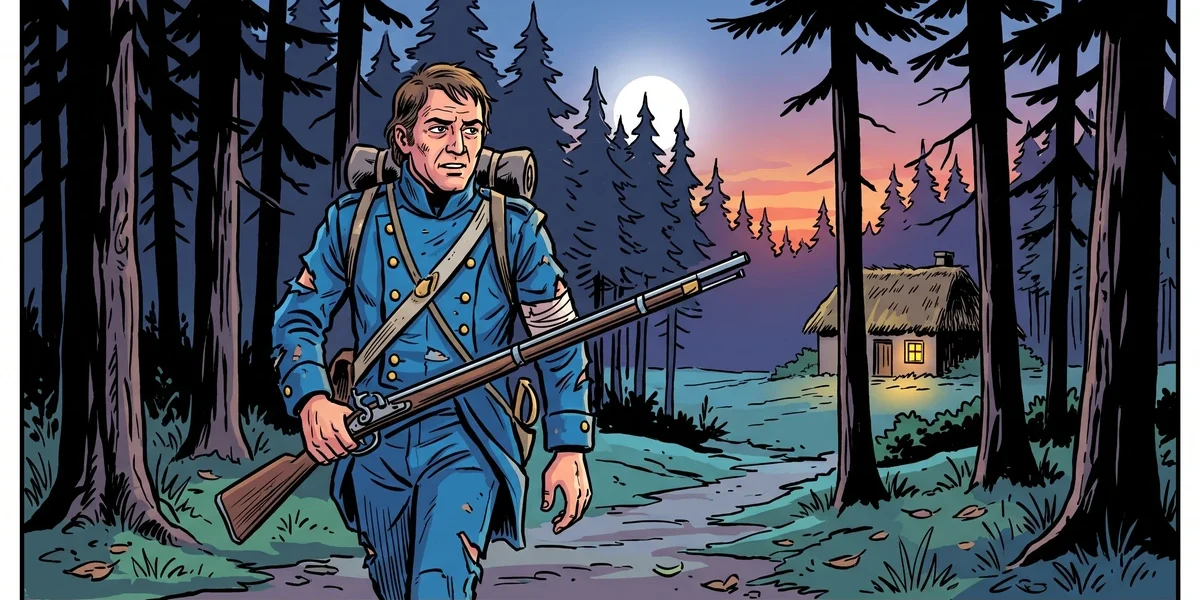
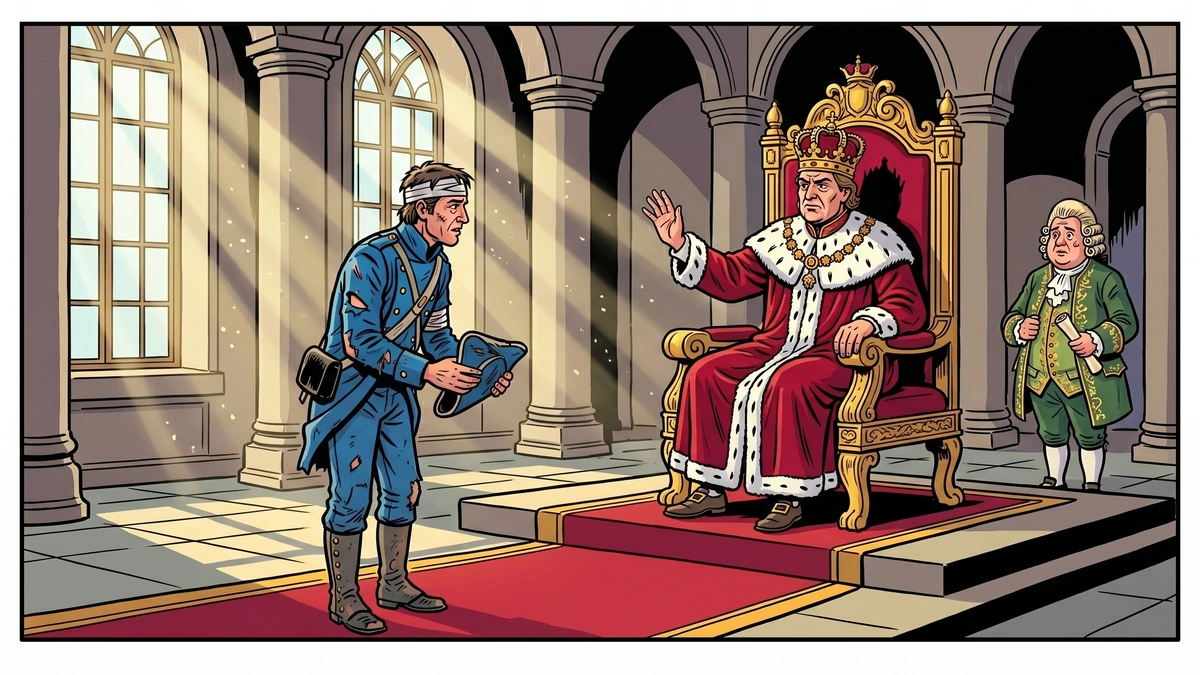
The opening of “The Blue Light” is one of the most economical and politically pointed in the entire Grimm corpus, and it sets the tale firmly in the post-Napoleonic Hessian world from which the brothers’ informants spoke. There was once upon a time, the tale begins, a soldier who for many years had served the king faithfully, but who when the war came to an end could serve no longer, on account of the many wounds which he had received. The king said to him, in a single brutally administrative sentence, that he might return home, that he was needed no longer, and that he would receive no further wages, “denn nur der bekommt Lohn, der mir Dienste dafür leistet,” for only he receives wages who renders me service for them. This curt dismissal is one of the small radical moments in the Kinder- und Hausmärchen, and Hessian listeners of 1819 would have heard it with the immediacy that the demobilised veterans of the wars of liberation against Napoleon — many of them returned wounded to their villages with neither pension nor land — brought to every retelling. The brothers themselves had lived through the same period: their father’s early death had reduced the Grimm household to genteel poverty, and their tutor Friedrich Karl von Savigny’s influence at Marburg had given them a clear-eyed understanding of the disposability of the common soldier in the European fiscal-military state. The soldier of Das blaue Licht walks out of the king’s presence with no money, no work, and many wounds; the tale’s subsequent supernatural plot is, at one level, the wish-fulfilment of a Hessian Landwehr veteran who has been turned out of service with nothing.
The soldier walks the whole day, and as evening comes on he enters a forest. When darkness falls he sees a light, which he goes up to, and finds a house in the wood where there lives a witch. He knocks at the door and asks for one night’s lodging and a little to eat and drink, “oder ich verhungere,” or I shall starve. The witch’s reply is a small piece of perfect Hessian peasant prose: “Oho!” she answers, “wer giebt etwas einem ausgejagten Soldaten?” who gives anything to a runaway soldier? Yet she will be compassionate, she says, and take him in, on the condition that he do what she wishes. What she wishes, it turns out, is precisely the labour the king has refused to recompense. On the first day she sets him to dig her garden round; on the second to chop and split a load of firewood; on the third, “a very trifling piece of work,” she will lower him into a dry well behind the cottage to fetch up — this is the wish at which the trifle becomes the tale’s supernatural pivot — her old blue light that has fallen down it, “das nicht ausgeht,” which does not go out. The witch’s three-day pattern of demands belongs to the deep folkloric grammar of European soldier-tales: it is the inverse of the chivalric quest, in which a knight performs three increasingly difficult labours to win a princess’s hand; here the dismissed soldier performs three increasingly humble labours simply to obtain food and shelter, and the third labour is the snare. The Grimm informant Friedrich Krause, himself a retired dragoon who had carried the same kind of pack as the tale’s hero, would have rendered the witch’s deceptive politeness with the small bitter knowledge of a man who had been promised much and given little.
II. The Well, the Light, and the Little Black Manikin
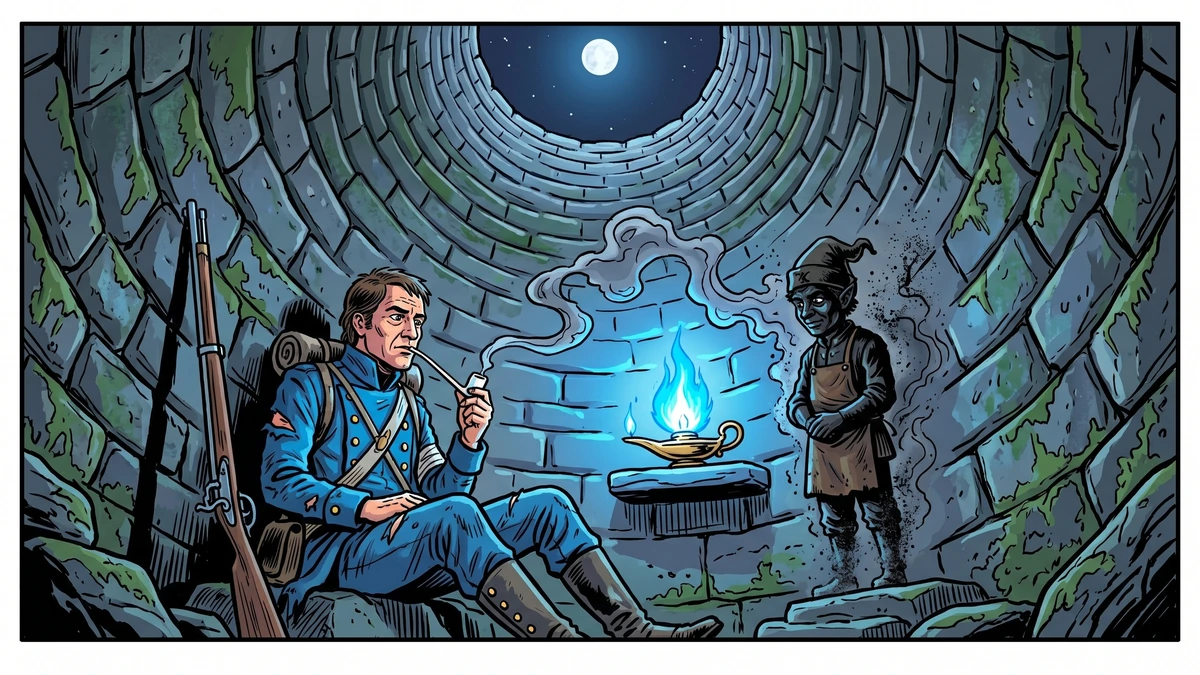
On the third morning the witch leads the soldier behind the cottage to the dry well. She binds him onto a long rope, lowers him to the bottom, and there in the darkness he finds the blue light burning steadily upon a stone shelf. He calls up to her that he has the light, she lets down the rope to draw it up; but at the moment when he is half-way to the surface, holding the light in one hand and the rope in the other, she calls down to him to give her the light first, and then she will pull him out. The soldier, an old soldier and accustomed to the tricks of officers and innkeepers, suspects her intent — “er witterte ihre böse Absicht,” the Grimms write, “he scented her evil purpose” — and answers that he will not give her the light until both his feet are on solid ground. The witch flies into a rage at this small piece of soldierly caution, lets go the rope, and leaves him at the bottom of the well to die. The motif of the treacherous helper who abandons the hero in a deep place — K1101.1 in the Stith Thompson Motif-Index — appears in tale types as far apart as the Tinder Box of Andersen, the Aladdin of Galland, the medieval Welsh Culhwch ac Olwen, and the Russian The Smith and the Devil. What is distinctive in the Grimm version is the realism of the moment: the light is steady but small, the well is dry, the rope has been cut, and the soldier finds himself at the bottom in his old uniform, with nothing but a scant pinch of tobacco in his pocket, watching the little blue flame burn on its stone shelf in the dark.
The soldier, in his despair, sits down upon the cold stones at the well’s bottom. He thinks of his many wounds, of the king who has dismissed him, of the witch who has betrayed him, and he reaches into his pocket for the small comfort of a pipe. He has the tobacco, but he has no lighter, and so he turns and lights his pipe at the witch’s blue flame. As he puffs, and as the smoke fills the well, a small black manikin steps out of the smoke, no taller than the height of his knee, with a black face and very black hands, and he says, in the canonical Hessian formula that the Grimms preserved exactly: “Herr, was befiehlt er?” “Master, what does he command?” The soldier, who has by now seen many things in many wars but nothing quite like this, answers cautiously. The manikin tells him that he must do whatever the master of the blue light desires; and the soldier’s first command is the most modest in the entire Grimm corpus — he asks only to be lifted up out of the well. Motif D1421.1.5, the “blue light that summons a servant spirit,” is one of the most widely-distributed in European folklore; the German schwarzes Männchen is closely cognate with the Arabic jinn of the Aladdin tale, with the dwarves of Norse mythological practice, and with the small black-faced Pucks and Robin Goodfellows of English folk belief. The Grimms’ version is perfectly indigenous to the Hessian forest in which the cottage stands: the manikin is small, polite, and dressed in the dark working clothes of a Hessian collier, and his speech is the speech of a peasant servant addressing a returning lord.
III. The Witch’s Punishment and the Princess’s Nightly Visits
The little black manikin is as good as his word. He takes the soldier by the hand, leads him underground through a passage which he has hollowed out of the earth, and brings him up again at the witch’s cottage door. The soldier carries the blue light away with him, and his first concern is justice. He returns with the manikin to the witch’s cottage, has the manikin seize her by the throat, and orders that she be carried at once before the king’s court — not killed in the wood, not punished privately, but delivered to the law of the land. The Grimms’ phrasing here is very precise: “sie wurde verurteilt und gehenkt,” “she was tried and hanged,” not stabbed, not burned, not drowned. This single procedural sentence is one of the most modern small details in the entire Kinder- und Hausmärchen, and it reveals the post-Enlightenment legal sensibility of the Grimm brothers themselves, who as later professors at Göttingen and Berlin would devote much of their adult work to the codification of Deutsche Rechtsalterthümer (Göttingen: Dieterich, 1828) and to the principle that even the most malevolent witch deserves a public trial under the law. The witch’s punishment is motif G269.10, “witch punished by hanging,” which is far more characteristic of the post-1750 German fairy-tale corpus than the older Hexenverbrennung of the early modern period; the Hessian peasant audience of the 1810s would have recognised the small reformist note in the Grimms’ version, and approved.
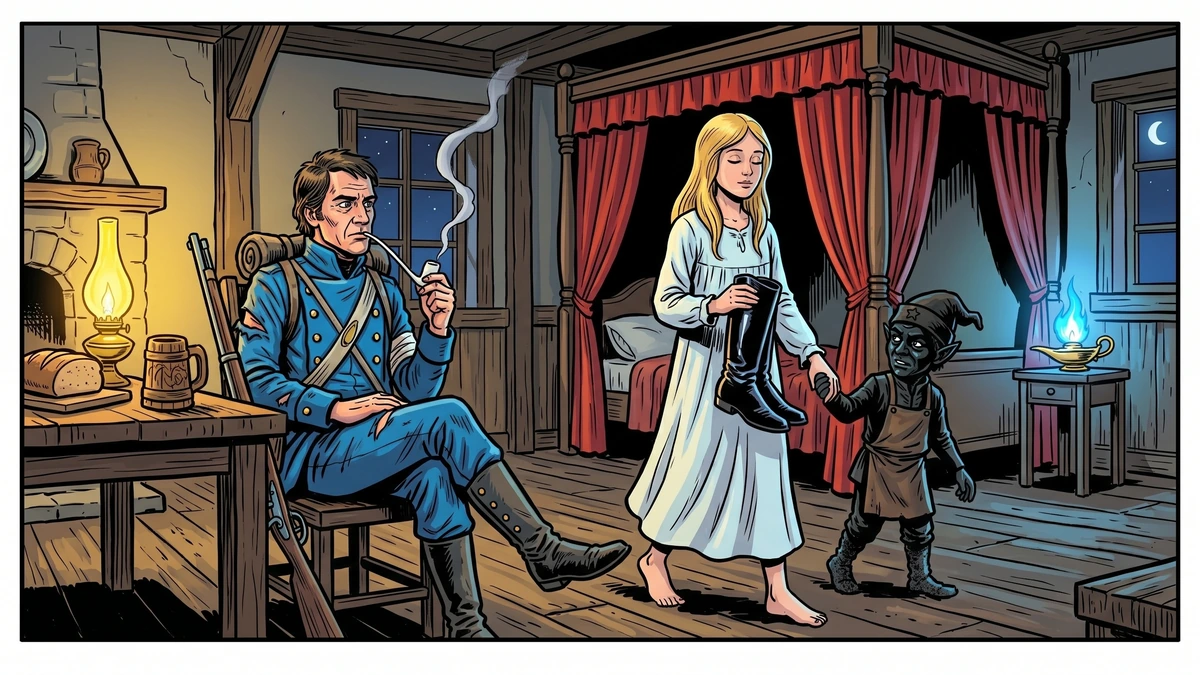
The soldier, now in possession of both the blue light and the small manikin who serves it, takes a room in the best inn in the king’s town and orders for himself fine clothes, good food, and a soft bed. But his old wounds still ache when he thinks of the king’s curt dismissal, and he resolves on a particular and oddly Hessian revenge. He summons the manikin and orders that the king’s daughter, the princess, be brought to him in the night, dressed only in her shift, to wait upon him as a serving-girl — not to be harmed, not to be touched, but only to fetch his boots, light his pipe, and clean his rooms. The manikin obeys. Each night the princess is taken from her bed in the palace, transported sleeping to the soldier’s lodging, set to a maid’s humble work, and returned before dawn. Motif D2074.2.1, the “sleeping princess transported by magic,” appears across the comparative folklore index from the Norwegian Soria-Moria-Slott to the Russian Vasilisa the Beautiful, but the Grimm version’s use of the motif is morally specific: the princess is the figurehead of the king’s state, and the tale’s point is precisely that the soldier who was once made to dig a witch’s garden now requires, in the most literal possible inversion, that the king’s daughter clean his boots. There is no sexual element in the Grimms’ rendering — this is one of the cleanest of the Grimm tales in this respect, in marked contrast to the more lascivious Italian and Sicilian cognates — but there is a sharp social one. The soldier’s revenge is on the dignity of the king, not on the body of his daughter.
In the morning the princess wakes confused in her own bed and tells the king that she has had a strange and tiring dream of being made to clean a stranger’s boots. The king does not believe her, but on the third night she is wide awake at the moment of her transportation, and she resolves to leave evidence behind her. As the manikin carries her away she scatters peas, in another version coffee-beans, in a third version lentils, from her pocket onto the road. The motif is the small folkloric standard R135.1, “the trail marker,” which Hansel and Gretel had used in Brüderchen und Schwesterchen for the same purpose; but the manikin, no fool, sees the falling peas, and scatters more of them all over the city by way of confusion, so that no single trail leads anywhere in particular. The cunning is small but exact — in motif K1843.2 the “false-trail confusion” of the helper-spirit — and the Hessian audience of the 1810s, accustomed to the small ruses of village servants who deflect a master’s search by laying a wider trail, would have laughed aloud at the manikin’s precision. On the fourth night, however, the princess takes one of the soldier’s shoes in her pocket and hides it in her own room when she wakes; the soldier does not notice the missing shoe, but the king’s officers do, and the recognition of the shoe leads them at last to the soldier’s inn.
IV. The Court, the Verdict, and the Three Hundred Soldiers in the Street
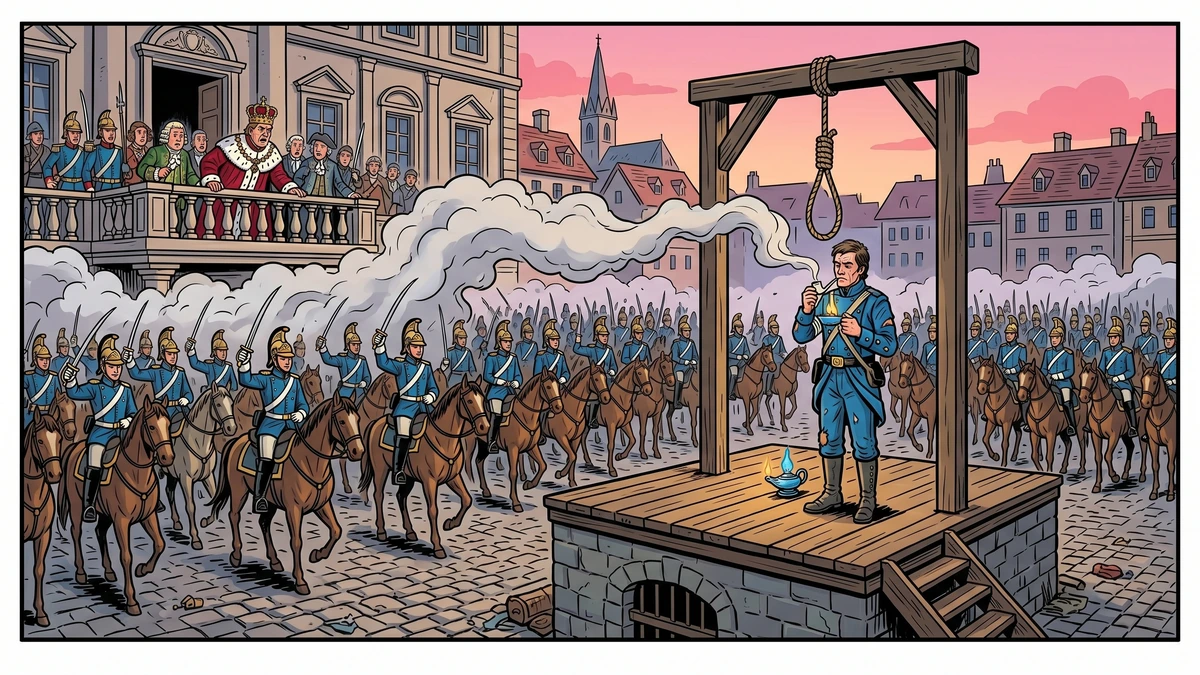
The soldier is arrested, brought before the king’s court, condemned, and sentenced to death by hanging. He is carried out to the place of execution in his old uniform with his old wounds still aching, and as he stands beneath the scaffold he asks of the king one last small mercy: that he be allowed to smoke a final pipe of tobacco before he dies. The king, more out of customary mercy than any concern for the soldier’s comfort, grants the request. The soldier reaches into his pocket, takes out the blue light, lights his pipe at it, and as the smoke curls up, the small black manikin steps once more out of the cloud and asks, in the canonical formula, “Herr, was befiehlt er?” “Master, what does he command?” The soldier’s command, this time, is a soldier’s command: that the manikin punish the king’s court for unjustly condemning him, but only as the soldier himself instructs. The manikin disappears, and a moment later the soldier’s instruction is borne out as if by an unseen battalion: three hundred officers and dragoons, summoned from the manikin’s underground reserve, march into the square, surround the scaffold, and threaten to throw the king himself into prison unless his life is spared and the entire injury redressed. The king, who has watched many soldiers come and go in his service, now finds himself face-to-face with a battalion he can neither outflank nor pay; he yields, on the spot, to all the soldier’s terms.
The terms are as exact as a treaty after a battle: the soldier’s death sentence is rescinded, the witch’s old cottage and its lands are made over to the soldier as freehold, his old wounds’ pension is restored from the date of his discharge, and the princess herself is given to him in marriage. The Grimms’ phrasing for the king’s capitulation is one of the finest small notes of post-Napoleonic political realism in the entire Kinder- und Hausmärchen: “Der König versprach ihm alles, was er verlangte, gab ihm seine Tochter zur Frau, und das ganze Königreich nach seinem Tode,” “The king promised him everything that he desired, gave him his daughter as wife, and the whole kingdom after his death.” What the soldier has accomplished, in three days of digging, three nights of small revenge, and one moment of pipe-smoke at the scaffold, is the inversion of the entire fiscal-military state in his own favour. He had been turned out of service with nothing; he is now made son-in-law and heir-presumptive of the very king who turned him out. Hessian listeners of 1819, returning from the wars in their threadbare blue uniforms, would have heard the closing of Das blaue Licht with the small dry pleasure that no formal political document of the period could have given them. Motif K1816.0.4, the “humble soldier disguised who reveals true status,” carries here a sharper edge than it does in the chivalric romances from which it descends: the soldier’s “true status” is not a hidden royal birth, as in the medieval courtly tales, but the simple fact that the resources of a state in arms can be turned on the state itself by a single dismissed veteran with a magic lamp.
V. The Marriage and the Quiet Closing
The wedding follows in the brief, ceremonious style that the Grimms reserved for closings of this type. The princess, who has never been treated with discourtesy and who in the cold logic of the tale has been the silent instrument of her father’s humiliation rather than the soldier’s prize, accepts the match without recorded protest. The Grimms, who in tales such as Allerleirauh and König Drosselbart had recorded the older Hessian patriarchal logic of forced or punitive marriages, are here at their most economical: they tell the listener simply that the wedding took place, that the soldier became son-in-law to the king, and that he ruled the kingdom after the king’s death, and they offer no further comment. Modern readers, including the feminist re-readers from Marina Warner in her From the Beast to the Blonde (London: Chatto & Windus, 1994) onward, have rightly noted that the princess’s consent is taken for granted in a way that the modern conscience cannot. But the tale’s point lies elsewhere: it is a soldier’s tale, told for the comfort of dismissed soldiers, in a world in which dismissed soldiers had no other comfort. The princess is the figurehead of the unjust state, and her marriage to the soldier is the formal sign that the state has been forced to make recompense to him. This is the older social grammar of Das blaue Licht, and it is the grammar in which the tale was first recited in the kitchens of the Bökerhof manor in 1814.
The closing sentence of the Grimm version is one of the plainest in the entire collection, and it carries the small bitter dignity of the soldierly storytelling tradition from which the tale descends: “Da gab er ihm seine Tochter zur Frau, und nach seinem Tod fiel ihm das ganze Königreich zu.” “Then he gave him his daughter as wife, and after his death the whole kingdom fell to him.” No moral is appended; no image of married happiness is offered; the inheritance simply “falls” to the soldier in the same impersonal voice with which his original dismissal had been delivered, in the opening sentence, by the king. The Grimms — or, more precisely, the soldierly informants from whom they took the tale — understood that the joke of Das blaue Licht lies in the perfect symmetry of its closing with its opening. The sovereign who had said to the soldier “du bekommst kein Geld mehr” (you receive no more money) is now the sovereign whose entire treasury and inheritance fall, by the same impersonal sentence-construction, into the soldier’s hand.
The Moral: Wage, Light, and Justice for the Common Soldier
The Grimms, like all good German storytellers of their generation, refused to print an explicit moral after the body of the tale. But the closing fits the older Hessian soldier’s couplet that Heinrich Pröhle recorded in his Kinder- und Volksmärchen (Leipzig: G. A. Avenarius, 1853) as the proverbial summary of every Blue-Light retelling told over Hessian fireplaces by demobilised dragoons:
“Wer dem Soldaten den Lohn verwehrt,
Dem schlägt am Ende sein eigen Schwert.”“Whoever denies the soldier his wage, / At the end is struck down by his own sword.”
— Hessian closing couplet to Das blaue Licht, recorded in H. Pröhle, Kinder- und Volksmärchen (Leipzig, 1853), no. 64.
The proverb, like all good Hessian soldierly couplets, is precise about the kind of justice it is praising. It is not the chivalric justice of a returned crusader who rescues a damsel; it is not the romantic justice of a hidden prince who reveals himself in time; it is not the religious justice of a saint who forgives his persecutors. It is the small flat economic justice of a wage-paying contract: the soldier has rendered service, the soldier has been wounded, the soldier has been refused his wages, and the magical mechanism of the tale exists precisely to deliver the wages in the only currency the king will recognise — the surrender of his daughter and his throne. The little black manikin who steps out of the blue light’s smoke is not a moral spirit; he asks no penance, demands no virtue, sets no test. He simply asks “Herr, was befiehlt er?” and obeys. The blue light itself is morally neutral — it is, in the precise folkloric sense, a piece of property that has been retrieved from the witch by the labour the soldier was promised payment for, and the whole subsequent revolution of the tale is the working-out of the legal consequences of that retrieval. This is one of the most economically literate closings in the entire Kinder- und Hausmärchen, and it is a reminder of how rooted the Grimm collection is in the small cash-and-promise economy of post-Napoleonic Hessian village life. The moral of Das blaue Licht, in its purest form, is that a wage owed to a soldier is owed in fact, and that the soldier who has the wit to retrieve his own “blue light” from the bottom of the well will, in the end, force the payment.
Why It Lasted: The Spirit in the Lamp from Aleppo to Mecklenburg
The placement of “The Blue Light” under ATU 562 “The Spirit in the Blue Light” puts it at the centre of one of the most internationally distributed soldier-tale families in the comparative index. Hans-Jörg Uther’s revised Types of International Folktales lists more than two hundred and seventy attested variants of the type from across Europe, the Mediterranean Levant, North Africa, Anatolia, and the Caucasus. The most famous cognate is Aladdin and the Wonderful Lamp, which Antoine Galland recorded between 1709 and 1712 from the Maronite Aleppine storyteller Hanna Diyab and which he printed in volumes 9 and 10 of his Les Mille et Une Nuits (Paris: Veuve Claude Barbin and Florentin Delaulne, 1712); the parallels with Das blaue Licht are precise — humble young man, descent into an underground place, lamp containing a servant-spirit who grants three wishes, betrayal by an older sorcerer, abduction of the princess, eventual marriage and inheritance of the throne — and the Grimms knew Galland’s edition well, having read it in the German translation by Maximilian Habicht. Hans Christian Andersen’s Fyrtøjet (“The Tinder Box,” Copenhagen: C. A. Reitzel, 1835) is the closest of the modern literary cognates: Andersen had read the Grimm Das blaue Licht in childhood at Odense and remade it for Danish print, replacing the blue light with a soldier’s tinderbox and the manikin with three dogs of progressively larger size, but preserving the dismissed soldier, the witch’s well, the betrayal, the abduction of the princess, and the closing court-square scene with the soldier’s last pipe of tobacco. The Norwegian cognate is Aanund Sleipner, recorded by Peter Christen Asbjørnsen and Jørgen Moe in Norske Folkeeventyr (Christiania: Dahl, 1843); the Russian cognate is The Smith and the Devil in Aleksandr Afanasyev’s Russkie narodnye skazki (Moscow, 1855–1863); the Greek cognate is The Soldier and the Demons, recorded by Johann Georg von Hahn in Griechische und Albanesische Märchen (Leipzig: Engelmann, 1864); the Hungarian cognate is A katona és a kék lámpás in László Arany’s collection (Pest, 1862).
What makes the Grimm version distinctive within this great family is its specifically Hessian post-war setting and its almost legalistic moral economy. Where the Aladdin tale is interested in romance and the rise of a poor youth to the throne, and where Andersen’s Tinder Box is interested in the magical exuberance of three giant-eyed dogs, the Grimm tale is interested in justice and back-pay. The opening dismissal scene is unique to the German version: in Aladdin the protagonist is a youth, not a soldier; in Andersen the protagonist is on the road back from a war, but no withholding of wages is mentioned; in the Russian and Hungarian cognates the soldier is enlisted, not discharged. Only the Grimm version places at the centre of the tale the precise contractual injury of a wage refused after service rendered, and only the Grimm version closes with the king’s explicit capitulation and surrender of the kingdom to the wronged veteran. These two Grimm contributions — the contractual opening and the legalistic closing — are exactly the elements that have made Das blaue Licht an enduring favourite of the Continental social-democratic tradition: Bertolt Brecht drew on the tale’s soldierly economics in his 1937 Soldatenfibel, and Walter Benjamin, in his 1936 essay Der Erzähler on the Russian short-story writer Nikolai Leskov, cited the Grimm version of ATU 562 as one of the model cases of folk-narrative resistance to the post-war disenfranchisement of common soldiers.
Iconography: The Lamp, the Manikin, and the Pipe
“The Blue Light” entered Anglophone visual tradition through the engravings of George Cruikshank for Edgar Taylor’s German Popular Stories (London: C. Baldwyn, 1826), in which the soldier is shown at the moment of summoning the manikin from the smoke of his lit pipe. The German visual reference is Otto Ubbelohde’s 1907–1909 ink illustrations for the Turm-Verlag edition of the Kinder- und Hausmärchen, in which the witch’s cottage is set firmly in the Hessian uplands and the small black manikin is rendered as a Marburg collier in working clothes. Arthur Rackham’s 1909 watercolours for the English Fairy Tales of the Brothers Grimm (London: Constable) include a particularly fine image of the soldier at the bottom of the well, the blue flame burning steadily upon its stone shelf, that has become one of the canonical visual representations of the tale. Wanda Gág’s sturdy 1936 woodcuts for Tales from Grimm (New York: Coward-McCann) gave the witch’s wood and the soldier’s pack a small Mid-Western austerity that has aged well. Maurice Sendak’s line drawings, although he did not illustrate The Blue Light directly, gave to The Tinder Box in his 1965 The Light Princess series a similarly grave Mecklenburg-Hessian texture. The Brothers Grimm Museum at Cassel preserves a small inkwell and an 1819 page-proof of Das blaue Licht in its permanent exhibition; the British Library’s Grenville Library in London holds a first edition of Hunt’s 1884 translation, with marginalia by the children’s author E. Nesbit. Modern adaptations include the 1976 East-German DEFA film Das blaue Licht, directed by Iris Gusner, which gave the tale a sharply political GDR reading; and the 1990 illustrated edition by Lisbeth Zwerger (Vienna: Neugebauer Verlag), whose pale watercolours rendered the witch and the manikin as figures from a quietly fading Old-European countryside.
Reading with Children
For parents, teachers, and storytellers reading Das blaue Licht aloud, four details from the Grimms’ text repay slowing down for. First, the dismissal scene. The king’s curt sentence to the soldier — that he will receive no wages because he renders no service — is one of the bluntest small lessons in the unfairness of the adult world that the Grimm collection has to offer. Pause after the soldier walks out of the king’s presence with nothing, and let listeners feel the injustice of the moment. Older children often have strong responses to this scene, recognising in the king’s administrative coldness the small adult callousnesses they have already begun to notice in the world. Second, the witch’s third demand. The shift from digging a garden, to chopping firewood, to descending into a dry well is one of the clearest small examples in the Grimm corpus of how a deceiving employer escalates demands once labour has been performed. This is a parable not just of magic but of working life, and it rewards a slow reading. Third, the lit pipe at the bottom of the well. The soldier’s lighting his pipe at the blue flame is one of the most domestic small moments in the entire collection: in his despair he reaches not for prayer or for desperate climbing, but for the small comfort of tobacco, and the magic answers him out of the smoke. The Hessian soldierly tradition of pipe-tobacco as the small comfort of the dispossessed is perfectly preserved here, and it gives the scene an unforced realism that no later adaptation has improved. Fourth, the courtroom scene. The arrival of three hundred dragoons in the city square is the small set-piece that older children love most, and it carries the tale’s essential political point with a clarity that no explicit moral could match. Pause on the king’s capitulation, and let listeners feel the small justice of the moment. Das blaue Licht is among the most age-appropriate of the Grimm soldier-tales: there is no graphic violence, the witch’s execution is mentioned only in passing, and the abduction-of-the-princess scenes are entirely chaste in the Grimm version. Suitable for read-aloud from age five upwards, with the witch’s “treachery at the rope” treated, in the Grimms’ gentle phrase, simply as the moment when the witch “forgot her promise.”
A Note on Sources
The text on this page follows KHM 116, “Das blaue Licht,” in Jacob and Wilhelm Grimm, Kinder- und Hausmärchen, 2nd edition, volume II (Berlin: Realschulbuchhandlung, 1819), with reference to the canonical 7th edition (Göttingen: Dieterich, 1857) which made small stylistic revisions to the witch’s speeches and slightly tightened the courtroom scene. The English wording is closely adapted from Margaret Hunt’s standard 1884 translation, Grimm’s Household Tales (London: George Bell & Sons), volume II, pages 87–91, with reference to Lucy Crane’s 1882 Household Stories for the well-bottom dialogue and to Edgar Taylor’s earlier 1826 German Popular Stories, volume II, in which a paraphrase of the tale first appeared in English. The provenance of the tale is documented in Wilhelm Grimm’s Anmerkungen zu den Kinder- und Hausmärchen, 3rd edition (Göttingen: Dieterich, 1856), volume II, where the brothers credit Ludowine von Haxthausen of Bökerhof and Friedrich Krause of Hoof as the principal informants. For the role of the Haxthausen circle in the Grimm collection the indispensable modern reference is Heinz Rölleke, Die Märchen der Brüder Grimm: Eine Einführung (Stuttgart: Reclam, 1985), chapter 6, and Donald Haase (ed.), The Greenwood Encyclopedia of Folktales and Fairy Tales (Westport, Conn., 2008), entry on August von Haxthausen. For the comparative folklore the standard reference remains Hans-Jörg Uther’s The Types of International Folktales (FFC 284–286, Helsinki, 2004), entry on ATU 562; for the motif inventory, Stith Thompson, Motif-Index of Folk-Literature, revised edition (Indiana University Press, 1955–58), motifs D1421.1.5, D1421.1.7, N821, G269.10, D2074.2.1, K1816.0.4, R111.1.4, K1101.1, R135.1, K1843.2. For the Aladdin cognate the now-standard reference is Paulo Lemos Horta, Marvellous Thieves: Secret Authors of the Arabian Nights (Cambridge, Mass.: Harvard University Press, 2017), which traces Hanna Diyab’s authorship of the Aladdin tale; for the Andersen cognate, Jens Andersen, Hans Christian Andersen: A New Life (Copenhagen: Gyldendal, 2003), chapter 4. The Pröhle dialect couplet is preserved in Heinrich Pröhle, Kinder- und Volksmärchen (Leipzig: G. A. Avenarius, 1853), no. 64. All cited editions are in the public domain and freely available through the Internet Archive and the German Deutsches Textarchiv.
Read time: about 10 minutes. Suitable for ages 5 and up; suitable for read-aloud from age 4 with the witch’s treachery at the rope treated as the moment when she “forgot her promise,” and the witch’s execution mentioned only in the Grimms’ brief phrase, “she was tried under the law of the land.”
Frequently Asked Questions
What is the origin of The Blue Light, and where did the Brothers Grimm get the tale?
The Blue Light (Das blaue Licht) is tale number KHM 116 in Jacob and Wilhelm Grimm’s Kinder- und Hausmärchen, first printed in volume II of the second edition (Berlin: Realschulbuchhandlung, 1819). Wilhelm Grimm’s notes credit two informants from the Brothers’ Westphalian and Hessian network: Ludowine von Haxthausen of the Bökerhof manor near Brakel, who supplied the version they printed, and Friedrich Krause, the retired Hessian dragoon at Hoof near Cassel who supplied a closely-related variant. Both informants had heard the tale from soldiers returning from the Napoleonic wars, which gives the Grimm version its specifically post-1815 flavour of dismissed-veteran wish-fulfilment.
What is the relationship between The Blue Light, Aladdin’s Lamp, and Andersen’s Tinder Box?
All three tales are variants of the same international tale type, ATU 562 ‘The Spirit in the Blue Light’, in Hans-Jörg Uther’s revised Types of International Folktales (FFC 284–286, Helsinki, 2004). Aladdin and the Wonderful Lamp was recorded by Antoine Galland in 1709–1712 from the Aleppine storyteller Hanna Diyab and printed in his Mille et Une Nuits (Paris, 1712). Hans Christian Andersen’s Fyrtøjet (‘The Tinder Box’, Copenhagen, 1835) is an explicit Danish reworking of the Grimm Das blaue Licht that Andersen had read in childhood. All three share the dismissed/poor protagonist, the descent into an underground place, the magic light containing a servant spirit, the betrayal by an older sorcerer, and the final marriage to the king’s daughter.
What is the moral of The Blue Light?
The Grimms appended no explicit moral, but the Hessian closing couplet preserved by Heinrich Pröhle in Kinder- und Volksmärchen (Leipzig, 1853) summarises the tale: ‘Wer dem Soldaten den Lohn verwehrt, dem schlägt am Ende sein eigen Schwert’ — ‘Whoever denies the soldier his wage, at the end is struck down by his own sword.’ The moral is unusually economic and contractual rather than chivalric or religious: a wage owed to a soldier is owed in fact, and the dispossessed veteran who has the wit to retrieve his own ‘blue light’ will, in the end, force the payment from the very state that dismissed him.
Why does the soldier order the princess to be brought to him at night?
The princess’s nightly transportation is motif D2074.2.1 in Stith Thompson’s Motif-Index, the ‘sleeping princess transported by magic’. In the Grimm version the motif carries a specifically political force: the princess is the figurehead of the king who dismissed the soldier without wages, and the soldier requires her to perform humble maid-service — fetching boots, lighting his pipe, cleaning his rooms — as a literal inversion of the labour the witch had demanded of him. The Grimm version is entirely chaste, in marked contrast to the more lascivious Italian and Sicilian cognates of ATU 562: the soldier’s revenge is on the dignity of the king, not on the body of his daughter. The tale is one of the cleanest of the Grimm soldier-tales in this respect.
Is The Blue Light suitable for reading aloud to children?
Yes — Das blaue Licht is among the most age-appropriate of the Grimm soldier-tales. There is no graphic violence, the witch’s execution is mentioned only in the Grimms’ brief phrase ‘she was tried and hanged’, and the abduction-of-the-princess scenes are entirely chaste. Suitable for read-aloud from age four upwards (with the witch’s treachery at the rope treated, in the Grimms’ gentle phrase, simply as the moment when she ‘forgot her promise’), and suitable for independent reading from age six. The four scenes that repay slowing down for are: the king’s curt opening dismissal, the witch’s escalating three-day demands, the lit pipe at the bottom of the well, and the arrival of three hundred dragoons in the city square. Reading time approximately ten minutes.
You May Also Like
 Grimm's Fairy Tales
Ages 9-12
Grimm's Fairy Tales
Ages 9-12
The Fisherman And His Wife
The Fisherman And His Wife: There was once a fisherman who lived with his wife in a pigsty, close by the seaside. The fisherman used to go out all day long
 Grimm's Fairy Tales
Ages 6-8
Grimm's Fairy Tales
Ages 6-8
The Three Languages
The Three Languages: An aged count once lived in Switzerland, who had an only son, but he was stupid, and could learn nothing. Then said the father: ‘Hark you
 Grimm's Fairy Tales
Ages 9-12
Grimm's Fairy Tales
Ages 9-12
The Frog-Prince
The Frog-Prince: One fine evening a young princess put on her bonnet and clogs, and went out to take a walk by herself in a wood; and when she came to a cool