Doctor Knowall
Doctor Knowall: There was once upon a time a poor peasant called Crabb, who drove with two oxen a load of wood to the town, and sold it to a doctor for two
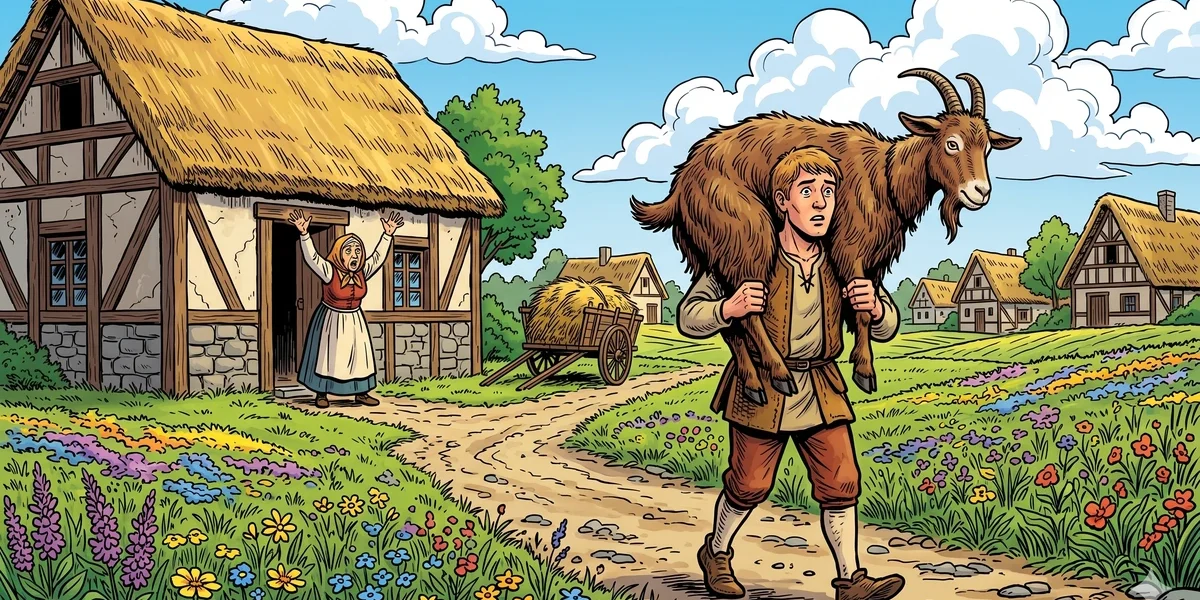
Doctor Knowall: The Self-Made Expert and the Lucky Truth
A poor peasant named Crab (Krebs in German) acquires a doctor’s coat and a book, puts up a sign reading “Doctor Knowall,” and is invited by a rich lord to identify who has stolen his money. Through a combination of fortunate coincidences and his own peasant cunning, Crab manages to identify each of the four servants who stole the money — not through any actual knowledge but through lucky exclamations (“there’s one!”, “there’s two!” and so on) that the guilty servants interpret as revelations of their specific crimes. He is celebrated as an all-knowing oracle and rewarded handsomely. The tale is one of the Grimm collection’s most elegant explorations of how reputation and circumstance conspire to produce the appearance of expertise that then — crucially — functions as genuine expertise.
This narrative belongs to a cross-cultural genre that Indian folk tradition represents through figures like the village jyotishi (astrologer) who gains a reputation for accurate predictions through a combination of keen observation, psychological astuteness, and fortunate coincidence — and whose reputation then becomes self-fulfilling, because clients who believe in the astrologer’s powers interpret ambiguous pronouncements as specific prophecies confirmed by events. The Doctor Knowall tale is the secular, comic version of this dynamic: accidental accuracy creates reputation; reputation creates the context within which further accidental accuracy is interpreted as certain knowledge; certainty produces real results.
The Peasant’s Shrewd Observation and the Luck That Looks Like Skill
What saves Crab is not entirely luck: he is a keen observer of human behavior, and his “lucky” exclamations happen to align with what the guilty servants most fear. The guilty person’s hypersensitivity to detection — their tendency to read every ambiguous signal as a specific accusation — is the mechanism through which Crab’s generic exclamations become specific accusations. Crab observes their reactions; his subsequent “revelations” are partly informed by what he sees. His knowledge is impure — part luck, part observation, part inference — but it is not zero.
This mixture of luck, observation, and inference is precisely what Indian folk tradition praises in the figure of the clever ascetic or village elder who seems to know everything. The Panchatantra‘s famous story of the camel’s tracks — in which a merchant’s description of a camel he has lost is reconstructed entirely from tracks, browsed vegetation, and other physical evidence by a passerby who has never seen the camel — demonstrates that what looks like miraculous knowledge is often systematic observation deployed at speed. Crab’s “knowall” is a lower-resolution version of this: genuine observational intelligence operating in conditions where the subjects’ guilt amplifies every ambiguous signal into apparent certainty.
The Self-Fulfilling Prophecy of Expertise: Reputation as Reality-Generator
The tale’s deepest insight is about how expertise reputation generates real expertise effects. Once the servants believe Crab knows all, their behavior — their guilty reactions, their confessions, their bribes — provides him with the actual information he needs to perform the role of all-knower convincingly. The reputation produces the conditions that confirm the reputation. This is what psychologists call a “self-fulfilling prophecy” and what Indian ritual theory identifies as the mechanism underlying certain forms of mantra-siddhi (mantra-power): the efficacy of a mantra is partly dependent on the belief system of those who encounter it, which their belief in its efficacy itself generates.
The Arthashastra is explicit about reputation as a political resource: a king who is believed to be omniscient is functionally omniscient in his kingdom, because subjects who believe he knows everything act as if he knows everything — confessing before interrogation, avoiding crimes they believe will be detected, providing information proactively. Crab’s “Doctor Knowall” sign is a peasant’s Arthashastra move: by claiming omniscience, he creates the conditions under which omniscience becomes functionally real. The knowledge he lacks, he acquires through the behavior his claimed omniscience produces.
The Peasant’s Wit and the Expert’s Robe: Class and Credentialing
The tale also functions as a gentle satire on credentialing: Crab’s expertise is constituted entirely by his costume (the doctor’s robe) and his sign (“Doctor Knowall”), with no underlying competence to support it. Yet his outcomes are at least as good as those of legitimate experts — he identifies the thieves correctly. This suggests that the costume and sign are doing real work: they create the social context within which his peasant shrewdness can operate effectively. Without the credentials, his observations would be dismissed; with them, they are amplified into certainty by his subjects’ credulity.
Indian folk narrative treats the relationship between status markers and actual competence with similar complexity. The vidya (knowledge) that a figure possesses and the pratijna (claim of knowledge) they make are not always aligned, and folk tales frequently expose this gap — while simultaneously acknowledging that the claim of knowledge sometimes functions as a necessary precondition for the exercise of genuine observational intelligence. Crab’s coat is both a fraud and a tool; his sign is both false and enabling. The tale refuses to resolve this ambiguity cleanly, which is one reason it has remained interesting across centuries.
“He called himself Doctor Knowall and knew nothing — until the people who believed he knew everything began acting as though he did, and their acting made it true.”
Why This Story Lasted
Doctor Knowall endures because the dynamic it depicts — accidental expertise becoming real through the mechanism of reputation — is a permanent feature of social life. Every field has its Doctor Knowalls: people whose initial reputation was partly luck or circumstance, but whose reputation then generated the social conditions within which genuine expertise (or at least effective performance) developed. The tale is neither a pure celebration of fraud nor a pure condemnation of credentialing; it is an astute observation that expertise and its reputation are more entangled than either pure meritocracy or pure cynicism about credentials would suggest.
Frequently Asked Questions
How does Crab actually identify the thieves — is it pure luck?
Not entirely — Crab is a keen observer of human behavior, and the guilty servants’ hypersensitivity to detection amplifies his generic exclamations into specific accusations they interpret as targeted revelations. His knowledge is impure (part luck, part observation, part inference) but not zero. The Panchatantra’s camel-track story demonstrates the same principle: what looks like miraculous knowledge is often systematic observation deployed in conditions where subjects’ reactions amplify every ambiguous signal into apparent certainty.
What is mantra-siddhi and how does it relate to Crab’s reputation?
Mantra-siddhi (mantra-power) is partly dependent on the belief system of those who encounter it — their belief in its efficacy generates the conditions of its efficacy. Similarly, Crab’s “Doctor Knowall” reputation generates the conditions that confirm it: servants who believe he knows all confess before being directly accused, providing him with actual information. Belief creates behavioral changes that make the belief functionally true — the self-fulfilling prophecy of expertise.
How does the Arthashastra treat omniscience reputation as political resource?
The Arthashastra identifies a king believed to be omniscient as functionally omniscient: subjects who believe he knows everything confess proactively, avoid detected crimes, and provide information voluntarily. Crab’s “Doctor Knowall” sign is a peasant’s Arthashastra move — claiming omniscience creates the conditions under which omniscience becomes functionally real. The knowledge he lacks, he acquires through the behavior his claimed omniscience produces in the guilty parties.
Does the tale endorse credentialing fraud?
The tale refuses to resolve this cleanly — Crab’s robe and sign are both fraud and enabling tool. Without the credentials his observations would be dismissed; with them they are amplified into effective investigation. The tale acknowledges that status markers and actual competence are not always aligned, while recognizing that the claim of knowledge sometimes functions as a necessary precondition for exercising genuine observational intelligence. It is satire without simple condemnation.
Does the Indian jyotishi (astrologer) tradition parallel this tale?
Yes — the village jyotishi who gains reputation through keen observation, psychological astuteness, and fortunate coincidence is Doctor Knowall’s Indian analog. Reputation becomes self-fulfilling as clients interpret ambiguous pronouncements through the lens of confirmed expertise: they find confirmations that casual observers would not notice. In both cases, accidental accuracy creates reputation that creates context for further accuracy — making the expertise increasingly genuine over time.
You May Also Like
 Grimm's Fairy Tales
Ages 9-12
Grimm's Fairy Tales
Ages 9-12
The Story Of The Youth Who Went Forth To Learn What Fear Was
The Story Of The Youth Who Went Forth To Learn What Fear Was: A certain father had two sons, the elder of who was smart and sensible, and could do everything
 Grimm's Fairy Tales
Ages 9-12
Grimm's Fairy Tales
Ages 9-12
How Chanticleer And Partlet Went To Visit Mr Korbes
2. How Chanticleer And Partlet Went To Visit Mr Korbes: Another day, Chanticleer and Partlet wished to ride out together; so Chanticleer built a handsome
 Grimm's Fairy Tales
Ages 9-12
Grimm's Fairy Tales
Ages 9-12
The Raven
The Raven: There was once a queen who had a little daughter, still too young to run alone. One day the child was very troublesome, and the mother could not