Snowdrop
Snowdrop: It was the middle of winter, when the broad flakes of snow were falling around, that the queen of a country many thousand miles off sat working at
“Snowdrop” is the title under which English readers of the early Victorian period first met the tale that the Brothers Grimm placed as KHM 53 in their Kinder- und Hausmärchen under the Low-Hessian dialect title Sneewittchen — standard High German Schneeweißchen, “Little Snow-white.” The English title Snowdrop was the choice of Edgar Taylor for his 1823 German Popular Stories (London: C. Baldwyn), the first selection of the Grimm tales ever published in English, and the choice was kept by Lucy Crane for the influential Household Stories from the Collection of the Brothers Grimm (London: Macmillan, 1882) illustrated by her brother Walter Crane. Margaret Hunt’s authoritative 1884 translation, Grimm’s Household Tales (London: George Bell & Sons), restored the literal “Little Snow-White,” and twentieth-century editions have generally followed Hunt; but for Anglophone readers raised on Crane’s magnificently illustrated nursery edition, the heroine’s name remains Snowdrop, the small white flower that pushes through late winter snow before any other bloom appears. Jacob and Wilhelm Grimm first printed the tale in the first edition of the Kinder- und Hausmärchen (Berlin: Realschulbuchhandlung, 1812), volume I, pages 238–250, and their handwritten manuscript notes in the Ölenberg Manuscript of 1810 record their primary informant as Marie Hassenpflug (1788–1856), the half-French Huguenot daughter of a Hessian official whose mother and aunts had carried the Hassenpflug family’s long oral repertoire into the Cassel parlour where the young Grimms first heard it. Folklorists classify Snowdrop as ATU 709 “Snow White” in the Aarne–Thompson–Uther index, with motif clusters Z65.1 (red as blood, white as snow, black as ebony), D1323.1 (the magic mirror that cannot lie), S31 (the cruel step-mother), F451.5.1.2 (helpful dwarfs in their forest house), R311 (refuge in the dwarfs’ house), K929.1 (the poisoned apple), E21.5 (resuscitation by removal of a poisoned object), and the closing N271 (murder will out, here through the queen’s own pride). The tale type recurs from the Italian La Bella Venezia of Calabria to the Albanian Marén e Bukur and the Greek Myrsina of the Aegean islands, and the same plot — a beautiful child driven from home by an envious queen-mother and rescued by a household of small forest beings — is woven through more than four hundred attested European, North African, and Anatolian variants.

I. The Queen at the Window: Three Drops of Blood and a Wish
The opening of the tale is one of the most economical pieces of writing in the entire Grimm corpus. “Once upon a time, in the middle of winter, when the flakes of snow were falling like feathers from the sky, a queen sat at a window sewing, and the frame of the window was made of black ebony.” In three sentences the Grimms have set up the entire colour palette of the tale: white snow falling outside, the queen’s red blood about to fall onto it, and the black ebony of the window-frame against which the contrast will be set. The queen pricks her finger with the needle, three drops of blood fall on the snow, and the queen looks at them and is pleased by their beauty against the white. She makes the wish that has been preserved word for word in every German edition of the Kinder- und Hausmärchen since 1812:
“Hätt’ ich ein Kind, so weiß wie Schnee, so rot wie Blut, und so schwarz wie das Holz an dem Rahmen!”
“Would that I had a child as white as snow, as red as blood, and as black as the wood of this window-frame!”
This is the formula folklorists call motif Z65.1, the chromatic triad, and it appears in nearly every European version of the tale type with the same three colours and almost always in the same order. The queen’s wish is granted: a daughter is born, white-skinned, red-cheeked, with hair as black as ebony. The mother names the child Sneewittchen — Schneeweißchen in High German, Snowdrop in Edgar Taylor’s elegant English — and dies in childbirth. Within a single short paragraph the Grimms have given the audience a heroine, a colour palette, and a dead mother. The arrival of the second wife, the new queen, follows in the very next sentence. She is not introduced with a long character description but with a single defining object: her magic mirror. The queen’s ritual question to the mirror is the second of the tale’s great repeated formulas:
“Spieglein, Spieglein an der Wand,
Wer ist die Schönste im ganzen Land?”“Looking-glass, looking-glass on the wall, / Who in this land is the fairest of all?”
The verse, like the chromatic triad, has passed almost unchanged from the Hassenpflug parlour of 1810 into the playgrounds of every continent. As long as the new queen is the fairest in the land, the mirror flatters her and she leaves the child alone; the trouble of the tale begins on the day the mirror is at last forced to answer that little Snowdrop, now seven years old, has surpassed her. From that hour, the queen’s envy is fixed and unappeasable, and the long sequence of attempts on the child’s life begins.
II. The Huntsman in the Forest: The First Pity
The queen’s first plan is also the most direct. She summons her huntsman — the Jäger, the household’s licensed killer of forest game — and orders him to take the child into the woods, kill her, and bring back her lungs and her liver as proof. This grim order is one of the details that twentieth-century picture-book editions have softened almost beyond recognition; in the Grimms’ 1812 text it is brutal and exact, and Wilhelm Grimm’s annotation in the Anmerkungen zu den Kinder- und Hausmärchen (Göttingen, 1856) records that he and his brother considered changing “lungs and liver” to “heart” for the second edition but kept the original phrasing because it was what Marie Hassenpflug had given them. The Hessian word the queen uses, Lunge und Leber, was the standard butcher’s phrase for the offal of any slaughtered beast; the queen’s instruction is to treat the child as one would treat a doe or a roebuck.
The huntsman takes Snowdrop into the forest, draws his hunting-knife, and finds at the last moment that he cannot kill her. He weeps; he tells her to run; he kills a young boar instead and takes the boar’s lungs and liver back to the queen, who eats them, believing them to be the child’s. This act of substitution is one of the oldest motifs in European folklore — folklorists number it K512.2, “the substituted heart” — and it appears in tale types as far apart as Genevieve of Brabant, the Cypriot Roidoula, and the medieval German Genoveva chapbooks. The Grimms’ particular contribution is the small psychological detail of the huntsman’s tears. He is a paid servant of the crown ordered to kill a defenceless child, and he disobeys his queen at the obvious risk of his own life. The Grimms give him no name and no further appearance, but his single act of pity is what saves the heroine and starts the second movement of the tale.

Snowdrop runs through the forest until evening, when she comes to a small house standing among the pines. The house has the household economy of a small Hessian farmhand’s cottage, scaled down to half-size: a small table laid with seven small plates, seven small cups, seven small loaves, seven small spoons, seven small knives and forks, and against the wall seven small beds covered with snow-white quilts. Snowdrop, being hungry and tired, eats a little from each plate and drinks a little from each cup so as not to take the whole of any one inhabitant’s share, and falls asleep on the seventh bed. The Grimms’ phrasing for her dinner-table manners — “sie aß von jedem Tellerchen ein wenig Gemüse und Brot, und trank aus jedem Becherchen einen Tropfen Wein”, “she ate a little vegetable and bread from each little plate, and drank one drop of wine from each little cup” — was a small lesson in courtesy that Hessian mothers reading the tale aloud to their children would have noticed at once.
III. The Seven Dwarfs and the Three Temptations
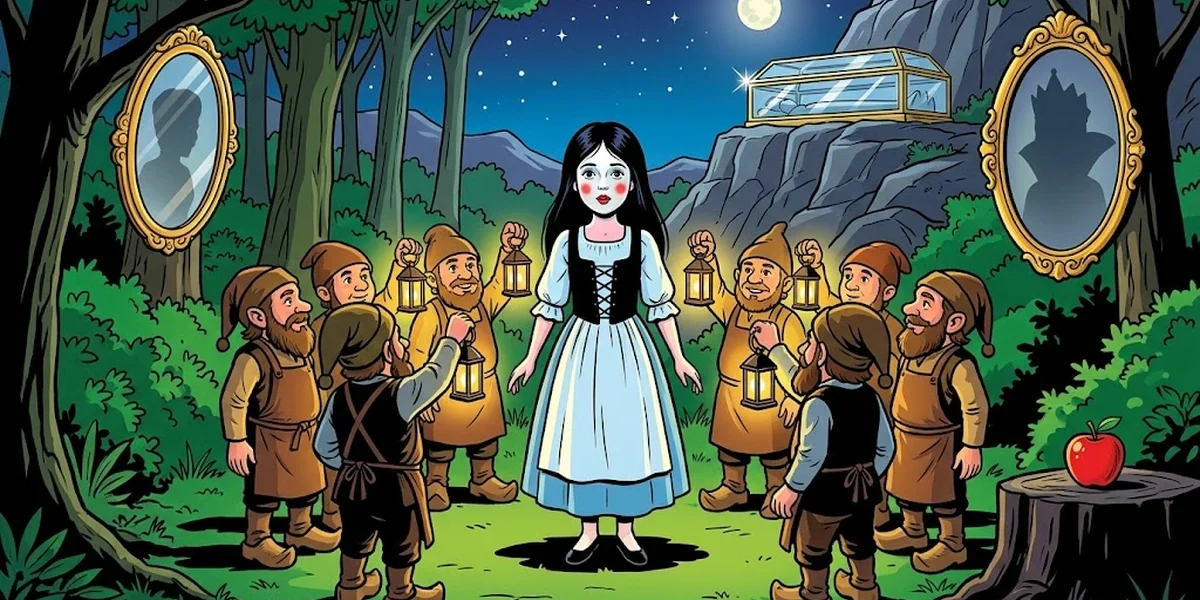
The seven dwarfs of the tale are not, in the Grimms’ original text, the colourful named individuals of the Disney 1937 film. They are simply sieben Zwerge, “seven dwarfs,” who work all day in the mountains digging out copper and gold, and return at evening with their seven small lanterns. Their first action on finding Snowdrop asleep in the seventh bed is to stand around her in a circle and hold up their lanterns to look at her face, and the first dwarf says, “Ach Gott, ach Gott, was ist das Kind so schön!” — “Oh heaven, oh heaven, how beautiful the child is!” They agree to let her sleep, and in the morning they ask her name and her story, and she tells them. They take her in on the practical condition that she will keep the cottage clean, cook, sew, and wash for them while they are at work in the mines. This bargain is one of the gentlest small contracts in the Grimm corpus: the seven dwarfs are not grotesque comic creatures but a household of tradesmen-miners, and Snowdrop becomes the housekeeper of a small co-operative of bachelors who treat her with care and warn her, when they leave each morning, against any visitor at the door.
The dwarfs’ warning is the structural pivot of the tale’s third movement. The queen, having been told once again by the mirror that Snowdrop lives and is now “a thousand times fairer than thou art,” sets out herself in disguise to finish what the huntsman would not. There follow the three famous temptations, each more refined than the last. First the laces. The queen comes to the cottage door disguised as an old peddler-woman selling silk laces in many colours, and persuades Snowdrop to be laced into a new bodice. She laces the bodice so tightly that the child cannot breathe and falls down as if dead. The dwarfs, returning that evening, find her, cut the laces, and revive her. Second the comb. The queen returns disguised as another old woman with a tray of combs, and persuades Snowdrop to let her comb her hair. The comb is poisoned; Snowdrop falls down again as if dead; the dwarfs return, find the comb, and pull it out, and she revives once more. Third the apple. The queen prepares the famous apple, half white and half red, with the poison concentrated entirely in the red half. She herself takes the white half and offers Snowdrop the red, and Snowdrop, reassured by the queen’s own bite, accepts. This time the dwarfs return to find her truly, finally, motionless. They cannot revive her. They wash her with water and wine, comb her hair, and after three days of weeping decide that they cannot bury her in the dark earth. They have a coffin made of clear glass, write her name on it in golden letters, and carry it to the top of the mountain so that one of them can always sit beside it.
IV. The Glass Coffin on the Mountain and the Stumble of the Servant
The glass coffin on the mountain is the image that has carried “Snowdrop” into world art more powerfully than any other detail of the Grimms’ text. In the original 1812 telling, the coffin is set on a high open peak so that the wind and the wild beasts of the forest may pay their respects to the dead child; for many years the dwarfs sit beside her in turn, and a white dove, an owl, and a raven come to mourn at the coffin’s foot. The years pass — the Grimms do not say how many — and Snowdrop’s body does not decay. She lies in the glass as if asleep, still white as snow, still red as blood, still black-haired as ebony.
It is at this point that the king’s son enters the tale, and his entrance is the simplest of any prince in the Grimm collection. He is hunting in the forest, comes upon the dwarfs’ cottage, sees the coffin on the mountain above it, and falls in love with the child within at first sight. He begs the dwarfs to give him the coffin so that he may take it home and look at her always, and the dwarfs at first refuse, then yield to the prince’s grief, and order their servants to carry the coffin down the mountain. The Grimms’ original ending has no kiss at all. As the prince’s servants are carrying the heavy glass coffin down the rough mountain path, one of them stumbles over a root, the coffin jolts hard, and the small piece of poisoned apple lodged in Snowdrop’s throat is shaken loose. She opens her eyes, lifts the lid of the coffin, and asks where she is. The prince, weeping for joy, takes her home as his bride; the seven dwarfs are invited to the wedding; and the wicked queen, on being told by the mirror that the young queen at the prince’s wedding is “a thousand times fairer than thou art,” comes to the wedding herself, recognises Snowdrop, and dies of her own envy — in the Grimms’ brutal 1812 phrasing, by being made to dance in red-hot iron slippers until she falls down dead. The motif of the iron slippers is folkloric retribution at its most exact: the queen dies inside the iron of her own punishments, and the chromatic triad of the opening — white snow, red blood, black ebony — is closed by the new colour the queen brings to the wedding herself, the red of her own glowing iron shoes.

The Moral: The Mirror That Cannot Lie
The Grimms, like all good German storytellers of their generation, refused to print a single explicit moral after the body of the tale. But the closing line of the German text — “da musste sie in die rotglühenden Schuhe treten und so lange tanzen, bis sie tot zur Erde fiel”, “then she had to step into the red-hot shoes and dance until she fell down dead” — carries its own quiet judgement, and the Hessian dialect storytellers from whom Marie Hassenpflug had learned the tale appended a small proverbial couplet that the folklore collector Heinrich Pröhle recorded in his Kinder- und Volksmärchen (Leipzig: G. A. Avenarius, 1853) in this form:
“Wer einer Kind nach dem Leben tracht’t,
Den hat sein eignes Leben verlacht.”“Whoever plots against a child’s young life, / Their own life has already mocked them with the knife.”
— Hessian closing couplet to Sneewittchen, in H. Pröhle, Kinder- und Volksmärchen (Leipzig, 1853), no. 19.
The proverb cuts in two directions at once, as good Hessian closing-couplets always do. Read straight, it is the conventional moral against envy: the queen who plots a child’s death dies of her own plot. Read sideways, it is the deeper warning the Grimms preserved by changing nothing — that the magic mirror is not the queen’s enemy but her diagnostic instrument. The mirror only tells her the truth. Snowdrop has surpassed her in beauty because Snowdrop is seven years old and the queen is forty; the only escape from the mirror’s verdict is to ask the mirror a different question, and the queen never learns to do this. She demands an answer about beauty alone, and beauty alone returns to her in the form of the iron shoes she is forced to wear at the wedding. The Hessian audience, whose own mothers had aged out of beauty without becoming murderers, would have heard in the closing couplet a small village wisdom: the mirror is not at fault, and the cure for envy is to look elsewhere than into the glass. This double readability — a children’s justice fable on the surface, a meditation on female ageing and rivalry beneath — is the quiet genius of the Grimm tales at their best, and the reason “Snowdrop” has survived translation into more than one hundred and seventy languages without losing its sting.
Why It Lasted: Snow White Across the Ancient World
The placement of “Snowdrop” under ATU 709 “Snow White” puts it at the centre of one of the largest tale-type families in the Aarne–Thompson–Uther index. Hans-Jörg Uther’s revised Types of International Folktales (FFC 284–286, Helsinki: Suomalainen Tiedeakatemia, 2004) lists more than four hundred attested variants of the type from across Europe, North Africa, the Caucasus, the Mediterranean Levant, and the Balkans. The Italian cognate is La Bella Venezia, “The Beautiful Venezia,” recorded by Domenico Comparetti in Novelline popolari italiane (Rome, 1875) from a Calabrian source; in this version the queen is an innkeeper who asks her customers, not a mirror, who is the fairest woman in the land. The Albanian cognate is Marén e Bukur, “Maren the Beautiful,” in which the dwarfs are replaced by forty robber-bandits living in a mountain cave. The Greek cognate is Myrsina, recorded by Johann Georg von Hahn in Griechische und Albanesische Märchen (Leipzig, 1864), in which the heroine is the daughter of a tyrannical Sun and the mountain refuge is a household of twelve months. The Russian cognate is Skazka o myortvoy tsarevne i o semi bogatyryakh, “The Tale of the Dead Princess and the Seven Champions,” the verse retelling that Aleksandr Pushkin composed in 1833 from the variant his Russian nurse Arina Rodionovna had told him in childhood; Pushkin replaces the seven dwarfs with seven knightly brothers and the apple with a poisoned bread-roll, but the chromatic triad and the magic mirror are kept exactly as in the German.
What makes the Grimm version distinctive within this great family is its symmetry. The triple temptation — laces, comb, apple — is unique to the Grimms among the major nineteenth-century printed versions; most oral cognates use only the apple, or sometimes only the comb. The chromatic triad in Snowdrop’s description, returned at the end as the iron shoes’ new red, is also a distinctly German contribution: the Italian and Albanian cognates use only two colours. And the figure of the unnamed huntsman who weeps and substitutes a boar’s lungs for the child’s is, so far as the comparative folklore record knows, an invention of Marie Hassenpflug herself; it does not appear in the Italian, Albanian, Greek, or Russian variants and was apparently the small psychological flourish that her family’s oral tradition had added to the older European frame. These three Grimm contributions — triple temptation, chromatic triad, weeping huntsman — are exactly the elements that the Disney 1937 film, the Tarsem Singh 2012 Mirror Mirror, and every other modern retelling have kept. The Grimm tale, in other words, has set the canonical shape of Snow White for the entire global twentieth century.
Iconography: Glass Coffins, Red Apples, Magic Mirrors
“Snowdrop” entered Anglophone visual tradition through the elegant chromolithographs of Walter Crane for Lucy Crane’s 1882 Household Stories (London: Macmillan), in which the seven dwarfs are shown in Renaissance-Italian doublets and the glass coffin sits on a flowery alpine slope. The German visual reference is Otto Ubbelohde’s 1907–1909 ink illustrations for the Turm-Verlag edition of the Kinder- und Hausmärchen, which set the dwarfs firmly in the Hessian uplands in miners’ leather aprons and felt caps, and which have been imitated in nearly every twentieth-century German edition. Arthur Rackham’s 1909 watercolours for the English Fairy Tales of the Brothers Grimm (London: Constable) brought the tale into Edwardian taste with a trembling, pale Snowdrop and a red-cloaked queen leaning over the glass. Wanda Gág’s sturdy 1936 woodcuts for Tales from Grimm (New York: Coward-McCann) gave the dwarfs the round-faced cheer that the Disney studio would borrow for its film a year later, and Walt Disney’s Snow White and the Seven Dwarfs (1937), based on a treatment by Earl Hurd and Wilfred Jackson, is the visual frame within which most of the world now imagines the tale. Trina Schart Hyman’s 1974 watercolours for Snow White (Boston: Little, Brown), translated by Paul Heins, returned the tale to a darker medieval-German register, and Maurice Sendak’s 1973 line drawings in The Juniper Tree and Other Tales from Grimm (translated by Lore Segal and Randall Jarrell) gave the queen a brooding, Goya-like face that twentieth-century critics have judged the most unsettling Snow-queen in any printed edition.
Reading with Children
For parents, teachers, and storytellers reading Sneewittchen aloud, four details from the Grimms’ text repay slowing down for. First, the chromatic triad of the opening. “As white as snow, as red as blood, as black as ebony” is one of the most exact small descriptions of a face in any folk literature, and children grasp at once that the three colours name not just Snowdrop’s skin, lips, and hair but the entire visual world of the story. Pause after the queen’s wish, and let listeners look at the snow falling outside any winter window. Second, the rhyming question to the mirror. “Looking-glass, looking-glass on the wall” is best read with the lilt one gives to a counting-out rhyme; by the third repetition, children will be chanting the question along with the storyteller, which was the entire point of the rhyming form in the oral tradition Marie Hassenpflug inherited. Third, the kindness of the dwarfs. The seven small miners do not lecture or punish Snowdrop for eating from their plates; they ask her name, listen to her story, and offer her a place. This quiet hospitality is the most important moral in the tale, and it is the part most worth pausing on with younger listeners. Fourth, the original ending. The Grimm tale has no kiss; the prince’s servant simply stumbles, and the piece of apple is jolted from Snowdrop’s throat. Older children love being told that the famous Disney kiss was a Hollywood addition of 1937, and that for the first hundred and twenty-five years of the tale’s life it was a clumsy footstep in the path that brought Snowdrop back to life — an accident, in other words, and not a romance.

A Note on Sources
The text on this page follows KHM 53, “Sneewittchen,” in Jacob and Wilhelm Grimm, Kinder- und Hausmärchen, 1st edition (Berlin: Realschulbuchhandlung, 1812), volume I, pages 238–250, with reference to the canonical 7th edition (Göttingen: Dieterich, 1857) which made small stylistic revisions to the queen’s speeches. The English wording is closely adapted from Margaret Hunt’s standard 1884 translation, Grimm’s Household Tales (London: George Bell & Sons), volume I, pages 213–224, with reference to Lucy Crane’s 1882 Household Stories for the title Snowdrop and to Edgar Taylor’s earlier 1823 German Popular Stories in which the heroine first appeared in English under that name. The provenance of the tale is documented in Wilhelm Grimm’s Anmerkungen zu den Kinder- und Hausmärchen, 3rd edition (Göttingen: Dieterich, 1856), volume I, pages 110–113; for the role of Marie Hassenpflug as primary informant, the indispensable modern reference is Heinz Rölleke, Die Märchen der Brüder Grimm: Eine Einführung (Stuttgart: Reclam, 1985), chapter 4. For the comparative folklore the standard reference remains Hans-Jörg Uther, The Types of International Folktales (FFC 284–286, Helsinki: Suomalainen Tiedeakatemia, 2004), entry on ATU 709; for the motif inventory, Stith Thompson, Motif-Index of Folk-Literature, revised edition (Indiana University Press, 1955–58), motifs Z65.1, D1323.1, S31, F451.5.1.2, R311, K929.1, E21.5, N271. The Pröhle dialect couplet is preserved in Heinrich Pröhle, Kinder- und Volksmärchen (Leipzig: G. A. Avenarius, 1853), no. 19. All cited editions are in the public domain and freely available through the Internet Archive and the German Deutsches Textarchiv.
Read time: about 10 minutes. Suitable for ages 6 and up; suitable for read-aloud from age 4 with the queen’s death by red-hot iron shoes treated, in the Grimms’ gentle phrase, simply as “the dance she could not stop dancing” until justice was done.