The Frog Prince: A Promise Kept, A Curse Broken
The Frog Prince: A Promise Kept, A Curse Broken: In a kingdom where crystal towers caught the sunlight and turned it into rainbows, there lived a princess
Long before disco balls and digital crowns, when forests still kept their oldest secrets and stars were thought to whisper down to wells, there lived a princess who learned that a promise made in panic still counts when the morning comes. This is the story Jacob and Wilhelm Grimm placed first — first — in their famous 1812 collection of fairy tales. Out of two hundred stories they would eventually gather, they chose this one to open the door. There must be a reason. Perhaps because everything that matters about being a person is folded into it: the careless promise, the slow lesson, the unlikely friend, the moment a face we judged ugly turns out to be the face of someone we needed all along.
1. The Golden Ball and the Cool Dark Well
In the days when wishing still helped — “In den alten Zeiten, wo das Wünschen noch geholfen hat,” as the Brothers Grimm open their tale — there lived a king whose youngest daughter was so beautiful that even the sun, which has seen so many things, paused on her face whenever it shone. The princess did not know yet what beauty cost; she only knew that it was hers, and that no one in the palace told her no.
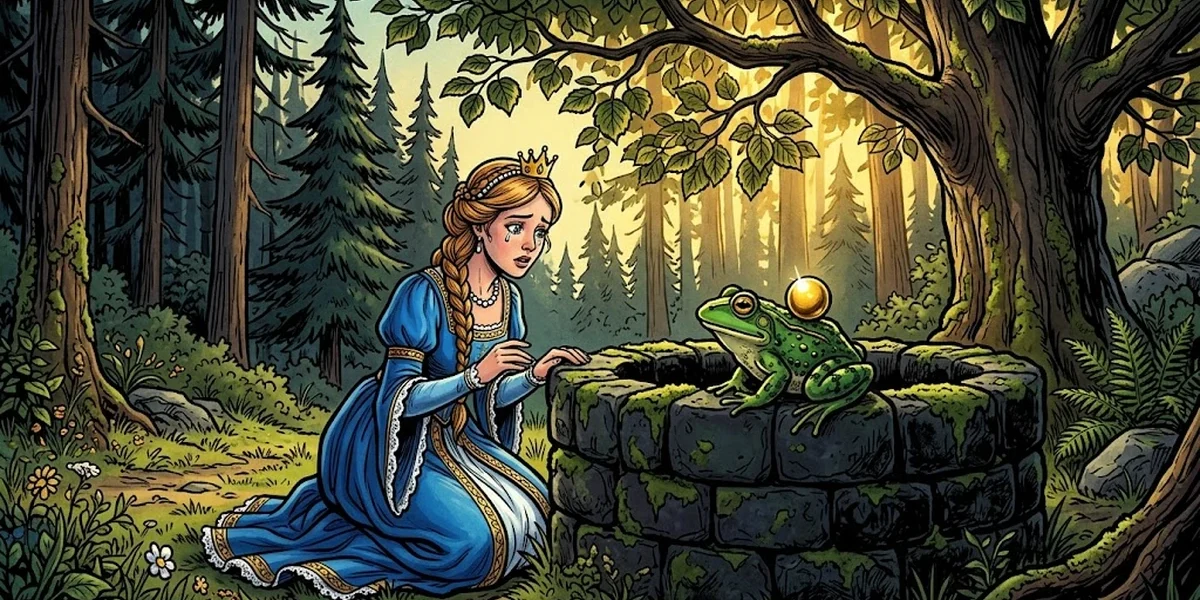
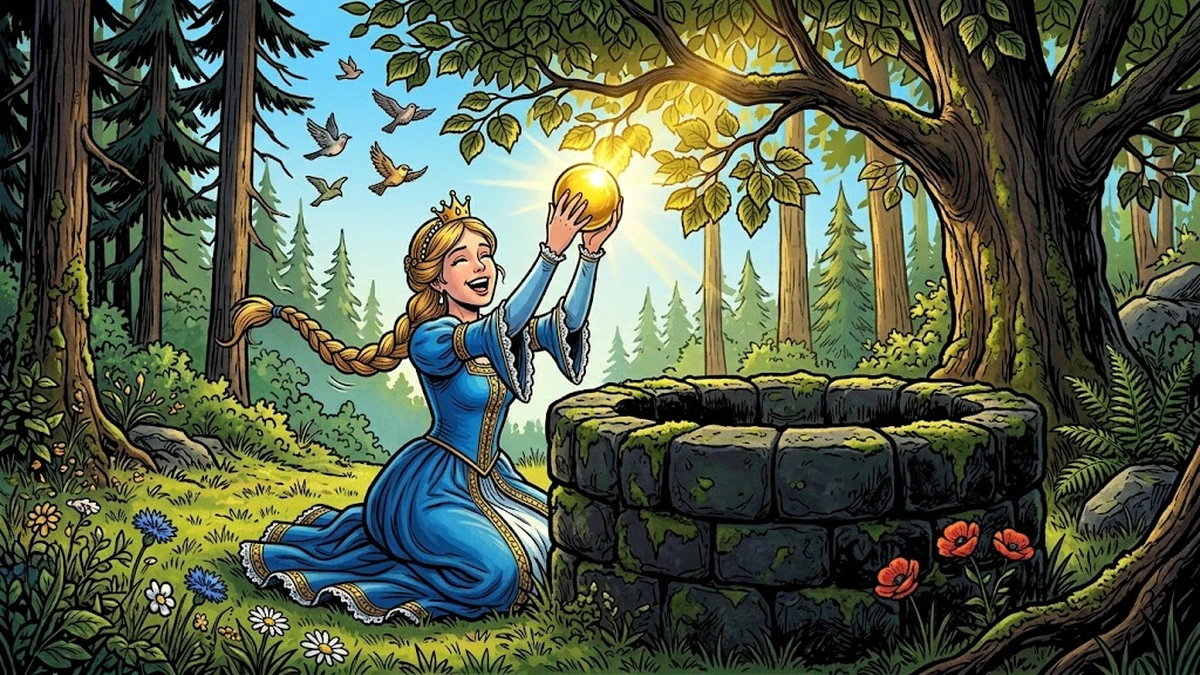
Near the king’s castle there stood a great dark forest, and in the forest, beneath an old linden tree, there was a well. When the days were hot the princess would slip out of the palace alone — the kind of solitude only a child of immense privilege can take for granted — and sit by the cool stones and play with her favourite toy: a golden ball. She tossed it up, she caught it, she tossed it again. The ball flashed in the sunlight like a small sun of her own.
One day she threw it a little too high. It slipped through her fingers, struck the rim of the well with a small heart-stopping tock, and dropped — flash, gone — into the deep black water. The princess ran to the edge and looked down, but the well was bottomless to her eyes, and the gold was lost in the dark like a star fallen into a hole in the world. She sat down by the well and began to cry, and she cried louder and louder, and could not be comforted.
It is here that the story does its first quiet trick. A child in tears at a well is the most ordinary thing in the world — tantrums dressed up in lace. But the Grimms make us pause. The princess has lost something golden into something deep. Folklorists from Bruno Bettelheim onward have read the well as a threshold image, an opening into the unconscious; what falls in is not just a toy but the smooth easy world of childhood, where every wish was answered and every loss could be cried away. From the depths, a voice answers her grief. Something old has been waiting.
2. The Promise Made in a Hurry
“What ails thee, king’s daughter?” said a voice. “Thou weepest so that even a stone would show pity.”
She looked up — and there, peering out of the water, was a frog. A great, ugly, wet, sticky-mouthed frog. The princess told him, between sniffs, what had happened. “Dry your tears,” said the frog. “I can help you. But what will you give me if I bring back your golden ball?”
“Anything you want, dear frog,” said the princess at once. “My clothes, my pearls, my jewels — even the golden crown I am wearing.”
The frog answered, “Thy clothes, thy pearls and jewels and thy golden crown are not for me; but if thou wilt love me and let me be thy companion and play-fellow, and sit by thee at thy little table, eat from thy little golden plate, drink from thy little cup, and sleep in thy little bed — if thou wilt promise me this I will go down below and bring thee thy golden ball up again.”
“Oh yes,” said she, “I promise thee all thou wishest, if thou wilt but bring me my ball back again.” But she thought, in her heart: What nonsense the silly frog talks. He lives in the water with the other frogs and croaks; he can be no companion to any human being.
This is the beat the Grimms sharpen most carefully across their seven editions. In the first edition of 1812, the princess’s lie is almost reflexive — the way any frightened child will agree to anything to make a problem stop. By the seventh edition of 1857, the Grimms have allowed her interior monologue to bloom, the small private contempt of a girl who believes that what she promises a frog cannot possibly be binding in the world of human beings. The story turns on this gap. A promise has been made. The maker doesn’t take it seriously. The receiver does. Everything that follows is the difference between those two states.
The frog dives. The water closes over him. After a long moment he comes back up, the golden ball balanced on his wide green back, and rolls it onto the grass. The princess shrieks with joy, snatches up her toy, and runs — runs like the wind — back to the castle, leaving her promise floating on the cool dark water like a leaf nobody bothered to fish out.
3. The Knock at the Door
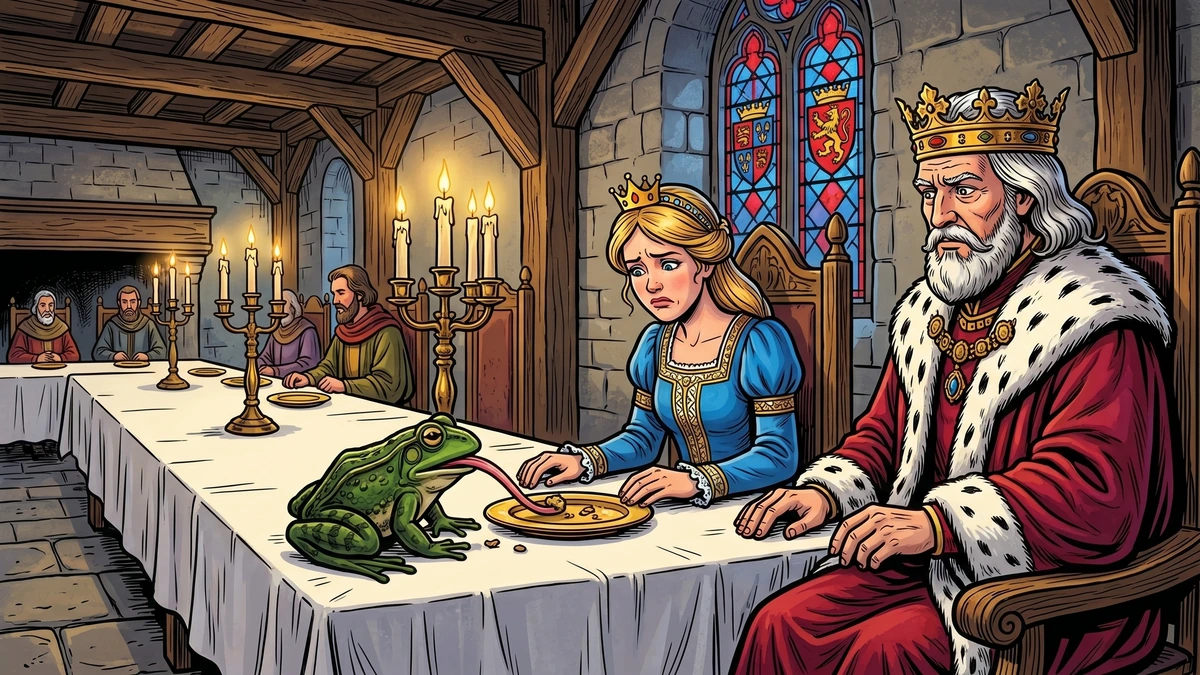
The next day, the princess sat at the long royal table beside her father the king, eating from her little golden plate. The court was grand, the room was warm, the linen was white, and the well in the forest was very far away. Then — plitsch, platsch, plitsch, platsch — something wet was coming up the marble stairs. There was a knock at the door, and a small voice cried: “Königstochter, jüngste, mach mir auf!” — “King’s youngest daughter, open to me!”
The princess ran to look. There on the step sat the frog. She slammed the door, came back to the table white as her napkin, and tried to eat her soup. The king saw the change in her face. “My child, what is it? Is there a giant outside the door wanting to take you away?”
“Oh no,” said the princess. “Not a giant. A nasty frog.”
“And what does the frog want of you?”
So she had to tell him. She told him about the golden ball, about the well, about the promise made in panic. The king listened to every word. Then he set down his spoon and looked at his daughter with the calm seriousness that belongs to fathers in fairy tales who have, for once, decided not to be charmed.
“That which thou hast promised must thou perform,” he said. “Go and let him in.”
It is the line that swings the whole tale. That which thou hast promised must thou perform. Not poor darling, never mind, not I’ll have him chased away. The king does not ask whether the promise was wise or fair or convenient. He asks only whether it was made. It was. So it stands. There are entire libraries of fairy-tale criticism written about this sentence. In the most patriarchal readings the king is simply enforcing obedience; in the more recent feminist readings he is teaching his daughter the moral seriousness of her own word, the reality that even a promise made to a creature she despises is hers to honour. Either way, the door opens, the frog hops in, and the long lesson begins.
The frog asks to be lifted onto the table. The princess hesitates. The king nods. She lifts him. He asks her to push her little golden plate closer so they may eat together. She hesitates. The king nods. She does it. She eats slowly and unhappily; the frog eats with a frog’s appetite. When supper is done, the frog says, “I am tired now, carry me into thy little room and make thy little silken bed ready, that we may both lie down and sleep.” And the princess, the same princess who only yesterday spent her afternoons tossing a golden ball into the air without a thought in her head, begins to cry again — because childhood is over, and one cannot cry it back.
4. The Throw, the Transformation, and Iron Heinrich
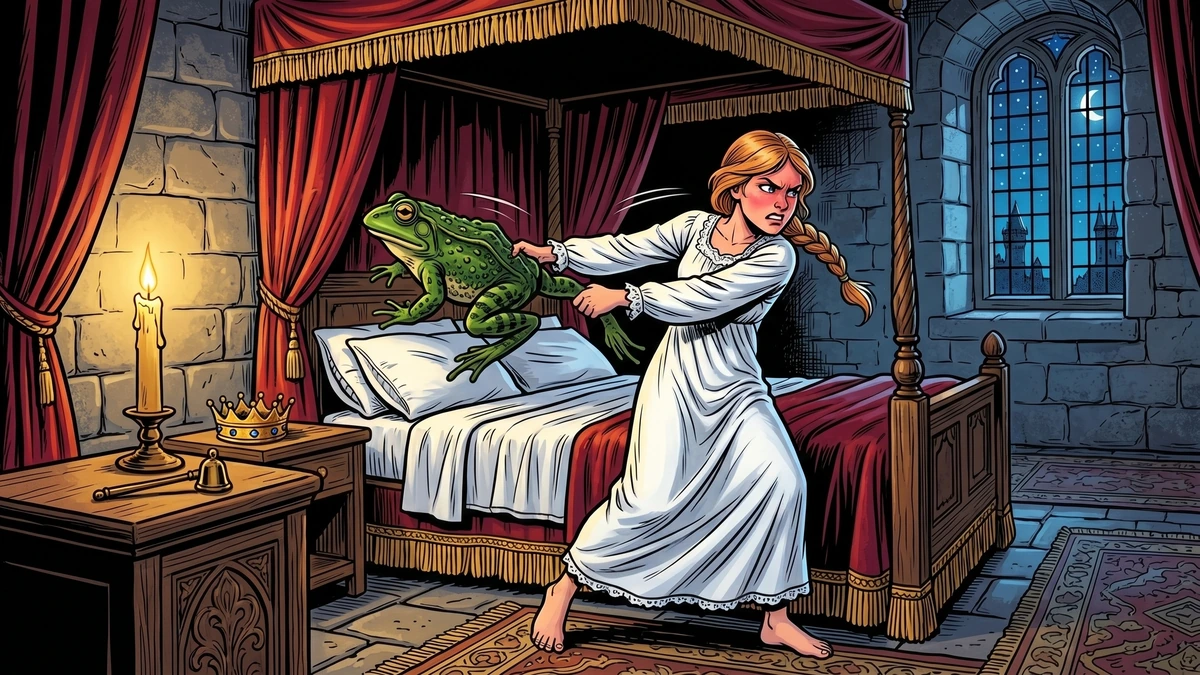
The Grimms left the ending of this story in a curious shape, and modern readers often hear a softened version they were never given. There is no kiss in the original. In the first 1812 edition and in every edition that followed, the princess does not bend down to lift the cold-bodied frog to her lips. She picks him up — this is the line that has astonished schoolteachers for two centuries — and in a sudden burst of disgust and frustration she flings him at the wall. “Da packte sie ihn mit zwei Fingern, trug ihn hinauf und warf ihn aus allen Kräften wider die Wand.” She seizes him with two fingers, carries him upstairs, and throws him against the wall with all her strength.
And there, mid-air — the moment her arm uncoils, the moment her temper finally finds its target — the spell breaks. He is no longer a frog. He is a young prince with kind eyes, and he tells her his story. A wicked witch had cursed him; only a princess, by accepting him as her companion at table and bedside, could break the enchantment. Honour the promise long enough, and the frog reveals what was always inside him.
The next morning a carriage drawn by eight white horses comes to fetch them, with white ostrich plumes on every head and golden chains on every harness. Behind it stands the prince’s servant, “the faithful Heinrich,” who, when his master had been turned into a frog, had been so heartbroken that he had bound three iron bands around his own chest to keep his heart from bursting. As the carriage rolls on, again and again the prince hears a great cracking behind him — krack! krack! Each time he turns and asks if the carriage is breaking apart. And each time Heinrich, with shining eyes, answers: “Nein, Herr, der Wagen nicht, es ist ein Band von meinem Herzen, das da lag in großen Schmerzen, als Ihr in dem Brunnen saßt, als Ihr eine Fretsche (Frosch) wasßt.” — “No, Lord, it is no carriage, but a band from my heart, that was in such pain when you were sitting in the well, when you were a frog.”
It is one of the strangest, most quietly beautiful endings in the Grimms’ entire collection. The lovers ride forward in their gold and ostrich plumes; behind them, the iron bands of a servant’s grief snap one by one into the air. The story is called Der Froschkönig oder der eiserne Heinrich — The Frog King or Iron Heinrich — for a reason. Two hearts have been freed in this tale. One was a prince trapped in cold green flesh. The other was a faithful servant who had loved his master so completely that he had banded his own grief in iron just to survive it.
The Moral
The moral of The Frog Prince sits inside the king’s great line and inside Heinrich’s breaking iron. A promise is not weighed by who you make it to. It is weighed by the fact that you made it. The princess promised a frog because she was certain a frog could not collect; the lesson of the tale is that the universe is more honest than that, and the small dignified creatures we are tempted to dismiss are often carrying something gold inside.
“Was du versprochen hast, das musst du auch halten.”
— “That which thou hast promised, that must thou also perform.” (Brothers Grimm, KHM 1, 1812)
For a child, the moral is plain: keep your word, even when keeping it is uncomfortable, even when the person you gave it to seems beneath your notice. For an older reader, the moral folds in on itself: the people we are quickest to find ugly — the inconvenient kindnesses, the awkward friendships, the embarrassing relatives — are sometimes the very ones whose company will turn out, in the end, to have been a prince in disguise. And tucked behind both of these is Heinrich, who reminds us that some loves are so deep they leave iron around the heart, and that part of being human is letting those bands break, one cracking sound at a time, when the long fear is finally over.
Why It Has Lasted
The Brothers Grimm placed Der Froschkönig oder der eiserne Heinrich as story number one in their Kinder- und Hausmärchen when the first volume appeared in Berlin on 20 December 1812. Their immediate source, according to their own household notes, was the oral tradition of the Wild family of Kassel — specifically, several Wild sisters, one of whom (Dortchen) Wilhelm Grimm would later marry. This domestic, almost familial origin is part of the story’s power: it was a tale told by a young woman to the man who loved her, and from that hearth it has travelled to almost every nursery in the Western world. Folklorists classify the tale as Aarne–Thompson–Uther type 440 (The Frog King, or Iron Henry), and Hans-Jörg Uther’s 2004 catalogue records variants from Ireland and Scotland to Sweden, Finland, the Low Countries and the German lands — a roughly northern-European core, with scattered cousins as far south as the Mediterranean.
The story has lasted, two hundred and more years on, because it does what the very oldest stories do: it puts a small enormity into a child’s afternoon. A ball drops into a well. A promise is made and broken. A wet thing climbs the marble steps. An angry throw shatters a curse. A servant’s iron heart cracks open behind a golden carriage. None of these images have lost their hold. We will keep telling this story to children for as long as children make hasty promises and adults try, gently, to teach them that words are real. We will keep telling it to ourselves for as long as we suspect, secretly, that the wet ugly creature on the doorstep might one day turn out to have been carrying our own happiness in its mouth all along.
Frequently Asked Questions
What is the moral of The Frog Prince?
Who wrote The Frog Prince?
What is the story of The Frog Prince?
Why is the story actually called 'The Frog King or Iron Henry'?
Why is The Frog Prince the first story in the Grimm collection?
You May Also Like
 Grimm's Fairy Tales
Ages 9-12
Grimm's Fairy Tales
Ages 9-12
1. How They Went To The Mountains To Eat Nuts
1. How They Went To The Mountains To Eat Nuts: The nuts are quite ripe now,’ said Chanticleer to his wife Partlet, ‘suppose we go together to the mountains
 Grimm's Fairy Tales
Ages 9-12
Grimm's Fairy Tales
Ages 9-12
The Raven
The Raven: There was once a queen who had a little daughter, still too young to run alone. One day the child was very troublesome, and the mother could not
 Grimm's Fairy Tales
Ages 6-8
Grimm's Fairy Tales
Ages 6-8
The Bremen Town Musicians: The Strength of Friendship and Kindness
The Bremen Town Musicians: The Strength of Friendship and Kindness: There was once a farmer who owned four animals: a donkey, a dog, a cat, and a rooster. True