The Valiant Little Tailor
The Valiant Little Tailor: One summer’s morning a little tailor was sitting on his table by the window; he was in good spirits, and sewed with all his might. A
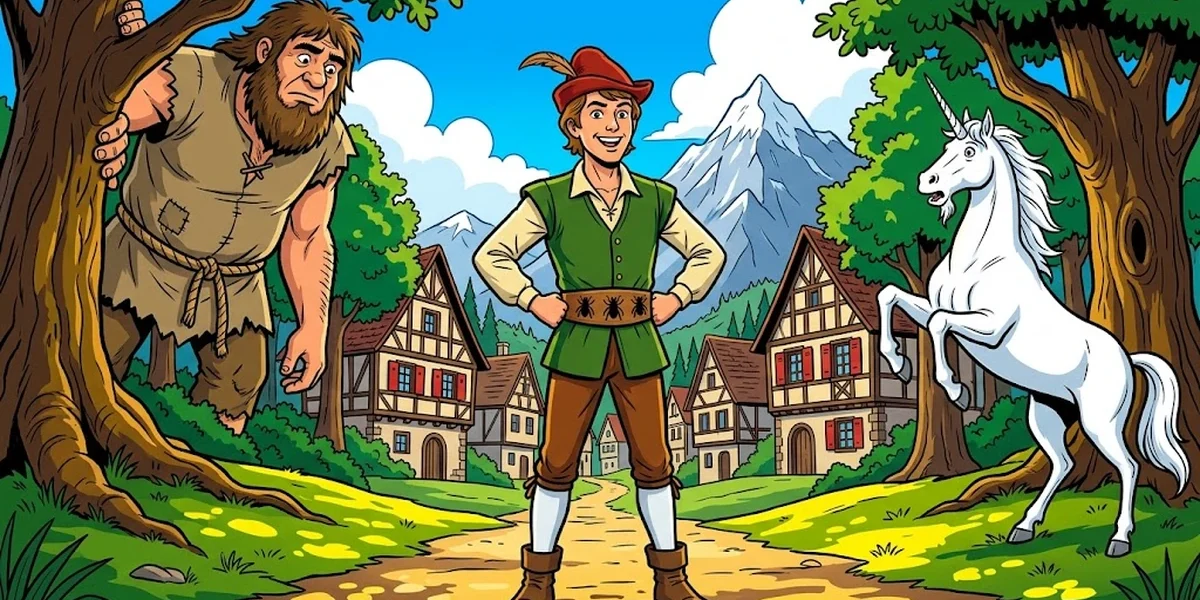
The Valiant Little Tailor (German: Das tapfere Schneiderlein, also Sieben auf einen Streich — “Seven at One Blow”) is tale number 20 in the Brothers Grimm’s Kinder- und Hausmärchen, classified as Aarne-Thompson-Uther Type 1640: The Brave Tailor. First printed in the 1812 first edition (volume 1, Realschulbuchhandlung, Berlin) and revised through every subsequent Ausgabe until the canonical 1857 seventh edition, the story preserves a comic boast-and-bluff hero who outwits giants, kings, unicorns and wild boars armed with little more than a needle, a chunk of cheese and an outsize self-belief. Wilhelm Grimm noted the source as “aus Märtens Märchensammlung” — Martinus Montanus’s Wegkürzer of 1557, which itself rests on a stratum of medieval European jest material reaching back at least four hundred years before the Grimms.
This page restores the bibliographic skeleton beneath the familiar plot: KHM 20, ATU 1640, Montanus 1557, the Grimms 1812, and the long line of English translators — Edgar Taylor (1823, “The Valiant Tailor”), Lucy Crane (1882), Margaret Hunt (1884), Marian Edwardes (1912) — whose phrasings shaped how Anglophone children have heard the tailor brag for two hundred years.
Beat 1 — Seven at One Blow
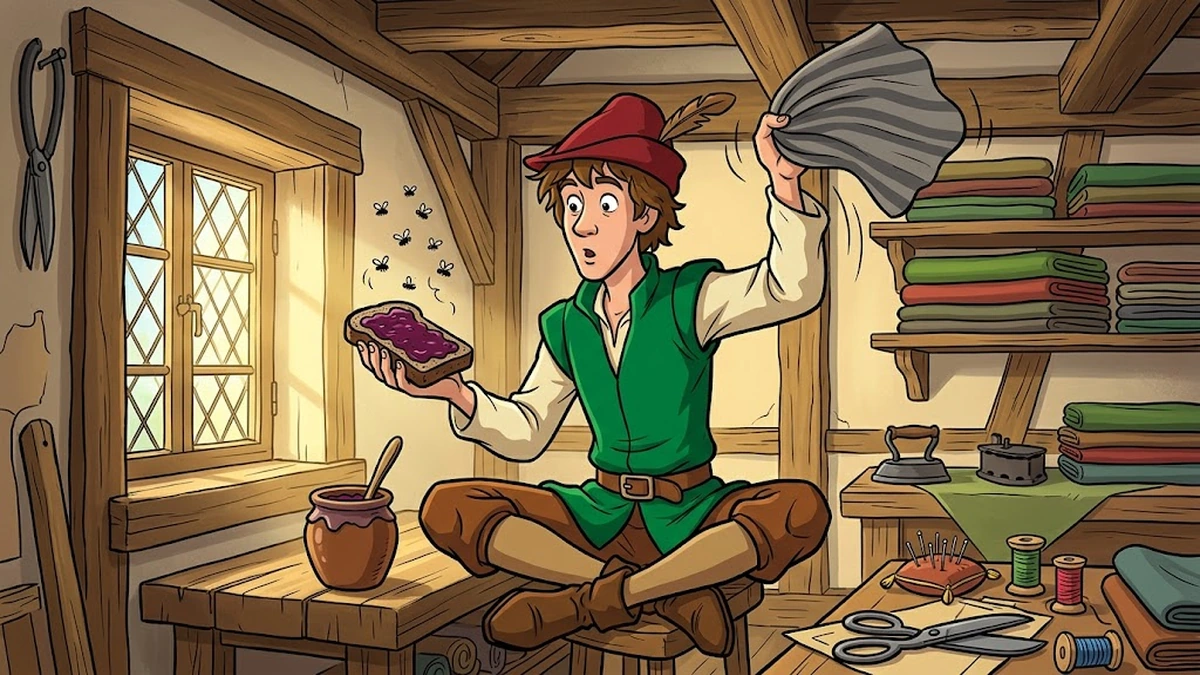
One summer’s morning a little tailor sat on his work-bench by the window, sewing in good spirits, when a peasant woman called her wares up the lane — “Good jam, cheap! Good jam, cheap!” The tailor stretched his slim head out, beckoned her up the three flights with her heavy basket, lifted every pot, sniffed every lid, and at last bought a stingy four ounces. The woman left grumbling. The tailor cut a slice of bread across the loaf, smeared it generously, and laid it aside while he finished the seam he was on.
The smell drew flies in clouds from every corner of the room. The tailor flapped his hand, but flies, who (says the narrator dryly) “understood no German,” would not be driven off. Seizing a strip of cloth he beat at the swarm and counted the dead: seven flies lay still on the bread. “Bist du so ein Kerl?” — “Art thou such a fellow?” — he cried, marvelling at his own valor; and at once he cut a girdle, embroidered upon it in great letters “SIEBEN AUF EINEN STREICH” (“Seven at One Blow”), buckled it round his waist, and decided the wide world must learn of his deed. He dropped a bit of old cheese in his pocket, met a little bird struggling in the hedge and stowed that beside it, and set out into the mountains.
The boast is the engine of the whole tale. Folklorists call it the schein-tat — the “deed-by-appearance.” The tailor never lies; he simply lets a true sentence (he killed seven, of flies) be heard as a different true sentence (he killed seven, of men). Every subsequent encounter is a variation on the same trick: an honest object — cheese, bird, sapling, branch — performs work the listener attributes to muscle. Hans-Jörg Uther’s revision of the international tale-type catalogue (FFC 284, 2004) lists this as the type-defining sequence; it is found from Iceland to India, and its German lineage runs through Montanus’s Schwankerzählung of 1557 to the broadside chapbooks of the seventeenth and eighteenth centuries.
Beat 2 — The Stone, the Cheese and the Bird
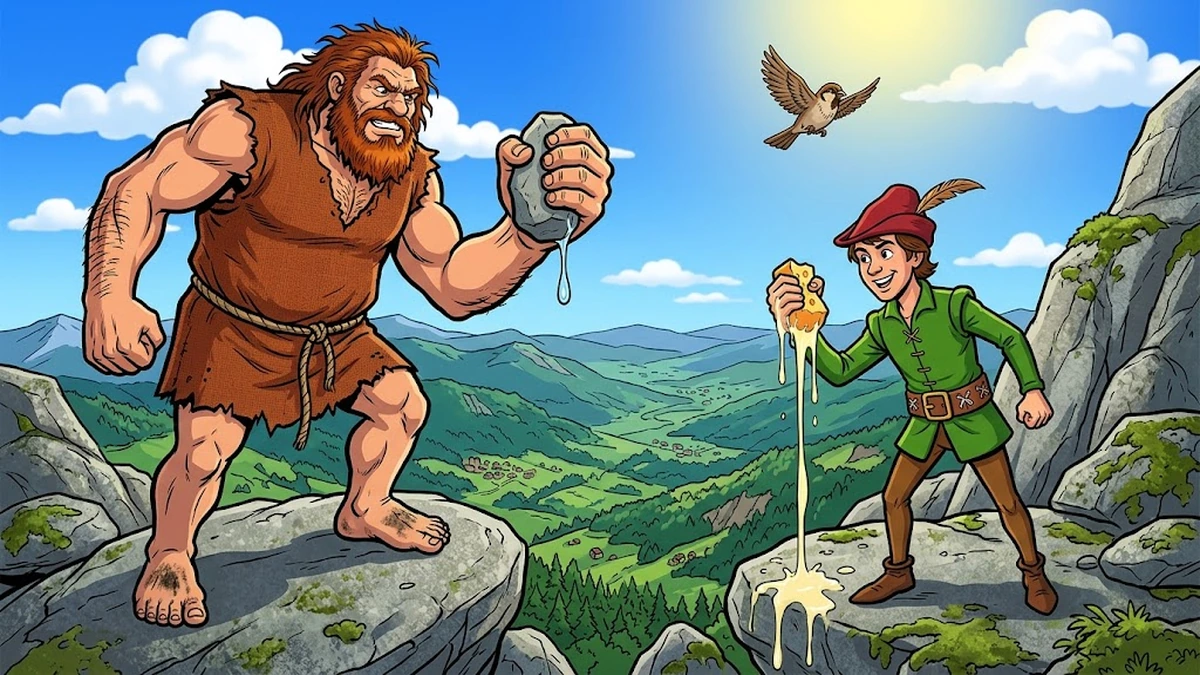
On the mountain top the tailor met a giant who was looking out over the world. The tailor stepped up bold as brass and read aloud the legend on his belt. The giant glanced at the slight figure, snorted, and proposed a contest of strength. He picked up a stone and squeezed it until water ran out. “That is nothing,” said the tailor, drew the soft cheese from his pocket, and squeezed until whey dripped down his fingers — “I have squeezed the moisture out of mine altogether.”
The giant flung a stone so high it became a black speck and at last fell back to earth. The tailor took the bird from his other pocket and hurled it skyward; the bird, glad of freedom, flew off and never returned. “What sayest thou now, comrade?” the tailor asked. “Mein Stein kommt nicht wieder.” — “My stone is not coming back.” Defeated twice, the giant invited him to help carry an oak that had been blown down. The tailor sat on the leafy crown while the giant lifted the trunk; when the giant wearied and let it fall, the tailor sprang to the ground and pretended he had been carrying the heavier branches all along. “Bist du so ein schmal Kerl und kannst den Baum nicht tragen?” — “Such a slight fellow as thou art, and thou couldst not carry the tree?”
The trio of trials — squeezing stone, throwing stone, carrying tree — is one of the oldest comic patterns in European folktale. ATU classes the entire sequence under the catch-phrase “Outwitting the giants by trickery.” Stith Thompson’s Motif-Index of Folk Literature tags the cheese-squeeze as K62 and the bird-as-stone as K71. Montanus already had it in 1557; the Grimms simply restored the German cadence to a story that had been told in every European tongue.
Beat 3 — The Giants’ Cave and the King’s Promise
The giant brought the tailor home to the cave to spend the night. He gave him an iron bedstead so vast the tailor curled up in a corner instead. At midnight the giant, supposing the small fellow asleep, took up an iron bar and smote the bedstead a blow that would have split it in two. In the morning he was startled to see the tailor strolling out, fresh and lively. The giants fled in panic, and the tailor went on his way.
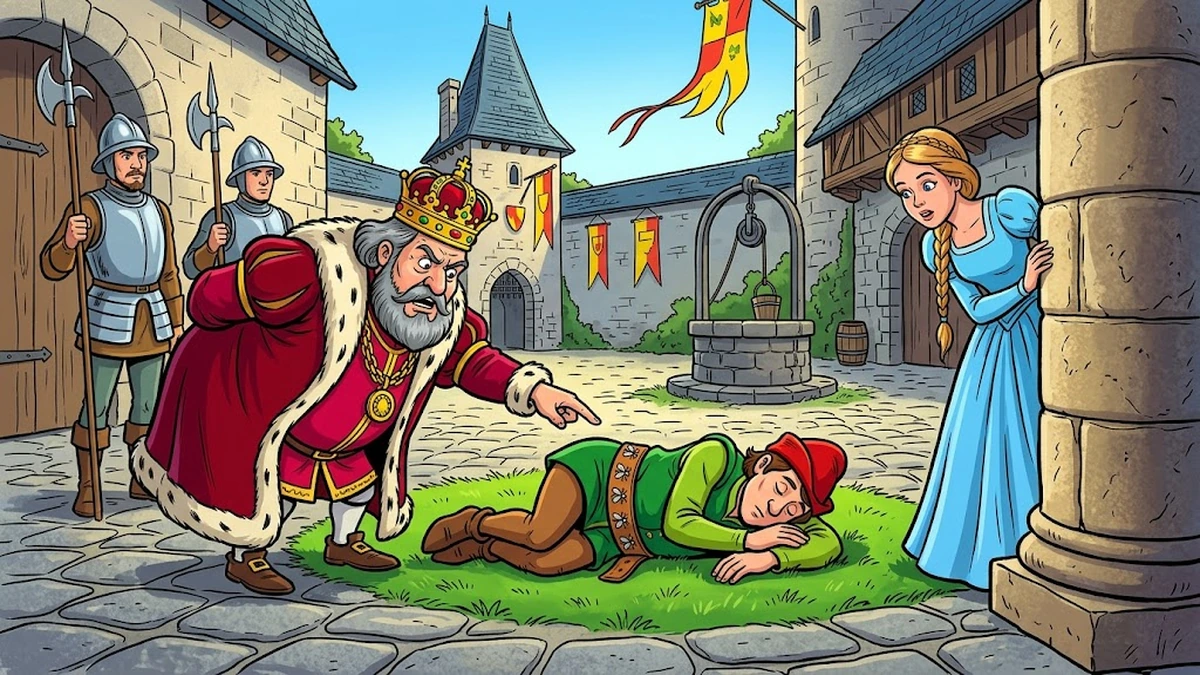
He came at last to a royal courtyard, lay down in the grass, and fell asleep with the legend “Seven at One Blow” visible across his belly. Servants noticed the words, the captain of the guard reported them to the king, and the king — thinking such a champion must be useful in time of war — offered him a place in the army. The other soldiers, alarmed at travelling with so terrible a swordsman, threatened to desert. The king, fearing to lose either his new captain or his old companies, hit on a stratagem: he would set the tailor three impossible tasks, and if he survived would give him his daughter and half the kingdom; if he refused, the king would have lawful cause to dismiss him. The tailor accepted at once.
The bargain is the structural pivot of ATU 1640: the boast attracts the king, the king devises tasks designed to be fatal, the boaster survives by guile rather than by force, and the throne tilts toward the trickster. Robert Darnton’s The Great Cat Massacre (1984) reads tales of this family as peasant fantasies of social mobility — the smallest, lowliest, and most apparently helpless figure parlays a single plausible word into a princess and a kingdom. The Grimms’ tailor is a figure German folklorists call the Hans im Glück archetype, kin to Lucky Hans, the Brave Little Tinker, the Lazy Boy Who Won the Princess.
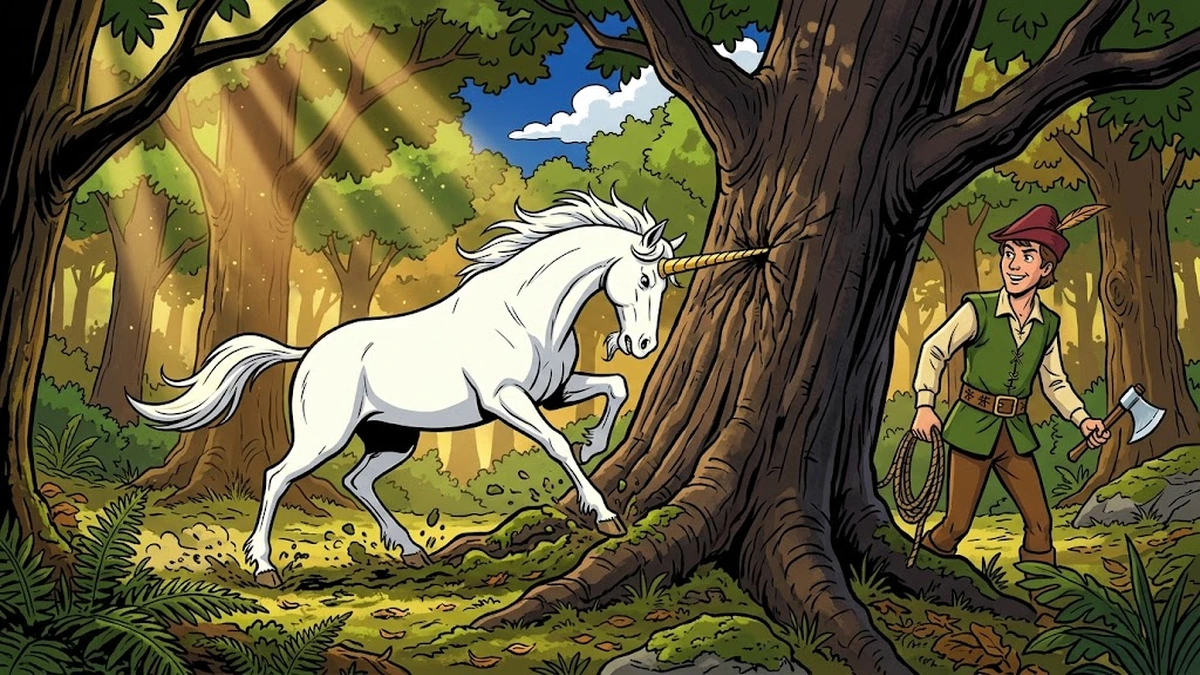
Beat 4 — Two Giants, a Unicorn and a Wild Boar
The first task was to rid the forest of two giants who slept under a tree by day and ravaged the country by night. The tailor crept up, filled his pockets with stones, climbed into the tree above the sleepers and let one stone fall on the chest of each giant in turn. Each woke and accused the other; soon they were tearing trees up by the roots and battering one another to death, until both lay still. The tailor came down, drew his sword, and gashed each chest a little so that he could swear to the king he had finished them himself.
The second task was to take alive a unicorn that had been spoiling the woods. The tailor went out with a length of rope and an axe, met the beast, and as it charged him head down, he sprang behind an oak; the horn drove deep into the tree and stuck fast. Then he tied the rope round its neck, hewed the horn out and led the captive home.
The third task was the wild boar. The tailor fled into a roadside chapel; the boar charged in after him; the tailor leapt out of a window, ran round the chapel, slammed the door behind the boar, and walked back to the king. The king, for all his cunning, was now bound by his own oath. The wedding was held with little joy, the tailor was crowned co-regent, and that — for our hero — should have been the end of the story.
It was not. One night the new queen heard her husband talking in his sleep: “Boy, make me the doublet, and patch the breeches, or I will lay the yard-stick across thy ears!” She understood at once and went weeping to her father, begging him to be rid of a tailor-king. The king promised that armed men would seize her husband that night, bind him, and put him on a ship to the ends of the earth. But a faithful squire warned the tailor; he lay down feigning sleep, and when the men crept toward the bedchamber he cried out in a great voice his old refrain: “I have slain seven at one blow, two giants, taken a unicorn and a wild boar — and shall I fear those who stand outside this door?” The men ran for their lives. And so — says Wilhelm Grimm’s last sentence — “the tailor was and remained a king his whole life long.”
Moral — Wer’s nicht im Kopf hat, hat’s in den Beinen
“Wer den Mut nicht hat, der wird auch nicht klug;
und ein flinker Kopf wägt sieben Riesen auf.”“He who has no courage will never be cunning;
and a quick head outweighs seven giants.”
— proverb appended in early Hessian retellings, recorded by Rölleke (1980)
The moral the tale offers is not that boasting is wise — the queen plainly disapproves — but that the brain is a muscle, and a confident, calm intelligence will repeatedly defeat brute strength when the small fellow stays quick and lets the situation do the heavy lifting. Wilhelm Grimm, in his 1856 commentary, glossed the tale as a study of Geistesgegenwart: presence of mind. Every encounter is decided not by what the tailor possesses but by what he notices first — the cheese in his pocket, the bird in his hand, the oak’s leafy crown, the sleeping giants’ tempers, the unicorn’s straight charge, the chapel door behind the boar.
Why It Lasted
The Valiant Little Tailor has lived for nearly five centuries because it answers a question every culture asks of small children and small adults alike: what use is a clever, frightened, ordinary person in a world of giants? The Grimm answer is that the ordinary person, if quick of eye and steady of nerve, can pass for a giant-killer simply by behaving as if the giants did not frighten him. The story has been retold by Walter Scott (in his Border Minstrelsy notes), set to music by Engelbert Humperdinck (the unfinished Der tapfere Schneider, 1903), filmed by the East German DEFA studio in 1956, and reworked by Disney in the 1938 Mickey Mouse short Brave Little Tailor. ATU 1640 cognates include the Russian Foma Berennikov, the Italian Giovannin senza paura, the Indian Brave Hira Lal (Punjab) and the Chinese Little Bean Sprout — each a tribute to a single, durable joke: that the world routinely mistakes calm for power, and that the mistake is usually permanent.
Canonical Attribution
Title (German): Das tapfere Schneiderlein. Tale number: KHM 20. Tale type: ATU 1640 The Brave Tailor. First Grimm publication: Kinder- und Hausmärchen volume 1, Realschulbuchhandlung Berlin, 1812 (revised 1819, 1837, 1840, 1843, 1850, 1857). Source as cited by Wilhelm Grimm: Martinus Montanus, Wegkürzer, Strassburg 1557 (edited later by Bolte 1899). Printed predecessor: Von einem jungen Schneider und einem Riesen, in the same Montanus collection. Earliest English translation: Edgar Taylor, German Popular Stories, London 1823 (“The Valiant Tailor”). Subsequent translators: Lucy Crane, Macmillan 1882; Margaret Hunt, Bell 1884; Marian Edwardes, Dent 1912; Ralph Manheim, Doubleday 1977; Jack Zipes, Bantam 1987 and Princeton 2014.
Stith Thompson motif tags: K62 contest in squeezing water from stone, K71 deceptive throwing contest with bird substituted for stone, K1741 carrying the heaviest part of the tree, K1051 dropping stones on sleeping giants, F613.2 capture of unicorn by ramming horn into tree, F614 capture of boar by trapping in chapel.
Cultural Reception in India
Indian audiences encountered The Valiant Little Tailor in late-nineteenth-century English readers and missionary anthologies; A. K. Ramanujan, in Folktales from India (Pantheon 1991), notes that the boast-and-bluff plot is independently widespread in the subcontinent — the Punjabi Brave Hira Lal, the Kannada Heggadeya Maga, and several Jataka analogues all turn on the same comic tension between a small body and a large reputation. The Grimm version has therefore felt at once foreign and familiar to readers from Lahore to Madras: the tailor’s belt becomes the village headman’s tilak, the giant becomes the demon Bakasura, the cheese becomes a lump of curd, but the lesson sits the same way in the mouth.
Reading Notes for Modern Children
Children meeting this tale for the first time often ask why the tailor never tells the truth about the flies. The answer is that he never lies; he simply allows others to be wrong about him, and that distinction is the moral spine of the whole story. A useful question for a parent or teacher to put afterwards is: “When have you let someone believe you were braver, smarter, or stronger than you really were — and did the world reward you or punish you for it?” The tailor’s answer is that the world rewarded him; the queen’s answer is that the world should have punished him; and the Grimms wisely left the dispute unresolved, ending instead on the comic phrase and remained a king his whole life long, which lets the reader carry the question home.
You May Also Like
 Grimm's Fairy Tales
Ages 9-12
Grimm's Fairy Tales
Ages 9-12
The Four Clever Brothers
The Four Clever Brothers: Dear children,’ said a poor man to his four sons, ‘I have nothing to give you; you must go out into the wide world and try your luck.
 Grimm's Fairy Tales
Ages 9-12
Grimm's Fairy Tales
Ages 9-12
The Twelve Dancing Princesses
The Twelve Dancing Princesses: There was a king who had twelve beautiful daughters. They slept in twelve beds all in one room; and when they went to bed, the
 Grimm's Fairy Tales
Ages 6-8
Grimm's Fairy Tales
Ages 6-8
The Frog Prince: A Promise Kept, A Curse Broken
The Frog Prince: A Promise Kept, A Curse Broken: In a kingdom where crystal towers caught the sunlight and turned it into rainbows, there lived a princess