The Raven
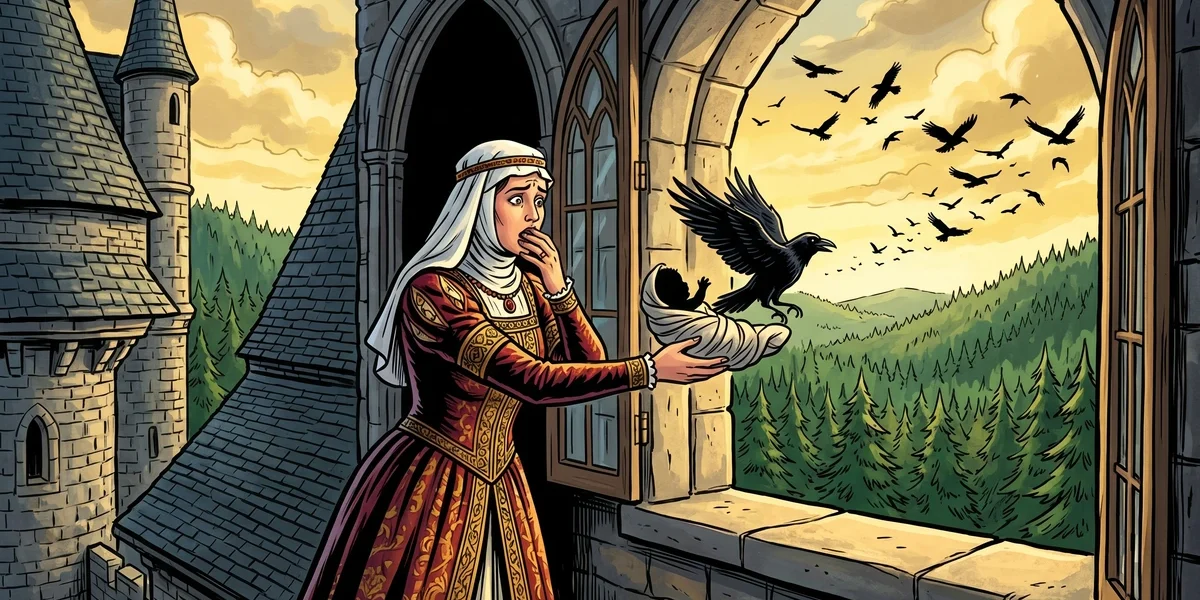
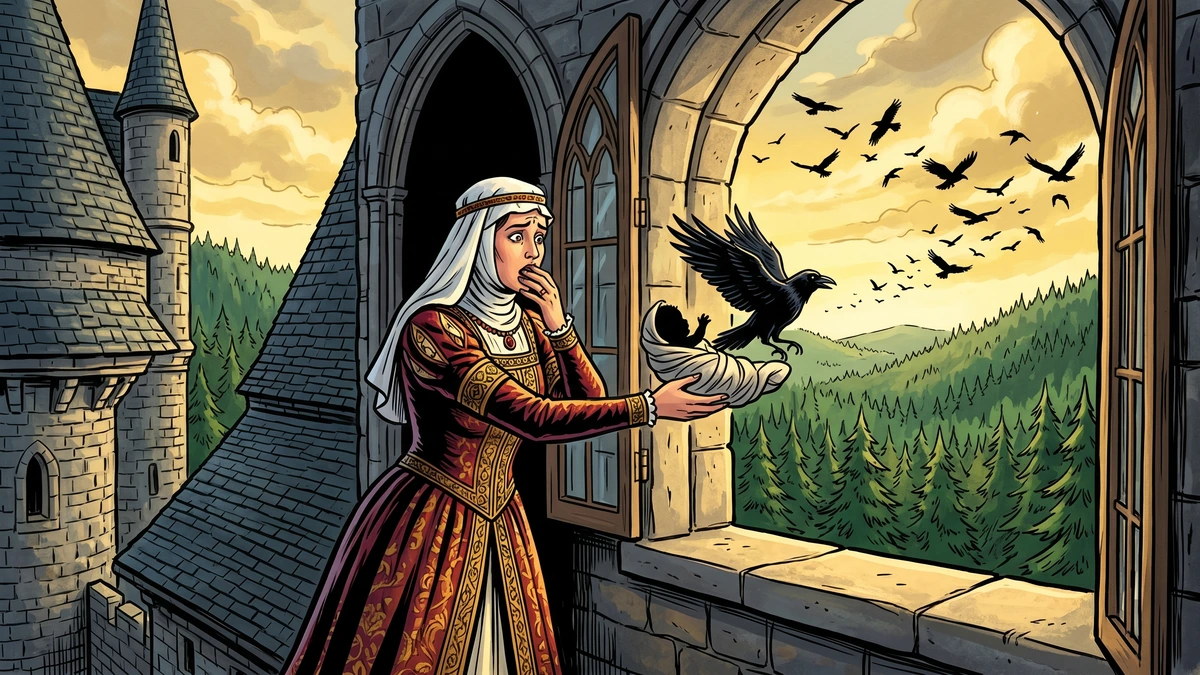
The Raven: There was once a queen who had a little daughter, still too young to run alone. One day the child was very troublesome, and the mother could not
The Raven — Die Rabe in the original German — is tale number 93 (KHM 93) in the Brothers Grimm Kinder- und Hausmaerchen, first published in the second volume of 1815 by Realschulbuchhandlung in Berlin. International tale-type indexes file the story under ATU 401, “The Princess Transformed into a Bird,” a sub-cluster of the great quest-for-the-disenchanted-bride family that begins at ATU 400. Wilhelm Grimm noted in the 1856 anmerkungen that the tale was contributed “aus dem Schwalmgrund in Niederhessen” — from the Schwalm valley of Lower Hesse — and modern source-critical scholarship (Heinz Roelleke, Hans-Joerg Uther) traces it through the Wild family circle of Cassel, the same Hessian household that gave the Grimms The Frog-King and The Twelve Brothers.
Origin & Canonical Attribution
The Raven occupies a quietly important place in the Grimm corpus. It is one of those tales the brothers reworked patiently across editions: the 1815 first printing is brisker and rougher; by the seventh and final Ausgabe letzter Hand of 1857 the prose has acquired the cadenced, faintly archaic register that English readers know from Edgar Taylor’s German Popular Stories (London, John Murray, 1823) and from Margaret Hunt’s complete two-volume Grimm’s Household Tales (London, George Bell & Sons, 1884), the translation against which all later English editions, including Lucy Crane’s 1882 selection, are measured.
- KHM number: 93 — from the 1819 second edition onward; volume II of the 1815 first edition
- German title: Die Rabe (literally “The Raven,” feminine in the Hessian original because the bird is a princess)
- English title: The Raven (Edgar Taylor 1823; Margaret Hunt 1884; Lucy Crane 1882)
- Year: 1815 — volume II, first edition; revised across 1819, 1837, 1840, 1843, 1850, and 1857
- Collectors: Jacob Grimm (1785–1863) and Wilhelm Grimm (1786–1859)
- Informants: Aus dem Schwalmgrund in Niederhessen, transmitted through the Wild family of Cassel (per Roelleke 1980, Uther 2008)
- Tale-type: ATU 401 — The Princess Transformed into a Bird (sub-type of ATU 400, The Man on a Quest for His Lost Wife)
- Publisher (first edition): Realschulbuchhandlung, Berlin (volume II, 1815)
- Standard scholarly edition: Roelleke, Heinz, ed. Kinder- und Hausmaerchen, Reclam, Stuttgart, 1980 — based on the Ausgabe letzter Hand of 1857
Because the tale belongs to the wide ATU 400–459 cluster, comparativists routinely set it beside the Norwegian “East o’ the Sun and West o’ the Moon” (Asbjornsen & Moe, Norske Folkeeventyr, 1845), Apuleius’s “Cupid and Psyche” (Metamorphoses Book V, second century), Madame d’Aulnoy’s L’Oiseau Bleu (1697), and, in the Indo-European far east, the Sanskrit story of Urvasi the apsara who is bound and lost by Pururavas. In every variant a shape-shifted lover must be redeemed by a vigil that the lover himself nearly fails: the structural fingerprint is unmistakable.
Beat One — The Curse of an Impatient Word
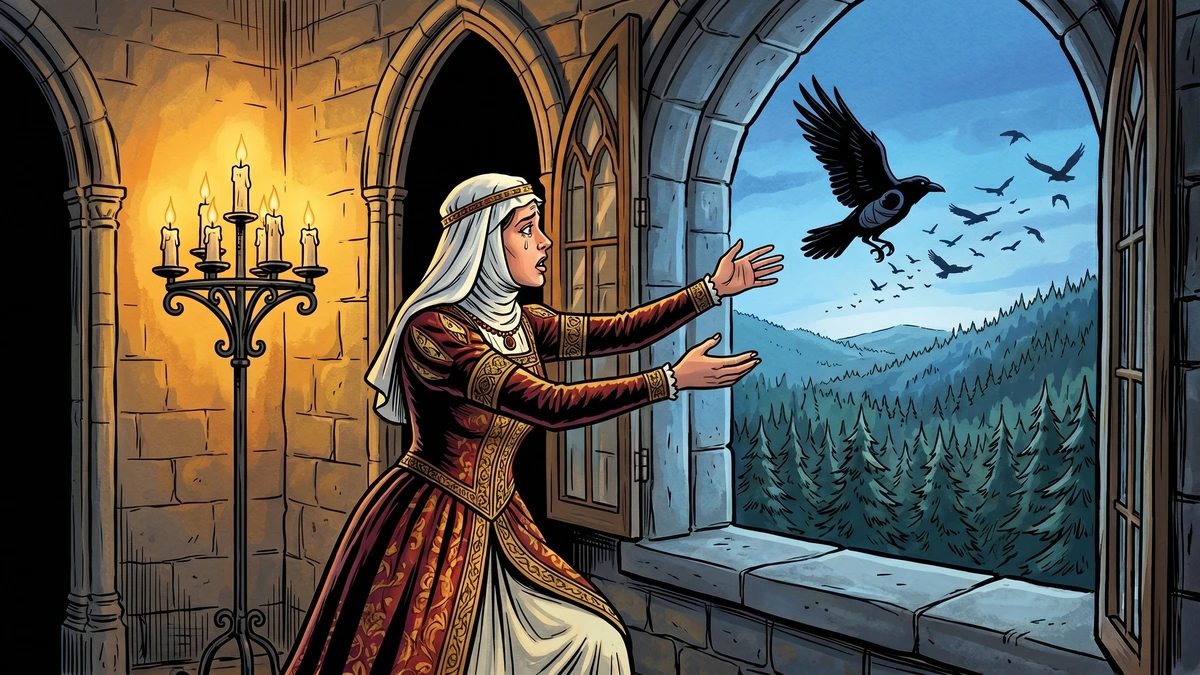
The story begins, as so many Grimm tales do, in a queen’s chamber where the ordinary trouble of an infant becomes the hinge of a fate. The little princess will not be quieted; the queen, exhausted, looks out at the ravens wheeling above the castle walls and lets fly the careless wish: “Ich wollte, du waerest ein Rabe und floegest fort, so haette ich Ruhe.” (I wish you were a raven and would fly away, then I should have peace.) The wish is granted on the instant. The child becomes a black bird and is gone through the open casement, and the wood swallows her.
The Grimms understood the moment exactly. Words once given to the air cannot be reeled back, and the maerchen world, like the world of Hessian peasant proverb, treats the wish as a binding sacrament. The opening compresses three motifs that will rule the tale: the impatient word (German Fluch, a half-curse that the speaker did not mean), the border-crossing of the casement (in Grimm tales, an open window is almost always the hinge between the human and the enchanted), and the raven itself, that ancient bird of Odin, of Noah, and of the mourning psalmist, never far from the threshold of the next world.
The reader is meant to feel the chill of inevitability. There is no villain in this opening, no witch and no dragon — only a tired mother and a wood waiting to receive what is sent. It is the rare Grimm tale whose wound is opened by a parent rather than by a stepmother or a usurping queen, and the story gathers all its later weight from this single domestic moment.
Beat Two — The Vow in the Wood
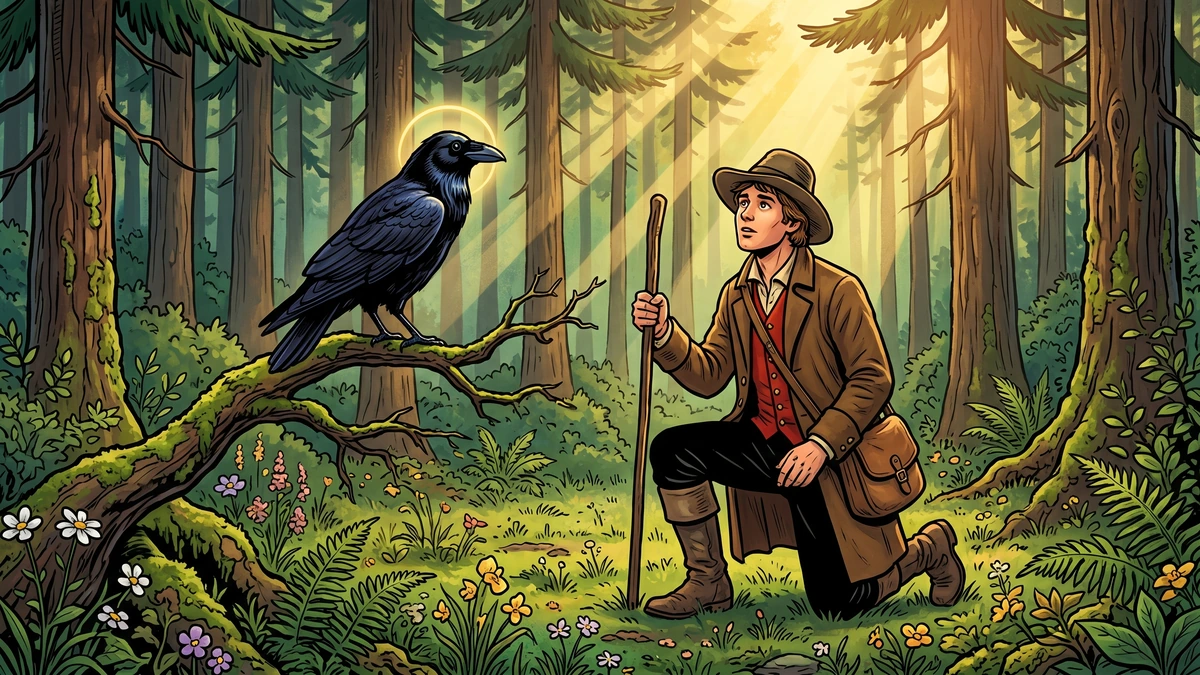
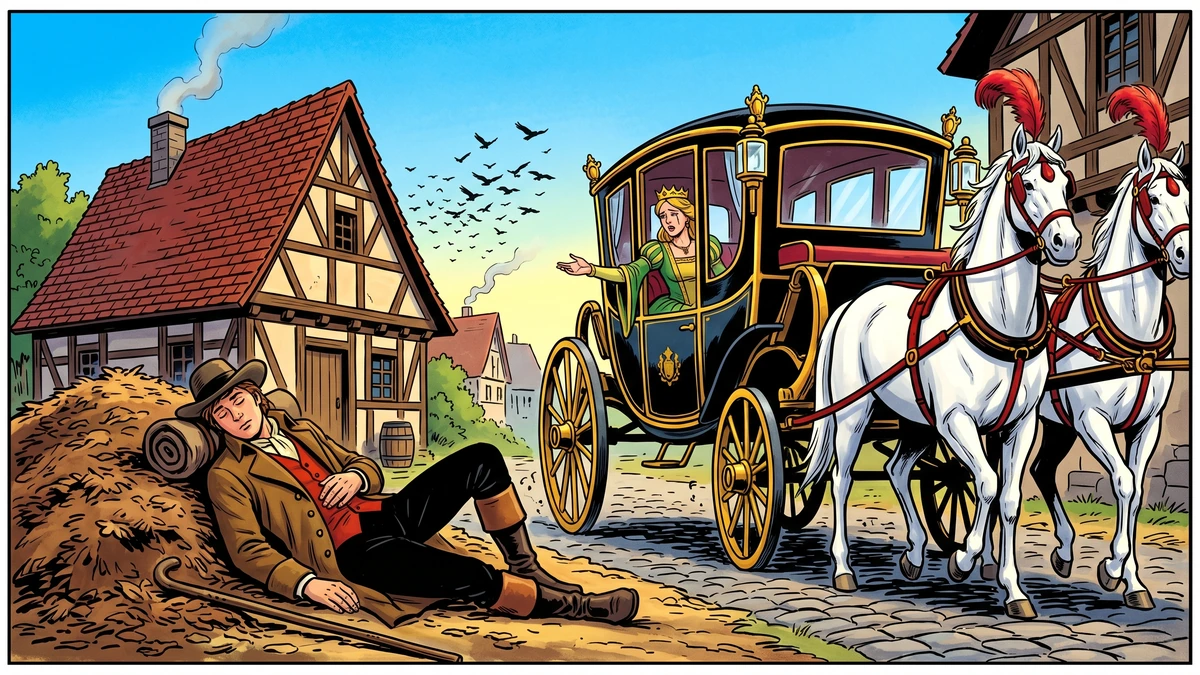
Years pass. A man — he is never named, and never given a kingdom; he is simply der Mann, a wanderer in the wood — hears a raven call. The bird speaks in the voice of a king’s daughter and tells him the law of her unbinding. He must walk farther, to the cottage of an old woman; he must take neither food nor drink from her, however kindly she presses; and on the great tan-heap behind the garden he must keep watch for three afternoons. At two o’clock she will drive past in her carriage, drawn first by four white horses, then by four chestnuts, then by four blacks — the colours running, as the Hessians say, from morning to mourning. If he is awake when she passes on the third day, the spell breaks. If he sleeps, she is lost forever.
“Ach!” the raven sighs even as he swears the oath, “I know already that you will take something from her, and you will not save me.” It is one of the great prophetic lines of the Grimm collection — spoken not as accusation but as melancholy foreknowledge, the way a long-suffering wife predicts a husband’s familiar weakness.
The triple test is itself an archaic structural unit. Stith Thompson’s Motif-Index of Folk-Literature (Indiana University Press, revised 1955–58) catalogues this configuration as motif D2006.1.1 (“forgotten fiancee re-awakens memory”) and motif H1471 (“watch for devil’s bride”); ATU 401 specifically requires the threefold approach in vehicles of escalating gravity, exactly as the Grimms record it. The chromatic ladder — white, brown, black — is the world’s oldest visual representation of the soul’s descent toward death and was already a commonplace in Hessian folk songs collected by Friedrich David Graeter in the 1790s.
Beat Three — Three Sleeps and a Bone Ring
The man enters the cottage. The old woman — the Grimms in 1815 call her simply eine alte Frau, but Wilhelm in the 1857 redaction tints her language faintly witch-like, with the soft persuasion that runs through Hessian folk diction — sets bread and wine before him. He refuses, again and again, but at last allows her to press on him “nur einen Schluck Wein, ein Schluck zaehlt nicht” — “just one mouthful of wine, one mouthful counts for nothing.” It is the immortal small lie that opens the door to every great loss.
He climbs the tan-heap. The white horses come, and the man is asleep. The raven leaves a loaf of bread, a flask of wine, and a slip of paper to tell him what has gone wrong. The next day he eats nothing, but the old woman gives him “nur einen Tropfen” — just one drop — and he sleeps through the chestnut horses too. On the third afternoon the woman tries again, but this time the man, half-warned by the raven’s tearful note, knocks the cup aside and stays awake. He misses her too — for in the Grimms’ version the spell has by then advanced too far, and the raven-princess, weeping, leaves him three tokens — a loaf, a flask, and a gold ring stamped with her name — and a long, hard message: he must walk to the glass mountain, and only there can she be won.
This is the great middle of the tale, and it does what only the Grimms quite manage: it converts a simple test of vigilance into a meditation on human inadequacy. The man is not wicked. He loves her. He means to keep watch. And still he cannot. The Grimms collected the tale at the same time they were copying out, in their philological notebooks, the proverb der Geist ist willig, aber das Fleisch ist schwach — “the spirit is willing, but the flesh is weak” — and the story is, at heart, a domestic Lutheran sermon on that text.
Beat Four — The Glass Mountain and the Won Word
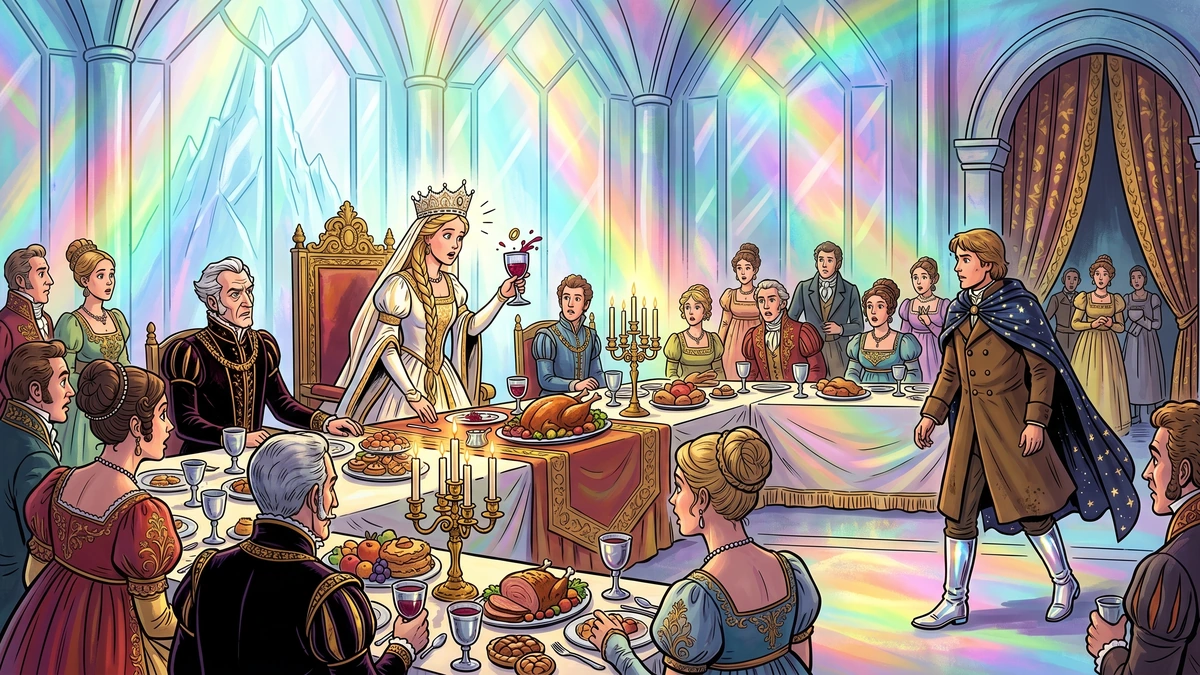
The man’s penance is the long road. He walks for years; the Grimms compress this with the formula er ging lange, lange — “he went long, long.” He passes the giant who fights with the cloud, the robbers who quarrel over the magic cloak and the magic boots and the cudgel that strikes by itself, and by skill and trickery he wins all three relics from them — the same triadic theft motif (ATU 518) that the Grimms record under “The Quarrelling Giants” and under Tischlein deck dich (KHM 36). With cloak and boots and stick he climbs at last the glass mountain, where the raven-princess now reigns and is about to be married to another, the false bridegroom.
He hides; he waits in the kitchen of the wedding feast. Into the cup of wine she will drink at the wedding he drops the gold ring she gave him at the tan-heap. She lifts the cup, sees the ring, sets it down, and asks the company who has come into the kitchen. The man steps out. She knows him. She comes to him without a word and the false bridegroom is sent away. They are married, and the tale closes with the Grimms’ favourite simple cadence: “sie lebten zufrieden bis an ihr Ende.”
Lucy Crane’s 1882 phrasing is worth keeping — “they lived happily till they died” — not the more familiar Disney “ever after” but the older Hessian register, in which contentment, not eternity, is the gift that the long penance has bought.
Moral — The Word, the Watch, and the Won
The Raven holds three lessons in tight succession, and the Grimms intended every one. The first is the moral of the queen’s careless wish at the open window:
Was du in der Hitze sagst, wird die Welt am kalten Morgen beim Wort nehmen.
“What you say in heat, the world will hold you to in the cold morning.” — Hessian household proverb, recorded in Grimms’ notebooks, 1812
The second is the moral of the three sleeps on the tan-heap: that good intention is not enough; only the vigilance that resists the small offered comfort — the one mouthful, the one drop, the one harmless concession — can keep faith with what we love. The third is the moral of the long road and the glass mountain: that what is lost by a careless word is recoverable, but only by labour out of proportion to the original sin. The queen’s wish takes a single breath; the man’s redemption of it takes years.
This three-fold structure — word, watch, won — is the architectural signature of the tale, and it is the reason editors from Andrew Lang (The Yellow Fairy Book, 1894) to Maria Tatar (The Annotated Brothers Grimm, 2004) have placed The Raven among the Grimms’ most quietly moral fictions. There are no swords, no fires, no executions. The whole thing is told in a register no louder than a kitchen clock, and yet it touches three of the deepest fears of the European household: that a parent may unmean their child, that a lover may sleep when love most needs them, and that the road back from a bad word is longer than any of us would choose to travel.
Why It Has Lasted
The Raven has lasted for two centuries because it knows that the worst things in life are not done by villains. They are done by tired mothers, by tired travellers, by people who meant well and who, when the white horses came, were already asleep. Edgar Taylor in 1823 sensed this and softened the tale a little for English nurseries; Margaret Hunt in 1884 restored the Grimms’ harder edges; Lucy Crane in 1882 found a middle register, and it is hers that most modern English readers know. In every translation the central image holds — the man on the tan-heap, the carriage going by, the raven watching from above, knowing already that he sleeps. It is a picture of human frailty that no later century has improved upon.
The Schwalm valley is now a quiet farming country an hour west of Cassel. The Wild family house in Cassel was destroyed in the bombing of 1943. The Grimm Brothers Museum in Cassel keeps a printed copy of the 1815 first edition of volume II under glass; turn to page 58 and there is Die Rabe in its original setting, between Das junge Riese and Die kluge Bauerntochter. The Raven still flies there.
Scholarly Notes & Editorial History
The textual transmission of Die Rabe rewards close attention. In the 1815 first printing the tale runs barely four octavo pages; by 1857 Wilhelm Grimm has expanded it by perhaps a third, smoothing the dialogue, adding the loaf-and-flask details on the tan-heap, and most importantly inserting the Hessian dialect line of the raven-princess to the man — “du wirst doch nicht wachen koennen” — which gives the second beat of the story its tender, predictive grief. The Grimms did not invent the tale; they polished it. Their editorial method, defended in Wilhelm’s 1819 preface as treue Wiedergabe des Volkstons (faithful reproduction of the folk register), was in practice a careful literary stylisation that made the Hessian voice readable to a national German-speaking public.
Hans-Joerg Uther’s 2008 critical study Handbuch zu den Kinder- und Hausmaerchen der Brueder Grimm (de Gruyter, Berlin) offers the most complete modern source apparatus. He identifies four key analogues in the German-speaking record before 1815: an unnamed Hessian fragment in the August von Haxthausen papers, the Pomeranian variant gathered by Philipp Otto Runge, the Bavarian text recorded by Franz Xaver von Schoenwerth in the Oberpfalz, and a Swiss-German variant from the canton of Aargau. None of these is identical with the Grimm version; the Wild family redaction the Grimms used is the most narratively complete, with the threefold horse-test fully developed and the tan-heap (German Lohehaufe, the heap of spent oak bark used in tanning) fixed as the place of vigil. The tan-heap is itself a precise piece of period detail: every Hessian village in 1815 had a tannery, and the tan-heap was a permanent earthwork of bark and dung outside the workshop, warm with slow fermentation, and notoriously a place where workers fell asleep in the afternoon sun.
For the comparative folklorist, the most striking feature of the Grimm text is its sympathetic treatment of the failed watcher. In the Norwegian and Italian analogues he is often a fool or a peasant whose stupidity is half the joke; in the Grimms’ Hessian version he is a sober man who knows perfectly well what he must do, who refuses food and drink for as long as any human watcher could, and who fails anyway. That moral seriousness, more than any plot device, is the Grimms’ particular contribution to the tale, and it is what has held the story in print on three continents for two hundred and ten years.
You May Also Like
 Grimm's Fairy Tales
Ages 9-12
Grimm's Fairy Tales
Ages 9-12
The Brave Little Tailor
The Brave Little Tailor: In a small cottage at the edge of a great city, there lived a tailor whose hands were as skilled as any craftsman in the kingdom, but
 Grimm's Fairy Tales
Ages 9-12
Grimm's Fairy Tales
Ages 9-12
Iron Hans
Iron Hans: There was once upon a time a king who had a great forest near his palace, full of all kinds of wild animals. One day he sent out a huntsman to shoot
 Grimm's Fairy Tales
Ages 6-8
Grimm's Fairy Tales
Ages 6-8
The Three Languages
The Three Languages: An aged count once lived in Switzerland, who had an only son, but he was stupid, and could learn nothing. Then said the father: ‘Hark you