Rumpelstiltskin: The Miller’s Daughter and the Golden Bargain
Rumpelstiltskin: The Miller's Daughter and the Golden Bargain: The Miller’s Desperate Boast Once upon a time, in a kingdom where water wheels turned day and


Origin: Germany — Kinder- und Hausmärchen, Brothers Grimm, KHM 55 (“Rumpelstilzchen”), first published in volume 1 (Berlin: Realschulbuchhandlung, 1812) and revised through the seventh and final edition of 1857. Tale type: ATU 500 “The Name of the Supernatural Helper,” one of the most precisely defined types in the Aarne–Thompson–Uther index. Oral source: Henriette Dorothea (“Dortchen”) Wild of Kassel, who would later marry Wilhelm Grimm in 1825, and the Hassenpflug sisters Marie and Jeanette — both Hessian families with whom the Grimms collected in 1810 and 1811. Earliest German printed reference: Johann Fischart’s Geschichtklitterung (Strasbourg, 1577), where “Rumpele stilt oder der Poppart” already appears as a household bogey-name. Translators: Edgar Taylor (London, 1823, German Popular Stories) and Margaret Hunt (London, 1884, Grimm’s Household Tales), revised by James Stern in 1944. Read time: 11 minutes.
The Story Behind the Story: A Name Older Than the Tale
Of the two hundred and ten tales that survived into the seventh and final edition of the Kinder- und Hausmärchen, “Rumpelstilzchen” is among the dozen the Brothers Grimm revised most heavily. The 1810 manuscript version, which Wilhelm wrote down in his own hand and sent to the poet Clemens Brentano in the so-called Ölenberg notebook, runs to barely six hundred words and ends without the famous foot-stamping outburst. The 1812 first printed edition adds the rumpelstilt’s leap into the air; the 1819 second edition adds the queen’s ride through the forest with her messenger; the 1857 final edition adds the line about the little man tearing himself in two. The bones of the tale, however, were already there in 1810: a miller, a boast, a daughter, three nights of impossible spinning, three rooms of straw, a bargain for a child, a riddle of a name, and a small angry creature who vanishes into the floor.
Within the international catalogue of folk tales established by Antti Aarne (1910), expanded by Stith Thompson (1928, 1961) and Hans-Jörg Uther (2004), this story is the type-specimen of ATU 500, “The Name of the Supernatural Helper.” The cardinal feature of the type — a desperate human bargains for impossible help, the helper demands a price (usually the firstborn child), and the human is freed only by guessing the helper’s secret name — is recorded across the whole of Northern Europe. In England the helper is called Tom Tit Tot, in Scotland Whuppity Stoorie, in the Lowlands of Scotland Habetrot, in Iceland Gilítrutt, in Wales Trwtyn-Tratyn, in Sweden Titteliture, in the French salon tale of Marie-Jeanne L’Héritier (1696) Ricdin-Ricdon, and in the Cornish version Terrytop. Bolte and Polívka, in their Anmerkungen zu den Kinder- und Hausmärchen (Leipzig, 1913–1932, vol. 1, §55), list more than thirty-five European cousins and trace the type at least as far back as the medieval German Schwankliteratur.
The character’s name is in fact older than the tale. In Johann Fischart’s Geschichtklitterung of 1577 — a free German rendering of Rabelais — the word “Rumpele stilt” appears in a list of household games and bogey-names that German children used to scare each other. The compound is plain Middle High German: rumpeln, “to make a clattering noise,” and Stelze, “a stilt” or “wooden post”; the “chen” suffix turns it into a diminutive, “the little stilt-rattler.” The name therefore means, almost literally, the goblin who rattles his stilts under your floorboards in the night. By the time the Grimms collected the story two and a half centuries later, that figure had grown into a fully formed folk-tale character, and the tale around him had absorbed the name-guessing motif that anthropologists have traced from ancient Egyptian magic, through the Norse riddle contests of the Alvíssmál, into the children’s bedrooms of Hesse.

The Miller’s Boast and the Three Rooms of Straw
The tale opens in a poor miller’s cottage on the edge of a small Hessian town. The Grimms do not give the miller a name — he is simply der Müller, the man who runs the village wheel — and they tell us only two things about him: he is poor, and he has a beautiful daughter. The poverty matters; the beauty matters more. One day the miller is summoned to speak with the king, and to fill the silence between them, and to make himself sound less small in the throne room than he feels, he blurts out a boast he has no right to make: his daughter, he says, can spin ordinary straw into gold thread.
It is a peasant’s lie of the simplest kind — the lie a frightened man tells to make the world a little less frightening — but the king takes it seriously. He has the miller’s daughter brought at once to the castle, and he leads her himself to a small chamber that has been filled, that very afternoon, with a great heap of straw. He sets a spinning-wheel and a stool in the corner; he tells her she has until dawn to spin all the straw into gold; and he says, very quietly, that if she fails she will be put to death. Then he locks the door behind him.
The miller’s daughter sits down on the stool and weeps, because of course she cannot spin straw into anything, let alone gold. The Grimms say she “weeps so loudly that the walls hear her,” and as the night deepens the door creaks open and a small man comes in. He is no taller than a child, with a beard that touches his belt and a face like a wrinkled apple. He looks at her, looks at the straw, and asks what she will give him if he spins it for her. She offers her necklace; he takes it; he sits down at the wheel and begins to work. By dawn every stalk of straw has become a golden thread, and the small man is gone before the king’s footstep is heard on the stair.
The king, instead of being satisfied, is greedier than ever. He moves her to a larger chamber, fills it with more straw, and sets her again to spin. The second night she gives the small man her ring; he spins again; the second room becomes gold. On the third night the king moves her to the largest chamber of all — a hall the size of a barn, heaped to the rafters with straw — and he tells her that if she succeeds this time he will marry her, and if she fails she will die. The little man comes, looks at the impossible heap, and asks what she will give him. She has nothing left. “Then promise me,” he says, “your first child when you are queen.” She has no choice; she promises; he spins; the third room becomes gold; the king marries her at sunrise; and the bargain, she tells herself, will surely be forgotten.
The Bargain Comes Due and the Riddle of the Name
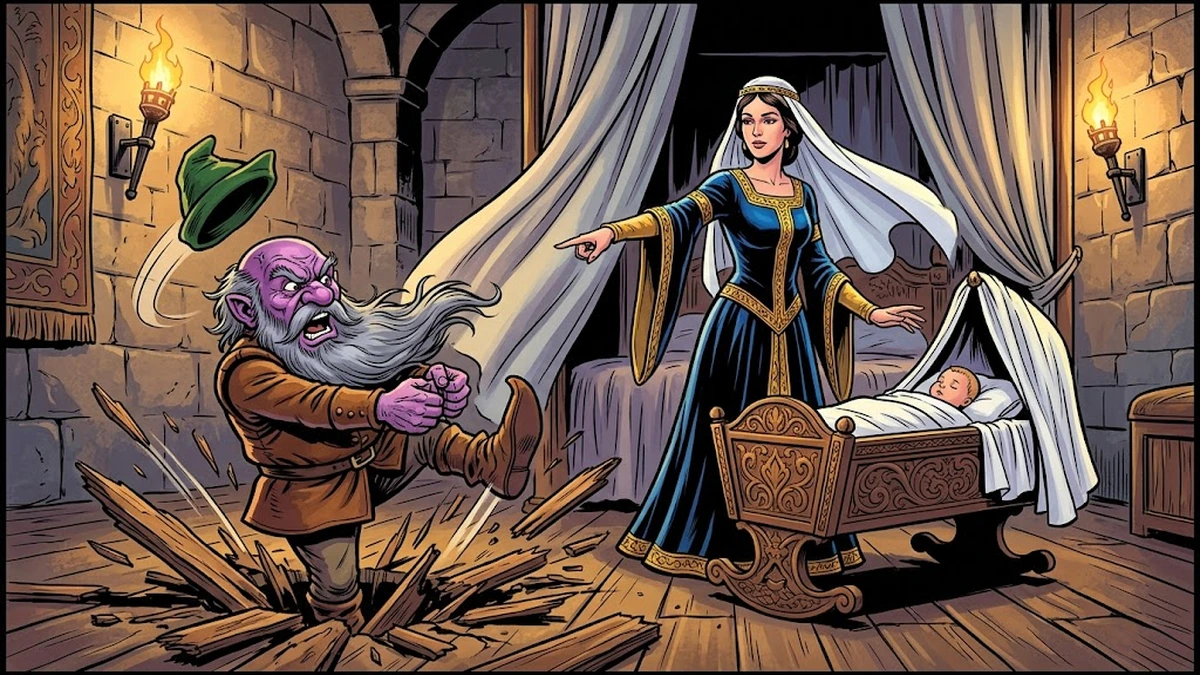
A year passes, and a second year, and the miller’s daughter, now queen, gives birth to a son. She has half-forgotten the small man and his bargain; the wheel of the locked chamber feels like a half-remembered dream. But on the eighth day after the birth, while the queen sits alone in her bedchamber rocking the cradle, the door opens of its own accord and the rumpelstilt is standing on the rug, his beard grown longer, his eyes brighter than before. “You promised,” he says simply. The queen falls to her knees. She offers him every treasure of the kingdom — gold, silver, the king’s own crown — but the small man shakes his head; he has gold enough already; he came for the child.
The queen weeps so bitterly, and so long, that the rumpelstilt at last softens. He cannot bear weeping; the Grimms tell us that the noise of weeping disturbs his small ears more than the noise of shouting. He offers her a wager. “I will give you three days,” he says, “and if in three days you can guess my name, you may keep the child. If you fail, the child is mine.” Then he is gone, and the queen is left alone with a sleeping baby and three days to discover a name no one in the kingdom has ever heard.
The first day she sends out messengers in every direction with orders to gather every name they can find. They return at evening with hundreds of names, common and rare; the queen reads them aloud to the small man when he appears that night — Caspar, Melchior, Balthazar, Ludwig, Wilhelm, Christoph, Friedrich — and at every name the rumpelstilt shakes his head and laughs. The second day the queen sends the messengers further, into the neighbouring kingdoms, and they return with stranger names — Cunz, Heinz, Veit, Ruprecht, Dietrich, Sebald, Sigismund — and again the small man shakes his head, and again he laughs, and again he disappears at midnight.

The Messenger in the Forest and the Song at the Fire
On the morning of the third and final day, the queen has almost given up. She sits at her window watching the snow begin to fall on the palace garden, and she calls in her last messenger and tells him to ride out one more time and listen, simply listen, in every village and forest and farmstead within a day’s ride, for any name he has never heard before. The messenger rides for hours, and finds nothing; but as evening comes he finds himself deep in a great pine forest where no road goes, and there, in a clearing he had never seen before, a small fire is burning, and around the fire a small man is dancing on one leg and singing.
The messenger crouches behind a tree and listens. The small man is hopping in a circle, slapping his thigh, and singing the strangest song the messenger has ever heard. The Grimms preserve it almost exactly as it was sung to Wilhelm by Dortchen Wild in the kitchen at Kassel:
“Heute back ich, morgen brau ich,
übermorgen hol ich der Königin ihr Kind;
ach, wie gut ist, dass niemand weiß,
dass ich Rumpelstilzchen heiß!”
— Today I bake, tomorrow I brew, the day after that I’ll fetch the queen’s child; ah, how good it is that nobody knows my name is Rumpelstilzchen!
The messenger memorises the song, slips away through the trees, and rides through the night to the palace. At dawn he tells the queen what he has heard. She thanks him, gives him a bag of silver, and waits at her window until the small man arrives that evening. She lets him ask his question first — “Now, my queen, what is my name?” — and she pretends, for the pleasure of it, to be uncertain. “Is it Caspar?” she asks. “No.” “Is it Heinz?” “No.” “Is it — Rumpelstilzchen?”
The small man’s face goes white, then black, then purple. “The devil told you that!” he screams, and he stamps his right foot so hard that it goes through the floorboards up to his waist; and in his rage he seizes his left foot in both hands and pulls so hard that he tears himself in two, and the two halves of him sink down into the floor and are seen no more. The queen lifts her sleeping child from the cradle, kisses him on the forehead, and takes him out of the bedchamber into the morning sun.
The Moral: The Power and the Danger of a Name
The 1857 Grimm edition closes the tale without an explicit moral — the brothers preferred to let the foot stamp through the floor speak for itself — but the implicit lesson is older than the tale, and the queen’s victory carries the weight of an entire pre-modern European theology of names. The principle is the principle of nominal magic: to know the true name of a thing is to have power over it, and to keep one’s true name secret is to remain free. The same principle runs through the Hebrew prohibition against pronouncing the Tetragrammaton, through the Egyptian story in which Isis seizes power over the god Ra by tricking him into revealing his secret name, through the Norse Alvíssmál in which Thor defeats the dwarf Alvíss not by strength but by holding him in conversation until sunrise turns him to stone, and through the medieval European custom of giving children a “use-name” different from their baptismal name to confuse evil spirits. The closing line of the implicit moral, in the spare cadence the brothers used for their oldest material, would run:
“Wer seinen Namen verbirgt, behält seine Kraft; wer den Namen eines anderen errat, hat ihn in der Hand.”
— Whoever hides his name keeps his power; whoever guesses another’s name holds him in his hand.
The deeper moral the tale carries is double, and both halves cut. The first half is the moral of the boasting miller: a careless lie spoken in the king’s hall puts a child of one’s own house in danger of death. The miller is never punished in the tale — the Grimms simply forget about him after the second paragraph — but his lie is the door through which every disaster of the story walks. The second half is the moral of the small man himself. The rumpelstilt is not, as later children’s editions sometimes pretend, a wholly evil creature. He keeps his bargains; he comes when he is called; he does the work he agrees to do; and when he is beaten he is beaten fairly, by a queen who has learned to listen. His undoing is not malice but vanity: he sings his own name in the forest, alone, certain that no one will ever hear. The tale tells us, very quietly, that even the powerful are undone the moment they grow proud enough to talk to themselves where the wind can carry their words.
Why the Tale Has Lasted: From the Ölenberg Manuscript to the Picture-Book Shelf
Of the two hundred and ten tales the Grimms left us, “Rumpelstilzchen” is one of the half-dozen that have refused, in two centuries, to settle into any single shape. The 1810 Ölenberg manuscript ends with the queen merely guessing the name and the small man flying out of the window on a wooden ladle; the 1812 first edition has him stamping his foot and leaping up into the air; the 1819 second edition has him stamping his foot through the floor; the 1857 final edition has him tearing himself in two. Each redaction sharpens the violence of the ending, as if the brothers themselves were discovering, with each printing, how much rage had to be in the small man for the tale to feel right.
The Swiss psychoanalyst Marie-Louise von Franz, in Shadow and Evil in Fairytales (1974), reads the rumpelstilt as the rejected creative shadow of a young woman who has been forced into a corner by male economic violence: he is the part of her psyche that can in fact spin straw into gold, the part she has been taught not to acknowledge, and the bargain for the child is the price of refusing to integrate that gift. Bruno Bettelheim, in The Uses of Enchantment (1976), reads the tale as a parable of the child’s growing power over hidden things: the child reader sees the queen learn to listen, and learns by her example that the world is full of names and songs sung in dark forests that the patient ear can catch. The Anglophone retellings have multiplied beyond counting — from the Edgar Taylor English text of 1823, through Andrew Lang’s The Blue Fairy Book (1889), Margaret Hunt’s 1884 translation, Arthur Rackham’s 1909 illustrations, Wanda Gág’s 1936 picture book, and the dozens of post-war picture books from Paul O. Zelinsky’s Caldecott Honor edition of 1986 to the present.
The tale survives because every reader has, at some point in life, made a bargain in a small locked room with a creature whose name they do not yet know. The bargain comes due. The creature returns. The reader has three days to find a word that will set them free; and in the third day, in the deep forest of their own listening, the word eventually comes. “Rumpelstilzchen” lasts because it is, finally, a tale about the power of paying close attention to the language of the world — and about the small angry creatures inside us all, who, when finally named, do not so much fight back as simply stop being able to stand on the ground.
Frequently Asked Questions
What is the moral of Rumpelstiltskin?
Who wrote Rumpelstiltskin?
What is the story of Rumpelstiltskin?
What is the moral lesson of the name Rumpelstiltskin?
How old is the Rumpelstiltskin story?
You May Also Like
 Grimm's Fairy Tales
Ages 9-12
Grimm's Fairy Tales
Ages 9-12
The Dog And The Sparrow
A shepherd's dog had a master who took no care of him, but left him to starve. The dog ran away into the forest where he met a sparrow who took pity on him.
 Grimm's Fairy Tales
Ages 9-12
Grimm's Fairy Tales
Ages 9-12
The Little Peasant
The Little Peasant: There was a certain village wherein no one lived but really rich peasants, and just one poor one, whom they called the little peasant. The
 Grimm's Fairy Tales
Ages 9-12
Grimm's Fairy Tales
Ages 9-12
Rapunzel
Rapunzel: There were once a man and a woman who had long in vain wished for a child. At length the woman hoped that God was about to grant her desire.