The Elves and the Shoemaker: A Grimm Retelling
The Elves and the Shoemaker: A Grimm Retelling: In a quiet town of Germany, there lived a shoemaker whose heart was pure though his fortune was poor. His shop
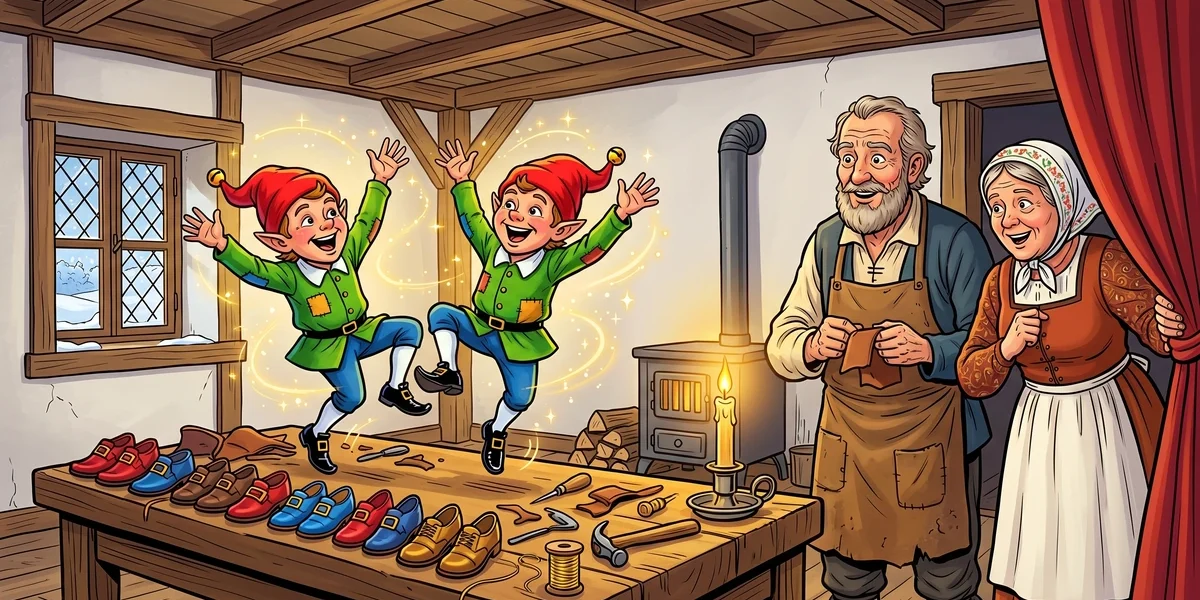
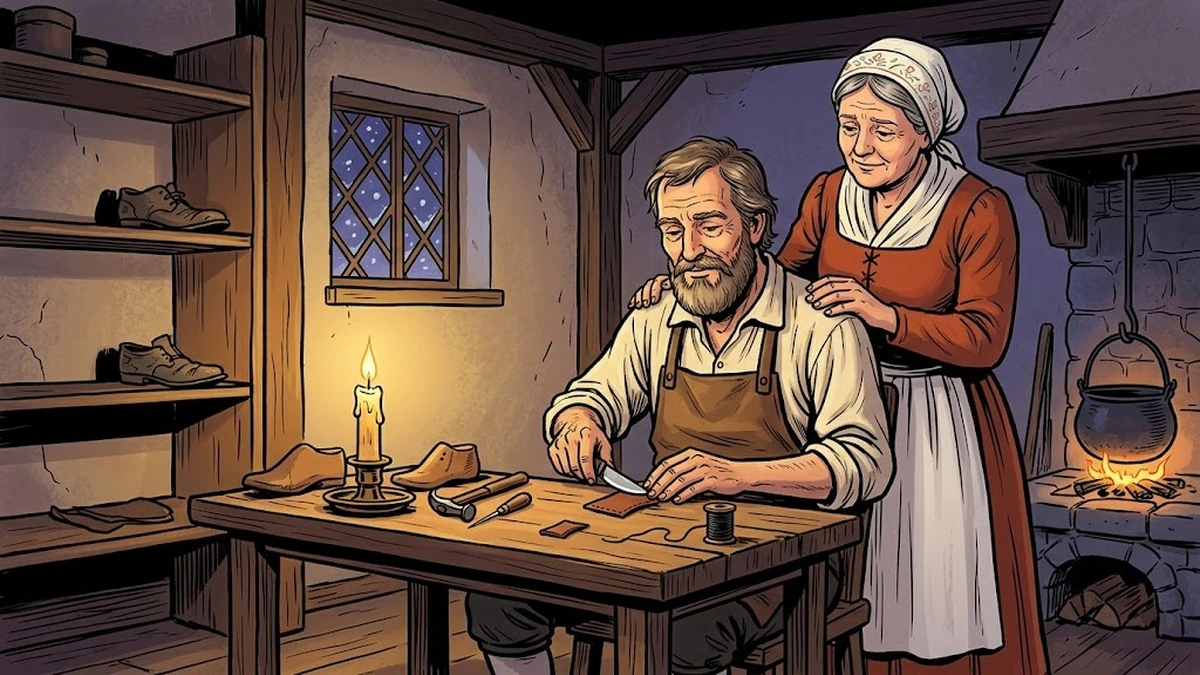
The Elves and the Shoemaker — known in its native German as Die Wichtelmänner — is the celebrated first tale of KHM 39 in the Brothers Grimm’s Kinder- und Hausmärchen (Children’s and Household Tales), first published in the foundational 1812 volume. Jacob and Wilhelm Grimm placed three short tales under the shared umbrella title Die Wichtelmänner, and this opening narrative — the helpful cobbler-elves who vanish the moment they are clothed — has eclipsed the other two in popular imagination, becoming one of the most beloved miniature parables in the entire European fairy-tale canon.
Folklorists classify the tale as Aarne–Thompson–Uther type 503*, “Helpful Elves,” and Reidar Th. Christiansen catalogued it as the migratory legend ML 7015, attesting to the story’s deep penetration across Germanic, Scandinavian, and Celtic oral traditions. The German word Wichtelmänner — literally “Wicht-men” — preserves the Proto-Germanic root *wihtiz (“creature, being”), cognate with the English wight and the Old Norse vættr, anchoring the tale in a pre-Christian cosmology of household spirits whose favour brought prosperity and whose offence brought ruin.
Setting the Scene: A Workshop on the Edge of Ruin
The Grimms open the tale with one of the most economical and devastating sentences in their entire collection: “Es war ein Schuster ohne seine Schuld so arm geworden, daß ihm endlich nichts mehr übrig blieb als Leder zu einem einzigen Paar Schuhe” — “There was a shoemaker who, through no fault of his own, had become so poor that at last nothing remained to him but leather enough for a single pair of shoes.” The phrase ohne seine Schuld (“through no fault of his own”) is doing immense moral work: the Grimms refuse to allow the listener to dismiss the cobbler as lazy or improvident. Poverty here is structural, not personal. The shoemaker is a craftsman in good standing, brought low by forces — failed harvests, war, market collapse — that the early-nineteenth-century German peasantry knew all too well.
In a workshop that smells of tanned hide and beeswax, the shoemaker cuts his last piece of leather with the same care he would give to a king’s commission. He pauses at his bench by the dying lamp, sets aside his tools in their accustomed order, and offers the day to God before climbing the narrow stair to bed. There is no bitterness in him, no shaking fist at fate — only the quiet dignity of a man who has done what he could and now trusts the morning to do what he cannot. It is precisely this posture of patient, blameless integrity that opens the door to the supernatural visitation that follows.
Beat One: The Miraculous Morning
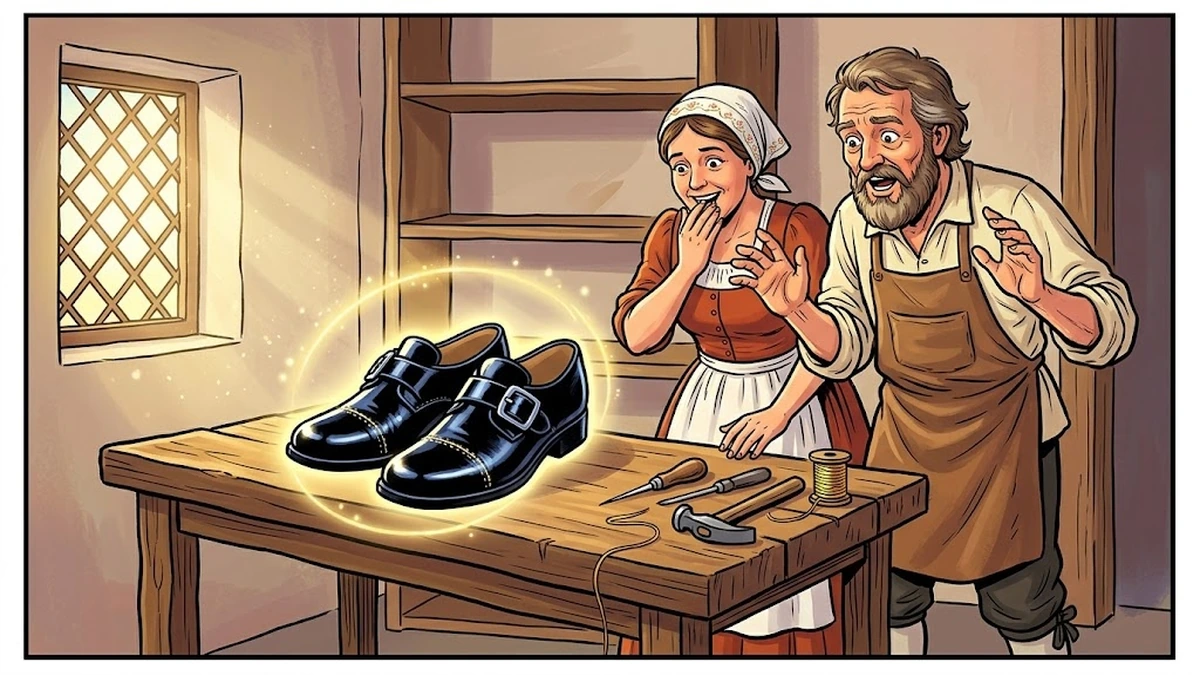
Dawn breaks on a workshop transformed. Where the shoemaker had laid out his cut pieces, there now stand a pair of completed shoes — but completed in a way no journeyman could equal. The stitching is so fine that the eye cannot count the threads; the leather is burnished to a soft glow; the soles are perfectly seated; the lasts have been pulled and the work polished. The shoemaker examines the seams in trembling disbelief, finds no flaw, and carries the shoes to his window. Within the hour a wealthy customer enters, tries them on, declares them the finest shoes he has ever worn, and pays a sum so generous that the cobbler walks to the leather merchant and buys material for two pairs.
That night the cobbler again cuts and lays out his leather; that morning he again finds two perfect pairs upon the bench. The pattern repeats — four pairs from the next night’s labour, eight pairs the night after — and within a few weeks the once-empty shop is thronged with customers, the shelves crowded with stock, and the family larder is full. The Grimms render this transformation in plain, almost biblical cadence, allowing the wonder to do its own work without rhetorical embroidery. The miracle is not theatrical; it is workmanlike, daily, and almost embarrassingly modest in its scale — yet it is precisely the right miracle for a tradesman who never asked for more than what his hands could earn.
Beat Two: The Midnight Vigil
It is the cobbler’s wife — given no name in the original, but central to its turning — who insists on knowing their benefactor. “Wie wär’s,” she says, “wenn wir diese Nacht aufblieben, um zu sehen, wer uns diese hülfreiche Hand leistet?” (“How would it be if we stayed up tonight to see who gives us such helpful hands?”) Her question is gentle but resolute. To accept a gift without seeking the giver, in the moral grammar of the German countryside, is to remain forever in the posture of taking. To know the giver is to begin to be able to give in return. The wife’s curiosity is not idle; it is the first stirring of reciprocity.
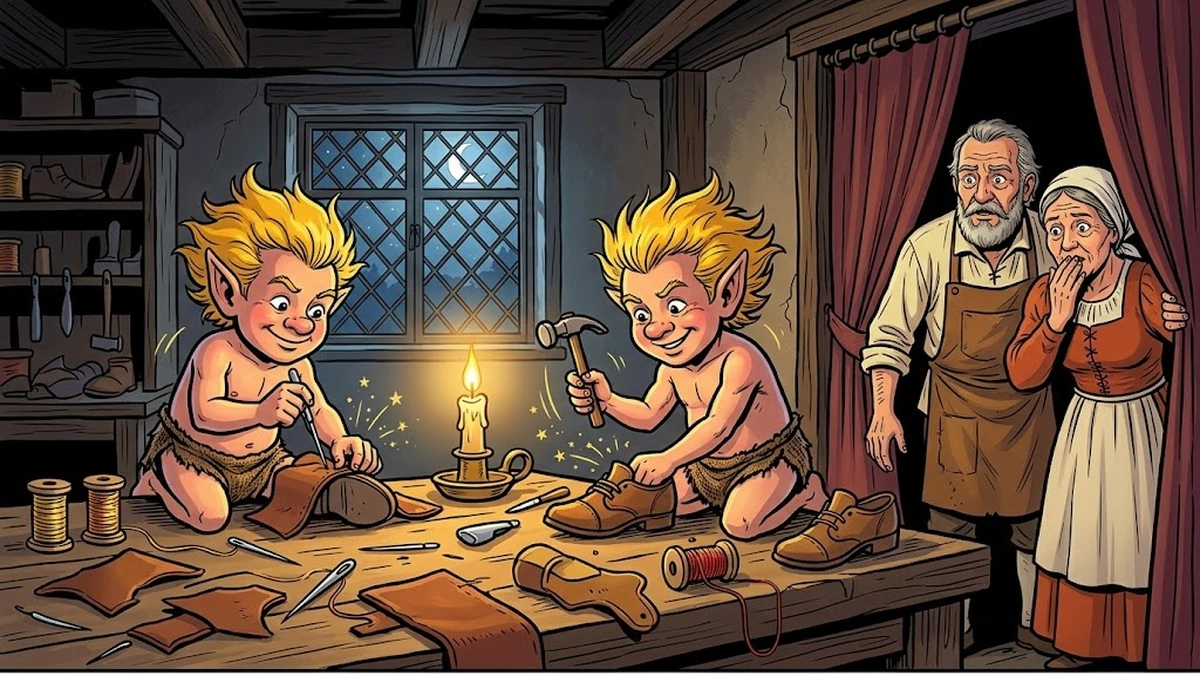
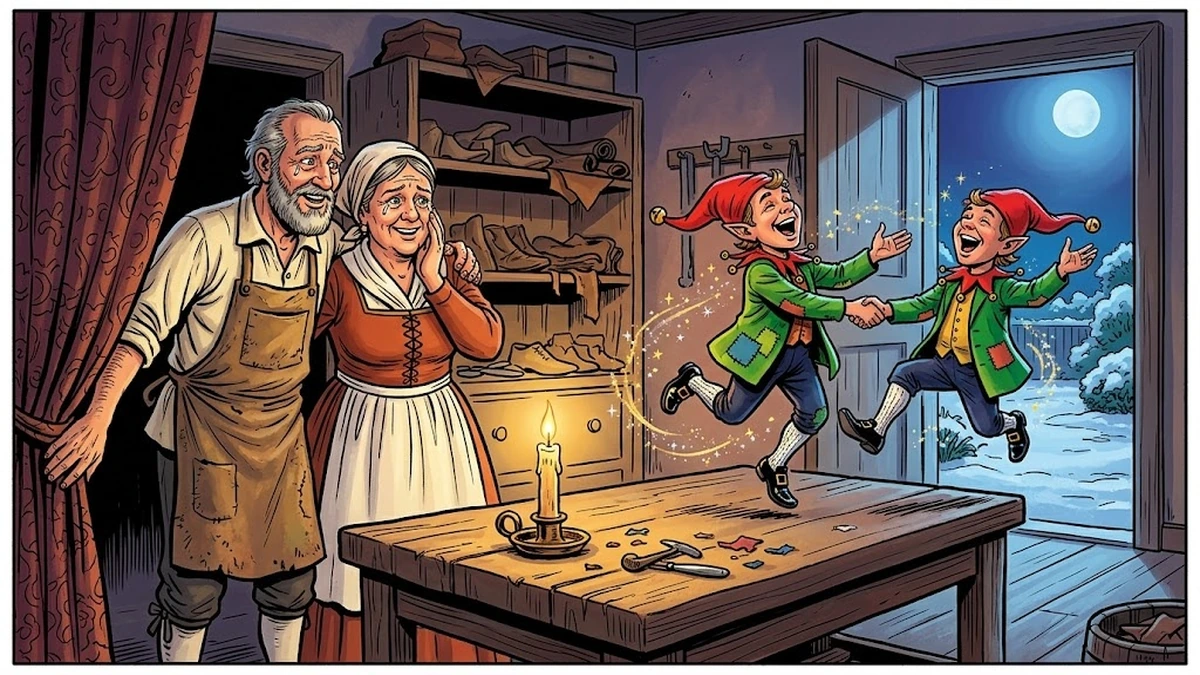
Her husband agrees. They light a candle behind the curtain, leave the leather laid out on the bench as always, and settle themselves to watch. The hours creep by; the lamp gutters; the village clock strikes eleven, then twelve. At the stroke of midnight the door swings open of itself, and into the workshop come two tiny naked men — “zwei kleine, niedliche, nackte Männlein” in the original — who climb upon the shoemaker’s stool, take up his awl and his needles in fingers no larger than a sparrow’s claw, and begin to work with such uncanny speed that the watching couple can scarcely follow the movement of their hands. They sew, they hammer, they polish, they stitch — and as the first cock crows they leap from the bench and vanish through the door, leaving behind a row of finished shoes.
Beat Three: The Gift of Clothes
The wife’s eyes brim. “Die kleinen Männer haben uns reich gemacht,” she whispers. “The little men have made us rich. We must show ourselves grateful for it. They run about, and have nothing on, and must freeze. Do you know what? I will sew them little shirts, and coats, and waistcoats, and trousers, and knit each of them a pair of stockings — and you, husband, you make each of them a pair of little shoes.” The cobbler agrees with delight, and for the next several days the household is busy with the most curious commission of their lives: garments cut to a span’s length, stitched in the finest cloth they can afford, finished with a tiny pointed cap apiece and a pair of buckled shoes no bigger than a thimble.
On the appointed evening they lay out the gifts in place of the usual leather, blow out the candle, and hide once more behind the curtain. Midnight strikes; the door opens; the elves spring up onto the bench expecting their work — and find instead the little shirts, the little trousers, the tiny shoes. For a moment they stand still in astonishment. Then, with cries of pure delight, they dress themselves with frantic care, smoothing the cloth, admiring the buckles, turning this way and that to see themselves in the polished leather of the cobbler’s tools. And then they begin to sing.
Beat Four: The Song and the Departure
The song the elves sing is one of the most quoted couplets in all of Grimm:
“Sind wir nicht Knaben glatt und fein?
Was sollen wir länger Schuster sein!”
— “Are we not lads so smooth and fine?
Why should we longer cobblers be!”
And with that they spring from the bench, hop, skip, and dance their way out of the workshop, through the door, and away across the threshold of the visible world — never to be seen again. The shoemaker and his wife do not pursue them. They understand, in the way the German countryside has always understood such moments, that a gift offered to a household spirit is also a release: to clothe the helper is to acknowledge the helper as no longer one’s servant. The work is done; the favour has been repaid; the bond is honourably dissolved. “Nun aber ging es dem Schuster, so lange er lebte, wohl, und glückte ihm alles, was er nur unternahm” — “But from that time on the shoemaker fared well, as long as he lived, and prospered in everything he undertook.”
The Wichtelmänner in Their Wider World
The little men who help and then vanish belong to a deep and ancient stratum of European folk belief. Across northern Germany they are Heinzelmännchen (most famously the cobbler-helpers of Cologne); in Lower Saxony they are Klabautermänner; in Scotland they are brownies; in Scandinavia they are tomtar and nisser; in Cornwall they are knockers; in Wales they are the bwbachod. In every variant the rule is the same — these spirits work willingly for a household that treats them with quiet respect, but they vanish forever the moment they are directly paid, named, mocked, or clothed. Folklorists call this the “taboo of payment”, and Reidar Christiansen identified it as the spine of migratory legend ML 7015.
What makes the Grimms’ version definitive is its tonal restraint. There is no menace in these elves, no malice when they are clothed, no curse upon the household. The departure is melancholy but not tragic. The story refuses to moralise the wife’s gift as a mistake; the family’s prosperity continues. Wilhelm Grimm, who polished the prose for successive editions between 1812 and the canonical seventh edition of 1857, was careful to preserve the tale’s ambiguity — that gratitude and loss can be the same gesture, that to honour a helper is sometimes to send them away.
Why It Has Lasted: The Moral at the Heart of the Tale
The deepest lesson of Die Wichtelmänner is one the Grimms never spell out and yet which every reader feels immediately: the only kindness that frees its recipient is a kindness that does not seek to bind them. The shoemaker’s wife does not give the elves clothes in order to keep them. She gives because they are cold, and because gratitude, in her moral universe, is something one acts upon whether or not it is convenient. The elves’ departure is not punishment for her generosity; it is the natural fulfilment of it. Once the helpers have been seen, named in the heart, and dignified with garments of their own, the asymmetry of the relationship dissolves — and with it the conditions under which their nightly labour was possible.
For the modern reader the tale carries an even sharper edge. We live in an age that struggles mightily with the ethics of help — when to give, when to withhold, when to rescue, when to release. The Grimms’ shoemaker offers a quiet model: do your honest work as long as you can; receive grace gratefully when it comes; honour the giver openly; and when the time of help has passed, let the helpers go with a song. The elves’ couplet — “Sind wir nicht Knaben glatt und fein?” — is not a complaint. It is a hymn of completion. The work is finished. Both parties have been changed. Each can now walk forward into a life of their own.
That is why, more than two hundred years after Jacob and Wilhelm Grimm first wrote it down in their study in Kassel, this miniature tale still moves audiences from kindergartens to opera houses (Engelbert Humperdinck adapted it; so did Sendak; so have Pixar storyboard artists in their seminars on emotional release). The shoemaker did not lose his elves. He completed them. And in completing them, he completed himself.
Frequently Asked Questions
The five questions and answers that follow are also encoded as schema.org FAQPage data for search engines and voice assistants.
What is the original German title and KHM number of “The Elves and the Shoemaker”?
The tale is the first of three short stories grouped under the title Die Wichtelmänner (“The Wicht-men” or “The Little Folk”) at entry KHM 39 in the Brothers Grimm’s Kinder- und Hausmärchen, first published in 1812. Folklorists usually refer to this opening tale specifically as Die Wichtelmänner — Erstes Märchen, with the second and third tales of the trio dealing with elf midwifery and changelings respectively.
What is the Aarne–Thompson–Uther tale-type, and where else does this story appear?
The tale is classified as ATU 503*, “Helpful Elves” (formerly AT 503*), and Reidar Th. Christiansen catalogued the same narrative as the migratory legend ML 7015. Variants are recorded across Germany (the Cologne Heinzelmännchen), Scandinavia (tomtar and nisser), Scotland (brownies), Cornwall (knockers), and Wales (bwbachod) — all sharing the core motif of household spirits whose service ends the moment they are paid, named, or clothed.
Why do the elves leave when they are given clothes?
The “clothing taboo” is one of the oldest and most consistent rules in European household-spirit belief. A spirit who labours for a family does so out of free affinity, not as a servant, and the gift of clothing — being a payment, however affectionate — converts the relationship from kinship to employment. Once that line is crossed, the spirit’s nature changes: they are now “smooth and fine lads,” dressed for the world, no longer cobblers. Their departure in Die Wichtelmänner is therefore not a punishment for the wife’s generosity but the proper closure of a service freely given and freely repaid.
Did the shoemaker fall back into poverty after the elves left?
No. The Grimms close the tale with the explicit reassurance: “Nun aber ging es dem Schuster, so lange er lebte, wohl, und glückte ihm alles, was er nur unternahm” — “But from then on the shoemaker fared well as long as he lived, and prospered in everything he undertook.” The elves had broken the cycle of misfortune and had passed on enough of their craft, by example, that the cobbler’s own hands now carried the magic. This insistence on enduring prosperity is one of the gentler features of the Grimms’ moral universe: grace, once received with dignity, becomes a permanent inheritance.
How does this tale fit within Brothers Grimm’s wider collection?
Among the 200-odd tales of Kinder- und Hausmärchen, Die Wichtelmänner is unusual for its lack of villain, its compact length, and its quiet ethical weight. It belongs alongside such “domestic” Grimm tales as Die Sterntaler (KHM 153) and Frau Holle (KHM 24) in showing how supernatural goodness rewards humble, patient labour — but uniquely among them, it dwells on the moment of the helper’s release rather than on the heroine’s reward. Wilhelm Grimm refined the prose across the seven editions between 1812 and 1857, but the structure has remained essentially unchanged for over two centuries, a testament to the original story’s perfect economy.
You May Also Like
 Grimm's Fairy Tales
Ages 9-12
Grimm's Fairy Tales
Ages 9-12
Fundevogel
Fundevogel: There was once a forester who went into the forest to hunt, and as he entered it he heard a sound of screaming as if a little child were there.
 Grimm's Fairy Tales
Ages 9-12
Grimm's Fairy Tales
Ages 9-12
The Pink
The Pink: There was once upon a time a queen to whom God had given no children. Every morning she went into the garden and prayed to God in heaven to bestow on
 Grimm's Fairy Tales
Ages 9-12
Grimm's Fairy Tales
Ages 9-12
Doctor Knowall
Doctor Knowall: There was once upon a time a poor peasant called Crabb, who drove with two oxen a load of wood to the town, and sold it to a doctor for two