The Robber Bridegroom
The Robber Bridegroom: There was once a miller who had one beautiful daughter, and as she was grown up, he was anxious that she should be well married and
The Robber Bridegroom (German: Der Räuberbräutigam; KHM 40 in the Brothers Grimm’s Kinder- und Hausmärchen; ATU 955 “The Robber Bridegroom”) is one of the most chilling and dramatic of all the Hessian household tales the Grimms collected. It first appeared in the original 1812 first edition of the Kinder- und Hausmärchen at number 40 in volume one, where it was set down by Wilhelm Grimm from the oral telling of Marie Hassenpflug of Cassel — daughter of a Hesse-Kassel court official and one of the chief informants for many of the Grimms’ best-known stories. The tale survived essentially unchanged through every subsequent edition (1819, 1837, 1840, 1843, 1850, 1857), and was first translated into English by Edgar Taylor in 1823 (German Popular Stories) and then more faithfully by Margaret Hunt in 1884 (Grimm’s Household Tales). It is the German member of an international tale-type catalogued by Antti Aarne, Stith Thompson and Hans-Jörg Uther as ATU 955 — the family that includes the English “Mr Fox,” the Italian “The Marriage of Mr Misery,” and the Norwegian “Robber Husbands.”
Origins and Canonical Attribution
The Hassenpflug family of Cassel were Huguenot in descent, and their household preserved a French-flavoured stratum of folk-narrative that probably accounts for some of the close affinities between this tale and earlier French and English motifs. Heinz Rölleke (Kinder- und Hausmärchen, Vollständige Ausgabe, Reclam 1980) and Hans-Jörg Uther (Handbuch zu den Kinder- und Hausmärchen der Brüder Grimm, de Gruyter 2008) both identify Marie Hassenpflug as the principal informant, with possible secondary contributions from her sisters Jeanette and Amalie. The Grimms themselves note in their Anmerkungen (“Notes”) to volume three (1822) that the tale “stems from Hesse” and connects it to the older English “Mr Fox” recorded by Edmund Spenser, to the Italian “Sigarello” tradition, and to the medieval European motif of the cannibal bridegroom found scattered through the gesta and the late-medieval German Schwankbücher. The tale was first printed by the Realschulbuchhandlung in Berlin in 1812 in a small print-run of around 900 copies, with a green-and-cream paper wrapper, and stands today as one of the touchstones of the European fairy-tale canon.
The Tale
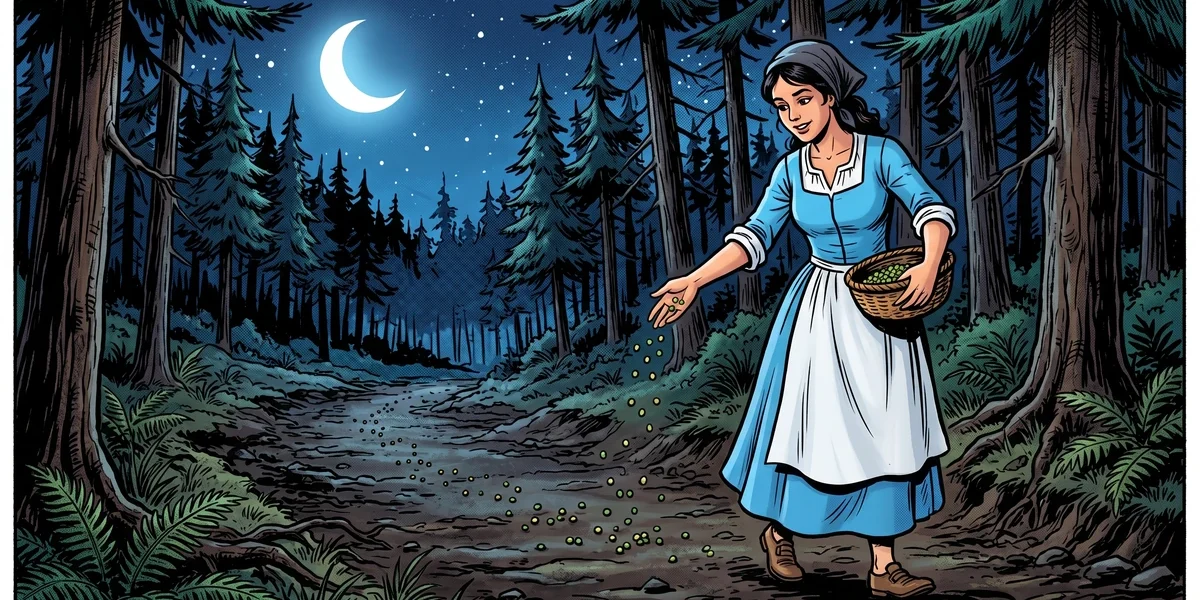
There was once a miller who had a beautiful daughter, and as she was grown up he was anxious to see her well married and well provided for. “I will give her,” he said to himself, “to the first respectable man who comes and asks for her hand.” It was not long before a suitor appeared who seemed to be very rich, and as the miller could see no fault in him, he betrothed his daughter to him. But the girl did not love this man as a girl ought to love her betrothed; whenever she looked at him, or even thought of him, her heart sank with a secret shudder. One day the man said to her, “You are my betrothed, yet you have never come to see me. My house lies out in the dark forest.” “I do not know the way,” she said. “Then I will mark a path for you with ashes,” he answered, “so that next Sunday you may follow it and come to me. I shall be expecting you, and there will be guests.” When Sunday came the girl set out, but a strange foreboding lay on her, and she filled both her pockets with peas and lentils so that she might mark the path for herself, in case the ashes should fail. She walked on through the deep woods, scattering the seeds as she went, and at last she came to a dark and lonely house deep among the pine-trees, and not a soul was to be seen.
The Cellar of Bones
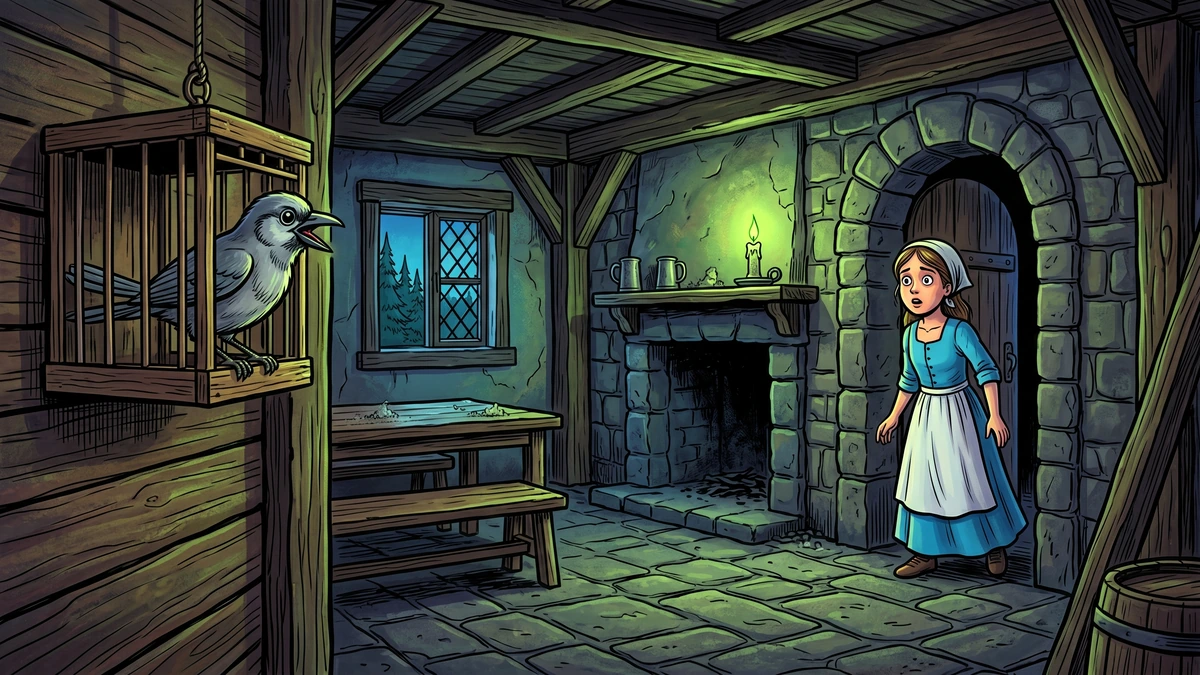
The girl stepped into the empty house and called out, but no one answered. Suddenly a voice cried, “Turn back, turn back, young maiden dear; this is a house of murderers here!” She looked up and saw, hanging in a wooden cage on the wall, an old grey-feathered bird, and the bird called out the warning a second and a third time. Trembling, the girl went on through the empty rooms until she came to the cellar, and there she found a very old woman shaking her head. “Oh, you poor child,” cried the old woman, “where have you got to? You are in a den of murderers. You think yourself a bride who is soon to be married, but the wedding you will keep is the wedding with death. Look — they have made me put a great kettle of water on the fire to boil, and when they have you in their power, they will cut you in pieces without mercy, and cook you, and eat you, for they are cannibals. Unless I take pity on you and save you, you are lost.”
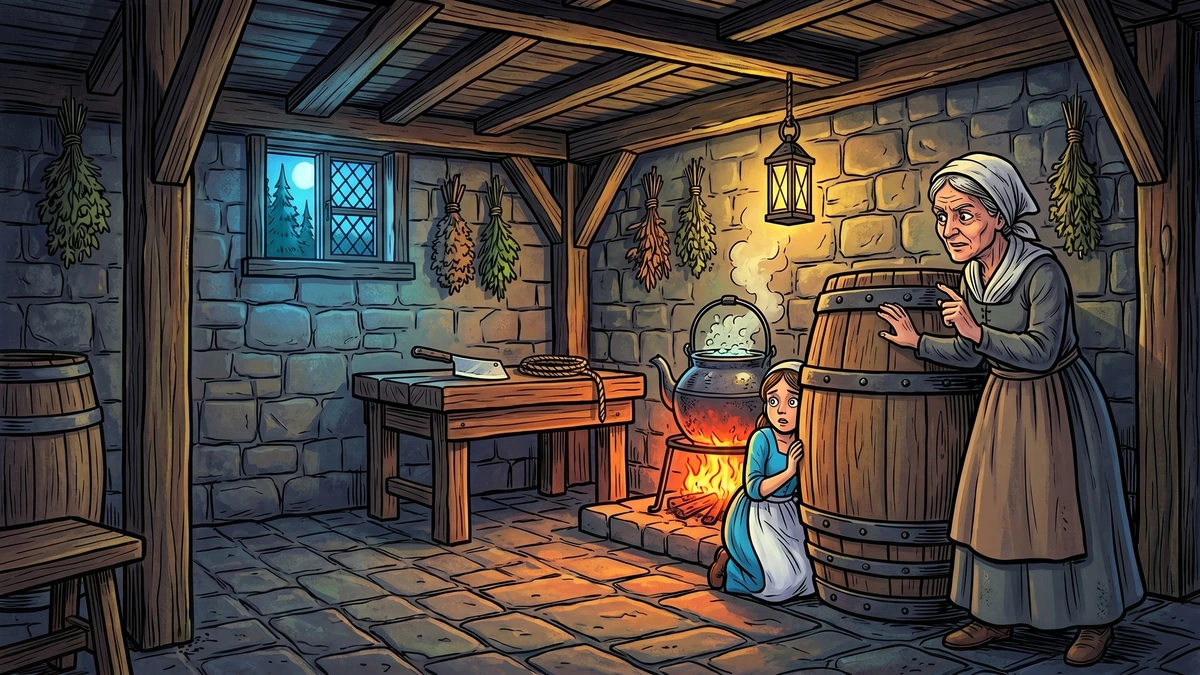
The old woman led the girl behind a great cask, where she could not be seen, and bade her stand quite still: “Stir not, move not, or all is over with you. To-night, when the robbers are asleep, we will escape together. I have long waited for the chance.” Hardly had the old woman spoken when the godless crew came home. They dragged with them another young maiden; they were drunk, and paid no heed to her cries. They gave her wine to drink — three glasses full, one of white wine, one of red, and one of yellow, and her heart broke in two. Then they tore off her fine clothes, laid her on a table, hewed her beautiful body into pieces, and strewed salt over it. The poor bride behind the cask trembled and shuddered, for she saw clearly the fate that the robbers had ordered for her. One of them noticed a gold ring upon the murdered maiden’s little finger, and as it was tight and would not come off easily, he took up an axe and chopped the finger; but the finger sprang up in the air over the cask, and fell straight into the lap of the bride. The robber took a candle, and tried to find the finger, but he could not find it. “Have you looked behind the great cask?” said another. “Come and eat first,” cried the old woman, “the search may wait till morning; the finger will not run away.” So she set on the table a sleeping draught, and the robbers drank, and lay down in the great hall, and snored.
The Flight Through the Forest
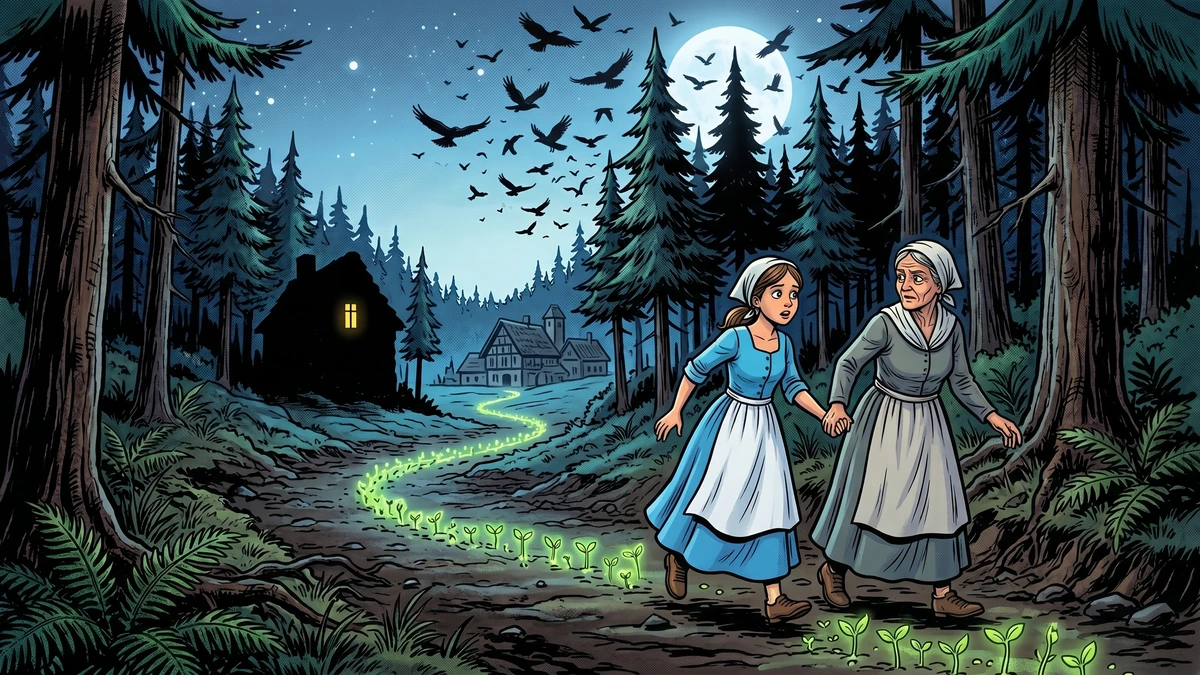
When the bride heard the robbers snoring, she came from behind the cask, and had to step over the sleepers as they lay in rows on the floor; she was in great fear that she should awaken any of them, but God so guided her steps that she got safely through. The old woman with her went up with her, opened the doors, and they hurried out of the murderer’s house with all the haste they could. The wind had blown the strewn ashes away, but the peas and lentils which the girl had scattered had taken root and were sprouting up out of the ground, and shewed them the way through the moonlight. They walked all that night, and in the morning they reached the mill. Then the girl told her father all that had befallen her.
The Wedding Feast and the Telling of the Dream
When the day came on which the wedding feast was to be held, the bridegroom appeared, and the miller had bidden all his kindred and friends. As they sat together at table, every one was asked to tell something. The bride sat still, and said nothing. Then the bridegroom said to his bride, “Come, my heart, do you know nothing? Tell us a tale!” She answered, “Then I will relate a dream. I was walking alone through a wood, and at last I came to a house in which not a single soul was alive, but on the wall there was a cage in which was a bird, that cried, ‘Turn back, turn back, thou young bride; thou art in a murderers’ house!‘ This it cried once again. — My darling, I only dreamt this. Then I went through all the rooms, and they were all empty, and there was something so eerie there. At last I went down to the cellar, and there sat a very old woman, shaking her head. I asked her, ‘Does my bridegroom live in this house?’ She answered, ‘Alas, poor child, thou hast got into a murderers’ den; thy bridegroom does live here, but he will hew thee in pieces and kill thee, and then he will cook thee, and eat thee.’ — My darling, I only dreamt this. But the old woman hid me behind a great cask, and scarcely had I been hidden when the robbers came home, dragging a maiden with them, to whom they gave three kinds of wine to drink, white, red, and yellow, with which her heart broke in two. — My darling, I only dreamt this. Then they pulled off her pretty clothes, and hewed her fair body in pieces on a table, and sprinkled them with salt. — My darling, I only dreamt this. And one of the robbers saw that a golden ring was sticking on her little finger, and as it was hard to draw off, he took an axe and cut it off; but the finger sprang into the air, and fell behind the great cask, and into my bosom. And here is the finger with the ring.” And with these words she drew it forth, and showed it to the company.
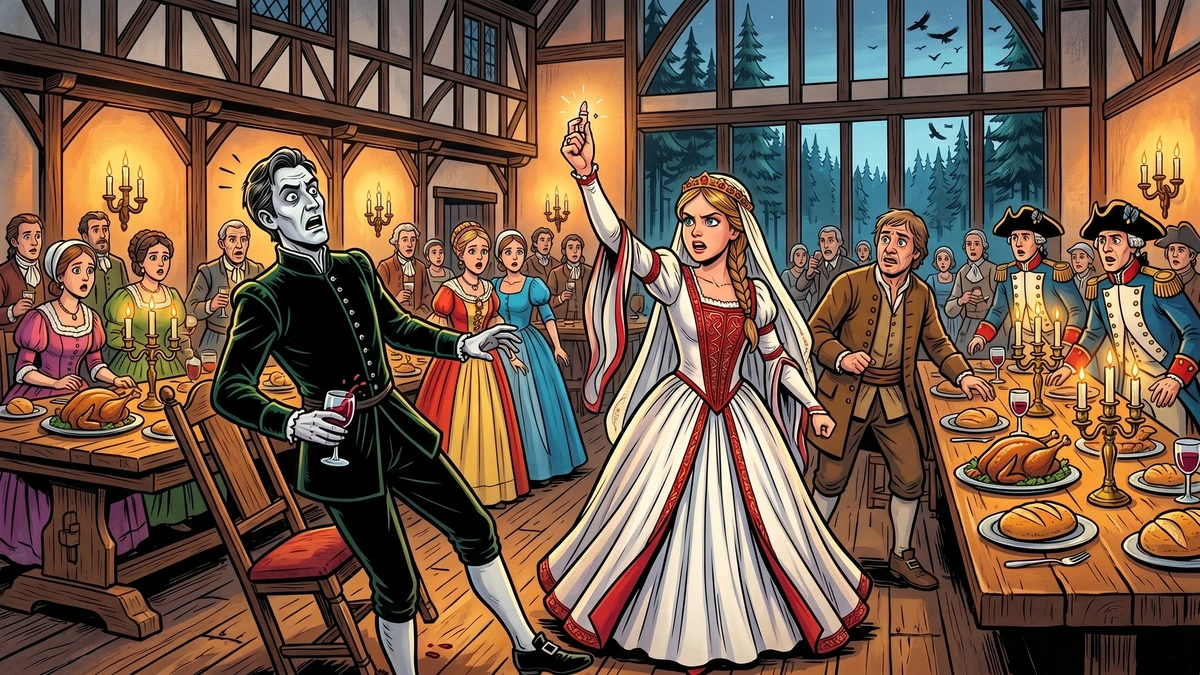
The robber, who had during this story become as pale as ashes, leapt up and tried to escape, but the guests held him fast and delivered him over to those who saw justice done. Then he and his whole troop were executed for their infamous deeds.
Moral
Morgenstund hat Gold im Mund — und ein Vögelein warnt das reine Herz. (“Morning has gold in its mouth — and a little bird warns the pure heart.”) The Grimms gloss the tale’s moral as: a bride must trust the cold whisper of her own heart, for the truth of a man is in his deeds, not in his wealth or his words. Folly is to be wooed by riches alone; wisdom is to listen to that small instinctive shudder when the eye meets the eye, and to mark a return-path of one’s own.
Why It Has Lasted
“The Robber Bridegroom” survived two centuries of fairy-tale fashion because it does what the very best Grimm tales do — it joins the homely and the horrific in a single sentence, and lets the heroine’s own voice deliver the verdict. The peas-and-lentils path, the prophetic bird in the cage, the severed finger leaping into the bride’s lap, and above all the ingenious courtroom set-piece in which the bride tells her dream and at each interval reassures her bridegroom “Mein Schatz, das träumte mir nur” (“My darling, I only dreamt this”) — these are images of folk-narrative architecture so finely cut that Eudora Welty borrowed the title for her 1942 American novella, Stephen Sondheim drew on its archetype for Into the Woods, and Margaret Atwood turned its plot inside out in her 1993 novel of the same name. The tale’s tale-type ATU 955, with its sister “Mr Fox” recorded by Edmund Spenser and “The Cellar of Blood” recorded across the Slavonic and Italian peninsulas, makes “The Robber Bridegroom” one of the rare oral fairy-stories where a young woman’s quiet courage and quiet truth-telling, not magical helpers, brings the tale to its just and terrible end. It is, in the Grimms’ own phrase, “ein Märchen von der Wahrheit” — a tale of the truth.
The Manuscript Tradition and the Variant Voices
Although the printed text is the one most readers know, “Der Räuberbräutigam” travelled to the Grimms in several manuscript forms before it reached print. The Grimms’ famous handwritten Ölenberg manuscript of 1810 — sent to Clemens Brentano and now preserved at Schloss Ölenberg in Alsace — does not contain this particular tale, but the closely related “Mr Fox” / “Der Räuber-Bräutigam” ATU 955 fragment was already known in their circle through the English novelist Henry Fielding’s offhand reference in Joseph Andrews (1742), and through Thomas Blakeway’s prose summary which Edmond Malone printed in his 1790 edition of Shakespeare’s Much Ado About Nothing as a possible source for Benedick’s joke “Like the old tale, my Lord: it is not so, nor ’twas not so, but indeed God forbid it should be so.” Blakeway’s “Mr Fox” — an English Mister Bluebeard who keeps a chamber of slain brides over a doorway inscribed “Be bold, be bold, but not too bold, lest that your heart’s blood should run cold” — is, in essence, the same plot the Grimms collected from Marie Hassenpflug. The Grimms cite it explicitly in their own notes (KHM Anmerkungen III, 1822, p. 67), and this English-German parallel is now the textbook example of how oral tradition crosses linguistic frontiers.
Translations and English Reception
Edgar Taylor’s German Popular Stories (London: C. Baldwyn, 1823, two volumes, illustrated with George Cruikshank’s tiny etched plates) was the first English translation of any Grimm tale. Taylor’s “Robber Bridegroom” softened the cannibalism into an ambiguous “they cut her in pieces” and dropped the salt; but his version made the Grimms a household name in Victorian England. Margaret Hunt’s complete and scholarly 1884 translation (Grimm’s Household Tales, two volumes, George Bell, with John Ruskin’s introduction) restored every detail of the cellar scene and gave the tale its now-canonical English text — including the ringing refrain “My darling, I only dreamt this.” Lucy Crane’s 1882 translation (Household Stories from the Collection of the Brothers Grimm, illustrated by her brother Walter Crane) softened the ending again for a children’s audience. Joseph Jacobs’s 1890 English Fairy Tales printed the closely related English variant “Mr Fox” — and David Luke’s 1982 Penguin edition gave the modern reader the first translation since Hunt to honour the tale’s terrifying register without softening it.
Tale-Type and Comparative Folklore
Aarne-Thompson-Uther catalogue this story as ATU 955: The Robber Bridegroom, a tale-type Antti Aarne first identified in 1910 (Verzeichnis der Märchentypen, FF Communications no. 3) and which Stith Thompson refined in 1928 and 1961. Hans-Jörg Uther’s 2004 Types of International Folktales records 230 known oral versions of ATU 955 across thirty-seven national folktale archives, with the densest clusters in northern Germany, Scotland, Ireland, Lower Italy, Romania, Latvia and the upper Volga. The standard motif-numbers from Stith Thompson’s Motif-Index of Folk-Literature (Indiana 1955-1958) for this tale are: K912 (Robbers’ heads cut off as they enter house one by one), K1916 (Robber bridegroom), N455.4 (Bride hidden behind cask hears robbers’ plot), S139.6 (Murdered bride’s finger falls in lap of next bride), H11.1 (Recognition by tale telling), K1815 (Bird as warner). The “Be bold, be bold, but not too bold” inscription found in many Western European variants is motif Z65.1 (Three-fold inscription warning against over-curiosity). Together these motifs make ATU 955 a tightly designed folk-narrative whose recognisable shape can be assembled from a small set of stock units that storytellers across Europe rearranged for centuries.
Symbolism and Reading
Folklorists from Bruno Bettelheim (The Uses of Enchantment, 1976) to Maria Tatar (The Hard Facts of the Grimms’ Fairy Tales, 1987) and Jack Zipes (The Brothers Grimm: From Enchanted Forests to the Modern World, 1988) have read “The Robber Bridegroom” as a coming-of-age parable about a young woman’s growing capacity to read the danger written on a man’s face, and to refuse the suitor her father has chosen for her on the strength of his money alone. The peas and lentils that root and sprout overnight to mark her safe return-path are the small, organic, female-coded counter-image to the masculine ashes that the bridegroom strewed and that the wind blew away — a symbolic contrast first noted by Marie-Louise von Franz in her 1972 lectures on women’s archetypes in fairy-tales. The cannibalism, the salting of the body, and the severed finger are rooted in much older European folk-belief — the medieval “Wechselbalg” and “Werwolf” trial records of the sixteenth century preserved at Marburg and Würzburg contain almost identical motifs — and the courtroom scene at the wedding feast, in which the heroine’s own controlled telling of her dream-that-was-no-dream becomes the instrument of justice, is one of the few moments in the Grimms’ canon where the female narrator herself is the agent of legal verdict. It is no accident that Eudora Welty made the dream-scene the centre of her 1942 novella, that Margaret Atwood retold the plot from three rival women’s points of view in her 1993 novel, or that Angela Carter (“The Bloody Chamber,” 1979) drew on this exact sequence of cellar, hidden bride, returning robber and tell-all dream for her own most celebrated story.
You May Also Like
 Grimm's Fairy Tales
Ages 9-12
Grimm's Fairy Tales
Ages 9-12
The Twelve Huntsmen
The Twelve Huntsmen: There was once a king’s son who had a bride whom he loved very much. And when he was sitting beside her and very happy, news came that his
 Grimm's Fairy Tales
Ages 9-12
Grimm's Fairy Tales
Ages 9-12
The Twelve Dancing Princesses
The Twelve Dancing Princesses: There was a king who had twelve beautiful daughters. They slept in twelve beds all in one room; and when they went to bed, the
 Grimm's Fairy Tales
Ages 9-12
Grimm's Fairy Tales
Ages 9-12
Snow White and the Seven Dwarfs
Snow White and the Seven Dwarfs: In a kingdom where mountains touched the clouds and forests stretched endlessly, there lived a king and queen who ruled with