The Little Peasant
The Little Peasant: There was a certain village wherein no one lived but really rich peasants, and just one poor one, whom they called the little peasant. The
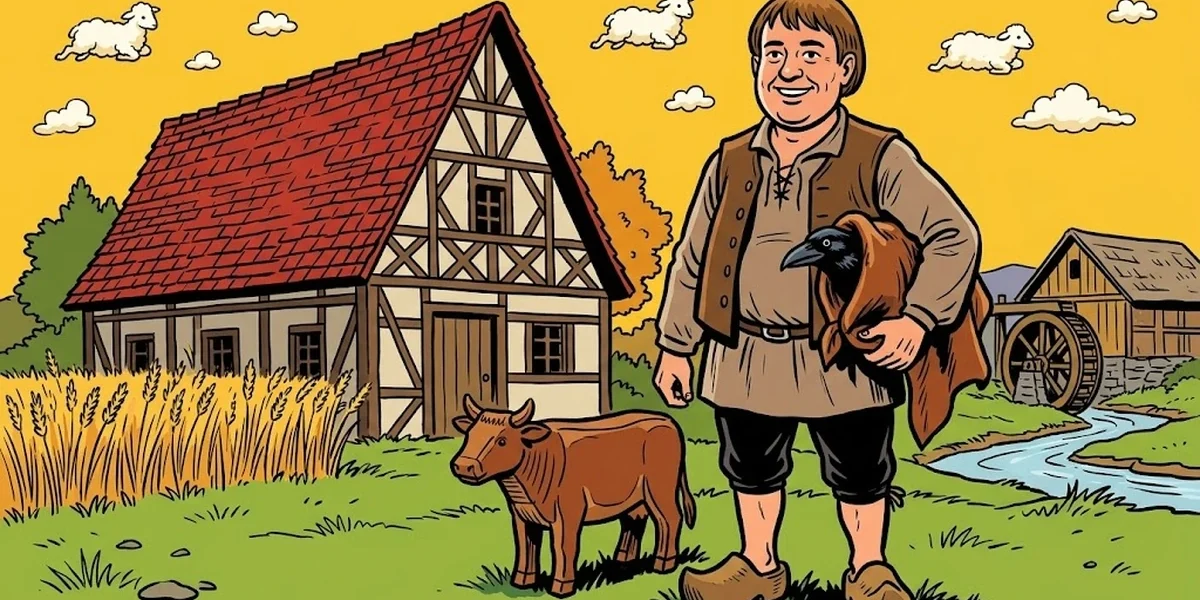
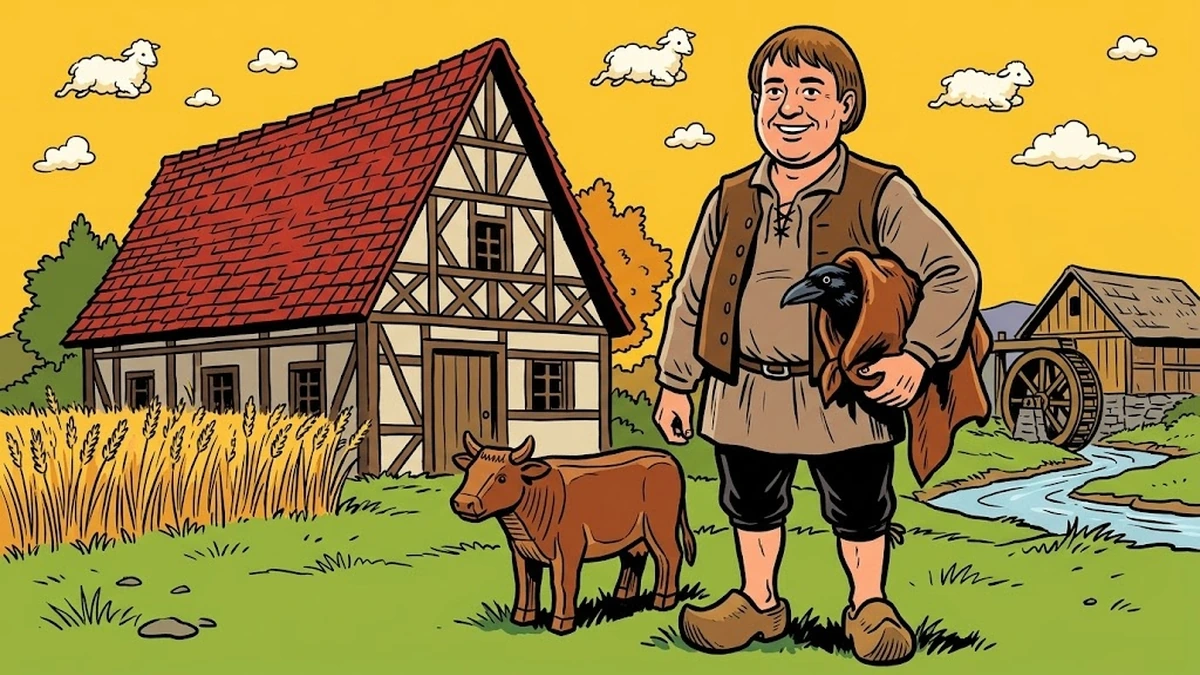
The Little Peasant — in the original German Das Bürle, also catalogued as Der kleine Bauer — is tale number 61 in the Brothers Grimm Kinder- und Hausmärchen, the celebrated Children’s and Household Tales. It first appeared in the 1812 first edition (Berlin, Realschulbuchhandlung) as part of the inaugural volume that gave the world Hansel and Gretel, Rumpelstiltskin, and the Frog King, and was carried with successive philological refinements through every one of the seven editions Jacob and Wilhelm Grimm prepared between 1812 and the definitive Ausgabe letzter Hand of 1857. In the international Aarne–Thompson–Uther index of folk-tale types the story is the canonical European example of ATU 1535 — “The Rich and the Poor Peasant,” sometimes still cited under its older Latin name as the Unibos cycle, after the eleventh-century Lotharingian Latin verse-novella Versus de Unibove (c. 1050) which is the oldest surviving European recension of the type. The Grimms received the tale orally from Dorothea Viehmann — the great Hessian story-teller of Niederzwehren, the tailor’s wife who supplied so much of the second volume of Kinder- und Hausmärchen — and their notes in the Anmerkungenband (the third, scholarly volume of Kinder- und Hausmärchen, 1822 and 1856) trace its analogues to the Norwegian Lille-Per og Store-Per (Asbjørnsen and Moe), the Russian Brat bogatyy i brat bednyy (“The Rich Brother and the Poor Brother”), the Italian Cassandrino of Straparola’s Le piacevoli notti (Venice, 1551), and the Latin Unibos itself. English readers met the tale first in Edgar Taylor’s German Popular Stories (London, 1823, with George Cruikshank’s iron-line engravings), and then more fully in the standard Margaret Hunt translation for George Bell & Sons (London, 1884), which remains the canonical English text and is the one in which generations of English-speaking children have first met the small peasant with his wooden calf. In the Stith Thompson Motif-Index of Folk-Literature the tale gathers a brilliant cluster of trickster motifs: K1655 (the lawyer’s mad client – the trickster’s pretended innocence), K1956 (sham wise man), K1971.7 (the soothsaying raven who reveals hidden food), K335.1.4 (the priest hidden in the closet), K842 (dupe persuaded to take prisoner’s place in a sack to be drowned), J2349.1 (cattle slaughtered after duping the rich neighbours), and J2133.5 (fools jumping into the water after reflected clouds taken for sheep). It belongs, in genre, to the Schwankmärchen — the comic trickster tale — and it is one of the most architecturally ambitious of the Grimm trickster-cycle, a small peasant epic in which the same cunning hero springs the same trap on his neighbours four separate times, each at a higher stake, until at last an entire greedy village has thrown itself into the river after its own shadow.
I. The Wooden Calf and the First Cow
The story opens, in the way so many Grimm tales open, in the modest, almost middle-class world of the German peasant village rather than the courts of kings: a small Hessian community in which everyone is a comfortable farmer of the Bauernstand with cows and barns and rye-fields except one, a single poor man known to the rest only by the diminutive nickname das Bürle — “the little peasant,” “the little farmer-fellow.” He has neither cow nor money for one, and he and his wife do dearly wish for a beast of their own; and out of that wish, with the slow patience of folk-narrative, the whole tale unrolls. He goes to his Gevatter the village carpenter — the godfather to his children, in the close-knit kinship-language of the German village — and asks him to cut and plane a small wooden calf and paint it brown like a real one, head bent as if grazing. The carpenter does the work; the painted calf comes home; and the next morning the little peasant carries it out to the village cow-herd as if it were a real young beast that simply needed to be carried until it learned to walk. The cow-herd takes it on his arm, sets it down among the grass with the rest of the herd, and that evening, when the calf is missing, the little peasant hauls him before the village mayor for negligence and is awarded, in compensation for the lost “calf,” a full-grown cow.
The motif — Stith Thompson K1655, the trickster who turns a court-of-law to his own advantage, and K431, the false complaint that produces real damages — is the founding move of the entire Unibos cycle and runs from the eleventh-century Lotharingian Latin original through the medieval Petrus Alfonsi and the Disciplina clericalis into Straparola, into the Russian Ivan-the-Fool tales, into the Norwegian Asbjørnsen and Moe, and into the modern Yiddish Chelm cycle. The folk-claim is precise and unsentimental: the village court is an instrument that rewards whoever knows how to use it, and the small peasant has just discovered, with the stunned pleasure of a man who finds a new tool in his hand, that he knows how to use it perfectly. The Grimms preserve the laconic register of the oral telling exactly — no comment, no moralising, no judicial outrage — and let the painted calf, the carrying cow-herd, the absent calf, the village mayor, and the unexpected cow do their own quiet work on the listening ear.
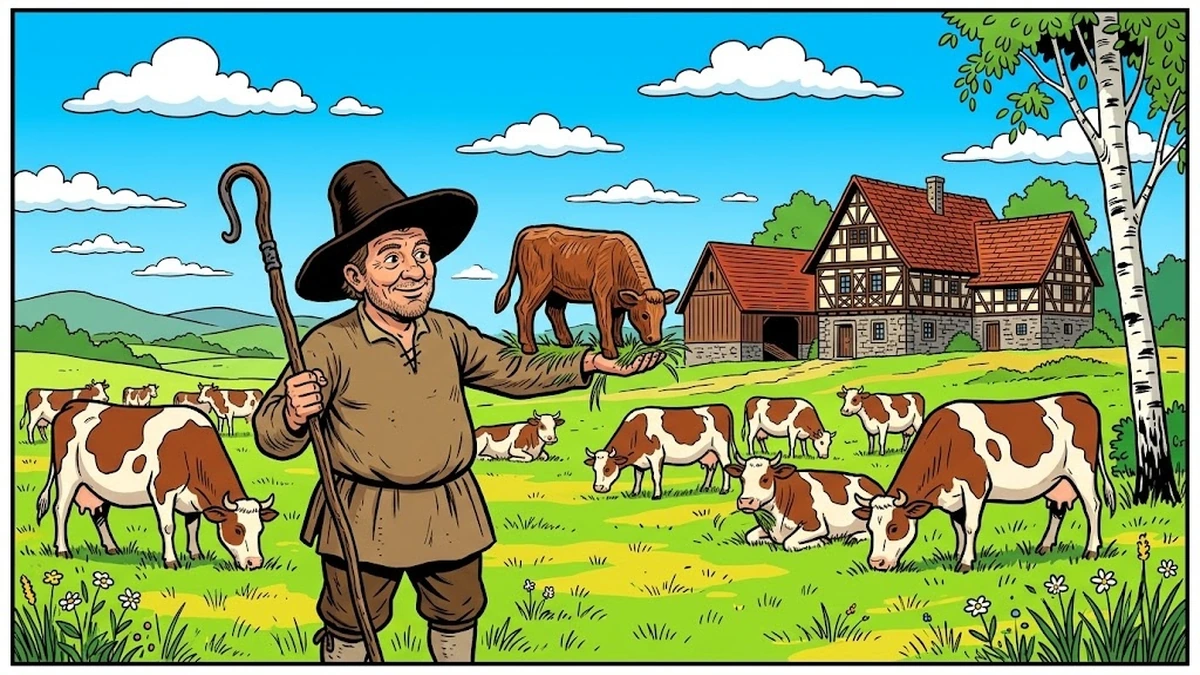
The cow comes home; the little peasant and his wife are heartily glad; but they have no fodder for it, and so, in the brisk practical economy of the Hessian farmstead, the cow is slaughtered, the meat salted, and the hide carried into the nearest market town for sale. On the way, in the gathering dusk and a rising autumn storm, the little peasant passes a watermill and finds, sitting on the parapet of the millstream with one wing trailing broken, a raven. He picks the bird up out of pity, wraps it in the folds of the cow-skin he is carrying for sale, and — the rain coming on hard now, the wind tearing at the millwheel — turns back to the mill itself and asks the miller’s wife for shelter. The motif of the kindness-to-the-wounded-bird that returns as folk-magical luck is one of the deepest in European folk-tradition (Stith Thompson B450, helpful birds, and B521.3, animals warn of impending death), and it is the small kindness on the road that is about to make the entire fortune of the tale. The little peasant lays himself down on the straw in the corner of the kitchen with his cow-skin and his wrapped raven beside him, eats a slice of bread and cheese which the miller’s wife grudgingly gives him, and pretends, with the sharp social cunning of folk-heroes, to be asleep.
II. The Soothsaying Raven and the Three Hundred Talers
What he sees through half-closed eyes is the most enduring image in the whole tale, and the one most often illustrated: the miller’s wife, believing herself alone, cooks a private feast — roast meat, salad, cakes, wine — and admits at the kitchen door her secret guest, the village parson. They sit down to eat. The little peasant, hungry and vexed under his cow-skin, says nothing. There is a sudden hammering on the outer door: the miller has come home unexpectedly through the storm. The miller’s wife, in a passage the Grimms preserve almost word-for-word from their Hessian source, hides the roast meat in the great green-tiled Kachelofen (the standing tile-stove of the German peasant kitchen), the wine under the bed-pillow, the salad on the bed itself, the cakes underneath it, and the parson, hastily and with the hem of his cassock catching on the latch, in the closet on the porch. Then she opens the door for her husband. The little peasant has seen everything.
The miller comes in, complains of the storm, sees the stranger on the straw, hears that he is a poor traveller given a slice of bread and cheese, and — in the open hospitality the Grimms give again and again to their German millers — offers him more. The peasant accepts, sits up, and produces the cow-skin with the wrapped raven inside. “What have you there?” asks the miller. The peasant answers, in the understatement that is the proper folk-tale voice, “einen Wahrsager” — a soothsayer. “Can he foretell anything to me?” “Why not? But he only says four things, and the fifth he keeps to himself.” The miller is curious, the storm is rattling the shutters, the kitchen is warm; and the little peasant, with the cool steady cunning that is his only fortune, pinches the raven sharply under the skin. The bird croaks — krr, krr — and the soothsaying begins. The motif — Stith Thompson K1971.7, the soothsaying bird used by the trickster to reveal hidden objects — runs from the Latin Unibos through the Italian Straparola into the Russian and the Norwegian; but nowhere is the rhythm of revelation more exquisitely managed than in the Grimm telling.
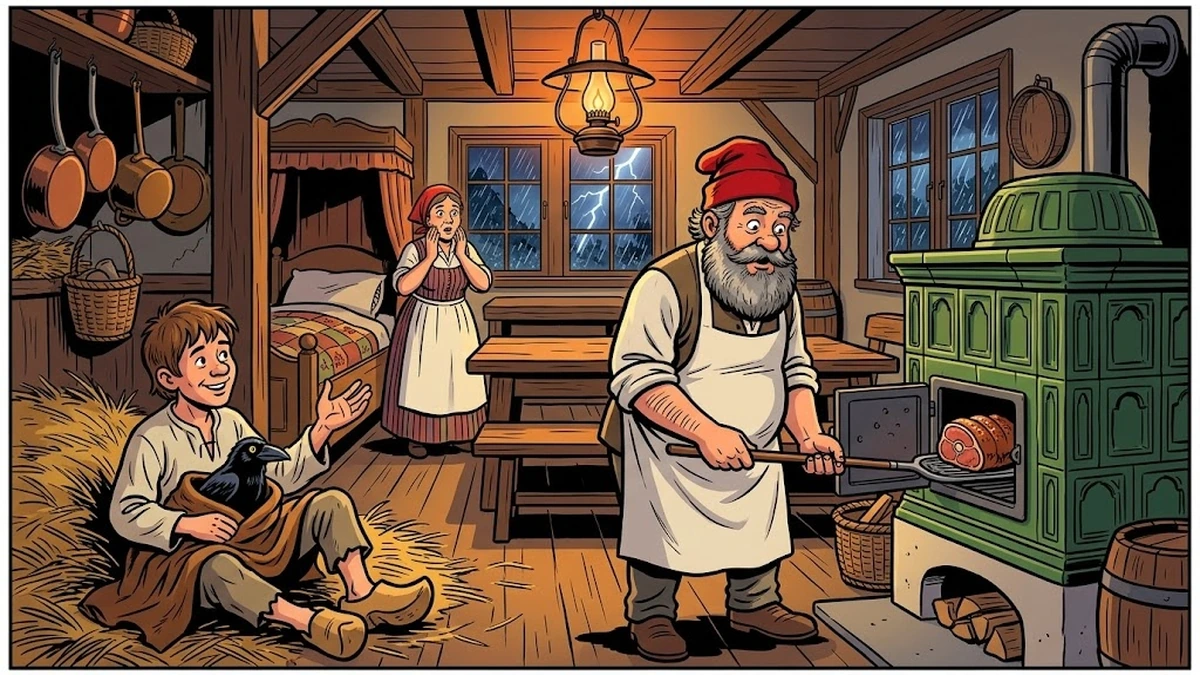
“In the first place, he says that there is wine hidden under the pillow.” The miller goes there: there is wine. “In the second place, he says that there is roast meat in the tiled stove.” The miller opens the stove: there is roast meat. “Thirdly, salad on the bed.” There is salad. “Fourthly, cakes under it.” There are cakes. By now the miller’s wife has gone white as her own apron and crept upstairs to bed with all the keys of the house in her pocket; and the little peasant, having brought the household’s hidden feast onto the kitchen table course by course, names his price for the fifth and final prophecy. They bargain, in the slow sober way of village men over a real transaction, until they agree on three hundred talers — the price of a small farm, a folk-magical sum that recurs across the whole Grimm corpus from The Master Thief to The King of the Golden Mountain. The peasant pinches the raven once more. “Fifthly,” he says quietly, “the Devil himself is hiding in the closet on the porch.” The miller, brave in the warmth of his own kitchen, opens the closet; out runs the parson with his cassock in his hand; the miller, satisfied that he has driven away the Devil with his own eyes, pays the three hundred talers; and the little peasant slips out before sunrise and walks home through the wet fields as a man with a small farm in his pocket. The motif — K335.1.4, the lover hidden in a closet revealed by the trickster as the Devil — is one of the great enduring comic images of the European fabliau-tradition and is closely related to the medieval French Le Prêtre teint and to Boccaccio’s seventh-day novellas; the Grimms inherit it through the long oral German Schwank tradition and give it back in the laconic perfect register of folk-narrative.
III. The Slaughtered Cows and the Barrel
The little peasant builds himself a beautiful house. The neighbouring rich peasants, seeing his sudden ease, summon him before the mayor and demand to know whence the wealth has come. With the ostentatious truthfulness that is the trickster’s most lethal weapon, he tells them: “I sold my cow’s hide in the town for three hundred talers.” The motif — Stith Thompson J2349.1, fools who slaughter their cattle after the trickster’s example and find no buyer — turns the village inside out. Every rich peasant in the place runs home, kills his cow, strips off the hide, and races into the market town to make his fortune; the merchant there, faced with an entire village’s worth of bloody hides on a single afternoon, buys the mayor’s servant’s hide for two talers and refuses to take any of the others at any price; and an entire village of formerly comfortable cow-owning farmers comes home in the evening twilight with no cows, no hides, no money, and no patience. They turn on the little peasant. They accuse him of treachery before the mayor. They unanimously sentence him to death by the old folk-judicial method of the Gerädert — rolled into the river in a barrel pierced full of holes — and lead him out into the meadow at the river’s edge, where a priest is sent for to say the office for a soul about to be drowned.
The priest who comes is, of course, the parson of the mill. The two men recognise one another in a single glance over the open barrel. “I freed you from the closet,” murmurs the little peasant, in the cold understatement of the Grimm trickster, “now free me from the barrel.” But before the parson can find a way to do it, into the meadow drives a third figure the Grimms have been holding in reserve since the start of the tale — a young shepherd of the village, a poor man too, who has long had the foolish ambition of one day becoming mayor. The little peasant, seeing him through the gaps in the barrel, raises a great cry of refusal: “Nein, ich tu’s nicht! Wenn die ganze Welt es will, ich tu’s nicht!” — “No, I will not do it! If the whole world wills it, I will not do it!” The shepherd hurries up. The little peasant, with the perfectly straight folk-tale face, explains that the village is forcing him to be made mayor by climbing into the barrel, and that he refuses the office. The shepherd, dazzled, asks if he might take the place. The little peasant graciously consents; the shepherd climbs in; the little peasant nails down the lid, takes up the shepherd’s flock of sheep, and walks quietly out of the meadow.
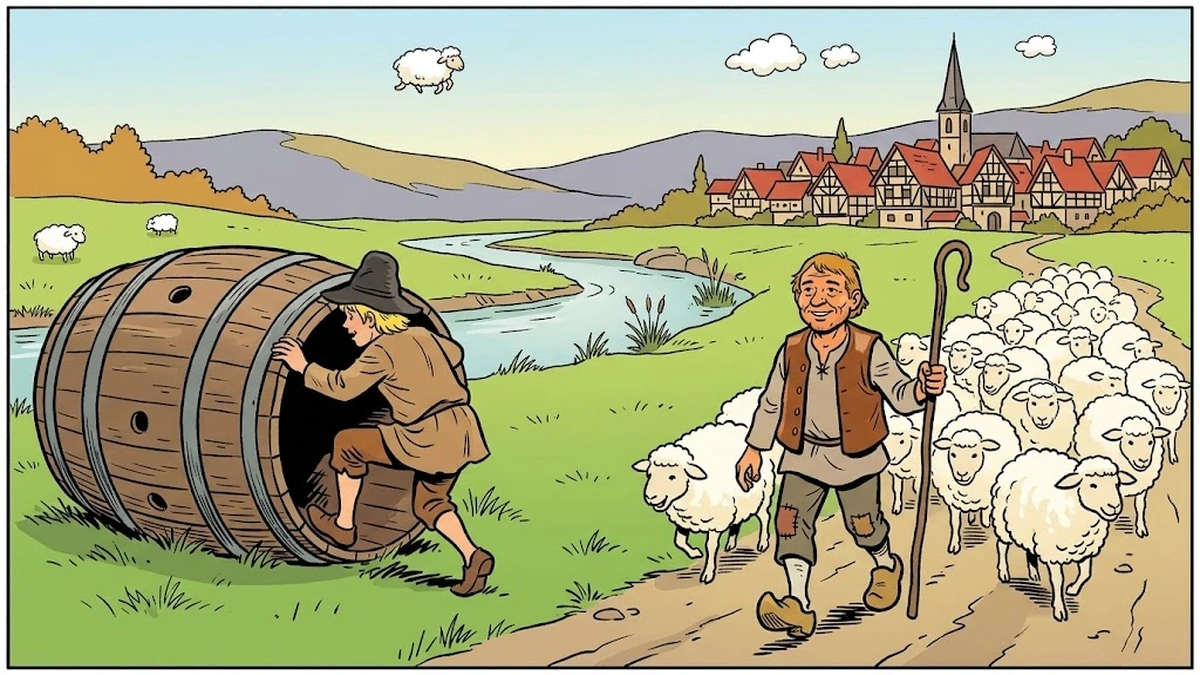
The motif — Stith Thompson K842, the dupe persuaded to take the prisoner’s place in a sack to be drowned — is one of the most widely distributed in the European folk-stock and is the single most famous episode of the entire Unibos cycle. It runs from the medieval Latin Versus de Unibove (c. 1050) through Straparola’s Le piacevoli notti (1551), through the French Le Petit Bossu, through Asbjørnsen and Moe’s Norwegian Store-Per og Lille-Per, through the Russian Brat bogatyy, through countless central European Schwank-versions, and on into Hans Christian Andersen’s Lille Klaus og store Klaus (“Little Claus and Big Claus”), which is in fact a direct nineteenth-century Danish reworking of the Grimm KHM 61 with the names changed and the ending lengthened by Andersen’s literary hand. The brutal economy of the folk-version is the Grimms’ alone: a single conversation through the gaps in a barrel, a single pious confidence-trick, a single nailed lid, and the trickster walks out of his own execution leading a flock of sheep. The parson, having said the mass over what he supposes is still the little peasant, walks back to the village; the villagers roll the barrel, with the shepherd inside protesting that he is willing now to be mayor, into the river; and the river takes the barrel, and the shepherd inside it, with the same indifference with which it has carried Moses, the merchant’s son in The King of the Golden Mountain, and a thousand other folk-victims of the unbargaining water.
IV. The Reflected Lambs and the Drowning of the Village
And here, in the closing movement of the tale, comes one of the most extraordinary images in the whole Grimm corpus — an image of folk-credulity so lucid that it has become almost a proverb of European literature. The little peasant comes back into the village in the evening, contented, driving the shepherd’s flock of sheep before him. The villagers, who supposed him drowned an hour ago, stop in the road and stare. “Peasant, where do you come from?” “I sank deep, deep, to the very bottom of the river; I pushed the bottom out of the barrel and crept out, and there were beautiful meadows under the water on which a great flock of lambs was grazing, and I drove this flock home.” “Are there any more there?” “Oh, yes, more than I could want.” The motif is Stith Thompson J2133.5, the credulous fools who jump into the water after reflected clouds taken for sheep, and it is one of the oldest and most pitiless folk-jokes in the entire Indo-European stock; it is closely related to the Aesopian fable of the dog and the reflection of the bone (Perry 133), to the medieval Hodja Nasreddin tale of the moon at the bottom of the well, and to the Greek folk-saying that “the fool fishes for shadows.”
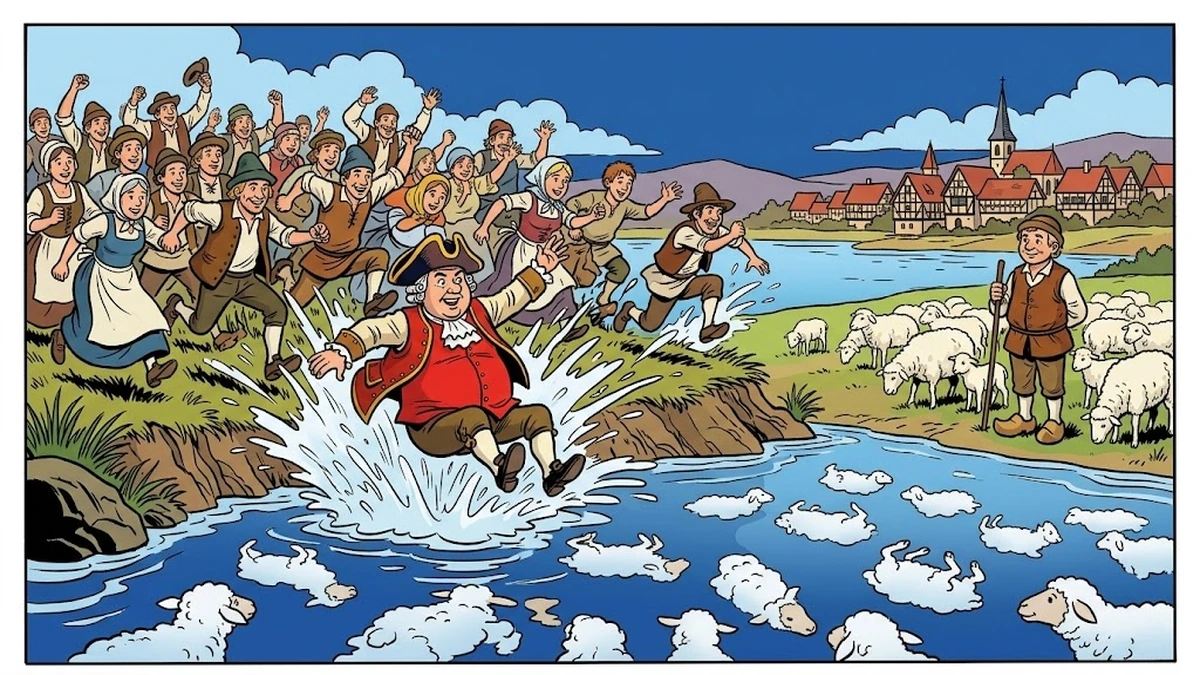
The villagers run together to the riverbank. Above the river that evening, the Grimms tell us, in a single line of folk-poetry that is as precise as a meteorological observation, there are scattered in the blue sky the small fleecy white clouds “die man Lämmlein nennt” — “which one calls little lambs” — and the calm surface of the water, in the way of all calm Hessian river-waters in an autumn evening, is reflecting them as a glittering scattered flock of lambs grazing on a meadow far below the surface. The villagers, peering down, see the sheep. The mayor, in a final act of village hierarchy, claims the right to go first; he leaps; the splash of the water is taken by his fellows for an enthusiastic call to follow; and the entire village, mayor and all, jumps in after him. None come up. The river closes over them; the small fleecy lamb-clouds in the sky drift slowly south; the little peasant, now sole heir of the entire village, walks home with his shepherd’s flock and his three hundred talers and his beautiful house and is, the closing line tells us in the laconic perfect of folk-conclusion, “a rich man.” The tale ends, as so many Grimm trickster-tales end, on the cool unsentimental note of an entire greedy village swallowed by its own credulity, and a single small clever poor man left standing on the bank with the meadows of an empty village ahead of him.
Moral — Die Moral der Geschichte
“Der Reiche frisst den Armen, bis der Arme schlauer wird als der Reiche; dann frisst der Arme den ganzen Reichtum auf einen Schlag.”
The German moral of Das Bürle — “The rich eat the poor, until the poor man grows cleverer than the rich; then the poor man eats the whole of the riches at a single stroke” — gathers the entire moral architecture of the tale into one uncompromising peasant epigram. This is not the gentle moral of a Sunday-school collection; it is the savage moral of the medieval European Schwank, a literature written by and for poor men, in which the only justice the world contains is the justice the trickster makes for himself out of his own wits. The little peasant has no cow, no money, no land, no rank, no patron, no friends in the village court; he has only one resource, and that is the speed and accuracy of his own thinking. He uses it four times in the tale, and each time the stakes are higher: a wooden calf for a real cow; a wrapped raven for three hundred talers and a beautiful house; a barrel-execution for a flock of sheep and his own life; the reflected clouds in the river for the inheritance of an entire village. The folk-claim, beneath the comedy, is hard and unflinching. In an unjust world, cunning is the only currency the poor possess that cannot be confiscated. The richer peasants of the village, the priest, the miller, the mayor, the shepherd: each is greedy, each is credulous, each takes the bait that the little peasant offers him. The little peasant takes none. He never asks for anything; he simply waits to be offered the rope, and pulls. The Grimms, who knew their Hessian peasantry from inside, preserve the moral with no comment of their own — the only judgement passed in the whole tale is by the river itself, and the river takes the greedy and leaves the clever. The deeper moral is one the Grimms shared with Hans Christian Andersen, with the medieval Latin Unibos, and with every clever-peasant tale of the European folk-stock: that the world is full of foolish hierarchies, and the sharpest tool a poor man has is the one between his ears.
Why The Little Peasant Has Lasted Two Hundred Years
Of the more than two hundred tales in Kinder- und Hausmärchen, only a relatively small group have crossed every linguistic boundary to become genuinely global property. Das Bürle is not, in itself, among that tiny outermost ring of universally illustrated tales; but it has, by way of its direct nineteenth-century Danish descendant, achieved a strange second life as one of the most widely read of all European trickster-tales. Hans Christian Andersen’s Lille Klaus og store Klaus (“Little Claus and Big Claus”), published in his first slim volume of Eventyr, fortalte for Børn (Copenhagen, 1835), is, by Andersen’s own admission in his autobiographical Mit Livs Eventyr, a direct retelling of the Grimm KHM 61 he had read as a boy in Danish translation; the painted calf becomes a horse, the soothsaying raven becomes a magic peck-corn-grinder, the parson hidden in the closet becomes the parson hidden in a chest, and the barrel by the river becomes a sack at the millstream — but the architecture is exactly that of the Grimms, and through Andersen’s worldwide circulation the small Hessian Bürle has reached, indirectly, almost every nursery in Europe and the Americas. It is one of the rare cases in which a Grimm tale has lived its own life in two languages: as Das Bürle in the philological-scholarly Grimm tradition, and as Lille Klaus og store Klaus in the popular Andersen tradition, with each side preserving features the other has lost.
Its scholarly reception has been correspondingly rich. Bolte and Polivka, in their monumental five-volume Anmerkungen zu den Kinder- und Hausmärchen der Brüder Grimm (Leipzig, 1913–1932), devote a substantial entry to KHM 61 (volume II, pages 1–18) tracing the entire Indo-European descent of ATU 1535 from the eleventh-century Latin Versus de Unibove through the medieval Disciplina clericalis of Petrus Alfonsi (c. 1110), through the Italian Straparola (1551) and Basile (1634), through the Norwegian Asbjørnsen and Moe (1841), through the Russian Afanasyev (1855), through the French Le Petit Bossu tradition, into the Yiddish Chelm tales, and outward into more than a hundred recorded oral variants from the Pyrenees to the Volga. Stith Thompson, in The Folktale (1946), groups KHM 61 with the great cluster of ATU 1525–1540 trickster-types as one of the canonical European examples of the “Master Trickster” pattern, and devotes special attention to the four-step escalation of stakes that the Grimm telling preserves so cleanly. Max Lüthi, in The European Folktale: Form and Nature (1947, English edition 1982), uses passages from the tale to illustrate the famous “one-dimensionality” of folk-narrative — the way in which the soothsaying raven, the painted calf, the closet-parson, and the reflected lambs all stand on the same flat narrative plane with no metaphysical seam between them. Heinz Rölleke, the leading modern editor of the Grimms, in his standard apparatus for the Reclam edition (1980), points out that the Grimms left the laconic register of the oral source unusually intact in this tale and that the Hessian dialect-substrate shows through clearly in the rhythm of the four-stage soothsaying scene.
Its hero remains, in his particular Grimm way, one of the most unusual protagonists in the European tradition: a poor man with no royal blood, no magical helper, no fairy godmother, no wishing-ring, no seven-league boots, no obedient sword. He has only a wooden calf, a wounded raven, a cow-skin, and his own steady reading of the credulity of his neighbours. He earns his fortune not by virtue but by quickness, not by piety but by precision; and the tale gives him in the end, with the unsentimental folk-blessing of the Schwank tradition, an entire village to inherit. The closing image — the small fleecy clouds reflected on the water, the village peering over the bank, the mayor’s first plunge, the splash mistaken for a call, the whole crowd plunging in after him — is one of the most enduring images of folk-justice in any European literature: the credulous swallowed by their own credulity, the meadow of reflected lambs become the grave of the greedy. What the rich would not share with the poor, the river takes from both. Two hundred years on, Das Bürle remains exactly as it stood in its Hessian source in 1812: one of the great parables of the European imagination of how a single clever poor man, with nothing but his wits and a wrapped raven, can outlast an entire village of comfortable fools, and walk out of his own execution leading their sheep.
Frequently Asked Questions about The Little Peasant
Q1. Who wrote The Little Peasant, and when was it first published?
The Little Peasant (German Das Bürle, also catalogued as Der kleine Bauer) was collected, edited, and published by the brothers Jacob and Wilhelm Grimm as tale number 61 (KHM 61) in Kinder- und Hausmärchen (Children’s and Household Tales), first issued in Berlin in 1812 by the Realschulbuchhandlung. The Grimms did not “write” the tale in the modern authorial sense; they recorded an oral German folk story whose source they record in their Anmerkungenband (the third, scholarly volume of Kinder- und Hausmärchen, 1822 and 1856) as taken down from the great Hessian story-teller Dorothea Viehmann of Niederzwehren near Cassel, the tailor’s wife whose oral repertoire supplied so many of the second-volume tales. The story was revised across all seven editions of Kinder- und Hausmärchen between 1812 and the definitive Ausgabe letzter Hand of 1857. Edgar Taylor introduced an English version in German Popular Stories (London, 1823) and Margaret Hunt issued the standard accurate English translation in 1884, the version through which generations of English-speaking children have first met the small peasant with his wooden calf and his soothsaying raven.
Q2. What is the ATU classification of The Little Peasant, and what is the Unibos cycle?
In the international Aarne–Thompson–Uther index of folk-tale types, The Little Peasant is the canonical European example of ATU 1535 — “The Rich and the Poor Peasant,” sometimes still cited under its older Latin name as the Unibos cycle, after the eleventh-century Lotharingian Latin verse-novella Versus de Unibove (c. 1050), the oldest surviving European recension of the type. The defining features of the ATU 1535 tale type are: a poor man (the Latin original calls him Unibos, “One-Ox,” because he owns a single ox) who outwits a community of richer neighbours through a four-step escalation of trickery — a false sale (the cow-hide), a sham soothsayer (the raven, the magic horse, or the magic peck-corn-grinder), a substitution-execution (the barrel, the sack, or the chest), and a final mass-drowning of the credulous (the reflected lambs, the underwater meadows, or the magic herd-cattle of the river-bottom). Cognate ATU 1535 tales appear all across Europe: Asbjørnsen and Moe’s Norwegian Lille-Per og Store-Per, the Russian Brat bogatyy i brat bednyy (“The Rich Brother and the Poor Brother”) in Afanasyev (1855), Straparola’s Italian Cassandrino in Le piacevoli notti (Venice, 1551), and most famously Hans Christian Andersen’s Lille Klaus og store Klaus (“Little Claus and Big Claus”), published in Eventyr, fortalte for Børn (Copenhagen, 1835), which is by Andersen’s own admission a direct retelling of KHM 61. The Stith Thompson motif-index pinpoints the operative trickster-mechanisms as K1655 (false complaint that produces real damages), K1971.7 (the soothsaying bird), K335.1.4 (the lover hidden in the closet revealed as the Devil), K842 (dupe persuaded to take prisoner’s place in a sack to be drowned), J2349.1 (fools who slaughter their cattle after the trickster’s example), and J2133.5 (fools who jump into the water after reflected clouds taken for sheep).
Q3. Who is Dorothea Viehmann, and what is her place in the Grimm tradition?
Dorothea Viehmann (1755–1815) was the great Hessian story-teller of Niederzwehren, a village near Cassel in central Germany, who supplied a substantial portion of the second volume of the Brothers Grimm’s Kinder- und Hausmärchen — including The Little Peasant, The Goose-Girl, The Twelve Brothers, The Three Little Men in the Wood, and many more. The wife of a Niederzwehren tailor of Huguenot descent and the daughter of an innkeeper at the village of Knallhütte on the highroad between Cassel and Frankfurt, she had grown up listening to the stories of carters, soldiers, peddlers, and travellers who stopped at her father’s inn, and she had a peasant story-teller’s memory and rhythm of an extraordinary kind. Wilhelm Grimm, in his preface to the second volume of Kinder- und Hausmärchen (1815), pays her one of the most famous compliments in the history of folkloristics: she possessed “die wahre Erzählergabe” — “the true gift of the storyteller” — and “told her tales the second time exactly as the first, never adding, never leaving out.” The small painted portrait of her by Ludwig Emil Grimm (Wilhelm’s brother), made in the last year of her life, has hung as a frontispiece to many later editions of the Grimms and is one of the very few authentic likenesses we have of any oral source in the entire history of European folk-collection. Das Bürle bears all the marks of her sharp-witted Hessian peasant register.
Q4. How is The Little Peasant related to Hans Christian Andersen’s Little Claus and Big Claus?
Hans Christian Andersen’s Lille Klaus og store Klaus (“Little Claus and Big Claus”), published in his first slim volume of Eventyr, fortalte for Børn (“Tales, Told for Children,” Copenhagen, 1835), is by Andersen’s own admission in his autobiographical Mit Livs Eventyr (“The Story of My Life”) a direct retelling of the Grimm KHM 61 Das Bürle, which he had read as a boy in Danish translation. The architectural parallels are exact: a poor protagonist with a single ox or horse instead of a calf; a four-stage trickster-escalation in the same order; a sham soothsaying scene (the magic peck-corn-grinder in Andersen, the raven in Grimm); a parson hidden in the household by an adulterous wife; a substitution-execution scene at the millstream (a sack in Andersen, a barrel in Grimm); and a final mass-drowning of the greedy (the underwater cattle of the river-bottom in Andersen, the reflected lambs in Grimm). Andersen’s literary additions are an extended dialogue, a more elaborate inn-scene, and a softening of the Grimms’ brutal mass-drowning into a single drowned brother — but the bones of the tale, and the ATU 1535 architecture, are identically those of the Grimm KHM 61. Through Andersen’s worldwide circulation in the second half of the nineteenth century, Lille Klaus og store Klaus became one of the most widely translated trickster-tales in the world, and through it — indirectly — the small Hessian Bürle of Dorothea Viehmann’s telling has reached almost every nursery on earth.
Q5. What does the closing image of the reflected lambs mean, and why is it the heart of the tale?
The closing image — the small fleecy white clouds in the autumn sky reflected as a glittering flock of lambs on the surface of the river, and the entire greedy village leaping in after them and drowning to a man — is one of the most extraordinary single images in the whole Grimm corpus, and it is the moral heart of the tale. The motif is Stith Thompson J2133.5, “fools who jump into the water after reflected objects taken for real,” and it is one of the oldest and most pitiless folk-jokes in the entire Indo-European stock; it is closely related to the Aesopian fable of the dog and the reflection of the bone (Perry 133), to the medieval Hodja Nasreddin tale of the moon at the bottom of the well, and to the Greek folk-saying that “the fool fishes for shadows.” Its folk-meaning is precise and uncompromising: the credulous are destroyed by their own credulity, and the river of folk-justice gives back to a greedy village the exact mirror-image of its own greed. The Grimms preserve the meteorological precision of the original oral telling — “die kleinen weissen Wolken, die man Lämmlein nennt”, “the small white clouds which one calls little lambs” — and the German peasant listener, looking up at the same autumn sky over the same Hessian fields, would have understood at once both the natural image and the moral force of the closing scene. The little peasant survives the river not because he is virtuous but because he never looks down into it for sheep that are not there; and the deep folk-claim of Das Bürle is that, in the end, the world drowns those who confuse their own reflection in the water with a flock of lambs grazing on the meadows of an underwater Otherworld.
You May Also Like
 Grimm's Fairy Tales
Ages 9-12
Grimm's Fairy Tales
Ages 9-12
Cat-Skin
Cat-Skin: There was once a king, whose queen had hair of the purest gold, and was so beautiful that her match was not to be met with on the whole face of the
 Grimm's Fairy Tales
Ages 9-12
Grimm's Fairy Tales
Ages 9-12
Doctor Knowall
Doctor Knowall: There was once upon a time a poor peasant called Crabb, who drove with two oxen a load of wood to the town, and sold it to a doctor for two
 Grimm's Fairy Tales
Ages 9-12
Grimm's Fairy Tales
Ages 9-12
The Wolf and the Seven Young Goats
The Wolf and the Seven Young Goats: In the days when animals spoke and understood the human tongue, there lived a mother goat with seven children born under a