The Queen Bee
The Queen Bee: Two kings’ sons once upon a time went into the world to seek their fortunes; but they soon fell into a wasteful foolish way of living, so that
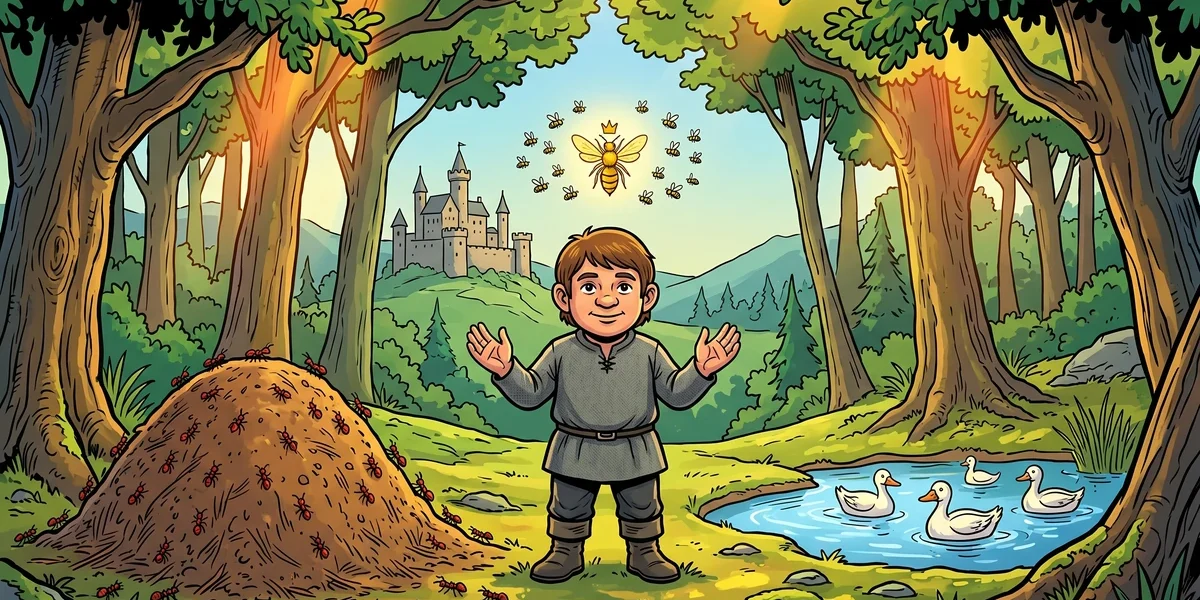
The Queen Bee is a quiet, kindly tale of small mercies that ripen into great rescues. Two reckless princes wander the world wasting their inheritance until their slighted youngest brother — called only “Dummling” or “the Simpleton” — sets out to find them, and on the way home all three pass an anthill, a duck-pond, and a wild bees’ nest. The elder brothers are eager to trample, roast, and burn; the youngest forbids them, saying each time, “Let the creatures alone.” When the brothers reach an enchanted castle whose inhabitants have been petrified to stone, three impossible tasks await — and the very ants, ducks, and queen bee whom the youngest spared step in to deliver him.
Origins, Editor’s Note, and Canonical Attribution
This story was published by Jacob Grimm (1785–1863) and Wilhelm Grimm (1786–1859) in the second volume of Kinder- und Hausmärchen, where it appears as tale number 62 in the standard numbering established from the 1819 second edition onward. In the 1812 editio princeps the same tale carried the position number 64; the renumbering to KHM 62 came when the brothers reorganised the corpus for the enlarged 1819 edition, which became the canonical sequence followed by all subsequent editions through the seventh and final edition of 1857. The German title is Die Bienenkönigin, literally “the bee-queen” or, idiomatically, “the queen bee.” Edgar Taylor’s 1823 German Popular Stories rendered it as “The Queen Bee,” Lucy Crane’s 1882 Household Stories kept the same title, and Margaret Hunt’s 1884 Grimm’s Household Tales followed suit, so the English title has been stable for two centuries.
In the international tale-type catalogue compiled by Antti Aarne and Stith Thompson and revised in 2004 by Hans-Jörg Uther (The Types of International Folktales, FF Communications 284–286), the story is classified as ATU 554, “The Grateful Animals.” The defining motifs — a youngest hero who spares small creatures, the same creatures returning later to perform impossible tasks (counting pearls, retrieving a lost key, and selecting the right princess from look-alike sleepers) — are catalogued as B360 (“Animals grateful for rescue from peril”), H1091 (“Task: sorting grains performed by helpful ants”), H1132 (“Task: recovering lost key from sea, performed by helpful fish/ducks”), and H324 (“Suitor test: choosing princess by signs”). The tale belongs to a wide European cluster that includes Russian, Italian, French, and Norwegian analogues; the Grimms themselves cross-referenced it to Das Wasser des Lebens (KHM 97) and to Basile’s Pentamerone 4.3 in their notes.
Unlike most of the Grimm corpus, Die Bienenkönigin was not collected from a Hessian oral informant in the household sense. Wilhelm Grimm’s own annotations in the Anmerkungenband (annotation volume) of 1822 and 1856 acknowledge that the immediate source was the printed text of Albert Ludwig Grimm (1786–1872, no relation), whose Kindermährchen appeared in Heidelberg in 1808, four years before the first KHM. A. L. Grimm’s chapter “Die drei Königssöhne” on pages 113–134 of that volume contains a longer, more sentimental version of the same plot; the brothers Jacob and Wilhelm pruned and tightened the diction, restored the dwarf-brother’s epithet “Dummling,” and gave the tale its proverbial three-task structure in the 1819 redaction. Subsequent collation with French cognates of the Madame d’Aulnoy school — particularly L’Oranger et l’abeille (1697) — and with Hassenpflug-family oral retellings from Cassel may have informed minor revisions, but the spine of the printed text remains A. L. Grimm’s. The first edition was issued in Berlin by the Realschulbuchhandlung of Georg Andreas Reimer at the end of 1812 (volume one) and 1815 (volume two).
The Three Mercies on the Road
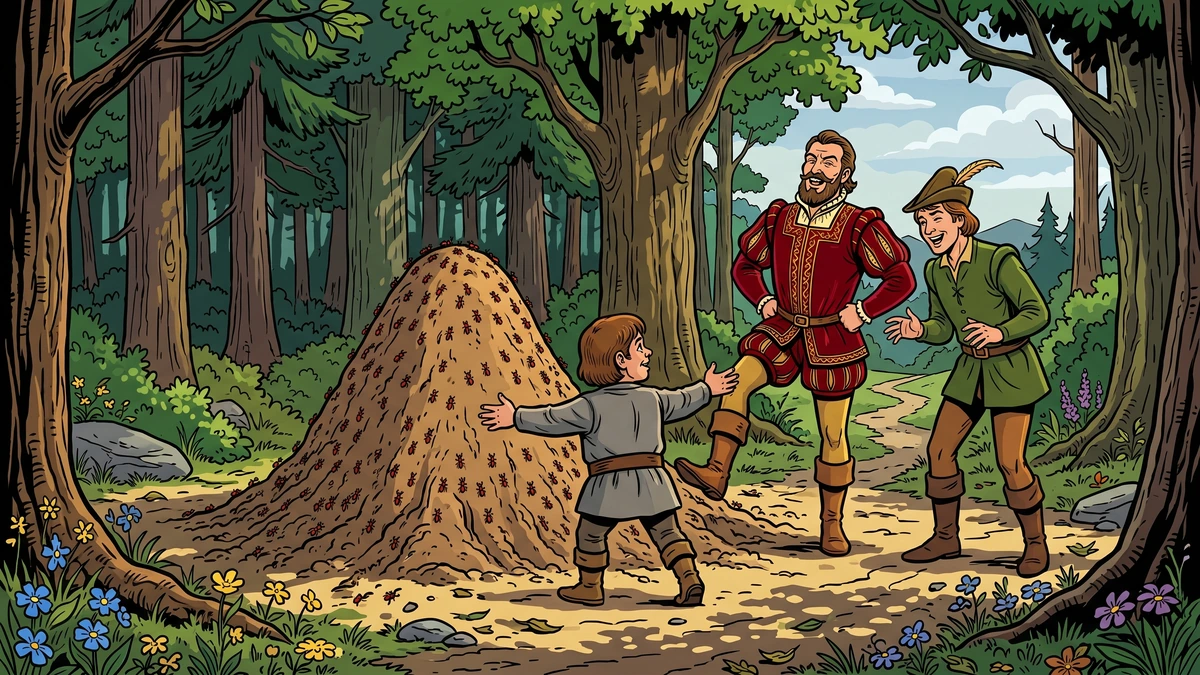
The tale opens with two king’s sons who have squandered their patrimony and dare not return home — a familiar Grimm opening that echoes Luke 15 and the prodigal son but recasts him in triplicate. Their youngest brother, a dwarf-like figure mocked by his elders and called Dummling (“Little Dummy” or “Simpleton”), goes out after them. The Grimms’ diction is precise: he is not stupid but small, and his smallness in the world’s eyes is the very condition of his attentiveness to other small things. When the brothers arrive at an anthill, the elders propose to kick it open “so that the poor ants in their fright would run about and carry off their eggs”; the dwarf says, in the formula that gives the tale its rhythm, “Lasst die Tiere in Frieden” — “let the creatures be in peace.” At the lake the elders would shoot ducks and roast them; he forbids it. At the bees’ nest they would smoke out the hive for honey; he forbids that too.
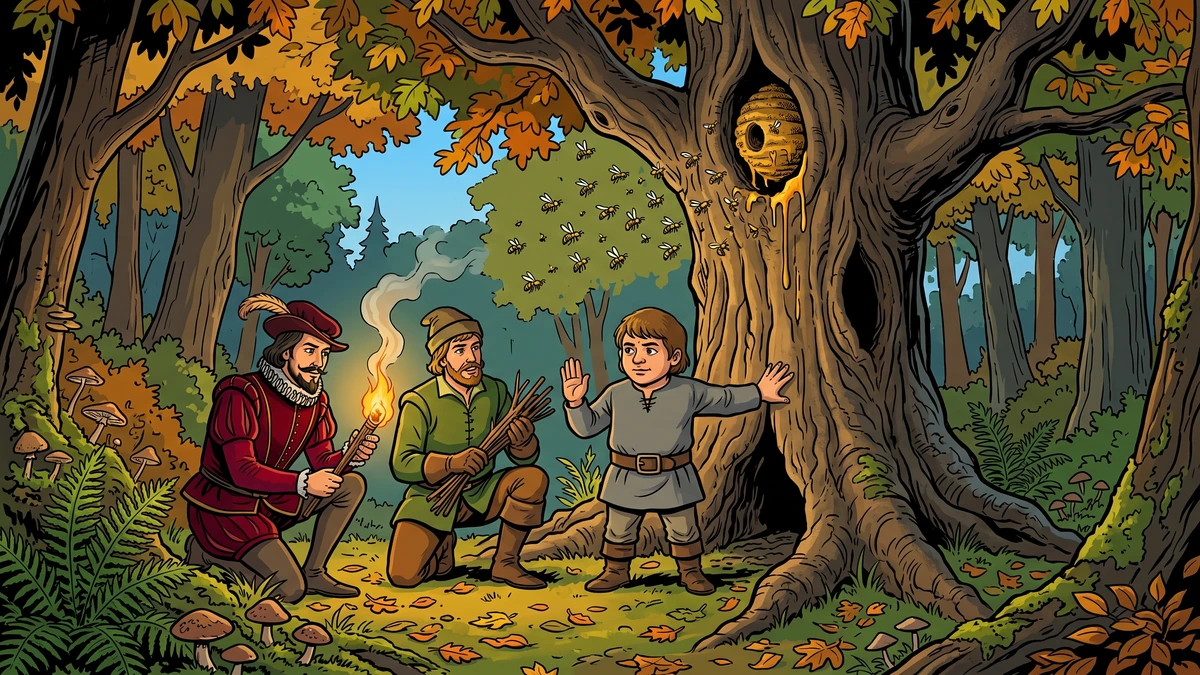
This triple refrain — Wilhelm Grimm’s most consistent hand on this tale — is doing several things at once. First, it sets up the structural promise of folktale economy: every detail planted in the first half must bear fruit in the second. Second, it establishes the youngest as morally deserving without ever calling him good; the storyteller withholds adjective and lets action stand. Third, it reverses the medieval bestiary hierarchy. Ants, ducks, and bees are precisely the three creatures the early modern peasant household most casually destroyed — pests, prey, and a domesticated swarm — and the dwarf protects them in the order of ascending utility, which is also the order of ascending narrative reward. The Grimms had read Reynard, the Aesopic corpus, and the medieval Physiologus, and they knew that the smallest helpers traditionally save the largest heroes; what they added was the moral economy that makes the rescue feel earned rather than magical.
The Castle of Stone and the Three Tasks
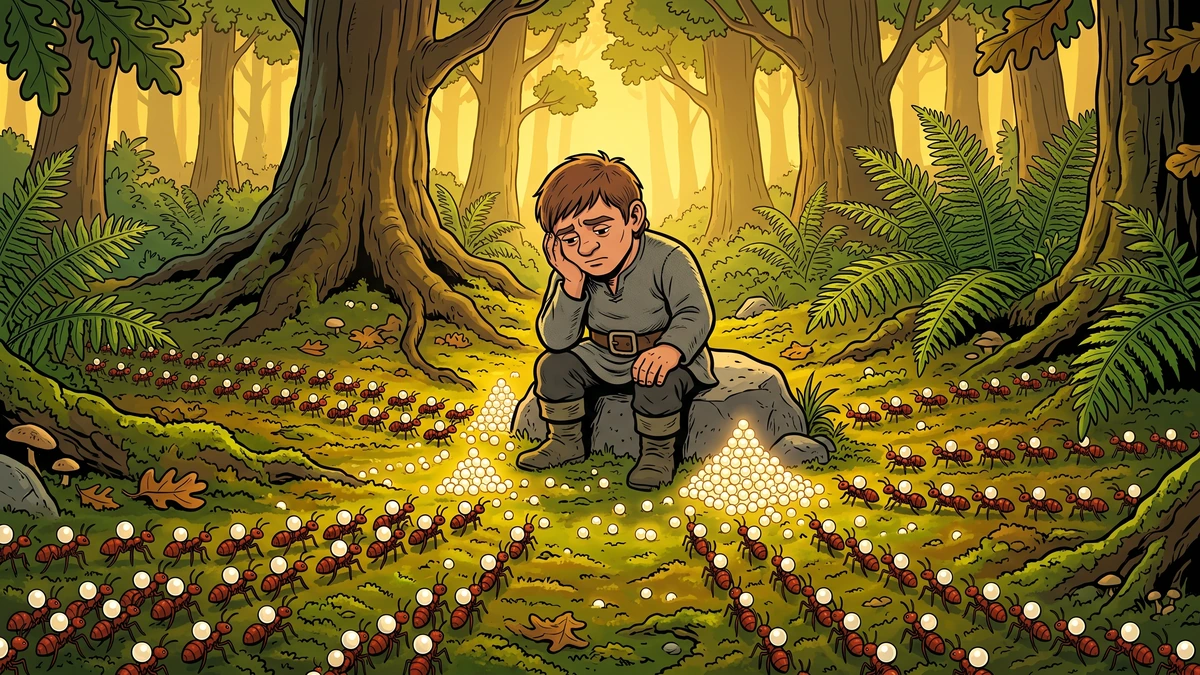
The brothers come to a castle whose stables hold marble horses and whose halls hold marble men. A grey old man — the petrified king, by implication — rises in silence, leads them to a meal, and on the next morning sets the eldest the first task. A tablet warns that whoever fails will himself be turned to stone. The first task is to gather, before sundown, a thousand pearls of the King’s daughter that lie scattered in the moss of the forest. The eldest searches, gathers a hundred, and is turned to stone at sunset. The second brother does no better — two hundred pearls, then stone. When the dwarf’s turn comes he sits down on a stone in the wood and weeps. Then five thousand ants — the very colony he saved — come marching in long lines, and by sunset the pearls are heaped in shining order at his feet.
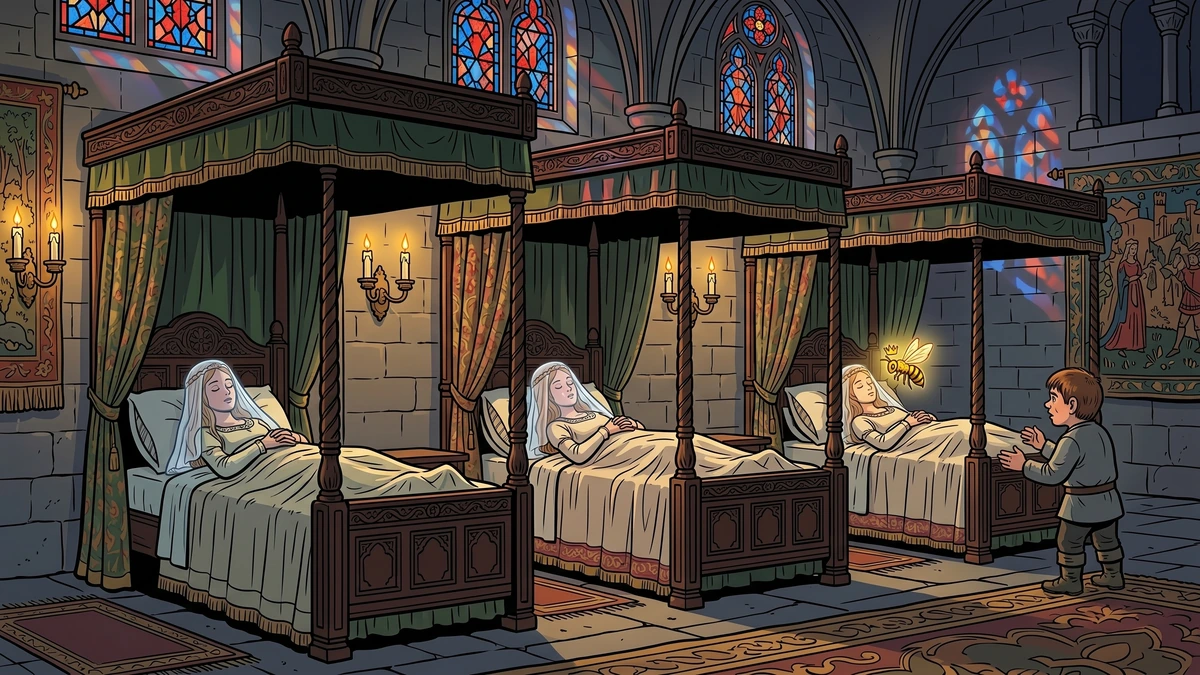
The second task is to fetch the key of the bedchamber from the lake. The dwarf goes to the shore, and the ducks he had rescued dive and return with the iron key in their bills. The third task is the strangest and the most morally pointed: three princesses lie sleeping in identical chambers, each veiled, and the suitor must pick out the youngest — the one whose touch will undo the petrification. They look exactly alike, but the eldest had eaten sugar before sleep, the second syrup, and the youngest a spoonful of honey. The queen bee, in payment of the dwarf’s earlier mercy, flies in at the window, alights on the lips of the honey-eater, and the dwarf names the right princess. The petrification breaks, the marble men wake, the marble horses snort and stamp, and the dwarf — who is no longer called Dummling but recognised as a king’s son — marries the youngest princess.
Why the Queen Bee, and Not Some Other Helper?
Of the three grateful animals, only the bee is given a sovereign — a Königin, a queen — and only the bee provides the title. The Grimms knew that early-nineteenth-century apiary science had only just established (against centuries of Aristotelian and Virgilian belief in a “king bee”) that the colony was ruled by a queen. Jan Swammerdam in the 1670s had dissected the queen and proved her ovaries; Charles Bonnet in the 1740s had described parthenogenesis; and by 1806 François Huber’s Nouvelles Observations sur les Abeilles was widely read in Germany. The image of the female queen who confers legitimacy on the right consort by a single touch was therefore both folkloric and scientifically modern in 1812, and it carried specific weight in a tale whose climax turns on selecting the rightful bride from among look-alike sisters. The bee is the matchmaker, the verifier of true sweetness, and her crown links the natural order with the matrimonial.
The tale also belongs to a Grimm sub-cluster — Die drei Federn (KHM 63), Die goldene Gans (KHM 64), and Die weisse Schlange (KHM 17) — in which the despised youngest brother triumphs through kindness to overlooked creatures. Die Bienenkönigin is the most condensed of these. Where Die weisse Schlange spreads its grateful animals across the entire kingdom of beasts, fish, and fowl, Die Bienenkönigin picks three small species and weights each with a specific cognitive task: counting (ants), retrieving (ducks), and discriminating (bees). Each task corresponds to a faculty the human cannot supply alone. The deep logic of the tale is that mercy is not weakness but a different kind of intelligence — one that knows, before the test arrives, which allies the test will require.
The Moral and Its Original-Language Phrasing
The Grimms ended the tale, in their economical way, with the petrification undone and the dwarf married. They did not append a moralising couplet, in keeping with their declared method of letting the stories teach by their own shape. But within the tale itself sits a single line that carries the moral, repeated three times by the youngest brother as he protects the ants, the ducks, and the bees:
“Lasst die Tiere in Frieden, ich leide nicht, dass ihr sie stört.”
— “Leave the creatures in peace, I will not suffer that you trouble them.” (Grimm, KHM 62, 1819 edition; Margaret Hunt 1884 reads “Leave the creatures alone, I will not suffer you to disturb them.”)
The moral, then, is the oldest and quietest in folklore: that the smallest mercies, given when there is no expectation of return, return at the moment of greatest peril, and that the world is a moral economy in which no kindness is wasted. Wilhelm Grimm in the 1856 Anmerkungen marked this story as one of the purest examples of what he called “der dankbare Tiere” — the grateful-animals motif — and noted that its German form was deliberately stripped of the courtly flourishes that the French d’Aulnoy tradition had added; he wanted the tale’s ethics to stand bare.
Why the Tale Has Lasted
For two centuries The Queen Bee has been one of the Grimm tales most reliably retold to children, and there are reasons that go beyond the charm of insects. The tale answers a question that children, in particular, ask early: do small acts of kindness matter? The narrative answer is unequivocal — yes, and they matter precisely when their reward is invisible at the time of giving. The dwarf does not save the ants because he expects pearl-counters; he saves them because he refuses to let them be hurt. The story’s structure makes the moral palpable rather than preached: by the time the queen bee descends to identify the honey-eating princess, the listener has already grasped, without instruction, that mercy makes its own bridge across time.
The tale has also lasted because it solves, in folktale form, the eldest-brother problem of inheritance. In the 1812 Hessian world from which the Grimms collected, primogeniture left younger sons with prospects bleaker than the elder’s; Die Bienenkönigin reverses that worldly hierarchy without violence — the elders are not killed, only frozen, and the youngest’s marriage breaks the spell that holds them — so that justice is restored without destruction. Every petrified man wakes; every marble horse stamps. This is folk theology of mercy, not vengeance. It is also why the tale found early favour in nineteenth-century German nursery education and why it has remained, in the Grimm canon, one of the gentlest places where the moral imagination of childhood meets the moral imagination of the storyteller.
You May Also Like
 Grimm's Fairy Tales
Ages 9-12
Grimm's Fairy Tales
Ages 9-12
Tom Thumb
Tom Thumb: A poor woodman sat in his cottage one night, smoking his pipe by the fireside, while his wife sat by his side spinning. How lonely it is, wife,’
 Grimm's Fairy Tales
Ages 6-8
Grimm's Fairy Tales
Ages 6-8
The Golden Goose: Kindness Rewarded, Greed Punished
The Golden Goose: Kindness Rewarded, Greed Punished: The Foolish Youngest Son In a time when the world still held magic in its forests and mountains, there
 Grimm's Fairy Tales
Ages 9-12
Grimm's Fairy Tales
Ages 9-12
Briar Rose
Briar Rose: A king and queen once upon a time reigned in a country a great way off, where there were in those days fairies. Now this king and queen had plenty