Ashputtel
Ashputtel: The wife of a rich man fell sick; and when she felt that her end drew nigh, she called her only daughter to her bed-side, and said, ‘Always be a
Ashputtel: The Grimm Cinderella and the Power of the Ancestral Bond
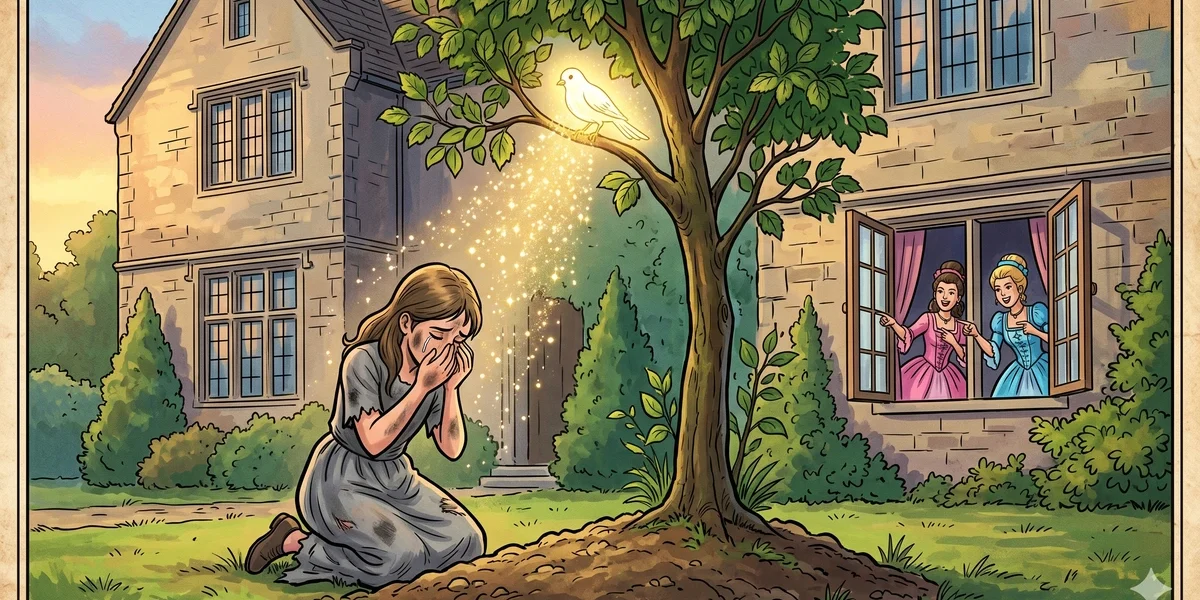
The Brothers Grimm version of Cinderella — known as “Ashputtel” (Aschenputtel in German, literally “ash-fool” or “ash-girl,” referring to the ashes she sleeps among) — differs from the Perrault version familiar to most modern audiences in one crucial respect: there is no fairy godmother. Instead, Ashputtel receives her magical assistance from the hazel tree she planted on her mother’s grave and watered with her own tears. This substitution transforms the story’s theological underpinning entirely: in the Grimm version, the magic is not bestowed by an external benevolent intermediary but springs from the protagonist’s own piety, her sustained relationship with her dead mother, and the spiritual power that accumulated through that relationship. The ancestral bond is the source of all power.
This version resonates profoundly with Indian folk and religious tradition, where the relationship between the living and the dead — particularly the maternal dead — is maintained through continuous ritual attention and understood to be genuinely generative. The concept of pitru-tarpanam (libations to ancestors) and the entire Pitru-Paksha (fortnight of ancestor honor) rests on the understanding that the dead retain capacity to bless, protect, and assist the living when properly honored. Ashputtel’s daily visits to her mother’s grave, her watering of the hazel tree with tears, her prayers — all constitute an Indian-style ancestral piety that activates genuine ancestral power.
The Hazel Tree as Ancestral Vehicle: Connecting the Living and the Dead
The hazel tree (Corylus avellana) that grows from the mother’s grave is not merely a plot device but a symbol with deep roots in European and Indo-European religious imagination. In Germanic folk belief, certain trees were understood to be inhabited by ancestral spirits — the family tree as literal family tree, roots connecting to the underworld, canopy reaching toward the divine. The hazel specifically was associated with wisdom, divination, and the boundary between worlds.
In Indian tradition, the peepal tree (Ficus religiosa) serves a strikingly parallel function: believed to be inhabited by ancestral spirits, visited by the devout for prayers and circumambulation, especially by women seeking fertility, protection, and guidance. Offerings are made at the peepal’s base; the tree’s rustling is sometimes interpreted as the ancestor’s response. Ashputtel’s hazel tree and the Indian peepal occupy the same symbolic niche in their respective traditions: the living tree as intermediary between the human world and the ancestral realm, maintained by pious attention and generative of protective power in return.
The Stepmother’s Household as Ritual Pollution: Ash, Labor, and Sacred Inversion
Ashputtel’s name — “ash-girl” — and her situation (sleeping among the ashes of the hearth, assigned the most degrading household labor) are not merely indices of oppression but carry specific symbolic weight in the Grimm narrative. The ash-heap is simultaneously the lowest place in the household and the place closest to the sacred fire, the hearth that maintained the family’s spiritual center. Ashputtel’s proximity to the ash is thus a form of paradoxical sacred inversion: she is the most humble in social terms and the most connected to the household’s sacred center in spiritual terms.
Indian folk narrative contains numerous parallel examples of this sacred inversion — the servant girl who is closest to the deity, the widow who performs the most rigorous austerities, the abandoned child who receives the sage’s blessing. The concept of tapas-siddhi (power arising from disciplined endurance) applies: Ashputtel’s years of labor and humility under unjust conditions constitute a form of involuntary tapas whose accumulated spiritual power must eventually manifest. The hazel tree’s gifts are the tapas-phala (fruit of discipline) delivered through the ancestral channel her piety has maintained.
The Festival, the Recognition, and the Shoe’s Verdict
The tale’s climax — the prince’s recognition of Ashputtel at the festival, despite the stepsisters’ attempts at impersonation, culminating in the shoe test — operates on the same symbolic logic as the entire tale: true nature (svabhava) cannot be permanently hidden or simulated. The slipper that fits only Ashputtel’s foot is not a mere plot coincidence but a symbol of the precise correspondence between authentic identity and its external tokens. The stepsisters’ mutilation of their feet to force the shoe’s fit is the tale’s most striking image: they have the form (a foot) but lack the essence (Ashputtel’s identity) that the form is supposed to signify.
This aligns directly with the Sanskrit principle that lakshana (characteristic signs or marks) reveal the essential nature of a being — the principle underlying the Brahmanical science of bodily signs (samudrika-shastra). A being of genuine royal quality bears specific marks; a being of genuine virtue carries specific tokens of that virtue. The glass slipper is Ashputtel’s lakshana — the external sign of an interior quality that cannot be fabricated by those who lack the interior reality it expresses.
“She went to her mother’s grave and wept, and the hazel tree her tears had fed shook its branches and rained down gold and silver. The dead do not forget those who remember them.”
Why This Story Lasted
Ashputtel endures in its Grimm form because it tells a more demanding story than the Perrault version: here, no external agent rescues the protagonist. Her salvation comes from her own piety, her sustained relationship with her dead mother, and the spiritual power that relationship accumulated through years of patient honoring. The story tells every person in a degraded situation that ancestral connection, maintained faithfully through whatever private ritual keeps it alive, is a genuine source of transformative power — not metaphorically, but in the folk tale’s literal, practical universe. This is a teaching that requires no fairy godmother and loses nothing by her absence.
Frequently Asked Questions
How does the Grimm Ashputtel differ from Perrault’s Cinderella?
The key difference is the source of magic: Perrault gives Cinderella a fairy godmother (external benefactor); Grimm gives Ashputtel a hazel tree grown from her mother’s grave and watered by her tears (ancestral piety). This shifts the story’s theology entirely: magic in Grimm comes from the protagonist’s own sustained relationship with her dead mother, not from external benevolent intervention.
What is pitru-tarpanam and how does it relate to Ashputtel’s piety?
Pitru-tarpanam (libations to ancestors) and the Pitru-Paksha (fortnight of ancestor honor) rest on the Indian understanding that the dead retain capacity to bless and assist the living when properly honored. Ashputtel’s daily grave visits, tears, and prayers constitute this ancestral piety — maintaining the bond that makes the hazel tree’s gifts possible. The ancestral connection is not sentimental but operative: it generates real protective power.
What is the symbolic significance of the hazel tree?
In Germanic folk belief, certain trees were inhabited by ancestral spirits — roots connecting to the underworld, canopy reaching toward the divine. The hazel specifically was associated with wisdom and the boundary between worlds. This parallels the Indian peepal tree (Ficus religiosa), visited by the devout as an intermediary with ancestral spirits, maintained by pious attention, and generative of protective power in return.
What is tapas-siddhi and how does it apply to Ashputtel’s situation?
Tapas-siddhi (power arising from disciplined endurance) applies because Ashputtel’s years of unjust labor constitute involuntary tapas — accumulated spiritual energy that must eventually manifest. The hazel tree’s gifts are the tapas-phala (fruit of discipline) delivered through the ancestral channel her piety maintains. Her degraded situation and her pious response together produce the spiritual power that transforms her circumstances.
Why can the stepsisters not wear the slipper despite physical effort?
The slipper is a lakshana (characteristic sign) of authentic identity — it fits only Ashputtel because it expresses her essential nature, not merely her foot’s dimensions. The stepsisters’ foot-mutilation is the tale’s most striking image: they have the form (a foot) but lack the interior quality the form signifies. Like the Nyaya school’s critique of abhasa (semblance without substance), the slipper test reveals that identity cannot be successfully impersonated by those who lack the interior reality it expresses.
You May Also Like
 Grimm's Fairy Tales
Ages 9-12
Grimm's Fairy Tales
Ages 9-12
The Fisherman and His Wife: A Brothers Grimm Tale
The Fisherman and His Wife: A Brothers Grimm Tale: In a small cottage on the edge of a vast sea lived a fisherman named Heinrich and his wife Margaretta. The
 Grimm's Fairy Tales
Ages 9-12
Grimm's Fairy Tales
Ages 9-12
Lily And The Lion
Lily And The Lion: A merchant, who had three daughters, was once setting out upon a journey; but before he went he asked each daughter what gift he should
 Grimm's Fairy Tales
Ages 9-12
Grimm's Fairy Tales
Ages 9-12
Pied Piper of Hamelin | German Legend of Promises Broken (9-12+)
The German legend of Hamelin: rats, a broken bargain, and the children who followed the piper. History, moral, and FAQ.