The Barber’s Tale of His Sixth Brother
Shakashik the starving beggar of Baghdad accepts an imaginary feast from a Barmecide nobleman, plays through the cruel charade with patience, and wins both real food and a place in the great house - the Arabian Nights tale that gave English the word 'Barmecide.'

In the bright noise of the markets of medieval Baghdad, where Persian, Arab, Indian and Central Asian travellers met under the patronage of the ‘Abbasid caliphs, one tale of the Alf Layla wa-Layla proved so memorable that its central character gave the English language a permanent word. The Barber’s Tale of His Sixth Brother — the closing voice in the long, nested cycle of the Barber of Baghdad — is the story of a starving beggar named Shakashik who is invited to a phantom feast by a wealthy Persian nobleman of the historic Barmakid family. From that single, dazzling scene of imaginary platters and imaginary wine, the word “Barmecide” entered English in the late 1700s to mean an illusory, pretended generosity. It is a tale whose laughter masks one of the sharpest folk-meditations on patience, dignity, and hunger ever recorded in Arabic prose.
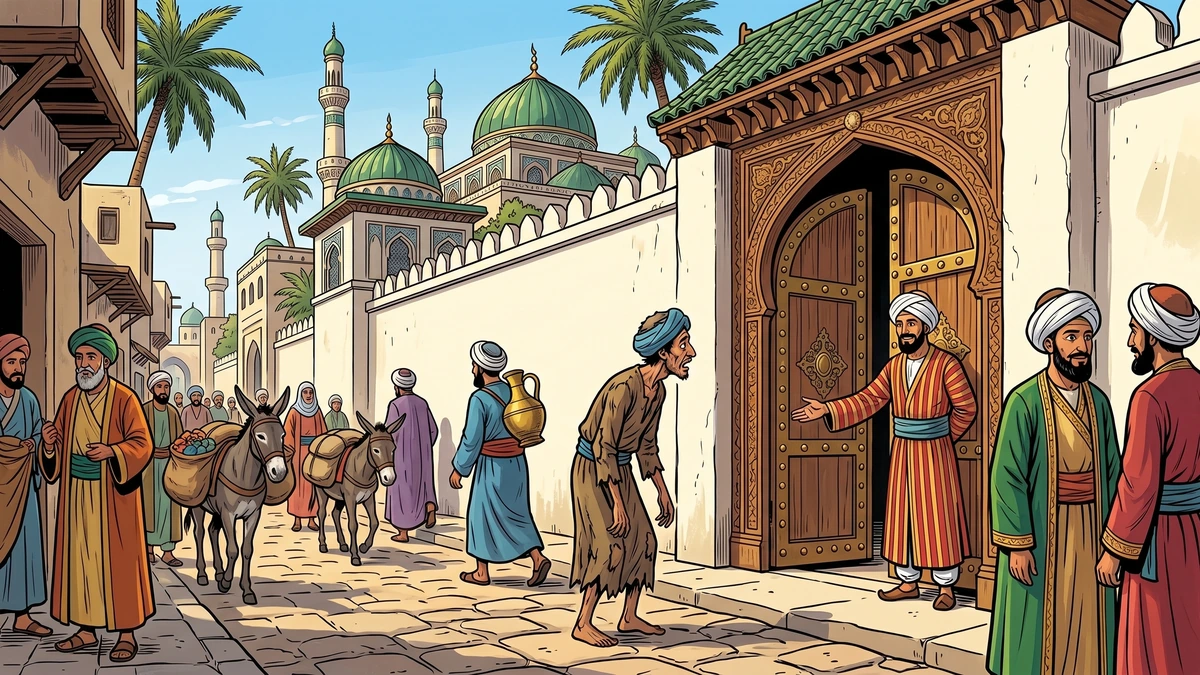
The Barber Begins His Last Tale
The Barber of Baghdad, that prodigious and self-celebrating talker of the Nights, has already told the Sultan of his own five ill-fated brothers: al-Bashar, the chatterbox; al-Haddar, the noisy one; al-Faqqa‘, the gabbler; al-Kuz al-Aswani, the long-necked jug; and al-Nashshar, the braggart. He now turns, with theatrical solemnity, to the sixth and youngest. “O Commander of the Faithful,” he says, “my last brother was named Shakashik — which is to say, the one who lacks — for poverty followed him like his own shadow, and yet his patience was greater than all of ours combined.”
Shakashik, the Barber explains, had once been a man of modest means. A run of misfortune — a partner who fled with the takings, a fire that ate the storeroom, a fever that carried off his wife — had reduced him to the most absolute of beggars. He had, by the day this tale begins, eaten nothing for two days and a night. He wandered the streets of Baghdad on the side of the river Tigris where the great houses stood, hoping the smell of food from a kitchen window might keep his stomach from twisting itself inside out.
So he came, at last, before a tall and beautifully wrought gate of carved cedar, set into a high wall of white stucco above which rose the pointed cupolas of an enormous private mansion. The doorman, recognising at once a starving man, did not chase him away. “Ring the bell, brother,” said the doorman, “for our master is the most generous of all the Barmakids, and he turns away no one in need.”
The Mansion of the Barmecide
The master of the house, in the framing of the Nights, is identified as a Barmaki — that is to say, a member of the great Persian noble family of the Barmakids, whose ancestor had been a barmak or high priest of the famous Buddhist monastery of Nawbahar outside Balkh, in present-day Afghanistan. Converted to Islam in the early eighth century, the family had risen to become the most powerful viziers under the ‘Abbasid Caliphs al-Mansur, al-Mahdi and Harun al-Rashid. Yahya ibn Khalid al-Barmaki and his son Ja‘far were household names in the Baghdad of c. 786–803 CE; their wealth and patronage of poets and scholars was, even in their own lifetime, the stuff of legend. Their fall — Ja‘far executed by Harun al-Rashid in 803 and parts of his body displayed on the bridges of Baghdad — was equally famous, and gave their name a long literary afterlife as a synonym for spectacular, unstable munificence.
It is the more telling, then, that the storyteller chooses a Barmecide as the host of this particular fable. The Barmecide of the tale is a tall, thin man of great age, dressed in a robe of striped Khurasan silk, his beard parted by hand into seven white forks. He receives the beggar with all the courtesy due to a wandering sage. “Welcome, welcome, my brother in God,” he cries. “You arrive, by the will of Allah, at the very hour of my own dinner. Sit, sit, in the seat of honour, and let us eat together as fellow travellers in this brief world.”
Shakashik, who had not heard such words addressed to him in years, almost wept with relief. He bowed three times, settled himself among silk cushions, and waited.
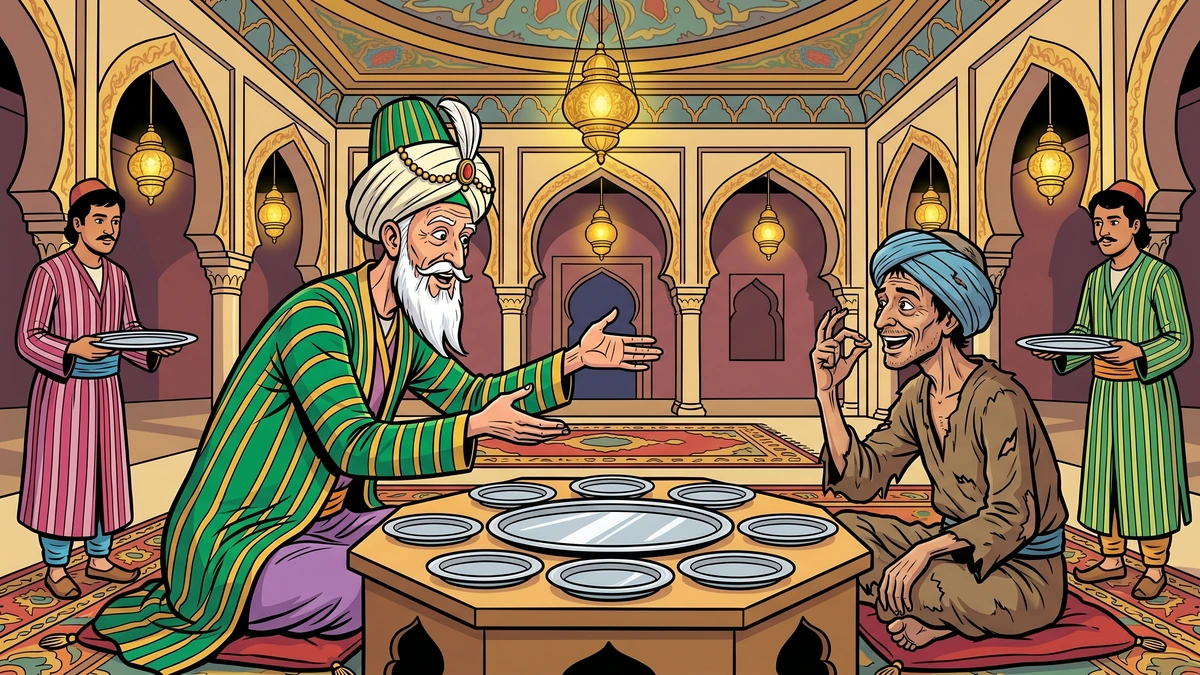
The Phantom Banquet
The host clapped his hands. A servant approached and set down, with infinite care, an enormous silver tray on which there was — nothing. The tray was empty. The Barmecide bent over it as though over a roasting bird and inhaled deeply. “Smell this, O my guest!” he cried. “Was there ever such a kid as my cook has prepared today — stuffed with pistachios and almonds, glazed with rose-water and saffron! Eat, eat, before it grows cold.”
Shakashik understood at once. He had heard of the Barmecide’s strange humour. To stand on dignity, to walk out, to weep — any of these would have been to lose the game and to lose the chance of any food at all. So he leaned forward, mimed pinching a piece of meat between his fingers, raised it to his mouth, and chewed with great satisfaction. “O master,” he said, “in all my travels I have never tasted a kid so tender. Allah keep your cook a hundred years.”
The Barmecide laughed with pleasure. Another tray was brought. This one, too, was empty. “Ah, the sikbaj!” the host cried — sikbaj being the famous sweet-and-sour vinegar stew of medieval Baghdad, made with fat lamb, almonds, dates and saffron. “My cook has used the recipe of the great al-Mahdi himself. Do not be shy, my friend.” And Shakashik fell upon the empty tray with imaginary spoonfuls and praised the dish to the heavens.
And so it continued. Dish after dish was paraded in: imaginary tharid (the Prophet’s own bread-and-broth), imaginary roast goose with apples and quinces, imaginary khabis (the spiced date-sweet), imaginary falúdhaj (almond pudding with rose-water), imaginary sand-grouse stuffed with pistachio nuts. With each invisible plate, the host’s descriptions grew more elaborate; with each invisible mouthful, Shakashik’s flattery grew more inspired. He pretended to be too full. He pretended to belch politely. He pretended to wipe his beard.
At last came the wine. The Barmecide poured an invisible cup from an invisible flagon. “This wine, O my friend, was laid down in the year of the caliph al-Saffah. Drink, drink — it is older than your grandfather’s memory.” Shakashik raised the empty cup, drank, and made the small theatrical sigh of a satisfied man. A second cup. A third. A fourth. “Ya sidi,” he said at last, swaying on his cushion, “your wine is stronger than I had remembered. I fear I shall do something unworthy of your roof.”
The Slap and the Real Feast
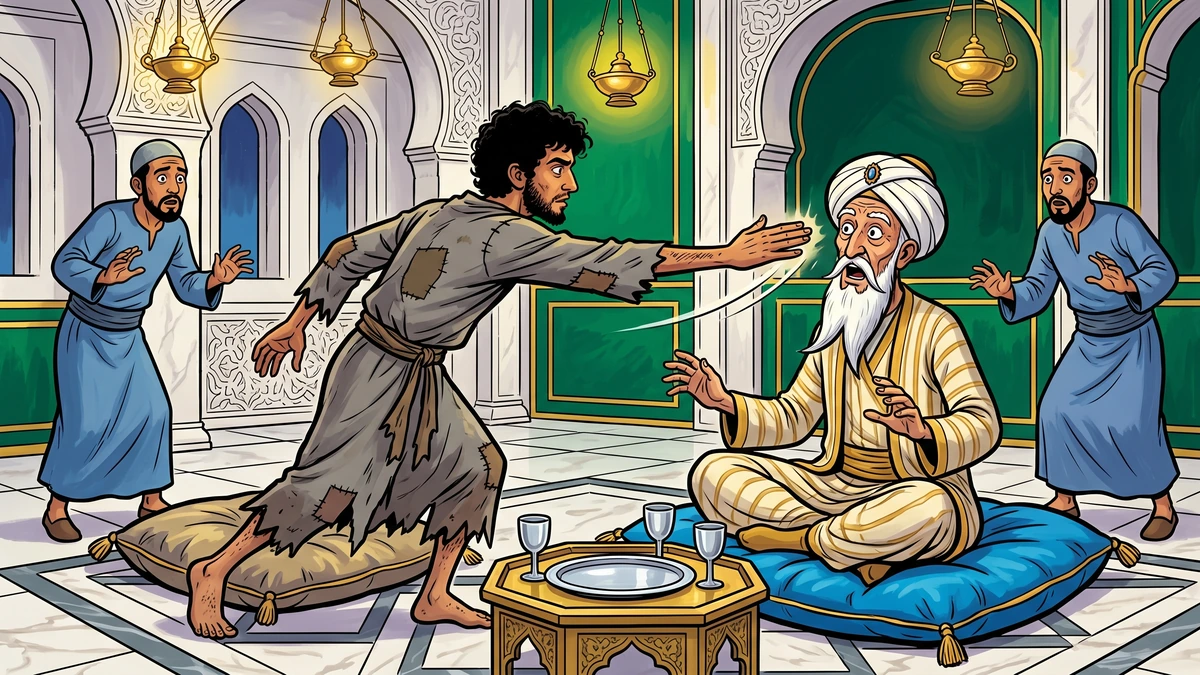
And here, with the Barber’s characteristic relish, the tale turns. Shakashik rose to his feet as a man rises when very, very drunk. He staggered toward his host with eyes half closed. And then, in one swift movement, he drew back his open hand and brought it down on the Barmecide’s cheek with a sound that echoed off the marble walls. The startled servants froze. The slap rang in the air. The old Persian nobleman stared at the beggar in shock.
“O Barmaki,” said Shakashik, opening his eyes calmly and bowing low, “your wine, alas, is too strong for the brain of a poor man. Forgive your servant. You poured him four cups of so excellent a vintage that the manners of his fathers have departed from him.”
For one second the Barmecide’s face was unreadable. Then he threw back his head and roared with laughter — a great, free, delighted laughter that bent him double on his cushions and brought tears to his eyes. He pounded the floor with his fist. He called upon Allah to bless this poor man’s wit. “O my brother,” he gasped at last, “for many years I have served this dinner to many guests, and every one of them has gone away offended or weeping or both. You alone have understood the game and played it back to me with such grace. From this day forward you shall not leave my house.”
And here the tale tips abruptly out of jest and into generosity. The host clapped his hands a different way. The doors of the great kitchen opened, and the slaves brought in — not invisible food now, but the real tharid and the real sikbaj and the real roast kid and the real almond pudding, all that had been mimed before now placed in true dishes of bronze and silver before Shakashik’s astonished eyes. The Barmecide and the beggar ate together until the small hours; then the host took Shakashik into his household, gave him robes of honour, set him over his stores, and treated him as a son. For twenty years, the Barber says, his sixth brother lived in the Barmecide’s house in honour and ease. And only when the old Persian died did Shakashik return, robed in mourning and weeping, to his brothers in Baghdad — carrying with him the wealth which patience and a well-judged slap had earned him.
The Moral, in the Mouth of the Barber
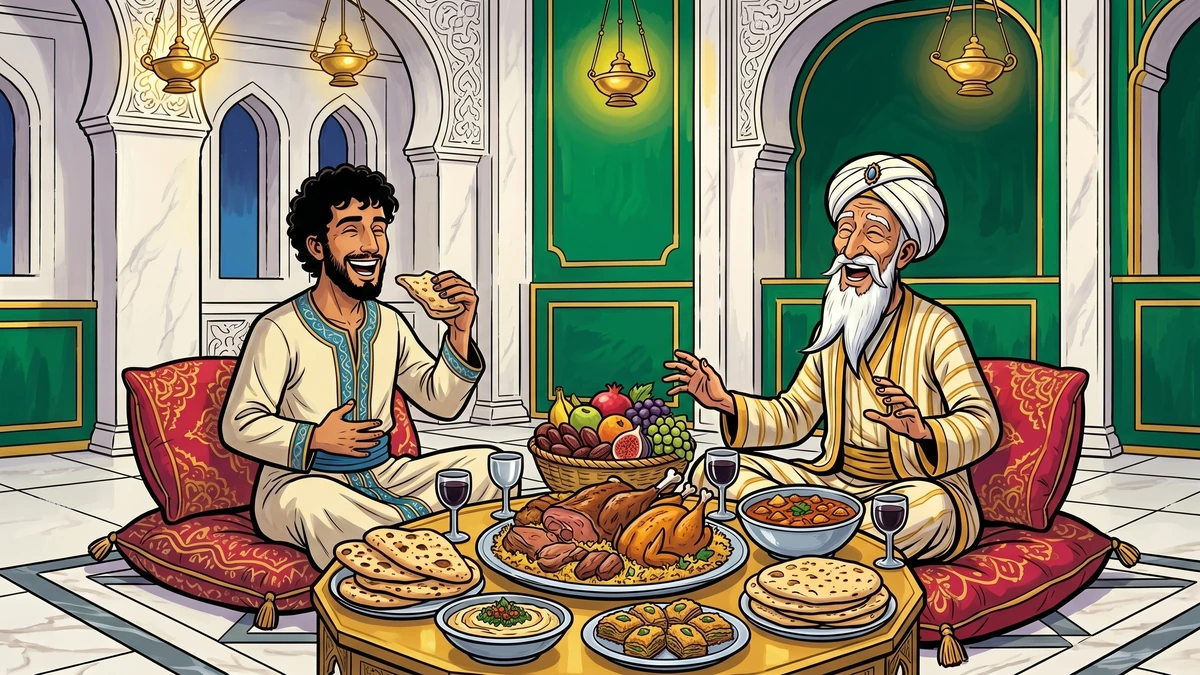
The Barber, having finished, looks at the Sultan and explains the moral in his usual self-important fashion. The proverb that closes the tale in the Arabic of the Macnaghten recension is one of the most quoted of all the lines attributed to Shahrazad. The original reads:
« الصَّبْرُ مِفْتاحُ الفَرَجِ، وَمَنْ صَبَرَ ظَفِرَ. »
— Alf Layla wa-Layla, Night 32, end of the Barber’s Sixth Tale (Macnaghten / Calcutta II edition)
“Patience is the key of relief, and whoever endures shall triumph.”
Shakashik triumphs not because he is clever — the slap is improvised, almost accidental — but because he is patient enough to keep playing a game whose end he cannot see. The Barmecide’s charity is real, but it is hidden behind a test of dignity. To pass it, the beggar must accept humiliation without resentment and humour without bitterness. This is the moral spine of the tale: that true generosity often comes disguised as mockery, and that the best response to a strange host is neither anger nor flattery but a calm willingness to play through.
Why This Tale Has Endured
The Barmecide Feast survives because it captures, in one elegant comic scene, a tension that every culture knows: the chasm between the rich and the hungry, and the question of what the hungry man owes the rich one in return for charity. The story turns on a hinge that is half cruel and half generous. The rich man toys with the beggar; the beggar refuses to be broken; and in that refusal he wins not pity but partnership. By the end the two men are eating together as equals, and the social abyss between them — for one hour — closes.
The image was so vivid that by the late eighteenth century the word Barmecide had entered English as both a noun and an adjective for any pretended generosity, any feast which is all show. The Oxford English Dictionary records its first English appearance in 1763 (in a translation of the Nights) and notes that Samuel Johnson, Charles Dickens (in David Copperfield) and Robert Louis Stevenson all used “Barmecide” in this metaphorical sense. The same phantom-feast motif recurs in Hans Christian Andersen’s “The Emperor’s New Clothes” (1837), where the trick is reversed: there, the powerful are conned and the child sees through it.
The tale also memorialises the historical Barmakids. In the popular imagination of medieval Iraq, the family stood for breathtaking munificence, and their downfall in 803 made any reference to them a memory of greatness lost. Robert Irwin observes in The Arabian Nights: A Companion (Penguin, 1994) that the Barmecide of this tale — eccentric, theatrical, finally kind — is in some sense an oblique elegy for the real Barmakids: a comic refraction of a vanished court.
Canonical Attribution & Scholarly Context
Arabic title: Hikayat al-Hallaq ma‘a Akhihi al-Sadis (حكاية الحلاق مع أخيه السادس) — “The Tale of the Barber with His Sixth Brother.”
Position in the Nights: Nights 31 and 32 in the Calcutta II (Macnaghten) recension, 1839–1842. The tale forms the final segment of the long Barber-of-Baghdad cycle, which itself is nested inside “The Hunchback’s Tale” (Nights 25–33). The Barber tells of his six brothers in turn, and the sixth, Shakashik, is the climax.
Major English translations: The story first reached Europe in Antoine Galland’s French Les Mille et Une Nuits (Paris, 1704–1717), Vol. II, “Histoire du Sixième Frère du Barbier.” Edward William Lane gave a careful and bowdlerised English version in The Thousand and One Nights, commonly called in England The Arabian Nights’ Entertainments, Vol. I (London, 1840), pp. 374–385. The standard unabridged English text is Sir Richard Francis Burton’s The Book of the Thousand Nights and a Night, Vol. I (Benares, 1885), pp. 350–361. J. C. Mardrus translated it for his French Mille et Une Nuits, Vol. II (1899), and Husain Haddawy’s The Arabian Nights (Norton, 1990) and Malcolm Lyons’s Penguin Classics edition (2008) both contain modern renderings.
Tale-type classification: ATU 1545* (“The Boy with Many Names” / phantom-feast variant) overlapping with ATU 1610 (“Dividing the Gifts”). Hans-Jörg Uther, The Types of International Folktales (Helsinki, 2004), discusses the imaginary-feast motif separately under Motif J1341 (“The Stupid Guest”) and K1984 (“Deceptive bargain”) of Stith Thompson’s Motif-Index of Folk-Literature.
Reference work: Ulrich Marzolph & Richard van Leeuwen, The Arabian Nights Encyclopedia (ABC-CLIO, 2004), entries “Barber’s Tale of his Sixth Brother” (Vol. I, pp. 91–92) and “Barmakids” (Vol. I, pp. 93–94). For the historical family see Kevin van Bladel, “The Bactrian Background of the Barmakids,” in Islam and Tibet: Interactions along the Musk Routes (Ashgate, 2011), and Hugh Kennedy, The Court of the Caliphs (Weidenfeld & Nicolson, 2004), Chs. 5–7.
Linguistic legacy: The English word Barmecide (noun and adjective) is first recorded in 1714 (Steele in The Englishman) and was firmly established by the time of Johnson’s Dictionary (1755). Dickens uses “Barmecide Room” in David Copperfield (1849), Ch. 28, and Stevenson uses “Barmecide feast” in The Wrecker (1892). The Persian and Ottoman Turkish languages preserve the proverbial sense of the tale as well.
Cognate tales: Hans Christian Andersen, “The Emperor’s New Clothes” (1837); the Spanish trickster story of El Conde Lucanor (Tale 32, “Of what happened to a King with the swindlers who made cloth,” 1335); the Talmudic tale of the poor scholar at the rich man’s table (b. Eruvin 53b); and the Chinese imperial story of the empty bowls in Liu Yiqing’s Shishuo Xinyu (5th c.).
For the Modern Reader
What is the Barmecide Feast in the end? A cruel game? A profound test? A piece of street-wise comedy? It is all three at once, and that is why it has refused to die. Every age finds in it some new metaphor: in the eighteenth century it was a comment on the empty promises of patronage, in the nineteenth a fable of capitalist plenty for the poor, in the twentieth a parable of advertising. In the twenty-first, it might be read as a small masterpiece on the dignity of the hungry and the strange unreliability of generosity.
Shakashik does not win because he is wise. He wins because he is patient, because he plays along, and because at the right moment he turns the joke around. The tale’s sympathy is unmistakably with him — with the man who has nothing and who, when offered nothing, refuses to be diminished by it. That, more than any feast, is what the storytellers of Baghdad wished to set down.
You May Also Like
 Arabian Nights
Sinbad the Sailor: The Second Voyage
The voyage of the Roc and the Valley of Diamonds. Marooned on a deserted island, Sinbad ties himself to a giant bird, survives a ravine of serpents and gem-strewn rock, and rides a slab of meat back to freedom and fortune.
 Arabian Nights
Ages 9-12
Arabian Nights
Ages 9-12
Scheherazade and the Sultan
Scheherazade and the Sultan: In the great city of Baghdad, there lived a Sultan named Shahriar who had been betrayed by his first wife. In his grief and rage
 Arabian Nights
Ages 9-12
Arabian Nights
Ages 9-12
The Enchanted Horse and the Princess of Bengal: Love Across the Skies
The Galland-Lang version of the Arabian Nights tale of the ebony horse (ATU 575): Prince Firuz Shah of Persia rescues the Princess of Bengal in a love story that crosses the widest geography in world folklore.