Scheherazade and the Sultan
Scheherazade and the Sultan: In the great city of Baghdad, there lived a Sultan named Shahriar who had been betrayed by his first wife. In his grief and rage
Origin: Arabic Alf Layla wa-Layla (The Thousand and One Nights) — the frame story itself, Hikayat al-Malik Shahrayar wa-Akhihi al-Malik Shahzaman (“The Story of King Shahrayar and His Brother King Shahzaman”), and the prologue introducing Shahrazad (Persian Chehrāzād, “Of Noble Origin”). The frame is older than the Arabic collection: it descends from the lost Middle Persian Hazār Afsān (“A Thousand Tales”), itself drawing on an Indian story-cycle tradition.
Textual witnesses: the Galland Manuscript (Bibliothèque nationale de France, MS arabe 3609–3611, 14th–15th c. Syrian recension); Bulaq 1835; Calcutta II / Macnaghten 1839–1842; Calcutta I 1814–1818; Breslau (Habicht) 1825–1843.
Earliest external mentions: al-Masʻudi, Muruj al-Dhahab (947 AD), names Alf Khurafa as a translation of the Persian Hazār Afsān; Ibn al-Nadim, Kitab al-Fihrist (Baghdad, c. 987 AD), confirms the Persian origin and summarises the very frame — a king who kills each bride at dawn, until “a clever woman” stops him with stories.
Translators & transmission: Antoine Galland, Les Mille et Une Nuits, Paris 1704–1717 (12 vols.); Edward William Lane 1838–1840; John Payne 1882–1884; Sir Richard Francis Burton, Plain and Literal Translation of the Arabian Nights’ Entertainments, 10 vols. 1885 + 6 Supplemental Nights 1886–1888; Husain Haddawy (after the Galland MS), 1990.
Motifs & type: Aarne–Thompson–Uther frame motif Z11 (“Endless tale” / nested narrative); H561 (“Clever girl”); T172.0.1 (“Bridegroom kills wife on bridal night”); J1185.1 (“Scheherazade: woman saves life by telling endless stories”). Robert Irwin (The Arabian Nights: A Companion, 1994) and Mia Gerhardt (The Art of Storytelling, 1963) are the standard modern studies.
Before any of the famous tales — before the lamp, the carpet, the talking fish, the city of brass — there is the woman in the lamplight, and the king who has sworn to kill her at dawn. The whole of the Thousand and One Nights stands on the slender thread of her voice. This is her story: not one of the tales she tells, but the tale that frames them all.
The frame is one of the oldest pieces of the collection. The lost Persian Hazār Afsān — “A Thousand Tales” — is described in two tenth-century Arabic sources, the historian al-Masʻudi (writing in 947 AD) and the Baghdad bookseller Ibn al-Nadim (whose Fihrist was completed about 987). Both men name the Persian original; both say it had already been translated into Arabic; both summarise the very frame readers still read today. By the time Antoine Galland brought the first volumes to Paris in 1704, the prologue had passed through Sanskrit, Pahlavi, and three centuries of Cairene and Damascene scribes — and it had not changed in its essentials. A king kills a wife each dawn. A clever woman stops him with stories.

A Wound in Two Kingdoms
The Galland Manuscript opens in the days of the Sasanian empire, before the coming of Islam, when two royal brothers ruled the islands of India and China. The elder, Shahrayar (Persian Shahriyār, “the king-friend”), held the lands of India and Indochina. The younger, Shahzaman, ruled Samarkand. They had not seen one another for twenty years, and at last Shahrayar sent his vizier to bring his brother on a visit.
What followed has shocked and intrigued every translator. On the night of his departure Shahzaman discovered that his wife had betrayed him with one of the palace servants. He killed them both and rode for India with his grief locked inside his chest. At Shahrayar’s court he could neither eat nor sleep, and the elder brother, mistaking the cause, pressed him until Shahzaman confessed. The two kings, hunting together a few days later, returned secretly to the palace and saw with their own eyes that the queen of India, Shahrayar’s own wife, was no more faithful than Shahzaman’s. The brothers were brought to the same pit at the same hour: a betrayal of trust no king has ever forgiven, and no scribe in the long history of the Nights has ever softened. The Bulaq, Calcutta II, and Breslau texts agree on this prologue almost word for word.
The brothers, in despair, left the palace together and went into the wilderness. There, beneath a tree by the sea, they met a third betrayed husband — an ʻifrit (jinni) who had locked his bride in a glass chest and carried her with him to the ends of the earth, and who was nevertheless deceived by her. “We are not alone,” Shahrayar said to his brother, “and there is no remedy on earth for what has been done to us.” Shahzaman returned to Samarkand. Shahrayar returned to the palace of India and put to death his queen and all who had served her, and on that day he made his vow.
The Vow and the Vizier’s Despair
Shahrayar would marry no woman as his wife again. Each evening he would take a new bride from among the daughters of his subjects, and each dawn the executioner would put her to death before her tongue could betray him. For three years — the manuscripts vary; some say one year, some say “a long time” — the executioner came at dawn and the vizier provided the brides. The mothers of the city wept until they had no tears. The merchants smuggled their daughters across the borders into the territory of the King of China. At last there came a day when the vizier returned home and could find no maiden left in the kingdom.
He sat alone in his chamber and put his head in his hands. He was an old man, learned in the Qurʾan and the histories of kings, and he had two daughters of his own. The elder he had named Shahrazad (Persian Chehrāzād, “Of Noble Lineage”; sometimes rendered Shirazad or Scheherazade after Galland’s French). The younger he had named Dunyazad (Persian Dunyāzād, “Of Worldly Birth”; in some Arabic manuscripts Dinarzad, in Galland Dinarzade). Shahrazad had read, the manuscripts say, “the books, the annals, and the legends of preceding kings, and the stories, examples, and instances of bygone men and things.” She is described as ʻālimah, fāḍilah — “learned, accomplished” — with a thousand tales by heart.
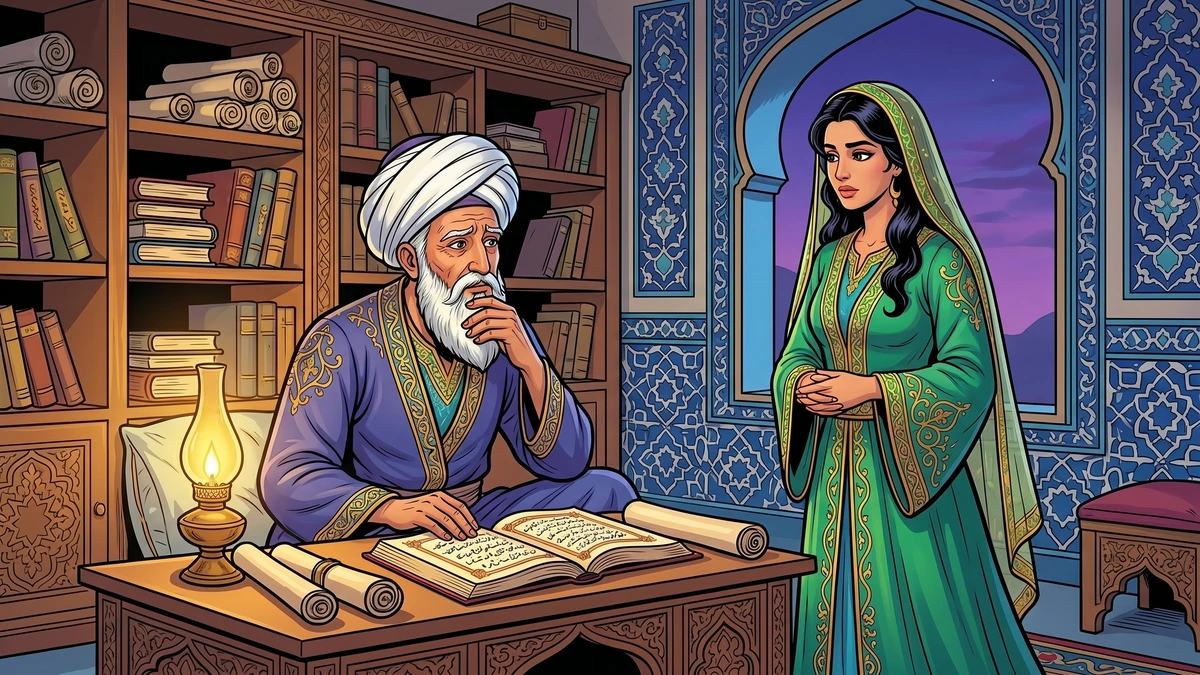
That evening Shahrazad came into her father’s chamber and said, “Father, give me in marriage to the king.” The vizier stared at her as though she had become a stranger. He told her the story of the donkey and the ox and the merchant who understood the speech of beasts, a parable in which a husband almost kills his wife and is talked out of it just in time. He meant it as a warning. She listened politely and answered, “Father, by Allah, even were you to tell me a thousand such tales, you would not turn me from my purpose. Give me in marriage to the king. Either I shall live and be the deliverance of the daughters of the Muslims from his hands, or I shall die and perish as those before me have perished.” The vizier wept; she did not weep. At sunrise he went up to the palace and informed Shahrayar that his own daughter would be the next bride.
The First Night — and the Sister at the Foot of the Bed
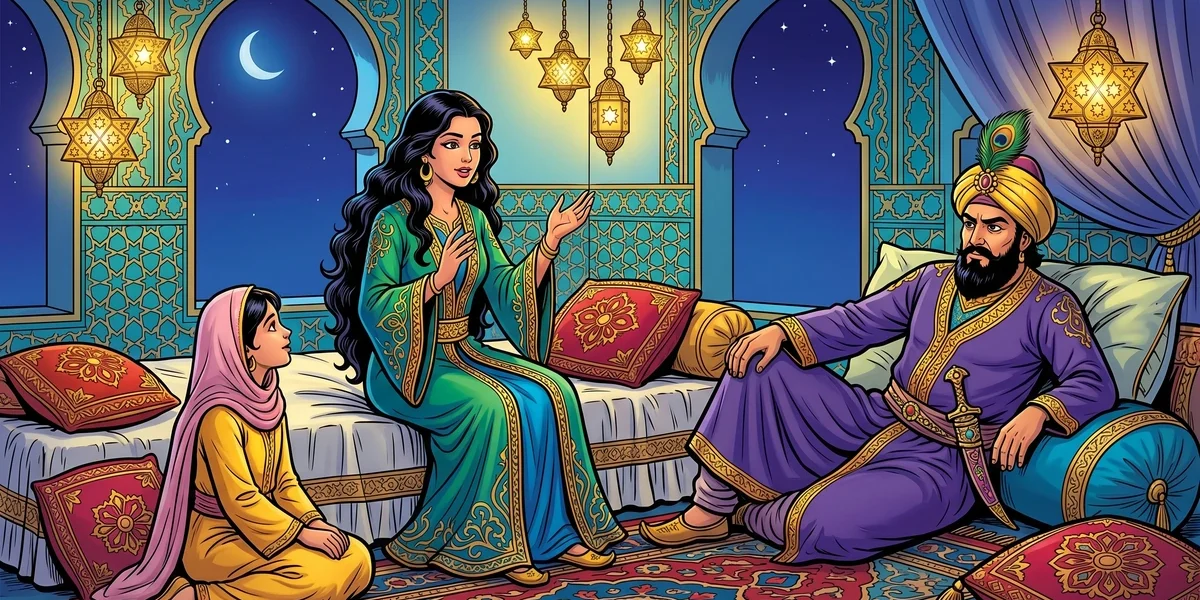
Before she went to the palace Shahrazad called her younger sister Dunyazad to her and spoke with her in private. She gave Dunyazad a single instruction: when the king has taken me as his wife, I will send for you. You will come into the chamber and sit on the floor at the foot of the bed. When the night is half spent and you see that I am awake, you will say to me, “Sister, if you are not asleep, tell me one of your delightful stories to beguile our waking hours.” Then I will tell, and the king will listen.
So it was done. The wedding was completed; the king sent for the vizier’s daughter; and at midnight Dunyazad came as she had been instructed and asked for a tale. Shahrazad turned to Shahrayar and said, “With the king’s permission?” He, sleepless and angry, gave it. She began the Tale of the Merchant and the Jinni. She told it through the dark hours, and when the first thread of grey appeared at the window she stopped — in the Bulaq edition, exactly at the words “but the dawn overtook Shahrazad, and she lapsed into silence.” The king, his curiosity caught against his will, did not order her execution that day. He delayed it by one night. And by one night she lived.
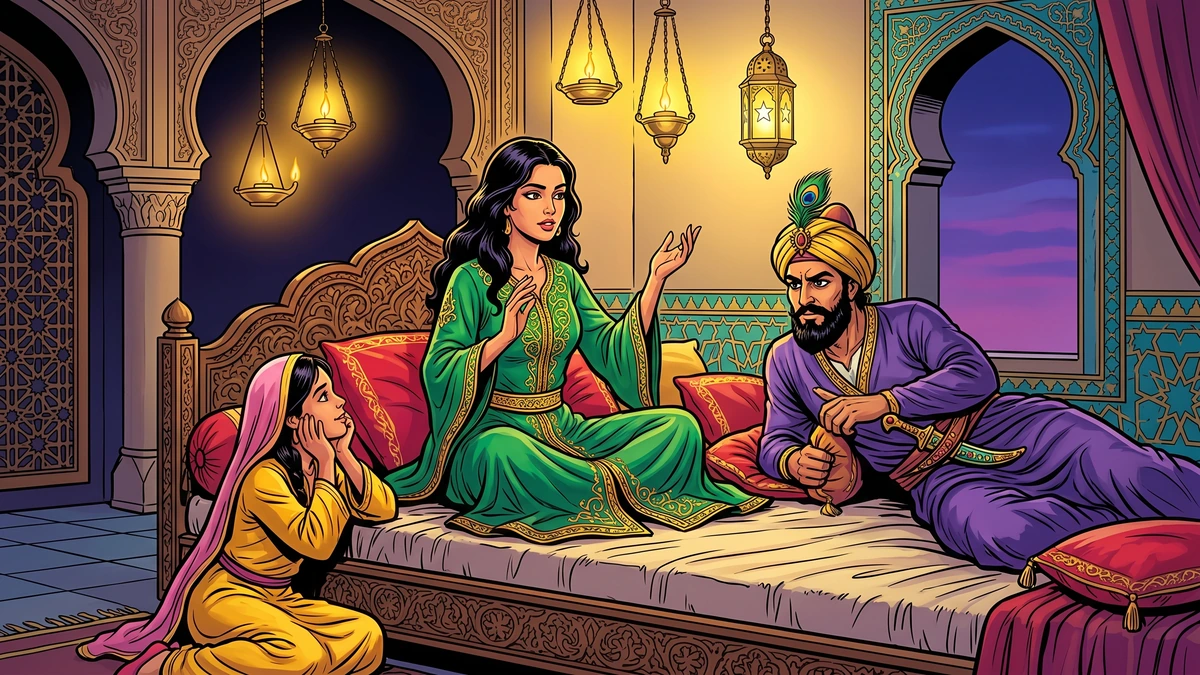
So the stories went on. The Tale of the Fisherman and the Jinni. The Three Apples. The Three Kalandars. Sindbad the Sailor. The City of Brass. Hundreds of tales nested inside one another the way matryoshka figures do, each ending at dawn on a cliff, each beginning again at midnight when Dunyazad — faithful, awake, beloved — asked her sister for another. The book-scholars call this device the frame tale, and the Sanskrit tradition that shaped the Persian original (the Panchatantra, the Kathasaritsagara, the Sukasaptati) had perfected it a thousand years before Shahrazad opened her mouth. But no other frame in world literature carries such weight: every story Shahrazad tells, the death of every character in it, is also her own life. The reader cannot forget the executioner waiting in the next room.
The Thousand and One Nights
The number “a thousand and one” is itself part of the meaning. In the Arabic of the manuscripts, alf (“a thousand”) is the conventional way of saying “very many indeed”; alf wa-layla (“a thousand and one”) adds the extra night to break the round number and signal that the count is no longer poetic but real. The Galland Manuscript, the oldest, ends at Night 282 and breaks off mid-story; later compilers and translators filled in the missing nights from other tales, sometimes by stitching in unrelated cycles (the Calcutta II text includes the Sindbad and the Aladdin sequences; the Mahdi critical edition of 1984 rejects most of them as later additions). Calcutta II is the only edition to actually reach Night 1001.
In the ending preserved in the Calcutta II manuscript, the morning of Night 1001 arrives and Shahrazad has finished her last tale — the long Tale of Maʻruf the Cobbler. She is silent. The king is silent. Then she rises from the bed and says, “O King of the age, I have a boon to ask of you.” She brings forward three little boys. The eldest is walking, the second is crawling, the third is at her breast. “These are your sons,” she says. “I bore them in the days and nights I told you stories. For their sake, if you would do so, spare my life.”
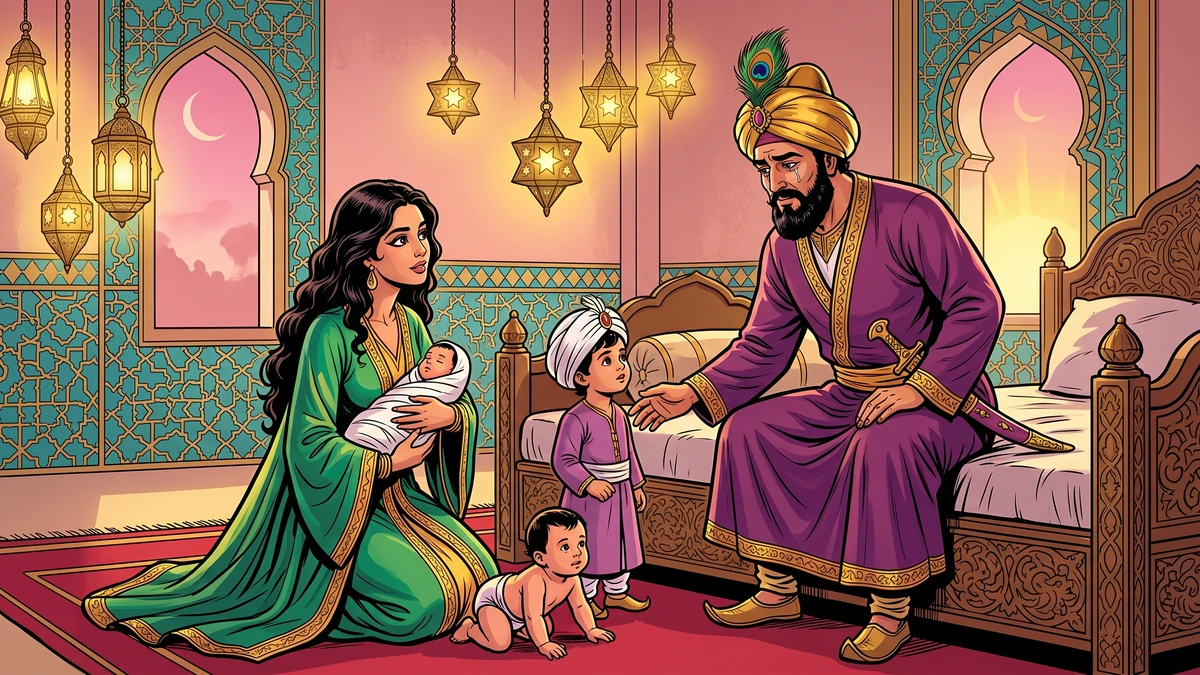
Shahrayar wept — the manuscript is quite specific about the king’s tears — and he embraced her and the children and said, “By Allah, I had already pardoned you, Shahrazad, before the children came. I found you chaste and pure, learned and wise. May Allah bless you and your father and your mother and your root and your branch.” The next day he summoned his vizier and ordered the wedding to be celebrated again, in public, with all the joy that had been denied the kingdom for three years. He sent for his brother Shahzaman in Samarkand. Shahzaman married Dunyazad. The book closes with a long blessing on storytellers and on listeners. Galland’s ending, transmitted from a different oral source by his Maronite informant Hanna Diyab, is briefer but agrees in essentials: the king pardons her, marries her openly, and her death is no longer the price of a story.
Moral — Why Storytelling Is the Older Power
The frame story makes a quiet argument that violence is a small thing beside the imagination, and that the imagination — if it is generous, and if it is patient — can outwait cruelty. Shahrayar’s vow is undone not by counter-violence and not by reasoned argument but by a thousand and one nights of attention. He becomes, in slow degrees, a man who can listen. The Bulaq edition prints the king’s pardon with this Arabic line, attributed in some manuscripts to the early proverb-collectors:
إنَّ الحِكايةَ أَطْوَلُ عُمراً مِنَ السَّيف
“Innaʾl-ḥikāyata aṭwalu ʻumran min al-sayf” — “A story lives longer than a sword.”
The proverb is older than the book. Shahrazad weaponises nothing; she withholds nothing. She offers Shahrayar the thing he has refused himself for three years — the company of a human voice past midnight — and asks nothing for it but that the next night may come. The risk she takes is not the risk of dying, which her sisters in the city have taken without choice; it is the more frightening risk of being heard. To tell a story to a man who has killed every woman before her is to assume he is capable of being a different kind of man. The book is the record of that assumption proving correct.
Why the Tale Has Lasted
No other frame story in world literature has carried so heavy a load. Edgar Allan Poe wrote a sequel, The Thousand-and-Second Tale of Scheherazade (1845), in which the king kills her after all because the last tale is too implausible. Tennyson’s Recollections of the Arabian Nights (1830) makes her the patroness of all poets. Rimsky-Korsakov’s symphonic suite Scheherazade, Op. 35 (1888), gives her a solo violin line of unbearable tenderness against the king’s heavy brass. Jorge Luis Borges, who came back to her again and again, said in Seven Nights that “the night the queen began to tell her tales was a night without an end.” A. S. Byatt wrote The Djinn in the Nightingale’s Eye (1994) as a tribute. Salman Rushdie’s Haroun and the Sea of Stories (1990) and his more recent Two Years Eight Months and Twenty-Eight Nights (2015 — the title equals 1001 nights) are both extensions of her premise.
Feminist scholarship has rescued her from the orientalist frame in which Galland and Burton placed her: Fatema Mernissi (Scheherazade Goes West, 2001) reads her not as a passive captive but as a learned woman of the Abbasid court tradition — the figure of the jariya al-muʻallama, the educated companion-wife — who saves a kingdom by being more literate than its king. Suzanne Gauch (Liberating Shahrazad, 2007) and Yasmine Seale (in her 2021 retranslation) have followed. Marina Warner’s Stranger Magic (2011) places the frame at the centre of the modern novel: every framed narrator from Conrad’s Marlow to the unnamed voice of Italo Calvino’s If on a winter’s night a traveller is descended from her.
For children she remains what she has been since the first grandmother told it: the girl who outwitted the king with stories, and saved every other girl in the city, and was loved by her sister, and lived. There is no version of the tale in which Dunyazad is forgotten, because Shahrazad never tells a story without her. The two sisters at the foot of the bed are, in the end, the centre of the book. The thousand and one tales come from one of them. The patience to listen for a thousand and one nights comes from the other.
Frequently Asked Questions
Who is Shahrazad and where does her name come from?
Shahrazad is the daughter of King Shahrayar’s vizier in the frame story of Alf Layla wa-Layla, the Arabic Thousand and One Nights. Her name is Persian: Chehrāzād (“Of Noble Lineage” or, by another etymology, “Freeborn of the City”), with the variant Shirazad. The French form Schéhérazade, invented by Antoine Galland in 1704, is the spelling that reached English. She volunteers to marry the king in order to stop his nightly executions of new brides, and survives by telling him stories that end on a cliff at dawn each night.
Where does the frame story actually come from? Is it Arabic or Persian or Indian?
All three, in layers. The Arabic Alf Layla wa-Layla as we have it dates from the 9th–15th centuries in Iraq, Syria, and Egypt. The frame is older: al-Masʻudi (947 AD) and Ibn al-Nadim (c. 987 AD) both report that it was translated into Arabic from a lost Middle Persian book called Hazār Afsān (“A Thousand Tales”). That Persian book in turn drew on the older Indian frame-tale tradition — the Panchatantra, Kathasaritsagara, and Sukasaptati all employ a clever speaker telling stories to delay a violent outcome. Shahrazad’s frame is the most famous descendant of that tradition.
Why one thousand and one nights, and not just a thousand?
In the Arabic of the manuscripts, alf (“a thousand”) is a conventional poetic way of saying “very many”; alf wa-layla (“a thousand and one”) adds the extra night to break the round number and signal a literal count. The Galland Manuscript (the oldest, BnF MS arabe 3609–3611) actually breaks off at Night 282 and includes only a few dozen complete tales; the count of 1001 is reached only in the late Calcutta II / Macnaghten edition (1839–1842), where later compilers added the Sindbad, Aladdin, and Ali Baba cycles to fill the nights. The critical edition of Muhsin Mahdi (1984) rejects most of these later additions as orphan tales.
What part does the younger sister Dunyazad play?
Dunyazad (also spelled Dinarzad in some Arabic manuscripts, and Dinarzade by Galland) is Shahrazad’s younger sister, and her role is essential: she is the listener whose presence in the room makes the storytelling possible. By Shahrazad’s prior instruction, Dunyazad sits on the floor at the foot of the royal bed each night and asks for a story when the night is half spent. Shahrazad answers her, and the king listens. Without Dunyazad’s prompted question, no Arabian Nights tale would be told. The frame closes by giving her in marriage to Shahrayar’s brother Shahzaman, so that the two pairs of royal marriages mirror one another.
Who translated the Nights into European languages, and how did Shahrazad reach the West?
Antoine Galland, a French orientalist working in Paris, published the first European translation as Les Mille et Une Nuits in twelve volumes from 1704 to 1717. His manuscript source was the 14th- or 15th-century Syrian recension now in the Bibliothèque nationale de France (MS arabe 3609–3611); for tales not in that manuscript (including Aladdin and Ali Baba) he relied on the oral telling of the young Maronite scholar Hanna Diyab in 1709. Edward William Lane (1838–1840), John Payne (1882–1884), and Sir Richard Francis Burton (10 vols. 1885 plus 6 Supplemental Nights 1886–1888) followed with English versions. Husain Haddawy’s 1990 translation, based on Muhsin Mahdi’s critical edition of the Galland Manuscript, is the modern standard.
You May Also Like
 Arabian Nights
All Ages
Arabian Nights
All Ages
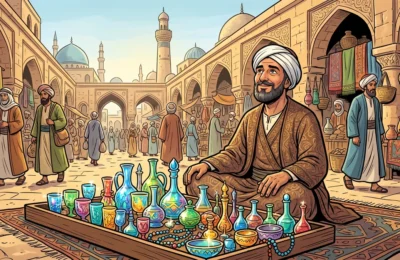
The Barber’s Story of His Fifth Brother
The barber's fifth brother, Al-Nashshar, invested his whole inheritance in glassware and, lost in a daydream of the fortune it would bring, kicked over the tray and shattered everything - the Arabian Nights tale that gave English the word 'Alnaschar'.
 Arabian Nights
Ages 9-12
Arabian Nights
Ages 9-12
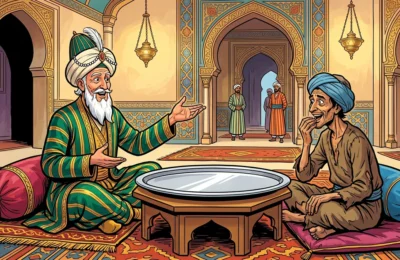
The Barber’s Tale of His Sixth Brother
Shakashik the starving beggar of Baghdad accepts an imaginary feast from a Barmecide nobleman, plays through the cruel charade with patience, and wins both real food and a place in the great house - the Arabian Nights tale that gave English the word 'Barmecide.'
 Arabian Nights
Ages 9-12
Arabian Nights
Ages 9-12
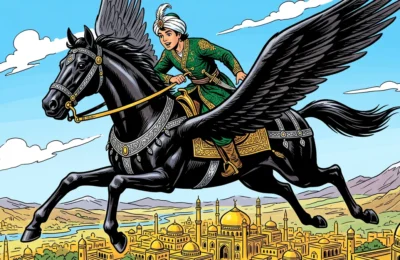
The Enchanted Horse
The Enchanted Horse, or Ebony Horse, from the Thousand and One Nights - a Persian prince masters a flying mechanical horse, wins a princess, and outwits the inventor who steals her away.