The Tale of the Three Apples
The Tale of the Three Apples from the Arabian Nights - one of the earliest murder mysteries ever told. A locked chest pulled from the Tigris, a three-day deadline, and a husband undone by his own haste.


Of all the tales that Shahrazad spins out across the long nights of Alf Layla wa-Layla, few feel as startlingly modern as this one. A locked box is pulled from a river. Inside it lies a crime. A powerful man gives an investigator three days to name the killer, on pain of his own life. More than a thousand years before anyone coined the word “detective,” the Arabian Nights had already written a murder mystery — and then, with a twist that still unsettles, refused to let it be a simple one.
Origin & Canonical Attribution
Collection: Alf Layla wa-Layla (ألف ليلة وليلة), “The Thousand and One Nights,” known in English as the Arabian Nights.
Tale: “The Story of the Three Apples,” also called “The Tale of the Murdered Woman.” In Edward William Lane’s English edition the episode is headed “Commencing with Part of the Eighteenth Night, and Ending with Part of the Twentieth” — the chapter heading that long served as this page’s title.
Place in the frame: Shahrazad (Scheherazade) narrates the tale to King Shahryar within the Harun al-Rashid cycle. It is taken up on the eighteenth–nineteenth night and flows directly into “The Tale of Nur al-Din Ali and his Son.”
Standard Arabic texts: the Bulaq edition (Cairo, 1835) and the Calcutta II / Macnaghten edition (1839–1842).
Major translations: Antoine Galland, Les Mille et Une Nuits (French, 1704–1717); Edward William Lane (English, 1838–1840); John Payne (1882–1884); and Sir Richard Francis Burton, The Book of the Thousand Nights and a Night (1885). The collection itself grew over many centuries from a lost Persian book of stories, Hazar Afsana (“A Thousand Tales”), gathering Arabic, Indian, Mesopotamian and Egyptian layers; the oldest surviving Arabic fragment dates to the ninth century.
What makes “The Three Apples” remarkable is not its setting but its shape. It belongs to the great cycle of stories built around Harun al-Rashid, the historical Abbasid caliph who ruled in Baghdad from 786 to 809, and his clever vizier Ja’far the Barmakid. In the Nights these two roam the night city in disguise, testing the justice of their own realm. Here, that habit of wandering pulls them into something far darker than the usual comedy of mistaken identity — a true crime, an innocent victim, and a question that the storyteller deliberately leaves ringing: how certain can a person ever be before acting on what they think they know?
The Chest Drawn from the Tigris
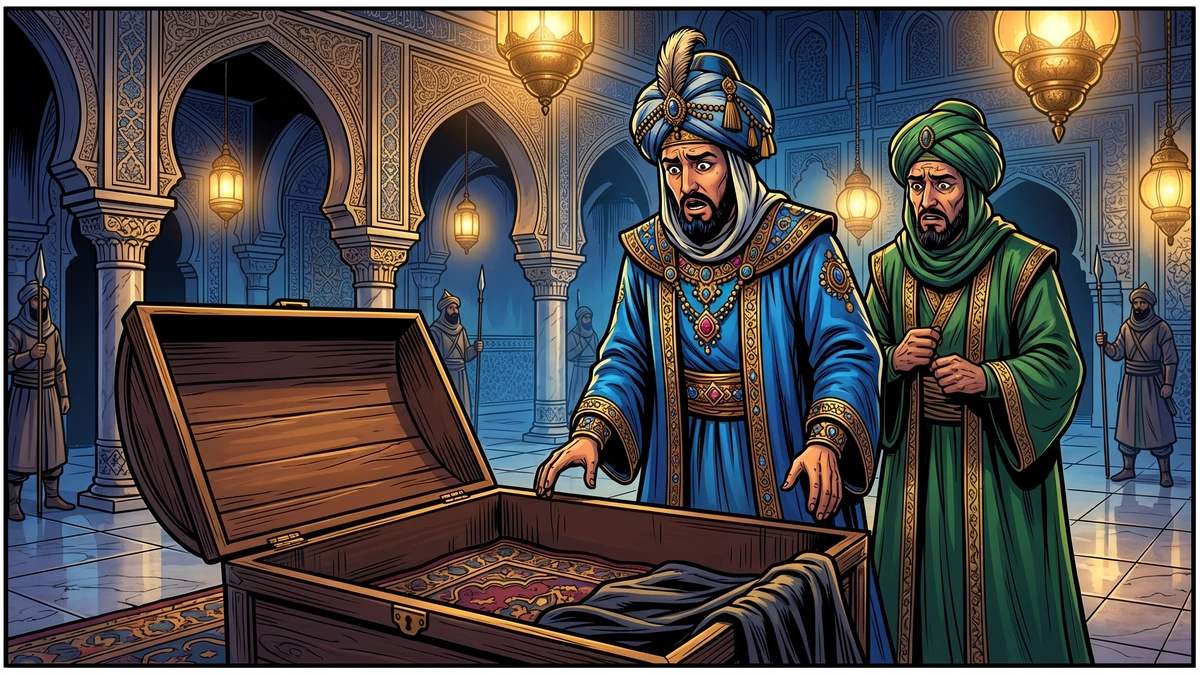
The tale opens with the Caliph restless. Harun al-Rashid summons Ja’far and announces that they will go down into Baghdad by night to learn how the city is truly governed — “him against whom anyone shall complain,” the Caliph says, “we will displace.” So the Caliph, his vizier, and the swordsman Masrur slip into the streets in plain clothes.
By the bank of the Tigris they meet a poor old fisherman, weary and empty-handed, reciting bitter verses about a learned man who cannot earn a day’s bread. Moved, Harun promises him a hundred gold pieces for whatever his next cast of the net brings up. The fisherman throws, hauls, and drags ashore not fish but a heavy chest, locked tight. The Caliph pays as promised and has the box carried back to the palace.
When the chest is broken open, the court recoils. Inside, wrapped in a cloak and a costly carpet, lies the body of a young woman, beautiful and richly dressed — and cut into pieces. The Caliph’s grief turns at once to fury. He rounds on Ja’far. Someone in his city has murdered this woman, and the crime has surfaced almost in his own hands. He gives his vizier an ultimatum with no softness in it: find the murderer within three days, or be hanged in his place.
It is worth pausing on how cleanly this sets up a structure readers now recognise instantly. A body. An authority figure. An investigator. A deadline. The Nights arrived at this architecture casually, as one tale among hundreds — yet it is the same scaffolding that would carry detective fiction more than a millennium later.
Ja’far’s Failure and the Two Confessions
Here the story does something quietly subversive: the investigator gets nowhere. Ja’far is the wisest man in the Caliph’s service, and he searches, and he finds nothing. There is no trail of clues, no overlooked detail, no flash of deduction. The woman is a stranger; no one comes forward; the city keeps its secret. Three days pass and Ja’far has failed completely.

On the appointed day he is led out to be executed. A crier is sent through Baghdad announcing that the Caliph’s vizier will die for the murder of the unknown woman, and inviting the whole city to watch. The scaffold is raised. Ja’far weeps, not for cleverness lost but for a life ending on another’s crime.
And then the tale turns. As the rope is readied, a handsome young man pushes through the crowd and cries out that the vizier must not die — he killed the woman. Before the moment can settle, an old man forces his way forward too, swearing that the young man is lying to spare himself and that he, the old man, is the true murderer. Each insists. Each demands to be put to death.
It is a strange and human scene: not a killer hiding, but two people competing to confess. Ja’far, suddenly the judge rather than the condemned, asks for proof. The young man answers by describing the murdered woman, the chest, the cloak, the carpet — every detail exactly, things only the killer could know. The old man can give no such account. The young man is telling the truth. He is taken before Harun al-Rashid, who, before passing sentence, demands to hear how such a thing came to pass. And so the young man tells his story.
The Three Apples and a Husband’s Haste
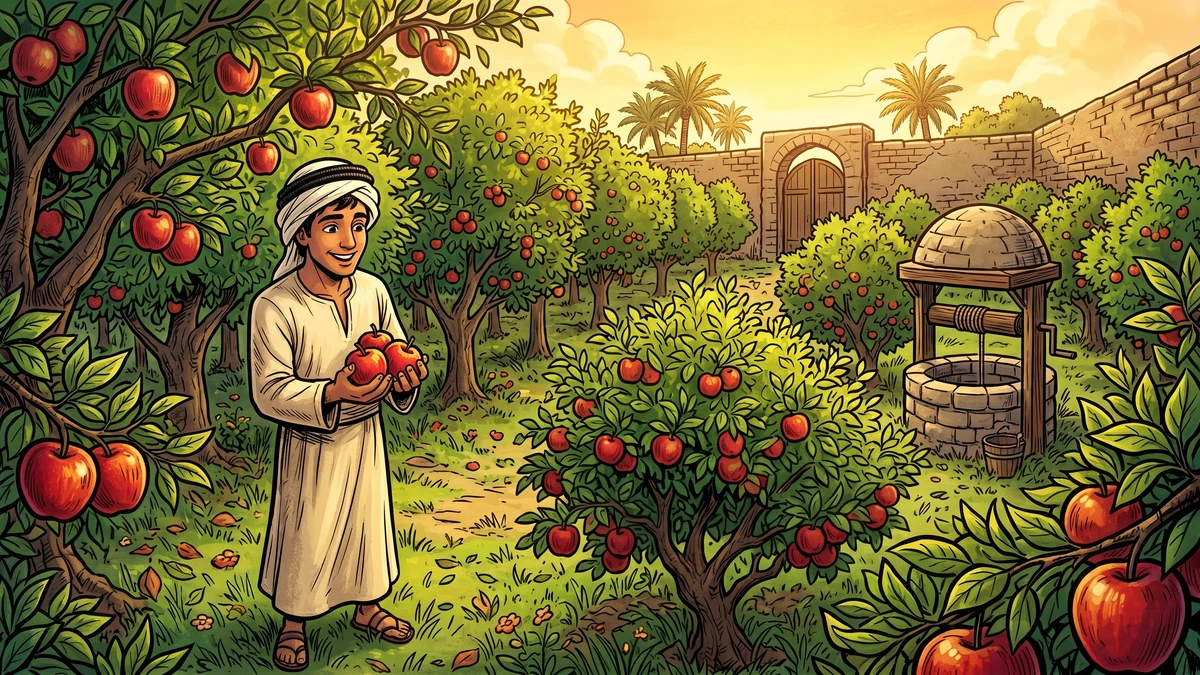
The murdered woman, the young man says, was his wife and the mother of his three children, and he had loved her without measure. She fell gravely ill. When he asked what might comfort her, she answered faintly that she longed for an apple. He searched every market in Baghdad and found none for sale at any price. At last he learned that the Caliph kept rare apples in an orchard at Basra. He travelled fifteen days there and fifteen days back — a month on the road for his sick wife — and returned with three apples bought, at last, for three gold pieces.
His wife, by then too weary even to want them, set the apples aside untouched. Soon after, the husband went to his shop. There, in the street, he saw a black slave pass by tossing an apple in his hand — and boasting. Where did you get that, the husband asked. The slave laughed and said his sweetheart had given it to him; her foolish husband, he said, had journeyed a whole month to Basra and come home with three apples bought for three dinars.
The words went into the husband like a knife. He rushed home and counted the apples on the shelf. There were only two. Where is the third? he demanded. His wife said she did not know. To the husband, in that instant, her not-knowing was a confession. Sick with jealousy and certain he had been betrayed, he fell upon the woman he had crossed a month of desert to comfort, and he killed her, and in his frenzy he cut her body apart, and packed it in a chest, and locked it, and at night cast it into the Tigris — the very river from which his Caliph’s net would later draw it.
Then comes the detail that turns grief into something unbearable. When the husband returned home, his eldest son was weeping. The boy confessed that he had taken one of the three apples to play with, and that a passing slave had snatched it from his hands and run off, asking where such a fine apple had come from — and the child had told him: my father brought it from Basra for my sick mother. The wife had been wholly innocent. There had been no lover. There had only been a boy, a stolen toy, and a stranger’s idle, cruel boast. The apple that was meant to heal her had, by the crookedest of chances, killed her instead.
The Slave, and the Limits of a Verdict
Harun al-Rashid, hearing this, is shaken. The husband is guilty of a horror, yet he is also a man destroyed by it; and the spark of the whole catastrophe was a slave who lied for the pleasure of lying. The Caliph turns once more to Ja’far and lays a fresh and impossible command on him: bring me the slave who started this, within three days, or take the young man’s place on the scaffold.
Again Ja’far searches, and again he finds nothing, and again the third day comes with the vizier resigned to death. In the Nights’ best-loved version the resolution arrives not by detection but by accident and mercy. As Ja’far embraces his small daughter in farewell, he feels a round shape in her pocket: an apple, with the Caliph’s name written on its skin. The child says cheerfully that their own slave, Rayhan, sold it to her for two gold pieces. The murderer’s first link in the chain had been, all along, a slave of Ja’far’s own household. The vizier carries the truth to Harun al-Rashid — and then, to spare even the slave, begins another story so wonderful that the Caliph grants the pardon in exchange for the tale. In the Nights, a story can quite literally buy a life.
The Moral: Haste, Doubt, and the Things That Cannot Be Undone
“The Three Apples” is, on its surface, a mystery. But its heart is not who did it — the killer confesses freely and early. Its heart is why, and the answer is as old as human weakness: a man acted on a suspicion as though it were a proven fact. He had a slave’s boast and a missing apple and a wife who said “I don’t know,” and out of those scraps he built a certainty, and on that certainty he did a thing that no later truth could ever reverse.
The Arabic tradition has a proverb, attributed to the Prophet, that the tale seems written to illustrate:
العَجَلةُ مِنَ الشَّيطَانِ، وَالتَّأَنّيُ مِنَ الرَّحمن
“Haste is from Satan, and deliberateness is from the Merciful.”
The murdered wife is the price of haste. The husband never paused to ask his children a single question; he never gave his wife a second sentence in which to explain; he never tested the slave’s story against anything. He treated a fear as a finding. And the tale is merciless about the cost — not a quarrel, not an estrangement, but a death, and then a lifetime of knowing. The young man does not even ask to be spared. He has been carrying his own sentence since the moment the boy stopped crying long enough to explain.
There is a second, gentler lesson folded inside the first. Notice who tells the truth in this story and who does not. The child confesses. The young man confesses, twice over, and proves it against his own interest. The old man confesses out of compassion, to save a stranger. The only liar in the whole tale is the slave — and his lie was small, careless, told for vanity, costing him nothing to speak. Yet that one idle lie set everything else in motion. The Nights quietly insists that words are not weightless; that a boast tossed off in a street can travel, and gather force, and end in a chest in a river.
The Real Baghdad Behind the Tale
Part of the strange power of “The Three Apples” is that two of its central figures were not invented at all. Harun al-Rashid was a real caliph, the fifth of the Abbasid dynasty, and his reign — from 786 to 809 — sat near the height of Baghdad’s golden age, when the city was perhaps the largest in the world and its House of Wisdom drew scholars, translators and mathematicians from three continents. Ja’far ibn Yahya, of the powerful Persian family known as the Barmakids, was his real vizier and close companion. The Nights took these historical names and set them loose to wander a half-imagined Baghdad, solving and stumbling through hundreds of nights of story.
History, however, gave the friendship a far grimmer ending than any single tale. In the year 803 Harun al-Rashid, for reasons still debated by historians, turned suddenly on the Barmakids, had Ja’far executed, and stripped the family of its wealth and offices. A medieval listener would have known this. It lends the recurring image in “The Three Apples” — Ja’far led out, again and again, to die at his master’s word — an extra, quietly tragic charge. The Nights lets the vizier be saved each time by confession, accident or a story. The real world was not so kind. The tale’s fascination with mercy, with the thinness of the line between a verdict and an injustice, was not an abstract theme for the people who first told it.
This is also a useful reminder of what the Arabian Nights actually is. It is not a single book by a single author. It is a vast, layered anthology — oral and written, Persian and Arabic and Indian and Egyptian — that absorbed real history, court gossip, romance, fable and farce, and bound them all inside Shahrazad’s desperate, brilliant frame: a woman keeping herself alive one night at a time by never finishing a story before dawn. “The Three Apples” is one of those withheld endings, and it carries the frame’s deepest logic in miniature — the conviction that a story told well enough can hold off death itself.
Why the Tale Has Lasted
Scholars of detective fiction return to “The Three Apples” again and again, because it reached the form so early and so completely. It has the discovered body, the pressured investigator, the ticking deadline, the false confessions, the final reveal. What it does not have is the thing modern readers expect — a hero who solves the puzzle by intellect. Ja’far fails, twice. The truth arrives because a guilty man cannot live with his silence, and later because a child happens to keep an apple in her pocket. It is a “whydunit” rather than a “whodunit,” and a study of conscience rather than cleverness.
That is also why it has outlived the genre it anticipated. A pure puzzle, once solved, is spent. But “The Three Apples” leaves nothing tidy behind it. The murderer is pardoned by the Caliph; the slave is spared by a story; the wife stays dead; and the apple — bought with love, carried a month through the desert — remains the saddest object in the tale. Generations of listeners, hearing it by lamplight, have understood the warning in their own bones, because everyone has at some point been certain of something that was not true.
Like every story in the Arabian Nights, this one was shaped by countless tellers across centuries and across an immense geography — from Persia and India to Baghdad and Cairo — each smoothing it, sharpening it, passing it on. The technology of our lives has changed past recognition since a fisherman first hauled that chest from an imagined Tigris. The questions have not. We still act on incomplete knowledge; we still mistake fear for proof; we still wish, too late, that we had asked one more question. That is why a family reading “The Three Apples” together today is doing real work, not merely passing an evening. The tale hands them, very gently, the most useful sentence a person can learn to say before they act: wait — let me make sure.
Frequently Asked Questions
Why is ‘The Three Apples’ considered one of the earliest murder mysteries?
The tale, told within the Arabian Nights, contains the core architecture of detective fiction more than a thousand years before the genre had a name: a body is discovered (sealed in a chest pulled from the Tigris), an authority figure (Caliph Harun al-Rashid) demands the crime be solved, an investigator (the vizier Ja’far) is given a strict three-day deadline on pain of his own life, and the story builds to a confession and reveal. Literary historians frequently cite it as a striking early example of the murder-mystery form.
Who actually killed the woman in ‘The Three Apples’?
Her own husband. He had travelled a month to Basra to bring his sick wife three rare apples. Later he saw a slave boasting in the street with an apple, claiming a married woman had given it to him. The husband found one of his three apples missing, assumed his wife had been unfaithful, and killed her in a jealous rage. Only afterward did his young son confess that he had taken the apple and a passing slave had snatched it from him. The wife was entirely innocent.
What do the three apples symbolize in the story?
The apples begin as a pure emblem of love and devotion – bought at great cost and carried a month across the desert for an ailing wife. By the tale’s end the same apples have become the instrument of catastrophe. Their journey from healing gift to fatal misunderstanding captures the story’s central idea: that the same object, the same fact, can mean entirely opposite things depending on what a person assumes about it.
How does ‘The Three Apples’ connect to the rest of the Arabian Nights?
It belongs to the Harun al-Rashid cycle and is narrated by Shahrazad (Scheherazade) to King Shahryar across roughly the eighteenth to twentieth nights. It flows directly into ‘The Tale of Nur al-Din Ali and his Son,’ which the vizier Ja’far tells inside the story to win a pardon for the guilty slave – a perfect example of the Nights’ nested, story-within-a-story structure, where a well-told tale can literally save a life.
What is the moral of ‘The Three Apples’?
The tale is a warning against acting on suspicion as though it were proven fact. The husband treated a slave’s idle boast and a missing apple as certain proof of betrayal, and committed an irreversible act before asking a single question. The story echoes the Arabic proverb ‘Haste is from Satan, and deliberateness is from the Merciful,’ urging patience, doubt, and the discipline of verifying before acting – because some mistakes can never be undone.
You May Also Like
 Arabian Nights
Ages 9-12
Arabian Nights
Ages 9-12
The Ebony Horse: A Tale of Love and Deception
The Ebony Horse, the canonical Arabian Nights tale of al-Faras al-Abnus (Nights 357-371), retold as a study of love and deception: a Persian prince, the princess of Sanaa, an old Indian sage who lies to steal her, a Kashmiri king who calls coercion love, and a feigned madness that wins her freedom back.
 Arabian Nights
Ages 9-12
Arabian Nights
Ages 9-12
Ali Baba and the Forty Thieves
The world-famous orphan tale of the Thousand and One Nights: a poor woodcutter, the magic words Open Sesame, forty robbers, and the quick-witted servant Morgiana who outwits them all.
 Arabian Nights
Ages 9-12
Arabian Nights
Ages 9-12
The Tale of the Merchant and the Genie
The first tale Shahrazad ever tells: a merchant condemned to die for an accidental killing is ransomed from a demon's wrath by three strangers who pay with nothing but wondrous stories.