The Tale of the Merchant and the Genie
The first tale Shahrazad ever tells: a merchant condemned to die for an accidental killing is ransomed from a demon's wrath by three strangers who pay with nothing but wondrous stories.
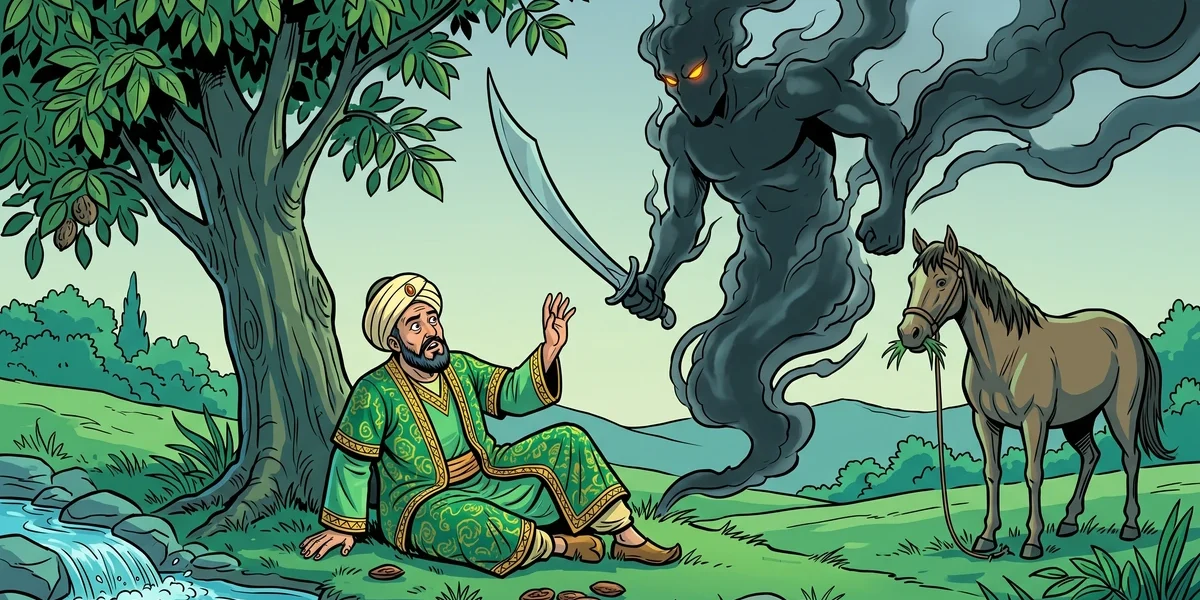
Of all the tales in the Thousand and One Nights, none carries a heavier weight than The Tale of the Merchant and the Genie, for it is the very first story Shahrazad tells. When the doomed bride opens her mouth on the first night, this is the tale she begins — a story about a man who must die for an accident he never knew he caused, and about three strangers who buy back his life with nothing more than stories of their own. It is, in miniature, the whole secret of the book that contains it: the discovery that a well-told tale can hold death itself at bay.
Origin & Canonical Attribution
Tradition: Arabian Nights (Middle Eastern frame-tale cycle)
Arabic title: Hikayat at-Tajir ma‘a al-‘Ifrit (حكاية التاجر مع العفريت) — “The Tale of the Merchant with the Ifrit”
Source collection: Alf Layla wa-Layla (The Thousand and One Nights). This is the first tale Shahrazad (Scheherazade) tells King Shahryar, begun on the opening night of the cycle and continued across the nights that follow.
Principal Arabic editions: Bulaq 1835; Calcutta II / Macnaghten edition 1839–42; Calcutta I (1814–18); Breslau edition (Habicht / Fleischer). The tale also stands near the beginning of the fourteenth- or fifteenth-century Syrian manuscript known as the Galland Manuscript (Bibliothèque nationale de France, MS arabe 3609–3611), the oldest substantial witness to the Arabic Nights.
Major translations: Antoine Galland, Les Mille et Une Nuits (1704–17); Edward William Lane (1838–40); John Payne (1882–84); Richard Francis Burton (1885–88).
Structure & type: A “ransom frame” — embedded tales told to redeem a condemned life. The inset stories turn on the folktale motif of transformation into animal form (Thompson motifs D100–D199): a wife changed into a gazelle, two brothers changed into hounds. The framing device itself — tale-telling to delay or avert a death — mirrors Shahrazad’s own predicament and is the structural heart of the entire collection.
Public-domain status: The Arabic text and all four classic translations cited above are firmly in the public domain. The retelling below is an original scholarly version prepared for this site.
The Thousand and One Nights grew over many centuries. Its oldest layer descends from a lost Persian collection, the Hazar Afsana (“A Thousand Tales”), which passed into Arabic by roughly the ninth century and gathered fresh material in Baghdad and, later, in Mamluk Cairo. The outermost frame — the story of King Shahryar, betrayed and made cruel, who weds a new bride each night and kills her at dawn until the vizier’s daughter Shahrazad volunteers to marry him — is part of that ancient core. So is the tale she first chooses to tell. “The Merchant and the Genie” is not a late “orphan tale” like Aladdin or Ali Baba, which entered the book only through Galland; it belongs to the genuine early stratum, present in the Galland Manuscript itself. Shahrazad does not pick it by accident. By opening with a story in which storytelling literally saves a man from the sword, she shows the king — and the reader — exactly what she intends to do.
The Date Stone and the Demon’s Vengeance

There was once a merchant of great wealth, with trading interests scattered through many lands. One day, business called him to a distant country, and he mounted his horse and rode out with a small saddle-bag of food for the road — some bread, and a quantity of dried dates.
The day grew hot. Coming upon a walnut tree beside a clear spring, the merchant dismounted, tethered his horse, and sat down in the shade to rest. He took out his bread and dates and ate his fill, and as he ate he tossed the date stones from him, one after another, carelessly, the way any traveller does. When he had finished he washed, said his prayers, and prepared to ride on.
But before he could rise, an enormous ifrit stood before him — a towering spirit, terrible of face, with a drawn sword in his hand. The demon seized the merchant and cried, “Stand up, that I may kill you, as you killed my son!”
“How can I have killed your son?” the merchant stammered. “I have harmed no one.”
“When you sat down,” the ifrit answered, “you ate dates, and you flung away the stones. My son was passing by, unseen by you, and a date stone struck him in the breast and killed him on the spot. Now your life is forfeit for his.”
The merchant understood at once the terrible position he stood in. He had done a thing he could neither have foreseen nor prevented — a stone thrown blindly into the air had ended an invisible life — and yet the law of blood lay upon him all the same. He wept, and he reasoned with the demon, reminding him that the killing was wholly unintended; but the ifrit was deaf to it. “Your death is owed,” he said, and raised his sword.
Here the tale touches something old and serious. The merchant is guilty of nothing a court would punish, yet a life has genuinely been lost, and grief demands its answer. The story does not pretend the demon’s anguish is unreal. What it asks is whether vengeance is the only reply a wound can be given — and the rest of the tale is the slow, surprising answer.
A Year’s Reprieve and the Three Wanderers

Seeing that pleading would not move the ifrit, the merchant asked one thing only: a delay. “Grant me until the turn of the year,” he begged. “Let me go home, settle my debts, provide for my wife and children, and put my affairs in order. I swear by every solemn oath that I will return to this same spot when the year is out, and deliver myself into your hands.”
The demon, persuaded by the merchant’s oaths, released him. The merchant rode home heavy-hearted, paid what he owed and collected what was owed to him, told his family the truth, and spent the year setting everything in order against the day he would not come back. When the year had run its course he washed, said farewell to those he loved, took up his burial shroud, and rode out once more to the spring — weeping, but keeping his word.
As he sat there waiting for his death, an old man came along the road, leading a gazelle on a chain. The old man greeted the merchant and, struck by the sight of a man seated alone and grieving in such a desolate place, asked his story. The merchant told him everything. The old man was amazed. “By Allah,” he said, “your faith is a wonder. This is a thing I must see to its end,” and he sat down beside him.
Soon a second old man approached, with two black hounds at his heel; and after him a third. Each in turn heard the merchant’s tale, each marvelled at a man who had ridden back to certain death rather than break a promise to a demon, and each sat down to wait. So the four of them were together when the air darkened and the ifrit appeared, sword in hand, to claim what he was owed.
The First Old Man and the Gazelle

As the demon reached for the merchant, the first old man rose. “O ifrit,” he said, “I have a proposal. I will tell you the story of myself and this gazelle. If you find it a tale of wonder, will you grant me a third of this merchant’s blood?” The demon, intrigued, agreed.
“This gazelle,” the old man began, “is my wife. I married her when she was young, and we lived together for thirty years, but she bore me no child. So I took a slave-woman, and she gave me a son. When the boy was nearly grown, business called me away. In my absence my wife — who had studied sorcery in secret, and was eaten by jealousy — turned the boy into a calf and his mother into a cow, and gave them to my herdsman.”
“When I returned, my wife told me the slave-woman had died and the boy had run away. A year passed in mourning. Then came a feast-day, and I ordered a cow slaughtered — and she brought me the very cow that was the boy’s mother. The poor creature moaned and wept until my heart failed me, but my wife pressed me, and the cow was slaughtered; there was nothing under the hide but bone. Then I called for the calf. The calf broke its rope, ran to me, and grovelled at my feet, weeping. My herdsman’s daughter, who had also learned magic, told me the truth: the calf was my own son, and the cow had been his mother.”
“The herdsman’s daughter restored my son to his shape, and at my asking she enchanted my treacherous wife into this gazelle, so that I might never lose sight of what she had done. I have led her on this chain ever since, and I cannot bring myself to be parted from her. That is my tale.”
The ifrit shook his head in wonder. “This is indeed a tale of marvels,” he said. “I grant you a third of the merchant’s blood.”
The Bargain Completed, and the Merchant Set Free

Then the second old man stood up, the one with the two black hounds. “O ifrit,” he said, “if I tell you the tale of myself and these two dogs, and you find it more wonderful still, will you grant me a second third of this man’s blood?” The demon agreed, and the old man told his story.
“These two dogs are my elder brothers. When our father died he left each of us a thousand gold pieces, and each of us opened a shop. My eldest brother sold his stock, squandered the price on travel and came home ruined; I took him in and set him up again. The same befell the second. Three times I divided my gains with them. At last we set out on a trading voyage together, and they twice plotted against me out of envy — once they threw me into the sea, and a kindly spirit saved my life. That spirit, who had her own quarrel with my brothers’ wickedness, enchanted the two of them into these hounds, and laid on me a charge to keep them ten years in this shape. The term is nearly run; and so I walk the roads with my brothers at my heel.”
The ifrit marvelled again. “A wonder,” he said, “and I grant you the second third.”
Then the third old man came forward and offered the demon the tale of himself and his mule — another story of a wife’s treachery and a transformation worked in revenge — and the ifrit, hearing it, judged it the most astonishing of the three. “I grant you the last third of his blood,” he said. “The man is free.”
And so the demon released the merchant unharmed. The three old men had ransomed a stranger’s life entirely with stories — three tales weighed against one death, and the tales had outweighed it. The merchant gave thanks, the old men went their ways, and he rode home at last to the family who had long since wept for him as dead.
It is at this point that Shahrazad, in the great frame around the tale, falls silent — for the dawn has come, and she may not speak past daybreak. The king, who had meant to kill her that morning, finds he cannot: he must hear how the night’s wonders connect to the next. And so her own life, like the merchant’s, is bought for one more day by the unfinished promise of a story.
The Moral of the Tale
“The Merchant and the Genie” sets two forces against each other. On one side stands the rigid arithmetic of vengeance: a life for a life, owed and collectible, regardless of intent. On the other stands something harder to name — the capacity to be moved, to let wonder, pity and admiration soften a settled fury. The demon begins as pure law and ends as something more human. He is not argued out of his grief; he is told out of it, drawn by three strangers into worlds of marvel until the appetite for blood has quietly left him. The old Arabic maxim catches the turning point exactly:
العفو عند المقدرة
al-‘afwu ‘inda al-maqdirah
“Forgiveness is sweetest in the very moment one holds the power to punish.”
The tale also quietly defends the storyteller’s art. The three old men have no weapons, no wealth to offer, no legal case to plead. They have only their tales — and their tales are enough. Each story they tell concerns betrayal answered not by killing but by transformation: the guilty are changed, kept, and in time forgiven, never simply destroyed. The structure of the storytelling repeats the lesson of its content. Mercy is learned by being shown mercy at work, story within story, until the listening demon — and the listening king — cannot help but be changed too.
Why the Tale Has Lasted
This is the keystone tale of the Thousand and One Nights, and it has lasted because it teaches the reader how to read the entire book. Shahrazad’s situation and the merchant’s are the same situation: an innocent under a death sentence, granted a reprieve, and saved by tales of wonder told to a figure who holds the sword. When the merchant is freed by three nested stories, the reader sees in advance what will happen to Shahrazad herself across a thousand nights. Scholars call this device mise en abyme — a small mirror, set inside a story, that reflects the larger story containing it.
The tale also gave world literature one of its most durable architectures: the “ransom frame,” in which characters tell stories to buy time, buy life, or buy freedom. Its descendants run from Boccaccio’s Decameron and Chaucer’s Canterbury Tales to every modern narrative that pauses on a cliffhanger so the audience will come back for more. The very habit of the serial — “to be continued” — is Shahrazad’s habit, and it begins here, with a merchant beside a spring and three old men who would not let a stranger die while a story remained untold.
Above all, the tale endures because of its central, consoling claim: that the imagination is not idle. A story, well told at the right moment, can reach a grief that no argument can reach. It can hold back a raised sword. It can turn an executioner into a listener — and a listener, given long enough, into someone capable of mercy.
You May Also Like
 Arabian Nights
All Ages
Arabian Nights
All Ages
The Barber’s Story of Himself
The comic Arabian Nights tale of the self-styled Silent Barber - the busybody who climbs uninvited into a stranger's boat, lands in chains before the Caliph, and still cannot hear how he sounds.
 Arabian Nights
The Tale of Prince Agib
The Third Kalandar's Tale from the Arabian Nights: Prince Agib survives a ship-eating magnetic mountain, a brazen horseman and a boatman of brass, only to lose an eye to the one forbidden golden door he was begged to leave shut.
 Arabian Nights
Ages 9-12
Arabian Nights
Ages 9-12
The Enchanted Horse and the Princess of Bengal: Love Across the Skies
The Galland-Lang version of the Arabian Nights tale of the ebony horse (ATU 575): Prince Firuz Shah of Persia rescues the Princess of Bengal in a love story that crosses the widest geography in world folklore.