Aladdin and the Wonderful Lamp
A scholarly retelling of Aladdin and the Wonderful Lamp, the famous orphan tale of the Arabian Nights told to Antoine Galland in 1709 by Hanna Diyab of Aleppo, and the story of how a poor, idle boy grows worthy of the power he finds.

No tale of the Thousand and One Nights is more famous, and few are stranger in their history, than the story of the poor tailor’s son who finds a battered lamp in an underground cave and discovers that the whole machinery of fortune now answers to his hand. Generations have grown up with Aladdin — with the cave of jewels, the false uncle, the palace built between dusk and dawn, the cry of “new lamps for old.” Yet the most surprising thing about the story is that it almost certainly never belonged to the old Arabic Nights at all. It is a tale with a known teller, a known date, and a documented birth — and it is, beneath the wonder, a careful study of what a person becomes when sudden power is placed in his hands.
Origin & Canonical Attribution
- Collection: Alf Layla wa-Layla (الف ليلة وليلة) — the Thousand and One Nights, known in English as the Arabian Nights.
- This tale: Aladdin; or, the Wonderful Lamp (Antoine Galland); Alaeddin; or, the Wonderful Lamp (Richard Burton, Supplemental Nights).
- An “orphan tale”: Aladdin appears in no Arabic manuscript of the Nights known to predate Galland. It first reached print in the French Les Mille et Une Nuits, in the volumes Galland published from 1712 onward — one of a small group scholars call the contes orphelins, the orphan tales (with Ali Baba and others).
- The teller: Galland’s own diary records that on 5 May 1709, in Paris, the story was told to him by a young Maronite Christian traveller from Aleppo, Antun Yusuf Hanna Diyab (born c. 1688). Galland’s journal was rediscovered and published only in 1881, which is why Diyab’s name was forgotten for so long.
- Setting: Galland places the tale in “a city in one of the kingdoms of China,” though every custom, name, and office in it — sultan, vizier, qadi, mosque — belongs to the Islamic world; the “China” is a far-away elsewhere rather than a real geography.
- Arabic texts: the Arabic versions of Aladdin that later surfaced (such as the Sabbagh manuscript) are now widely judged to be back-translations derived from Galland, not independent older sources.
- Translators: Antoine Galland (French, 1704–17); Edward William Lane (1838–40); John Payne; Sir Richard Francis Burton (Supplemental Nights, 1887).
- Tale type: ATU 561, “Aladdin,” in the Aarne–Thompson–Uther index — the type stands beside ATU 560, The Magic Ring, and ATU 562, The Spirit in the Blue Light. Key motif: D1421, the spirit summoned from a magic object.
- Public-domain status: the Nights and the Galland, Lane, and Burton translations are long out of copyright and free to retell.
The Idle Boy and the Stranger Who Called Himself Uncle
In a city of the East — Galland says China, though the storyteller plainly imagined a place much like his own Aleppo — there lived a poor tailor named Mustafa and his wife, and their one son, Aladdin. The boy was not wicked, but he was idle. He would not learn his father’s trade; he slipped away to play in the streets and lanes with the other careless children of the bazaar. Grief at this idleness, the tellers say, helped carry Mustafa early to his grave, and the widow was left to spin cotton from dawn to dusk to feed the two of them. Aladdin, by then almost grown, drifted on as before, learning nothing and earning nothing.
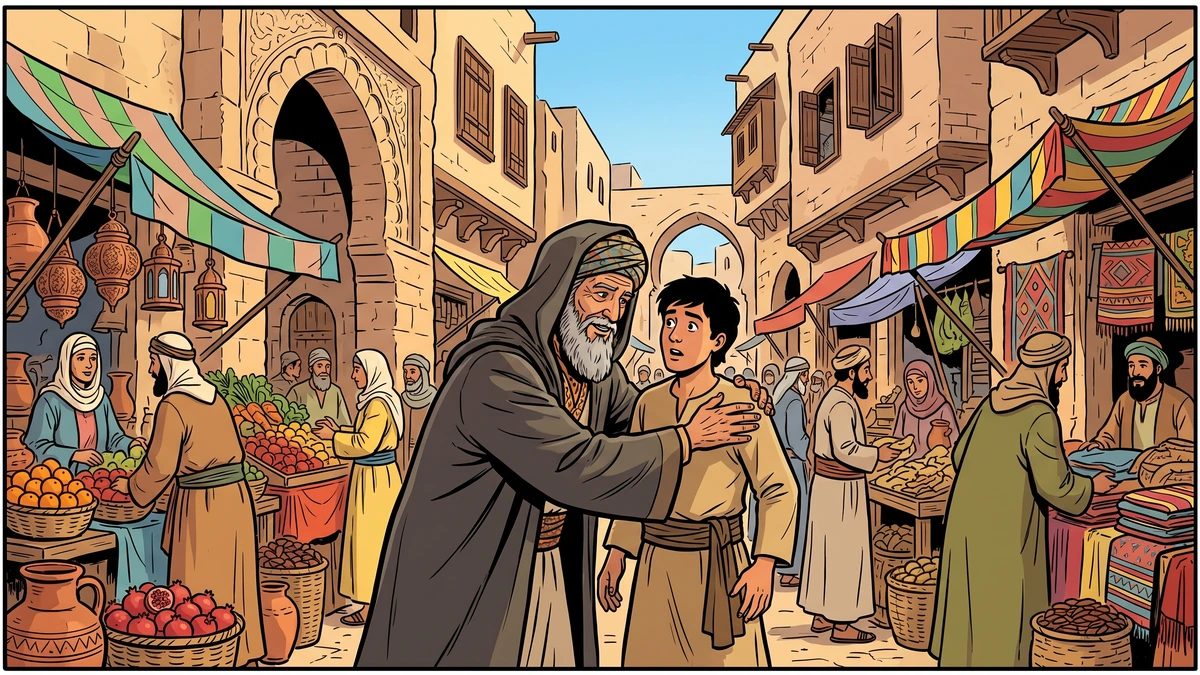
One day a stranger noticed him in the marketplace — a traveller from the far Maghrib, a man deep in the forbidden arts of geomancy and sorcery, who had read in his sand-figures that a certain idle boy in this distant city was the one person on earth who could fetch a particular treasure for him. The magician watched Aladdin, asked his name and his father’s trade, and then embraced him with tears, declaring himself Aladdin’s long-lost uncle, brother to the dead Mustafa. He sent the boy home with money and a kind message; he came to supper; he wept again over his “brother’s” memory and won the trust of the widow completely. He promised to set Aladdin up as a merchant with a shop of his own. The boy, who had never been offered anything, believed every word. It is worth pausing on this beginning: the story’s engine is not magic but flattery. Aladdin is captured by the first adult who treats his idleness as promise rather than fault.
The Cave of Wonders
The next morning the false uncle led Aladdin out of the city, further than the boy had ever walked, coaxing him on with talk of gardens and wonders, until they reached a lonely place between two mountains. There the magician lit a fire, cast a powder upon it, and spoke words Aladdin could not understand; the ground trembled, the earth opened, and a flat stone with a brass ring set in it was uncovered. The boy was terrified and tried to run. The magician struck him — then, needing him, soothed him again, and told him the truth he wanted Aladdin to hear: beneath that stone lay a treasure meant for Aladdin alone, and no other living hand could lift it. The boy must go down, pass through the chambers below without touching the walls, cross a garden of trees, and bring back a certain old lamp that burned in a niche at the end. He gave Aladdin a ring from his own finger, “to guard you,” and sent him down.
Aladdin found everything as the magician had said: halls of treasure, and then a garden where the trees bore fruit of coloured glass — or so the boy thought, filling his sash and his pockets with the bright useless things, never guessing they were emeralds, rubies, and diamonds beyond a sultan’s reckoning. At the end he took down the lamp, plain and a little tarnished, and turned back. But at the mouth of the cave the magician, greedy and impatient, demanded the lamp first, before he would help the boy up. Aladdin, weighed down and unable to reach into his sash, asked to be lifted out and then to give it over. The magician took this for defiance. In a rage he flung his last powder on the fire, spoke the words again — and the stone slammed down, sealing Aladdin in the dark. The man was no uncle at all; he had wanted only the lamp, and a boy to die holding it.

For two days Aladdin sat in the blackness, weeping and certain he would die. Then, wringing his hands in despair, he chanced to rub the ring the magician had carelessly left on his finger. The earth seemed to shudder; a vast figure rose before him and said it was the Slave of the Ring, and would do whatever its wearer commanded. Aladdin, hardly daring, asked only to be set free — and found himself above ground, in the daylight, near his own city. He came home half-dead, and his mother revived him. They were as poor as ever; so, to buy a meal, the mother decided to clean the shabby lamp Aladdin had carried out and sell it. At the first touch of her cleaning-rag a second and far greater spirit rose — the Slave of the Lamp. Whoever held the lamp, it said, it would obey. The two genies, and the difference between them, matter for everything that follows: the ring is a small protector that comes by accident; the lamp is true power, and it had to be carried up out of the dark by the boy’s own hands.
The Lamp, the Princess, and the Palace Built in a Night
At first Aladdin asked the lamp only for food, and the family ate. Slowly he learned to use it with more sense — selling, through honest stages, the “glass fruit” he now knew to be jewels, and carrying himself less like an idler and more like a man. Then, by chance, he saw the Sultan’s daughter, the Princess Badr al-Budur, pass to the baths, and he loved her past all reason or rank. He persuaded his astonished mother to carry a gift to the Sultan and ask for the princess’s hand — and the gift was a bowl heaped with the jewels of the cave, a splendour that struck the whole court silent. The Sultan was inclined to agree; but his vizier, who wanted the princess for his own son, begged for a delay of three months.
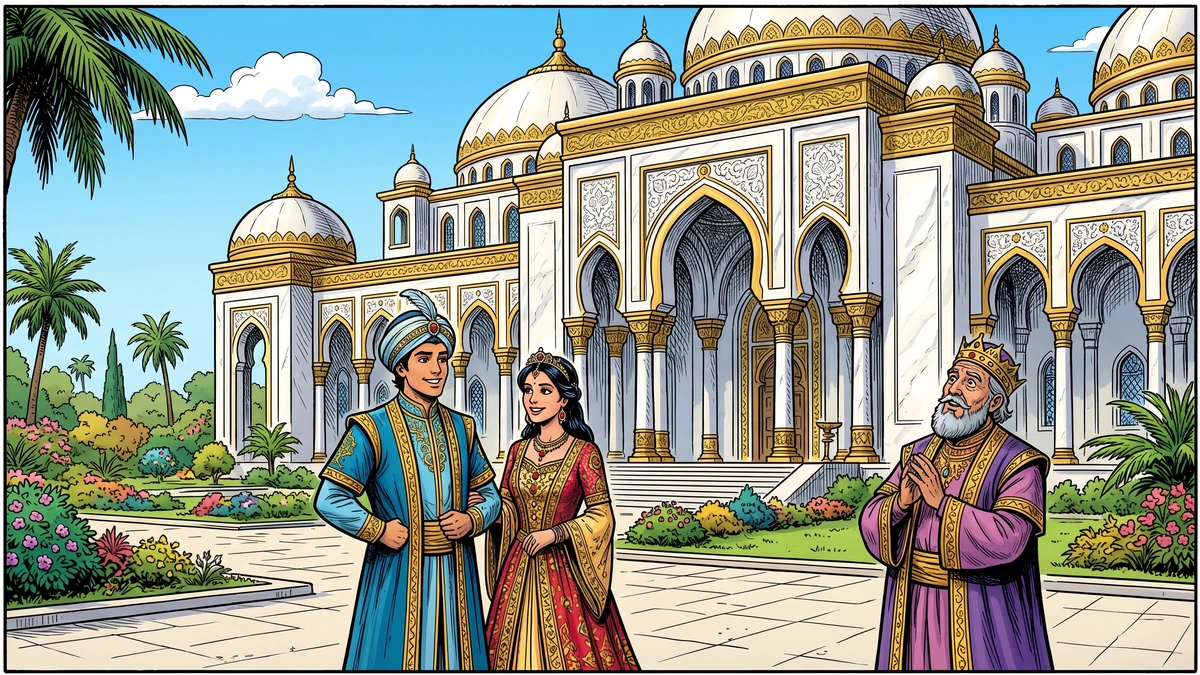
Within that delay the vizier had the princess married to his son instead. On the wedding night Aladdin, heartsick, commanded the genie of the lamp to bring the bridal pair to his house — harming no one, but separating them until dawn — and so unsettled the marriage that it was soon dissolved. When the three months passed, the Sultan, to be rid of the suit, set an impossible bride-price: forty basins of solid gold heaped with jewels, each carried by a richly dressed slave. The genie supplied it within the hour. The Sultan, astonished and delighted, consented at once. And for the wedding Aladdin had the genie raise, on open ground facing the palace, a building of marble, jasper, and gold so perfect that the Sultan himself came to marvel at it. The idle boy of the bazaar was now the husband of the princess and the wonder of the kingdom — and, the story is careful to show, he had grown into the part. He was generous to the poor, courteous at court, and brave in the field. The lamp had lifted him, but he was no longer the boy who needed lifting.
“New Lamps for Old”
Far away in the Maghrib, the magician learned by his sand-figures that Aladdin had not died in the cave but had escaped, won the lamp’s power, and risen to a throne’s side. Burning with envy, he travelled the whole long road back. He waited until he knew Aladdin was away hunting, then bought a number of bright new lamps, and went through the streets below the palace crying a fool’s bargain: new lamps for old. The Princess Badr al-Budur, who did not know the secret of the battered lamp on its shelf, thought it a harmless jest and an easy profit, and sent a servant to make the exchange. The magician had what he had crossed the world for. That night he rubbed the lamp and ordered its slave to carry the whole palace — princess, walls, and all — to a lonely place in Africa.
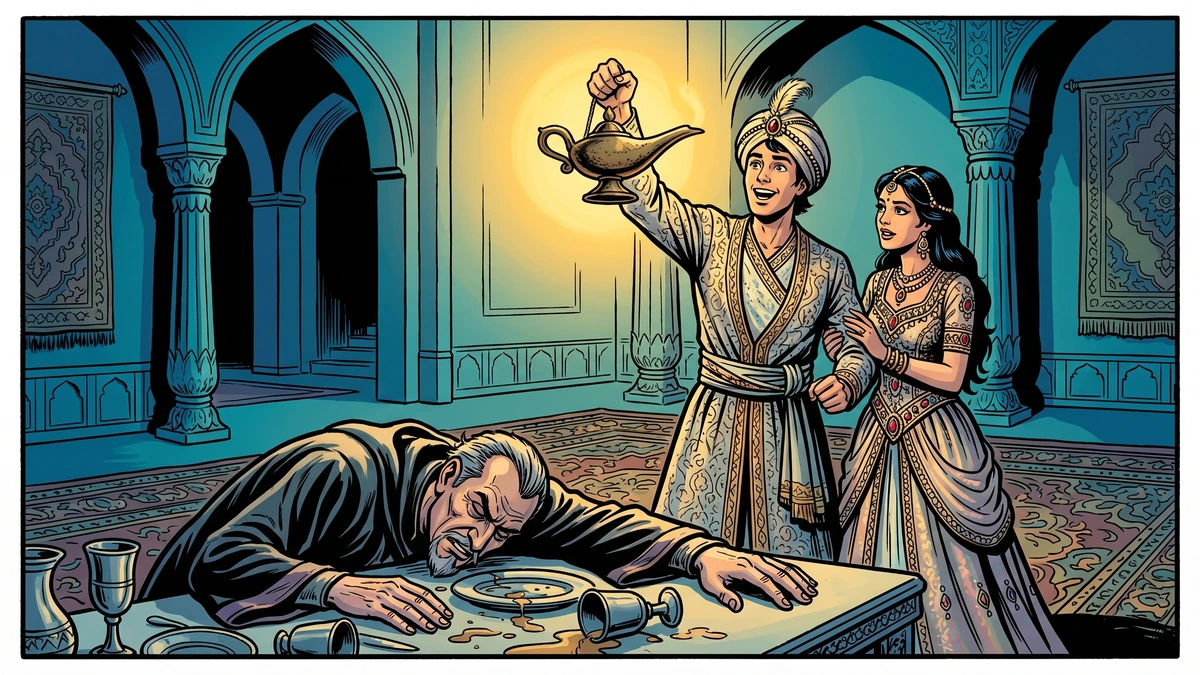
At dawn the Sultan looked out and saw bare ground where the marble palace had stood. He believed Aladdin a sorcerer and a fraud, had him seized, and would have had him killed; only the love of the common people, who had not forgotten his generosity, made the Sultan grant him forty days to recover the princess or die. Aladdin had lost the lamp — but not the ring. He rubbed it; the smaller genie could not undo the lamp’s great work, but it could, and did, carry Aladdin across the world to the place where his stolen palace now stood. There he and the princess took counsel together. She welcomed the magician to a private supper, wore her finest jewels and her warmest smile, and into his cup she slipped a powder Aladdin had given her. The magician drank, and fell. Aladdin took the lamp from the dead man’s breast, summoned its slave, and ordered palace and princess home. They woke the next morning where they belonged, facing the Sultan’s windows, and the Sultan’s wrath turned to joy.
The danger was not quite spent. In the longer tellings the dead magician had a brother, deeper still in the black arts, who came to avenge him — disguising himself as a famous holy woman, Fatima, to creep inside the palace. But Aladdin, warned by the lamp’s own genie, saw through the disguise and dealt with this second enemy as he had the first. After that the story closes in peace: Aladdin succeeded in time to the Sultan’s throne, and reigned long and justly with Badr al-Budur beside him. The boy who would learn no trade had, in the end, learned the only one that mattered — how to be worthy of what he had been given.
The Moral: The Lamp Is Only as Good as the Hand That Holds It
It is easy to read Aladdin as a daydream — a story about getting something for nothing, a magic wish that does the living for you. But the tale itself argues the opposite, patiently and from both ends. Two men in this story hold the wonderful lamp. One is the Maghribi magician, who has studied for a lifetime, crossed the world twice, lied, struck a child, and buried him alive, all to possess it — and the lamp, once his, does him no lasting good at all; he dies of a poisoned cup with his prize in his hand. The other is an idle, untaught boy who is handed the same object almost by accident — and who grows, across the story, into a generous husband, a brave soldier, and at last a just king. The lamp does not change. Only the hand changes, and with it everything.
The magician is the story’s warning. He wants the lamp the way the cave’s jewels almost killed Aladdin to gather — as pure accumulation, power for its own sake — and an old Arabic proverb names exactly what undoes him:
الطَمَعُ يُقِلُّ ما جَمَع
“Aṭ-ṭama‘u yuqillu má jama‘a” — Greed lessens what it has gathered.
It is greed, at the cave’s mouth, that makes the magician demand the lamp a moment too soon and lose the boy who alone could carry it; it is greed that drags him back across the world to his death. Aladdin’s rise is the mirror image. He begins idle and is nearly destroyed by it; what saves him is not the lamp but the slow work of becoming someone who deserves to keep it — learning the worth of what he holds, spending it on others, and standing his ground when it is stolen. The genie can build a palace in a night. It cannot build a character. That, the story insists, is the one thing every person must quarry up out of the dark themselves.
Why the Tale Has Lasted
For a story that was probably never part of the medieval Arabic Nights, Aladdin has had an astonishing afterlife. From Galland’s French it passed into every European language; by the nineteenth century it was one of the most popular subjects of the British Christmas pantomime, which is where the comic widow — “Widow Twankey” — and much of the broad humour were added. The twentieth and twenty-first centuries gave it stage musicals and animated films seen by hundreds of millions, each retelling shifting the setting, the songs, and the genie’s temperament while keeping the same bones: the cave, the lamp, the rise, the theft, the recovery.
Folklorists place it firmly as tale type ATU 561, one of a family of stories — with The Magic Ring and The Spirit in the Blue Light — in which a poor youth gains a wish-granting object, loses it to an enemy, and must win it back by his own resourcefulness. That last clause is the key to its endurance. Aladdin is not, finally, a fantasy of effortless wealth; it is a story about a second chance, and about the difference between the person who is merely lucky and the person who makes himself equal to his luck. The rediscovery of Galland’s diary in 1881, and the slow recovery of Hanna Diyab’s name, added a last irony the tale would have relished: the most “Oriental” of fairy stories turns out to have a real, half-forgotten author — a young traveller from Aleppo who, like Aladdin himself, arrived in a great foreign city with nothing but a story, and changed his fortune by telling it well.
Frequently Asked Questions
What is the moral of Aladdin and the Wonderful Lamp?
Who wrote Aladdin and the Wonderful Lamp?
What is the story of Aladdin?
Is Aladdin originally from Arabia or China?
What is the difference between the original Aladdin and Disney's Aladdin?
You May Also Like
 Arabian Nights
Sinbad the Sailor: The Second Voyage
The voyage of the Roc and the Valley of Diamonds. Marooned on a deserted island, Sinbad ties himself to a giant bird, survives a ravine of serpents and gem-strewn rock, and rides a slab of meat back to freedom and fortune.
 Arabian Nights
All Ages
Arabian Nights
All Ages
The Tale of the Three Apples
The Tale of the Three Apples from the Arabian Nights - one of the earliest murder mysteries ever told. A locked chest pulled from the Tigris, a three-day deadline, and a husband undone by his own haste.
 Arabian Nights
Sinbad the Sailor: The Third Voyage
The darkest of Sinbad's seven voyages: a storm strands the merchants on the Mountain of the Apes, a man-eating giant pens them in his house, and Sinbad must blind the monster and outwit a giant serpent to win his way home — the Arabian Nights' famous Polyphemus tale.