The Tale of Prince Agib
The Third Kalandar's Tale from the Arabian Nights: Prince Agib survives a ship-eating magnetic mountain, a brazen horseman and a boatman of brass, only to lose an eye to the one forbidden golden door he was begged to leave shut.
Among the most haunting stories in the Arabian Nights is the one told by a beggar with a shaven head and a missing left eye, who walks into a house in Baghdad on a night already crowded with mysteries. He is the third of three such mendicants, each blind in the same eye, each of royal blood, and his tale is the strangest of the three. It is the story of Prince Agib — a king’s son who set sail with a fleet behind him and came home, years later, with nothing: no ship, no crown, no companions, and only one eye to see the world with.
The tale of Prince Agib is a voyage story, but it is not a story about the sea. It is a story about a door — a single golden door among forty — and about what happens to a man who cannot leave a locked thing locked. Before that door is ever reached, the prince must survive a mountain that eats ships, a boatman of brass, and a palace of grieving men who will not say why they grieve. Each of those wonders is a warning. Agib survives them all, and then ruins himself anyway, in the one place he had been told plainly to be careful.
Origin & Canonical Attribution
Source collection: Alf Layla wa-Layla — the Thousand and One Nights, the Middle Eastern frame-tale anthology in which the vizier’s daughter Shahrazad delays her execution by telling King Shahriyar an unfinished story every night.
Arabic title: Hikayat al-Qalandar al-Thalith — “The Tale of the Third Kalandar” (also Englished as the Third Dervish’s or Third Mendicant’s Tale). The prince’s name appears in the Arabic as Ajib ibn Khazib; “Agib” is the spelling carried into English by way of the early translators. The Arabic ‘ajib means “wonderful” or “marvellous” — a fitting name for the hero of so wonder-filled a voyage.
Place in the cycle: The tale is one of three told by the kalandars inside the larger story of The Porter and the Three Ladies of Baghdad, which itself occupies roughly Nights 9–19 of the Calcutta II (Macnaghten) numbering. It is a nested tale — a story inside a story inside Shahrazad’s storytelling — and a version is already present in the fourteenth-century Galland Manuscript (Bibliothèque nationale de France, MS arabe 3609–3611), the oldest substantial witness of the Nights.
Principal editions: Bulaq (1835); Calcutta II / Macnaghten (1839–42); Calcutta I; Breslau (Habicht). Translators: Antoine Galland (Les Mille et Une Nuits, 1704–1717), Edward William Lane, John Payne, and Sir Richard Francis Burton, whose 1885 version names the peak the “Mountain of Loadstone.”
Tale type & motifs: The story braids together several wandering motifs — the ship-destroying Magnetic or Loadstone Mountain (a legend Ptolemy already knew, and which reappears across medieval European travel writing); the Roc, the giant bird of Indian Ocean sailors’ lore; and above all the Forbidden Chamber (motif C611 in the Aarne–Thompson–Uther index), the locked room that a host’s trust dares the guest to open. The same forbidden-door motif underlies the European Bluebeard tales (ATU 312) and the Grimm story of Fitcher’s Bird (ATU 311).
I. The Fleet and the Mountain of Loadstone
Agib, the third kalandar tells his hosts, was no beggar by birth. He was a king — the son of King Khazib, and a king in his own right over a realm of islands, with a fleet of ships and an army and the easy confidence of a man who has never yet been told no by the world. It was that confidence that put him to sea. He wished to see the far islands of his kingdom, and so he sailed out with ten vessels and provisions for two months, and for a while the voyage was everything a voyage should be.
On the twentieth day the weather turned, and the captain — an old hand who read the sea the way scholars read books — climbed down from the mast with his turban in his hands and wept. The wind, he said, had carried them off every chart he knew. They were driving toward the Mountain of Loadstone, a black peak that rose straight from the water in a sea no helmsman could steer. The mountain was magnetic. It would draw every nail and every bolt of iron out of the timbers of their ships, and the ships would simply come apart, plank by plank, and sink. By the captain’s reckoning they had until the following noon.
It happened exactly as he said. The next day the ten ships shuddered as though a hand had seized them from below; the iron sang out of the wood and flew to the mountain; and the fleet dissolved into a raft of loose planking and drowning men. Of all that company only Agib lived, clinging to a single board, washed at last to the foot of the black mountain — a king with no kingdom left to him but the rock under his hands.
The Mountain of Loadstone is one of those images the Arabian Nights did not invent so much as perfect. The idea of an island or peak whose magnetism could disarm a ship of its very fastenings was old long before Shahrazad: the geographer Ptolemy, writing in the second century, already passed on a tale of magnetic islands somewhere in the eastern seas that gripped any vessel built with iron and would not let it go. Arab and later European travel writers kept the legend alive for more than a thousand years. What the Nights added was the human scale — not a curiosity of natural philosophy but a death sentence read aloud by a weeping captain to men who have until noon tomorrow to make their peace. The mountain is the tale’s first lesson in a theme it will return to again and again: that a warning, however clearly delivered, changes nothing for the person who will not believe it applies to him.

II. The Brazen Horseman and the Boatman of Brass
On the summit of the loadstone mountain stood a dome of polished brass, and on the dome sat a horseman cast all of brass, mounted on a brass horse, holding across his breast a tablet of lead engraved with talismans. It was this rider, Agib would learn, that gave the mountain its terrible pull. That night, exhausted, he slept at the rock’s foot, and a voice came to him in a dream with precise instructions: dig beneath the spot where he lay, and he would find a bow of brass and three arrows of lead; with them he must shoot down the brazen horseman; the horseman would fall into the sea, the mountain’s power would break, and ships could pass it safely ever after. The voice added one more thing — that when the rider fell, the sea would rise until its water reached the very dome.
Agib woke and did all of it. He found the bow and the three lead arrows where the dream had said; he loosed them; the horseman pitched from his brass horse into the water; and the sea climbed the mountain exactly as he had been warned. When at last it calmed, a small boat was drifting toward him, and in it sat a man rowing — a man, Agib saw as it drew near, made entirely of brass, with a tablet of metal on his chest. The dream had a last condition, and it was a simple one: Agib might be carried safely to the Islands of Safety, but only if, the whole way, he never once spoke the name of God.
For hours he kept silent, and the brass boatman rowed, and the green shore of safety came up out of the haze ahead. And then — out of relief, out of joy, out of the oldest habit a believing man has — Agib’s gratitude rose to his lips and he cried aloud, “There is no god but God!” At once the boatman, the boat, and everything in it vanished, and the prince was left swimming. He reached the shore by his own strength alone. He had been told the rule. He had broken it within sight of the prize. It would not be the last time.

III. The Ten Young Men, Each Blind of One Eye
The island Agib washed up on was not empty. Walking inland, he came on a great house, and in it ten handsome young men — and an old man older than all of them — and every one of the ten was blind in his left eye. They took the prince in kindly, fed him, and asked nothing. But each night the same strange thing happened. As darkness fell the ten youths brought out basins of soot and ashes, and they blackened their faces, and they wept and beat their breasts until dawn, crying out against themselves for what their own curiosity had cost them.
Agib could not bear not knowing. He begged them, night after night, to tell him why they grieved. They refused — not out of unkindness but out of pity. To explain, they said, they would first have to show him; and to show him was to lose him an eye, as it had lost each of them an eye. If he truly insisted, they would set him on the road to the answer, but they would not be the ones to spare him from it. He insisted. And so, as the European tellers of the tale describe it, they sewed him into the skin of a slaughtered ram and laid him on the open ground, and a Roc — the vast bird that sailors swore could carry an elephant — stooped, seized the ram’s skin in its talons, and bore Prince Agib up off the island and away, setting him down at last on the roof of a palace he had never seen.
It is worth pausing on the ten one-eyed men, because they are the cleverest piece of architecture in the whole tale. Agib does not yet realise it, but he is looking at his own future. Every one of those grieving princes once stood exactly where he now stands — curious, warned, and certain that he, at least, would be the exception. The story has shown him the ending before it lets him walk into the beginning.
The Roc that carries him onward is itself a piece of well-travelled folklore. The vast bird that could lift an elephant or a ship belonged to the seafarers of the Indian Ocean, who carried its legend from port to port; it soars through Sinbad’s voyages elsewhere in the Nights, and medieval travellers from Marco Polo onward repeated reports of a monstrous bird in the seas off Madagascar. Here the Roc serves a precise narrative purpose: it is the bridge no man could build for himself, the means by which a tale moves its hero from a place he understands to a place designed entirely to test him.

IV. The Forty Ladies and the Door That Should Have Stayed Shut
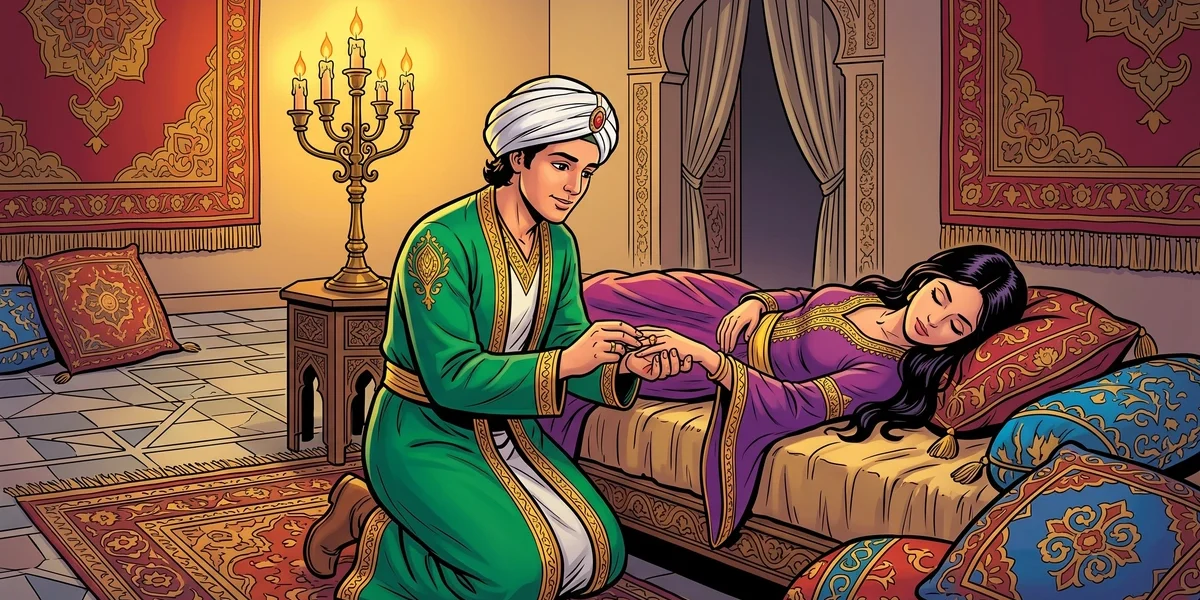
The palace the Roc carried him to belonged to forty young women, all of them noble, all of them beautiful, and they received the prince as though they had been waiting their whole lives for him. For a full year Agib lived there in a happiness so complete that he forgot the sea, forgot the mountain, forgot the weeping men. Then the day came when the forty ladies had to leave him — for forty days, they said, they were called away. Before they went they gave him the keys to the palace: one hundred chambers of treasures and gardens and wonders, all his to wander as he pleased. Only one door he must not open. They showed him which: a door of gold. They begged him — not ordered, begged — to leave that one alone.
Agib opened ninety-nine doors. Behind each was a marvel finer than the last: orchards, aviaries, halls of jewels, fountains of every colour. By the thirty-ninth day he had seen them all, and only the golden door was left, and the whole weight of forty days of self-control collapsed in a single afternoon. He told himself he would only look. He turned the key.
The room beyond was dark and sweet with the smell of saffron and ambergris, and in it stood a horse, black as the deepest night, saddled and bridled and utterly still. Agib led it out into the air, mounted it — and the horse unfurled two great wings, sprang into the sky, and carried him soaring over land and sea until it landed him, gently enough, on the rooftop of yet another palace. There it turned its head, lashed out once with its tail, and struck the prince full across the face, putting out his left eye. Then it spread its wings and was gone, and Agib stood on the roof with blood on his cheek and the truth finally, completely clear to him. He climbed down, and he found ten young men, each blind of one eye, and he understood that he had become the eleventh — one more wanderer who had been warned, and shown, and trusted, and who had opened the door anyway. From there he shaved his head and his beard, took the patched cloak of a kalandar, and set out as a beggar for Baghdad, where this night he has told his tale.

The Moral of the Tale
The tale of Prince Agib is usually read as a story against curiosity, and it is that — but it is a subtler thing than a simple scolding. Agib is never punished for wanting to know. He is punished for refusing to accept that some knowledge has a price he has been told, in advance and in plain words, that he will have to pay. The forty ladies do not hide the golden door; they point straight at it. The ten youths do not conceal their grief; they explain that the explanation itself is the wound. At every turn the tale is honest with its hero. What ruins him is not ignorance but the conviction — the very ordinary, very human conviction — that the rule which broke everyone else will somehow bend for him.
This is why the tale belongs, deep down, to the great family of stories about fate. The third kalandar lost his eye on a flying horse, but he had been losing it since the day he decided he would be the exception. Arabic storytelling has a proverb for exactly this:
ما كُتبَ على الجبين لا بُدَّ أن تَراهُ العَين
“What is written upon the brow, the eye must surely see.”
It is a grimly perfect proverb for this story. Agib’s whole undoing is “written on the brow” from the start — the captain reads it, the dream-voice spells it out, the ten weeping men embody it — and in the end it is precisely the eye that pays. The tale does not say: do not be curious. It says: when you are told the cost, believe it.
Why the Tale Has Lasted
The Third Kalandar’s Tale has outlived a thousand years because it keeps two very different pleasures in balance. On the surface it is pure adventure — a magnetic mountain, a brazen archer, a brass boatman, a Roc, a flying black horse — the kind of cascade of marvels that made the Arabian Nights the most translated book of wonders in the world, and that fed everything from medieval European travel legend to modern fantasy. Ptolemy had already recorded the ship-eating magnetic islands; the Nights turned a geographer’s footnote into one of literature’s most unforgettable images.
But underneath the spectacle the tale is doing something quieter and more durable. It is a story that has watched human beings carefully and noticed one specific weakness: not greed, not cruelty, but the small, almost likeable arrogance of believing that warnings are for other people. That weakness has not aged a day. Every reader who has ever been told “don’t” and felt their hand drift toward the handle anyway recognises Prince Agib instantly — which is why a one-eyed beggar’s tale, told in a borrowed house in old Baghdad, still finds its mark.
You May Also Like
 Arabian Nights
Ages 9-12
Arabian Nights
Ages 9-12
Joha and the Donkey
The famous tale of Joha, his son and their donkey. On the road to market, every passer-by criticises how they use the animal, and Joha keeps changing to please each new critic until he has pleased no one and lost the donkey: the classic story of why you cannot satisfy everyone.
 Arabian Nights
The Story of the Three Apples
The Story of the Three Apples: In the golden city of Baghdad, during the reign of the great Caliph Harun al-Rashid, a mystery unfolded that would test the
 Arabian Nights
All Ages
Arabian Nights
All Ages
The Tale of the Three Apples
The Tale of the Three Apples from the Arabian Nights - one of the earliest murder mysteries ever told. A locked chest pulled from the Tigris, a three-day deadline, and a husband undone by his own haste.