The Wise Girl of Turkey
The Turkish telling of the clever-girl tale (ATU 875): a poor weaver's daughter answers a padishah's impossible riddles, performs his paradoxical tasks, and at the last carries off the sleeping king himself as the one thing she holds most dear.

Among the folk tales of the world there is a whole great family of stories about a clever girl — poor, young, and almost always nameless — who out-thinks a king. The Germans tell it, the Russians tell it, the Italians and the Irish tell it, and the people of Anatolia have told it for centuries around their winter fires. The Wise Girl of Turkey is the Turkish branch of that family: the tale of a weaver’s daughter who answers riddles no scholar can answer, performs tasks that cannot be performed, and finally teaches a proud padishah the gentlest and most lasting lesson of his reign.
It is a story built almost entirely out of wit. There is no magic in it, no peri or dragon or enchanted horse — only a quarrel over a new-born foal, a set of impossible questions, a string of paradoxical tasks, a marriage made on a hard condition, a promise broken for the sake of justice, and one of the most quietly beautiful endings in all of folklore: a wife who, told to leave the palace and carry away the single thing she holds most dear, carries away the sleeping king himself.
Origin & Canonical Attribution
Tradition: A Turkish (Anatolian) oral folk tale, carried for generations by village storytellers and only written down by folklorists in the modern era. It belongs to the broad Near Eastern and European stock of “clever maiden” stories.
Tale type: ATU 875, The Clever Farmgirl (also called The Clever Peasant Girl) in the Aarne–Thompson–Uther international index — described by folklorists as the commonest of all European tales of witty exchange. The dispute over the foal is its classic opening episode, and the closing scene is catalogued separately as motif J1545.4, “The wife’s dearest possession.”
Turkish catalogue: The standard reference is the Typen türkischer Volksmärchen (“Types of Turkish Folktales,” Wiesbaden, 1953) compiled by Wolfram Eberhard and the Turkish folklorist Pertev Naili Boratav, which records the clever-maiden tales among Turkey’s most widely collected stories.
Collectors: Anatolian versions were gathered from villagers by the Hungarian Turkologist Ignác Kúnos in the 1880s and 1890s (his Turkish Fairy Tales and Folk Tales was Englished by R. Nisbet Bain), later by Pertev Naili Boratav, and in the twentieth century by Barbara K. Walker for the Archive of Turkish Oral Narrative.
Literary cousins: The Brothers Grimm tell it as Die kluge Bauerntochter (“The Peasant’s Wise Daughter,” tale KHM 94, in their collection from 1815); the Russians as The Wise Little Girl in Alexander Afanasyev’s great anthology; and the English poet John Gower set the same plot down as the “Tale of Three Questions” in his Confessio Amantis around 1390. The riddle-contest itself reaches back to the ancient legends of the wisdom of Solomon.
Key motifs: H561.1 (riddles solved by a clever peasant girl); H1050–H1052 (paradoxical, self-cancelling tasks); J1191 (the absurd judgment answered with an equal absurdity); and J1545.4 (the wife carries off her sleeping husband as her dearest possession).
I. The Quarrel over the Foal
The tale begins, as so many Turkish tales do, with two neighbours and a disagreement. In a village somewhere in the wide uplands of Anatolia there lived a poor man and a rich man. The poor man owned almost nothing in the world but a single grey mare; the rich man owned flocks and fields and a heavy wooden cart. One night the poor man’s mare was stabled, for shelter, beside the rich man’s cart. And in the morning a new-born foal was found lying in the straw — lying, as it happened, nearer to the cart than to the mare.
The rich man saw his chance. “The foal,” he announced, “was found beneath my cart. Therefore my cart gave birth to it, and the foal is mine.” The poor man protested that a wooden cart had never yet given birth to anything, and that the foal was plainly the child of his mare. But the rich man was loud and the poor man was timid, and so, getting nowhere, the two of them carried their quarrel all the way to the capital, to be judged by the padishah himself.
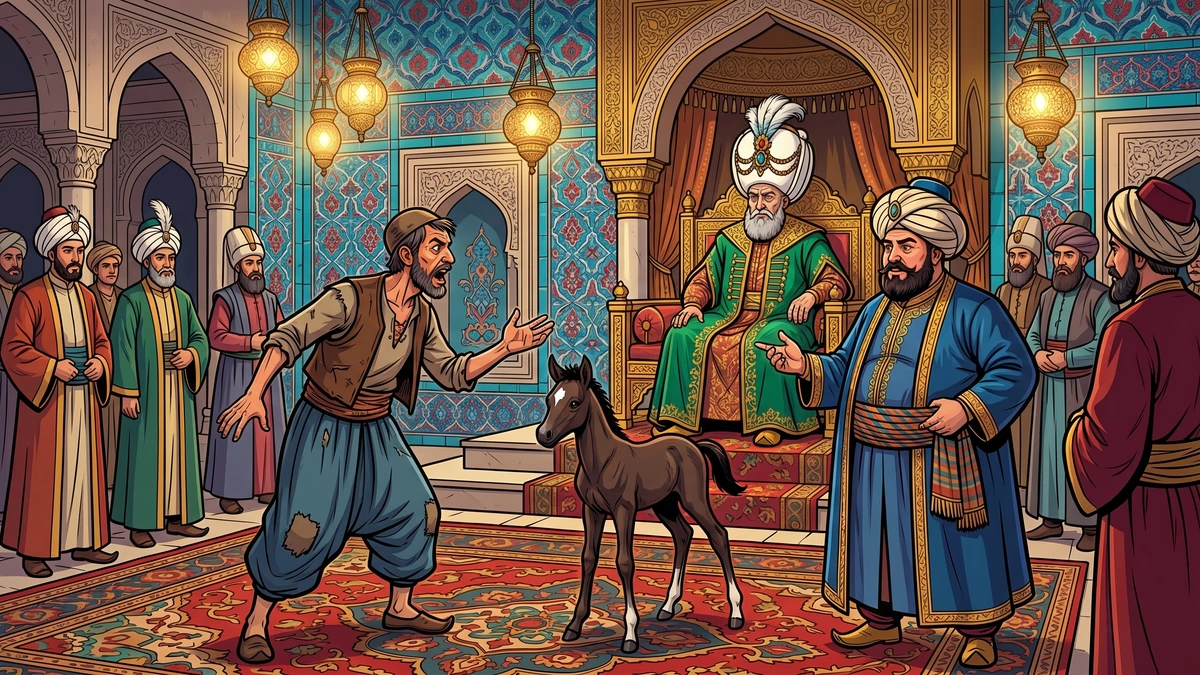
Now the padishah was a clever man, and like many clever men who hold great power, he had grown to enjoy his own cleverness more than was good for him. He saw at once that the rich man’s claim was nonsense. But instead of simply saying so and sending the foal home with the mare, he decided to make a game of it — a game that would show off his wit and, he privately hoped, prove once again that no mind in the kingdom was a match for his own.
“I will not judge between a mare and a cart,” the padishah declared. “Instead I set you both a test. I have three questions. Whoever brings me the truest answers shall have the foal, and the other shall go home empty-handed. Hear them well. What is the fattest thing in all the world? What is the swiftest thing in all the world? And what is the sweetest thing in all the world? Return to me in three days with your answers.”
The rich man went home well pleased with himself. He asked his wife, and his wife answered without a moment’s thought. “The fattest thing in the world,” she said, “is our own black hog, which we have fattened three years and which can barely walk for fatness. The swiftest thing in the world is our grey hound, which no hare has ever outrun. And the sweetest thing in the world is the honey in our own storeroom, for I have tasted no sweeter.” The rich man memorised her answers and counted the foal as good as won.
II. The Wise Girl’s Answers
The poor man walked home with his head low. He had no hog and no hound and no honey, and the three questions rattled in his skull like dried peas in a gourd. When he came through his own doorway he sat down heavily and sighed, and would not eat.
The poor man had one daughter. She was perhaps fifteen years old, and she helped him at his loom, and her fingers were always a little stained with the dyes of the wool. She was not famous for her beauty and she had no dowry at all, but in that small house everyone knew the truth about her: that her mind was quick and clear and deep, the way a mountain spring is clear and deep, and that she saw to the bottom of things that others only splashed about on top of. When she saw her father sitting in sorrow she asked him what was wrong, and bit by bit she drew the three questions out of him.
“Is that all?” said the girl, and she almost laughed. “Father, dry your eyes. These questions answer themselves to anyone who has lived with open eyes. When the padishah asks you what is the fattest thing in the world, tell him: the earth — the good black soil, for it feeds the wheat and the vine and the grass and every flock and every man, and grows no thinner for all the mouths it fills. When he asks what is the swiftest thing in the world, tell him: the eye — or the thought behind it — for in the time it takes to blink it has run to the farthest mountain and back, and no horse and no wind can do the like. And when he asks what is the sweetest thing in the world, do not say honey. Say sleep, the sweet sleep that the tired labourer and the troubled king long for alike, the one sweetness that gold cannot buy and that comes free to the poorest house.”
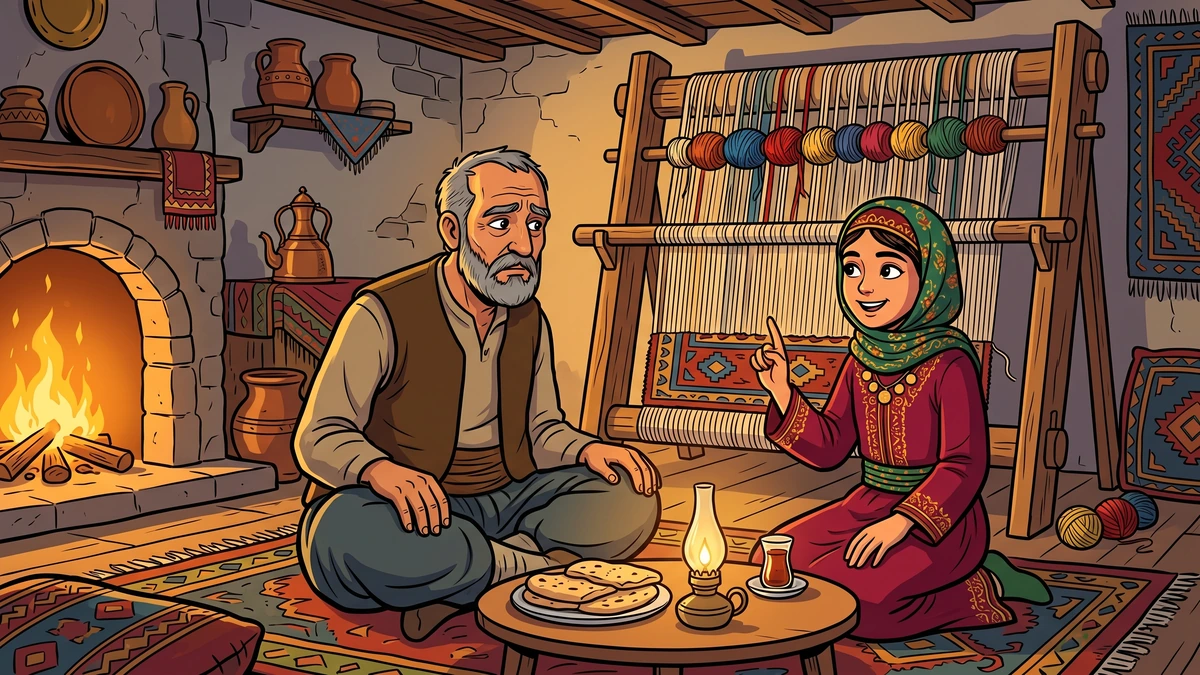
Her father made her say the answers over twice, until he had them safe, and on the third day the two neighbours stood again before the padishah. The rich man spoke first, and gave his hog and his hound and his honey, and looked very satisfied. Then the poor man, twisting his cap in his hands, gave the earth, and the eye, and sweet sleep.
The padishah leaned forward on his throne. The rich man’s answers were the answers of a comfortable man who had never thought past his own storeroom; the poor man’s answers were the answers of true wisdom, and the whole court knew it. “The foal goes to the mare’s owner,” the padishah ruled. But then he narrowed his eyes at the trembling poor man, for he did not believe such answers had ever been born in such a head. “Tell me honestly,” he said. “Those were not your words. Who gave them to you?”
The poor man was too honest to lie. “Forgive me, my padishah,” he said. “The answers are my daughter’s. She is wiser than her father, and wiser, I sometimes think, than anyone in our village.”
III. The Padishah’s Impossible Tests
A lesser king might have been angry to learn that a peasant girl had out-thought his court. This padishah was proud, but his pride took a more interesting turn: he became curious. He wanted to measure this girl for himself. So he sent the poor man home with the first of a series of tests — and every one of them was a trap built out of impossibility.
First the padishah gave the poor man a single handful of raw flax. “Tell your wise daughter,” he said, “to spin this flax, and weave it, and from the cloth make me shirts enough for my whole army — and to have them ready by the time three days are gone.” The poor man carried the little wisp of flax home in despair. But his daughter only smiled, broke a small twig from the broom by the door, and gave it to him. “Take this twig to the padishah,” she said, “and tell him, with all respect, that the moment he has made me a loom and a spinning-wheel and all their gear out of this one twig, I shall make his army’s shirts out of his handful of flax.” When the padishah heard that, he laughed aloud, for the girl had answered an impossible task with an impossible condition, and he could not fault her.
Next he sent the poor man a single hen’s egg — one egg — with the command that the girl hatch from it a flock of forty chickens by the next morning. This time the girl boiled a handful of wheat and sent it back. “Tell the padishah,” she said, “that on the day this boiled wheat sprouts in his garden and grows into a field, I shall feed his forty chickens on the grain — for chickens hatched from one egg in one night will surely eat grain grown from boiled seed.” Again the padishah laughed, and again he could not fault her, for she had matched his impossibility with its twin.
So the padishah set his last and most famous test. He sent word that the wise girl was to come and stand before him in person — but she must come neither walking nor riding; neither clothed nor naked; neither on the road nor off the road; and she must bring him a gift that was both a gift and not a gift. If she could do all of that, he would see her with his own eyes.
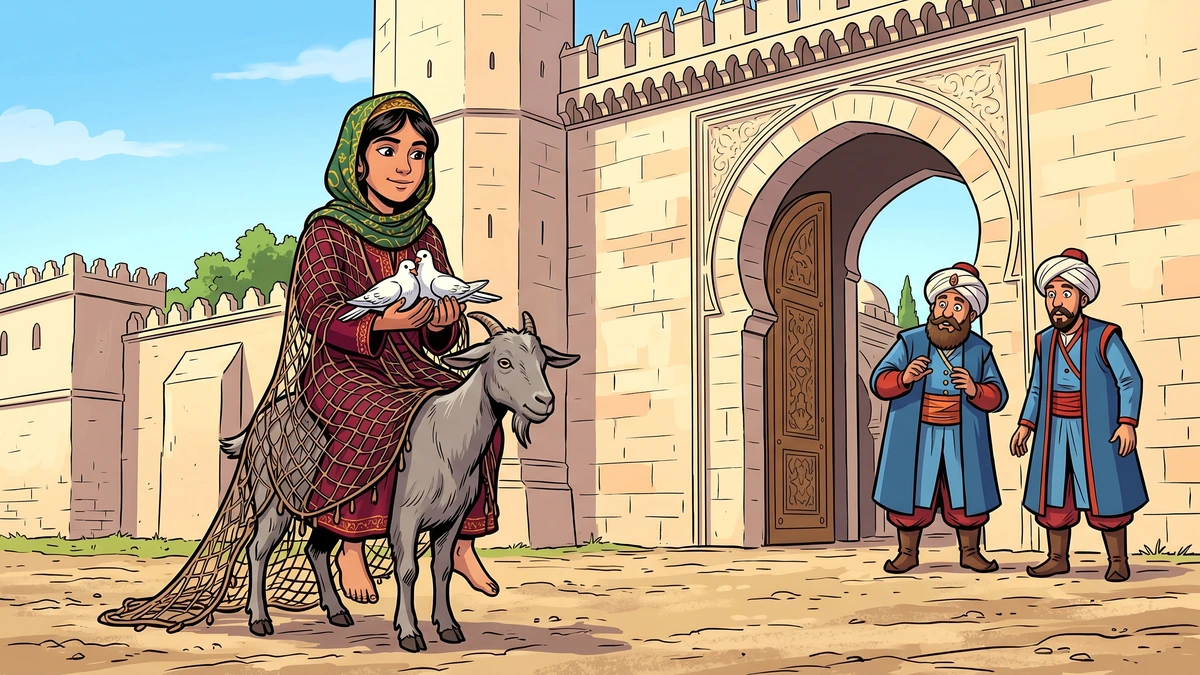
The wise girl thought for one evening, and then she made ready. She wrapped herself from shoulder to ankle in a loose fishing-net, so that she was covered yet not clothed, dressed yet bare. She did not walk, and she did not ride: she sat astride the family’s old grey goat, with her feet hanging down on either side so that her toes just brushed the dust at every step — so she was carried, yet she walked. She guided the goat so that it set its hooves always in the deep rut worn by cart-wheels, so that she travelled neither on the road nor beside it, but in the road’s own hollow seam. And in her cupped hands she carried two live doves. When at last she came before the padishah and he reached out to receive his gift, she opened her hands — and the doves sprang up and flew away through the high windows of the hall. She had brought a gift, and given a gift, and yet the padishah held nothing: it was a gift and not a gift. The whole court rose to its feet, and the padishah came down from his throne to look closely at the girl in the fishing-net, and he found that he had never in his life so wanted to keep talking to anyone.
IV. The Broken Promise and the Dearest Possession
The padishah asked the wise girl to be his wife, and she agreed. But the padishah was still a proud man, and he made one condition, and made her swear to it. “You are cleverer than my judges,” he said. “I do not doubt it. But I am the padishah, and the judging of cases in this land is mine. Swear to me that you will never, never give your counsel in any matter of law that comes before me. The day you meddle in my justice is the day you leave my palace.” The wise girl swore it, and they were married, and for a long while she kept her word and kept her peace.
Then one day a wrong came to the palace gate that she could not let pass. The story goes that two men, a buffalo-driver and an ox-driver, had quarrelled when a buffalo calf was born on the road between their two beasts, and the matter was carried — as such matters always are in this tale — before the padishah. The padishah, weary or careless that day, gave a foolish judgment: he awarded the calf to the wrong man, the man whose animal had plainly not borne it. The cheated man wept outside the palace, and the wise girl, hidden, heard him.
She could not bear it. She did not speak to her husband — that would have broken her oath outright — but she went quietly to the cheated man and whispered him a piece of advice. “Tomorrow,” she said, “take a fishing-net down to the dry, dusty road in front of the palace, in the full sight of the padishah, and begin solemnly to cast the net and haul it, as though you were fishing for fish in the middle of the road. When the padishah sends to ask whether you have lost your wits, answer him: It is no stranger for a man to catch fish on a dusty road than for an ox to give birth to a buffalo calf.”
The man did exactly as she said. And the padishah, watching from his window, understood in an instant that the words were too sharp and too apt to have come from a buffalo-driver — that this was wisdom, and that he had married wisdom, and that wisdom had broken its promise. He overturned his own bad judgment and gave the calf to its rightful owner. But that evening he came to his wife with a heavy face. “You swore an oath,” he said, “and you have broken it. The advice on the road was yours; do not deny it. By my own word, you must leave my palace and return to your father’s house. But because you have been a good wife to me, I will not send you away with nothing. Tonight, take with you from this palace the one thing you hold most dear — whatever it may be — and it is yours to keep.”
The wise girl bowed her head and said only, “Let us share one last supper together, then, before I go.” The padishah agreed. At supper she poured his wine herself, and into it she had stirred a gentle sleeping-draught; and before the meal was over the padishah’s head grew heavy, and he fell into a deep and peaceful sleep. Then the wise girl called for a cart, and with the help of her father’s household she lifted the sleeping padishah, blankets and all, and carried him out of the palace and home through the dark to her father’s small house, and laid him gently in the best bed there.
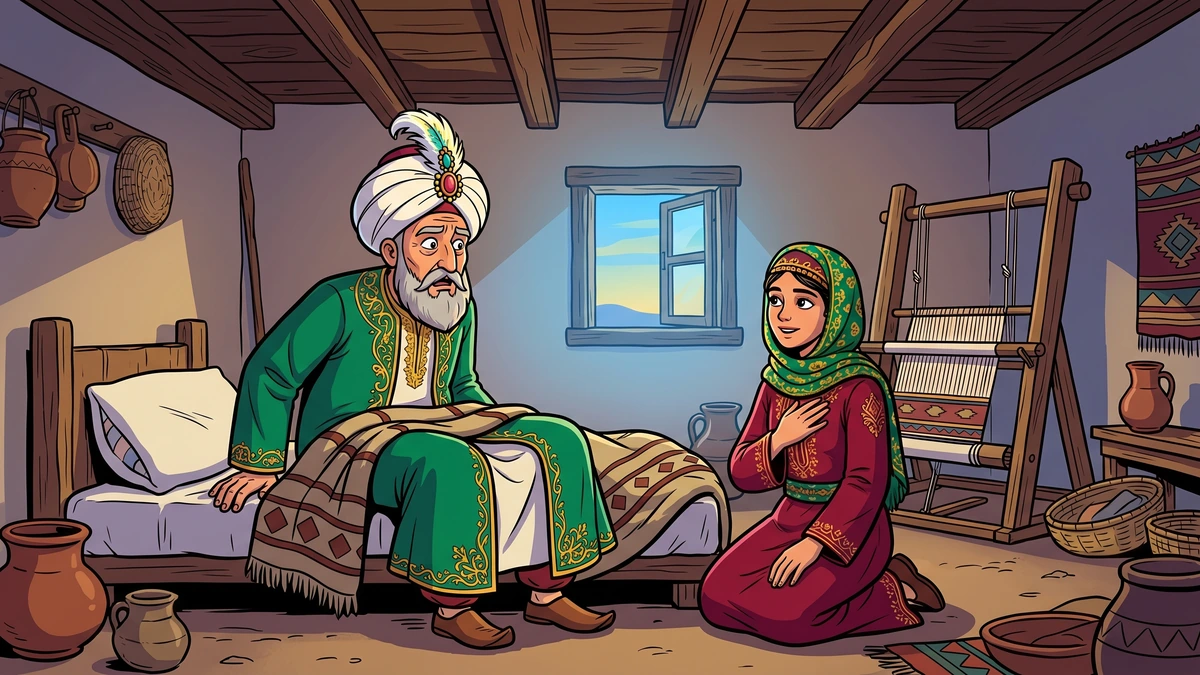
In the morning the padishah woke to a low ceiling of rough beams, a earthen floor, the smell of woodsmoke, and the clack of a loom in the next room. He sat up in great confusion. “Where am I?” he cried. “What is this place? How did I come here?” And the wise girl came and knelt beside the bed and answered him.
“My padishah,” she said, “last night you gave me leave to carry away from your palace the one thing I hold most dear, and to keep it as my own. I searched the whole palace in my heart — the treasuries, the gardens, the horses, the jewels — and in all of it there was nothing I held dearer than you. So I have brought away you. You are the thing I treasure above everything the palace holds, and by your own word, you are mine to keep.”
The padishah looked at her for a long moment in the grey morning light. All the pride went out of him at once, and what was left was something better. He understood that he had been loved past all his foolishness, and that the cleverness he had tried to fence out of his courtroom was the very thing that had honoured him most. He took the wise girl’s hand, and together they rode back to the palace — and from that day the padishah never again gave a judgment without first asking his wife what she thought, and the land was the better for it all the rest of their days.
The Moral of the Tale
On the surface this is a contest of wits, and the wise girl wins every round of it. But the tale is not really about winning. Look again at its shape. The girl never once humiliates the padishah, never crows over a beaten rival, never uses her cleverness as a weapon. She uses it, every single time, to set something right: to save her father, to rescue an innocent man from a false judgment, and at the last, to turn her own banishment into the most loving act of the whole story. Wit, the tale insists, is only as good as the heart that steers it.
And there is a second teaching folded inside the first, one that the Anatolian villagers who told this story for centuries felt keenly. Wisdom keeps no rules about who is allowed to have it. It does not wait for grey hair; the girl is fifteen. It does not wait for wealth; she is the poorest soul in the tale. It does not wait for rank, or schooling, or for a man’s permission to speak. It can live just as easily in a weaver’s stained-fingered daughter as in a padishah on a golden throne — and on the evidence of this story, rather more easily. The proud king had to learn that the cleverest person in his kingdom had been a village girl all along, and that the wise thing to do with such a person is not to silence her but to listen.
“Akıl yaşta değil, baştadır.”
— Turkish proverb: “Wisdom lies not in the years, but in the head.” No saying could sit more snugly at the centre of this tale.
Why the Tale Has Lasted
The clever-girl story is one of the most travelled tales on earth. Folklorists have traced it, in close to the same shape, across Europe, the Near East, Central Asia and beyond, and they classify it as international tale type ATU 875. The Brothers Grimm wrote down a German version; Afanasyev recorded a Russian one; the poet John Gower rhymed an English one six hundred years ago. The Turkish telling is one strong branch of that ancient, far-spreading tree — and it has lasted, in Anatolia and out of it, for reasons that are easy to feel and hard to wear out.
It lasts, first, because it is a pleasure to follow. Each riddle and each impossible task is a small locked door, and the wise girl’s answer is the click of the key — the boiled wheat for the egg, the broom-twig for the loom, the fishing-net and the goat and the two doves. A listener cannot help leaning forward to see how she will do it. The story is, in the plainest sense, fun.
It lasts, too, because of who its hero is. In a great many old tales the clever one is a prince, a vizier, a trickster, a wonder-worker. Here the clever one is a poor girl with no name, no dowry and no power, and she defeats not a monster but the most powerful man in the country — and defeats him so kindly that he ends up grateful. For every listener who has ever been overlooked because they were young, or poor, or a woman, or simply unimportant, the wise girl is a quiet promise that a good mind is a good mind wherever it is found.
And it lasts, above all, for its ending. Most riddle-tales would have finished at the wedding. This one keeps going, past the wedding and into a marriage, and finds there its finest moment: a woman told to take away her dearest treasure, who looks at gold and horses and jewels and chooses, instead, a sleeping man. It is a turn of such tenderness and such cleverness at once — the last and best of all her answers — that once heard it is never quite forgotten. That, in the end, is why the wise girl of Turkey has outlived every padishah who ever sat on a throne.
You May Also Like
 Arabian Nights
Ages 9-12
Arabian Nights
Ages 9-12
Joha and the Donkey
The famous tale of Joha, his son and their donkey. On the road to market, every passer-by criticises how they use the animal, and Joha keeps changing to please each new critic until he has pleased no one and lost the donkey: the classic story of why you cannot satisfy everyone.
 Arabian Nights
Ages 9-12
Arabian Nights
Ages 9-12
Nasreddin Hodja and the Smell of Soup
Nasreddin Hodja and the Smell of Soup: In the bustling streets of Aksehir, a small town in Anatolia, there lived a man of great wit and humble wisdom named
 Arabian Nights
Ages 9-12
Arabian Nights
Ages 9-12
Scheherazade and the Sultan
Scheherazade and the Sultan: In the great city of Baghdad, there lived a Sultan named Shahriar who had been betrayed by his first wife. In his grief and rage