The Barber’s Story of Himself
The comic Arabian Nights tale of the self-styled Silent Barber - the busybody who climbs uninvited into a stranger's boat, lands in chains before the Caliph, and still cannot hear how he sounds.
There is a particular kind of person everyone has met — the one who insists, at great length and without pausing for breath, that he is a man of few words. The Arabian Nights gave that person a whole tale of his own, and made him a barber. He calls himself “the Silent,” and to prove how silent he is he will keep an entire wedding feast hostage to a story. “The Barber’s Story of Himself” is comedy of the sharpest kind: a portrait of a man who cannot see himself, narrated, with perfect irony, by the man himself.
Origin & Canonical Attribution
Collection: Alf Layla wa-Layla (ألف ليلة وليلة), “The Thousand and One Nights,” known in English as the Arabian Nights.
Tale: “The Barber’s Tale of Himself” (also “The Barber’s Story of Himself”). It is the first of the seven linked anecdotes — the barber’s own story, followed by the tales of his six brothers — that the talkative barber recounts to prove that he is, in his own estimation, a man of admirable silence.
Place in the frame: the tale sits inside the great comic sequence known as the Hunchback cycle (The Story of the Hunchback), which Shahrazad (Scheherazade) narrates to King Shahryar across roughly the twenty-fifth to thirty-fourth nights. The barber is introduced within “The Tale of the Lame Young Man of Baghdad”; once he begins speaking he cannot be stopped, and the tale of himself is where he starts.
The barber’s name: in the Arabic he is nicknamed al-Samit (الصامت), “the Silent One” — the joke of the whole cycle, since his six brothers bear nicknames meaning “the Prattler,” “the Babbler,” “the Gabbler” and the like, and he out-talks every one of them.
Standard Arabic texts: the Bulaq edition (Cairo, 1835) and the Calcutta II / Macnaghten edition (1839–1842); the cycle also appears in the earlier Calcutta I (1814–1818) and Breslau (Habicht) printings.
Major translations: Antoine Galland, Les Mille et Une Nuits (French, 1704–1717); Edward William Lane (English, 1838–1840), whose text names the caliph “El-Muntasir bi-lláh”; John Payne (1882–1884); and Sir Richard Francis Burton, The Book of the Thousand Nights and a Night (1885). The Nights itself grew over many centuries from a lost Persian story-book, Hazar Afsana (“A Thousand Tales”), layering Arabic, Indian, Mesopotamian and Egyptian material; the oldest surviving Arabic fragment dates to the ninth century.
Most of the famous tales of the Nights — the flying carpets, the genies, the doomed lovers — ask to be believed. This one asks to be laughed at. It belongs to a rich vein of Arabic humour that the Nights preserves alongside its romance and its horror: the comedy of the tedious, self-admiring busybody. The barber is its masterpiece. And because he is the one telling the story, every word he chooses to make himself look good does the opposite. He is a narrator who indicts himself with every sentence, and never once notices.
How the Barber Came to Open His Mouth
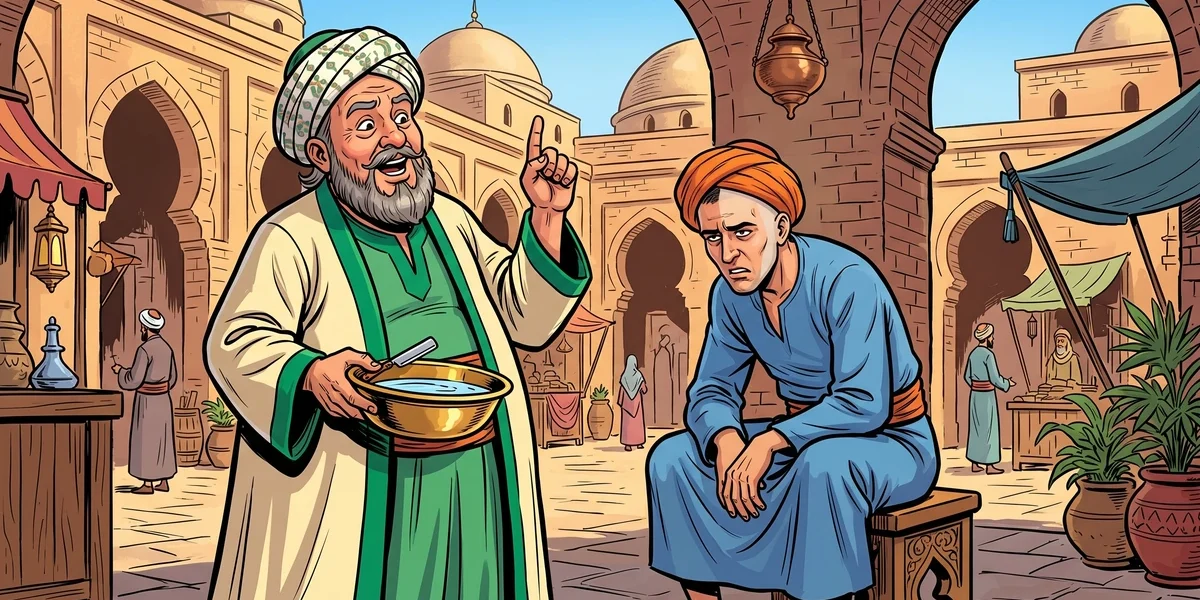
To understand the joke, it helps to know where the barber is standing when he begins. In the surrounding tale, a young man of Baghdad has been wounded and lamed, and he traces every misfortune of his life back to a single morning when he made the mistake of calling a barber to shave his head before an appointment he was desperate to keep on time.
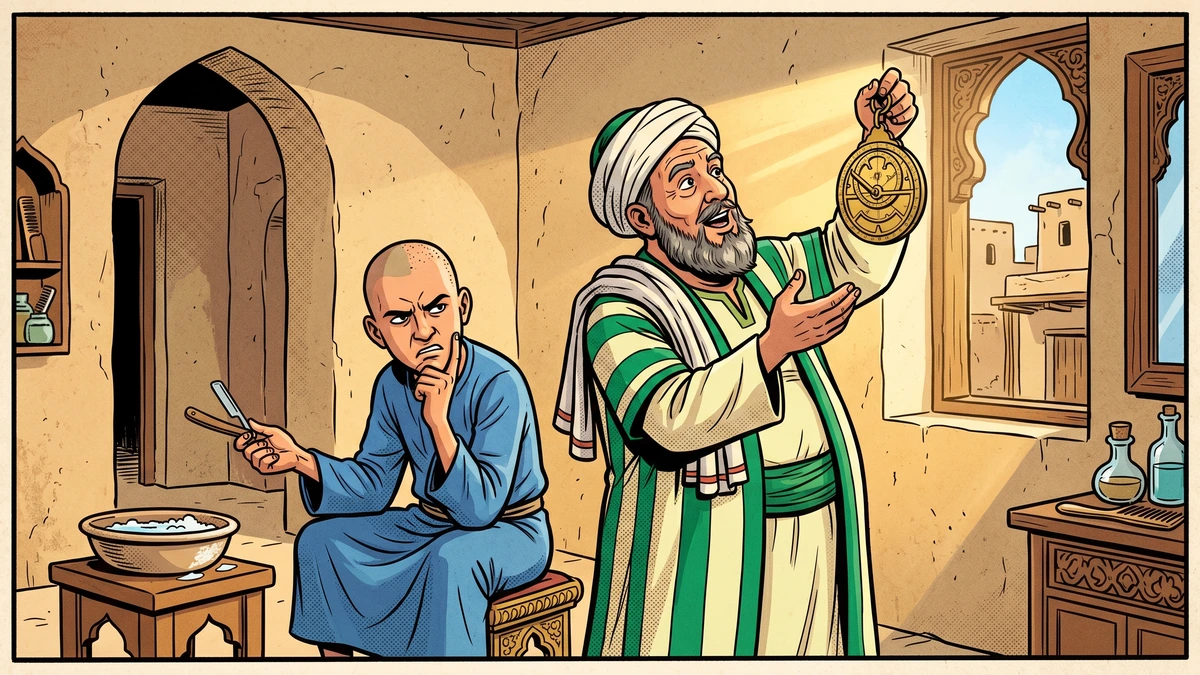
The barber arrived — and would not shave. First he fetched an astrolabe to read the hour from the sun. Then he announced his learning in astronomy, arithmetic, grammar, medicine, law and logic. Then he wished to discuss the young man’s horoscope, his diet, his future. The razor stayed idle while the morning burned away. The young man, frantic, begged only for silence and a quick shave. The barber, wounded, replied that he was the most discreet and economical of speakers — and that, to prove it, he would tell a few short stories about himself and his family.
That is the setup for everything that follows. “The Barber’s Story of Himself” is not told in a calm room to a willing listener. It is told over the protests of a man who has begged him to stop, as evidence in the barber’s own defence. He believes the story proves his modesty. The reader sees, immediately, that it proves the reverse.
The Boat on the Tigris

The barber’s tale of himself opens, as he tells it, in Baghdad in the reign of the Caliph al-Muntasir bi-llah — a ruler, the barber assures everyone, who loved the poor and kept the company of the learned and the virtuous. (The barber, naturally, counts himself among that company.)
One day, the barber says, the Caliph was angry with ten men, and ordered the chief magistrate of Baghdad to bring them to him by boat. The barber happened to be passing. He saw the ten men gathered at the riverside, about to embark — and here the tale opens a clear window into his character. He did not ask who they were. He did not ask where they were going. He simply concluded, on no evidence at all, that ten well-dressed men getting into a boat could only be bound for a pleasure party: a day of eating and drinking and good talk on the water.
And he decided that such a party plainly needed him. So the barber, uninvited, unannounced and entirely unknown to any of the ten, stepped into the boat and made himself one of the company. He says this without a flicker of embarrassment. To him it is simply the natural sociability of a charming man.
The boat pushed off and crossed the broad brown current of the Tigris. The barber, by his own account, said nothing the whole way over — and this, he wants his listeners to understand, was the first great proof of his extraordinary self-control.
The Chain Around the Eleventh Neck

On the far bank the day curdled. The Caliph’s guards were waiting. They came forward with chains, and one by one they fastened a heavy iron collar around each of the ten men’s necks — and then, finding an eleventh man among them, they fastened a chain around the barber’s neck as well.
This is the moment that ought to undo any ordinary person. A stranger has been swept up, in chains, into the punishment of ten men he has never met, for an offence he knows nothing about, simply because he could not resist climbing into someone else’s boat. It is the direct, mechanical consequence of his meddling.
The barber does not see it that way. He tells his listeners that even now — collared, chained, marched along in a line of condemned men — he held his tongue and did not speak. “Now this, O people,” he says, in Lane’s translation, “is it not a proof of my generosity, and of my paucity of speech?” He had, he explains, firmly resolved not to speak. He offers his own silent terror as a moral achievement. He has confused having nothing useful to say with the virtue of restraint.
The chained company was led through the streets and brought before the Caliph al-Muntasir bi-llah, seated in his power, still burning with the anger that had set the whole day in motion. Eleven men knelt before him where there should have been ten.
The One Who Remained
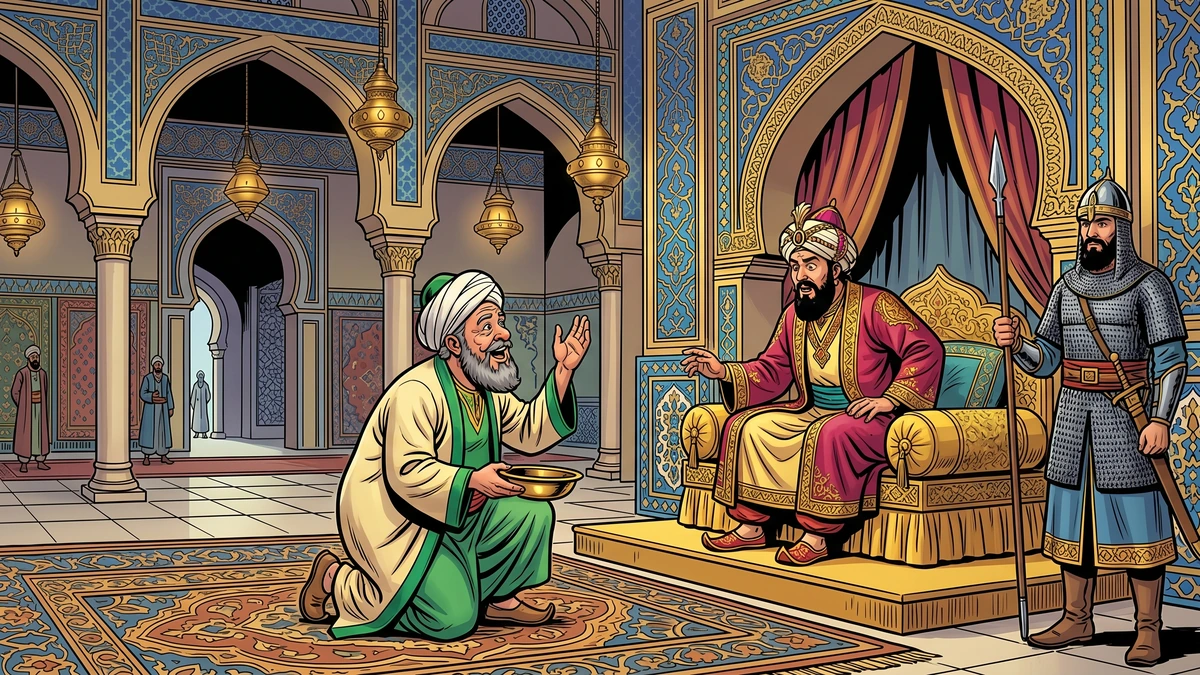
The Caliph gave his order, and it was carried out: the ten men on whom his anger had fallen met their punishment, and the executioner did his work. And then — the line of the condemned exhausted — one man was still kneeling there. The barber. Alive. Uncounted. Inexplicable.
The Caliph turned, astonished, and asked the obvious question: who was this eleventh man, and why, when ten had been brought to be punished, did one remain? The guards confessed they did not know; he had simply been among the group at the boat. The Caliph looked at the silent stranger and demanded to know who he was.
And the barber — at last — spoke. He explained that he was a barber, that he was famous as a sage, that he was known to all as a man of grave and weighty discretion; that he had seen the ten men embark, had assumed a feast, had joined them out of pure good fellowship, and had then borne his undeserved chains in dignified silence rather than trouble anyone with complaint.
The Caliph, in the barber’s telling, was charmed. Here, it seemed to him, was a rare thing: a man of such modesty and such economy of speech that he would walk in a condemned man’s chains sooner than make a fuss. The Caliph praised him, the barber says, and rewarded him with gifts and sent him on his way a favoured man. And so the barber’s reckless intrusion was, by the sheerest accident, rewarded instead of punished — which is precisely why he has told the story. He offers it as the crowning proof that his silence is golden, that his judgement is sound, and that the world, rightly understood, agrees with his high opinion of himself.
His listeners — the lame young man, and through him every reader of the Nights — hear something quite different. They hear a man who escaped death by luck, learned nothing from it, and has spent the years since polishing the episode into a trophy.
The Moral: The Man Who Cannot Hear Himself
“The Barber’s Story of Himself” is built on a single, beautifully sustained irony, and the irony is the moral. The barber’s every claim is contradicted by the very story he chooses to prove it. He says he is silent, and tells an endless tale to say so. He says he is discreet, and describes himself shouldering into a boat full of strangers. He says he is wise, and recounts mistaking a prisoners’ transport for a picnic. He says his judgement is excellent, and the evidence is a chain that was locked around his own neck.
The flaw the tale anatomises is not chatter for its own sake. It is the absence of self-knowledge — the inability to stand outside oneself for even a moment and hear how one actually sounds. The barber is not lying. That is the point. He genuinely believes he is modest, brief and shrewd. He has never once caught his own reflection clearly. He is a busybody who experiences himself as a sage, a bore who experiences himself as a delight, and the comedy is also a quiet warning: the gap between how we appear and how we imagine we appear can be very wide, and the person it is hidden from is usually ourselves.
There is a second lesson threaded through the first, and it is the one the barber’s adventure on the Tigris exists to teach: do not force your way into business that is not yours. Every misfortune in the tale flows from one small failure of restraint — not a wicked act, simply an intrusion. He was not asked into the boat. He invited himself. Ten men’s catastrophe became his catastrophe purely because he could not let a closed door stay closed. The Arabic tradition has a proverb the whole episode seems written to illustrate:
إن كان الكلامُ من فِضّة، فالسّكوتُ من ذَهَب
“If speech is of silver, then silence is of gold.”
The barber would agree with the proverb wholeheartedly. He quotes its spirit constantly. He simply cannot apply it to the one person in the room it was meant for. And the Nights lets him off lightly — he keeps his head, he keeps his gifts, he keeps his unshakable good opinion of himself — because the tale is not interested in punishing him. It is interested in showing him to us, exactly, so that we might recognise the type, and perhaps catch a flicker of him in ourselves before we climb uninvited into the next boat.
Why the Tale Has Lasted
“The Barber’s Story of Himself” has survived for more than a thousand years because it discovered something the modern world still mines for comedy daily: the unreliable narrator. The barber is one of the earliest fully drawn examples in world literature of a storyteller whose every word must be weighed against him. Nothing he reports is necessarily false — the boat, the chains, the caliph are all real inside the tale — but everything he concludes is wrong, and the reader is invited to enjoy the steady, silent gap between his account and its meaning. That technique runs straight from this medieval barber to the self-deceiving narrators of the modern novel and the oblivious bores of every situation comedy since.
The tale also lasts because its caliph was real. Al-Muntasir bi-llah was the eleventh caliph of the Abbasid dynasty, and his reign was one of the briefest and most troubled of the age — he held the throne for only about half a year, in 861 and 862, during the turbulent period when the Turkish guard of the army made and unmade rulers in the city of Samarra. The Nights, as it so often does, plucked a genuine name out of history and set it loose in a half-imagined Baghdad of riverside boats and sudden royal anger. To a medieval listener the name carried a real shiver: the caliph’s anger in this story was the kind of thing that, in living memory, had actually cost men their lives.
Most of all, the tale endures because the barber endures. Strip away the turbans and the astrolabe and the slow brown Tigris, and he is instantly recognisable — the colleague who narrates his own brilliance, the relative whose “quick word” lasts an hour, the guest who joins the conversation he was not part of and calls it warmth. The Arabian Nights is rightly loved for its wonders. But it was also a sharp and very funny observer of ordinary human folly, and in the Silent Barber it created a comic figure so true that he has never once gone out of date. He is still, somewhere, stepping into a boat, certain it is a party, certain he is welcome, certain he will not say a word.
Frequently Asked Questions
Why is the barber in ‘The Barber’s Story of Himself’ called ‘the Silent’?
The nickname is the central joke of the whole cycle. In the Arabic the barber is called al-Samit, ‘the Silent One,’ yet he is the most relentless talker in the Arabian Nights. His six brothers carry nicknames meaning things like ‘the Prattler’ and ‘the Babbler,’ and the barber genuinely believes he is the discreet, restrained member of the family. He tells the long tale of himself specifically to prove how few words he uses – which is precisely how the storyteller exposes him.
What happens to the barber in his story of himself?
The barber sees ten men boarding a boat on the Tigris in the reign of Caliph al-Muntasir bi-llah. Without asking who they are, he assumes they are bound for a pleasure party and climbs aboard uninvited. The ten men are in fact prisoners. On the far bank the Caliph’s guards chain all of them – including the barber – and bring them before the Caliph. The ten are put to death; the barber, an unexplained eleventh man, is spared. The Caliph, charmed by the stranger’s silence, praises him and sends him away with gifts.
Where does ‘The Barber’s Story of Himself’ fit within the Arabian Nights?
It belongs to the Hunchback cycle, a long comic sequence that Shahrazad narrates to King Shahryar across roughly the twenty-fifth to thirty-fourth nights. The barber is introduced inside ‘The Tale of the Lame Young Man of Baghdad.’ To prove he is a man of few words, the barber tells a string of seven anecdotes – his own story first, followed by the tales of his six brothers – making it one of the most elaborate story-within-a-story structures in the collection.
What is the moral of ‘The Barber’s Story of Himself’?
The tale is a study in the absence of self-knowledge. The barber claims to be silent, discreet and wise, yet every detail of his own story contradicts him: he chatters endlessly, forces his way into strangers’ affairs, and mistakes a prisoners’ boat for a picnic. The deeper warning is twofold – that we are often the last to hear how we truly sound, and that meddling in business that is not ours invites disaster. The episode echoes the Arabic proverb that if speech is silver, silence is gold.
Was Caliph al-Muntasir bi-llah a real ruler?
Yes. Al-Muntasir bi-llah was the eleventh caliph of the Abbasid dynasty, and his reign was among the shortest of the age – only about six months across 861 and 862 CE, during the unstable Samarra period when the Turkish military guard repeatedly made and unmade caliphs. As it often does, the Arabian Nights borrowed a genuine historical name and set it loose in a half-imagined Baghdad, which gave the barber’s brush with royal anger a real and recognisable menace for medieval listeners.
You May Also Like
 Arabian Nights
Ages 9-12
Arabian Nights
Ages 9-12
The City of Brass: A Lesson in the Vanity of Power
The City of Brass: A Lesson in the Vanity of Power: In the great halls of Damascus, Caliph Muawiyah sat upon his throne, disturbed by troubling dreams. joins a
 Arabian Nights
All Ages
Arabian Nights
All Ages
The Story of the Slave Kafur
An enslaved boy in the Arabian Nights tells one lie a year. The year his lie convinces a whole household their master is dead, and the master that his household is dead, a city is thrown into mourning over corpses that never existed - a comic, unsettling parable on the runaway speed of a falsehood.
 Arabian Nights
Ages 9-12
Arabian Nights
Ages 9-12
The Tale of the Merchant and the Genie
The first tale Shahrazad ever tells: a merchant condemned to die for an accidental killing is ransomed from a demon's wrath by three strangers who pay with nothing but wondrous stories.