Jack and His Comrades
Poor Jack sets off to seek his fortune and rescues a donkey, a dog, a cat and a cock, and together the five comrades rout a gang of robbers.
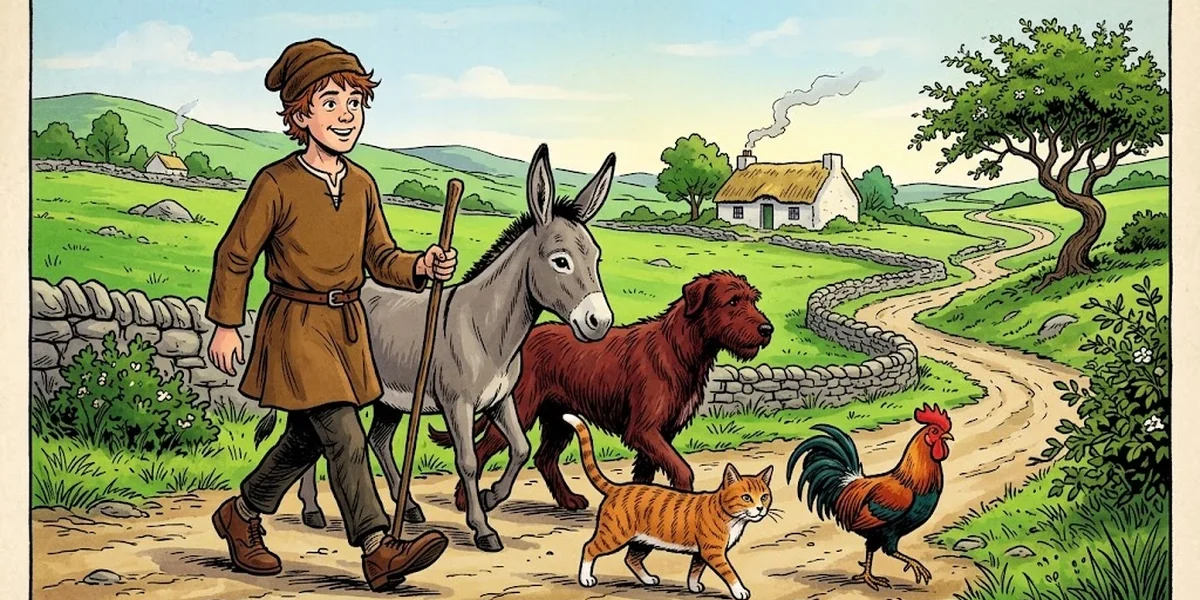
There was once a poor widow, as there often has been, and she had one son. A very hungry summer came, and they did not know how they would live until the new potatoes were ready to eat. So one evening Jack said to his mother, “Mother, bake my cake and kill my hen, and I’ll go and seek my fortune. If I find it, never fear, I’ll soon be home to share it with you.”
She did as he asked, and he set off at daybreak. His mother walked with him to the yard gate. “Jack,” she said, “which would you rather have: half the cake and half the hen with my blessing, or the whole of them with my curse?”
“Musha, mother,” said Jack, “why ask me that? You know I wouldn’t take your curse if the finest estate in the county came with it.”
“Well then, Jack, here’s the whole lot, with my thousand blessings.” And she stood on the yard fence and blessed him for as long as she could see him.
He walked and walked until he was tired, and not one farmer whose house he called at wanted a boy. At last his road ran beside a bog, and there was a poor donkey, sunk up to his shoulders, trying to reach a big tuft of grass.
“Ah, Jack, my dear,” said the donkey, “help me out, or I’ll drown.”
“You needn’t ask twice,” said Jack, and he threw big stones and sods into the mud until the donkey found firm ground under his feet.
“Thank you, Jack,” said the donkey, once he was out on the hard road. “I’ll do as much for you some day. Where are you going?”
“I’m off to seek my fortune till the harvest comes in, God bless it.”
“If you like, I’ll come with you. Who knows what luck we may have?”
“With all my heart. It’s getting late, so let’s be moving.”
As they passed through a village, a whole crowd of little boys were chasing a poor dog with a kettle tied to his tail. The dog ran to Jack for protection, and the donkey let out such a roar that the young rascals fled as if the devil himself were after them.
“More power to you, Jack,” said the dog. “I’m much obliged. Where are you and the beast going?”
“We’re going to seek our fortune till the harvest comes in.”
“Wouldn’t I be proud to come with you, and get away from those badly behaved boys!”
“Well, well, throw your tail over your arm and come along.”
Outside the town they sat down under an old wall. Jack took out his bread and meat and shared it with the dog, and the donkey made his dinner of a clump of thistles. While they were eating and chatting, along came a poor half-starved cat, and the miaow he gave would break your heart.
“You look as though you’ve seen nothing but the tops of nine houses since breakfast,” said Jack. “Here’s a bone with something on it.”
“May your child never know an empty belly!” said Tom the cat. “It’s myself that needs your kindness. May I be so bold as to ask where you’re all going?”
“We’re going to seek our fortune till the harvest comes in, and you can join us if you like.”
“That I will, with a heart and a half, and thank you for asking.”
Off they went, and just as the trees’ shadows were three times as long as the trees, they heard a great cackling in a field beside the road, and out over the ditch leaped a fox with a fine black cock in his mouth.
“Oh, you villain!” roared the donkey like thunder.
“At him, good dog!” cried Jack, and the words were hardly out of his mouth before the dog was racing after the fox. The fox dropped his prize like a hot potato and was gone like a shot, and the poor cock came fluttering and trembling back to Jack and his comrades.
“Oh, neighbours,” he said, “wasn’t it the greatest luck that brought you my way! I won’t forget your kindness if ever I find you in trouble. And where in the world are you all going?”
“We’re going to seek our fortune till the harvest comes in. Join us if you like, and ride on Neddy’s back when your legs and wings get tired.”
So the march went on. By the time the sun had set, there was neither cabin nor farmhouse in sight. “Well, well,” said Jack, “bad luck now means better luck later, and it’s only a summer night after all. We’ll go into the wood and sleep on the long grass.”
No sooner said than done. Jack stretched out on a heap of dry grass, the donkey lay beside him, the dog and cat curled up in the donkey’s warm lap, and the cock went to roost in the nearest tree.
They were all fast asleep when the cock took it into his head to crow. “Bother you, Black Cock!” said the donkey. “You woke me from as lovely a wisp of hay as I ever tasted. What’s the matter?”
“Daybreak is the matter. Don’t you see the light over there?”
“I see a light all right,” said Jack, “but it comes from a candle, not the sun. Since you’ve woken us, we might as well go over and ask for a bed.”
So they shook themselves and made their way through grass and rocks and briars down into a hollow. There was the light shining through the darkness, and with it came the sound of singing, laughing and swearing.
“Easy, boys,” said Jack. “Walk on tiptoe till we see what sort of people we’re dealing with.”
They crept up to the window and saw six robbers inside, armed with pistols, blunderbusses and cutlasses, sitting at a table eating roast beef and pork and drinking mulled beer, wine and whiskey punch.
“Wasn’t that a fine haul we made at the Lord of Dunlavin’s!” said one thief with his mouth full. “And little we’d have got but for the honest porter. Here’s to his health!”
“The porter’s health!” they all cried, and Jack beckoned to his comrades.
“Close ranks, my men,” he whispered, “and every one of you mind the word of command.”
So the donkey put his front hooves on the windowsill, the dog climbed onto the donkey’s head, the cat onto the dog’s head and the cock onto the cat’s head. Then Jack gave the signal, and they all sang out like mad.
“Hee-haw, hee-haw!” roared the donkey. “Bow-wow!” barked the dog. “Miaow, miaow!” cried the cat. “Cock-a-doodle-doo!” crowed the cock.
“Level your pistols!” shouted Jack. “Blow them to smithereens! Don’t leave a mother’s son of them alive! Present! Fire!”
With that they gave another yell and smashed every pane in the window. The robbers were frightened out of their wits. They blew out the candles, knocked over the table and fled out of the back door, and they did not stop running until they were in the very heart of the wood.
Jack and his comrades went into the room, closed the shutters, lit the candles, and ate and drank until they could manage no more. Then they settled down for the night: Jack in the bed, the donkey in the stable, the dog on the doormat, the cat by the fire and the cock on the perch.
At first the robbers were glad to be safe in the thick wood, but soon they began to grumble. “This wet grass is very different from our warm room,” said one. “I had to drop a lovely pig’s trotter,” said another. “I didn’t get a spoonful of my last glass,” said a third. “And all the Lord of Dunlavin’s gold and silver left behind!” said the last.
“I think I’ll risk going back,” said the captain, “and see if I can save anything.”
“Good man!” they all said, and off he went.
The lights were all out, so he felt his way to the fire, and there the cat flew at his face and tore him with teeth and claws. He let out a roar and made for the bedroom door to find a candle, but he trod on the dog’s tail and got the dog’s teeth in his arms and legs. “A thousand murders!” he cried. “I wish I was out of this unlucky house!” At the front door the cock dropped onto him with claws and beak, and what the cat and dog had done was a flea-bite compared to that. Gasping and reeling, he spun round and round until he staggered backwards into the stable, where the donkey gave him a kick in the seat of his breeches that landed him neatly on the dung heap.
When he came to his senses, he scratched his head and wondered what had happened. As soon as his legs would carry him, he limped away, dragging one foot after the other, until he reached the wood.
“Well, well,” they all called when he came within earshot, “any chance of our property?”
“Chance, you say? Poor chance it is. Will one of you pull me a bed of dry grass? All the sticking plaster in Enniscorthy wouldn’t cover my cuts and bruises. If you only knew what I’ve suffered for you! At the kitchen fire, looking for a lighted sod of turf, what should I find but an old woman carding flax, and look at the marks her combs left on my face. I ran for the bedroom door and fell over a cobbler at his bench, and if he didn’t set on me with his awls and pincers, call me a rogue. I got away from him somehow, but going out of the door, it must have been the devil himself that pounced on me, with claws and teeth like sixpenny nails, and wings too, bad luck to him! At last I reached the stable, and there, by way of greeting, I got a blow from a sledgehammer that sent me half a mile. If you don’t believe me, go and see for yourselves.”
“Oh, our poor captain,” they said, “we believe every word. Catch us going within a hen’s race of that unlucky cabin!”
Next morning, before the sun was fairly up, Jack and his comrades were up and about. They made a hearty breakfast of the leftovers and agreed to go to the castle of the Lord of Dunlavin and give him back all his gold and silver. Jack packed it into the two ends of a sack and laid it across Neddy’s back, and off they went through bogs, up hills and down valleys, and sometimes along the yellow high road, until they reached the front door of the Lord of Dunlavin’s castle.
And who should be standing there, airing his powdered hair, white stockings and red breeches, but the thieving porter. He scowled at the visitors and said to Jack, “What do you want here, my fine fellow? There’s no room for the lot of you.”
“We want,” said Jack, “what I’m sure you haven’t got to give: plain good manners.”
“Be off with you, you lazy tramps, quicker than a cat could lick her ear, or I’ll set the dogs on you.”
“Would you tell us,” said the cock, perched on the donkey’s head, “who it was that opened the door to the robbers the other night?”
Ah, the porter’s red face went as white as his frill, and the Lord of Dunlavin and his pretty daughter, who had been standing at the parlour window without the porter knowing it, put their heads out. “I’d like to hear your answer, Barney,” said the lord, “to the gentleman with the red comb.”
“Ah, my lord, don’t believe the rascal. I never opened the door to the six robbers.”
“And how did you know there were six, you poor innocent?” said the lord.
“Never mind that, sir,” said Jack. “All your gold and silver is in this sack, and I don’t think you’ll grudge us our supper and a bed after our long march from the wood of Athsalach.”
“Grudge it? Not one of you will ever see a poor day if I can help it.”
So they were all made as welcome as could be. The donkey, the dog and the cock got the best places in the farmyard, and the cat took over the kitchen. The lord took Jack in hand and dressed him from head to toe in fine broadcloth, with frills as white as snow, dancing shoes and a watch in his pocket. When they sat down to dinner, the lady of the house said Jack had the air of a born gentleman, and the lord said he would make him his steward. Jack brought his mother to live in comfort near the castle, and everyone was as happy as could be.
About this telling
Jacobs took “Jack and His Comrades” from Patrick Kennedy’s Legendary Fictions of the Irish Celts, and he called it the fullest and most dramatic version he knew of Grimm’s “Town Musicians of Bremen.”
Dunlavin and Enniscorthy set the tale in south-east Ireland, in the Wicklow and Wexford countryside. Musha is an Irish exclamation, and carding flax means combing its fibres with spiked wooden “cards,” which is why the captain mistakes the cat’s claws for an old woman’s cards.
Read the original: Joseph Jacobs, Celtic Fairy Tales (Project Gutenberg 7885, Jack and His Comrades)
Best for ages 9–12 with discussion: animal mistreatment, armed robbers, shouted threats and a returning robber injured by the animals. The companions’ safety grows from several acts of mutual help.
Reading the story closely
Jack rescues the donkey, then the donkey helps protect the dog, and the dog chases the fox away from the cock. Help already circulates before the group reaches the robbers. Their shared meal also meets an immediate need rather than waiting for a reward. The ending completes Jack’s opening promise when he brings his mother into comfort.
Map the captain’s account onto what actually happens: cat to flax-carder, dog to cobbler, cock to winged attacker, donkey to hammer blow. His frightening explanation combines partial sensations in the dark. Compare that mistaken inference with the porter’s revealing knowledge of ‘six’ robbers: the lord catches a detail no visitor has yet supplied to him. The tale uses both misunderstanding and careful listening to undo wrongdoing.
Questions to ask
- How did Jack come to have four animal companions?
- How did the animals frighten the robbers away?
- What does the cock ask, and what detail does the porter’s own answer reveal?
Related stories
- Jack and His Master — another Jack from Jacobs’s Irish tales who outwits more powerful people
- Hudden and Dudden and Donald O’Neary — a darker Irish trickster tale with fatal deceptions
- The Match-Making Jackal — a Bengali tale of a clever animal helping a poor man
Frequently Asked Questions
How does Jack gain four companions?
How do they drive away the robbers?
How is the porter exposed?
You May Also Like
 Celtic Folk Tales
Ages 9-12
Celtic Folk Tales
Ages 9-12
The Lad with the Goat-Skin
Tom, a poor widow’s son dressed only in a goat-skin, wins three magic gifts from giants and sets out to make the gloomy princess of Dublin laugh three times.
 Celtic Folk Tales
Conal Yellowclaw
Caught stealing the King of Lochlann’s brown horse, Conal Yellowclaw wins his three sons’ lives one by one by telling of the narrowest escapes of his life.
 Celtic Folk Tales
Ages 9-12
Celtic Folk Tales
Ages 9-12
How Cormac Mac Art Went to Faery
High King Cormac trades his family for a silver branch whose music ends all sorrow, then follows them into a strange land of wonders to win them back.