Hudden And Dudden And Donald O’Neary
Hudden And Dudden And Donald O'Neary: There was once upon a time two farmers, and their names were Hudden and Dudden. They had poultry in their yards, sheep on
Hudden and Dudden and Donald O’Neary is one of the best-loved tales in Joseph Jacobs’ Celtic Fairy Tales (London: David Nutt, 1892), the eighth story in a landmark collection that brought the rich oral storytelling of Ireland, Scotland, Wales, Cornwall, Brittany and the Isle of Man into a single popular volume for English readers. Jacobs adapted the story from Patrick Kennedy’s Legendary Fictions of the Irish Celts (1866) and from oral versions still told in rural Ireland in the late nineteenth century. The tale is a classic example of what folklorists, following the Aarne–Thompson–Uther index, call type ATU 1535 “The Rich Peasant and the Poor Peasant” — the same international tale family as the Brothers Grimm’s Das Bürle (KHM 61, “The Little Peasant”) and Hans Christian Andersen’s Lille Claus og Store Claus. In its Irish dress the story sparkles with the dry, mischievous wit that the Gaelic-speaking countryside reserved for the cunning under-dog, and it remains one of the cleanest illustrations of the old Munster proverb “Is fearr glic ná láidir” — better to be clever than to be strong.
I. The Quiet Cottage Between Two Greedy Farms
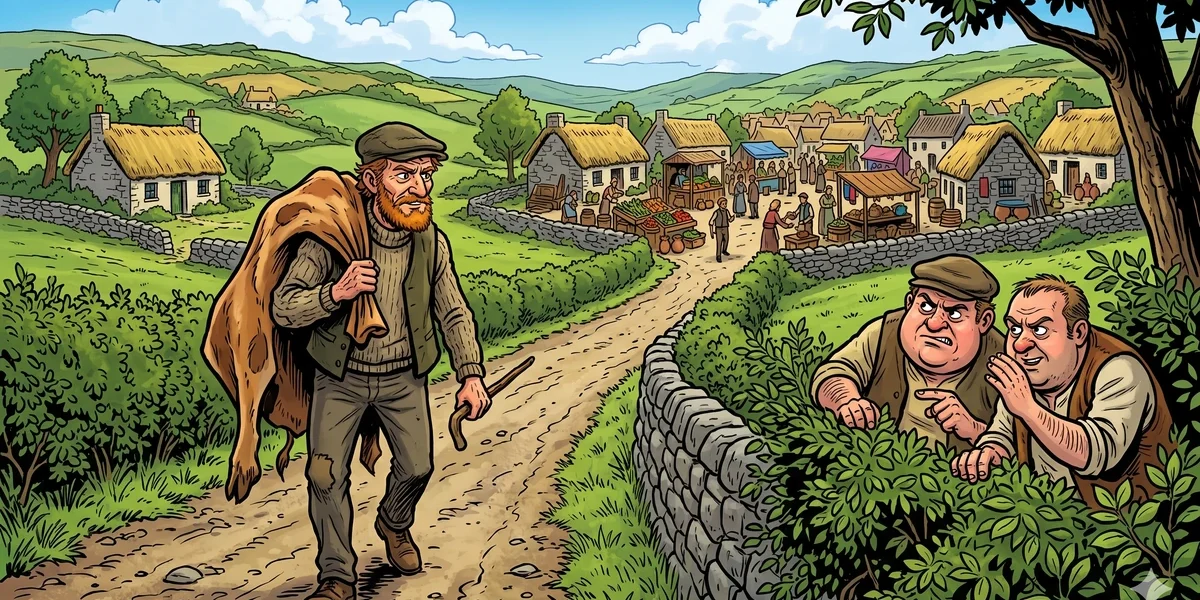
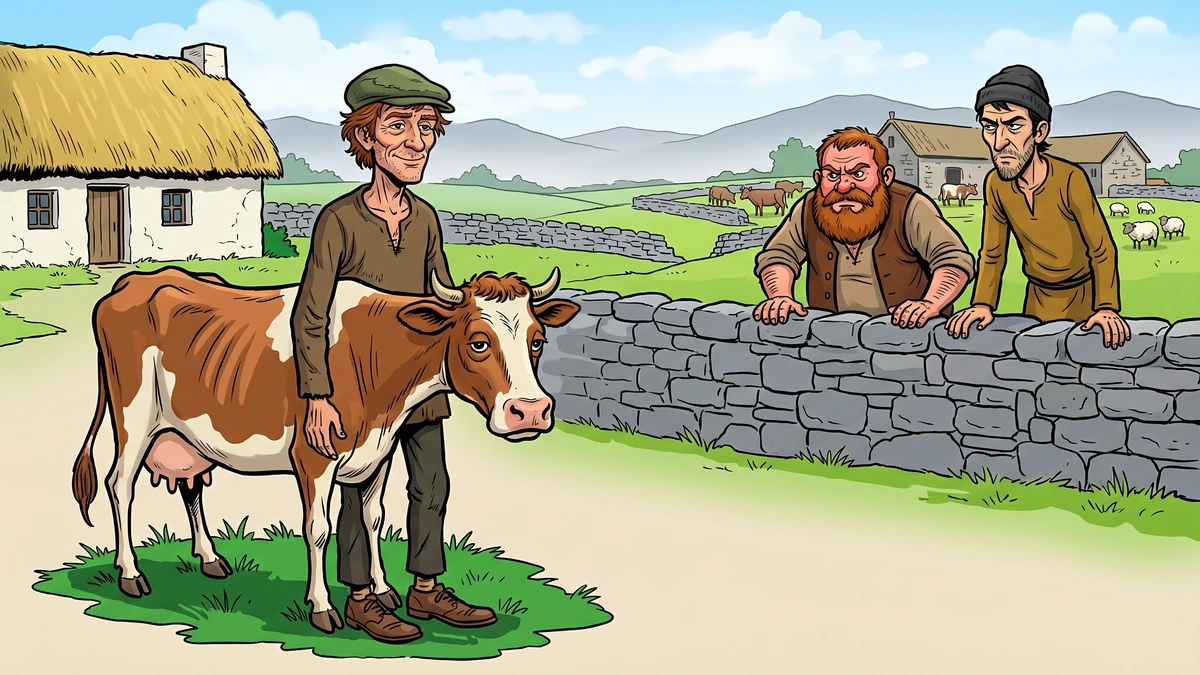
The opening of the tale carries the unmistakable rhythm of a fireside opening: “There was once upon a time two farmers, and their names were Hudden and Dudden.” They have everything a Connacht farmer could wish for — poultry in the yards, sheep on the uplands, scores of cattle in the river meadows. Yet their lives are poisoned by the one thing they cannot have: the small green strip of grass that lies between their two prosperous holdings, owned by their poor neighbour Donald O’Neary. Donald has nothing but a thatched hovel, a strip of pasture barely larger than a kitchen garden, and a single bony cow named Daisy whose ribs show through her hide. He cannot even manage a regular bowl of milk or a fresh roll of butter. By any honest reckoning, his neighbours have already won every contest of property and comfort. And yet, in the moral world of the Irish folk tale, this is precisely the situation that breeds calamity, for it is the rich men, not the poor one, who lie awake at night scheming. The narrator’s wry comment — “the more one has the more one wants” — is one of the oldest convictions of Irish oral tradition, where avarice is treated not as the cunning of the strong but as the disease of the comfortable.
This first movement of the story functions as the moral architecture for everything that follows. Hudden and Dudden are not merely greedy; they are actively unjust. They covet a piece of land that supports a single starving cow, and they decide that the simplest way to dispossess Donald is to kill the only living creature he loves. The reader is therefore prepared, almost from the opening lines, to root unreservedly for the small man — not because he is a saint, but because his enemies have crossed the line that separates ordinary envy from cruelty. In the long European tale family of ATU 1535, this opening establishes the licence that the trickster will spend the rest of the story exercising: when the system is rigged, cleverness is no longer a vice but a tool of justice.
Folklorist Patrick Kennedy, writing in 1866, recorded this story in almost exactly the form that Jacobs would later popularise. Kennedy was a Wexford bookseller whose great gift to nineteenth-century scholarship was simply that he listened — he transcribed the tales his country customers told in his shop and on the road, preserving cadences, place-names, and phrases of dialect that earlier antiquarians had quietly trimmed away. His Hudden and Dudden, like Jacobs’ after him, opens with this same patient, almost rueful tone. The Irish storyteller knew that his audience needed no warming up; everyone in the cottage already understood that the prosperous farmer with two cart-horses was perfectly capable of conspiring against the cottier with a single cow.
II. The Hide Trick: How Donald Turns Loss Into Gold
When Daisy is murdered in the night, Donald does the most surprising thing in the whole tale: he refuses to despair. Jacobs gives us a single perfectly observed sentence — “Donald was a shrewd fellow, and downhearted though he was, began to think if he could get any good out of Daisy’s death.” In one stroke, the storyteller has set out the philosophical centre of the entire Irish trickster tradition: grief is permitted, but grief must yield to invention. Donald flays the cow, slits the hide in several places, slips a copper penny into each slit, slings the hide over his shoulder, and walks the long dusty road to the fair.
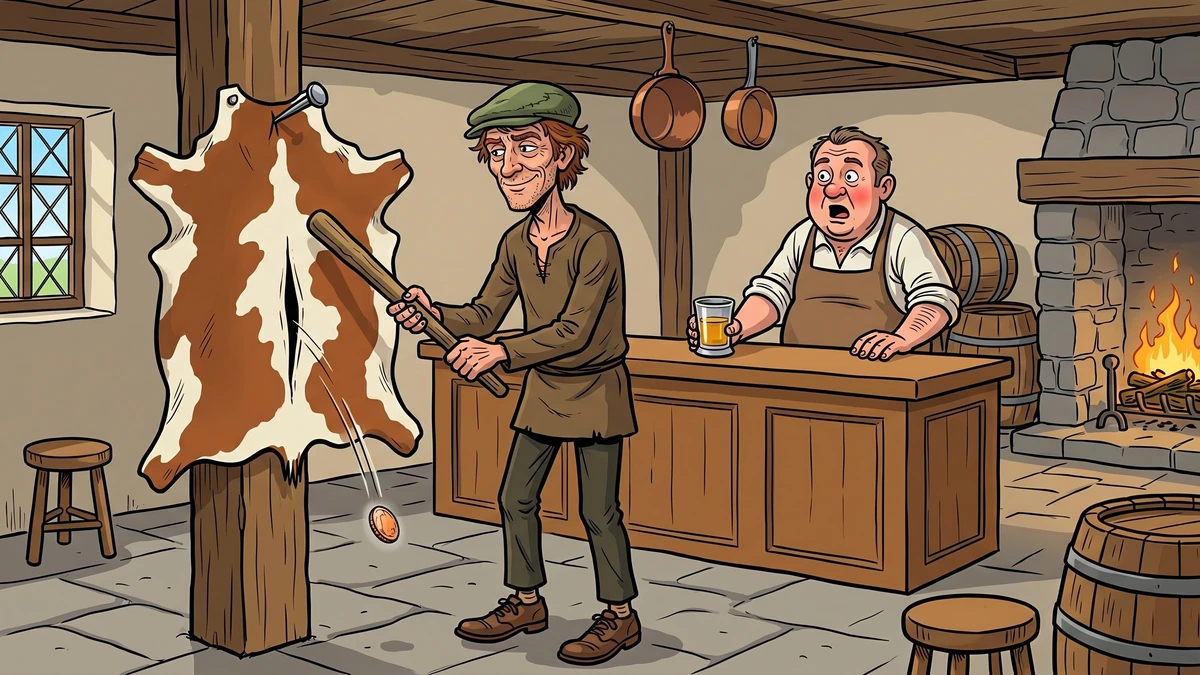
What follows is one of the cleanest small confidence-tricks in European folk literature. At the best inn in the town Donald orders a glass of the landlord’s finest whiskey. When the suspicious landlord hesitates over the bill, Donald cheerfully strikes the hanging hide with his stick — and out drops a penny. He strikes again, and out drops another. The landlord, who has spent his whole working life believing that money is hard to come by, suddenly meets a man whose money seems to drop out of dead leather. The hide changes hands for a gold piece, and Donald walks home with a pocketful of coin. The trick is not really about supernatural cattle hides at all; it is about the way in which greed makes its own victims. The landlord wants the magical money-purse for himself, and his wanting is what blinds him to the obvious. In the Aarne–Thompson–Uther index this episode is logged precisely as motif K111.1 – “Sale of pseudo-magic ox-hide”, attested in versions from Norway to Sicily, but the Irish telling is sharpened by a particular wry dignity: Donald never lies outright. He merely lets the landlord overhear his own assumptions.
The trickery deepens when Donald arrives home and casually borrows Hudden’s best pair of weighing-scales, a perfectly innocent request that nevertheless plants the seed of his neighbours’ ruin. Hudden has hidden a small lump of butter in the bottom of the scales — an old country trick to keep an eye on a borrower — and one of Donald’s last gold coins sticks fast to the butter when the scales are returned. The detail is masterful folk-craft: the cheaters are undone by the very cheating they had thought too clever to be detected. Hudden races to Dudden, the gold piece in his hand; Dudden stares; together they stomp to Donald’s door without so much as a polite knock and find him calmly stacking gold ten coins at a time. “Hides are worth their weight in gold in the market just now,” Donald tells them with a mild smile, and the trap snaps shut. The story then turns, with the speed of a good joke, on Hudden and Dudden’s decision to slaughter every animal on their two farms and march to the fair with their arms full of useless skins. The cobblers, the tanners and the innkeeper are by now thoroughly tired of being made fools, and the two prosperous farmers are driven out of town with their coats torn and the dogs of the county at their heels.
III. The Meal-Sack and the Farmer Who Wanted a Princess
Furious at being humiliated in front of the entire fair, Hudden and Dudden decide that Donald must be drowned. They stuff him into a meal-sack, run a stout pole through the knot, and shoulder the bundle towards the Brown Lake of the Bog. But the road is long, the day is hot, and the sack is heavier than they had reckoned for so small a man. When they pass an inn they cannot resist; they prop Donald against the door-jamb like a sack of potatoes and go inside for a glass.
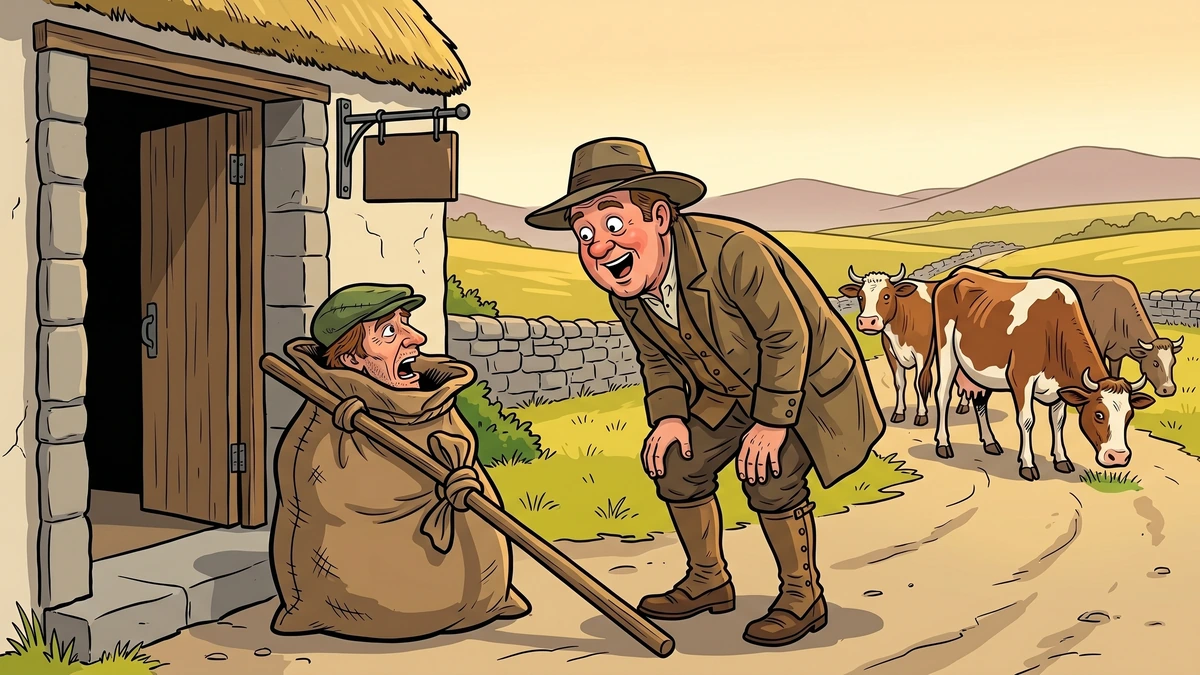
Here Jacobs’ storytelling reaches one of its loveliest comic peaks. Donald, blinking inside the sack, hears the glasses chinking through the wall. He raises his voice and begins to repeat, with mounting theatrical anguish, “I won’t have her, I tell you; I won’t have her!” A passing cattle-drover, on his way in for a drink, stops to ask the sack what it is refusing. The king’s daughter, says Donald sorrowfully; her father is determined to marry her off to him, and she is covered with jewels from top to toe, but he has no use for princesses. The drover’s eyes shine. They make the old swap from a hundred trickster tales: the drover unties the sack, climbs in, and offers Donald his entire drove of cattle in exchange for the privilege of being delivered to the palace. By the time Hudden and Dudden lurch back out of the inn, much the worse for porter, the sack is rocking and shouting “I’ll have her now! I’ll have her now!” and the two farmers, satisfied that Donald has at last seen reason, hurry on to throw him into the Brown Lake.
This third movement of the tale draws on motif K842 – “Dupe persuaded to take prisoner’s place in sack”, one of the oldest and most widely diffused trickster motifs in the Indo-European world. Variants of this scene appear in the Norwegian Big Peter and Little Peter, the German Das Bürle, the Russian Pop and Workman Balda, and an Indian Panchatantra cousin called “The Brahmin Who Built Castles in the Air”. What gives the Irish version its peculiar tang is the precise choice of bait. The drover is not tempted by gold, or by escape from punishment, or by entry to heaven — he is tempted by the chance to marry above his station. There is a sly social commentary buried in the laughter: in nineteenth-century rural Ireland, where a princess was as remote from a small farmer as the moon, the dream of marrying upwards was a private joke shared by every cottage in the parish. Donald, the supposed simpleton, weaponises that fantasy without uttering a single direct lie.
IV. The Brown Lake and the Land of Promise
Donald arrives home long before his enemies, driving the drover’s entire herd of fat cattle ahead of him. By the time Hudden and Dudden, well-watered and full of porter, hurl their squirming sack into the lake and turn for home, they have already been outwitted for the second time in two days. They reach Donald’s strip of grass-land and stop in stunned silence: Donald is sitting in his own field with cows grazing all around him, calves butting their heads together, sheep wandering off into the hills.
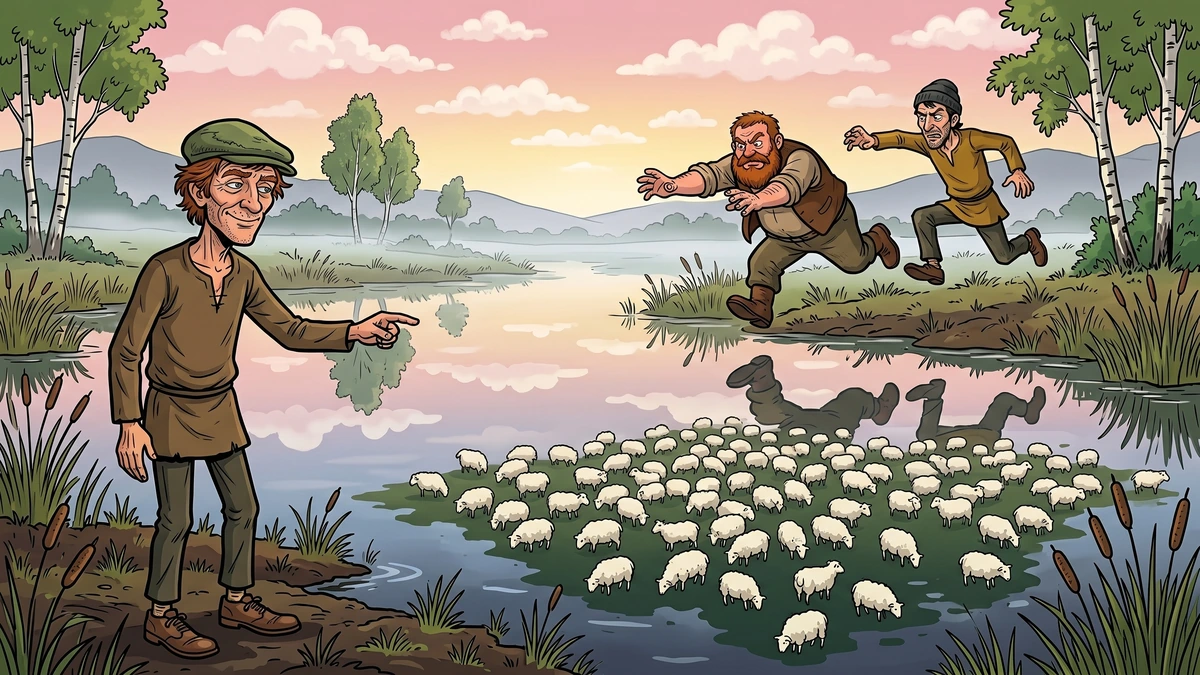
“You’ll have heard, like me, that the Brown Lake leads to the Land of Promise,” Donald tells them with a perfectly straight face. “I always put it down as lies, but it is just as true as my word. Look at the cattle.” Hudden gapes; Dudden swallows. They cannot, of course, mention that they have just thrown a man into the lake hoping to drown him; to admit such a thing now, in the face of all this prosperity, would be to confess murder for nothing. So they ask Donald to lead them back to the lake, and Donald obligingly does. The sky overhead is full of small white clouds; the lake beneath, perfectly mirroring it, is full of the same small white clouds, drifting like a vast underwater meadow. “Ah! now, look, there they are,” says Donald, pointing into the water at the reflected herds. Hudden jumps first; Dudden, terrified of being beaten to the cattle, jumps an instant later. The lake closes over them. Maybe, the storyteller adds with a tiny shrug, they got too fat, like the cattle. As for Donald O’Neary, he had cattle and sheep all his days to his heart’s content.
The Brown Lake of the Bog is no random setting. An Loch Donn, the “Brown Lake”, is a familiar motif in Irish folklore, an inland water-mirror associated with the threshold between this world and the Otherworld. The Land of Promise — in Old Irish Tír Tairngire — is one of the names given in the Mythological Cycle to the islands of the blessed where Manannán mac Lir, god of the sea, kept his herds of immortal cattle. By placing Donald’s climactic trick on the shore of just such a lake, the storyteller is quietly reminding the listener that the entire Irish landscape is a layered text: every reflection in still water is potentially a window into the world of the sídhe, and any greedy man who cannot tell a cloud from a cow has already failed the deepest test of Gaelic spiritual literacy. Hudden and Dudden are not killed by Donald; they are killed by their own inability to read the sky.
The Moral — Is fearr glic ná láidir
“Is fearr glic ná láidir.”
— old Irish proverb: Better to be clever than to be strong.
Few folk tales make the case for cleverness over strength as cheerfully as this one. Donald O’Neary owns nothing at the start of the story but a strip of grass and a starving cow; by the end he owns a herd of fat cattle, a pocketful of gold, and his own life. He has not robbed anyone: every penny and every cow comes to him because someone richer or stronger insisted on outsmarting him and was outsmarted in return. The story does not pretend that he is morally pure — Donald lies, dissembles and exploits the avarice of his enemies — but it insists that in a world where the rich man is willing to murder the poor man’s only cow for a strip of grass, the wits of the poor man are a perfectly honourable form of self-defence. This is the Gaelic moral that Patrick Kennedy heard around the hearth and that Joseph Jacobs preserved for English readers: cleverness is not a substitute for goodness, but it is the only weapon left to those who have nothing else.
Why This Tale Has Lasted
Hudden and Dudden and Donald O’Neary has been told in Irish kitchens for at least three centuries and probably much longer; Patrick Kennedy already heard several local variants in 1860s Wexford, and folklorists collecting for the Irish Folklore Commission in the 1930s recorded the story from County Galway, County Mayo, County Donegal and County Kerry, sometimes with the names changed to local farmers. The Aarne–Thompson–Uther index lists more than two hundred and fifty recorded variants of ATU 1535 in Europe alone, with full Indian, Arab and Caucasian counterparts. The tale survives because it answers a question every poor man asks at some point in his life: when the powerful refuse to play fair, what is left to me? The answer, in story after story, is your own cleverness, used with patience and timed with mischief.
Modern readers sometimes wonder whether tales of village trickery still apply in an age of corporations and apps. They do, perhaps more than ever. The forms of greed change — today’s Hudden and Dudden may wear suits and own a hedge fund — but the human need for stories in which the small, witty figure outmanoeuvres the powerful is constant. Children who hear this tale absorb something quietly liberating: that being weaker, smaller or less wealthy than one’s adversaries is not the end of the argument, only the beginning. Donald O’Neary smiles at us across more than a century of print and at least three centuries of fireside performance, and he is still saying the same thing the old Irish proverb says: Is fearr glic ná láidir. Better to be clever than to be strong. The cattle, in the end, will follow the wit.
Sources and Further Reading
Joseph Jacobs, Celtic Fairy Tales (London: David Nutt, 1892), tale VIII; Patrick Kennedy, Legendary Fictions of the Irish Celts (London: Macmillan, 1866); Hans-Jörg Uther, The Types of International Folktales: A Classification and Bibliography (Helsinki: Academia Scientiarum Fennica, 2004), type ATU 1535; Stith Thompson, Motif-Index of Folk-Literature, motifs K111.1 and K842; Seán Ó Súilleabháin and Reidar Th. Christiansen, The Types of the Irish Folktale (Helsinki, 1963), Irish version of ATU 1535; Sacred-Texts Archive digitisation of Jacobs’ Celtic Fairy Tales.
You May Also Like
 Celtic Folk Tales
Ages 9-12
Celtic Folk Tales
Ages 9-12
Fair, Brown, And Trembling
Fair, Brown, And Trembling: King Hugh Curucha lived in Tir Conal, and he had three daughters, whose names were Fair, Brown, and Trembling. Fair and Brown had
 Celtic Folk Tales
Ages 9-12
Celtic Folk Tales
Ages 9-12
Paddy O’Kelly and the Weasel
Paddy O'Kelly and the Weasel: long time ago there was once a man of the name of Paddy O’Kelly, living near Tuam, in the county Galway. He rose up one morning
 Celtic Folk Tales
Ages 9-12
Celtic Folk Tales
Ages 9-12
The Shepherd Of Myddvai
The Shepherd Of Myddvai: Up in the Black Mountains in Caermarthenshire lies the lake known as Lyn y Van Vach. To the margin of this lake the shepherd of