Battle Of Birds
<p>A hero witnesses a magical battle between birds and must choose between safety and helping those in peril.</p>
Among the Celtic story-traditions of the West Highlands and the Irish coast, no tale travelled wider or rooted deeper than the wonder-narrative the Gaelic seanchaidhean called Cath nan Eun, “The Battle of the Birds.” It survives in at least sixteen distinct Gaelic and Irish recensions, was set down in its fullest form by John Francis Campbell of Islay between 1859 and 1860, and its plot — the youth who serves a giant, performs three impossible tasks with the help of the giant’s youngest daughter, and escapes through a magic flight of transformations — reaches across the whole Indo-European story-store. As Andrew Lang first noted in 1881 and as Reinhold Köhler’s exhaustive list in Revue Celtique III demonstrates, the same narrative skeleton stands behind the classical Greek myth of Jason and Medea, the Russian tale of “The Sea-Tsar and Vasilissa the Wise,” German “Fundevogel,” and dozens of further variants from Lapland to Madagascar.
I. The King’s Son and the Wonder of the Wood
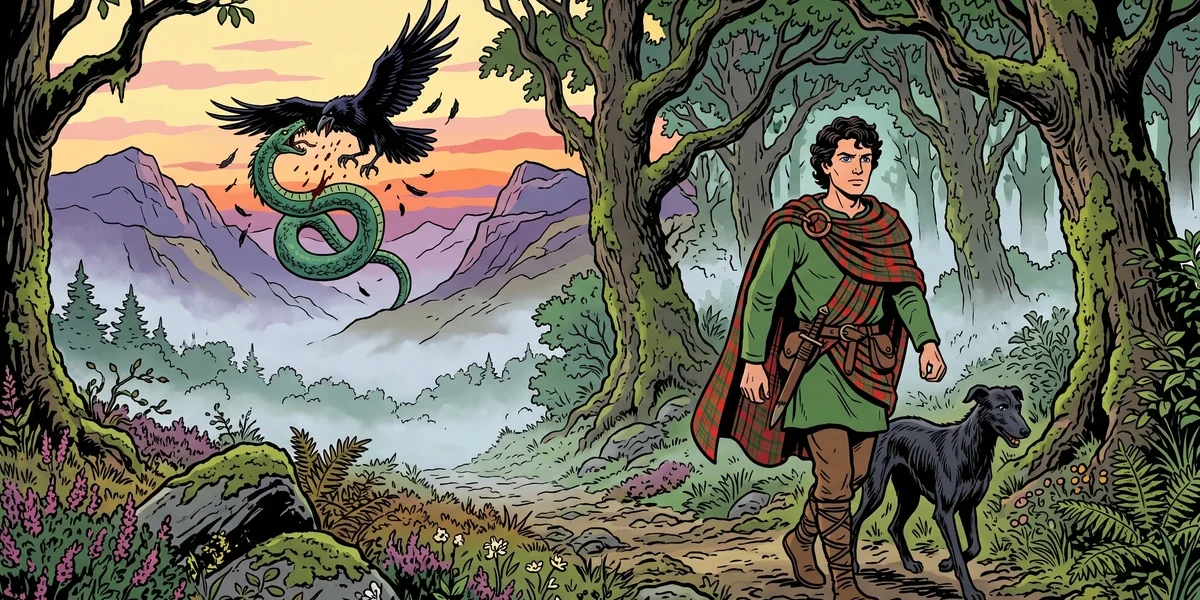
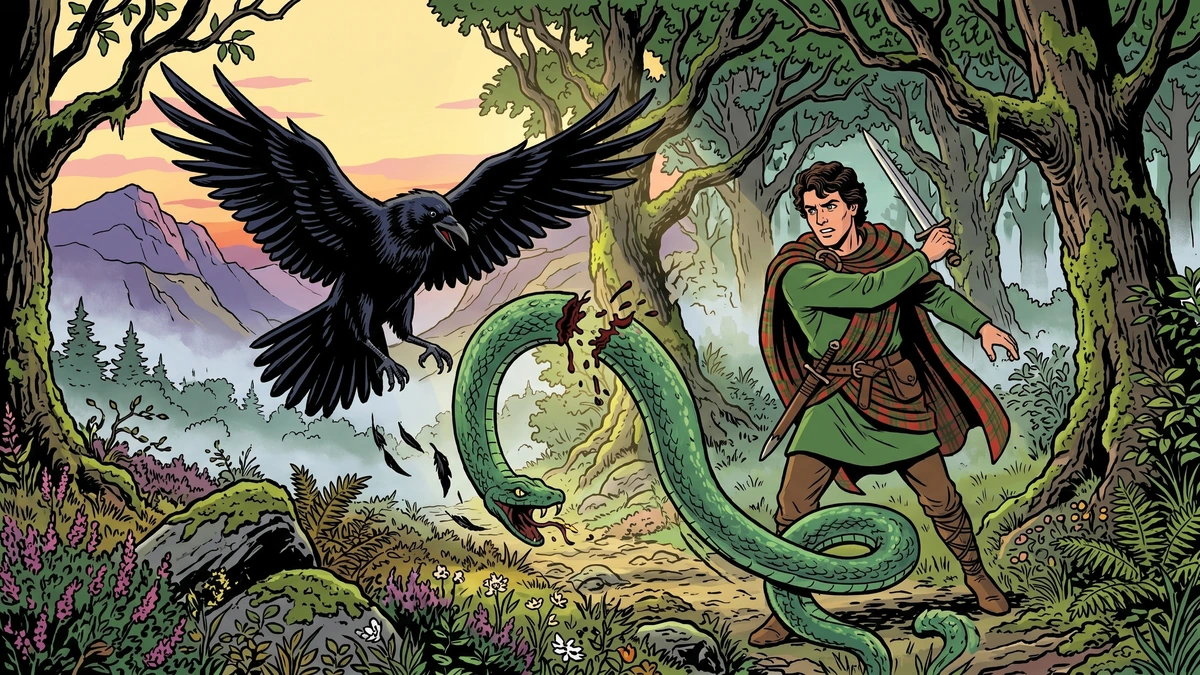
The tale opens in the simplest of frames. A king of one of the Western Isles — Campbell’s reciter set him in the Hebrides, while Curtin’s Irish version named him “King of Erin” — rules over a fair country and has a single cherished son. One bright morning the prince walks out alone into the great oak-forest beyond the dun, his hound at his heel, and there, in a clearing dappled with sunlight, he comes upon the wonder that gives the tale its name. Two birds — in some recensions an enormous raven and a coiling water-serpent, in others an eagle and a snake — are locked in mortal combat above the fern. The serpent has wound itself thrice round the bird’s body; the bird tears at the serpent’s throat with its iron-black beak. Feathers and dark blood fall together upon the moss.
The prince could pass on; the law of the wilderness is to leave the wild creatures to their own quarrel. But pity moves him. He draws his short sword, takes careful aim, and with one clean stroke severs the serpent’s head from its body. The bird sinks exhausted into the heather, and as the prince watches, he sees the great raven shimmer and stretch and stand up — for the bird was an enchanted youth, son of a king of the upper air, cursed to that shape by a wizard’s spell that the snake-stroke had now broken. In gratitude, the bird-youth presses upon the prince a small bundle wrapped in cloth, with one solemn injunction: “Open it not, save when thou art come where most thou wouldst be.”
II. The Forbidden Bundle and the Bargain with the Giant
The prince sets out for home. The road is long, the bundle small but unaccountably heavy, and curiosity, as ever in Celtic tale, is the engine of catastrophe. He has barely crossed three glens when he can bear it no longer. He looses the cord; he opens the cloth.
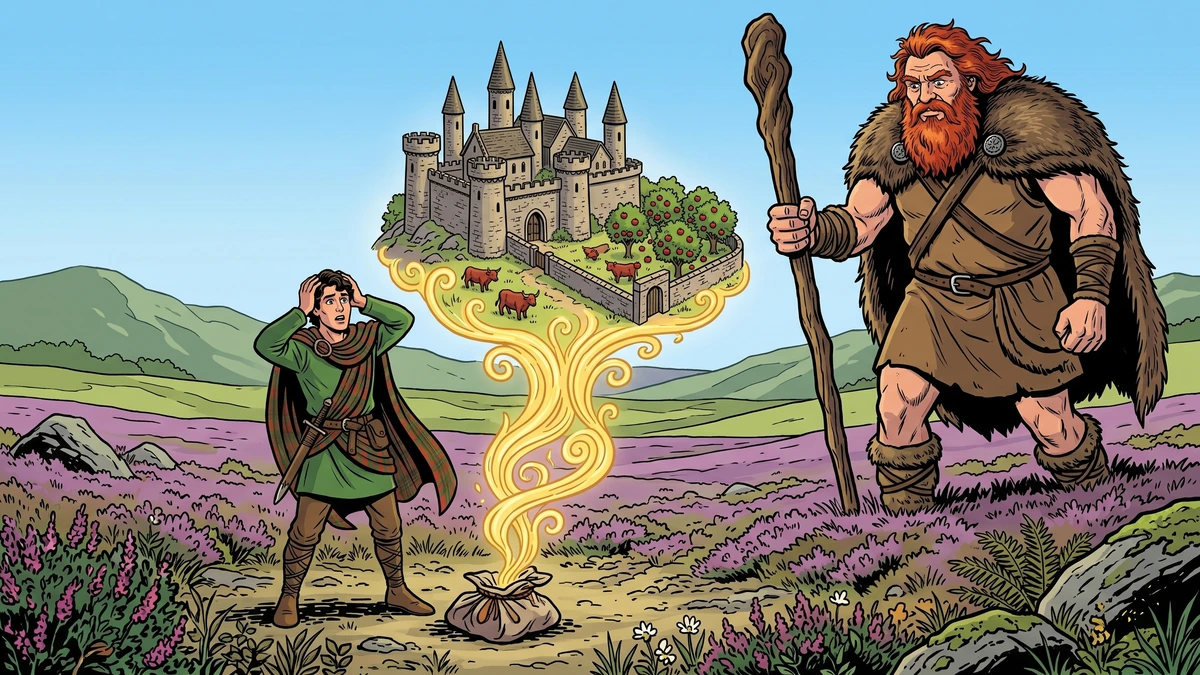
What unfolds before him is no parcel but a whole country. Out of the bundle pours a fair castle of dressed stone with seven white towers, an orchard of apple-trees ripe with red fruit, herd-cattle lowing in green pasture, servants going about their work, and a wide river running cold from a hill. The prince stands aghast in the middle of the wonder. He has unwrapped his fortune in the wrong place — on a barren moor, miles from his father’s hall — and there is no folding it back.
It is then, as he sits with his head in his hands, that the giant comes. He strides up out of the heather, twelve feet of him with a beard the colour of bracken, and looks the trouble over. Yes, says the giant, he can fold the country back into its bundle for the prince — for a price. The price is the prince’s first son, when that son shall come to his seventh year. The prince, faint with relief and not yet a father, agrees. The giant breathes once; the castle and its orchards and its lowing herds collapse back into the cloth as silk into a slipper. The bundle is corded again. The prince walks home.
Years pass. The prince becomes king, marries a princess of great beauty, and a son is born to them — Iain, John, the boy hero of the tale’s main movement. On the day of his seventh birthday the giant returns, his shadow filling the courtyard. A nurse’s child is dressed up in Iain’s clothes and offered, and again, and a third time, but the giant is too cunning for the substitution: by his test he knows each false child for what it is. The true Iain is given up, and the giant carries him away, kindly enough, on his shoulder, to the giant’s own great house in a glen far in the north.
III. The Three Impossible Tasks
In the giant’s house, Iain grows tall and strong and learns the Gaelic of the giants and is given the run of the place — all save one barred door. The giant has three daughters; the youngest, called Auburn Mary by Campbell’s reciter and “the Henwife’s daughter” in the Curtin telling, falls in love with the king’s son, and he with her. Then comes the day the giant, weary of his fosterling, sets the test that the suitor of folk-tale must always face: three impossible tasks, each on pain of death.
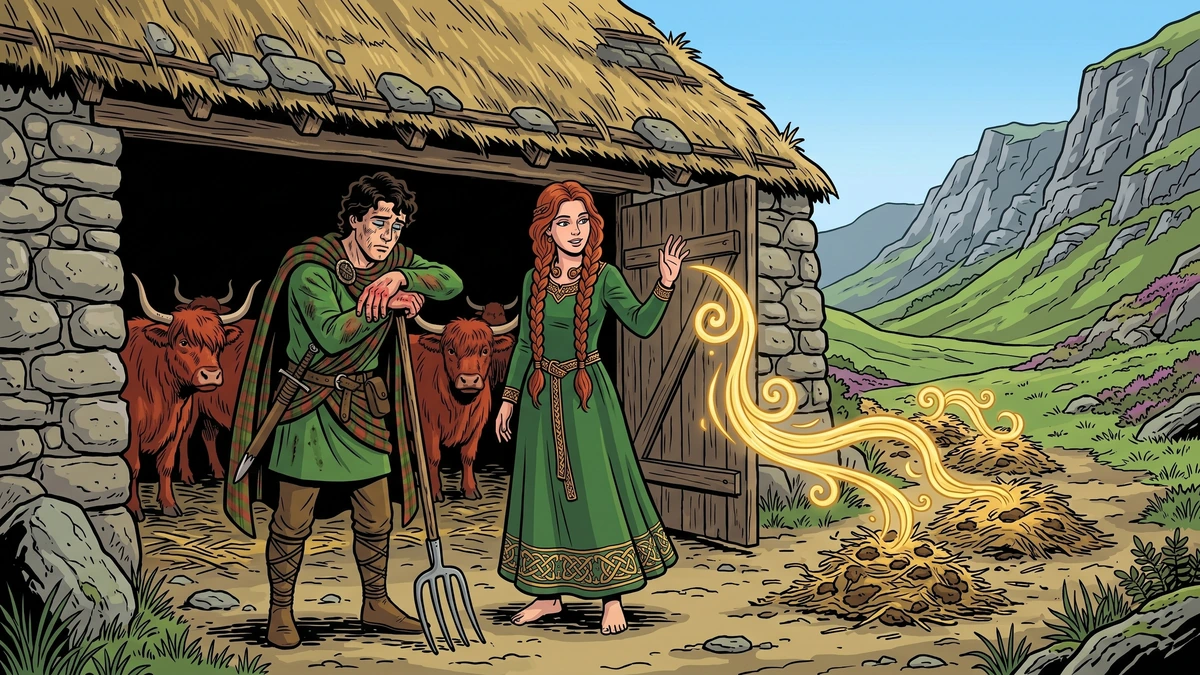
The first task is to clean the giant’s byre, into which the dung of seven hundred cattle has been heaped for seven hundred years. Each fork-load Iain throws out, the storyteller says, two fork-loads come back. By noon his hands are blistered and the byre is no cleaner. Then Auburn Mary appears at the door. She speaks one word in Gaelic to the dung, and the dung walks itself out, neat as a flock of sheep, and lays itself in heaps in the field. The byre stands clean to the flagstones.
The second task is to thatch a great barn-roof with the down of birds — one feather of every kind of bird that flies, and no two alike, and not a feather to fall out in the wind. Iain is given a fowling-piece and sent up the mountain. By dusk he has six feathers and a sore back; the birds of the air are too many and too quick. Auburn Mary comes again. She whistles three notes; from every airt of the wind the birds come, drop one feather of each on the barn-roof, and the thatch sets itself perfectly under her hand.
The third task is the cruellest. There is a great fir-tree in the giant’s garden, five hundred feet of smooth red bark with not a branch on it for the first four hundred. At its top lives a magpie’s nest, and in the nest are five eggs, and Iain must bring all five down without breaking one. To climb that tree is plainly impossible. Auburn Mary hears the task and goes pale; this one, she says, will cost. She bids Iain take a knife. She lays her own foot on the trunk. She slices off her toes one by one, and as each falls it strikes into the bark and becomes a step. Iain climbs the ladder of his beloved’s toes, gathers the five eggs, and climbs back down. As he descends, the steps return to her; but the smallest toe of all has rolled into a fissure of the bark and is lost. Auburn Mary stands up: she has only nine toes for the rest of her life, and Iain’s debt to her is a debt no man’s labour will ever repay.
“Mar a thug mis’ an òrdag dhuit, bheir mi mo chridhe.”
— Auburn Mary, in Campbell of Islay’s recension: “As I gave thee the toe, I will give thee my heart.”
IV. The Magic Flight: Apple-Pip, Forest, and Sea
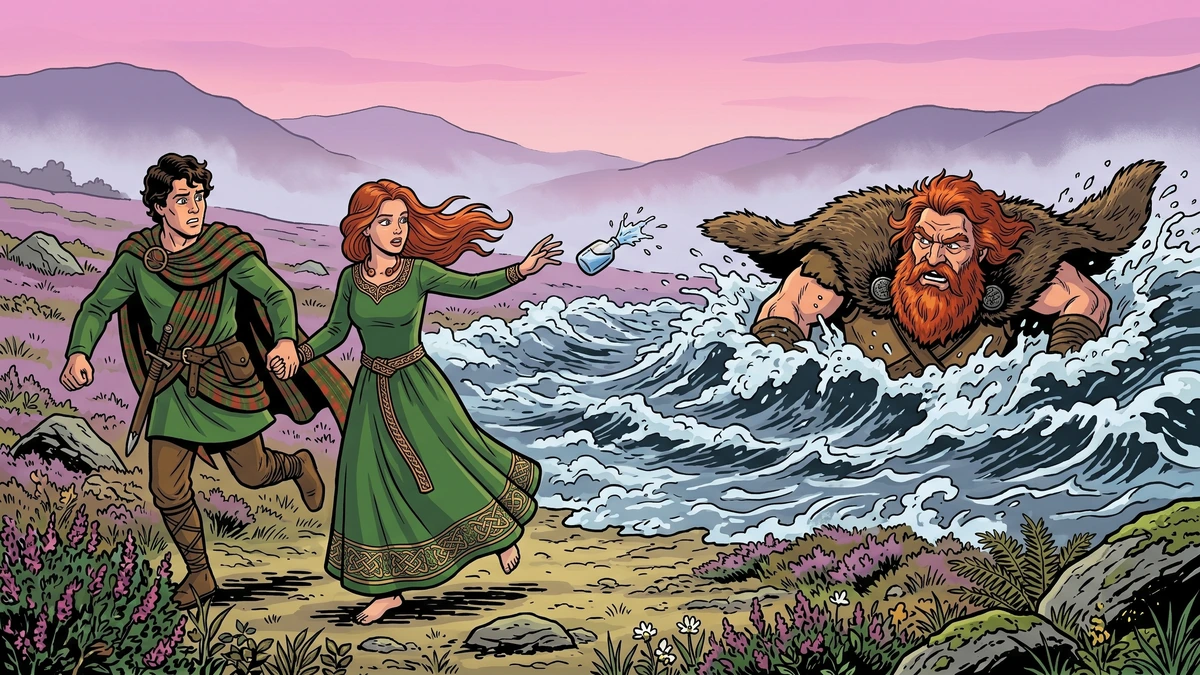
That same night Auburn Mary takes Iain by the hand. The giant is asleep; his snore shakes the slate-roof. The two lovers cross the threshold and run. But the giant wakes at dawn, scents the empty bed, and comes after them with strides that swallow miles.
This is the part of the tale folk-collectors know as the obstacle flight — in the indices it is Stith Thompson’s motif D672, “Obstacle Flight,” and in the Aarne-Uther type-list ATU 313 takes its name partly from this very episode. As the giant’s footfall thunders behind them, Auburn Mary throws first the twig of sloe she has brought from the giant’s garden: a thicket of black thorn springs up between them and their pursuer, a forest miles wide, that the giant must hew through tree by tree. He is delayed, but he comes on. She throws the shard of grey stone: a mountain of bare grey rock rises behind them, and the giant must climb it foot by foot. He is delayed, but he comes on. She throws at last the flask of cold water: the water becomes a wide river, salt and impassable, and the giant cannot cross it, and as he wades into the shallows the seven seas close over his head.
So they come, weary and at peace, to the borders of Iain’s father’s kingdom. Iain bids his bride wait by a wayside well while he runs ahead to bring his father and a coach to fetch her in honour. But while he is gone — and here Curtin’s Irish closing is grafted on by Jacobs — an old hen-wife passes the well, sets her dog upon Auburn Mary, and the dog’s bite makes Iain forget his bride utterly. He returns to his father’s hall and is at once betrothed to another princess. Auburn Mary, abandoned, takes the form of a small bird and waits in the apple-tree by the kitchen window.
On the wedding eve, two apple-pips set on the table by the cook leap up, and one pip turns to a tiny lad and the other to a tiny lass, and they speak to one another in the voice of true lovers, and they recount before all the company every task and every theft and every flight, until at the third recounting Iain’s memory breaks and he knows his Auburn Mary again. The false bride is sent home with gifts. Auburn Mary is brought into the hall, and the kingdom that started as the bird’s gift in the wood is at last given over to its true heirs.
V. The Moral — Debt, Memory, and the Cost of Help
Most folk-tales of magic close with a wedding and a moral the storyteller can put briefly. Cath nan Eun resists the easy summary. Its moral lies not in the hero’s virtue — Iain, like Jason before him, accomplishes nothing alone — but in the recognition that some debts can be deferred but never paid. Auburn Mary leaves nine toes in the bark of a fir-tree for love; the prince leaves his unborn son in the hand of a giant for the convenience of a closed bundle. The tale’s deepest lesson, sounding through all sixteen Celtic recensions and the classical Greek parallel, is that the help we receive in our hour of need is never free, and the only honourable response to it is to remember. When Iain forgets, the apple-pips remember on his behalf, and only then can the story end.
Mr. Alfred Nutt, in his note appended to the MacInnes Folk and Hero Tales of Argyllshire (1890, p. 441), proposed a still older reading: that the three obstacles — forest, mountain, river — are precisely the three boundaries of the old Teutonic Hades, and that Cath nan Eun in its remotest form is a Descent-to-Hell tale, the bride a queen of the dead, the giant a lord of shades, and the magic flight the soul’s return into the upper air. If Nutt is right, the tale belongs not to the post-Christian age but to the deep pre-Aryan story-stratum, and is older than any nation that now tells it.
Notes on the Variants and Their Motif-Index
Campbell of Islay’s edition of 1860 prints the tale under the rubric Cath nan Eun and discusses no fewer than seven Hebridean variants in the appendix. He notes the deliberately old-fashioned use of the Gaelic second-person singular thu for the speech of giants, who were felt by the reciters to belong to an older world — a usage Joseph Jacobs preserved by reserving the English thou for the giant’s own voice. Jacobs also drew on Jeremiah Curtin’s “Son of the King of Erin” (Boston, 1890, pp. 32 ff.) for the closing motif of the apple-pips and the casket, which Campbell’s reciter had given more briefly. William Carleton’s “The Three Tasks” (Dublin, 1832), Douglas Hyde’s manuscript “Son of Branduf” (Royal Irish Academy), Donald MacInnes’s First Tale (
Frequently Asked Questions
What is the Scots Gaelic title of the Battle of Birds and where was it first written down?
The original Scots Gaelic title is ‘Cath nan Eun.’ It was first written down in extended form by John Francis Campbell of Islay in ‘Popular Tales of the West Highlands,’ Vol. I, Tale No. II (Edmonston and Douglas, Edinburgh, 1860), based on recitations from Highland storytellers in Argyllshire and Inverness. Campbell discusses no fewer than seven distinct Hebridean variants in the appendix to his edition.
What ATU tale-type is the Battle of Birds, and how is it connected to Jason and Medea?
The Battle of Birds is classified as ATU 313, ‘The Magic Flight’ (subtype 313A, ‘The Girl Helps the Hero Flee’). Andrew Lang in ‘Custom and Myth’ (1884) and Reinhold Koehler in ‘Revue Celtique’ III demonstrated the structural identity between this Celtic tale and the classical Greek myth of Jason and Medea: three impossible tasks set by a hostile king or giant, the king’s youngest daughter as supernatural helper, the elopement, and the obstacle pursuit. Both narratives appear to descend from a single deep Indo-European tale-type.
Who is Auburn Mary and what does she sacrifice for Prince Iain?
Auburn Mary is the youngest daughter of the giant in Campbell of Islay’s recension; in Jeremiah Curtin’s Irish version she is called the Henwife’s daughter. She helps Prince Iain accomplish the three impossible tasks her father sets, and most painfully sacrifices her own toes one by one to make a ladder up the smooth bark of an unclimbable fir-tree so that Iain can fetch the magpie’s eggs. The smallest toe is lost in a fissure, leaving her with only nine toes for the rest of her life – a debt the storytellers say no man’s labour can ever repay.
What are the three obstacles thrown in the magic flight, and what older meaning did Alfred Nutt see in them?
Auburn Mary throws three objects in succession: a twig of sloe that becomes a thicket of black thorn, a shard of grey stone that becomes a mountain, and a flask of cold water that becomes a wide salt river in which the giant is finally drowned. In his note in Donald MacInnes’s ‘Folk and Hero Tales of Argyllshire’ (1890, p. 441), the folklorist Alfred Nutt argued that these three obstacles – forest, mountain, river – are precisely the three boundaries of the old Teutonic Hades, suggesting that ‘Cath nan Eun’ is in its remotest form a Descent-to-Hell tale, the bride a queen of the dead and the magic flight the soul’s return into the upper air.
Why does Iain forget Auburn Mary, and how is his memory restored?
In the closing motif drawn by Joseph Jacobs from Curtin’s ‘Son of the King of Erin,’ Iain leaves Auburn Mary at a wayside well while he runs ahead to bring his father a coach. An old hen-wife passes the well and sets her dog upon Auburn Mary; the dog’s bite causes Iain to forget his bride utterly, and he is at once betrothed to another princess. On the wedding eve, two apple-pips placed on the kitchen table by the cook spring into a tiny lad and lass who recount aloud every task, every theft, and every flight before all the company. At the third recounting Iain’s memory breaks and he knows his Auburn Mary again, and the false bride is sent home with gifts.
You May Also Like
 Celtic Folk Tales
Ages 9-12
Celtic Folk Tales
Ages 9-12
How Cormac Mac Art went to Faery
How Cormac Mac Art went to Faery: ormac, son of Art, son of Conn of the Hundred Battles, was high King of Ireland, and held his Court at Tara. One day he saw a
 Celtic Folk Tales
Ages 9-12
Celtic Folk Tales
Ages 9-12
Morraha
Morraha: orraha rose in the morning and washed his hands and face, and said his prayers, and ate his food; and he asked God to prosper the day for him. ’s
 Celtic Folk Tales
Ages 9-12
Celtic Folk Tales
Ages 9-12
The Lad With The Goat-Skin
The Lad With The Goat-Skin: Long ago, a poor widow woman lived down near the iron forge, by Enniscorth, and she was so poor she had no clothes to put on her