The Lad With The Goat-Skin
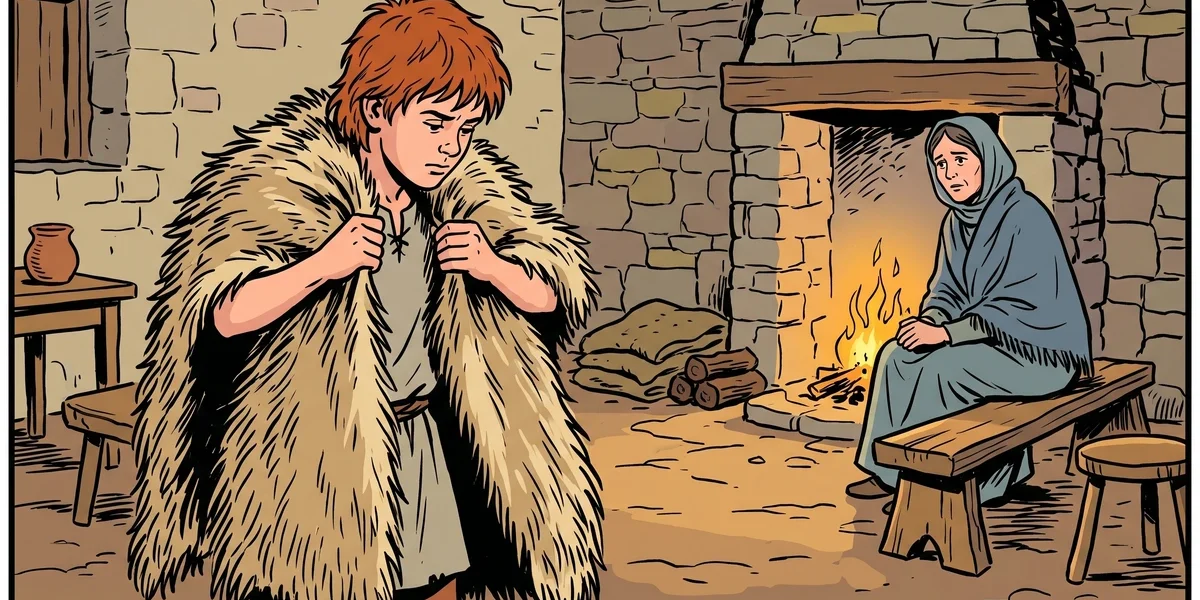
The Lad With The Goat-Skin: Long ago, a poor widow woman lived down near the iron forge, by Enniscorth, and she was so poor she had no clothes to put on her
“The Lad With The Goat-Skin” is one of the most beloved and structurally intricate tales in the Irish folktale canon, representing a distinctive sub-genre sometimes called the “disguised hero” or “unpromising hero” type—those narratives in which an apparently worthless or eccentric protagonist, often dressed in rags or animal skins, conceals extraordinary abilities beneath an absurd exterior. The tale belongs broadly to ATU 314 (Goldener/The Youth Transformed to a Horse) and shares significant features with ATU 675 (The Lazy Boy), but in its Irish manifestation it acquires a peculiarly Celtic character: the goat-skin disguise is not merely a comic eccentricity but a deliberate strategy, rooted in the Irish folkloric tradition of the geasa (binding obligation) and the practice of shape-shifting as a means of moving between social stations without attracting supernatural hostility.
The tale has been collected in numerous variants across all four Irish provinces, with particularly rich versions recorded in County Clare, County Kerry, and County Donegal. Lady Gregory, Douglas Hyde, and later the fieldworkers of the Irish Folklore Commission all encountered versions of this tale in their collecting travels, and Séamas Ó Catháin’s work on ATU 314 in Ireland traces the distribution of the goat-skin motif through oral tradition. The story’s persistence across centuries and its wide geographic spread suggest it taps into something fundamental in the Irish cultural imagination: the relationship between outward appearance and inner worth, the social mobility achieved through cunning rather than birth, and the figure of the trickster hero who succeeds precisely because his enemies cannot take him seriously.
Synopsis and Narrative Architecture
The tale typically opens with a poor widow and her son, the lad, who is regarded as a simpleton or ne’er-do-well by his community. While his mother and neighbours write him off as useless, the boy possesses an acute intelligence concealed beneath deliberate eccentricity. At the death of a goat—sometimes a magical goat given to the family by a mysterious stranger, sometimes simply their one household animal—the boy flays the skin and wraps himself in it, the fur turned outward, giving himself the appearance of a shaggy, half-animal creature. In this guise he sets off to seek his fortune.
The central movement of the tale involves the lad entering service at the household of a king or nobleman, where he accepts the most menial position available—swineherd, cowherd, or kitchen drudge. His fellow servants mock and despise him for his dirty goat-skin garment and his apparent stupidity. In secret, however, he is performing extraordinary feats: caring for the animals so perfectly that they produce more milk and grow faster than under any previous keeper; solving problems that have baffled the household’s best men; and at night, when he removes the goat-skin, transforming into a handsome and accomplished young man of apparent nobility.
The tale’s climax typically involves a series of tests—often three days of tournaments or trials to which the king has invited champions from across the land—at which the goat-skin lad appears on the first two days in magnificent disguise, performs spectacularly, and vanishes before he can be identified. On the third day he is unmasked, often through a wound or a distinctive token that reveals his identity. The king’s daughter, who has already fallen in love with the mysterious champion, is united with him, and the lad reveals himself as a young man of noble lineage who had hidden his identity for reasons that are either explained (a curse, a wager) or left deliciously unexplained—a mark of the tale’s sophistication in leaving certain mysteries intact.
The Goat-Skin Disguise: Symbolic and Mythological Resonances
The choice of a goat-skin as the hero’s disguise is not arbitrary. In Irish and broader Indo-European tradition, the goat occupies a liminal symbolic space: simultaneously associated with fertility, transgression, the margins of the community, and the boundary between the domestic and the wild. In classical tradition, the aegis—literally “goat-skin”—was the divine shield of Zeus and Athena, a garment of power disguised as a humble animal hide. While direct classical influence on Irish oral tradition is difficult to establish, the parallel suggests that the goat-skin as a repository of hidden power is a very old and widely distributed mythological concept.
In the specifically Irish context, the goat-skin garment connects the hero to the figure of the fear dearg (red man) and the bodach (churl) of the hero tales—supernatural figures who appear in mean or disgusting guise to test heroes’ courtesy and courage. The most famous such episode in Irish mythology is the beheading game in Fled Bricrenn (Bricriu’s Feast), where a monstrous churl who challenges Cú Chulainn to behead him is revealed as the god Cú Roí in disguise. The goat-skin lad inherits this tradition: his repulsive exterior is a test of other people’s ability to see past surface appearances, and those who fail the test—the mocking servants, the contemptuous nobles—are revealed as morally inferior to those who treat him with basic dignity.
The goat-skin also functions as a kind of magical protection. In several versions of the tale, explicit mention is made that no one can harm the lad while he wears it—a folk memory, perhaps, of the apotropaic function of animal skins in pre-Christian Irish ritual practice. The skin given by the dying goat (in some versions an explicitly supernatural animal) is thus simultaneously humble disguise, social armor, and magical talisman—a convergence typical of Irish folk objects that carry multiple simultaneous meanings.
The Unpromising Hero Type in Celtic Tradition
The goat-skin lad belongs to a well-populated family of Irish “unpromising heroes”—protagonists who are initially presented as simpletons, cowards, or outcasts, only to reveal extraordinary competence at the story’s crisis point. The most august ancestor of this type is Finn mac Cumhaill himself, who grows up in obscurity under assumed names (Deimne, then Finn) and is initially dismissed as a wild forest boy before revealing his genius and heroic destiny. The Ulster hero Cú Chulainn, though hardly unpromising in his physical attributes, is frequently presented as dangerously unstable and socially unacceptable—a figure whose power society cannot quite contain or categorize—which places him in the same structural position as the goat-skin lad.
More direct parallels exist in the international tale repertoire. The Norse hero Helgi, the Welsh Peredur (the Arthurian Perceval), and the English Jack the Giant-Killer all share the pattern of the apparently foolish young man who conceals exceptional ability. What distinguishes the Irish version in “The Lad With The Goat-Skin” is the specificity and physicality of the disguise: not merely foolish behaviour but an actual animal skin worn against the body, making the transformation from beast to prince a literalisation of a journey through states of being that in other cultures remains metaphorical.
Folklorists including Proinsias Mac Cana have argued that the unpromising hero type in Ireland is connected to the sovereignty goddess narrative: the hero must prove himself worthy of the land (represented by the princess) by demonstrating inner qualities that superficial social ranking would obscure. The king who initially dismisses the goat-skin lad is performing badly as a judge—he is valuing appearance over substance, which in Irish political theology is precisely the error that causes kingdoms to fail. The tale’s resolution, in which the lad is revealed as the true champion and receives the princess, is simultaneously a vindication of personal merit and a lesson in the proper criteria for social judgment.
Service and the Inversion of Social Hierarchy
A significant portion of the tale’s narrative energy is devoted to the lad’s period of service in the king’s household, during which the social hierarchy is systematically inverted. The most lowly servant proves most capable; the proudest knights fail the tests that the goat-skin boy passes easily. This inversion pattern is one of the most persistent structures in world folklore—it appears in “Cinderella,” in the Joseph narrative of the Hebrew Bible, in the Buddhist Jataka tales, and in countless other traditions—but in the Irish context it carries particular weight given the culture’s intense attention to the question of social rank and its relationship to inherent worth.
Early Irish society operated through an elaborate hierarchy of honour-prices (lóg n-enech), in which a person’s social value was precisely calculated and legally encoded. The goat-skin lad’s period of service represents a deliberate abandonment of this system—a voluntary descent to the bottom of the social scale—in order to demonstrate that true worth cannot be measured by such calculations. The tale implicitly argues that the most important qualities (courage, intelligence, loyalty, grace) are invisible to the social accounting system, and that the person who can set aside his status for a time and accept humiliation will ultimately prove superior to those who have never had to earn their position.
The king’s daughter typically recognises the lad’s worth before anyone else does. In the Irish tradition of female supernatural perception, the woman of the household—especially the king’s daughter, who carries the sovereignty symbolism—has a clearer vision than the men around her. Her attraction to the goat-skin boy before his unmasking is not mere romantic whimsy but a demonstration of her fitness to be queen: she can see what others cannot. The marriage that ends the tale is thus doubly validated—both as the hero’s earned reward and as the heroine’s correct exercise of judgment.
The Three-Day Tournament: Ritual Structure and Narrative Tension
The climactic tournament sequence—three days of tests, during each of which the goat-skin lad appears in magnificent disguise and disappears before identification—follows a ritual triadic structure deeply embedded in Celtic narrative logic. The number three governs Irish mythological and folkloric narrative with unusual consistency: three trials, three brothers, three wishes, three days. This reflects not merely an aesthetic preference for patterning but a theological principle in which significant events must happen three times to be fully real—a principle reflected in Irish legal practice (a claim had to be made three times before witnesses for it to be legally binding) and in Irish ritual practice (certain sacred actions were performed three times facing each direction).
The tournament itself functions as a ritual revelation of hidden identity. In Irish mythological tradition, true identity cannot be permanently concealed; it will manifest in moments of extreme pressure. This is the logic of the fír fer (fair play) principle in Irish heroic narrative: genuine heroism is self-revealing, and the hero who tries to hide will be exposed. The goat-skin lad’s successive appearances in brilliant disguise are therefore not deceptions of the audience but gifts to them—revelations of the true self that he has been concealing from the wrong people. The princess, who sees him at each appearance and falls in love with the magnificent stranger, is the right audience; the envious nobles who seek to capture and unmask him are the wrong one.
The wound or token that identifies the hero on the third day—in many versions he is cut on the hand or foot during the contest, and the wound corresponds to one the princess has examined or dressed—serves as a literal seal of identity, connecting the hidden body to the public performance. In the Celtic tradition of sacred wounds (Nuada’s silver hand, the Fisher King’s wound, the lance that bleeds), a wound is never merely injury but inscription—the body marked with its true narrative. The goat-skin lad’s wound reveals that his magnificent tournament performances and his humble servitude are performed by the same body, and thus the same person.
The Widow’s Son: Maternal Heritage and the Fatherless Hero
The goat-skin lad is almost always identified as a widow’s son—a figure with a specific social and symbolic resonance in Irish tradition. The widow’s son lacks a father’s social protection and inheritance, placing him outside the normal Irish kin-group structures that determined wealth, legal standing, and political alliance. He is, in formal social terms, a nobody. This precise social marginality is what gives the tale its point: the story argues that the criteria by which Irish society assigned worth were wrong, or at least insufficient.
At the same time, the widow’s son in Irish folklore frequently inherits extraordinary gifts from his marginality. Without a father’s expectations to conform to, he is free to develop unconventionally. Without a kin-group’s protection, he must develop his own resources. The folk wisdom encoded in these tales suggests that self-reliance, cunning, and the ability to read situations without conventional social blinders are precisely the qualities that the kin-group system suppresses in those who have it too easy. The poverty and social isolation of the goat-skin lad are not unfortunate accidents but the preconditions of his heroic development.
The mother in these tales is typically a dignified, long-suffering figure whose patient acceptance of hardship is contrasted with her son’s apparent recklessness. Yet she rarely actively opposes his decision to leave and seek his fortune—she understands, on some level, that the social world has nothing to offer her son through conventional channels. Her blessing, when given, carries a moral weight that no king’s commission could match: it is the blessing of those who have been judged worthless by the world and survived anyway.
Regional Variants and Comparative Analysis
The tale exists in significantly different forms across Ireland’s regional storytelling traditions, and these variations illuminate local concerns and values. In Connacht versions, particularly those collected from County Galway and County Mayo, the goat-skin lad often possesses an explicitly magical helper—a fairy woman or a transformed relative—who advises him on the tournament strategy and provides the magnificent horse and armour for each day’s appearance. This variant emphasises the fairy-world connection of the hero and situates the tale within the broader Connacht tradition of human-fairy interaction that runs through texts from the Ulster Cycle to the nineteenth-century hedge-school poetry.
Munster versions, particularly from County Kerry, tend to emphasise the comic dimension of the tale—the lad’s deliberate performance of stupidity, his grotesque appearance in the goat-skin, and the humiliation of the proud knights who cannot understand how the kitchen drudge has outperformed them. These versions often include an extended episode in which the lad is publicly accused of being the tournament champion and specifically and convincingly denies it, to the fury and embarrassment of his accusers. The Kerry tradition’s pleasure in verbal cleverness and the deflation of pomposity is evident in the relish with which these scenes are developed.
Ulster variants, particularly those from County Donegal collected by the Irish Folklore Commission in the 1930s and 1940s, tend to give more weight to the father’s absence as a motivating force: the goat-skin lad is seeking not merely a fortune but information about his true parentage, and the tournament victory sometimes reveals that he is the son of a king who was driven into exile before the boy’s birth. This addition transforms the tale from a story of social mobility through merit into a story of rightful inheritance recovered—a narrative with obvious appeal in a province with a complex history of displacement and land loss.
Scholarly comparison with non-Irish variants reveals the tale’s wide European distribution. The French Jean de l’Ours (John the Bear) shares the animal-skin disguise and unpromising hero structure. The Italian “Giovan di la Scala” collected by Calvino has near-identical tournament scenes. The Norwegian “Shortshanks” combines the animal disguise with the princess rescue in a manner very similar to the Irish version. This broad distribution suggests the tale’s origin in a common European or even Indo-European narrative stock, but the Irish version’s distinctive features—the goat-skin’s apotropaic function, the widow’s son’s specific social position, the sovereignty-goddess resonance of the princess—mark it as thoroughly acculturated to its Irish context.
The Unmasking and Its Moral Logic
The moment of unmasking—when the goat-skin is finally removed and the kitchen drudge is revealed as the tournament champion—is the tale’s emotional and moral climax. In the richest versions, this moment is delayed and its meaning multiplied by the reactions of the different characters. The king is astonished and shamed at his own failure to recognise worth. The envious knights are humiliated. The kitchen servants who mocked the lad are struck dumb. And the princess, who already knew—or felt—the truth, is vindicated in her unconventional affection.
The unmasking in “The Lad With The Goat-Skin” is structurally related to the díberg (outlaw band) narrative in early Irish literature, in which figures who are excluded from normal social structures through poverty, disgrace, or curse form alternative communities that ultimately prove more vital than the legitimate institutions they mirror. The goat-skin lad’s period of servitude is a kind of voluntary díberg—a self-imposed exclusion from the social hierarchy that paradoxically demonstrates his superiority to it. When he removes the skin, he does not simply reveal an improved version of himself; he reveals that the social hierarchy’s evaluation of him was always wrong, and that its wrongness was a structural flaw in the system, not a personal failing in himself.
The tale’s insistence that the hero should be allowed to explain himself—that the wound or token should be examined openly, in front of witnesses—reflects the Irish legal tradition’s emphasis on public testimony and the principle that truth must be established through recognized procedure. The goat-skin lad does not simply announce his identity; he proves it, following a logic of evidence and witness that mirrors the Brehon law procedures for establishing disputed claims. This legalistic dimension of the unmasking gives the tale a civic as well as a personal moral: not only is the hero individually vindicated, but the king’s court is publicly corrected and educated in the proper assessment of human worth.
Legacy: The Tale in Irish Literary and Cultural Tradition
“The Lad With The Goat-Skin” has had a rich afterlife in Irish literary and cultural production. Patrick Kennedy, the Victorian-era Wexford antiquarian who was among the first to publish Irish folktales in English, included a version in his Legendary Fictions of the Irish Celts (1866), helping to establish the tale’s profile for a literate audience that might otherwise have had no access to the oral tradition. Lady Gregory drew on the type in her handling of the Fenian Cycle, and the influence of the “unpromising hero” narrative structure can be detected in some of W.B. Yeats’s early short stories.
In twentieth-century Irish writing, the goat-skin lad’s structure—the person who hides their true self beneath a grotesque exterior, serving in conditions of humiliation while nursing a secret dignity—resonates with the condition of many characters in the literature of the Irish Revival and post-Independence period. The experience of cultural colonialism, in which a sophisticated literary and oral tradition was systematically denigrated as barbaric or primitive, finds its folk-tale mirror in the story of the ragged boy whom the king’s household cannot recognise as their superior. The moment of unmasking—the revelation of an identity that was always there, always real, always worthy—carries a political charge that the tale’s original tellers may not have consciously intended but that later audiences have found entirely legible.
For contemporary Irish storytellers, the tale continues to be performed and adapted, particularly in the storytelling revival that has been active since the 1970s. Its combination of comedy, pathos, social critique, and fairy-tale romance gives it a flexibility that more solemn tales lack. The goat-skin lad can be told as pure entertainment, as a lesson in not judging by appearances, as a meditation on disguise and identity, or as a reflection on the relationship between social hierarchy and human worth. That it can sustain all these registers without becoming incoherent is a mark of its narrative excellence—the achievement of a tradition that has refined these tales across many generations of telling and retelling.
“The Lad With The Goat-Skin” endures because it speaks directly to the experience of being underestimated—and to the hidden satisfaction of knowing yourself better than the world knows you. The goat-skin is the story’s central image: ugly, smelly, animal, and seemingly worthless, yet it protects, enables, and ultimately reveals a young man capable of anything he sets his mind to. In the long Irish storytelling tradition, this has always been understood as more than a fairy tale. It is an argument about where value really lies—and a reminder that those who make the mistake of judging by surfaces do so at their own eventual embarrassment.
You May Also Like
 Celtic Folk Tales
Ages 9-12
Celtic Folk Tales
Ages 9-12
The Enchanted Cave
The Enchanted Cave: A long, long time ago, Prince Cuglas,[7] master of the hounds to the high King of Erin, set out from Tara to the chase. As he was leaving
 Celtic Folk Tales
Ages 3-5
Celtic Folk Tales
Ages 3-5
The Three Golden Hairs of Grandfather Know-All: A Czech Tale of Wit and Destiny
The Three Golden Hairs of Grandfather Know-All: A Czech Tale of Wit: In the Kingdom of Bohemia, there lived a nobleman who was obsessed with destiny. He had
 Celtic Folk Tales
Ages 9-12
Celtic Folk Tales
Ages 9-12
Deirdre
Deirdre: _Celtic Magazine_, xiii. I have abridged somewhat, made the sons of Fergus all faithful instead of two traitors, and omitted an incident in the house