The Vision of MacConglinney
The Vision of MacConglinney: athal, King of Munster, was a good king and a great warrior. But there came to dwell within him a lawless evil beast, that
The Vision of MacConglinney
Canonical Attribution
| Irish Title | Aislinge Meic Con Glinne — “The Vision of MacConglinne” |
|---|---|
| Manuscripts | Lebor na hUidre (Book of the Dun Cow), c. 1100 CE, RIA MS 23 E 25; Leabhar Laighneach (Book of Leinster), c. 1160 CE, TCD MS H.2.18 |
| Genre | Burlesque vision-poem (aisling); mock-heroic prose-and-verse parody of the ecclesiastical vision tradition; the only surviving example of sustained comic parody in Old Irish literature |
| Date | Composed c. 1100–1150 CE, though incorporating older satirical traditions; the text’s language shows Early Middle Irish features with earlier Old Irish passages in the verse sections |
| Subject | Cathal mac Finguine, King of Munster (historically fl. 721 CE); possessed by the Demon of Gluttony (Gráinne); cured by the scholar MacConglinne through a satirical poem-vision of an entire country made of food |
| ATU / Motif | ATU 1645 (The Peasant’s Dream of Wealth); Motif F470 (Night-spirit); G303.16 (How the devil was cast out); Irish unique: K1963.1 (Scholar defeats demon by satire) |
| Scholarly Note | Described by medieval Irish scholar Kuno Meyer as “one of the most remarkable documents of the Middle Ages — a burlesque so elaborate and so sustained that it can only have been written by a master of his craft.” The text is simultaneously a parody of hagiography, a satire on clerical greed, and a fully realised comic narrative. |

I. The King Possessed
Cathal mac Finguine, King of Munster, was by all accounts a good king in his ordinary mode: fair in judgment, brave in battle, generous at the feast-table. But into him there had come to dwell a lawless evil thing — the Demon of Gluttony, which the Irish called Gráinne — and the Demon would not be satisfied. The king consumed in a single sitting what would have fed a village: a pig, a bull-calf, three hundredweight of bread, a vat of new milk, an entire side of beef. And when the feast was cleared he was hungry again within the hour. His household was being eaten into destitution. His province was being consumed one meal at a time.
The monks of Cork, whose hospitality the king honoured with his presence — and whose provisions he devoured with the comprehensive thoroughness of a very large, very polite, entirely supernatural appetite — sent for help in the form of a scholar. The scholar’s name was MacConglinne, which means the Hound of Glinne, and he was a young man from Connacht who had gone wandering for the love of learning and arrived at Cork at a bad moment, wet from the road and hungry himself, to find the monastery’s larder stripped to its walls.
The monks, irritated by their own destitution and looking for someone to blame, received MacConglinne poorly: they gave him nothing to eat, abused his scholarly pretensions, and in a burst of institutional pique that the text records with comic relish, they hung him up by his hands from a pillar for the night. It was while hanging there, cold and hungry and understandably aggrieved, that MacConglinne received his vision.

II. The Land of Food
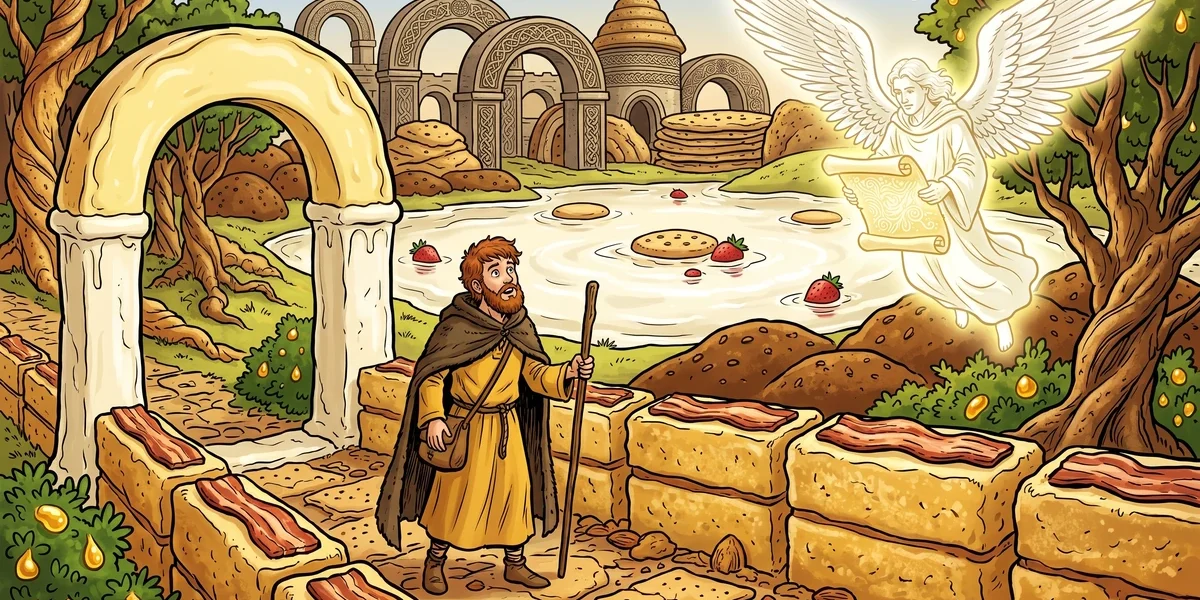
The vision came to him in the form of an angel, white-robed and carrying a scroll. The angel had a message for MacConglinne, and the message was delivered in verse — as all serious messages in the Irish tradition were — and what it described was a land entirely composed of food.
MacConglinne’s vision-poem, the aisling that gives the tale its name, is one of the most extraordinary passages in medieval Irish literature: a systematic and gleefully detailed topography of an impossible country where the fort’s walls are built of thick slabs of lard, the palisade is of prime bacon, the gate is a noble doorway of custard, the moat is of smooth cream cheese, and the roads are of solid butter. The lake is of new milk. The fish in it are pieces of lard. The trees bear branches of crisp brown wheaten bread. The very dew on the grass is honey.
“Is maith an t-anlann an t-ocras.”
“Hunger is a good sauce.”
— Irish proverb, cited in the scholarly commentary tradition surrounding Aislinge Meic Con Glinne
The poem is a parody of the immram tradition — the Irish voyage-poem in which a holy man travels to a series of wonderful islands — and simultaneously a parody of the ecclesiastical vision tradition in which angels deliver prophetic messages to deserving saints. MacConglinne is not a saint. He is a very hungry scholar. The angel tells him his vision is the cure for Cathal’s demon, and that if he can get the king to listen to the poem long enough, the Demon of Gluttony will leave the king’s body to come out and look for the food being described, and when it does, MacConglinne can catch it.

III. The Scholar and the King
MacConglinne’s plan required both theatrical skill and precise timing. He persuaded the king’s household to fast the king for three days — no easy task given that Cathal’s Demon would accept no argument — and then, at the moment of maximum hunger, he tied the king to a post and began to recite his vision-poem.
The effect was immediate and spectacular. The Demon of Gluttony, hearing its favourite subject — food, in extraordinary variety and impossible profusion — began to stir. It came forward in the king’s body, pressing toward the mouth, drawn by the richness of the description. MacConglinne kept reciting. He described the butter lake and the bacon palisade and the custard gate and the honey dew. He described the bread trees and the cream-cheese moat. He described, in elaborate and loving detail, a roasted pig with a great joint of bacon in its mouth, basted with apple-honey, resting on a bed of black pudding.
The Demon could stand it no longer. It emerged from Cathal’s mouth in the shape of a small animal — the texts vary on its exact appearance, but all agree it was small, dark, and manifestly unhappy about being removed from its comfortable habitation. MacConglinne caught it in a vessel and held it over the fire until it was disposed of. Cathal mac Finguine, King of Munster, rubbed his eyes, asked where he was, and said he was hungry in a tone of voice that was entirely his own for the first time in years.

IV. The Scholar’s Reward
The cure of a king from supernatural affliction was, in the Irish tradition, worth a reward commensurate with the king’s status and the scholar’s cleverness. Cathal was generous: he gave MacConglinne cattle, land, a cloak of the finest cloth from overseas, and a poem of praise that the court poets would record and preserve. He also gave him a formal declaration of immunity from clerical harassment, which was aimed pointedly at the monks of Cork who had hung him from their pillar and would presumably have to live with the permanent embarrassment of having mistreated the man who cured the King of Munster.
MacConglinne went back to his wandering, which was the natural condition of the Irish scholarly class of the early medieval period — the filid and the lesser poets who moved from court to monastery to court, dependent on patronage, earning their keep with their wit and their learning. He left behind him the most sustained piece of comic writing in the Old Irish corpus: a text that simultaneously celebrates and mocks the scholar’s life, the monk’s life, the king’s life, and the Irish love of food — all in the form of a visionary poem about a country you could eat.
The Moral
“Is fearr clú ná conách.”
“Reputation is better than wealth.”
— Irish proverbial wisdom; the scholar’s art outlasts the king’s gold
The moral of MacConglinne’s tale is embedded in its genre: the scholar, weaponless and officially powerless, defeats a supernatural affliction that no king’s warriors could touch, using nothing but the precise, carefully deployed resources of his art. The poem is the weapon; the knowledge of how and when to deploy it is the skill; the wit that made the poem in the first place is the gift. MacConglinne succeeds not despite being a poor, itinerant, temporarily-crucified scholar but because of it: his hunger in the Cork monastery gave him the visceral authority to imagine the food-land with convincing passion, and his position outside the power structures gave him the freedom to use satire as a cure.
Why This Story Has Lasted
Aislinge Meic Con Glinne has lasted for nine centuries because it is genuinely, repeatedly, surprisingly funny — and because its comedy carries serious cargo. The text is the earliest sustained satire in Irish literature, and it was written at a moment (c. 1100–1150) when the Irish church was undergoing significant reform pressure from the continental church, and the status of the native Irish literary class was under scrutiny. The text’s portrait of the Cork monks — petty, greedy, institutionally vindictive — and its elevation of the wandering scholar as the cure for what ails the kingdom is not merely entertainment: it is a position-paper for the value of the independent intellectual life against the claims of institutional religion.
The food-land vision itself has achieved a life independent of its narrative context: it is quoted as evidence of the richness of medieval Irish poetic imagination, anthologised in collections of world literature, and studied as the founding text of Irish comic writing. But its deepest claim to permanence is structural: it is the story of a man who had nothing — no food, no shelter, no institutional backing — and who produced, from pure imagination and furious wit, something powerful enough to cure a king. That story is told in every culture that has ever valued art over armies, and it never grows old.
You May Also Like
 Celtic Folk Tales
Ages 9-12
Celtic Folk Tales
Ages 9-12
Jack the Cunning Thief
Jack the Cunning Thief: here was a poor farmer who had three sons, and on the same day the three boys went to seek their fortune. The eldest two were sensible
 Celtic Folk Tales
Ages 9-12
Celtic Folk Tales
Ages 9-12
Deirdre of the Sorrows
Deirdre of the Sorrows: In the ancient times of Ulster, when the great warrior kings held sway over the land and magic still moved in the blood of those born
 Celtic Folk Tales
Ages 9-12
Celtic Folk Tales
Ages 9-12
Connla And The Fairy Maiden
Connla And The Fairy Maiden: Connla of the Fiery Hair was son of Conn of the Hundred Fights. One day as he stood by the side of his father on the height of