The Sea-Maiden
The Sea-Maiden: There was once a poor old fisherman, and one year he was not getting much fish. On a day of days, while he was fishing, there rose a sea-maiden
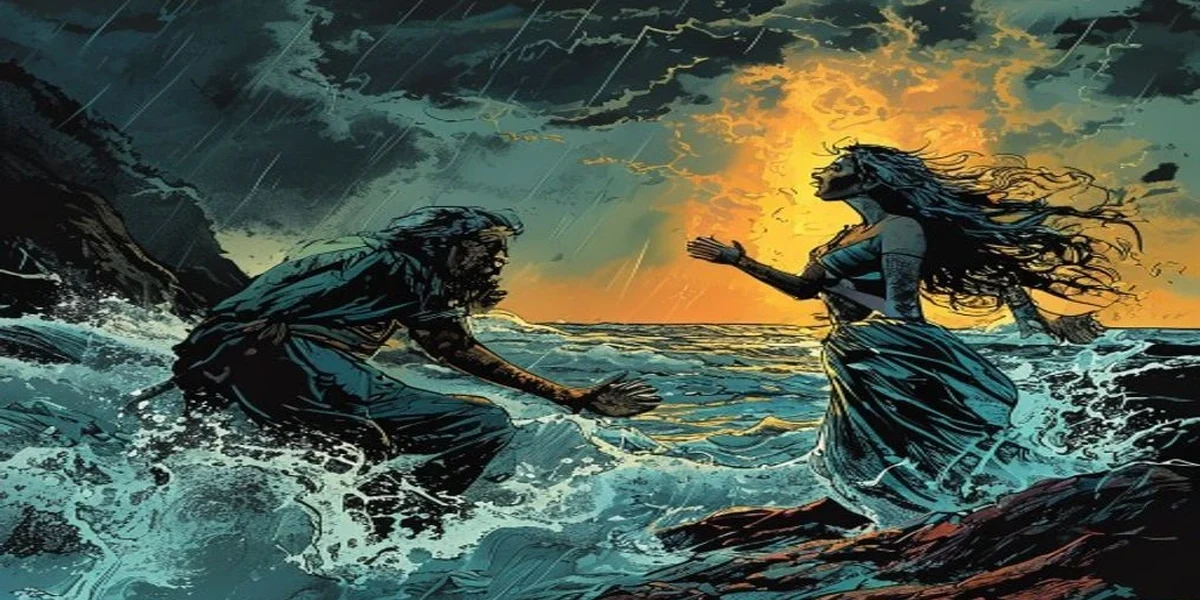
“The Sea-Maiden” is one of the most celebrated and structurally complex tales in the Scottish Gaelic tradition, recorded in exemplary form by John Francis Campbell in Popular Tales of the West Highlands (1860–62) from narrators in the Hebrides and along the western seaboard. The tale weaves together three of the most powerful narrative threads in Celtic folklore — the supernatural sea-woman, the external soul motif (where a villain’s life is hidden outside his body), and the grateful dead helper — into a story of unusual emotional depth and moral complexity. Its maritime setting is not incidental but essential: the sea in Gaelic mythology is the boundary of the known world and the threshold of the Otherworld, and the figure who emerges from it carries the full weight of that liminality.
The tale has attracted significant scholarly attention for its pan-European tale-type connections (it incorporates elements of ATU 302, ATU 303, and ATU 316 simultaneously) and for its distinctively Celtic rendering of motifs found across a wide range of world traditions. Yet it is above all a profoundly local story — rooted in the specific landscape of island and shore, in the specific cultural complex of the sea-covenant, and in a conception of supernatural obligation that is immediately legible to anyone who has grown up in the fishing communities of the Gaelic west.
Synopsis: Covenant, Quest, and Liberation
The tale opens with a poor fisherman whose luck has entirely failed. In desperation he enters into a covenant with a supernatural being — the Sea-Maiden herself, or sometimes a more ambiguous marine entity — trading his most precious possession (typically his unborn child or his wife’s first-born) for the return of his fortune. The covenant is struck, the luck returns, and in due time the debt falls due. The son who was promised must be surrendered.
The hero, the promised son, sets out on a journey that takes him through a series of adventures. He befriends a series of grateful dead — the spirits of men whose bodies he has treated with proper respect when others have refused to inter them. These grateful dead become his helpers in the crucial challenge that follows: the defeat of a giant who holds captive a princess (sometimes three princesses) in a tower or underground stronghold. The giant’s life is concealed in an external soul — hidden in a sequence of nested containers, an egg inside a duck inside a box inside a larger container — and can only be destroyed by finding and breaking this soul. The hero, guided by his grateful dead companions and their supernatural knowledge, locates the external soul and destroys it, killing the giant and liberating the prisoner.
The resolution varies significantly across versions. In some, the hero marries the rescued princess. In others, a false companion tries to steal the credit. In the most complex versions — closest to the Hebridean tradition — the Sea-Maiden herself reappears at the end, either to claim the hero or to release him from the original covenant, having been satisfied by the quality of what he has become through his trials. This final reappearance transforms the tale from a simple quest narrative into something considerably more complex: a meditation on the nature of supernatural obligation and the possibility of its honourable resolution.
The Sea-Maiden: Maritime Sovereignty and Otherworld Power
The figure of the Sea-Maiden in Gaelic tradition is related to but distinct from the mermaid of Continental and English tradition. Where the English mermaid is primarily a figure of erotic danger — beautiful, alluring, ultimately destructive — the Gaelic sea-woman is a figure of power and covenant, more akin to the sovereignty goddess than to the fatal temptress. She enters into binding agreements with mortals, she has the ability to bestow or withdraw good fortune, and she holds to her bargains with a rigour that is simultaneously terrifying and honourable.
The sea in Gaelic mythology is consistently associated with the Otherworld. The immrama — the great voyage narratives of early Irish literature, including the Voyage of Bran and the Voyage of Máel Dúin — describe journeys westward into an oceanic Otherworld of islands, each with its own character and supernatural logic. The Sea-Maiden belongs to this world: she is not merely a dangerous creature but a sovereign being in her own domain, and the fisherman who bargains with her is entering into a relationship with a power considerably greater than himself.
The covenant structure of the tale — where a human trades something precious for supernatural assistance — is one of the oldest and most widespread patterns in Celtic narrative. The Irish geasa (binding obligations placed on heroes) and the Breton interdictions operate on the same logic: supernatural powers and the humans they interact with are bound by agreement, and the consequences of breaking these agreements are severe. The Sea-Maiden’s claim on the fisherman’s son is not arbitrary cruelty but the strict enforcement of a covenant both parties freely entered, and the story’s resolution must negotiate this obligation with something more than force.
The External Soul: Hidden Life and the Logic of Invulnerability
The external soul motif — the villain whose life is hidden outside his body in a nested sequence of containers — is one of the most widely distributed elements in world folklore, found from Russian tales (the Kashchei the Deathless tradition) through Indian epics, African folklore, and Melanesian narrative. In “The Sea-Maiden,” the giant who holds captive the princess has hidden his soul (and with it his life) in an egg inside a duck inside a box inside a larger chest, often buried or locked in a remote location. He believes himself invulnerable because no one can kill him without first finding and breaking the hidden egg.
The external soul motif operates on a distinctive magical logic: the villain has achieved a form of immortality by separating his life from his body, placing it where no ordinary weapon can reach it. He cannot be killed in battle; he can only be destroyed by finding the hidden soul and destroying it. This logic inverts the usual heroic combat: the hero who faces the giant must be not a superior fighter but a superior searcher — someone who can locate hidden things, penetrate nested containers, and perform the precise act (breaking the egg) that the giant has believed impossible to perform.
In the Gaelic versions, the grateful dead companions are essential at this point. Their supernatural knowledge — acquired through the experience of death and the Otherworld — includes the ability to locate the hidden soul. They know where it is kept because the knowledge of hidden things belongs to those who have passed beyond the ordinary boundaries of human perception. The hero’s earlier act of charity (burying the unburied dead) is therefore not merely a moral virtue but a practical investment: he has acquired companions who know things that no living person can know, and this knowledge is the key to the giant’s defeat.
The Grateful Dead Helpers
The “grateful dead” element of “The Sea-Maiden” — in which the hero befriends the spirits of those whose bodies he has treated with honour — belongs to one of folklore’s most enduring and emotionally resonant motifs, classified as ATU 505–508 in the tale type index. The motif rests on a simple but profound moral logic: the proper treatment of the dead is a form of justice owed to the helpless, and performing this justice creates an obligation of reciprocity that transcends the boundary between the living and the dead. The man who ensures that a stranger receives proper burial has done something that ordinary social calculation would not require; his reward is supernatural rather than social.
In Gaelic tradition, the improper treatment of the dead was among the most serious of social failures. The sídhe (fairy mounds) were understood to be, among other things, the dwelling places of the dead, and the correct observance of burial rites was essential to maintaining the boundary between the living world and the world of the dead. A body left unburied was an offense against both the dead and the community, and the hero who rectifies this offense — at personal cost, against the mockery or indifference of others — performs an act whose moral weight is immediately legible in this cultural context.
The grateful dead helpers in “The Sea-Maiden” are typically warriors or companions who appear in human form and assist the hero through his trials, revealing their supernatural nature only at the tale’s resolution or in moments when their knowledge of hidden things becomes decisive. Their devotion to the hero mirrors the hero’s devotion to them when they were helpless: the reciprocity is exact, and the tale’s moral architecture is as precise as any formal argument.
Regional Variation and Comparative Context
Campbell’s Hebridean version, which established “The Sea-Maiden” in the English-speaking world’s awareness of Gaelic folklore, has been supplemented by numerous variants collected by the Irish Folklore Commission and by later collectors in the Gaelic-speaking areas of Scotland. These variants show the tale’s remarkable adaptability while maintaining its structural core.
Connacht and Munster Irish versions tend to give the sea-covenant a more explicitly domestic setting — the Sea-Maiden (or equivalent entity) may appear as a woman on the shore rather than emerging from the waves, and the covenant is sometimes struck in the context of a fishing agreement rather than a rescue from destitution. These versions also tend to elaborate the romantic element: the hero and the captive princess he rescues develop a more explicitly tender relationship, connecting the tale to the aislinge (vision poetry) tradition.
The external soul episode shows the most variation across versions. In some, the nested containers become extremely elaborate — up to seven levels of containment — reflecting both the tradition’s love of structural elaboration and a desire to make the villain’s apparent invulnerability as absolute as possible before revealing the fatal weakness. In others, the process of finding the external soul involves a long search across the Otherworld landscape, connecting the tale to the immrama tradition of the great western voyage.
The tale’s international parallels are extensive: the Kashchei the Deathless tradition of Russian folklore, the Hindi tale of Punchkin, the Egyptian tale of the two brothers, and numerous African and Melanesian versions all share the external soul structure. The Gaelic versions are distinguished by the maritime framing (the sea-covenant), the grateful dead element (which is common in Gaelic but not universal in other traditions), and the sovereignty-goddess colouring of the Sea-Maiden herself.
The Resolution: Honouring and Releasing the Covenant
The ending of “The Sea-Maiden” is one of the most culturally revealing elements of the tale. In the most common versions, the hero’s success in destroying the giant and rescuing the princess satisfies whatever obligation the original covenant imposed — either the Sea-Maiden accepts his accomplishment as payment for the debt, or the covenant is revealed to have been a test of exactly the qualities he has demonstrated. The son who was promised becomes the man who proved himself worthy of not being taken.
This resolution engages directly with the Gaelic tradition’s understanding of supernatural obligation. Unlike human contracts, which can be annulled by agreement or rendered void by changed circumstances, Gaelic supernatural covenants are binding in a way that human law cannot be. Yet they are also, in some traditions, responsive to the quality of what the obligated party does with their life: a covenant that asked for a child is honoured differently by a child who becomes a mediocre adult and a child who becomes a genuine hero. The Sea-Maiden’s release of the hero in the best versions is not a breach of the covenant but its fullest satisfaction.
“The Sea-Maiden” endures in the Gaelic tradition because it contains within one narrative arc nearly every element that the tradition values most: the sea as Otherworld threshold, supernatural covenant and its honourable resolution, the power of charitable action toward the helpless, the discovery of hidden truths, and the vindication of the hero who acts rightly when no social reward is available. It is, in the fullest sense, a comprehensive tale — one that uses the machinery of adventure to explore the deepest structures of a culture’s moral imagination.
Legacy and Narrative Influence
Campbell’s publication of “The Sea-Maiden” made it one of the most widely reproduced of all Gaelic folktales in the nineteenth and twentieth centuries, appearing in dozens of anthologies for both scholarly and general audiences. Its combination of maritime romance, magical quest, and moral depth gave it immediate appeal beyond the Gaelic-speaking community, and it was adopted as a representative tale of Celtic culture in the broader cultural nationalism of the Victorian era.
In the twentieth century, Alan Bruford’s comparative study of the tale and its variants illuminated the extraordinary range of the tradition, while Kenneth Jackson’s translations brought the specific beauty of the Campbell text to wider academic attention. In Ireland, analogous tales collected by Seán Ó Conaill and others from Connacht and Munster storytellers were studied as part of the wider inquiry into the oral narrative tradition’s relationship with medieval and pre-medieval sources.
For contemporary readers, “The Sea-Maiden” speaks to the experience of inherited obligation — of being born into a covenant one did not choose — and of finding, through the living of a genuinely courageous life, a way to honour that obligation that transforms it from burden into purpose. The fisherman’s son did not choose to be promised to the Sea-Maiden; he chose how to live in the shadow of that promise. In the Gaelic tradition, that choice is everything.
“The Sea-Maiden” is a story about the obligations we inherit and the quality we can bring to honouring them. The fisherman’s desperate covenant sets in motion a chain of events that his son must navigate not by breaking the original bargain but by living so fully, so courageously, and so generously that the bargain’s terms transform around him. When the Sea-Maiden finally releases her claim, she does not do so because she was cheated or overpowered — she does so because the young man proved that what was promised was worth more free than bound. In the cold, salt-grey world of the Gaelic west, that is the best any covenant can hope for.
You May Also Like
 Celtic Folk Tales
Ages 9-12
Celtic Folk Tales
Ages 9-12
Brewery Of Eggshells
The classic Welsh changeling tale from Joseph Jacobs' Celtic Fairy Tales (1892), in which a young mother of Treneglwys uses the ancient eggshell-brew ruse, prescribed by the Wise Man of Llanidloes, to expose two fairy changelings and recover her stolen twins.
 Celtic Folk Tales
Ages 9-12
Celtic Folk Tales
Ages 9-12
Gold-Tree And Silver-Tree
Gold-Tree And Silver-Tree: Once upon a time there was a king who had a wife, whose name was Silver-tree, and a daughter, whose name was Gold-tree. On a certain
 Celtic Folk Tales
Ages 9-12
Celtic Folk Tales
Ages 9-12
Hudden And Dudden
Hudden and Dudden and Donald O'Neary: An Irish Tale of Wit Over Greed In Ireland long ago, in a time when magic still seemed possible and cleverness was often