Sea-Maiden
Sea-Maiden: I have omitted the births of the animal comrades and transposed the carlin to the middle of the tale. Batten has considerately idealised the
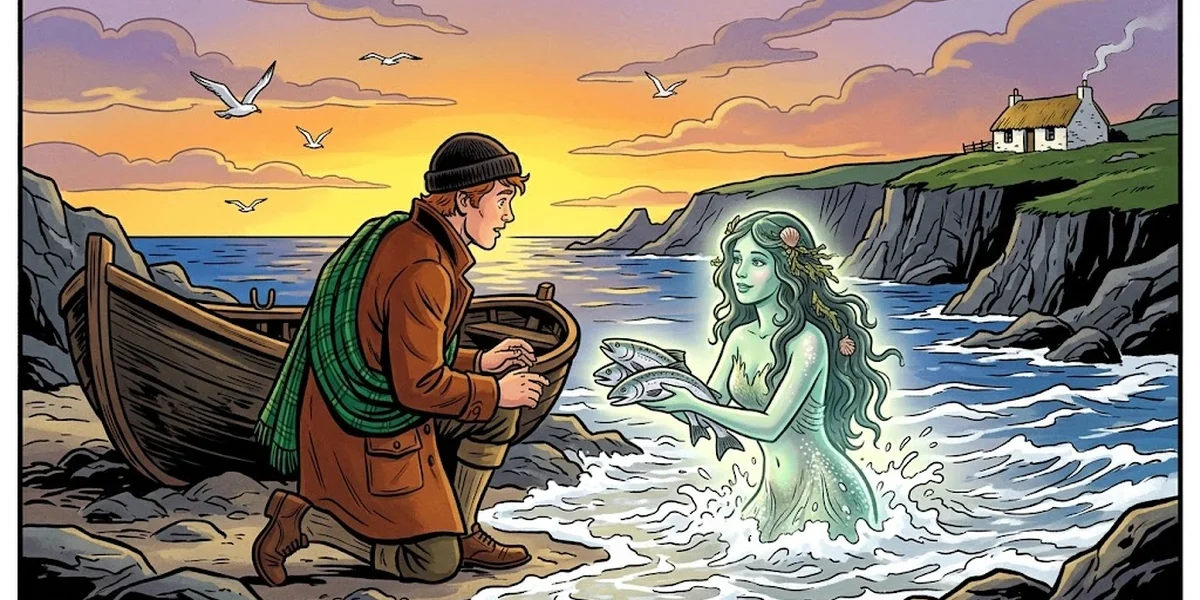
The Sea-Maiden is a celebrated tale of the West Highlands — a Scottish-Gaelic folk romance recorded in the mid-nineteenth century from the lips of stone-mason and small-tenant story-tellers, and afterwards anglicised for English nurseries by Joseph Jacobs. Its scaffolding is twin-international: the Dragon-Slayer who marries the rescued princess (Aarne–Thompson–Uther Type 300) welded onto the Ogre’s Heart in the Egg (ATU 302), with a Cinderella-like recognition motif (ATU 510A) tying the close. Beneath that armature stands an older, distinctively Celtic tale — one which Heinrich Zimmer, John Rhÿs and Alfred Nutt traced as far back as the Old Irish saga Tochmarc Emer (“The Wooing of Emer”), in which the hero Cu Chulainn rescues the daughter of Ruad from three Fomorian sea-raiders. The story we read today therefore carries the deposited memory of a thousand years of Gaelic story-craft: pre-Christian sea-demons, missionary monks, Hebridean fishermen, Victorian collectors, and Edwardian schoolrooms have each laid a hand upon its shoulder.
Origin, Provenance and Canonical Apparatus
The earliest published Scottish version is An Maighdean Mhara (“The Sea-Maiden”), Tale No. 4 in John Francis Campbell of Islay’s monumental four-volume Popular Tales of the West Highlands, Orally Collected (Edinburgh: Edmonston and Douglas, 1860–62; reprinted Hounslow: Wildwood, 1983). Campbell printed it in parallel Gaelic and English from a recitation taken down by his collector John Mackenzie, fisherman of Inverary, on April 1856 from the dictation of Roderick Mackenzie, a wandering tinker; an additional Berneray version came from John Smith, labourer, and a third from Kenneth Macleod of Berneray on the south end of Harris. The bilingual print — left-hand Gaelic, right-hand English — remains the gold-standard scholarly source. Joseph Jacobs reprinted the English text, with editorial smoothing, as Tale XVII of Celtic Fairy Tales (London: David Nutt, 1892), pp. 130–142, illustrated by John D. Batten; that is the version most modern English-language readers know.
The international classification places the tale at the junction of two of the most widely diffused folk-types in the Indo-European world. Hans-Jörg Uther, in The Types of International Folktales: A Classification and Bibliography (FFC 284–286, Helsinki: Suomalainen Tiedeakatemia, 2004), I.174–177 and 178–180, treats Scotland-Sea-Maiden as a hybrid of ATU 300 (The Dragon-Slayer) and ATU 302 (The Ogre’s Heart in the Egg), with a recognition coda derived from ATU 510A (Cinderella). The motif-index apparatus is dense: Stith Thompson indexes the relevant items as B11.10 (sacrifice of human being to dragon), B11.11 (fight with dragon), H335.0.1 (bride helps suitor perform tasks), D672 (obstacle flight), and most famously E710 (external soul) — the soul of the sea-maiden lodged in an egg, in a trout, in a hoodie, in a hind, on a far island. Tom Peete Cross, Motif-Index of Early Irish Literature, Indiana University Studies (Bloomington, 1952), confirms cognate motifs in the medieval Irish corpus.
The locus classicus on the external-soul motif is Edward Clodd, “The Philosophy of Punchkin”, Folk-Lore Journal II (1884), pp. 288–303 — written precisely with this Sea-Maiden cycle in mind — later incorporated in his Tom Tit Tot: An Essay on Savage Philosophy in Folk-Tale (London: Duckworth, 1898). Sir James George Frazer devoted Chapter LXVI of The Golden Bough, “The External Soul in Folk-Tales”, to a comparative meditation that draws Sea-Maiden together with Punjabi (Punchkin), Russian (Koshchei the Deathless), Norse (The Giant Who Had No Heart in His Body), Egyptian (The Tale of the Two Brothers) and Greek (Meleager) cognates — one of the most sustained pieces of comparative folkloristics in nineteenth-century Britain.
The First Movement: A Bargain in the Surf
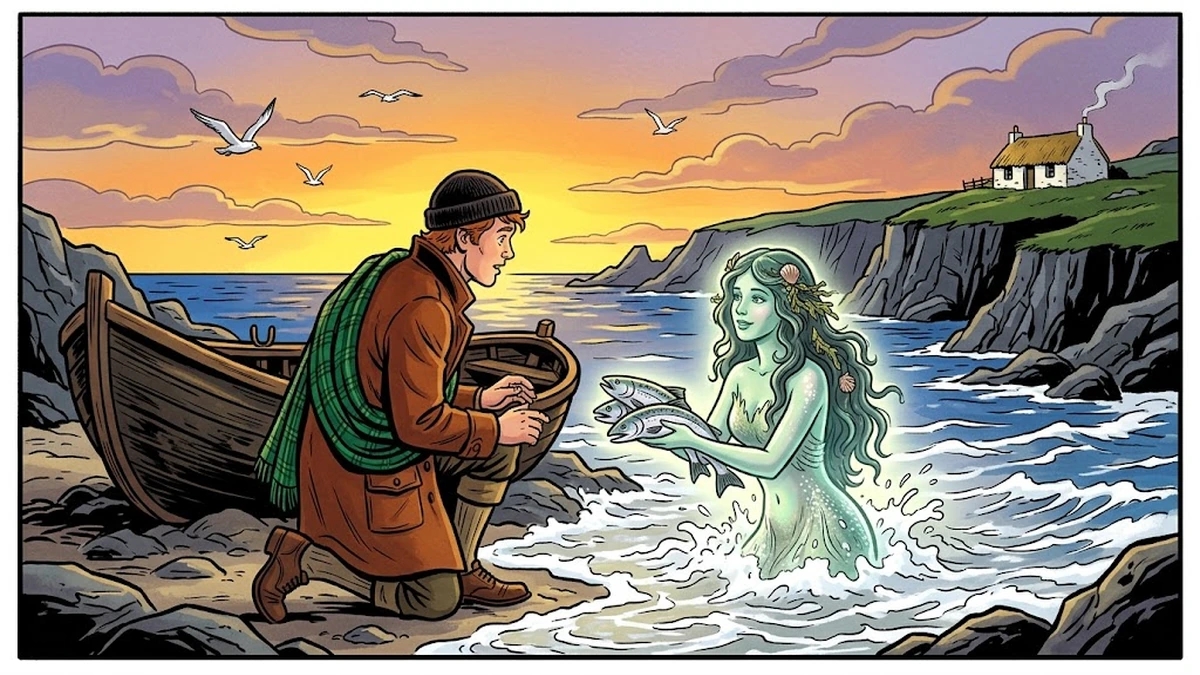
An old fisherman of the West Highlands has fished from the same skerry for half a lifetime and grown poor. The boat lies idle three days running for he can bring up nothing — not a sand-eel, not a saithe. On the fourth day, when his wife has nothing to set before him, the old man rows out alone to the deep water near a sea-stack. There the sea heaves and parts, and a Sea-Maiden of unearthly beauty rises to his gunwale, her hair like wet kelp shining in the sun. She offers him fish enough to fill his boat to the rowlocks — and a heap of gold besides — on a single condition. The first son she has not yet seen who shall be born at his hearth must be given over to her when he turns three years old.
The old man, having no children, swears the bargain easily, then rows home to find his wife with child. The Sea-Maiden’s gift — and it is the formal sign of Aarne-Thompson Motif M211, the Devil-Bargain — brings them three sons in three years and three foals in three years and three pups in three years and three salmon-eggs in three returns of the boat. (Triplication is the metric of Highland tale-craft: the storyteller told by threes because the audience remembered by threes.) The eldest son grows tall and bold; on the eve of his third birthday a black cloud rolls in off the open Atlantic and the Sea-Maiden is heard wailing in the surf. The boy hides among the sheep on the moor, and so the bargain is broken; but the storyteller pauses to remind us that bargains broken by the sea are paid in time, with interest.
The Second Movement: The Three Cubs and the Stone Sword
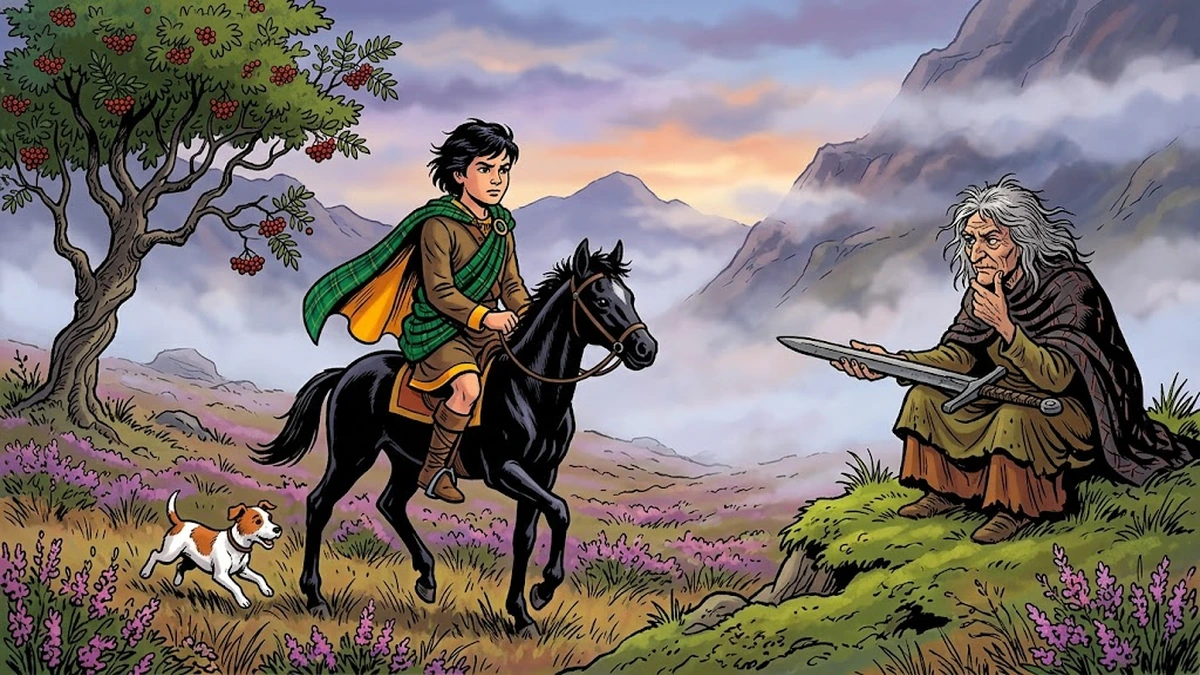
Years later the eldest son rides off into the wide world on the foal that was foaled the night he was born, with the pup that was whelped the same night running at his heel. By a green hillock he meets a hideous cailleach — the carlin of innumerable Highland tales, An Cailleach Bheur, the Old Wife of Winter — with a thumb on her chin as long as a stocking-foot. She gives him hospitality. She gives him a stone sword. She tells him that the King’s daughter at the white castle by the strand will tomorrow be given to a three-headed sea-monster on a strand-stone, for the people of that country owe an annual tribute of a maiden to the deeps, and the lot has fallen this year on the King’s eldest. The boy thanks her and rides on; but the carlin (here is the beauty of Campbell’s recension) is not yet finished with him — she will return three times before the tale is done, each visit a darker echo of the first.
The trial of the sword is a Celtic ornament of the deepest antiquity. Alfred Nutt, in his note to Donald MacInnes’s Folk and Hero Tales from Argyllshire (London: David Nutt, 1890), p. 473, identified at least seven Highland tales in which the hero must select a true blade from a counterfeit one (compare also Curtin, Myths and Folklore of Ireland, 1890, p. 320). The motif appears verbatim in the saga of Sigurðr Fáfnisbani in the Norse Völsunga saga, where Reginn forges and Sigurdr smashes two false blades before tempering Gram in the Rhine. Whether the Highland and Norse forms are independent or, as Nutt suspected, derived from a common Indo-European reservoir of heroic ornament, remains a chestnut of comparative philology. The boy hews thrice with the stone sword, and only the third blow takes; afterwards the carlin will give him an iron sword, then a sword of polished steel, and so by gradations of metal the boy is forged.
The Third Movement: Three Heads upon a Strand
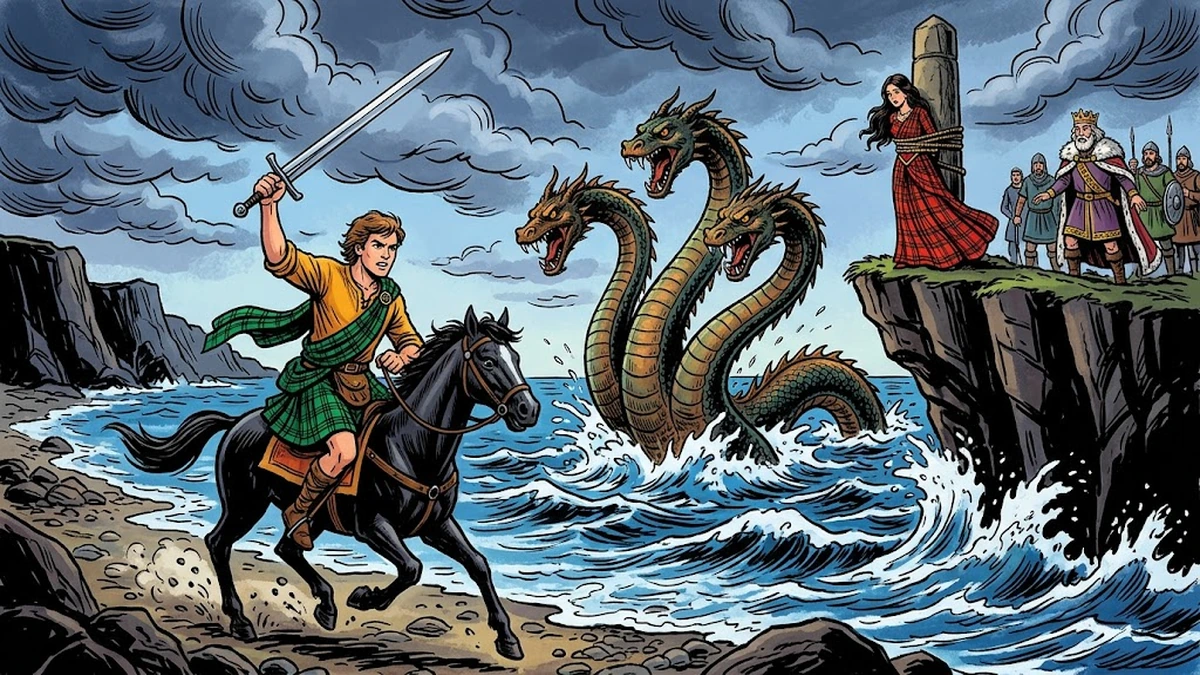
Now the action shifts to the white castle by the western sea, and to a battle-piece that is the heart of the tale. The princess has been bound to a rock by the high-water mark, the King and his retinue stand weeping above on the cliff, and the populace watch from a respectful distance. From the open ocean comes a churning — a creature with three heads on three necks, scales like flint, eyes like bog-fire — and the boy, mounted on his black foal with the pup at heel, charges down to the strand. The first day he hews off one head and the monster sinks back; the second day he returns and hews off the second; the third day, with the people now watching from the battlements in awe, he severs the third head, and the monster sinks for ever. Each day, after the slaying, the boy disappears among the shepherds, and on each evening the princess takes a lock of his hair (or, in Campbell’s Berneray version, a strip from her gown) and hides it.
This is the Celtic re-fitting of the Perseus and Andromeda myth (Apollodorus, Bibliotheca II.iv.3; Ovid, Metamorphoses IV.663–753): the maiden chained to the rock, the sea-monster from the depths, the helmeted hero, the rescue, the hidden tokens, the recognition. Sir John Rhÿs, in his Hibbert Lectures (London: Williams and Norgate, 1888), p. 464, and Alfred Nutt at MacInnes op. cit., p. 477, demonstrated that the same plot is told of Cu Chulainn in Tochmarc Emer (“The Wooing of Emer”), preserved in the Book of Leinster, a vellum manuscript of the twelfth century apparently copied from an eighth-century exemplar — the missing Sea-Maiden episode itself supplied by British Museum MS Harleian 5280 (c. 1300), where Cu Chulainn fights the three Fomori in succession, has his wounds bound by a strip of the maiden’s garment, and is afterwards recognised by a stratagem when others falsely claim the deed. The tale, then, was already in Irish letters before the Norman invasion of Britain. Eleanor Hull, The Cuchullin Saga in Irish Literature (London: David Nutt, 1898), and Cecile O’Rahilly, Táin Bó Cúailnge from the Book of Leinster (Dublin: Dublin Institute for Advanced Studies, 1967), give the Old Irish text in full.
The Fourth Movement: An Egg, a Trout, a Hoodie, a Hind
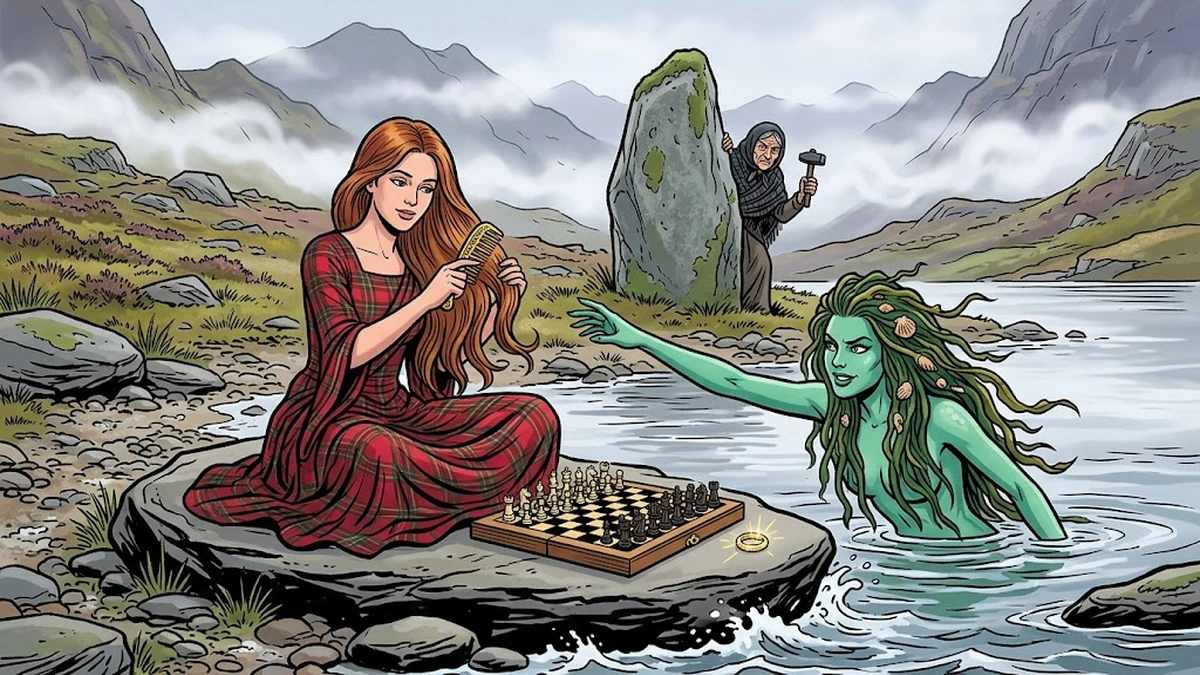
The wedding follows. The boy and the princess are married, and the carlin’s pup grows fat on bones from the King’s table. But the bargain made by the old fisherman in the boat has not been forgotten by the deep, and on a moonlit night the Sea-Maiden draws the young husband out of his chamber by enchantment and swallows him into her own throat. The princess, refusing to mourn, takes ship for the loch where the maiden lairs, and there she sits on the strand and combs her hair and waits. The Sea-Maiden, who covets the comb, raises herself out of the loch — once for the comb, once for a golden ring, once for a chess-board — and on the third asking she is far enough from her own water that the carlin’s smith’s-hammer comes down on her head, and the spell is broken. The maiden, dying, gives up the riddle of where her own life is hidden.
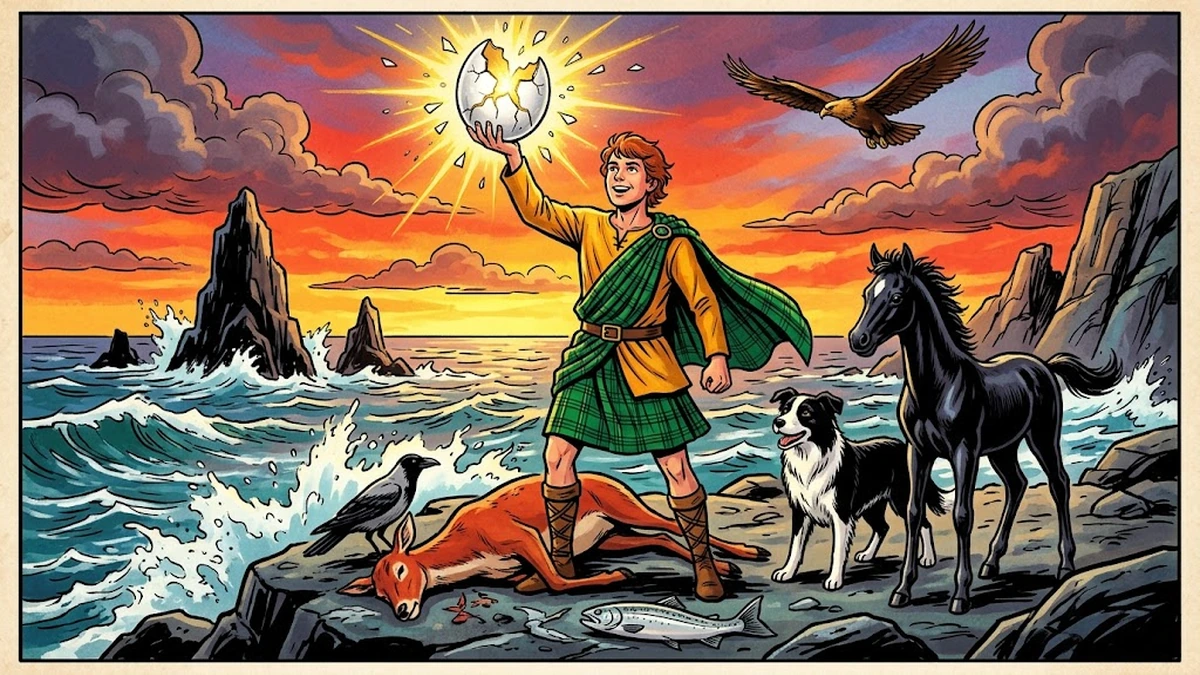
And here at last is the external-soul motif in its classic Celtic form: not in the body, not in any vital organ, but on a far island in the western sea, in the belly of a hind, in the breast of a hoodie-crow, in the gut of a trout, in an egg, on the point of a needle. The hero kills the hind with the help of the dog that was whelped on his birthday; the dog catches the hoodie; the trout is fished out by the otter that came in alongside the boat; the egg is shattered between the boy’s palms; and the Sea-Maiden, in the loch leagues away, is dead. The husband, restored from her belly, walks out into the dawn as if from a long sleep. The fisher father, who has fished from the same skerry for half a lifetime, sees three boats coming home with the rising tide, and the bargain is paid in full, with interest.
The Carlin and the Cailleach: Reading the Old Wife of Winter
The hideous old woman who befriends the boy on the moor is no incidental figure. Donald Alexander Mackenzie, in Scottish Folk Lore and Folk Life (Glasgow: Blackie, 1935), pp. 136–160, traces her back to the pre-Christian Cailleach Bhéar, the ‘Hag of Beare’, the Old Wife of Winter who, in the Hebridean year, holds dominion from Samhain (1 November) to Imbolc (1 February) and whose washing-day is the storm that rolls in off the Atlantic. In the wider Scottish tradition she rides a wolf, drops the boulders that compose the Cuillin range, and turns to stone at Beltane — a Mediterranean Demeter forever caught between forms. Here, in the Sea-Maiden tale, she is muted into a benevolent threshold-figure, the cailleach who tests and arms the youth at the boundary between the human world and the sea-realm; her three swords are the three meeting-points between worlds, and her three returns punctuate the boy’s passage from son to husband to king.
The Sea-Maiden herself is descended from a more dangerous lineage. She is sister to the Norse mármenill (sea-trolls of the Konungs Skuggsjá); cousin to the Greek nereids; first cousin to the Welsh Gwragedd Annwn of Llyn y Fan Fach; and remoter cousin to the Irish Fomori, those one-armed, one-legged, one-eyed sea-raiders who in the Lebor Gabála Érenn (twelfth-century, but reflecting older oral tradition) fight the Tuatha Dé Danann at Mag Tuired. John Carey, A Single Ray of the Sun: Religious Speculation in Early Ireland (Andover and Aberystwyth: Celtic Studies Publications, 1999), and Mark Williams, Ireland’s Immortals: A History of the Gods of Irish Myth (Princeton, NJ: Princeton University Press, 2016), trace this Otherworld topography in admirable detail. The folk-tale Sea-Maiden retains the dangerous beauty of the Otherworld bride: she gives, but she counts.
The Hebridean Setting and Its Diffusion
Campbell’s informants placed the action variously on the western seaboard between Loch Linnhe and the Sound of Berneray, but the tale belongs more broadly to the Gaelic west — an arc that runs from Donegal in north-west Ireland through Argyll and Lochaber to the Outer Hebrides, embracing islands where the herring-fishery is the household economy and the sea is the household’s great risk. John Lorne Campbell and Francis Collinson, in Hebridean Folksongs III: Waulking Songs from Vatersay, Barra, Eriskay, South Uist and Benbecula (Oxford: Clarendon, 1981), document how completely the sea-maiden cycle was woven into the women’s waulking songs, the rhythmic chants of cloth-making whose function was to wear the brain down to the same softness as the wool. Reidar Th. Christiansen, in “Studies in Irish and Scandinavian Folktales” (Copenhagen: Rosenkilde og Bagger, 1959), maps the diffusion of the type from the Lochaber and Inner Hebrides eastwards into Caithness, then into Orkney and Shetland (where it acquires a Norse colouring of trolls and selkies), and at length into West Norway via the herring-fleet contact-zone.
The literary afterlife is rich. Andrew Lang reprinted the Jacobs version, lightly retold, in The Orange Fairy Book (London: Longmans Green, 1906), placing the tale before generations of Edwardian children. W. B. Yeats, who knew Jacobs and Nutt personally and corresponded with both, draws on the Sea-Maiden cycle in his lyric “The Song of Wandering Aengus” (1899) and in the visionary prose of The Celtic Twilight (1893; expanded 1902), where he identifies the carlin and the sea-maiden as remnants of older deities. Lewis Spence, The Magic Arts in Celtic Britain (London: Rider, 1945), and Stith Thompson’s own The Folktale (New York: Dryden, 1946), preserve the tale in their indexes and treat it as a touchstone of Indo-European folk-narrative.
Moral
“Cha tèid air do shon ach na rinn thu air do shon fèin.”
“Nothing comes back to thee but what thou hast made for thyself.”
— Scottish Gaelic proverb, recorded by Alexander Nicolson in A Collection of Gaelic Proverbs and Familiar Phrases (Edinburgh: Maclachlan and Stewart, 1881), p. 78
The moral of the Sea-Maiden is older than the tale and deeper than its plot. A bargain made in extremity returns to be paid; a kindness given is the road by which a kindness returns; a courage offered to a stranger on the road comes back when the strand is loud and the monster rises. The fisherman in his idle boat owes the sea what the sea has lent him, and the boy in the saddle owes the carlin what the carlin has armed him with, and the princess on the strand owes her husband the wit to fish him back out of the deeps. Every gift in the tale is a debt held in trust until the right hour; and the tale’s consolation is that the right hour does eventually come. To children this is good moral instruction in disguise; to adults, a quiet philosophy of attention — for it is the patient, the watchful, and the grateful who recover what is theirs.
Why It Has Lasted
The Sea-Maiden has lasted because it carries the whole Celtic year inside it. The seasonal Cailleach who arms the youth, the Otherworld bride who tests him, the western sea on which the Hebridean year turns, the three salmon (creatures of wisdom in the Fionn cycle), the thrice-coming sea-monster, the external soul lodged in the bird-and-fish-and-egg of the western islands — all are images deeply imprinted on the Gaelic mind by a thousand years of weather and fishing and crofting. When Campbell took the tale down at Inverary in 1856, he was not preserving a curio; he was rescuing a way of seeing the world. When Jacobs printed it for nurseries in 1892, he made it a possession of every English-speaking childhood. And when we read it to children today, on whatever shore, we are putting them in conversation with a sequence of voices — tinker, fisherman, collector, editor, illustrator, parent — that runs unbroken back to the open Atlantic.
What makes the Sea-Maiden’s pattern unforgettable is the rhythm: three sons, three foals, three pups, three salmon, three swords, three heads, three returns, three gifts of the comb, the ring, the chess-board. The triplication is not idle decoration but the structural logic of oral memory; we are reading, in print, the mnemonic of a culture that had no print. The little reader of seven who listens at bedtime and the scholar of seventy who consults Stith Thompson are doing the same work in different keys: holding the rhythm, recovering the bargain, paying the debt.
The story’s lasting psychological gift, beyond its moral instruction, is its picture of relationship. The young husband is rescued from the maiden’s belly because his wife refuses to mourn and instead does the patient work of recovery; the dog and the hawk and the otter are borrowed from the natural world to undo what was bargained for at the sea’s edge. To love well, the tale says, is to attend with a long memory and a steady purpose; the sea will give back what it has taken if we sit by it long enough with a comb and a ring and a chess-board, and the right friends running by our side. That is a quiet and grown-up message for a tale that begins with a fisherman in an empty boat, and it is a chief reason the tale has not aged.
A Final Word for the Reader
We hope this telling has given you something to take into the rest of your day — a small image, a useful rhythm, a question for the dinner table. The Sea-Maiden has been told for at least eight hundred years in some form, in Gaelic and Old Irish and English and dozens of intermediate dialects; it has crossed sea-lanes and centuries; it has shaped how generations of Hebridean children imagined the world beyond their fathers’ boats. To read it now, slowly and aloud and with care, is to take a place in that long line. Thank you for keeping the tradition of attentive listening and thoughtful retelling alive. Folk tales do their best work in the hours and the years after the reading ends; they keep on quietly doing it long after the book has gone back to the shelf.
You May Also Like
 Celtic Folk Tales
Ages 9-12
Celtic Folk Tales
Ages 9-12
The Enchanted Cave
The Enchanted Cave: A long, long time ago, Prince Cuglas,[7] master of the hounds to the high King of Erin, set out from Tara to the chase. As he was leaving
 Celtic Folk Tales
Ages 9-12
Celtic Folk Tales
Ages 9-12
Hudden And Dudden And Donald O’Neary
Hudden And Dudden And Donald O'Neary: There was once upon a time two farmers, and their names were Hudden and Dudden. They had poultry in their yards, sheep on
 Celtic Folk Tales
Ages 9-12
Celtic Folk Tales
Ages 9-12
The Ridere of Riddles
The Ridere of Riddles: here was a king once, and he married a great lady, and she departed on the birth of her first son. And a little after this the king