Smallhead and the King’s Sons
Smallhead and the King's Sons: ong ago there lived in Erin a woman who married a man of high degree and had one daughter. Soon after the birth of the daughter
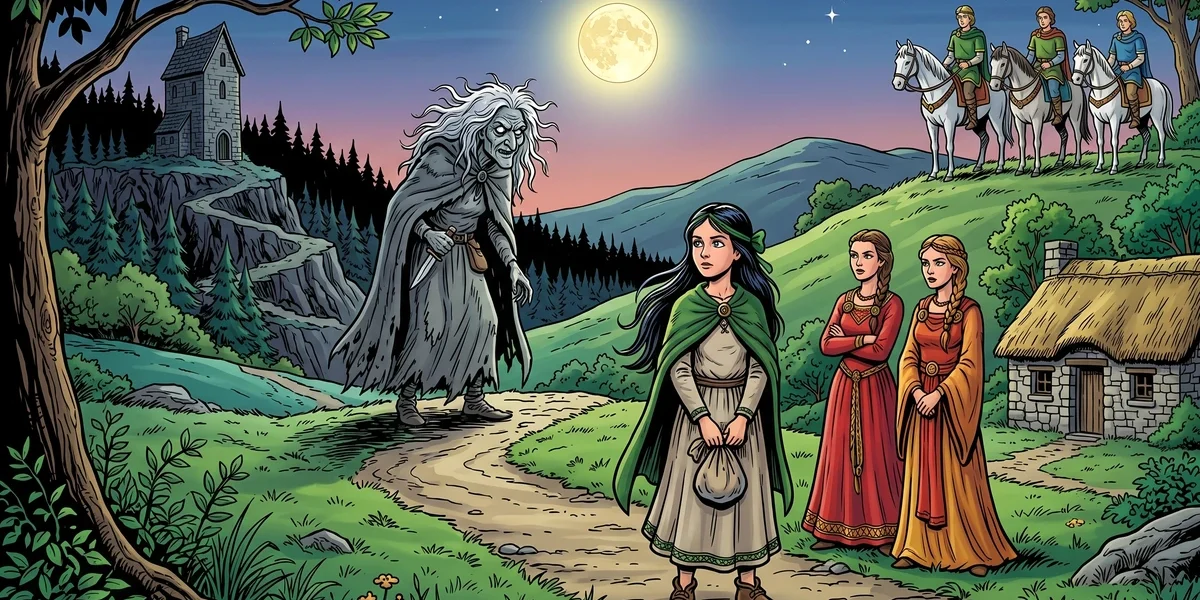
Smallhead and the King’s Sons is one of the most luminous heroine tales of the Irish oral tradition — a story of a clever, mocked half-sister whose wits outmatch the most dreadful witch in Erin and whose courage wins her the love of a prince. It belongs to a deep Indo-European story-cluster about youngest children, magic flights, and the trickster who cheats the ogress, and it survives today because every generation finds in Smallhead the same quiet thrill: the smallest head, when it is also the wisest, beats every giant in the field.
Origin and Canonical Attribution
This tale is one of the most fully recorded Celtic-Irish folk narratives of the late nineteenth century. The version best known to readers in English was collected by the American folklorist Jeremiah Curtin (1835–1906) during his fieldwork in the west of Ireland — in counties Galway, Kerry and Donegal — between 1887 and 1893. Curtin transcribed it in Donegal Irish from a native speaker and published it in his volume Hero-Tales of Ireland (Little, Brown & Co., Boston, 1894). The English folklorist Joseph Jacobs (1854–1916) re-edited Curtin’s transcription, smoothed the diction for child readers, and reprinted it as Tale XIII in More Celtic Fairy Tales (David Nutt, London, 1894), with illustrations by John D. Batten. Both books appeared the same year, and together they fixed the printed text now passed down to us.
In the Aarne–Thompson–Uther international tale-type index, Smallhead and the King’s Sons belongs to the family of tales that combine ATU 327B (The Brothers and the Ogre) with ATU 328 (The Boy Steals the Giant’s Treasure), and incorporates motifs from ATU 313 (The Magic Flight). Folklorists also classify it alongside the well-known Scottish-Gaelic tale Maol a Chliobain recorded by John Francis Campbell in Popular Tales of the West Highlands (1860), and the Lowland Scots tale Molly Whuppie printed in Robert Chambers’ Popular Rhymes of Scotland (1842). All three heroines — Smallhead, Maol a Chliobain, and Molly Whuppie — share the same core sequence: the youngest, smallest, scorned sister tricks an ogress into killing her own children, steals her treasures, and wins princes for her sisters and a king’s son for herself. Stith Thompson, in The Folktale (1946), identified the cluster as one of the oldest surviving examples of the female-trickster pattern in north-western Europe, with parallels reaching as far as the Norse Mjadveig Mánadóttir tales and the Russian Frost stories.
The Irish word ceann beag (“small head”) is a term of mock-affection in the Gaelic countryside — used for a clever child whom older relatives underestimate. The nickname survives in many Irish-language dialect glossaries, and folklorists believe that the heroine’s name preserves an older idiom in which “the smallest head holds the deepest sense” — a saying still recorded by the Irish Folklore Commission (Coimisiún Béaloideasa Éireann) in the 1930s.
The Tale Retold
1. The Half-Sister Who Was Mocked
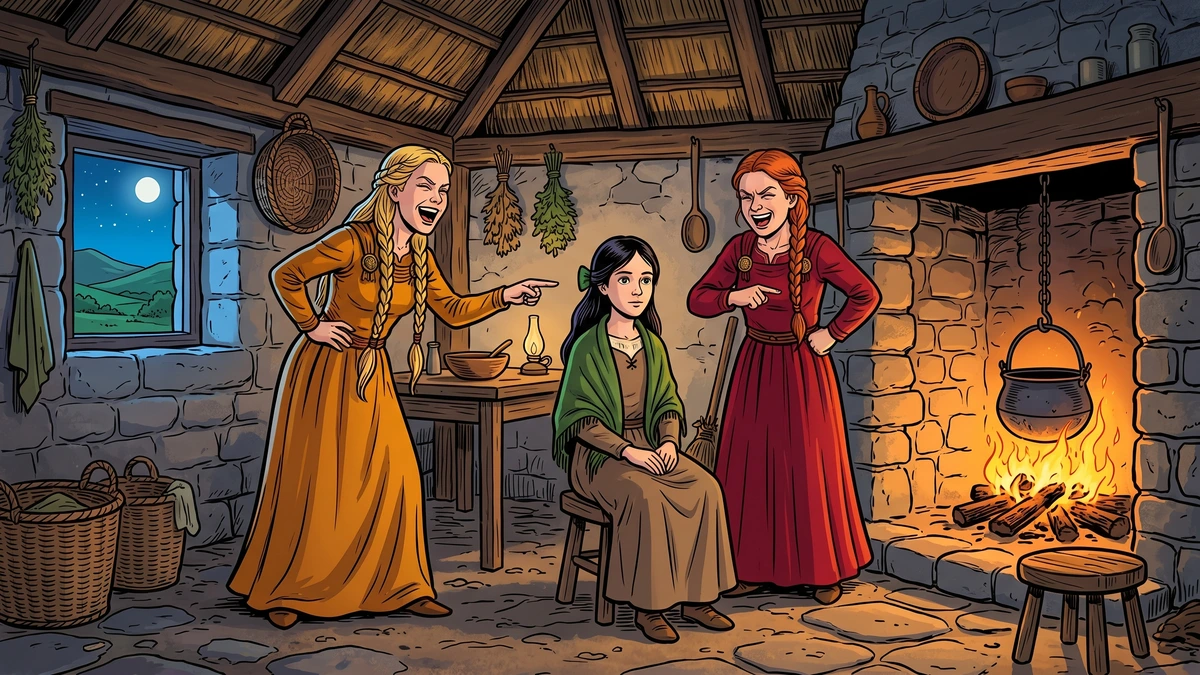
Long ago, in the green and rainy west of Erin, there lived a woman of high family who married a man of equal rank. They had one daughter, a quiet, watchful child with eyes that missed nothing. Soon the husband died, and the woman in her loneliness married a second time. By her second husband she had two more daughters, both vain and proud, who looked at the older child as if she were a stray cat at the door. Because the small girl was thoughtful and slow to boast, her half-sisters laughed at her. They said her head was too small to hold proper thoughts, and so they called her Smallhead; and the name stuck, and even the neighbours forgot what the child had been christened.
The years went on, and the second father died as well. The mother grew thin with grief and at last lay down in her bed and did not rise. The two proud daughters, with no parent left to scold them, decided to leave the cottage and seek their fortunes in the wide world. They took the meal-bag and the salt-box and what little gold there was, and they shut the door behind them, leaving Smallhead alone with the cold hearth. But Smallhead, knowing her sisters were proud and foolish and would walk straight into trouble, packed a small bundle and followed them at a distance, keeping always to the shadow of the hedges so they would not see her.
2. The House of the Hag of the Ridge
For three days the sisters walked, and on the third evening they came to a great house at the foot of a dark ridge, with smoke curling from the chimney and a glow at the window. They knocked, and the door was opened by a tall, grey-faced woman with eyes the colour of bog-water. This was the Hag of the Ridge, a witch known through seven kingdoms, who had three daughters of her own — black-haired, sallow-cheeked, with crooked smiles. The hag welcomed the travellers with sweet words, gave them porridge and milk, and seated them by the fire. But when she thought no one was looking, she whispered to her own daughters: “Tonight we shall have new shoes of the sisters’ skin, and a fine supper of their flesh.”
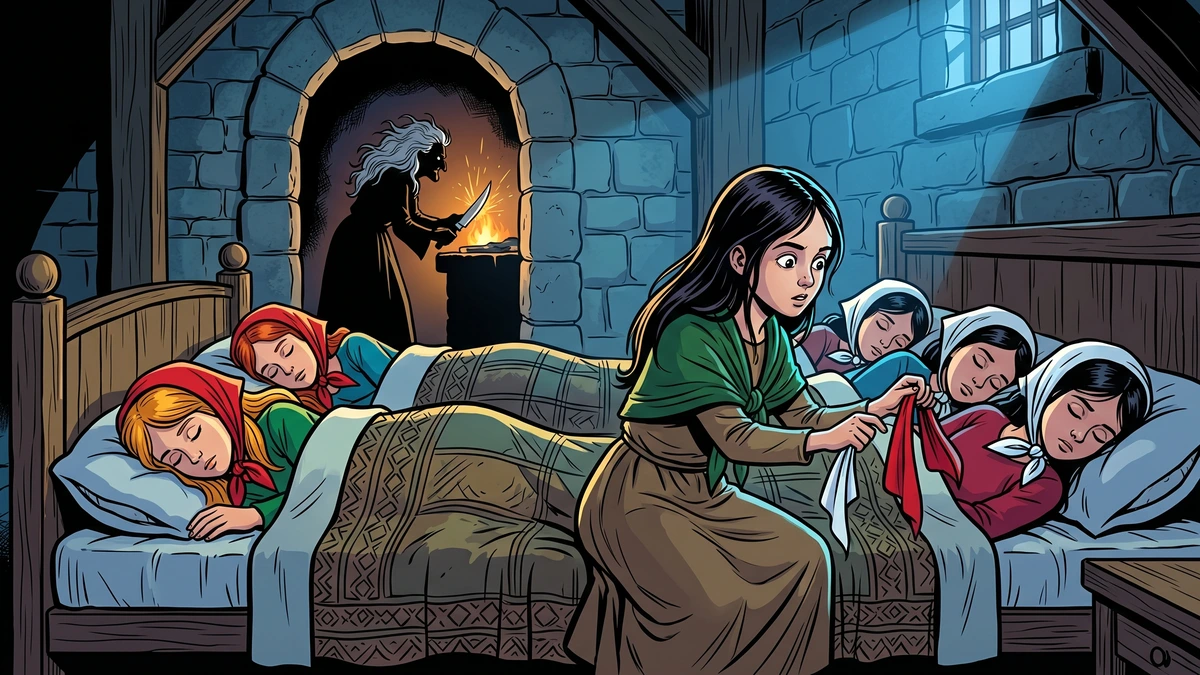
Smallhead, who had crept in unseen and hidden behind the meal-chest, heard every word. She watched the hag tie three white kerchiefs around the heads of the visiting sisters and three red kerchiefs around the heads of her own daughters, so that in the dark she could tell whom to strike. When the household lay down to sleep — the six girls in one long bed, the hag in another room sharpening a long knife on the hearthstone — Smallhead crept out of her hiding place. With trembling fingers she untied the white kerchiefs and tied them on the hag’s daughters, and tied the red kerchiefs on her own sleeping sisters. Then she lay down between the two beds and waited.
3. The Flight Across the Three Rivers
At the deep middle of the night the hag came in, feeling for red kerchiefs in the dark, and with three swift strokes did the dreadful work she had planned — not knowing she had killed her own children. Smallhead seized her two sisters, slapped them awake, hushed their cries, and dragged them out of the house through the back door before the hag could light a candle. Across the kitchen garden they ran, across the cabbage-patch, into the woods, and away to the king’s road.
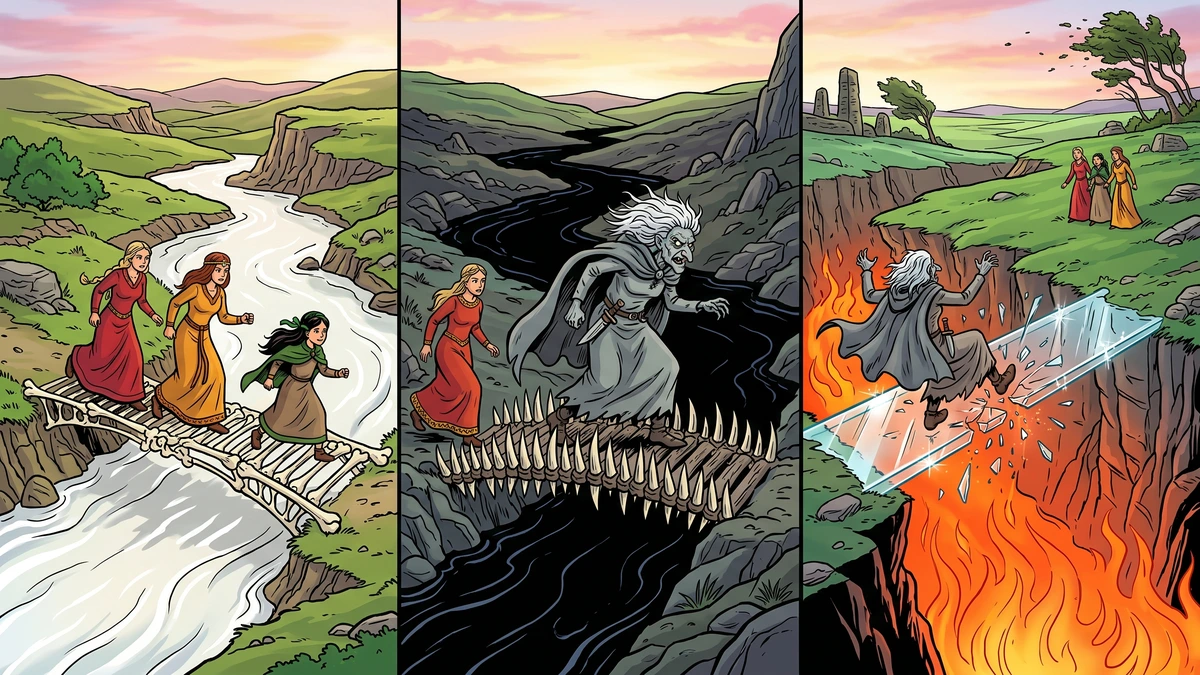
The hag, when she discovered her loss at dawn, gave a shriek that bent the tops of the rowans and set off in pursuit. The three sisters, panting, came to the First River, a river of milk. Smallhead tore a hair from her head and threw it in, and the hair became a bridge of bone, and they crossed; and when the hag tried to follow, the bridge crumbled beneath her. They came to the Second River, a river of black water. Smallhead threw in a comb, and it became a bridge of teeth; the hag struggled across this one, but slowly. They came to the Third River, a river of fire. Smallhead threw in a small flask of holy water she had taken from the hag’s own shelf, and a bridge of glass rose up; they crossed safely, and when the hag set foot on the glass it shattered beneath her and the river of fire received her, and that was the end of the Hag of the Ridge.
4. The King’s House and the Three Tasks
Beyond the third river stood the castle of a king who had three sons. The king had heard of the famous treasures of the Hag of the Ridge — a sword that could cut iron like cheese, a cloak that turned its wearer invisible, and a horse that flew on the wind — and he longed to possess them. When the three sisters appeared at his gate, footsore and brave, the king’s eldest son fell in love with the eldest sister, and the second son with the middle sister; but the youngest king’s son, a kind and modest prince, looked only at Smallhead, and saw her clear thinking shining through her plain dress.
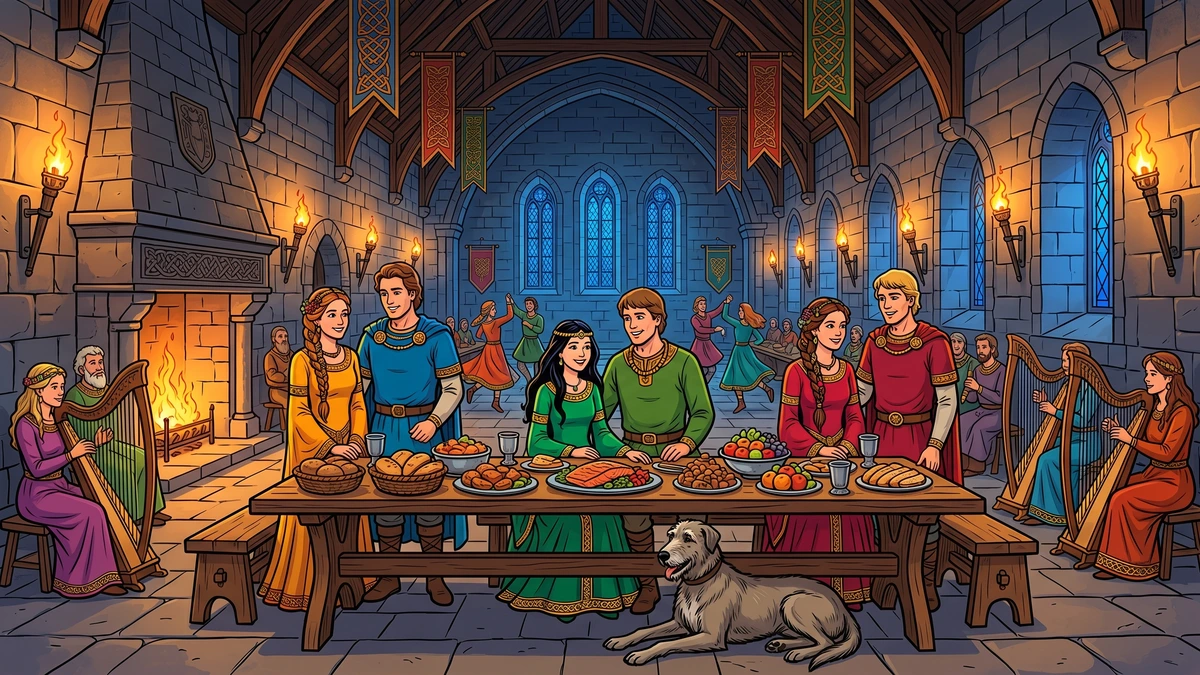
The king set three tasks. Whoever could fetch the hag’s three treasures from her ruined house should marry his choice. The two elder princes set off boldly and were lost in fog. It was Smallhead who slipped away each night, returned to the burnt cottage, used cunning to lift the sword from beneath a sleeping spell, the cloak from a thorn-tree, and the horse from a stable of fire — and brought all three back to the castle. The king, astonished, kept his word: a triple wedding was held in the chapel, harpers were summoned from Donegal, and Smallhead, who had been mocked all her life, sat in a green silk dress at the high table beside her chosen prince, while her sisters who had once scorned her now begged her forgiveness, which she gave gladly. And from that day she was called no longer Smallhead but the Wise Princess of the West.
The Moral
Is binne beagán cainte ná mórán amadántaíochta.
“A little speech is sweeter than a great deal of foolishness.” — old Connacht proverb
The moral of Smallhead and the King’s Sons is direct and humane: quiet wisdom outlives loud pride. Smallhead is small, plain, and laughed at; she has no charms, no looks, no inheritance. Yet because she watches and listens, because she keeps her counsel and acts when others panic, she alone survives the witch, saves the very sisters who tormented her, and earns a love freely chosen. The tale rebukes contempt for the modest. It reminds the listener that the surest mind in any company is often the one that says least — a teaching the Irish countryside has held in its bones for fifteen centuries, ever since the Brehon-law triads praised “the silent person who hears all”. The story also teaches a tougher lesson: cleverness is not the same as cruelty. Smallhead spares her sisters’ lives instead of leaving them to the hag, and in the end she forgives them, choosing kinship over revenge.
Historical and Cultural Context
The Celtic-Irish folk tradition that produced Smallhead reaches back at least to the early medieval period (sixth to ninth centuries CE), when storytellers called filí were ranked alongside priests in Gaelic society. After the collapse of the bardic schools in the seventeenth century the tales survived in cottage hearths, told in Irish and later in Hiberno-English by seanchaithe (“tradition-bearers”) through long winter evenings. By the late nineteenth century, when Curtin and Jacobs collected this story, the Gaeltacht regions still held a vibrant repertoire, and Smallhead was one of the wonder-tales most often requested by children at the fireside.
The hag in this story is not a generic European witch. She is a specifically Irish cailleach, a figure descended from a pre-Christian winter-goddess of the same name, whose memory is carved into mountains across Ireland and Scotland (the Cailleach Bhéara of the Beara peninsula in Cork, the Hag’s Head on the Cliffs of Moher). In folktale, the cailleach represents the dangerous wild — bog, storm, hunger — but she is also outwitted, never simply killed by force; she falls only to a wit sharper than her own. The river-crossings in the tale (milk, black water, fire) reflect the old Irish triadic landscape: rivers were boundaries between the living and the otherworld, and to cross three of them was, symbolically, to be reborn.
Reflection and Discussion
Read aloud, the story carries a quiet question for every listener: who in your own life has been called “Smallhead” by people who never bothered to look? The tale invites children to consider the worth of those they overlook in their own classroom or family. It also raises the harder, more grown-up question of what to do with cruel kin once they are in your power. Smallhead does not abandon her sisters to the hag, even though they would have left her to die; she chooses kinship, and the story ends in a triple wedding rather than a triple revenge. In a world that increasingly rewards the fastest and the loudest, Smallhead’s victory is a useful counter-fable: she watches, she remembers, she acts only when it counts, and she forgives.
Adults reading the tale will recognise its kinship with the cluster of “youngest” stories — Cinderella, Tom Thumb, Hop-o’-My-Thumb, Molly Whuppie, Maol a Chliobain — and will see how the Irish version sharpens the moral with that very particular Celtic seriousness about words: it is the small, quiet head, not the loud one, that wins. There is also a touch of dark Irish humour in the tale: the hag, for all her terror, is undone by her own gluttony for “new shoes of skin,” and the audience around the hearth always laughed at the moment the kerchiefs were swapped.
Why This Story Has Lasted
It has lasted because it is fair. The smallest, quietest girl wins because she works for her victory; the proud sisters survive only because Smallhead is generous; the hag dies because she preyed on travellers. The world of the tale, harsh as it is, settles its accounts. It has lasted because every household in every century has someone who is mocked, and everyone has at some point been the mocker; and the story gives both sides a way back to the same hearth. And it has lasted because of language: the rivers of milk, black water, and fire; the white and red kerchiefs; the triple repetition; the Gaelic music in the names — these are oral devices honed over many centuries by tellers who knew how to hold a child’s attention through three turfs of fire on a dark Donegal night.
Today, more than 130 years after Curtin wrote it down, Smallhead and the King’s Sons is taught in Irish schools as part of the heritage curriculum, recited at storytelling festivals from Cape Clear to the Aran Islands, and quietly told at bedside by parents who first heard it themselves from grandparents. It is, in every sense that matters, still alive — still doing the work all good folk tales do, which is to teach a small person to trust their own quiet head.
Frequently Asked Questions
Who collected and first published the tale of Smallhead and the King’s Sons?
The American folklorist Jeremiah Curtin (1835–1906) collected the tale in Donegal Irish during fieldwork in the west of Ireland between 1887 and 1893, and published it in his volume Hero-Tales of Ireland (Little, Brown & Co., Boston, 1894). The English folklorist Joseph Jacobs re-edited the same text the same year as Tale XIII of More Celtic Fairy Tales (David Nutt, London, 1894), which became the most widely read version for English-speaking children.
What is the ATU folktale classification of Smallhead and the King’s Sons?
The tale is classified in the Aarne–Thompson–Uther index under ATU 327B (The Brothers and the Ogre) combined with ATU 328 (The Boy Steals the Giant’s Treasure), and incorporates motifs from ATU 313 (The Magic Flight). Stith Thompson grouped it with the Scottish-Gaelic Maol a Chliobain (Campbell, 1860) and the Lowland Scots Molly Whuppie (Chambers, 1842) as the leading north-western European examples of the female-trickster pattern.
Why is the heroine called Smallhead, and what does the name mean in Irish?
The nickname is a translation of the Irish term ceann beag, literally ‘small head,’ a phrase used in the Gaelic countryside as mock-affection for a child whom older relatives wrongly believe to be slow or simple. Folklorists working with the Irish Folklore Commission (Coimisiún Béaloideasa Éireann) in the 1930s recorded the older saying behind the nickname: ‘the smallest head holds the deepest sense.’ The name is therefore an irony at the expense of the proud sisters who use it to mock her.
Who is the Hag of the Ridge in the story, and what does she represent in Celtic tradition?
The hag is a cailleach — not a generic European witch but a specifically Irish figure descended from a pre-Christian winter-goddess of the same name, whose memory survives in place-names such as the Cailleach Bhéara of the Beara peninsula and the Hag’s Head on the Cliffs of Moher. In folktale she embodies the dangerous wild (bog, storm, hunger), and she is always defeated by wits rather than force, expressing the Celtic belief that intelligence is the proper answer to the chaos of the wilderness.
What is the moral of Smallhead and the King’s Sons?
The moral is that quiet wisdom outlives loud pride. Smallhead is mocked, plain, and the youngest, yet she alone listens carefully, plans ahead, and keeps her counsel; this enables her to outwit the hag, save her cruel sisters, and win a freely-chosen love. The tale also teaches that cleverness is not cruelty: Smallhead forgives her sisters and chooses kinship over revenge. The accompanying Connacht proverb — Is binne beagán cainte ná mórán amadántaíochta, ‘a little speech is sweeter than a great deal of foolishness’ — captures the lesson exactly.
You May Also Like
 Celtic Folk Tales
Ages 9-12
Celtic Folk Tales
Ages 9-12
A Legend Of Knockmany
A Legend Of Knockmany: What Irish man, woman, or child has not heard of our renowned Hibernian Hercules, the great and glorious Fin M’Coul? Not one, from Cape
 Celtic Folk Tales
Ages 9-12
Celtic Folk Tales
Ages 9-12
Dream of Owen O’Mulready
Dream of Owen O'Mulready: here was a man long ago living near Ballaghadereen named Owen O’Mulready, who was a workman for the gentleman of the place, and was a
 Celtic Folk Tales
Ages 9-12
Celtic Folk Tales
Ages 9-12
Princess Finola And The Dwarf
Princess Finola And The Dwarf: A long, long time ago there lived in a little hut in the midst of a bare, brown, lonely moor an old woman and a young girl.