Powel, Prince of Dyfed
Powel, Prince of Dyfed: owel, Prince of Dyfed, was lord of the seven Cantrevs of Dyfed; and once upon a time Powel was at Narberth, his chief palace, where a


Powel, Prince of Dyfed is the English-language title under which Joseph Jacobs, working in the late 1880s and 1890s from earlier translators, brought one of the foundational stories of medieval Welsh literature to a wider readership. The Welsh original is Pwyll Pendefig Dyfed — “Pwyll, Prince of Dyfed” — and it is the First Branch of the four interlinked tales that make up the body of medieval Welsh prose narrative known since the nineteenth century as the Mabinogion. The Anglicised spelling “Powel” is a phonetic approximation that flourished in Victorian collections; the modern Welsh standard is Pwyll (pronounced roughly POO-eelh, with a voiceless lateral fricative). The same prince, the same Otherworld king, the same magical mound and the same lady on the white horse stand behind both names.
The Manuscript Tradition: White Book, Red Book, and Lady Charlotte Guest
The First Branch survives in two principal medieval manuscripts: the White Book of Rhydderch (Llyfr Gwyn Rhydderch, copied around 1350, now National Library of Wales Peniarth MS 4–5) and the Red Book of Hergest (Llyfr Coch Hergest, copied between roughly 1382 and 1410, now Oxford, Jesus College MS 111). Both manuscripts give substantially the same text, but with small variations of spelling and phrasing that have allowed editors to reconstruct an older common ancestor. The standard scholarly edition is R. L. Thomson’s Pwyll Pendeuic Dyuet (Dublin Institute for Advanced Studies, 1957), which prints the Middle Welsh from the White Book with full apparatus. The first complete English translation, and the volume that gave the world the very word Mabinogion, was the work of Lady Charlotte Guest, published in three parts between 1838 and 1849 from her home in Dowlais, Glamorganshire. Guest’s English is florid by modern standards, but it preserves the dignity of the Welsh original; nearly every later retelling — including the one that put the name “Powel” into circulation — flows from her work.
Behind both manuscripts lies a far older oral tradition. Internal references and metrical analysis suggest that the Four Branches were given their surviving prose shape sometime between roughly 1050 and 1170 by an unknown but evidently learned author working in north or south-west Wales. That author drew on much earlier Welsh and Irish material, including the Indo-European inheritance of Otherworld kings, helpful animals, and the pursuit of a fairy bride on a white horse. The tale that opens the cycle — the meeting of Pwyll and Arawn in the wood of Glyn Cuch — is, in narrative terms, our oldest surviving example of a written Welsh hero-story.
Aarne–Thompson–Uther and the Wider Indo-European Family
Folklorists place elements of the First Branch within several catalogue families. The opening exchange of shapes between Pwyll and Arawn is a clear example of ATU 470 (“Friends in Life and Death”) in its Otherworld variant; the pursuit of Rhiannon on her unhurriable white horse is associated with ATU 400 (“The Man on a Quest for His Lost Wife”) and motif F302 (“Fairy mistress”); the trick of the bottomless leather bag at the wedding feast — the famous “Badger in the Bag” — is motif K735 (“Capture in pitfall / by deception in a bag”). The whole opening journey to and from the Otherworld is in the family of motif F92 (“Pit entrance to the Otherworld”). None of these labels exhausts the tale; they are, as Stith Thompson put it, “fingerprints of a story rather than its skeleton.” But they let us see how the First Branch sits inside a much wider European inheritance — kin to the Irish echtra tales of the sídhe, to the Norse stories of Helgi and the disir, and (more distantly) to the Sanskrit episode of King Yayāti’s exchange of years.

Beat One: The Meeting in Glyn Cuch and the Year-Long Exchange of Shapes
The Branch opens with Pwyll riding out to hunt in the deep wooded valley of Glyn Cuch on the borders of his kingdom. He looses his hounds after a stag, but when he reaches the kill he finds a different pack — dogs of a colour no Welsh huntsman had ever seen, “shining bright white,” with ears “of a red so bright that the whiteness shone the brighter for it.” These are the hounds of Arawn, King of Annwn, the Welsh Otherworld; their appearance is one of the most famous descriptions in early medieval European literature, and it is the moment from which the modern reader knows, before Arawn himself appears, that the boundary between the worlds has thinned. Pwyll, in a fault that the storyteller does not minimise, drives Arawn’s hounds off the kill and sets his own dogs in their place — an act of casual discourtesy toward a being he has not yet recognised.
Arawn arrives, names the discourtesy, and offers a remarkable form of recompense: the two kings will exchange shapes for a full year and a day. Pwyll is to rule Annwn in Arawn’s likeness, and Arawn is to rule Dyfed in Pwyll’s. At the year’s end Pwyll, in Arawn’s shape, must meet and defeat Arawn’s rival, the otherworld king Hafgan, at a ford between their two kingdoms — and crucially, Pwyll must strike Hafgan only one blow, for a second blow would restore Hafgan to full strength. This is the first geis (taboo) of the cycle: a single stroke, no more. The whole moral architecture of the First Branch turns on whether its hero can keep that bond.
The year passes. Pwyll, ruling Annwn, sleeps every night beside Arawn’s wife but never touches her — a quiet, scrupulous fidelity that, when the year ends and the kings exchange back, becomes the foundation of the lifelong friendship between Pwyll and Arawn. From that day on, Pwyll is honoured in Welsh tradition with the title Pen Annwfn, “Head of the Otherworld,” a courtesy lineage that the Branches carry through to his son Pryderi.
Beat Two: Gorsedd Arberth and the Lady on the White Horse
Restored to his own shape, Pwyll holds court at his chief palace at Narberth in south-west Wales. After the first feast, he climbs to the top of a low mound above the palace called Gorsedd Arberth — the magical mound. It is one of the court who tells him the property of the place: “Whosoever sits upon it cannot go thence without either receiving wounds or blows, or else seeing a wonder.” Pwyll, who has just returned from a year in the Otherworld, is unafraid; he sits.
What he sees is the second great image of the First Branch: a lady riding alone on a tall pure-white horse of large size, dressed in a garment of shining gold, moving along the highway at a slow and steady pace. The image is one of the most studied in Celtic literature. The lady is Rhiannon (Welsh: Rhiannon, from older *Rīgantonā, “Great Queen”), the daughter of Hyfaidd Hen and one of the most numinous female figures in the whole Mabinogion. The historian of religion Proinsias Mac Cana argued (in The Mabinogi, 1977) that Rhiannon is a euhemerised survival of an older Brittonic horse-goddess directly cognate with the continental Gaulish goddess Epona; the iconography — solitary lady on a slow white horse, garbed in gold — is unmistakable. To the listener of 1100, hearing this passage for the first time, an entire pre-Christian theological background was being quietly walked along the road past Pwyll’s mound.
Pwyll sends a man on foot, then a man on horse, then his fastest horseman in pursuit. None can catch her. The faster they ride, the further she remains ahead — though her own horse plainly never quickens its pace. After three days of this Pwyll mounts himself, follows her, and at last calls out to her, “Lady, for the sake of the man thou lovest best, stay for me.” Rhiannon halts at once. “I will gladly,” she answers, “and it had been better for thy horse hadst thou asked it long since.” Her opening speech is one of the great moments of medieval Welsh prose: she has come of her own will to find Pwyll, her father has betrothed her against her wish to a man she loves not, and she has chosen Pwyll over every man in any kingdom — but only if he will pursue her honourably. The story has just modulated from a Celtic supernatural pursuit into a courtship of free consent, a hundred years before the troubadours of Provence will work out the same insight in song.

Beat Three: The Wedding Feast and the Badger in the Bag
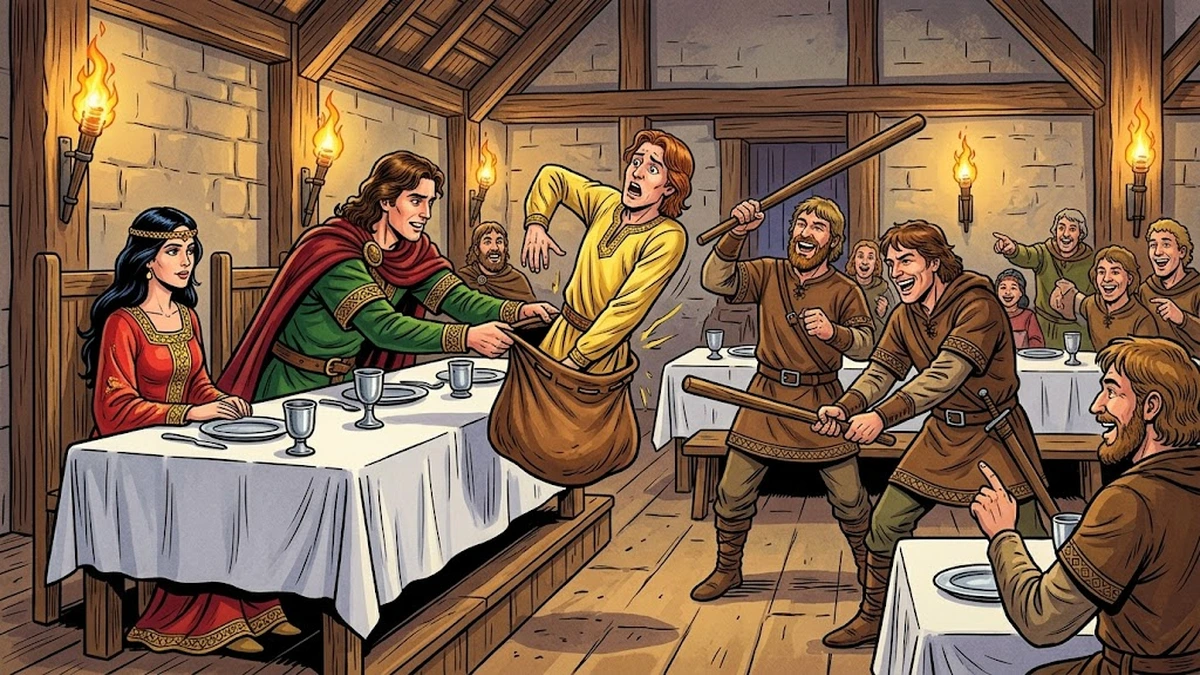
Rhiannon brings Pwyll to her father Hyfaidd Hen’s court, and a great feast is set for the betrothal. While they sit at the high table, a tall auburn-haired youth in fine yellow silk enters the hall, kneels before Pwyll, and asks a boon. Pwyll, in the unguarded courtesy of the wedding day, promises any boon in his power. The youth — who is Gwawl son of Clud, the very suitor Rhiannon has rejected — asks for Rhiannon herself, with the feast and all its provisions, that very night. Pwyll has been outwitted by his own promise. Rhiannon, with the cool intelligence that is her hallmark in the Branches, takes him aside and lays out a plan that is perhaps the most famous practical-magic episode in the whole Mabinogion: the trick of the leather bag.
A year later, on the night when Gwawl’s wedding feast is being held in turn, Pwyll comes to the hall in the dress of a poor traveller, carrying a small leather bag. He asks Gwawl, in turn, a boon: that the bag be filled with food. Gwawl, generous on his own wedding night, agrees. Servants pour in food but the bag will not fill — Rhiannon’s enchantment has made it bottomless. Gwawl himself at last steps forward and presses the food down with his foot, and as he does, Pwyll lifts the mouth of the bag over his head and pulls the cord tight. Pwyll’s warriors enter the hall, and each one in turn strikes the bag with a staff, asking, “What is in the bag?” — to which the answer is, “A badger.” This is the origin of the Welsh game Broch yng Nghod, “Badger in the Bag,” which medieval Welsh law later mentions as a recognised form of insult-redress. Gwawl, beaten and humiliated, releases all claim to Rhiannon and to vengeance, and is set free. Pwyll and Rhiannon are married that night.
Beat Four: The Loss and Return of Pryderi
Three years pass without a child, and the men of Dyfed begin to murmur. In the fourth year a son is born — but on the night of the birth, while six attendants sleep beside Rhiannon’s bed, the child vanishes. The terrified women smear puppy-blood on the sleeping mother’s face and accuse her of having destroyed her own son. Rhiannon, given the choice between disputing the charge and accepting a public penance, chooses the penance: for seven years she sits at the horse-block outside the gate of Narberth, telling every visitor the story of her supposed crime and offering to carry them on her back into the hall like a beast of burden. The image of the great horse-goddess reduced to the mounting-block of strangers is one of the most haunting in Welsh literature, and it is meant to be: the medieval author is consciously playing on the older theological resonance of Rhiannon’s name.
On a distant farm in Gwent Is Coed, meanwhile, the lord Teirnyon Twrf Liant has a fine mare that foals every May Eve, but the foal always vanishes that same night. He keeps watch armed, and in the small hours sees a great clawed limb come through the stable window to seize the new-born colt. He cuts off the limb at the elbow with one sword-stroke, and rushes outside — where, on the threshold, lies a swaddled human boy. He and his wife raise the boy as their own and call him Gwri Wallt Euryn (“Gwri of the Golden Hair”), but as he grows the resemblance to Pwyll becomes unmistakable, and at four years old Teirnyon takes him to the court at Narberth. Rhiannon’s penance ends in a single sentence: she names the day her son is restored to her her pryder — Welsh for “anxiety” or “deliverance from anxiety” — and from that day the boy is called Pryderi. Pwyll dies in old age soon after, and Pryderi succeeds him as the next Pen Annwfn; the Second Branch will follow him into adulthood.
“Arglwydd, gwell yth fuassei dy uarch hwy, hwy yth wnasut hynny.”
(Lord, it had been better for thy horse if thou hadst asked it long since.) — Rhiannon’s first words to Pwyll, from the White Book of Rhydderch (c. 1350), folio 1.
Moral: Honour Is Kept in the Small Things
The First Branch is, in moral terms, a sustained meditation on the keeping of bonds — the small, unwritten, unenforceable obligations on which every old society’s life depended. Pwyll’s first failing is small: he calls his hounds onto another huntsman’s stag. The remedy is enormous: a year of exile, a year of strict fidelity to a woman he can never touch, a single ordained blow at a ford between two otherworlds. He passes the test by attending to the small things — by not abusing the trust of a sleeping queen, by not striking the second blow Hafgan begs for — and the rest of his life flows from that quiet integrity. When, later, the wedding feast traps him by his own thoughtless promise, the moral pattern repeats itself: he had not weighed his words, and he must walk the long path of the Badger in the Bag back to safety.
The deeper moral, the one the medieval Welsh author signals through Rhiannon’s penance, is that the cost of public misjudgement is borne not chiefly by the misjudged but by the women in the household. Rhiannon does not protest her innocence; she sits at the horse-block. The narrator’s careful, unhurried account of those seven years is an early and powerful piece of medieval social criticism — a quiet rebuke to the easy male verdict that condemned her, and an answer made through patience rather than through speech. When at last the boy is restored, the Branch records no triumph and no recrimination. The morality of forgiveness is left to act on the listener directly.
Why This Tale Has Lasted
The First Branch survives in modern imagination because its central images are inexhaustible. The crowned king of the Otherworld at twilight in the wood; the lady on the slow white horse; the bottomless leather bag at the wedding feast; the swaddled boy on the threshold of a faraway farm — each of these has been borrowed by every generation of Welsh, English, and global storytellers since Lady Charlotte Guest first translated them in 1838. Alfred, Lord Tennyson drew on Mabinogion imagery for the Idylls of the King; Evangeline Walton made the Four Branches into four English-language novels (Prince of Annwn, 1974, retells precisely this Branch); Lloyd Alexander‘s Chronicles of Prydain (1964–68) takes the names Pwyll, Arawn and Pryderi from the First Branch directly; Susan Cooper‘s The Dark Is Rising sequence and Alan Garner‘s The Owl Service (1967) draw on the wider Mabinogion tradition. As far afield as Japan the slow white horse of the Welsh queen has been recognised — Hayao Miyazaki has cited the Mabinogion as one of the influences on the female mounts of Princess Mononoke.
The reason the imagery wears so well is that the Welsh storyteller refused, in every important place, to over-explain. Rhiannon is never described as a goddess, only as a lady on a horse who cannot be caught. Arawn is never given a theology, only a colour: white-bodied hounds with red ears. The bottomless bag is never magicked open with a spell on the page; the listener is told only that the bag is bottomless. Old stories last when their authors trust the image. The First Branch trusts its images entirely, and they have repaid that trust now for nearly a thousand years.
Pronunciation, Welsh Names, and a Note on the Spelling “Powel”
The Anglicised “Powel” is roughly the same as the modern Welsh Pwyll, but the consonant the Welsh write ll has no English equivalent — it is a voiceless lateral fricative, made by setting the tongue as for an L and forcing air past it. A reasonable English approximation is “Poo-eelh” or “Pwilth”; “Pow-ell” (as in the surname) is acceptable but not strictly accurate. Arawn is pronounced “AR-aw-n,” Annwn is “AN-oon” or “AN-noun,” and Rhiannon is “Rhee-AN-on” with the breathy rh articulated as a voiceless trill. Pryderi is “Prih-DAIR-ee,” Gwawl is “Goo-owl,” and Hafgan (Pwyll’s adversary at the ford) is “HAV-gan.” The Welsh place-names — Dyfed (DUH-ved), Narberth (NAR-berth), Glyn Cuch (Glin Kee-kh), Gorsedd Arberth (GOR-seth AR-berth) — survive on the modern map of south-west Wales, and a visitor to Pembrokeshire today can still walk to the mound that gave the magical hill its name.
For the Family Reader
This is a long story for a young listener, but the imagery does the heavy lifting. The four great images — the white-and-red hounds in the wood, the lady on the slow horse, the badger in the bag, and the boy on the threshold — are the four scenes a child will remember; the connective material between them can be summarised lightly until the listener is older. We recommend reading it in two sittings: the meeting with Arawn and the year of exchanged shapes on the first evening; the courtship of Rhiannon and the trick of the bag on the second; the loss and return of Pryderi as a third and quieter session. The blow at the ford and the seven-year penance are the two passages most likely to need a parent’s mediating voice — the first because its single-blow rule needs to be explained as a matter of magical fairness, the second because the patience of Rhiannon is the still centre of the whole Branch and is worth taking time over.
The Mabinogion: A Brief Map of the Four Branches
The First Branch is not a stand-alone tale but the opening movement of a four-part work. The Second Branch, Branwen daughter of Llŷr, follows the disastrous marriage of Branwen, sister of the giant king Bran, to the Irish king Matholwch, and ends with the wreck of two kingdoms and the survival of the Cauldron of Rebirth. The Third Branch, Manawydan son of Llŷr, returns to Dyfed under enchantment and makes Pryderi (now grown) and his mother Rhiannon central characters again; the wasting of the land and the recovery through patient farming and one sharp piece of legal cunning is among the most Christian-influenced of the Branches. The Fourth Branch, Math son of Mathonwy, opens in north Wales and tells the story of the magicians Gwydion and Gilfaethwy, the rape of Goewin, and the creation of the flower-woman Blodeuwedd — the longest, strangest, and most magical of the four. Across all four Branches, Pwyll’s quiet handling of his bonds in Glyn Cuch is the moral pattern that every later character is measured against. He is not the most powerful figure in the cycle, but he is its first fixed star.
Reading the Tale With Younger Listeners
A few practical notes for parents and teachers. The Welsh names should be read aloud rather than skipped: a child of seven who has heard Pwyll and Arawn and Rhiannon and Pryderi ten times will say them as easily as Henry or Robert, and the Welsh forms carry the emotional weight that the Anglicisations do not. The exchange-of-shapes opening is a useful talking-point: a child can be invited to imagine spending a year as another person and being asked to behave well in their household. The pursuit of Rhiannon is a useful way to introduce the idea that some people cannot be hurried — a useful idea for a small child to meet, in the form of a story, before they meet it as a frustration. The badger-in-the-bag scene is broad and funny and asks no special handling. The seven-year penance is the only passage where a younger child may need a gentle gloss; we suggest reading it as a story of patience rather than of injustice, and letting the closing return of Pryderi do its own emotional work.
A Final Note on Authorship and Date
The author of the Four Branches is unknown. Internal evidence — the warmth of the Dyfed setting in the First and Third Branches, and the precision of the Gwynedd geography in the Fourth — has led most scholars to suggest a single author working for one of the Welsh princely courts in the period roughly 1060–1170. The eleventh-century literary scholar Andrew Breeze has argued (in The Origins of the Four Branches of the Mabinogi, 2009) for the unusual hypothesis that the author was a woman, perhaps a princess of the royal house of Gwynedd, on the grounds of the unmistakable sympathy with Rhiannon, Branwen and Aranrhod. The hypothesis is contested, but the moral imagination behind the Branches is one of the most distinctive and humane in the whole literature of medieval Europe. Whoever the author was, he or she gave us, in Pwyll, the first quiet hero of British prose — a man whose chief virtue is the keeping of small bonds, and whose chief reward is the slow happiness of a life shared with a woman who chose him freely.
You May Also Like
 Celtic Folk Tales
Ages 9-12
Celtic Folk Tales
Ages 9-12
The Battle Of The Birds
The Battle Of The Birds: I will tell you a story about the wren. There was once a farmer who was seeking a servant, and the wren met him and said: “What are
 Celtic Folk Tales
Ages 9-12
Celtic Folk Tales
Ages 9-12
Conal Yellowclaw
Conal Yellowclaw: Tales of West Highlands_, No. 105-8, “Conall Cra Bhuidhe.” I have softened the third episode, which is somewhat too ghastly in the original.
 Celtic Folk Tales
Ages 9-12
Celtic Folk Tales
Ages 9-12
Dream of Owen O’Mulready
Dream of Owen O'Mulready: here was a man long ago living near Ballaghadereen named Owen O’Mulready, who was a workman for the gentleman of the place, and was a