Andrew Coffey
Andrew Coffey: My grandfather, Andrew Coffey, was known to the whole barony as a quiet, decent man. And if the whole barony knew him, he knew the whole barony
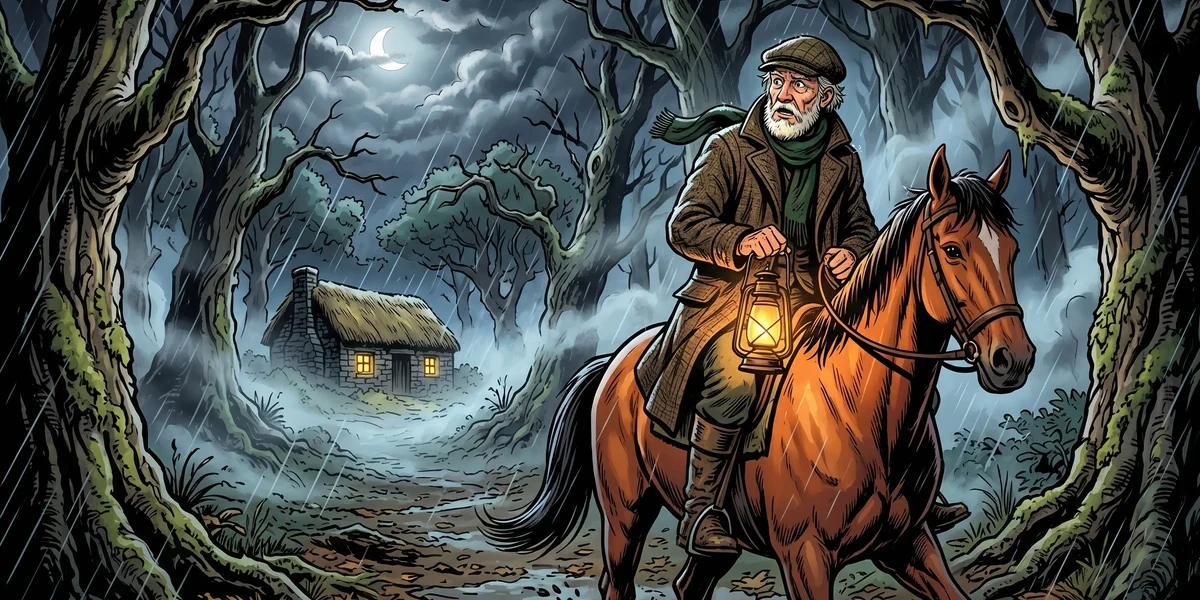

An old Irish farmer who knew every hill and bog of his barony loses his way one wild March night, stumbles into a cabin that ought not to be there, and finds the dripping corpse of a man he had once watched drown sitting by the fire — demanding a story upon pain of being put upon the roasting-spit. So begins one of the strangest and most enduring of Joseph Jacobs’s Celtic Fairy Tales, a story whose terror lives less in the ghost itself than in the simple, intolerable command: tell me a story, Andrew Coffey.
Origin and Canonical Attribution
“Andrew Coffey” appears as Tale XX in Joseph Jacobs’s Celtic Fairy Tales, published in London by David Nutt in 1892 with illustrations by John D. Batten. Jacobs, a Sephardic Jewish folklorist who served as president of the Folklore Society and as editor of the journal Folk-Lore, drew the tale from William Larminie’s West Irish Folk-Tales and Romances (London: Elliot Stock, 1893), where it had been collected from P. Minahan of Glencolumbkille (Glencolmcille), County Donegal — a parish on the wind-lashed western edge of Ireland whose Gaelic-speaking storytellers preserved an unbroken oral tradition stretching back to the medieval Fenian and Ulster cycles.
In motif-index terms the story belongs to a family of Irish ghost narratives organised around Stith Thompson motifs E235.6 “Return from the dead to demand a fulfilled promise”, E545.13 “Dead person speaks and demands speech in return”, and the broader Aarne–Thompson–Uther type cluster ATU 366 “The Man from the Gallows”, in which a corpse pursues the living to recover something owed. The narrative also shares deep structural DNA with ATU 326 “The Youth Who Wanted to Learn What Fear Is” — the genre of tale in which a man is set a series of supernatural ordeals by night and survives only by maintaining composure. What makes the Donegal version unique is the ferocious narrative inversion at its heart: the dead man does not want money, or burial, or vengeance. He wants a scéal — a story — and in the world of the Irish fireside no demand could be more sacred or more deadly.
The cultural logic is precise. In rural Gaelic Ireland the seanchaí (the keeper of tales) held an honoured place at every hearth, and the obligation to entertain a guest with story was as binding as the obligation to feed him. To sit at a fire and refuse to tell when asked was not merely rude — it was a breach of féile, the ancient code of hospitality that bound the living and, as Andrew Coffey discovers to his horror, the dead.

The Lost Demesne
Andrew Coffey was, by every account in the barony, a quiet, decent man. He knew the country the way a shepherd knows his sheep — every hill and dale, every bog and pasture, every field and covert, every twist of the river and every slab of standing stone. So when one wild March evening he found himself in a part of the demesne he could not recognise, the strangeness pressed upon him heavier than the rain.
The good chestnut horse he rode had served him fifteen years and had never once put a foot wrong. Now horse and man were forever stumbling against trees that ought not to have stood there, and slipping into bog-holes that by every right and reason did not belong on the path home. The March wind tore through the gnarled oaks with a noise like a keening, and the rain drove sideways. Glad indeed was Andrew when, through a clearing in the trees, he saw a single yellow light burning in a window, and drawing near found a low thatched cabin where, by every measure of his lifetime’s knowledge, no cabin had ever stood.
He tied his horse under a sloe-bush at the gable end and pushed open the door. The fire on the hearth was banked high with turf and crackling fiercely. A pot hung on the crane; a settle stood pulled up by the warmth. Of the householder there was no sign at all. “God save all here,” said Andrew, as a Christian man should on entering a house, and getting no answer he sat himself down by the fire to dry his sodden coat. He was glad of the heat. He was, for that one short minute, the warmest and safest man in the whole of County Donegal.
The Corpse on the Roasting-Jack
The fire spat. A drop of water fell from the rafter above. Andrew looked up — and saw, hanging from the great iron roasting-jack that swung above the hearth, the body of a man.

It was Patrick Rooney. Andrew knew him at once, for it had been Andrew himself who, the spring before, had stood on the river bank and watched, helpless, while Patrick Rooney slipped from a fording stone in the swollen Glen River and was swept away under the thorn-trees. The body had never been found. Yet here he hung, dripping wet from the river that had drowned him, his hair plastered to his cheek, his eyes shut, his mouth fallen open. The roasting-jack turned slowly above the flames, and the corpse turned with it.
Andrew was a quiet decent man, but no man living could have stayed seated under such a sight. He was halfway to his feet when the corpse opened one eye, then the other, and looked straight down at him out of a drowned face the colour of new cheese.
“Andrew Coffey,” said Patrick Rooney in a voice like wet stones grinding together, “tell me a story.”
Andrew Coffey could not have told a story to save his soul. His mouth was dry as oat-chaff and his tongue lay in it like a dead thing. He shook his head.
“Then if you will not tell me a story, Andrew Coffey,” said the corpse, beginning to climb down from the jack, “I will put you upon the spit.”
The Flight Through the Bog
Andrew did not wait for the second offer. He was through the door and onto his horse before the corpse’s bare feet had touched the hearthstone. He cut the tether with a single slash of his pocket-knife and put the chestnut to the gallop, and the rain came at him like a wall of needles and the wind howled through the trees as if the wind itself were laughing.
He rode until he could ride no further. The horse’s flanks heaved like a forge bellows; foam blew back in white flecks against Andrew’s coat. At last, in another clearing he had never seen before, he spied another light — and another low cabin, the very twin of the first — set among the same gnarled oaks. He pulled up trembling, but the cold and the wet and the desperate need of shelter were stronger than his fear. He tied the horse, he pushed the door, he went in.

The fire on the hearth was banked high with turf and crackling fiercely. A pot hung on the crane. A settle stood pulled up by the warmth. And from the great iron roasting-jack above the fire there hung, dripping wet from the river that had drowned him, the body of Patrick Rooney.
“Andrew Coffey,” said the corpse, opening one eye and then the other, “tell me a story.”
The Story That Could Not Be Told
Three times the same flight. Three times the same cabin. Three times the corpse upon the jack, dripping the cold black water of the Glen River onto the hearthstones, and three times the same patient, terrible request. Andrew Coffey, who knew every inch of the barony, ran himself and his horse to the edge of collapse, and at every turn found himself again at the door of the same cabin, with the same fire crackling, and the same drowned man swinging slowly above the flames, asking for the one thing Andrew could not give.
For a story would not come. Every tale he had ever heard at fair or wake, every adventure of Finn MacCool and the Fianna, every lay of Cuchulainn and the Brown Bull, every wonder-tale his own mother had crooned to him as a child by the same kind of turf fire — all of them stuck fast in his throat, dry as gorse-thorns. He could not make his mouth shape a single word.
The corpse climbed down from the jack. The corpse advanced on him across the cabin floor, leaving wet footprints in the rushes. The corpse said, very softly, “I will put you upon the spit, Andrew Coffey.”

Cockcrow and the Breaking of the Spell
What Andrew Coffey did then no man can rightly say, for Andrew himself never quite knew. He remembered the iron of the spit cold against his back. He remembered the firelight glinting in Patrick Rooney’s open, drowned eyes. He remembered praying — not the long prayers of the priest but the short, urgent prayer of a frightened child, the same words over and over: God between me and harm, God between me and harm, God between me and harm.
And then, through the wind and the rain and the crackling of the fire, came a sound that the dead cannot bear. It was the small, ordinary, blessed sound of a cock crowing for the dawn — Andrew’s own white cock, perhaps, calling from his own farmyard a half-mile away, or perhaps another bird, but a cock crowing all the same.
The fire went out as if a great wind had passed over it. The cabin was gone. The roasting-jack was gone. Patrick Rooney was gone. Andrew Coffey was lying in the wet grass at the gate of his own field, with his good chestnut horse standing patiently beside him and the first grey light of a March morning showing through the eastern oaks. A robin was singing in the hedge. The bog-cotton was beaded with rain.
He picked himself up. He led the horse home. He told no one for many a year what he had seen, and when at last he did tell — to his grandson, on a winter’s evening by a fire of good honest turf — he told the tale all the way through, slowly and carefully, from the lost demesne to the cock’s crow. And he never refused, to the end of his long life, when any man or woman or child asked him for a story, for he had learned, in one March night’s lesson that he would not have wished upon his enemy, the price of a silence kept too long.
The Moral
“Inis dom scéal, a Aindriú Choffey.”
— “Tell me a story, Andrew Coffey.”The dead man’s command, repeated three times in the original Donegal recitation, encodes a Gaelic ethical principle as old as the bardic schools: that storytelling is not entertainment but obligation. The hearth that does not give back its tales falls under judgment. The throat that hoards its stories chokes upon them.
The lesson the tale presses is double-edged. On its surface it is a ghost story, told to make children sit closer to the fire and adults check the latch twice before bed. Beneath the surface it is a parable about the social fabric of an oral culture: the duty owed by every member of a community to keep the storehouse of communal memory alive. Andrew Coffey survives not because he is brave or clever or pious, but because at the last extremity he learns to keep faith with the request he cannot, in the moment, fulfil. The cock crows. Dawn comes. He carries the lesson home.
Why the Tale Has Lasted
“Andrew Coffey” has survived for over a hundred and thirty years in print and for an unknown longer span in the oral memory of Donegal because it does what the very best folk-tales do: it converts a metaphysical anxiety into a vivid, repeatable, unforgettable image. The drowned man on the roasting-jack is one of the great compressed nightmares of European folklore — equal in concentrated horror to Grimm’s iron stove or to the Russian Baba Yaga’s chicken-legged hut — and it endures because it speaks to a fear that does not date. We all carry within us things we have failed to say. We all carry stories untold to people we will never see again. The drowned man at the fire is the unfinished business of every life, asking, with terrible patience, to be heard.
Modern Irish writers from W. B. Yeats to Eilís Dillon to Kate Thompson have drawn on the tale’s atmosphere; folklorist Henry Glassie collected closely related variants in Ballymenone, County Fermanagh, in the 1970s, demonstrating that the corpse-by-the-fire motif was still alive in living oral tradition more than eighty years after Larminie’s collection. The tale’s structural architecture — the threefold flight, the inescapable return to the same cabin, the breaking of the spell at cockcrow — has been adapted into stage drama, into the BBC Radio 4 ghost-story tradition, and into the syllabi of folklore courses on three continents.
Read it once and you remember the dripping water. Read it twice and you remember the silence. Read it a third time and you understand, as Andrew Coffey understood, that the cure for the silence is the same as the cause of it: open your mouth, and tell.
Notes for Readers and Folklorists
The hospitality contract. The medieval Brehon laws of Ireland imposed an explicit obligation on the householder to feed and entertain any traveller who came to the door — and a parallel obligation on the guest to recompense that hospitality with conversation, news, and most prized of all, story. By the late nineteenth century the legal force of these féile obligations had long faded, but the moral force lived on in every cabin in Donegal. Andrew Coffey’s failure to deliver a story is not merely a personal embarrassment; in the moral universe of the tale it is a tear in the social cloth, and the dead Patrick Rooney is the agent dispatched to mend it.
The number three. Three is the structural backbone of Irish wonder tales, inherited from the medieval saga tradition through the early modern seanchas. Andrew flees three times. The corpse climbs down three times. The same words are spoken three times. This is not laziness on the storyteller’s part — it is a mnemonic and ritual signature, marking the tale as belonging to the inherited canon rather than to private invention. To break the threefold pattern would be, in performance terms, to shatter the spell. P. Minahan, the Glencolumbkille storyteller from whom Larminie took the tale down, would have learned the threefold structure as a fixed feature of the form long before he learned the particular incidents of this particular story.
Cockcrow as exorcism. The motif of supernatural beings vanishing at the crow of the dawn cock is one of the most ancient and widespread in European tradition, attested in Norse Þrymskviða, in the medieval Cantares de Mio Cid, in countless Slavic vampire tales, in Hamlet’s father’s ghost (“It started, like a guilty thing, upon a fearful summons”), and in Donegal as in everywhere else where the Christian and pre-Christian layers of folk belief intertwine. The cock’s call marks the moment when night-creatures must return to whatever country lies beyond the firelight. In “Andrew Coffey” it functions both as practical deliverance and as theological reassurance: the natural order, however terrifyingly suspended for a night, will resume.
The drowned man and the river. Drowning was one of the most ordinary and most feared deaths in nineteenth-century rural Ireland — the Glen River and its sisters claimed lives every spring during the snowmelt floods. Folk belief held that a drowned soul could not rest until the body was recovered and waked properly, and the figure of the unburied drowned man returning to demand acknowledgment from the living recurs throughout the Irish ghost-story corpus. Patrick Rooney’s body has not been found; his demand for a story is, in one folklore-anthropological reading, a displaced demand for the wake he never received.
Cast of Characters
Andrew Coffey — an elderly farmer of unspecified parish in the western Donegal barony, “known to the whole barony as a quiet, decent man.” Owner of a chestnut horse and presumably a small holding. The story is told of him as if he were a real local man, in the Irish manner of attaching wonder-tales to identifiable persons. Whether a historical Andrew Coffey lay behind the figure is unrecoverable; folklorists generally treat such names in Larminie’s collection as either real informants or as community memory of nineteenth-century neighbours.
Patrick Rooney — the drowned man, lost a year before the night of the tale in the Glen River, body never recovered. In the cabin he appears wet from the river, hung from the iron roasting-jack, his eyes shut until the moment he speaks. He speaks in a voice “like wet stones grinding together” and demands story upon pain of impalement.
The chestnut horse — Andrew’s faithful mount of fifteen years, whose own bewilderment in the lost demesne signals to Andrew (and to the audience) that what is happening is genuinely supernatural and not merely a trick of his own tired senses. The horse survives the night and is found, in the dawn, standing patiently by Andrew at his own gate.
Suggested Further Reading
Joseph Jacobs, Celtic Fairy Tales, illustrated by John D. Batten (London: David Nutt, 1892), Tale XX “Andrew Coffey,” with editorial notes pp. 234–235. William Larminie, West Irish Folk-Tales and Romances (London: Elliot Stock, 1893). Henry Glassie, Passing the Time in Ballymenone: Culture and History of an Ulster Community (Philadelphia: University of Pennsylvania Press, 1982), for the corpse-by-the-fire motif in twentieth-century Fermanagh tradition. Lady Augusta Gregory, Visions and Beliefs in the West of Ireland (London: G. P. Putnam’s Sons, 1920), for parallel revenant narratives. Patricia Lysaght, The Banshee: The Irish Supernatural Death-Messenger (Dublin: Glendale Press, 1986), for the broader Irish death-omen tradition. Stith Thompson, Motif-Index of Folk-Literature, six volumes (Bloomington: Indiana University Press, 1955–58), motifs E235.6, E545.13, F302.6.2.
You May Also Like
 Celtic Folk Tales
Ages 9-12
Celtic Folk Tales
Ages 9-12
The Huntsman’S Son
The Huntsman’S Son: A long, long time ago there lived in a little hut on the borders of a great forest a huntsman and his wife and son. From his earliest
 Celtic Folk Tales
Ages 9-12
Celtic Folk Tales
Ages 9-12
Jack And His Comrades
Jack And His Comrades: Once there was a poor widow, as often there has been, and she had one son. A very scarce summer came, and they didn’t know how they’d
 Celtic Folk Tales
Ages 9-12
Celtic Folk Tales
Ages 9-12
A Legend Of Knockmany
A Legend Of Knockmany: What Irish man, woman, or child has not heard of our renowned Hibernian Hercules, the great and glorious Fin M’Coul? Not one, from Cape