Paddy O’Kelly and the Weasel
Paddy O'Kelly and the Weasel: long time ago there was once a man of the name of Paddy O’Kelly, living near Tuam, in the county Galway. He rose up one morning
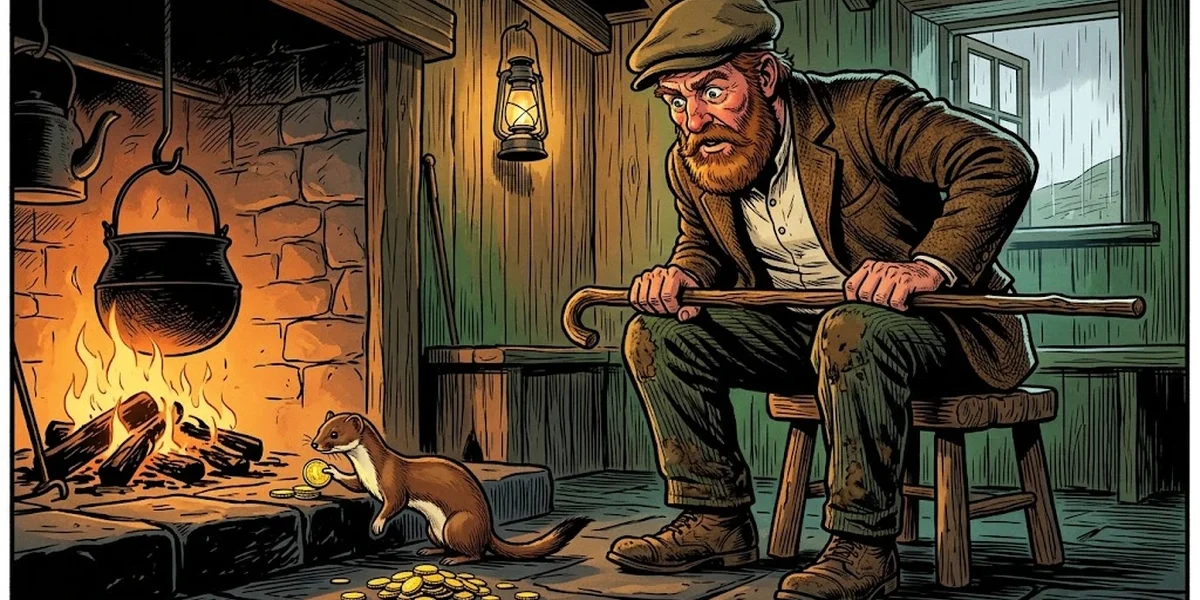

In the green country near Tuam, in the County Galway, where the limestone fields run down to the bog and the distant blue of the Connemara hills lifts the eye on a clear morning, there once lived a poor farmer named Paddy O’Kelly. This is one of the best-loved tales of the Connacht oral tradition — a tale of weasels and witches, of a piper called Donal who lives beneath a cellar flag, and of the hurling match played at Moytura between the fairy hosts of Connacht and Munster while the moon rose over Slieve Belgadaun. It is also one of the few surviving folk tales that names its own narrator: the storyteller closes by telling us he had it from his grandmother, an Irish-speaking woman of Galway whose voice we still hear, faintly, behind every English word.
Origin & Canonical Attribution
The tale was collected by Douglas Hyde (Dubhghlas de hÍde, 1860–1949), the Irish-language scholar, poet, and first President of Ireland (1938–1945), from a native speaker in County Galway. Hyde first published it in Irish in Leabhar Sgeulaíghteachta (Dublin, 1889), a watershed volume in the Irish-language revival, and then in his own English translation in Beside the Fire: A Collection of Irish Gaelic Folk Stories (London: David Nutt, 1890). Joseph Jacobs (1854–1916) reprinted the Hyde translation as Tale XX of Celtic Fairy Tales (London: David Nutt, 1892), with appended scholarly notes. The Irish title in Hyde’s manuscript reads Pádraig Ó Cheallaigh agus an Easóg (“Paddy O’Kelly and the Weasel”).
In the international tale-type system of Hans-Jörg Uther, the story sits at the meeting point of ATU 503 (“The Gifts of the Little People”) and the distinctively Celtic legend-cycle of the cailleach — the shape-shifting hag whose long life is bound up in penance and gold. The fairy hurling sequence, in which a mortal champion is borrowed by the sidhe to tip the balance of a supernatural game, belongs to a wider Gaelic motif that Alfred Nutt documented in his notes to the Waifs and Strays of Celtic Tradition (London, 1889). Comparative parallels are gathered by Reidar Th. Christiansen in The Migratory Legends (FF Communications 175, Helsinki, 1958), and by Patricia Lysaght in The Banshee: The Irish Supernatural Death-Messenger (Dublin, 1986). The placename etymologies in the tale — Pull-na-gullam at Cong, Cnoc Matha (the seat of King Finvara), and Doon-na-shee — align with topographical lore in P. W. Joyce, Irish Names of Places (Dublin, 1875).
The Tale Retold
I. The Shower, the House, and the Weasel’s Hoard
One night before dawn, Paddy O’Kelly rose with a lump of bread in his pocket and a halter slung over his shoulder, meaning to walk the road to the fair of Cauher-na-Mart and there sell a sturk of an ass that had grown too thin for ploughing. The moon rode high and bright, so he mistook the small hours for first light, and he had not gone three miles before the sky darkened with a sudden Connacht shower and the rain came down upon him in cold sheets. Five hundred yards in from the road, behind a screen of ash and rowan, stood a great house with the door standing open, and Paddy stepped inside to wait the weather out.
A turf fire burned low on the hearth of a long, panelled room. Paddy sat upon a stool by the wall, the warmth came creeping up his shins, and he was nearly asleep when he saw a long brown weasel come gliding across the boards with something yellow gripped in her teeth. She dropped it on the hearthstone — the dull clink told him it was a guinea coin — and slipped away. Back she came, and again, and again, building a small bright cairn of gold upon the stone. When at last the weasel had been gone a long while, Paddy rose softly, swept the whole hoard into his deep pockets, and walked out into the wet dawn.

II. The Pursuit on the Road and the Beasts in the Byre
He had not gone half a mile before the weasel came after him, screeching like a bag-pipes, twisting herself in the air, leaping for his throat. Paddy laid about her with his oak stick until two men came up on the road behind him, one with a sharp-tongued terrier; the dog drove the weasel into a hole in the wall, and Paddy went on to Cauher-na-Mart. There, instead of the shilling he had hoped for from the ass, he bought himself a fine grey horse with the weasel’s gold and turned his face for home.
But as he passed the wall again the weasel sprang from her hole and fastened upon the horse’s throat. The horse bolted in terror, plunged into a black drain full of bog-water, and was nearly drowned before travellers from Galway came running and beat the creature off. Paddy got the horse home and turned him loose in the byre. Next morning he opened the door to feed him and the weasel came out past his foot, her muzzle red. Inside, the horse, two milch cows, and two calves all lay dead upon the straw. Paddy whistled up his own dog, set him at the weasel, and followed her across two fields to a low turf hovel by a lakeshore, where she vanished within.
III. The Cailleach’s Bargain and the Pot of Gold
Inside the hut sat an old woman, white-haired and bent, who told Paddy she was sick with the plague and bade him be gone. The dog crept past her warning and sprang at her throat, and she cried out: “Paddy Kelly, take off your dog, and I’ll make you a rich man!” Paddy called the dog off, and the old woman — her name was Mary Kerwan — confessed all. She was a cailleach, a witch under penance for a great crime committed in her youth; for five hundred years she had gathered guineas across the hills and hollows of the world in the form of a weasel, and now she was within a month of release if Paddy would pay twenty pounds for one hundred and sixty masses to be said for her soul. He must dig beneath a whitethorn bush at the corner of a certain field, lift the flag, and let a great black dog leap out without flinching, for the dog was her son. With the rest of the gold he must buy the great house where he had first seen her, which the gentry would let him have cheap because the country said it was haunted; her son the piper would dwell in its cellar and be a good friend to him as long as he kept her secret. In a month she would be dead, and Paddy must put a coal under the hovel and burn it down upon her bones.

IV. The Cellar, the Piper, and the Hurling Match at Moytura
All fell out as the cailleach foretold. Paddy dug, the black dog leapt out and away over the wall, and Paddy carried the pot of guineas home in his shirt. He bought the great house from the gentleman, brought his wife and children up to it, and that night went down by candle to the cellar. There upon a barrel sat a small green-coated man with his legs spread wide, who hailed him as a friend and gave him a gold goblet, telling him to draw wine from the barrel beneath. They drank, and Paddy danced, and the little man — whose name was Donal — played the uilleann pipes from a niche beneath the hearth-flag.
One night Donal told Paddy he must come away with him to play music for the good people at Doon-na-shee, the fairy fort. He carried Paddy from his sleeping wife’s side on a broomstick, and they came down at Cnoc Matha, the green hill that is the palace of Finvara, arch-king of the fairies of Connacht, and his queen Una (Nuala). Finvara declared that the Connacht host must hurl that night against the fairy host of Munster on the plain of Moytura, beneath Slieve Belgadaun, or their fame would be lost forever. Now the sidhe can win such matches only if a living mortal plays for each side — and so Paddy O’Kelly took up a hurley for Connacht while a Clare man called the Yellow Stongirya, brought from Ennis, stood for Munster. The pipers played; the puck was tossed; and when the Munster host saw their fame slipping they turned themselves to flying beetles and ate the green country bare as far as Cong, where a black flock of doves rose out of a hole in the ground and swallowed every beetle down. That hole has been called Pull-na-gullam, the Dove’s Hole, ever since. King Finvara gave Paddy a purse of gold and Donal carried him home before dawn. A month later the cailleach died, Paddy burned her hovel as he had been bidden, and Donal pressed a second purse into his hand, saying: “You will not see me again. But have a loving remembrance of the weasel; she was the beginning and prime cause of your riches.”

“Bhí cuimhne ghrámhar agat ar an easóg, óir ba í tús agus prímh-chionnsiocair do shaibhris í.”
— closing words of the piper Donal in Hyde’s manuscript Irish (Leabhar Sgeulaíghteachta, 1889): “Have a loving remembrance of the weasel, for she was the beginning and prime cause of your riches.”
Moral
The story’s moral is the moral of every Celtic tale that opens with a stolen hoard and closes with a blessing: even crooked beginnings can be redeemed if the debt is named, the bargain is kept, and the dead are remembered with the proper rites. Paddy is no spotless hero. He pockets a witch’s gold without thinking twice and spends it on a horse before the sun is up. But when he is brought face to face with the cailleach he behaves with the grave courtesy that the Connacht tradition admires above all other virtues: he hears her out, he names her crime back to her without scorn, he commissions her masses, he keeps her secret, and he burns her hut as she has asked. In return the sidhe — who in Irish tradition are not capricious tricksters but a stern, exact people — render him their friendship and their wealth. The deepest teaching of the tale is that luck in Connacht-Irish is never random; it is the dividend paid out on debts honestly settled with the unseen world.
Why It Has Lasted
This tale has lasted in living memory along the western seaboard of Ireland for at least two centuries because it does, in miniature, what every great Celtic story does: it weaves the everyday and the otherworldly into one cloth. The fair of Cauher-na-Mart, the price of a sturk of an ass, the byre with its calves, the oak stick — these are the props of an actual nineteenth-century farming life. Yet the same farmer drinks wine with a fairy piper, rides a broomstick to a hill that opens at a spoken word, and watches doves swallow a host of enchanted beetles whole. The boundary between the two worlds is not a wall but a door, and Paddy O’Kelly is the kind of man who, finding the door open and a fire on the hearth, will simply walk in. That is the Connacht imagination at its most generous, and it is why the tale was still being told to Douglas Hyde’s grandmother, why she told it to the man who told it to Hyde, and why we keep telling it now.
Historical & Cultural Context
The tale stands at the centre of the great Irish-language revival of the late nineteenth century. Douglas Hyde would in 1893 found Conradh na Gaeilge (the Gaelic League) and become the most influential single figure in the rescue of spoken Irish; Beside the Fire was the laboratory in which he learned that the language could not be saved without its stories. He insisted on collecting from Irish-only speakers, on printing the original Irish opposite his English, and on naming his narrators — an approach that would later guide Lady Augusta Gregory and W. B. Yeats at Coole and Sligo. The geography of the tale is exact: Tuam is in north Galway; Cauher-na-Mart (Cathair na Mart, “the stone fort of the beeves”) is the modern town of Westport in Mayo; Cnoc Matha is Knockmaa Hill near Tuam, traditionally the palace of Finvara, last fairy king of Connacht; Moytura (Magh Tuireadh, “the plain of pillars”) is the site of the legendary battle of the Tuatha Dé Danann; Slieve Belgadaun overlooks Lough Arrow in Sligo; and Cong, where the doves rose, sits between Lough Corrib and Lough Mask. To Hyde’s grandmother and her listeners these were not made-up names but landmarks visible from any door in the parish — the supernatural was always local.
Reflection & Discussion
- Paddy steals the cailleach’s gold without hesitation, and yet the tale ends with him blessed rather than punished. Why does the storyteller forgive him?
- The cailleach can only be released by paid masses, but the masses are paid out of her own gold. What does this tell us about how the Connacht imagination understood penance, debt, and the relationship between the living and the dead?
- The fairy hosts cannot win their hurling match without a living mortal on each side. What does this say about how Irish tradition imagined the dependence of the Otherworld upon ours?
- Compare Paddy’s bargain with the witch to similar bargains in the Brothers Grimm (e.g. KHM 12, “Rapunzel”). How do Celtic and German tales differ in the moral weight they place on a promise to the supernatural?
- Why does Donal warn Paddy that he must “not tell a living soul” about the cellar piper? What ancient idea about the visibility of the sidhe stands behind this rule?
Did You Know?
- Douglas Hyde (1860–1949), the collector of this tale, became the first President of Ireland in 1938 — he is the only folklorist in modern history to be elected head of state.
- The Irish word cailleach originally meant simply “old woman” or “veiled one,” but in Connacht oral tradition it almost always names a hag who can shape-shift into a hare, a weasel, or a heron.
- The fairy king Finvara (Fionnbharr) is still pointed out today on Knockmaa Hill outside Tuam, where a small white cairn marks what locals call “Finvara’s Cap.”
- Hurling, the “swiftest game on grass,” is more than 3,000 years old — the Táin Bó Cúailnge describes the boy Setánta playing it before he became Cú Chulainn — and matches between fairy hosts are a recurring motif in both Irish and Scottish folklore.
- The cave called Pull-na-gullam (the Dove’s Hole) at Cong is a real karst sinkhole on the Cong River; visitors can still see it today on the trail between Ashford Castle and Pigeon Hole Wood.
What This Tale Teaches Us Today
- That windfall money — lottery winnings, an unexpected inheritance, a gold rush of any kind — almost always comes with hidden obligations to people we have not yet met.
- That a promise made privately to someone in distress is owed even when no one else knows of it; the keeping of the promise is the whole of the matter.
- That courtesy to the old — even when they are difficult, even when they are angry, even when they have hurt us — is not weakness but the highest form of strength.
- That the dead deserve the rites we owe them, whatever our private feelings; this is the oldest moral in the world and the one this tale will not let us forget.
- That hospitality, in the Celtic understanding, is the quiet engine of fortune: walk in when the door is open, sit by the fire that is offered, and the wealth that finds you will be the wealth you can keep.
Why This Story Still Matters
Paddy O’Kelly and the Weasel is one of those small masterpieces of Connacht oral tradition in which the whole of an island culture is folded into a single morning’s walk. Hyde collected it at the very last moment when such a tale could still be heard from the lips of an Irish-speaking grandmother in Galway, and Joseph Jacobs carried it into the wider English-speaking world before the language that gave it birth was driven from its native fields. To read it now is to overhear a voice that almost did not survive: a voice that knew the smell of the byre and the weight of a guinea coin, that believed without doubt in the door of the green hill, and that taught its listeners — gently, indirectly, through the misadventures of a man who was just like them — that the smallest courtesies of this life buy a full purse in the next. We keep telling such stories not for nostalgia but because they are still useful: they are the moral grammar of an old people, and the grammar is still good.

Cultural Context and Continuing Influence
The tale has fed steadily into the work of later Irish writers. W. B. Yeats drew on Hyde’s collection for Fairy and Folk Tales of the Irish Peasantry (1888) and for the fairy passages of The Celtic Twilight (1893); Lady Gregory echoed its placenames in Visions and Beliefs in the West of Ireland (1920); Flann O’Brien, three generations later, would turn the cellar piper Donal into a comic ghost in The Third Policeman (1939, pub. 1967). In our own century the tale has been retold for children by Marie Heaney in Over Nine Waves (1994). Each retelling makes the same simple discovery the original storyteller made — that the supernatural in Ireland is not exotic but domestic, that the door of the green hill opens off the same lane that takes you to the fair, and that a man who keeps his bargains with the dead will lack for nothing as long as he lives.
You May Also Like
 Celtic Folk Tales
Ages 9-12
Celtic Folk Tales
Ages 9-12
Deirdre
Deirdre: _Celtic Magazine_, xiii. I have abridged somewhat, made the sons of Fergus all faithful instead of two traitors, and omitted an incident in the house
 Celtic Folk Tales
Ages 9-12
Celtic Folk Tales
Ages 9-12
A Legend Of Knockmany
A Legend Of Knockmany: What Irish man, woman, or child has not heard of our renowned Hibernian Hercules, the great and glorious Fin M’Coul? Not one, from Cape
 Celtic Folk Tales
Ages 9-12
Celtic Folk Tales
Ages 9-12
The Shepherd Of Myddvai
The Shepherd Of Myddvai: Up in the Black Mountains in Caermarthenshire lies the lake known as Lyn y Van Vach. To the margin of this lake the shepherd of