Munachar And Manachar
Munachar And Manachar: There once lived a Munachar and a Manachar, a long time ago, and it is a long time since it was, and if they were alive now they would
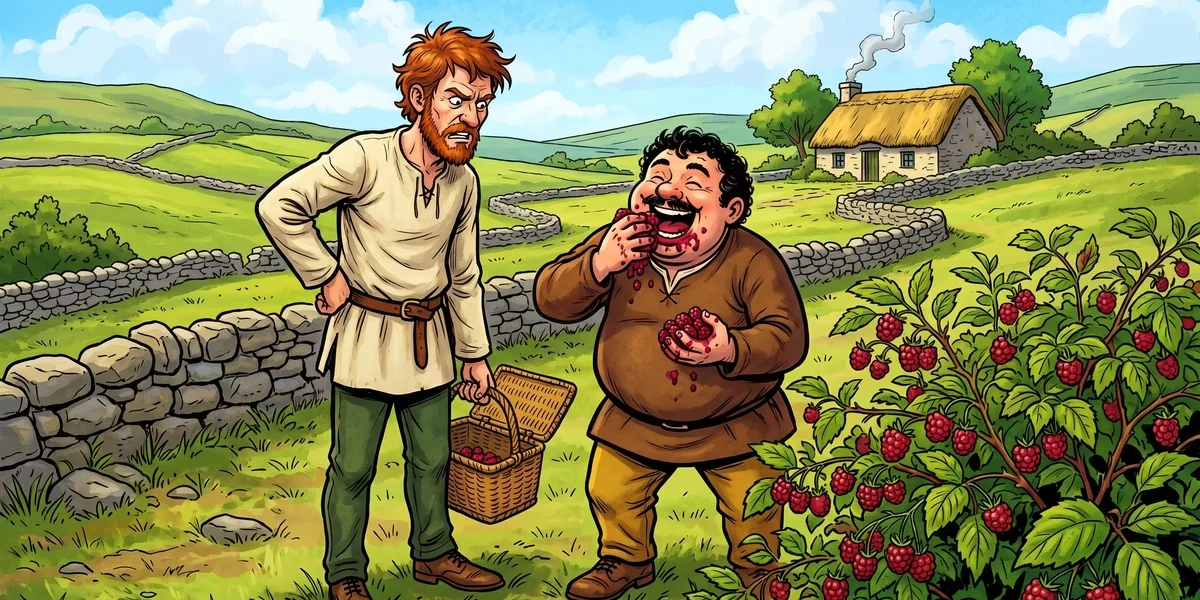
Munachar and Manachar is a celebrated Irish cumulative folk tale, gathered from the oral tradition of the Gaeltacht and set down in print by the folklorist Joseph Jacobs in Celtic Fairy Tales (David Nutt, London, 1892), with illustrations by John Dickson Batten. The tale belongs to the international tale-type catalogue as ATU 2030 / 2031, “The Old Woman and Her Pig” / “Stronger and Strongest” — chains of events, and is the Irish cousin of the English nursery favourite “This is the House that Jack Built” and the Russian “The Old Woman and the Pig”. Jacobs notes in his appendix that the story was “told to me by Mr Douglas Hyde from the Connacht Irish” and that it is one of the most perfect specimens of the cumulative or “endless” tale in Gaelic literature.
The collection in which the story first appeared in English — Jacobs\’s Celtic Fairy Tales — was published at the high tide of the late-Victorian fairy-tale revival, the same decade that gave the world Andrew Lang\’s coloured Fairy Books and the founding of the Folk-Lore Society. Jacobs (1854–1916), an Australian-born scholar trained in Cambridge and the British Museum reading-room, made his name precisely by insisting that the storytelling traditions of England, Wales, Scotland, and Ireland deserved the same loving editorial care that the Brothers Grimm had given Germany; Munachar and Manachar was one of the small Irish jewels he set into that crown.
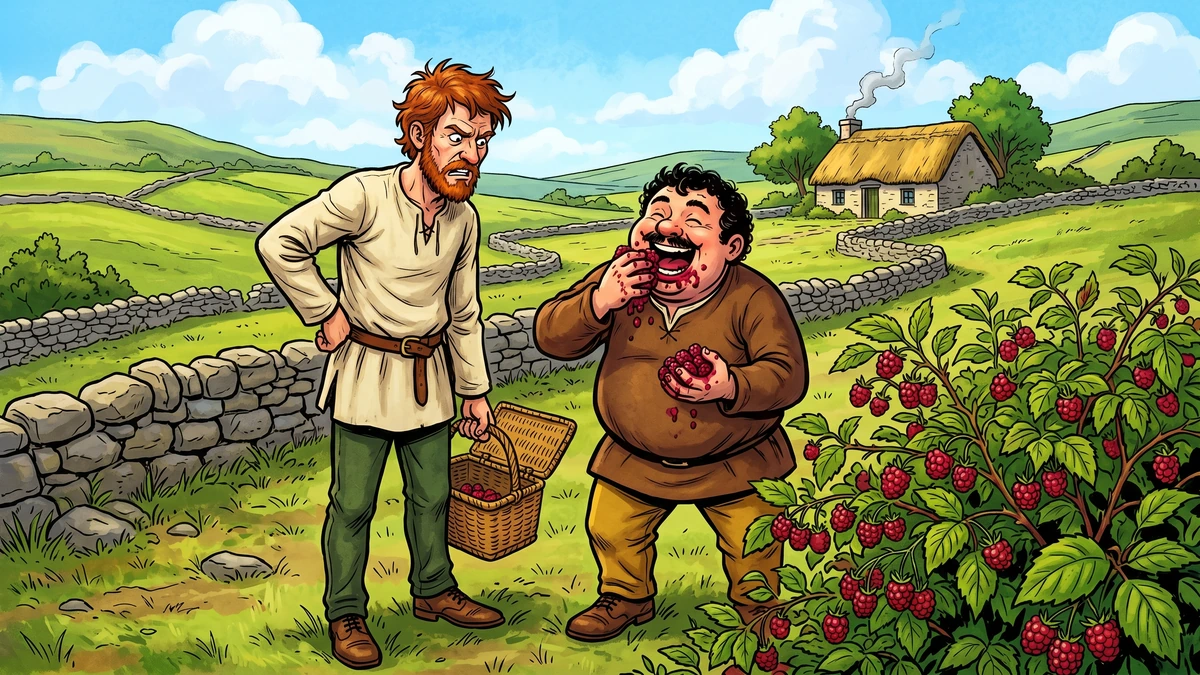
The two protagonists carry names that themselves rhyme like a children\’s chant. Munachar and Manachar are not historical figures but a pair of comic Everymen whose squabble over a handful of raspberries triggers a long, lilting chain of refusals — rod, axe, flagstone, water, deer, hound, butter, cat, milk, cow, hay, miller, cake, bread-baker — until at last the gad is woven and Munachar marches home triumphant only to discover that his quarrelsome companion has, of his own accord, eaten so much that he has burst. The tale runs on the rhythm of repetition, and it is meant to be spoken: every Irish granny who recited it at the hearth would slow at the same lines and let the children chime in.
Joseph Jacobs, Douglas Hyde, and the Connacht source
The fingerprints on this tale are unusually well preserved. Jacobs\’s note (Celtic Fairy Tales, p. 246) names his informant openly: it was Douglas Hyde (1860–1949), then a young Trinity College Dublin scholar of Irish, later first President of the Gaelic League (Conradh na Gaeilge) and, in 1938, the first President of Ireland. Hyde collected the tale in the West of Ireland, almost certainly in Roscommon or East Galway, where Connacht Irish was still the kitchen language. He printed an Irish-language version in his own bilingual collection Beside the Fire (David Nutt, 1890); Jacobs adapted it for an English-only audience two years later.
This collaborative provenance — a Gaelic-speaking native scholar working with a London-based folklorist — gave Munachar and Manachar an authority that other Victorian “Celtic” tales sometimes lacked. Hyde was no romantic outsider sweeping up legends from afar; he was an Irish-speaker collecting from his own neighbours, with a linguist\’s ear for cadence and rhythm. Jacobs, in turn, refused to “improve” the language for nursery use. The result is a printed text that retains, almost uniquely among English-language fairy-tale anthologies of the 1890s, the genuine breath-pause and idiomatic stutter of an oral Irish reciter at the hearth.
The cumulative chain: rod, axe, flag, water
The opening of the tale is one of those marvellous Irish openings that places us in a time outside time: “There once lived a Munachar and a Manachar, a long time ago, and it is a long time since it was, and if they were alive now they would not be alive then.” The two go out to pick raspberries together, but Manachar is a glutton — for every raspberry Munachar drops in the basket, Manachar plucks another straight to his mouth. Patience snaps. Munachar resolves to fetch a gad (an Irish word for a withe, a twisted rope of green wood) and hang the thief.
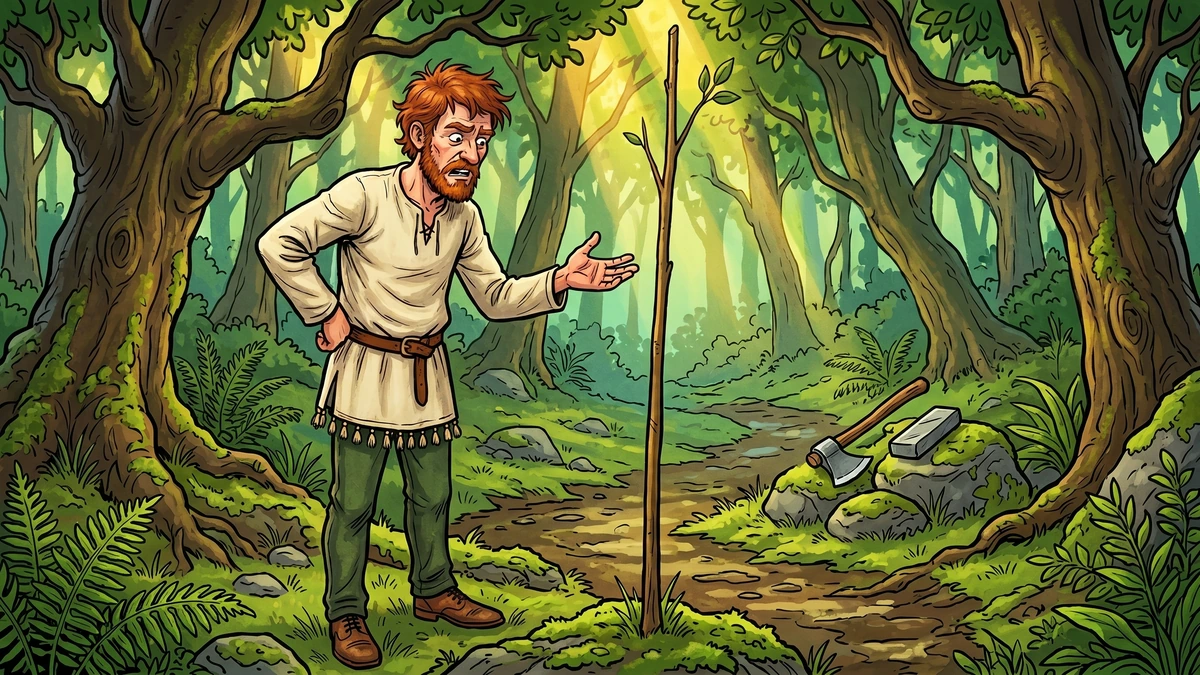
The rod, when asked, refuses: “You will not get me until you get an axe to cut me.” The axe in turn refuses: “You will not get me until you get a flag to edge me.” The flag (a flagstone for whetting) refuses: “You will not get me till you get water to wet me.” Each refusal is delivered in the same lilting cadence, and each demands the next link in an ever-lengthening chain. This is the architecture of the cumulative tale: every new request piles on top of all the old ones, and the listener is invited to chant along with the reciter from the second refusal onward.
What makes the Irish version distinctive among its many international cousins is that the demands are not merely silly — they are technically correct. To make a withe-rope you really do need a rod; to cut the rod you really do need an axe; to sharpen the axe you really do need a flagstone wetted with water. The tale is, on one level, a small pre-industrial manual of how rural craftsmen actually worked. The humour lies not in absurdity but in the patient, deadpan completeness with which Munachar marches through every step of the process.
The chain widens: deer, hound, butter, cat
By the time Munachar reaches the water, the chain reaches outward into the wild Irish countryside. The water sends him to a deer to swim through it; the deer demands a hound to chase her; the hound demands butter to anoint his feet; the butter demands a cat to lick it. Each creature is rooted in the rhythms of Connacht rural life — the milking, the threshing, the deerhunt, the cottage hearth — and Jacobs preserves the working idiom of the original Irish reciter without softening it for English ears. The tale becomes, almost without our noticing, a guided tour through every implement and animal of a nineteenth-century Gaelic farm.
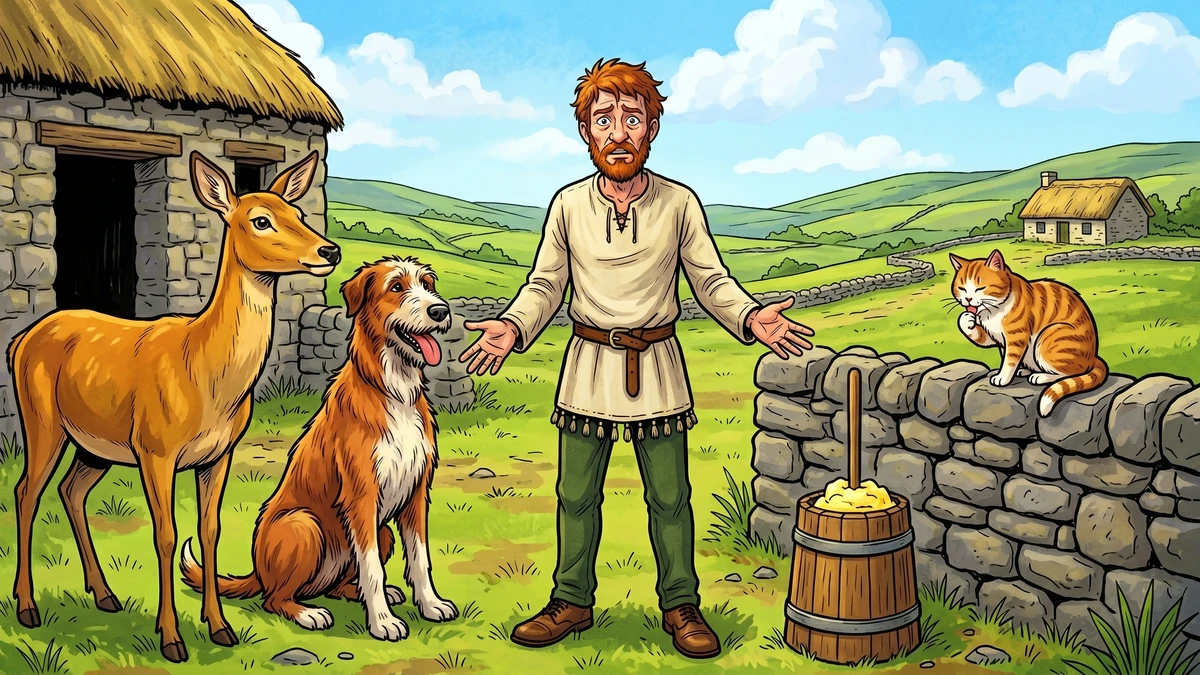
The cat, in turn, demands milk; the milk demands a cow; the cow demands hay; the hay demands a key; the key demands a miller; and the miller — most beautifully of all — demands the impossible: a sieve full of water. Munachar despairs, for water, of course, runs through a sieve as fast as you pour it in. He sits down on the bank of the river and begins to weep — and here the tale shows its second face, for the cumulative chain is broken not by force but by a small, inventive act of mercy.
The crow\’s counsel and the sieve of clay
A crow flies down (in some Connacht tellings it is a raven, in others a single small bird) and gives Munachar the secret known to every clever child: “Daub clay! Daub clay!” Munachar packs the holes of the sieve with red riverbank clay, dips the patched sieve in the stream, and at last carries water back to the miller. From the miller he gets the key; from the key the hay; from the hay the cow; from the cow the milk; from the milk the cat; from the cat the butter; from the butter the hound; from the hound the deer; from the deer the water; from the water the flag; from the flag the axe; from the axe the rod — and the rod, finally, is twisted into a gad.
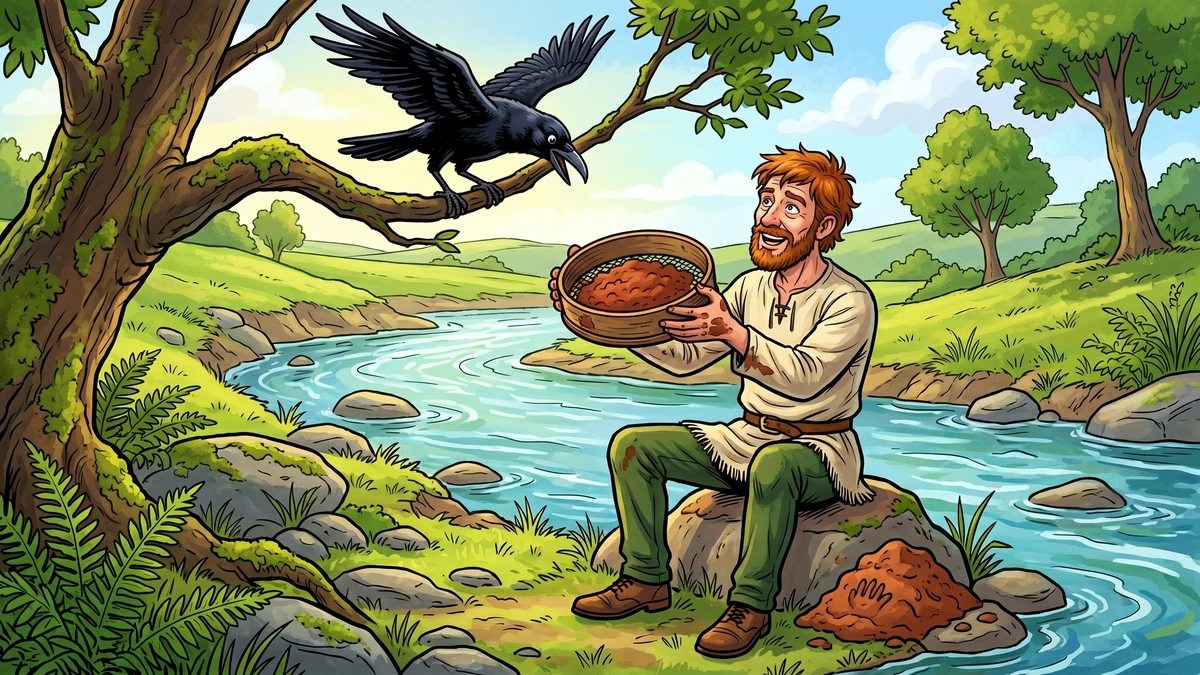
The reverse-cascade is the great pleasure of the tale in performance. A skilled reciter unwinds the entire chain backwards in one long, breathless sentence, and the listening children clap when the last link snaps into place. Jacobs preserves this breathless quality on the page, breaking only at the moments where Munachar acquires the next item, so that the reader\’s eye and ear together feel the gathering speed of triumph.
The crow, brief as its appearance is, is the secret heart of the tale. In Irish folklore the crow and the raven are old, watchful birds, sometimes connected with the goddess The Morrígan, sometimes simply with the wisdom of the byroad. Here the crow plays the role of the helpful donor in propp\’ian terms — the small, unexpected agent who breaks the deadlock with a piece of practical knowledge. The sieve patched with clay is one of the most quietly poetic images in the whole of Celtic fairy literature: the hero learns, in effect, that the impossible only requires you to seal what is broken and try again.
The empty victory: Manachar has burst
Munachar at last comes home, gad in hand, blood up, ready to hang the raspberry-thief — and finds Manachar lying flat on his back, having stuffed himself with so many raspberries (and, in some versions, so much porridge in his master\’s absence) that he has burst. The vengeance is unnecessary. Justice, the tale suggests with a wink, has already been served by Manachar\’s own greed. The gad, so painfully assembled, is never used.
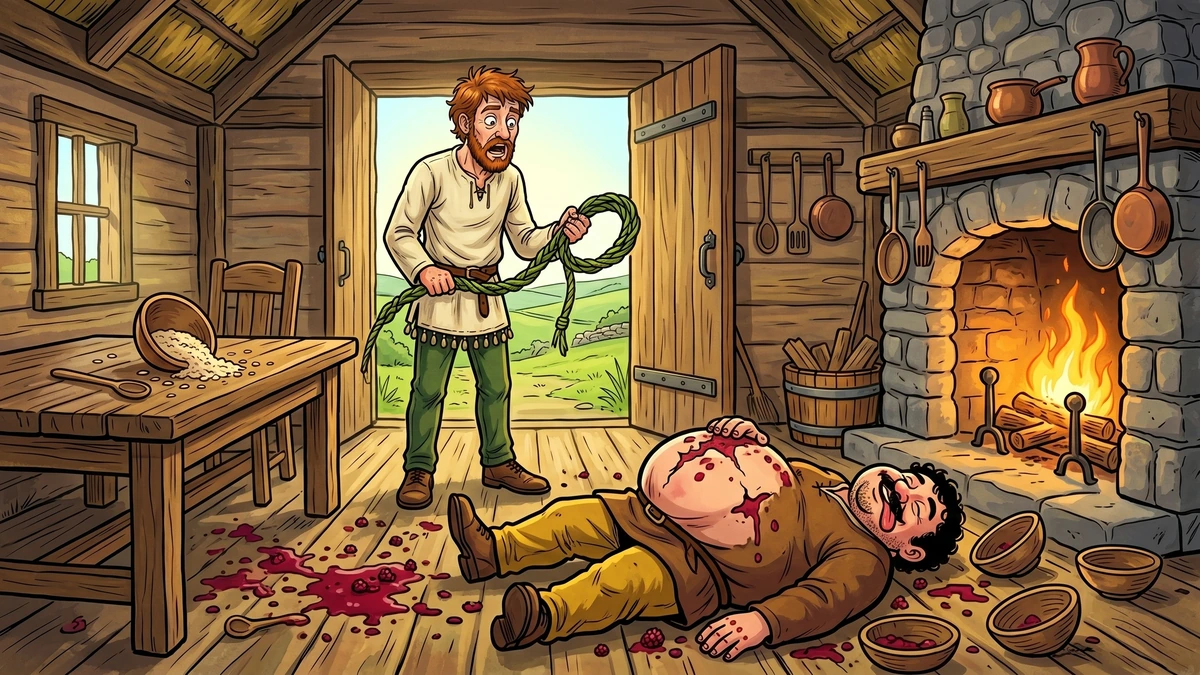
The ending is brilliantly Irish in its dry humour. There is no moralising peroration, no judge, no executioner — only the picture of an exhausted Munachar standing over a burst glutton with a useless rope of green wood in his hands. The whole long quest, the listener realises, was its own punishment. The thief did not need hanging; he needed only to be left alone with his appetite.
The moral: greed is its own gallows
“Sceith Manachar le linn dó bheith ag ithe” — “Manachar burst while he was eating.” (Connacht Irish, as recorded by Douglas Hyde, Beside the Fire, 1890.)
The Irish proverb that hangs over the tale is plain: greed needs no executioner. In ATU classification this is a tale of pointless labour — the entire cumulative chain is a great wheel of effort that turns to nothing, because the offence punishes itself. It is the same wisdom that the Greeks gave the figure of Tantalus, that the Hebrews gave the rich farmer of Luke 12, that the Sanskrit Panchatantra gave the jackal who chokes on his own bowstring. Manachar\’s burst belly is the West-of-Ireland version of a moral every storytelling tradition stumbled upon independently: the hand that takes too much is stilled by the very thing it grasped.
There is also a quieter, more peculiarly Irish moral underneath the obvious one: vengeance is wasted labour. Munachar\’s long chain of demands — rod, axe, flag, water, deer, hound, butter, cat, milk, cow, hay, miller, sieve — is a beautiful piece of work, technically perfect and rhythmically irresistible. But it is also, in the end, completely useless. The story shows us, with a half-smile, that even the best-built rope of vengeance often arrives too late. There are griefs that resolve themselves; there are thieves who eat themselves into oblivion; and there is wisdom in occasionally letting the world do its own scoring.
Why the tale has lasted
“Munachar and Manachar” has lasted because it is two stories at once, neatly stitched together. On the surface it is a memory game — the joyful Irish equivalent of “I packed my bag and in it I put…”, and many a Connacht child first learned the rhythm of formal language at its hearth. Underneath, however, it is a sly little parable about useless vengeance: the long chain of demands, the begged sieve, the patched clay, the running back home — all of it utterly wasted, because the thief has finished himself off without help. Jacobs\’s collection put the tale in front of an English-speaking audience for the first time in 1892, but its true home is still the kitchen and the schoolyard, where children chant the refusals together and laugh aloud at the burst at the end.
Jacobs himself wrote in his Notes (Celtic Fairy Tales, p. 246) that he “knew of no parallel to the burst” in any other European version of the cumulative tale. Most “Old Woman and Her Pig” cousins end with the chain completing and the pig hopping over the stile; only the Irish ending insists, with characteristic dark wit, that the whole quest was beside the point. That small, mocking flourish — the empty gad, the burst belly — is what has kept Munachar and Manachar alive on the page and on the tongue for more than a century.
The tale also lasted because it was a perfect teaching story for the bilingual classroom. When Hyde and the Gaelic League began the work of language revival in the 1890s and 1900s, cumulative tales like Munachar and Manachar were ideal pedagogical material: short, repetitive, structurally predictable, but lit up by humour and concrete vocabulary (rod, axe, flag, gad, sieve, miller, hay). A child who could chant the chain in Irish had absorbed a small but solid grammatical core; a child who could chant it in both English and Irish had laid the foundations of true bilingualism. The tale crossed from hearth into schoolroom into nursery rhyme almost without anyone planning it, and there it has remained.
Modern editors and storytellers have continued to find new uses for it. The American writer Riley K. Smith reworked the story as Manachar and Munachar: Two Celtic Tales (Doubleday, 1980); the Irish-American picture-book illustrator Sorche Nic Leodhas adapted it for read-aloud collections; and recordings of Connacht reciters chanting the chain in the original Irish are preserved in the National Folklore Collection at University College Dublin. The story remains a living thing — not a museum specimen but a piece of language that grandparents still use to make grandchildren laugh.
Frequently Asked Questions about Munachar and Manachar
Where does the story of Munachar and Manachar come from? The tale was collected from the oral Connacht Gaelic tradition by the Irish folklorist Douglas Hyde and first printed in English by Joseph Jacobs in Celtic Fairy Tales (London: David Nutt, 1892), the second volume of Jacobs\’s celebrated three-book series of British and Irish fairy collections, illustrated by John Dickson Batten. Hyde had previously printed an Irish-language version in his own collection Beside the Fire (1890); Jacobs reprints a Scots Gaelic cousin, “The Wife and Her Bush of Berries”, in his More Celtic Fairy Tales (1894).
What kind of tale is it in folklore classification? It is a cumulative or “chain” tale, classified by the international Aarne-Thompson-Uther index as ATU 2030 (and, in some readings, ATU 2031, “Stronger and Strongest”). Its closest English cousin is “The Old Woman and Her Pig”; its German cousin is found in the Grimms\’ Kinder- und Hausmärchen as KHM 80, “The Death of the Hen”. The defining feature of the type is a chain of conditional refusals that must be unwound in reverse order, often broken by a clever helper or a sudden moment of practical wisdom.
What does the word “gad” mean in the story? A gad (Irish: gad; Scots Gaelic: gad) is a length of green wood — usually willow, hazel, or birch — twisted while still flexible into a rough rope. Gads were used in the Irish countryside for tying bundles of straw, fastening gates, and (in the morbid fairy-tale sense) hanging trespassers. Munachar\’s entire quest is to assemble the materials needed to make this single twisted withe, a process that would have been instantly familiar to any nineteenth-century Connacht farmer.
Why does Manachar burst at the end of the tale? The tale\’s punchline is a piece of Irish dark humour: while Munachar is laboriously gathering the rod, axe, flag, water, deer, hound, butter, cat, milk, cow, hay, miller\’s cake, and sieve of clay needed to twist a gad, Manachar is at home gorging himself on raspberries (and in some versions, on the household\’s porridge). His own gluttony bursts him long before any rope of green wood can. The moral is that greed needs no executioner — and, more quietly, that vengeance is often wasted labour.
Who illustrated the tale and where can I read the original? John Dickson Batten (1860–1932), an English painter of fresco and tempera and a leading book-illustrator of the late Victorian fairy-tale revival, drew the original line-illustrations for Jacobs\’s Celtic Fairy Tales. The full 1892 first edition is in the public domain and freely available through the Internet Archive, Wikisource, and the Sacred-Texts archive; Jacobs\’s own scholarly notes on the tale appear on pages 245–246 of that edition, and the original Irish-language text appears in Hyde\’s Beside the Fire.
You May Also Like
 Celtic Folk Tales
Ages 9-12
Celtic Folk Tales
Ages 9-12
The Voyage of Bran
The Voyage of Bran: In the ancient days of Irish mythology, when the line between the mortal world and the realm of magic was gossamer-thin and easily crossed
 Celtic Folk Tales
Ages 9-12
Celtic Folk Tales
Ages 9-12
The Tale Of Ivan
The Tale Of Ivan: There were formerly a man and a woman living in the parish of Llanlavan, in the place which is called Hwrdh. And work became scarce, so the
![The House In The Lake.[2]](https://indianfolktales.com/wp-content/uploads/2026/05/p836_scene01-400x260.webp) Celtic Folk Tales
Ages 9-12
Celtic Folk Tales
Ages 9-12
The House In The Lake.[2]
The House In The Lake.[2]: A long, long time ago there lived in a little hut, in the midst of one of the inland lakes of Erin, an old fisherman and his son.