The Battle Of The Birds
The Battle Of The Birds: I will tell you a story about the wren. There was once a farmer who was seeking a servant, and the wren met him and said: “What are
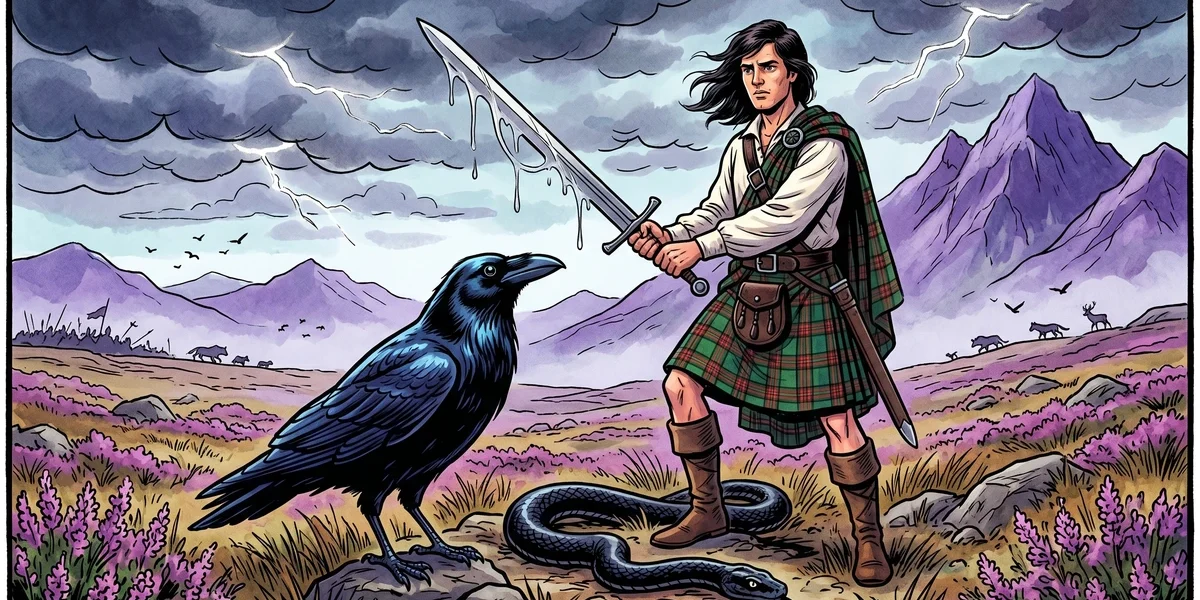
The Battle of the Birds is one of the great wonder-tales of the Scottish-Gaelic world — a sweeping romance of a king’s son, a black raven who is no raven at all, a giant of the western Bens, his clever youngest daughter, and a magic flight told in three thrown tokens that turn into a forest of thorns, a grey filly, and an inland sea. Beneath the marvellous machinery the tale poses, as Highland tales tend to, a deceptively simple question: which bird is the strongest in the world, and what is the price of finding out?
Origin and Canonical Attribution
This tale was collected in the spring of 1859 by John Francis Campbell of Islay (1822–1885), the most important nineteenth-century collector of Scottish-Gaelic folklore. Campbell’s transcriber and field assistant Hector Urquhart wrote it down in Gaelic on the 27th of April 1859 from the recitation of John Mackenzie, a fisherman of Inverary on the shore of Loch Fyne in Argyllshire, who told Urquhart he had learnt it as a boy from an old man in the same parish, who in turn had had it from a piper of the Macdonalds of Glencoe. Campbell published the tale in Gaelic and English on facing pages as Tale No. II of Popular Tales of the West Highlands, Orally Collected, Volume I (Edmonston & Douglas, Edinburgh, 1860, pp. 25–58). The Gaelic title is Cath nan Eòin, “The Battle of the Birds,” and Campbell printed the running text exactly as Mackenzie spoke it, including the breath-pauses and the formulaic opening “Bha siod ann roimhe,” “There was so before.”
In the Aarne–Thompson–Uther international tale-type index the story belongs to ATU 313 (The Magic Flight; The Girl as Helper in the Hero’s Flight), fused with introductory matter from ATU 222 (War of the Birds and the Quadrupeds) and a closing episode of the Forgotten Bride (ATU 313C). The folklorist Reidar Th. Christiansen, in The Migratory Legends (1958), and Stith Thompson, in The Folktale (1946), both single out Campbell’s Cath nan Eòin as one of the fullest and most archaic European witnesses to the type. A different and shorter reworking of the same tale was published thirty-two years later by the English folklorist Joseph Jacobs as Tale XV of Celtic Fairy Tales (David Nutt, London, 1892); Jacobs based his retelling on Campbell, smoothed the diction for child readers, and trimmed the more elaborate Gaelic flourishes. The Campbell version, however, remains the canonical source.
The narrative itself reaches back well behind 1859. The motif of a battle between birds and beasts to determine “which is the strongest” is recorded in Gaelic charm-lore as far back as the bardic compilations of the seventeenth century, and the magic-flight episode — in which fugitives throw three small objects behind them to raise three obstacles — is one of the most widely diffused folk-narrative patterns in Eurasia, with cognate forms reaching from Iceland to Mongolia. Campbell himself remarked, in his prefatory note to the tale, that it was “evidently very old, and very far travelled, and the gifts of the giant’s daughter are gifts of which traces are to be found in the oldest mythologies of the north.”
The Tale Retold
1. The Wren, the Mouse, and the Battle of the Birds
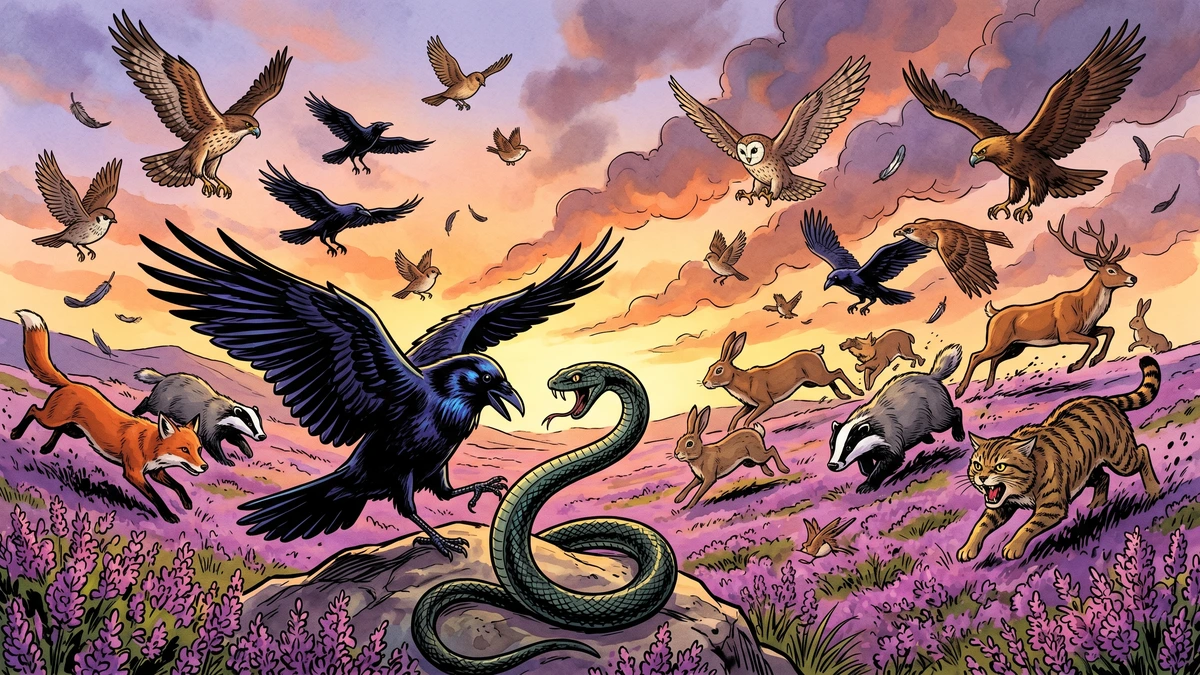
There was so before, a farmer in the West Highlands who needed a thresher for his barn, and one morning at the door he met a wren. “What are you seeking?” said the wren. “A servant,” said the farmer. “Will you take me?” “You? You poor little creature, what good would you do?” “Try me,” said the wren; and so the farmer hired him. The wren went to the threshing-floor and struck with his small flail; one grain hopped loose, and out from the hole came a mouse, who ate it. The wren struck again; two grains hopped, and the mouse ate them too. “I’ll trouble you not to do that again,” said the wren. The mouse tossed her tail and answered with the rudeness of small creatures, and so the matter could only be settled by an open contest of strength. The wren summoned all the birds of the air, the mouse summoned all the four-footed beasts of the field, and on a set day they met for a pitched battle on a bare moor in Argyll — the famous Battle of the Birds.
The fight was long and dreadful, and as the sun was setting the son of the king of Tethertown, a young prince in his first beard, came riding home across the moor and saw two creatures still locked in single combat after the rest had finished — a great black raven and a coiled snake. The snake was just rising for the death-stroke when the prince drew his sword and struck off its head with one blow. The black raven shook out its feathers, fixed a bright black eye on the prince, and said in a man’s voice, “For what you have done for me this day I will give you a sight of my house. Get up between my two wings.” The prince mounted, the raven rose, and they flew west over seven glens, seven hills, and seven straits of salt water, until they came down at the door of a fine grey house among lonely birch-woods, where the raven was welcomed as a master.
2. The Black Raven and the Bundle in the Wood
For three nights the king’s son lodged in the grey house, and each morning the raven took him on a further flight — over the third loch, over the third forest, over the third sea — and brought him at last to a high pass between two hills. There the raven set him down and said, “Now look at me well, for after this you shall not see me as a bird again.” The black feathers fell away as a cloak slips from a shoulder, and there stood a tall, fair young man with a sword at his side. “I am not a raven by nature,” he said, “but a king’s son under enchantment, and your blow upon the snake has freed me. Take this bundle — do not open it before you reach the place where you most desire to dwell.”
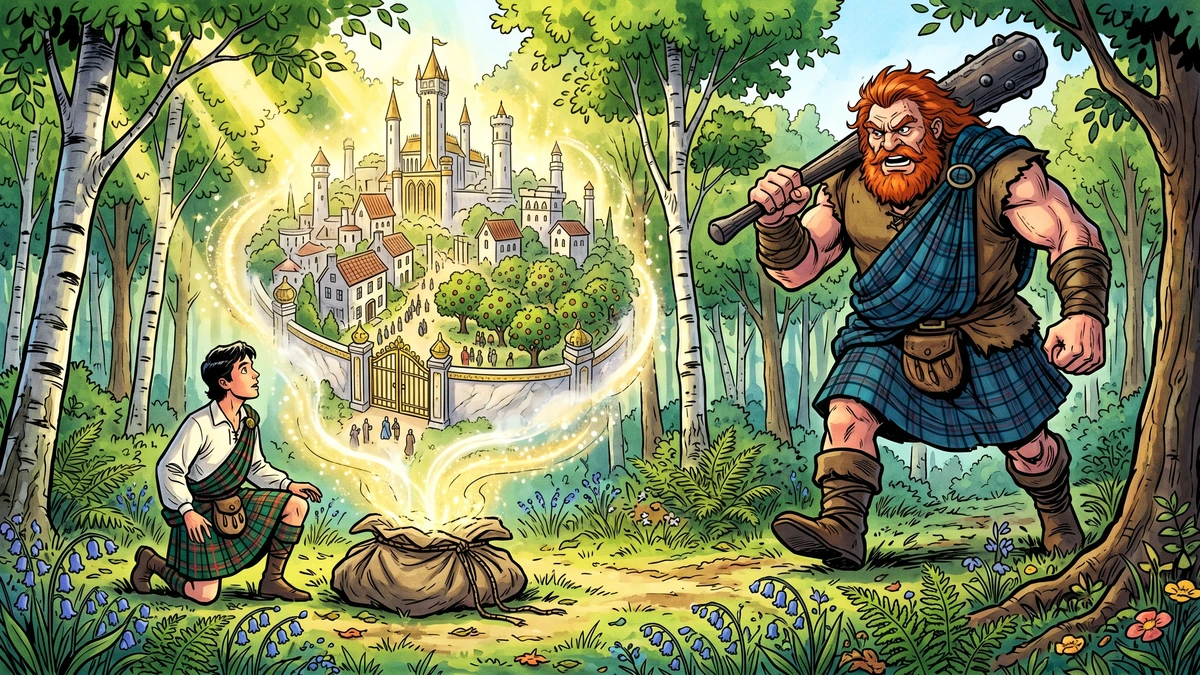
The young king’s son thanked him, slung the bundle on his back, and walked many days alone through forest and mountain. At last, weary, he sat in a green clearing, and the bundle pressed so heavily on his curiosity that he untied it. There rose out of the cloth, in an instant, a great walled city full of houses and orchards and a palace with twenty towers, but he had unbound it in the wrong place — in the dominion of a fearful giant, and the giant came striding out of the wood with the noise of an avalanche, demanding to know what right the prince had to spread a city in his lands.
3. The Giant’s Three Tasks and the Daughter’s Help
The giant, with the cunning of his kind, said he would let the prince keep the city — but only on condition that the prince serve him for a year and a day and accomplish three small labours. The first labour was to clean the giant’s byre, which had not been swept for seven years and lay seven feet deep in the muck of seven hundred cattle. The second was to thatch the byre, when cleaned, with the down of every bird of the air. The third was to fetch from the top of a fir tree at the lochside, five hundred feet high and smooth as glass, a magpie’s nest with the five eggs unbroken. Each labour, the giant promised, would be the prince’s death; for so it had been with the king’s sons before him, whose bones lay white at the foot of the fir.
But the giant had three daughters, and the youngest, who had hair the colour of corn and eyes the colour of a Highland loch, came at evening to the prince and said: “Eat your supper and sleep; the labour is mine.” On the first night she whispered a word that no daughter of giants should know, and the muck rose out of the byre like smoke and went away over the sea. On the second night she called out and every bird of the air flew over the byre and dropped one feather, until the roof was thatched in down of every colour. On the third morning she stood beneath the fir, and at her bidding the prince climbed her like a ladder — for she had taken off her fingers and toes and set them as steps in the bark — and brought down the magpie’s nest unbroken; but in his hurry he forgot her little finger at the top, and that finger was lost to her for ever. From that small loss came a great rescue: at the wedding-feast a few days later, when the giant called the prince to choose his bride from the three daughters, all three put out their hands draped in white linen, and the prince chose the hand off which the little finger was missing — and so chose her, and so was saved.
4. The Magic Flight and the Forgetting Kiss
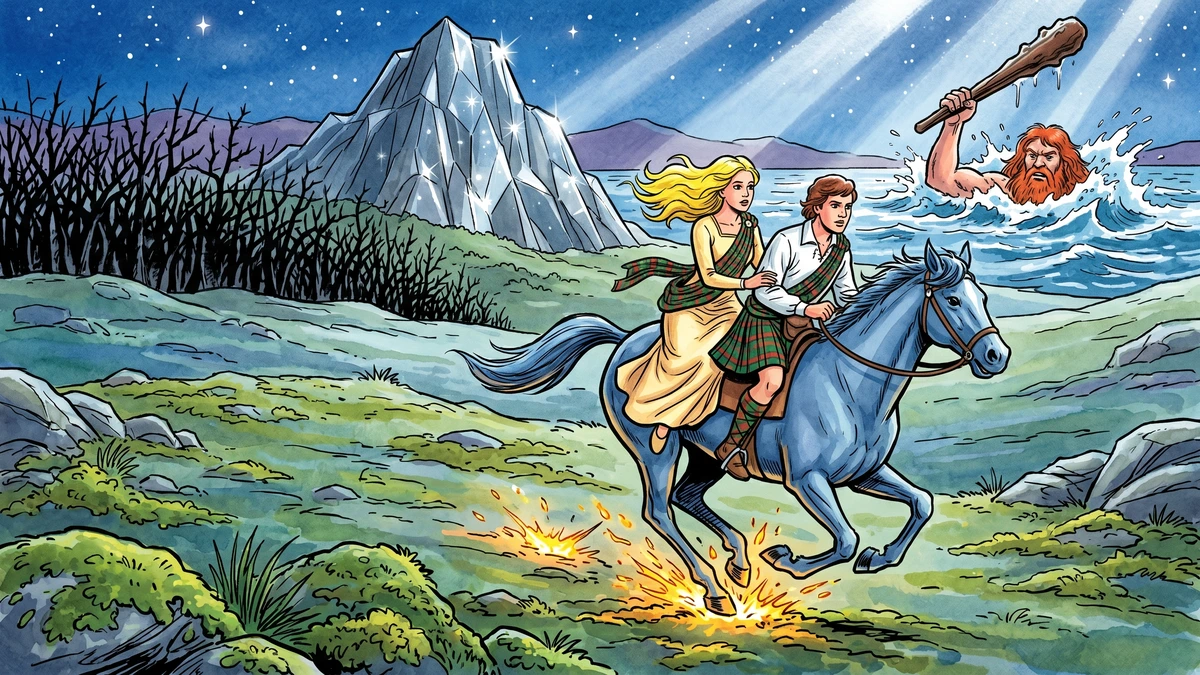
That very night, before the giant could discover the trick, the giant’s daughter wakened the prince. “Up!” she said. “We must fly, or in the morning he will eat us both.” She took from her father’s stable the blue-grey filly — the swiftest in the seven kingdoms — and they leapt up together, and the filly’s hooves struck the moss and the moss struck sparks. But the giant’s daughter, before she rode, cut a single apple into nine pieces and set them about the room: two at the head of the bed, two at the foot, two at the door of the kitchen, two at the great door, and one outside the threshold; and through the small hours, whenever the giant called from his chamber, “Are you asleep?” one piece or another answered, “Not yet.” Only at dawn, when the last apple had no breath left, did the giant rise and find the bed cold.
Then began the famous flight. The giant pursued, his stride a half-mile each, and the daughter, looking back, said to the prince: “Put your hand in the filly’s left ear and see what is there.” He drew out a thorn, threw it behind — and a black wood of thorn sprang up that took the giant a day to cut through. “The right ear now,” she said, and he drew out a small grey pebble; he threw it behind — and a grey mountain rose from earth to heaven, with cliffs of glass, and the giant a day in climbing it. “And one last thing,” she said, and he reached the third time, and drew out a single drop of water, and threw it behind — and a great inland sea sprang up between them, and into that sea the giant ran, for he could not stop his running, and was drowned. So they came at last, in safety, to the prince’s own country and the gates of his father’s hall.
But before they entered, the daughter said: “Set me on this rock by the well, and go in alone, and tell your father and mother that I am here. But on no account let dog, or cat, or any living creature touch your lips before you return for me, or you will forget me, and I shall be lost.” He left her by the well and ran into the hall; and at the door an old greyhound that had loved him from a pup leapt up in joy and licked his lips before he could turn his head. In that one touch he forgot her utterly — the byre and the feathers and the apple, the blue-grey filly and the inland sea, and the bright girl on the rock. The giant’s daughter, watching from the well, knew it had happened, and waited.
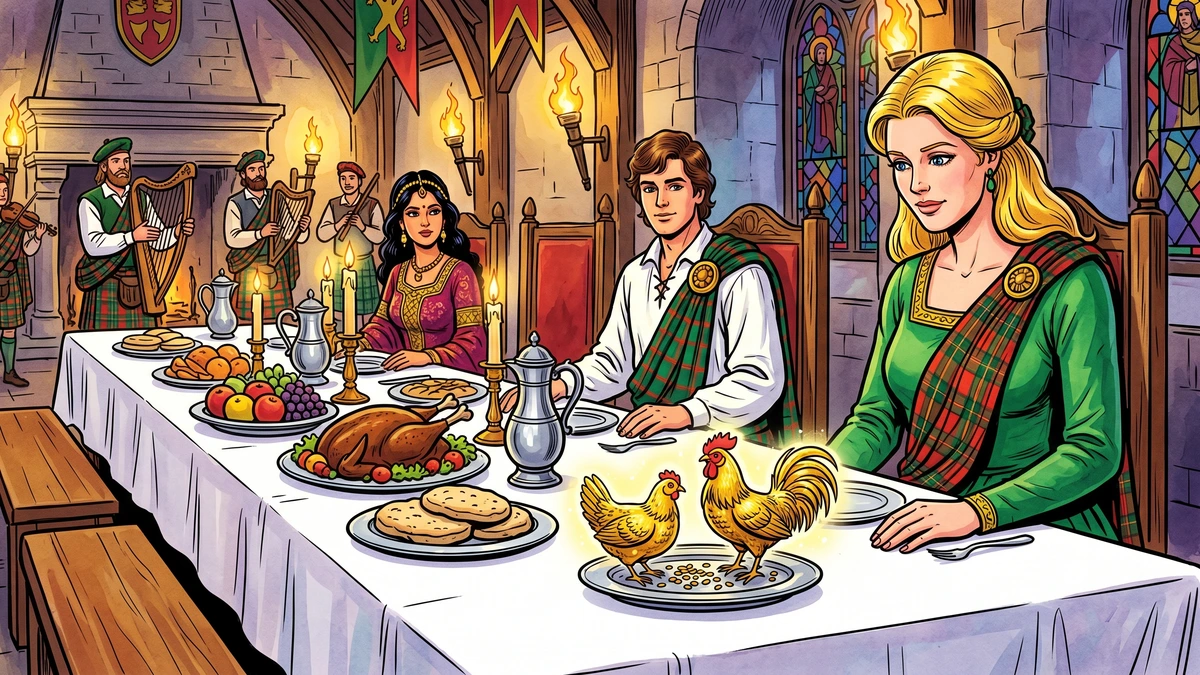
For a year and a day she lodged with a smith and his wife near the well, and at last word ran through the country that the prince was to marry a noble lady of his father’s choosing. The giant’s daughter went to the wedding-feast in a green silk gown the smith’s wife had stitched. At the high table the bride called for entertainment, and a small silver dish was placed before each guest, and on the dish of the giant’s daughter sat two birds of gold — a hen and a cock — and a few barley grains. The cock pecked, the hen pecked, and as they pecked the cock began to sing the whole story: of the wren and the mouse, of the raven and the snake, of the byre and the feathers, of the apple cut in nine, of the thorn and the grey hill and the inland sea, and of the kiss of an old greyhound that wiped a true love from a man’s mind. At the last verse the prince stood up at the table and remembered everything, and he took the girl by the hand before all the wedding company, and the new bride was sent home with great gifts, and the prince and the giant’s daughter were married that same hour, and the harpers played until dawn in the hall of Tethertown.
The Moral
Cha tèid ní air dhearmad nach iarrar leis a’ chrideachd.
“Nothing is forgotten that the heart sets out to seek.” — West Highland proverb, recorded by Alexander Nicolson, Gaelic Proverbs (1881)
The moral of The Battle of the Birds is rich and twofold, in the manner of the great Highland tales. Firstly, it teaches the worth of small kindnesses: the prince stops to cut the head off a snake for a stranger raven, and that single charitable blow opens to him a world of wonders he could never have found by himself. Secondly, it teaches that true love is not lost when it is forgotten: even after the greyhound’s kiss has driven the giant’s daughter from his memory, she remains real, waiting by the well, and the right token (a pair of golden birds and a few grains of corn) is enough to bring her back. The Gaelic proverb above, recorded by Alexander Nicolson in his great 1881 collection, captures the lesson exactly: the heart’s true business cannot be permanently mislaid; the world will keep returning it. The tale also rebukes a smaller human failing — the inability to leave a tied bundle alone — which is one of the oldest jokes in folk narrative, and a serious warning to the impatient.
Historical and Cultural Context
The world of Cath nan Eòin is the world of the Gaelic-speaking western seaboard of Scotland in the eighteenth and early nineteenth centuries — a world of small farms, fishing villages, peat fires, and long winter ceilidhs in which a single tale might take three hours to tell with all its formulaic interludes and proverbial asides. Campbell’s collectors found the tale strongest in Argyll, the Outer Hebrides, and Skye, but variants were known as far north as Caithness and as far south as Galloway. The “king of Tethertown,” Righ Bhaile na Cluige, is not a real kingdom but a poetic mock-name — “town of the bell-tether” — used by storytellers to begin princely tales without naming a living ruler. The “great giant of the Bens” is the same monstrous figure who appears in many Highland tales as Famhair, an over-large but slow-witted ogre whose downfall is regularly engineered by his own clever daughter; folklorists call this character-pair the “ogre and the helper-bride,” and it is one of the most ancient stable units in Indo-European storytelling.
The opening contest of the wren and the mouse is itself a fragment of older Gaelic charm-lore, in which small creatures speak with the voices of giants — an inheritance, as the Celticist Anne Ross argued in Pagan Celtic Britain (1967), of pre-Christian animal-cult belief in which birds were thought to carry messages between this world and the next. The black raven who is also a king’s son under enchantment belongs to the same network of beliefs and reappears in Irish tales such as The Children of Lir, where royalty and bird-shape are intimately connected. The three tokens of the magic flight — thorn, pebble, drop of water — have analogues in Norse, Slavic, Sanskrit, and Mongolian tradition; in Cath nan Eòin they are localised to the Highlands by the choice of materials, all three of which any Argyll listener would recognise from his own farm or shore.
Reflection and Discussion
For modern listeners, The Battle of the Birds is unusually rich in invitations to discussion. The hero is not especially clever; his courage is real but ordinary; almost every important act is performed by women or animals or small kind strangers (the raven, the giant’s daughter, the smith’s wife, the two golden birds at the wedding). It is a tale for thinking about what we owe to those who help us and what we owe to those who love us in silence. The episode of the greyhound’s kiss is famously ambiguous — the dog has done nothing wrong, the prince has done nothing wrong, and yet a great wrong is committed. Gaelic storytellers used this moment to teach children that good intentions do not protect a person from the consequences of broken promises, and that some warnings, however strange, must be obeyed exactly.
The tale also rewards a feminist reading. The giant’s daughter is not a passive prize: she is the one who cleans the byre, calls down the feathers, builds the ladder of her own bones, plans the flight, cuts the apple, names the three tokens, and finally engineers her own remembering at the wedding-feast. The prince is brave but blank; she is the brain and the heart of the story. This pattern — the helper-bride who is also the architect of her own marriage — is one of the secret strengths of the Highland tradition, and it persists in many of Campbell’s other tales (The Battle of the Birds, The Brown Bear of the Green Glen, The Daughter of the Skies).
Why This Story Has Lasted
It has lasted because it is generously made. There are three different stories woven into a single chain — a battle of small creatures, a quest of three tasks, a magic flight with a forgetting — and each of the three is complete in itself, so that a listener can take the tale in pieces or as a whole. It has lasted because its images are unforgettable: the wren with his flail, the apple cut into nine pieces that talks back to the giant in the dark, the blue-grey filly with thorn and pebble and water-drop in her ears, the two golden birds pecking the story out of the barley at the wedding. It has lasted because it is honest about love — about the way ordinary mishaps (a kiss from a faithful dog) can wreck what seemed unbreakable, and about the patience required, on both sides, to set things right.
And it has lasted because, like all the great tales John Francis Campbell wrote down in his careful Gaelic, it carries the rhythm of the firelit ceilidh inside it. Read it aloud and you can almost hear the slow Argyll voice of John Mackenzie of Inverary, the long pause at “she put one share at the door of the kitchen,” the rise of the listeners’ breath at the appearance of the inland sea. It is a tale for telling, not merely for reading; and as long as one Highland grandparent passes it on to one Highland grandchild, or one curious reader anywhere in the world stops to listen, The Battle of the Birds will be exactly as alive as it was on the April evening in 1859 when Hector Urquhart first dipped his pen and began to write down the words “Bha siod ann roimhe.”
You May Also Like
 Celtic Folk Tales
Ages 9-12
Celtic Folk Tales
Ages 9-12
Cu Chulainn and the Hound of Culann
Cu Chulainn and the Hound of Culann: In the ancient times of Ulster, when courage was valued above all other virtues and the strength of a warrior’s arm was
![The Fairy Tree Of Dooros.[6]](https://indianfolktales.com/wp-content/uploads/2026/05/P-0829-the-fairy-tree-of-dooros-6-cover-400x260.webp) Celtic Folk Tales
Ages 9-12
Celtic Folk Tales
Ages 9-12
The Fairy Tree Of Dooros.[6]
The Fairy Tree Of Dooros.[6]: Once upon a time the fairies of the west, going home from a hurling-match with the fairies of the lakes, rested in Dooros Wood
 Celtic Folk Tales
Ages 9-12
Celtic Folk Tales
Ages 9-12
A Legend Of Knockmany
A Legend Of Knockmany: What Irish man, woman, or child has not heard of our renowned Hibernian Hercules, the great and glorious Fin M’Coul? Not one, from Cape