A Legend Of Knockmany
A Legend Of Knockmany: What Irish man, woman, or child has not heard of our renowned Hibernian Hercules, the great and glorious Fin M’Coul? Not one, from Cape
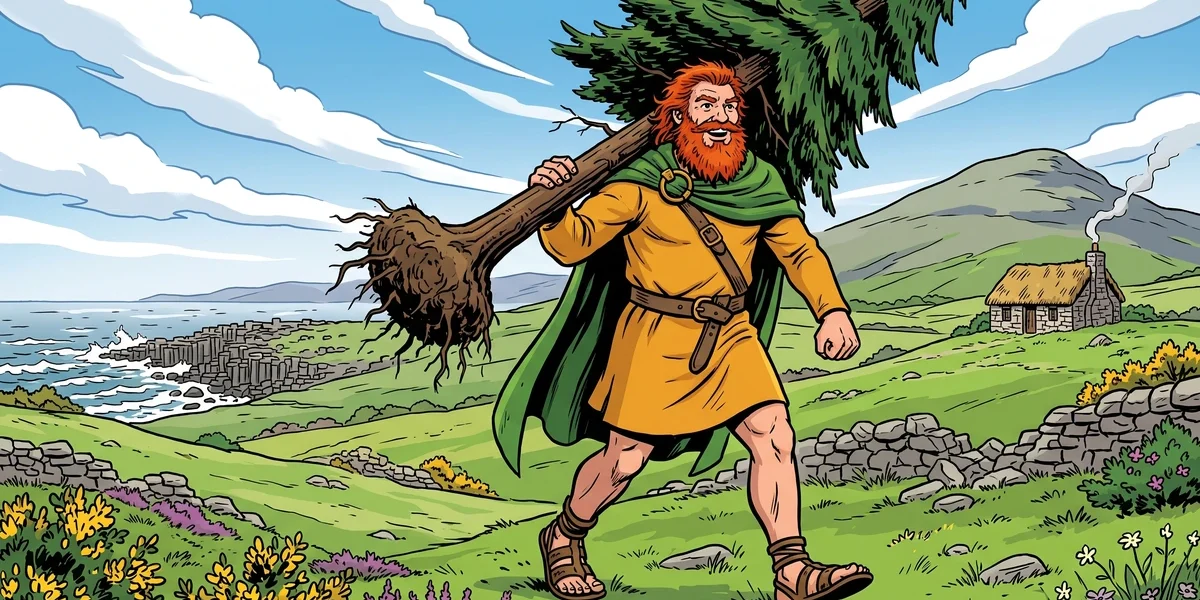
The Hibernian Hercules and the giant who came for him
What Irish man, woman or child has not heard, at least once at a kitchen table or fireside, of Fionn mac Cumhaill — the great Fenian warrior-poet of the third-century Annals, the chief of the Fianna of Ireland, the suitor of Gráinne and the father of Oisín? In the long literary tradition of the Fenian Cycle, Fionn is a serious figure: a king-warrior, a seer, a leader of the Fianna whose wisdom comes from biting the Salmon of Knowledge. But in the comic peasant tradition that William Carleton recorded for The Irish Penny Journal in the autumn of 1840, Fionn — anglicised as Fin M’Coul — is something rather different. He is the Hibernian Hercules, a lumbering, soft-hearted, slightly anxious giant who has built the Giant’s Causeway with his own hands and lives at the top of Knockmany Hill in County Tyrone with his quick-witted wife Oonagh. He is enormous, beloved and entirely at the mercy of his own reputation, because somewhere out across the country another giant has heard of him and is coming to settle accounts.
That other giant is Cucullin — Carleton’s anglicised spelling of Cúchulainn, the great Ulster hero of the Táin Bó Cúailnge (“The Cattle Raid of Cooley”), who in the Ulster Cycle is the half-divine champion of King Conchobar mac Nessa and dies young defending his homeland. The two heroes, Fionn and Cúchulainn, belong to different centuries and different cycles in the medieval Irish manuscripts; they almost never appear together in the older literature. But in nineteenth-century peasant memory the boundary between the cycles had softened, the two giants had drifted toward one another, and Carleton — listening in his native Tyrone — found them sharing a story. The folklorist Reidar Christiansen, in The Migratory Legends (Helsinki, 1958), notes that this kind of cross-cycle conflation is a regular feature of late oral tradition: the names persist, but the relationships between them are reshuffled by the imagination of the listener.
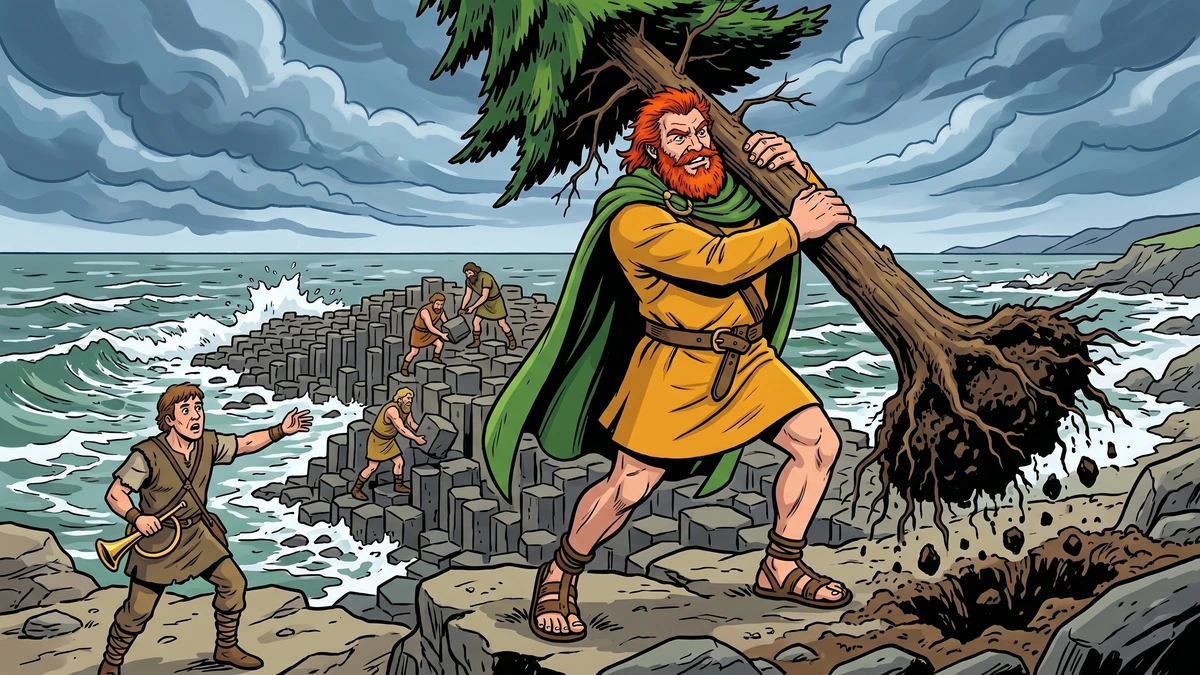
Fin uproots a fir tree and walks home
The tale begins, as Carleton tells it, with Fin and his men working at the Giant’s Causeway, that long basalt promontory that reaches out from the north Antrim coast toward Scotland. They are building a bridge, in the comic Irish tradition, so that giants on either side may visit one another without getting their feet wet. (The geological reality — that the Causeway’s hexagonal columns are the slow eruption of a Palaeocene basaltic flow — was already broadly known in Carleton’s time, but folklore had no quarrel with geology, and the Causeway in the imagination of Tyrone and Antrim was Fin’s own work.)
While Fin is laying basalt, word reaches him from the south that Cucullin is on his way. The giant has flattened a thunderbolt with his fist, the messengers say, and keeps it in his pocket as a pancake; his strength is concentrated, the rumour runs, in the middle finger of his right hand, and any blow from that finger shakes the whole island. Fin is suddenly seized — Carleton writes — with “a very warm and sudden fit of affection for his wife.” He pulls up a fir-tree, lops off the roots and branches with a careless sweep, makes a walking-stick of it, and sets out for home.
Oonagh, his wife, lives at the top of Knockmany Hill. Knockmany — from the Irish Cnoc mBáine, “Báine’s hill,” named for the legendary queen Báine, daughter of Tuathal Techtmar — is a real height above the Clogher Valley in County Tyrone, and on its summit stands Knockmany Cairn, a Neolithic passage tomb whose decorated stones Carleton would have known well as a local boy. The choice of Knockmany as Fin’s home is not casual: a Tyrone reader of The Irish Penny Journal would have recognised the cairn at once and understood that the story was anchored in the local landscape, not in a generic fairyland.
Oonagh: the clever wife of the Fenian Hercules
The figure of Oonagh is, on the surface, a comic peasant wife: practical, talkative, fond of her enormous husband, and perfectly clear-eyed about his limits. The folklorist Patricia Lysaght, in Folklore Studies in Honour of Bo Almqvist (1995), points out that Oonagh belongs to a long line of clever-wife figures in the Irish tradition — sister to the wife of the giant Brón Trogain in the Mythological Cycle and to the woman of Ross in the comic prose of the eighteenth century. She is the giant’s brain in a household where the giant’s brawn is, for once, not enough.
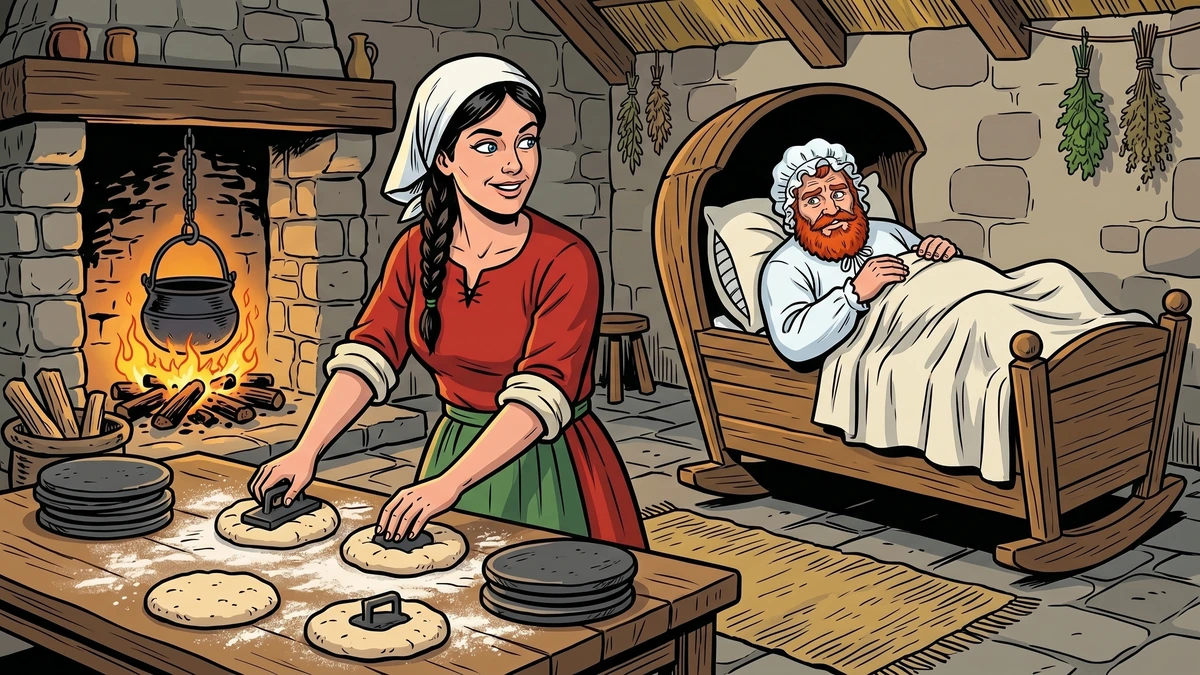
When Fin arrives home with the news that Cucullin is on his way, Oonagh does not panic. She does not even, in Carleton’s telling, look up from her work for very long. She borrows nine charmed stones from the woman of Cullamore — the cousin-hill across the valley — and sets to work in the kitchen. She bakes bread. Specifically, she bakes a great batch of round soda-bread cakes, and into the heart of every cake but one she works a flat iron griddle-stone — a greadán in the Irish — so that the cake looks like a perfectly ordinary loaf but is in fact almost unbreakable. The one cake without a stone she sets to one side. Then she dresses Fin in a baby’s bonnet and a long nightshirt, lays him in the giant cradle they keep in the corner of the room, and tucks the blankets up to his chin.
This is the central reversal of the story, and the moment that gives it a place in the international index of folktale motifs. Stith Thompson’s Motif-Index of Folk-Literature (Indiana, 1955–1958) catalogues the device under K1828.1 — “Disguise as baby” — and notes its appearance in tale-types as far afield as the Russian Bogatyr cycle, the Scandinavian Trolls-and-thunder traditions, and the Brittany legends of the giant Gargantua. But nowhere is the device deployed with quite the same comic confidence as in the Tyrone telling. Oonagh does not merely hide her husband. She turns him into a prop in a play she has scripted in her head between the moment Fin walked through the door and the moment Cucullin will walk through it.
Cucullin at the door
By and by — Carleton’s narrator never lets us forget that this is a tale told aloud — there is a great tramping on the side of Knockmany, and Cucullin himself appears. He is, in the description Carleton gives him, much larger than Fin, blunt-spoken, vain of his strength and openly contemptuous of any giant who is not at home to receive him. Oonagh greets him as if he were the most welcome guest she had ever seen. She invites him in, sets him down by the fire, and tells him with great cheerful regret that her husband Fin has just stepped out — but he should not be gone long, and won’t his cousin from Cullamore have a bite to eat while he waits?
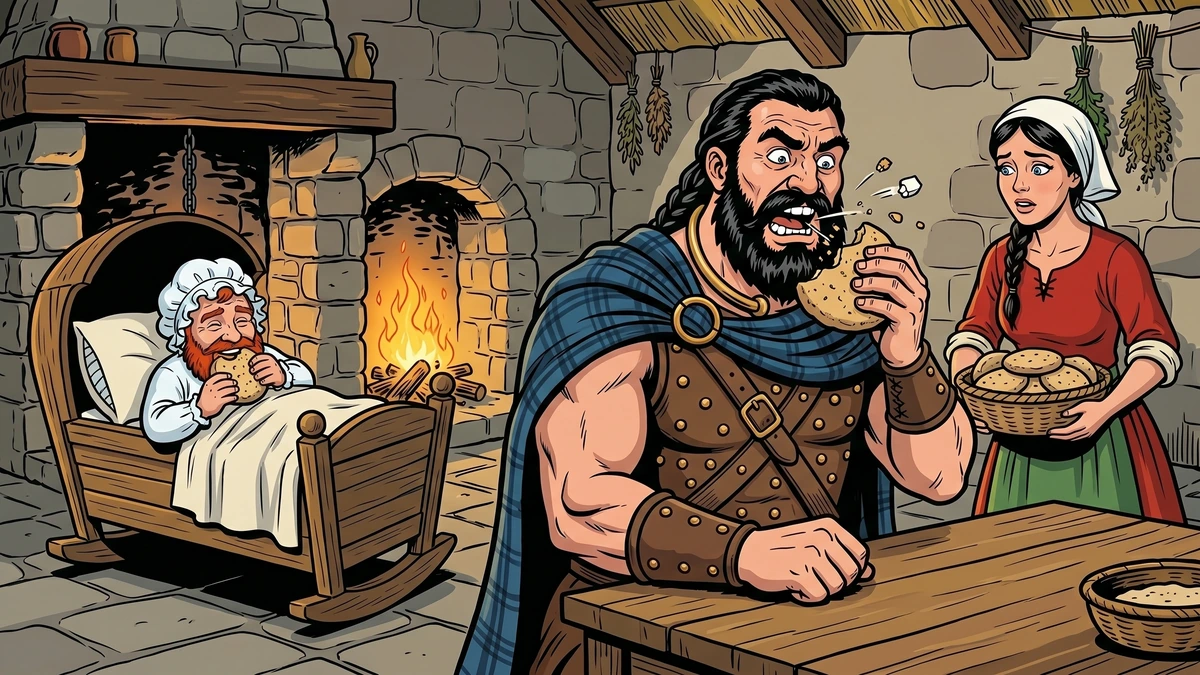
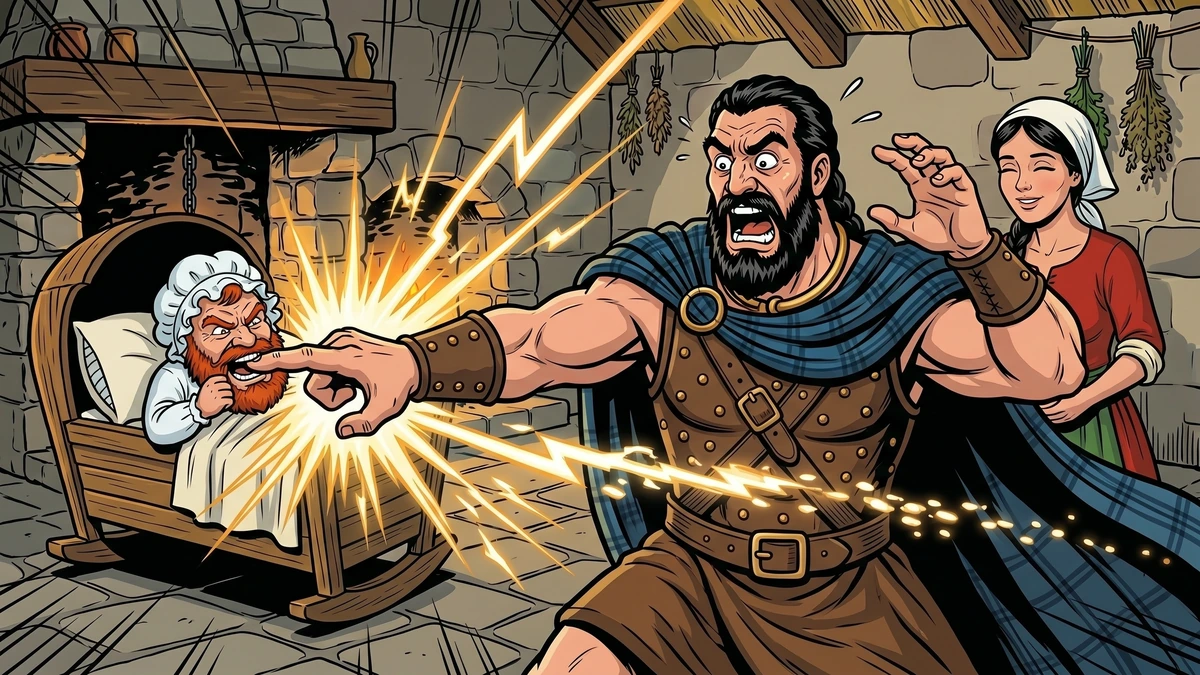
What follows is one of the most carefully timed comic sequences in Irish folk literature. Oonagh, all hospitality, hands Cucullin one of the iron-stone cakes. He bites into it with the relish of a hungry giant — and breaks two of his front teeth on the hidden griddle-stone. He roars. Oonagh, with the perfect innocence of the country wife, looks horrified. “Have you got a bad tooth, sir?” she asks. “These are the very cakes that little Fin himself eats every morning, the dote, and never a word out of him.”
Cucullin, his pride bleeding worse than his gum, glances over at the cradle. There lies what appears to be the most enormous infant he has ever seen — bigger than most men — placidly chewing on a cake of his own. Oonagh, helpful as ever, hands the giant a second cake. He sinks his teeth into it. Two more teeth crack. He spits out the cake and the splinters of his own enamel. Oonagh murmurs that perhaps he isn’t as strong as her Fin’s child. The “child” in the cradle, meanwhile, is being fed by Oonagh’s left hand a soft cake from the secret stockpile — the only loaf in the house without an iron stone in it — and is making a great show of eating it without trouble.
Cucullin, by now thoroughly unsettled, has begun to wonder what kind of giant Fin must be if his baby can chew through what breaks the teeth of a man who flattens thunderbolts. He says aloud, in Carleton’s perfectly observed dialogue, that he should very much like to feel the strength of such a child’s bite for himself. Will the missus of the house perhaps let him put a finger in the wee fellow’s mouth, just to feel the teeth?
“I will indeed, and welcome,” says Oonagh.
The middle finger of strength
Cucullin leans over the cradle and offers the infant the middle finger of his right hand — the very finger in which, the legends agreed, all his strength was concentrated. Fin, who has been listening to every word and biting his lip not to laugh, opens his mouth wide and bites down with the full force of an angry adult Fenian giant. The finger comes off in his teeth. Cucullin stares at his own ruined hand. His strength runs out of him like water from a broken pail. He staggers up from the cradle and sits down on the floor, and is, in that one second, no longer the most dangerous giant in the western world. He is a frightened bully on a Tyrone hilltop, and Fin M’Coul, still in his bonnet and his nightshirt, climbs out of the cradle and asks his wife for his trousers.
Cucullin is sent away, in some versions of the tale buried by Fin where he sits, in Carleton’s gentler version simply allowed to leave, broken and limping and quiet. He never troubles Fin again. Oonagh tidies the kitchen. The story ends, as Yeats put it in his 1888 anthology, “with the cleverest woman in Ireland having put the strongest man in Ireland to flight, and her husband not the worse for the day.”
The moral the country audience would have heard
For a Tyrone or Fermanagh audience listening to A Legend of Knockmany by the fireside in the 1840s — within living memory of the Act of Union, on the eve of the Great Famine — the moral was not far to seek. It is a tale about brain over brawn, about the woman of the house being the hidden strategist, and about the comic weakness of a strength that depends on a single lucky finger. But it is also, beneath the laughter, a tale about colonial pressure and how a smaller power can outlast a larger one without ever meeting it on its chosen ground. Cucullin is the strong, simple, threatening visitor; Oonagh is the speaker of the local language, the keeper of the local customs, the maker of the local bread. She does not fight him. She feeds him.
The Irish text Yeats and Jacobs both reproduce after Carleton preserves the comic moment of triumph in language a Tyrone child of the period would have recognised:
“Is fearr beagán céille ná mórán nirt.”
— “A little sense is better than a great deal of strength.” — traditional Irish proverb, recorded among the Tyrone reciters from whom William Carleton learned his folktales (cf. Thomas O’Crohan, An tOileánach, 1929; and Pádraig Ó Cuanacháin’s Seanfhocail Uladh, Belfast, 1933).
It is not by accident that the proverb survives in Ulster Irish almost unchanged into the twentieth century. The folklorist Henry Glassie, in Passing the Time in Ballymenone (Pennsylvania, 1982), recorded the same saying still in oral circulation in County Fermanagh in the 1970s, where it was used by older speakers to comment on disputes that had been settled by wit rather than force. The Knockmany tale dramatises the proverb. The proverb is, in a sense, the tale’s punchline read in advance.
The tellers: from Carleton to Jacobs to Batten
William Carleton was born in 1794 in the townland of Prillisk, County Tyrone, in the parish of Clogher, only a few miles from the foot of Knockmany itself. His father, James Carleton, was a small farmer and a celebrated reciter of folktales in both Irish and English; his mother, Mary Kelly, was a gifted singer of Gaelic songs. The young Carleton heard A Legend of Knockmany in his own kitchen long before he wrote it down, and when he came to compose the version that ran in The Irish Penny Journal in October 1840 — under the editorship of his friend George Petrie — he was working from the rhythms of his father’s voice. The text is therefore one of the closest things we have to a verbatim Tyrone fireside performance of the early nineteenth century, lightly polished for the printed page but never bowdlerised.
The tale was lifted from Carleton, with full attribution, by William Butler Yeats for his anthology Fairy and Folk Tales of the Irish Peasantry (London: Walter Scott, 1888), where it appears under the heading “Giants” alongside the Brewery of Eggshells and The Death of Bran. Yeats, in his introduction, singled Carleton out as “the great novelist of the Irish peasantry” and treated the Knockmany text as the period’s best representative of comic giant-lore. Four years later Joseph Jacobs reprinted the same text in Celtic Fairy Tales (London: David Nutt, 1892), where it appears as the second tale in the volume, illustrated by the splendid black-and-white pen-and-ink drawings of John D. Batten. Batten’s image of Cucullin recoiling from the iron cake — his enormous shoulders hunched, Oonagh smiling beside him, Fin’s bonneted face just visible in the cradle — became the canonical visual representation of the tale and was reprinted dozens of times in twentieth-century children’s anthologies.
Through Jacobs’ anthology the Knockmany tale entered the international canon of Celtic fairy literature. It has since been retold by Padraic Colum (The King of Ireland’s Son, 1916), by Ruth Sawyer in her Way of the Storyteller (1942), and most recently by Marie Heaney in Over Nine Waves: A Book of Irish Legends (Faber, 1994). Each reteller restores something of Carleton’s comic timing without quite catching the lift of the original Tyrone idiom.
Why the tale has lasted
Many Celtic giant tales survive only as antiquarian fragments. The Knockmany legend has lasted, in part, because it is funny. Folklorists from Reidar Christiansen to Dáithí Ó hÓgáin have observed that humour is a powerful preservative: a story that makes a child laugh will be repeated by that child to their own children, and so move down through generations along channels that purely heroic tales cannot use. A Legend of Knockmany is a great deal funnier than the gloomier corners of either the Fenian or the Ulster Cycle, and that humour has carried it across four centuries of Tyrone oral tradition and out into the wider English-speaking world.
It has also lasted because of its central figure. Oonagh is one of the few clever-wife heroines in nineteenth-century Irish print folklore who is allowed to win without being punished, scolded or domesticated by the closing line. She bakes the bread, she runs the show, and she retires to her own kitchen at the end with the satisfaction of a job well done. In a literature too often willing to let its female characters disappear at the moment of triumph, Oonagh stays in view. The American folklorist Marina Warner, in From the Beast to the Blonde: On Fairy Tales and Their Tellers (Vintage, 1995), reads Oonagh as a direct ancestor of the modern trickster-grandmother in writers as different as Eavan Boland and Angela Carter — the woman who tells the giant the truth he cannot afford to hear, while he eats her bread.
And finally, the tale has lasted because of its place. Knockmany is a real hill, with a real Neolithic cairn on its summit, in a real country whose people still know the name of every pass and townland in the Clogher Valley. Carleton’s story is rooted to that landscape so firmly that visitors to the cairn today, gazing across the valley toward Cullamore, can feel that they are standing where the cradle stood. Folklore that is anchored to a place outlives folklore that floats in fairyland. A Legend of Knockmany is anchored as deeply as any tale in Ireland.
The motif across the giant cycles
The disguise-as-baby device that Oonagh uses against Cucullin is rarer than one might expect in the European giant tradition. Stith Thompson’s Motif-Index records only a handful of clean examples: the Tyrone Knockmany, a fragmentary Welsh variant collected by Sir John Rhŷs in the 1880s in which the wife of the giant Bendigeidfran tricks an enemy in much the same way, and a single Norwegian Trolls-and-Thunder tale recorded by Peter Christen Asbjørnsen in Norske Folkeeventyr (1841–1844) in which a farmer’s wife dresses her husband as a swaddled child to put off a hill-troll. Reidar Christiansen, comparing the three, suggested in 1958 that they all descend from a common Iron-Age North-Atlantic substratum in which the smaller community outwits the larger by miming weakness.
What is unique to the Irish version is the bread. The iron-stone cakes are not present in the Welsh or Norwegian variants; they are Carleton’s own contribution, or rather his father’s. They turn the abstract motif of disguise into an act of hospitality — the Irish virtue par excellence — used as a weapon. Oonagh does not refuse to feed the giant. She feeds him with everything she has, and he breaks his teeth on her generosity. The Tyrone listener, who knew that hospitality could not be refused even to an unwelcome guest, would have caught the joke at once. The bread that broke Cucullin’s teeth is the bread of céad míle fáilte, the hundred thousand welcomes, weaponised.
For the curious reader
The original Carleton text of A Legend of Knockmany can be read in his Tales and Stories of the Irish Peasantry (Dublin: James Duffy, 1845), and in the modern critical edition prepared by Barbara Hayley, Carleton’s Traits and Stories and the Nineteenth-Century Anglo-Irish Tradition (Gerrards Cross: Colin Smythe, 1983). The Yeats anthologisation is in Fairy and Folk Tales of the Irish Peasantry (London: Walter Scott, 1888); the Jacobs version, with Batten’s illustrations, is in Celtic Fairy Tales (London: David Nutt, 1892), still in print in the Dover Books reprint of 1968. For folkloristic context, see Reidar Th. Christiansen, The Migratory Legends (Folklore Fellows Communications 175, Helsinki, 1958); Patricia Lysaght, The Banshee: The Irish Supernatural Death-Messenger (O’Brien Press, 1986); Henry Glassie, Passing the Time in Ballymenone (Philadelphia: Pennsylvania, 1982); and Dáithí Ó hÓgáin, The Lore of Ireland: An Encyclopaedia of Myth, Legend and Romance (Cork: Collins Press, 2006), entry “Fionn.” The Knockmany passage tomb itself is treated in Estyn Evans, Mourne Country (Dundalk: Tempest, 1951), and more recently in Conor McDermott’s The Cairns of Tyrone (Cork, 2014).
Reading the tale today
To a modern child, A Legend of Knockmany remains exactly what it was to a Tyrone child of 1840: a comedy. The bread, the cradle, the giant’s astonished face when he loses his finger, the wife’s perfectly innocent expression — these are gags that work in any language and any century. But to an adult reader the tale also offers something steadier: a portrait of a household that solves its hardest problem by talking to one another, by trusting one another’s wit, and by treating an enemy with such overwhelming hospitality that he defeats himself. There are not many ancient stories that say to a small country menaced by a larger one: feed your enemy until he breaks. A Legend of Knockmany says exactly that, in a Tyrone kitchen, in a giant’s nightshirt, with iron in the bread.
Frequently asked questions
You May Also Like
 Celtic Folk Tales
Ages 9-12
Celtic Folk Tales
Ages 9-12
Morraha
Morraha: orraha rose in the morning and washed his hands and face, and said his prayers, and ate his food; and he asked God to prosper the day for him. ’s
 Celtic Folk Tales
Ages 9-12
Celtic Folk Tales
Ages 9-12
Connla And The Fairy Maiden
Connla And The Fairy Maiden: Connla of the Fiery Hair was son of Conn of the Hundred Fights. One day as he stood by the side of his father on the height of
 Celtic Folk Tales
Ages 9-12
Celtic Folk Tales
Ages 9-12
The Horned Women
The Horned Women: A rich woman sat up late one night carding and preparing wool, while all the family and servants were asleep. Suddenly a knock was given at