How Fin went to the Kingdom of the Big Men
How Fin went to the Kingdom of the Big Men: in and his men were in the Harbour of the Hill of Howth on a hillock, behind the wind and in front of the sun
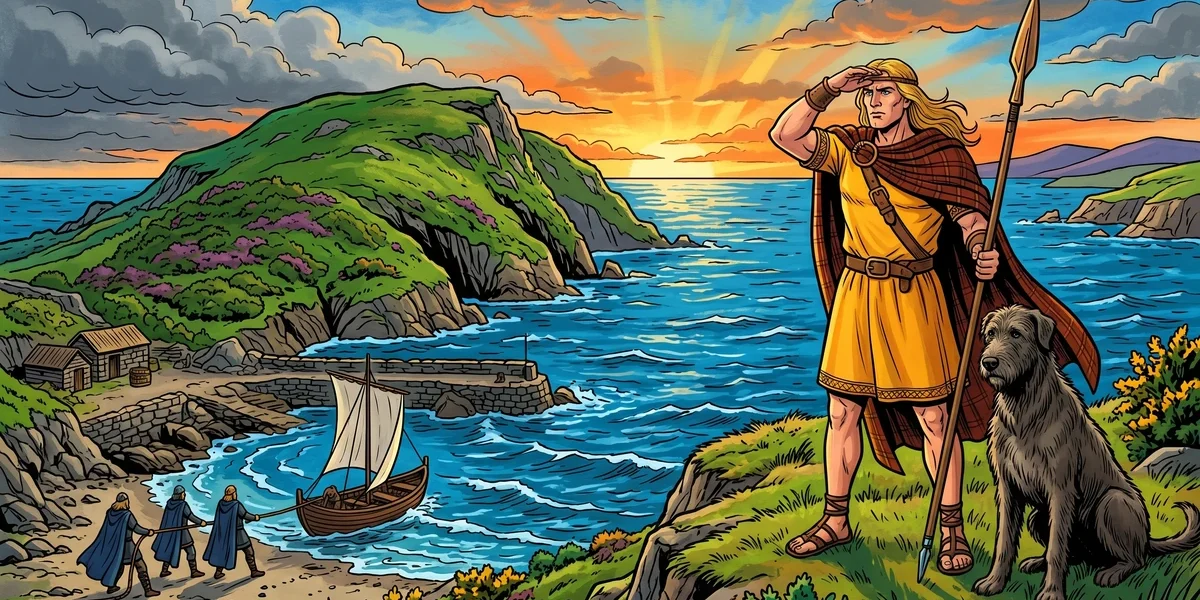
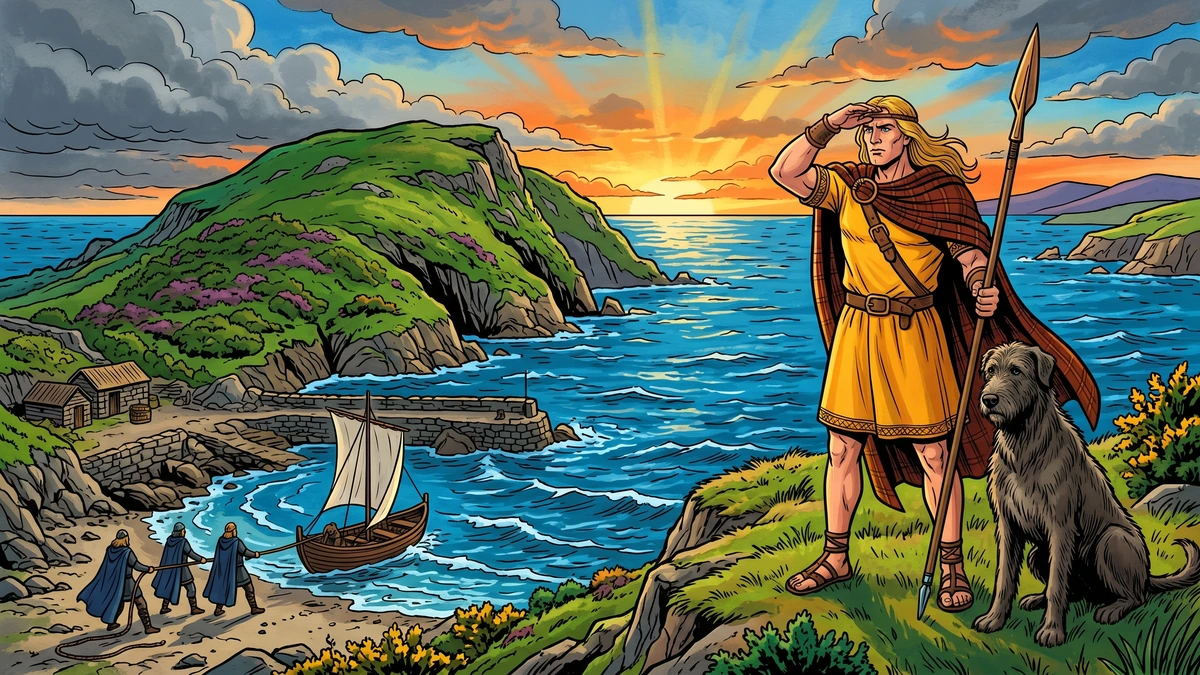
Long before clocks counted the hours and longer still before maps drew firm lines around the sea, the warrior-band of Ireland — the Fianna — kept the green coasts of Eire and the wide western roads. At their head stood Fionn mac Cumhaill, called by some Fin, called by others the fair one for his hair shone like ripening barley in the sun. This is the tale of how Fin sailed beyond the last sight of land and walked into the kingdom where men were not men but giants — and how he came home alive to tell of it.
The story is preserved in two great printed sources. It was first set down from oral Highland Gaelic recitation by John Francis Campbell of Islay in the third volume of his monumental Popular Tales of the West Highlands (Edmonston & Douglas, Edinburgh, 1862), entered as tale number eighty-four. Three decades later the folklorist Joseph Jacobs selected it for the English children of his day in More Celtic Fairy Tales (David Nutt, London, 1894). Folklorists Stith Thompson and Hans-Jörg Uther later catalogued its bones under the international tale-types ATU 301 — The Three Stolen Princesses / Journey to the Otherworld and ATU 650A — Strong John, with motif clusters around D1101.1 (magic boats), F531 (giant kings), and F167 (otherworld inhabitants). Within the Gaelic literary tradition the tale belongs to the Fenian Cycle (Fiannaíocht), the body of romances and lays which gathers around Fionn mac Cumhaill and his roving band the Fianna.
I. The Three Strangers at the Hill of Howth
Fin and his men were resting on the green slope of Beinn Eadair — the Hill of Howth that watches over the bay of Dublin — when one of the band raised his arm and pointed westward. A speck had appeared on the rim of the sea. They thought at first it was a thunder-cloud sliding low across the water, for the western sky was darkening. But the speck did not break and did not fade. It came on, and as it came it grew, and at last they saw that it was a boat.
The boat would not lower its sail until it slid into the harbour itself. Three men stepped from it: one had been guide in the bow, one had been steersman in the stern, and one had handled the tackle in the centre. They drew the boat up the strand seven times its own length and laid it down in dry grey grass — high enough that no schoolboy of the city would find it and make of it a stick for derision or ridicule. Then they walked up onto a level patch of green meadow where Fin sat watching, and they did a thing no Fian had ever seen before.
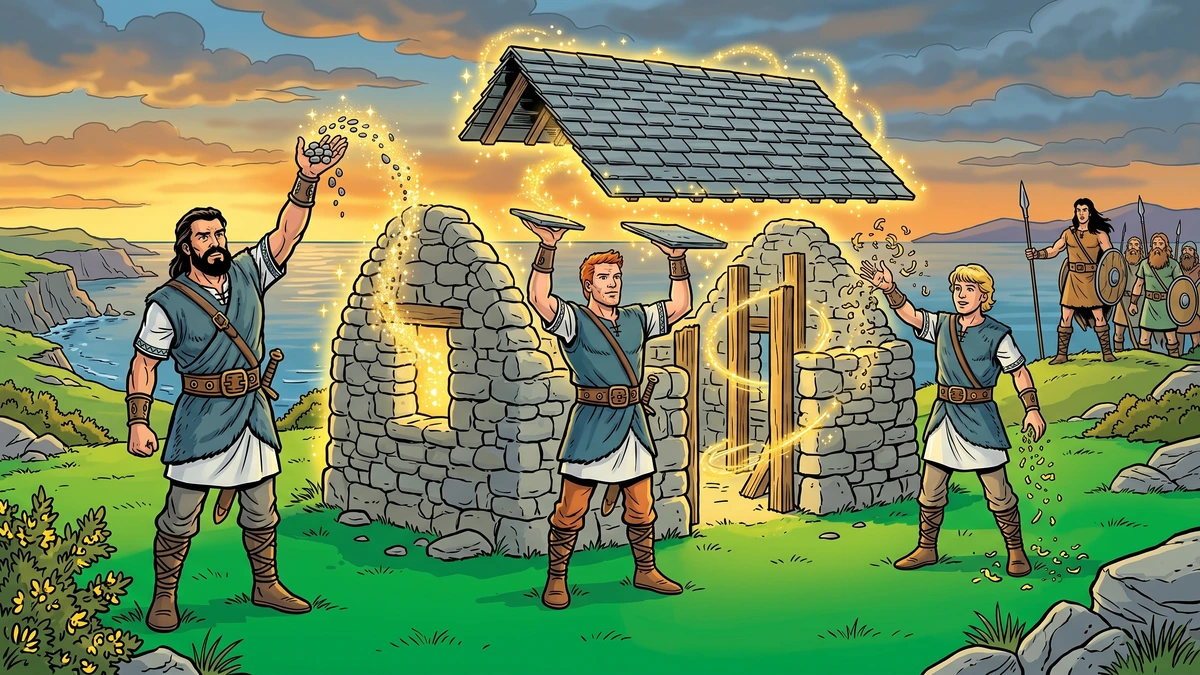
The first stranger stooped, gathered up a single handful of round shore pebbles, and breathed upon them. “Be a house,” he said, “the finest in Ireland.” The pebbles flew into the air as a swarm of bees rises, and where they fell they fell as walls: rounded, mortared, true. The second stranger lifted a thin slab of slate from the path. “Be slate upon the roof,” he said, “and let no better roof be in Eire.” A grey slate roof curved above the new walls. The third stranger caught up a bunch of pinewood shavings the carpenters had left behind. “Be timbers,” he said, “the straightest in the land.” The shavings stretched and lengthened into long pine beams that fitted themselves into the doorframe and the lintel. In the time it takes to draw three deep breaths, an entire dwelling stood on the meadow that had been bare a moment before.
Fin came down to the new house. He did not waste words. “Whence are you,” he asked the strangers, “and whither are you bound?” The first stranger answered for them all. “We are three Heroes whom the King of the Big Men has sent to ask combat of the Fians.”
II. The Combats on the Strand
So began the contests. There is in the Fenian tradition an ancient law called aighidh, the law of the visiting champion: a hero who comes asking battle must be answered, hand for hand and life for life, and the host who refuses is shamed forever. Fin would not break that law. He drew up his Fianna in their order — Goll mac Morna, Diarmuid Ua Duibhne, Caoilte mac Rónáin, Oscar son of Oisín, all the great names of the band — and he asked who would step forward.
The first strangers’s challenge was answered by the strongest of the Fianna and met with a strange ending: each Fian who fought won the bout but did not win, for at the close of every combat the three strangers from the boat melted backward into the sea-mist and were not slain, only beaten. After the last contest the eldest stranger straightened, looked Fin in the eye, and said: “This was but the messenger’s errand. The true contest is at home. The King of the Big Men sits on his throne and waits. He will not believe in the courage of the Fians until the captain himself comes to ask combat at his door. Will you come, Fionn mac Cumhaill?”
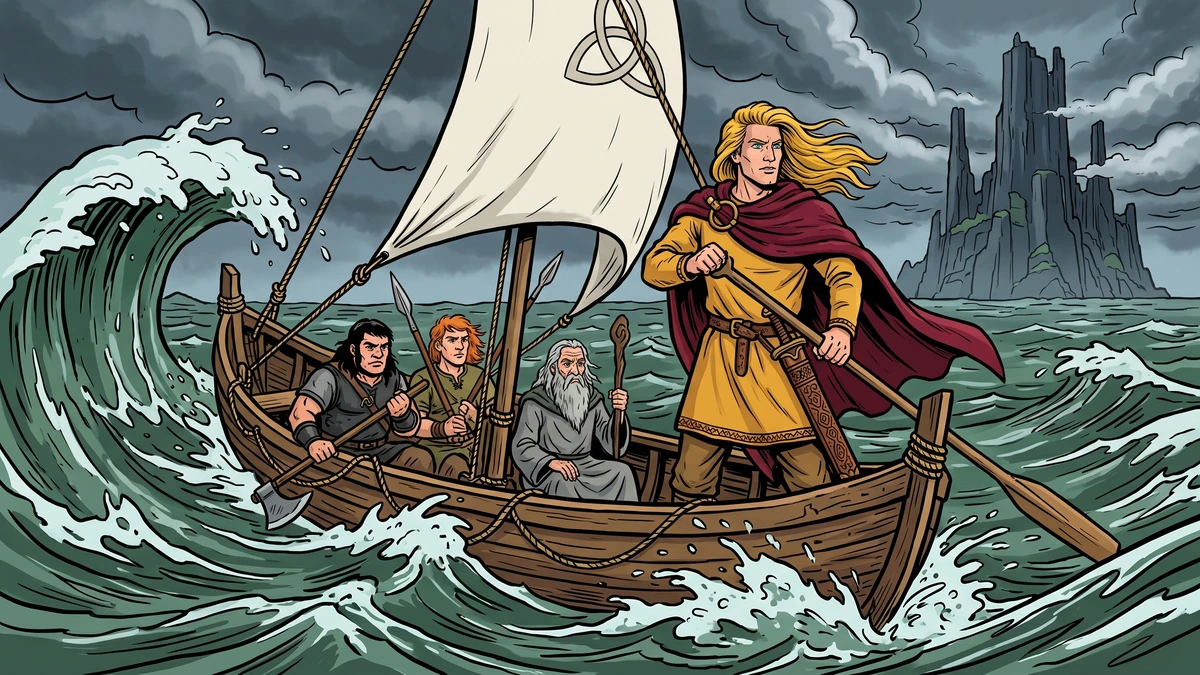
Fin did not hesitate. He could not. The honour of the band was in the question. He chose a small company — by some tellings three companions, by some four — and at dawn the next day he stepped into the magic boat. The strangers raised the white wool sail. The wind that filled it was a wind no Irish weather-watcher could name. The boat slid west, then west, then west again, and behind them the green hills of Eire dwindled to a thread of cloud and were gone.
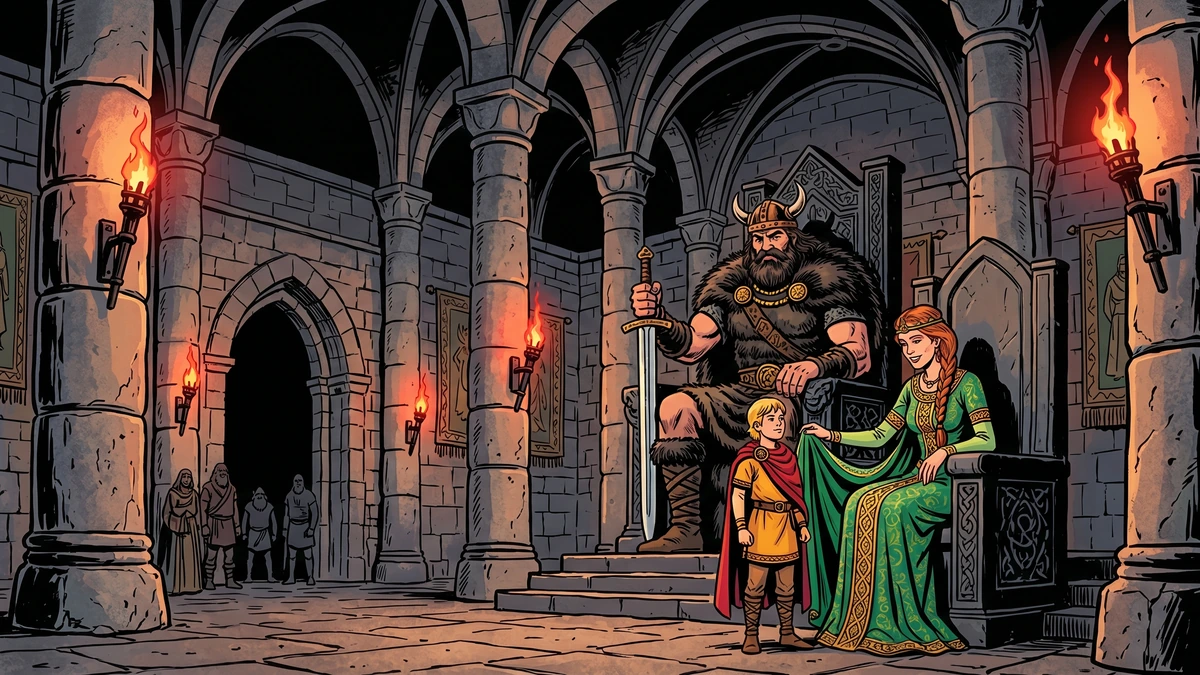
III. The Queen’s Cloak
How long the voyage lasted no man could afterwards say. Time runs differently on the western water. At length a coast rose before them: black cliffs of unimaginable height, gates of granite the size of mountains, towers that climbed into the cloud. This was the country of the Big Men, and as the boat slid in to land the Fians understood for the first time how small they were. A sentry on the wall above them was as tall as a pine tree. A child playing on the strand could have lifted Fin with one hand.
The travellers were brought before the King of the Big Men in his hall. The hall was the size of a sea-cave; the pillars were whole oaks rolled in iron bands; the throne was a single block of black stone. The King towered over Fin like a tower towers over a fence-post. He was bearded, dark-eyed, heavy-browed, and on his great hand the gold ring he wore could have served Fin as a torc.
But beside the King sat the Queen of the Big Men, and she was kinder than she looked. Stories tell that she had heard tell of Fin’s courtesy in some dream sent by Manannán mac Lir of the western sea, and so when she saw the small bright fair-haired captain stand before her husband she covered him with a fold of her own great green cloak. “Let him be my page-boy for the night,” she said. “He is too small to fight, and too well-mannered to harm. Tomorrow you may try him if you must.” The King grunted and turned to his meat. The Fians breathed again. So it is in many of the old tales: when the warrior is far from home, it is the queen — the lady of the threshold, of the loom, of the cup of welcome — who stands between him and ruin.
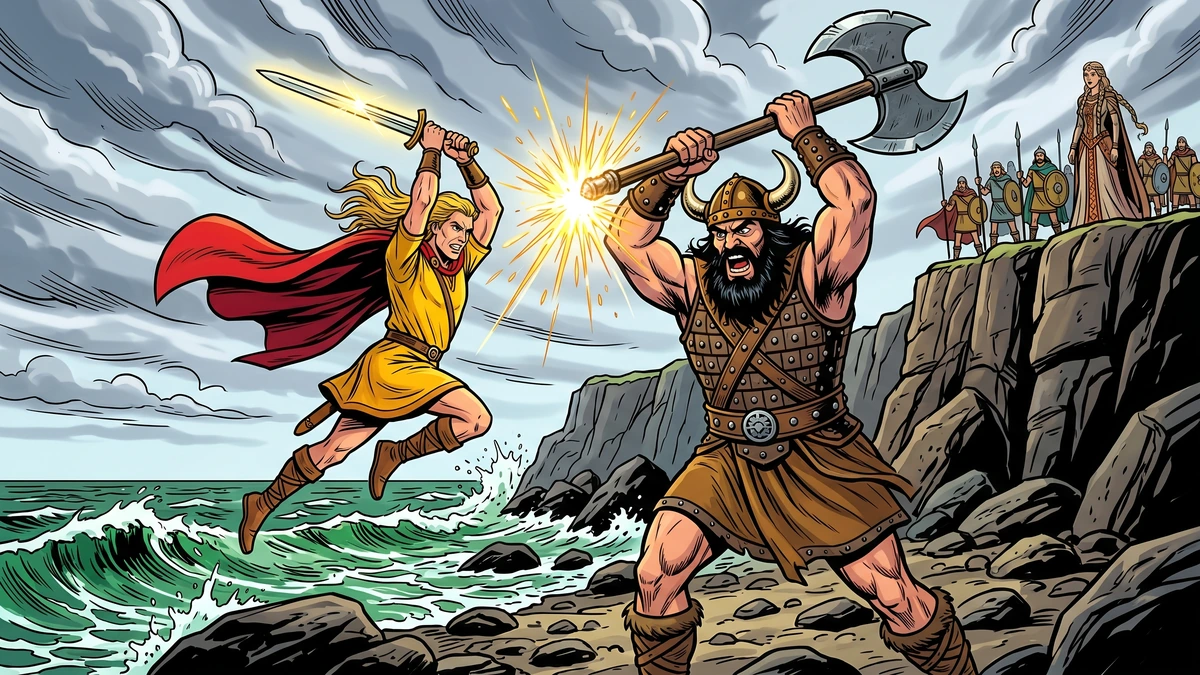
IV. The Combat at the Edge of the World
Morning came, and a morning in that country is broad and very still. The King of the Big Men called his greatest champion, a giant whose shadow blackened the strand, and bade him fight Fionn mac Cumhaill in single combat for the honour of both peoples. The champion swung an iron axe with two heads, each head as wide as a chariot-wheel. Fin drew his own sword Mac an Luin, the heir-blade of the Fianna, slim and bright.
The fight was long. The big man relied on his weight and his reach; Fin relied on what he had always relied upon — speed, footwork, and a clear head under fear. Three times the iron axe came down where Fin had been standing the breath before, and three times Fin was elsewhere. On the fourth pass Fin slipped inside the swing, and the long sword found a place under the helmet, and the matter was finished. The Big Men, who valued courage above all things, did not grumble. They lifted Fin on their shields and carried him three times around the hall, and the King himself put a great gold cup into his hands and said: “You may go home, captain of the Fians, and tell your people that the Big Men know honour when they meet it.”
The Queen of the Big Men gave Fin a parting-gift — by some tellings a cloak that could not be cut, by some a horn that called the wind — and she sent him back over the western water in his magic boat. The Fians on the Hill of Howth saw at last a speck on the eastern horizon: a boat coming home in the morning sun, with a small fair-haired man at the steering oar. They lit the great fire on the hill that night and did not put it out till dawn.
The Moral
From the Highland Gaelic recitation noted by John Francis Campbell, the storyteller closes with the line “Cha bhuannaichear ann an gnothach mór le neart amháin; buannaichear le modh agus le ealantachd.”
Which we may render: “A great matter is not won by strength alone; it is won by courtesy and craft.”
The tale carries that line at every layer. The three Heroes did not break down the Fians’ meadow with a battering-ram — they built a house on it and stated their errand inside its walls. The Queen of the Big Men did not draw a sword to save Fin — she covered him with the corner of her cloak. Fin himself did not match the giant champion blow for blow — he matched him cunning for force, and stepped inside the reach of his axe. The story-teller is teaching what the old fili always taught: a hero is not the strongest body in the room. A hero is the one who keeps a clear mind and a generous tongue when everything around him is larger than he is.
Why This Tale Has Lasted
Stories of the small hero who walks willingly into the country of giants are among the oldest stories the human race has told itself. Versions of this same plot can be found in the Greek-language Argonautica, in the Norse Útgarða-Loki episode of the Prose Edda, in the English chapbook of Jack the Giant Killer, in the Welsh Culhwch and Olwen, and in the Highland Gaelic cycles where this telling belongs. The constant beneath them is a piece of ancestral wisdom: that the world is bigger than any one of us, and that the only way to walk safely through it is with courage in the front of the heart and good manners in the front of the tongue. Fin’s voyage westward is, in the end, a voyage every reader still has to make. It is the journey out from the small known harbour of one’s own household into the larger sea of strangers who are stronger and stranger than oneself — and the story promises that, if one goes with courtesy, one may come home again with a gold cup and a tale to tell.
Sources, Versions, and the Line of Transmission
The version of the tale you have just read follows the contours laid down by John Francis Campbell of Islay in 1862, the closest printed witness we have to a full Highland Gaelic recitation. Campbell collected the story from one of his network of native reciters during the great Highland tale-gathering campaign he undertook with John Dewar, Hector MacLean, and Hector Urquhart between 1859 and 1862. The original Gaelic text, with Campbell’s facing English translation, appears in Volume III of Popular Tales of the West Highlands at pages 195 and following, under the title “Mar a chaidh Fionn do rìghachd nam Daoine Móra”.
Joseph Jacobs’s reworking in 1894 smoothed the language for English nurseries but kept the structural beats intact: the magic boat from the west, the conjured house, the messenger-combat, the voyage, the queen’s cloak, and the duel with the giant champion. The Jacobs version omits some of the more violent details Campbell preserved, but it is the version through which most modern readers first meet the story. Both texts are in the public domain and freely available through Internet Archive and Project Gutenberg.
Within the wider Fenian tradition, the tale belongs to the family of Fionn-and-the-otherworld stories that includes Bruidhean Chéise Chorainn (the Hostel of Quicken Trees), Bruidhean Eochaidh Bhig Dheirg, and the various tales of Fionn’s voyage to the underwater kingdom of Magh Mell. All these stories share the structural pattern called by Joseph Falaky Nagy “the journey to the otherworld testing-ground”: the hero leaves his familiar territory, enters a realm where the ordinary rules of size and time are suspended, and returns transformed but not destroyed. The tale-type ATU 301, in Hans-Jörg Uther’s revised classification (The Types of International Folktales, FF Communications 284–286, Helsinki, 2004), is the standard international filing-cabinet for stories of this shape.
For readers who wish to follow the trail further, the indispensable reference is still Reidar Th. Christiansen’s The Migratory Legends (Helsinki, 1958), which catalogues the Highland and Irish variants under group ML 6000. Eleanor Hull’s The Boys’ Cuchulain (1909) gives a popular but accurate retelling of the wider Fenian background. For the ethnographic context — what the Highland storyteller’s audience would have heard between the lines — Calum Maclean’s The Highlands (1959) and John MacInnes’s collected essays Dùthchas nan Gàidheal (Birlinn, 2006) remain unrivalled.
Frequently Asked Questions
Who is Fin in the story ‘How Fin went to the Kingdom of the Big Men’?
Fin in this story is the great Gaelic hero Fionn mac Cumhaill (also spelt Finn MacCool), captain of the Fianna, the legendary warrior-band of pre-Christian Ireland and Highland Scotland. He is the central figure of the Fenian Cycle (Fiannaíocht), one of the four great cycles of Old Irish literature, and appears across hundreds of medieval and early modern Gaelic tales as a wise, courteous, and physically gifted leader famed for his fair hair and quick wit.
Where does the original text of this tale come from?
The earliest printed witness is in John Francis Campbell of Islay’s ‘Popular Tales of the West Highlands’, Volume III, published by Edmonston & Douglas in Edinburgh in 1862, where it appears as tale number eighty-four with the Gaelic title ‘Mar a chaidh Fionn do rìghachd nam Daoine Móra’. It was later republished in English-only form by the folklorist Joseph Jacobs in ‘More Celtic Fairy Tales’ (David Nutt, London, 1894). Both volumes are in the public domain and the tale has been transmitted orally in the Highlands for many centuries before that.
What is the Kingdom of the Big Men?
In the Gaelic imagination the ‘Kingdom of the Big Men’ (Rìghachd nam Daoine Móra) is a kind of otherworld realm — neither Heaven nor Hell, but a separate country lying somewhere west of Ireland and Scotland, inhabited by giants who keep their own laws of honour, hospitality, and combat. It is a close cousin of Tír na nÓg, the Land of Youth, and of Magh Mell, the Plain of Delight. Folklorists classify these otherworld journeys under the international tale-type ATU 301 and motif F167 (otherworld inhabitants).
Why does the Queen of the Big Men hide Fin under her cloak?
The cloak gesture is one of the oldest images of mercy in Indo-European storytelling. In Gaelic custom a person under the corner of another’s cloak (in Irish ‘fá scáth a bhruit’) was placed under that person’s protection and could not be harmed without a breach of honour. The Queen’s act both saves Fin from immediate death and binds her husband, the King of the Big Men, to deal with him by the rules of formal combat rather than by sheer force. The same cloak-protection motif appears in the Welsh Mabinogion, in the Norse sagas, and in early medieval Irish law tracts.
What is the moral of the story?
The Highland storyteller closes with the line ‘Cha bhuannaichear ann an gnothach mór le neart amháin; buannaichear le modh agus le ealantachd’ — ‘A great matter is not won by strength alone; it is won by courtesy and craft.’ The tale teaches that courage is necessary but not sufficient: the small hero who walks willingly into the country of giants survives by good manners, quick wits, and footwork, not by trying to out-muscle the giants on their own terms. It is a piece of practical wisdom for any reader who finds themselves the smallest body in a large room.
You May Also Like
 Celtic Folk Tales
Ages 9-12
Celtic Folk Tales
Ages 9-12
Smallhead and the King’s Sons
Smallhead and the King's Sons: ong ago there lived in Erin a woman who married a man of high degree and had one daughter. Soon after the birth of the daughter
 Celtic Folk Tales
Ages 9-12
Celtic Folk Tales
Ages 9-12
The Russet Dog
The Russet Dog: h, he’s a rare clever fellow, is the Russet Dog, the Fox, I suppose you call him. Have you ever heard the way he gets rid of his fleas? Cunning
 Celtic Folk Tales
Ages 9-12
Celtic Folk Tales
Ages 9-12
Munachar And Manachar
Munachar And Manachar: There once lived a Munachar and a Manachar, a long time ago, and it is a long time since it was, and if they were alive now they would