The Russet Dog
The Russet Dog: h, he’s a rare clever fellow, is the Russet Dog, the Fox, I suppose you call him. Have you ever heard the way he gets rid of his fleas? Cunning
Canonical Sources: John Francis Campbell, Popular Tales of the West Highlands, Orally Collected, 4 vols (Edinburgh: Edmonston & Douglas, 1860–1862), with the Russet Dog and faithful-hound material in vol. III (Tales 65, 66, “Mac-A-Rusgaich”); J.G. Campbell of Tiree, The Fians, or Stories, Poems, and Traditions of Fionn and his Warrior Band (London: David Nutt, 1891); Whitley Stokes, ed., Acallam na Senórach, in Irische Texte IV (Leipzig: Hirzel, 1900); Eleanor Hull, The Cuchullin Saga in Irish Literature (London: David Nutt, 1898).
Tale Type: ATU 178A — The Innocent Dog (Hans-Jörg Uther, The Types of International Folktales, FFC 284–286, Helsinki: Academia Scientiarum Fennica, 2004, I.122–123). Motifs: Stith Thompson B331.2 (Llewellyn-and-Gellert: faithful dog killed); B524.1.1 (Dog kills serpent attacking master’s child); N342.3 (Hasty man kills helpful dog); F234.1.9 (Fairy in form of dog); B181 (Magic dog). Linguistic Note: Scottish Gaelic Cù Ruadh = “russet/red hound”; Old Irish cognate Cú Ruad, attested in Tochmarc Étaíne and the dindshenchas.
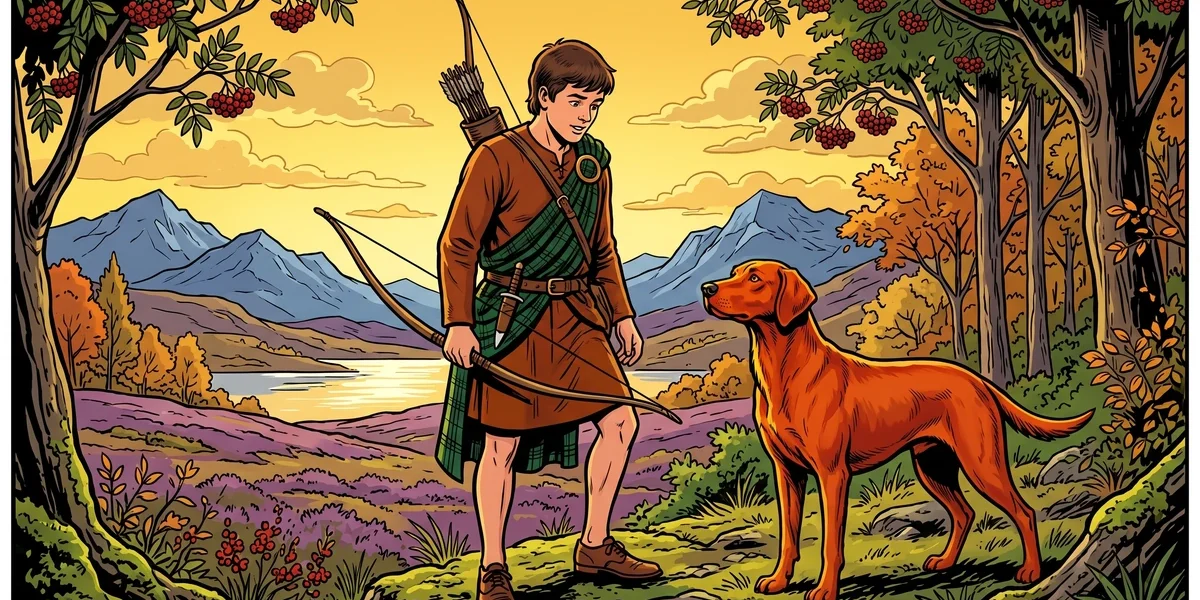
“The Russet Dog” — known in Scottish Gaelic as the tale of the Cù Ruadh — is one of the most distinctive animal tales in the Gaelic narrative tradition, sitting at the intersection of the Fenian Cycle’s hunting culture, the tradition of the marvellous hound, and the ancient mythological complex surrounding the dog as a liminal creature between the human and supernatural worlds. The tale, recorded in multiple variants across Scotland and Ireland, presents a dog of unusual colour, exceptional ability, and uncanny loyalty whose nature is gradually revealed to be more than ordinary — a being whose canine form conceals either a supernatural origin, an enchanted identity, or a quality of fidelity so extreme that it crosses from the animal into the mythological. The russet or reddish-brown colour of the dog is itself significant in the Celtic supernatural taxonomy, marking the creature as one that stands between the ordinary and the Other, neither the ominous white-with-red-ears of the death hound nor the common colours of mortal dogs.
The tale’s cultural roots run deep into the Gaelic world’s profound engagement with the dog as a companion in the hunt and in war. The hound in Irish and Scottish Gaelic tradition is not merely a domestic animal but a figure of mythological weight — Cú Chulainn’s very name (“Hound of Culann”) encodes this connection, as does the legendary status of Fionn mac Cumhaill’s hounds Bran and Sceolán, who were themselves enchanted humans. The russet dog participates in this tradition while adding its own distinctive narrative logic: its unusual colour, its remarkable capabilities, and the mystery of its origin or nature are the engines of a tale whose resolution typically involves recognition — of the dog’s true nature, of the human it serves, and of the bond that transcends species.
Synopsis and Narrative Core
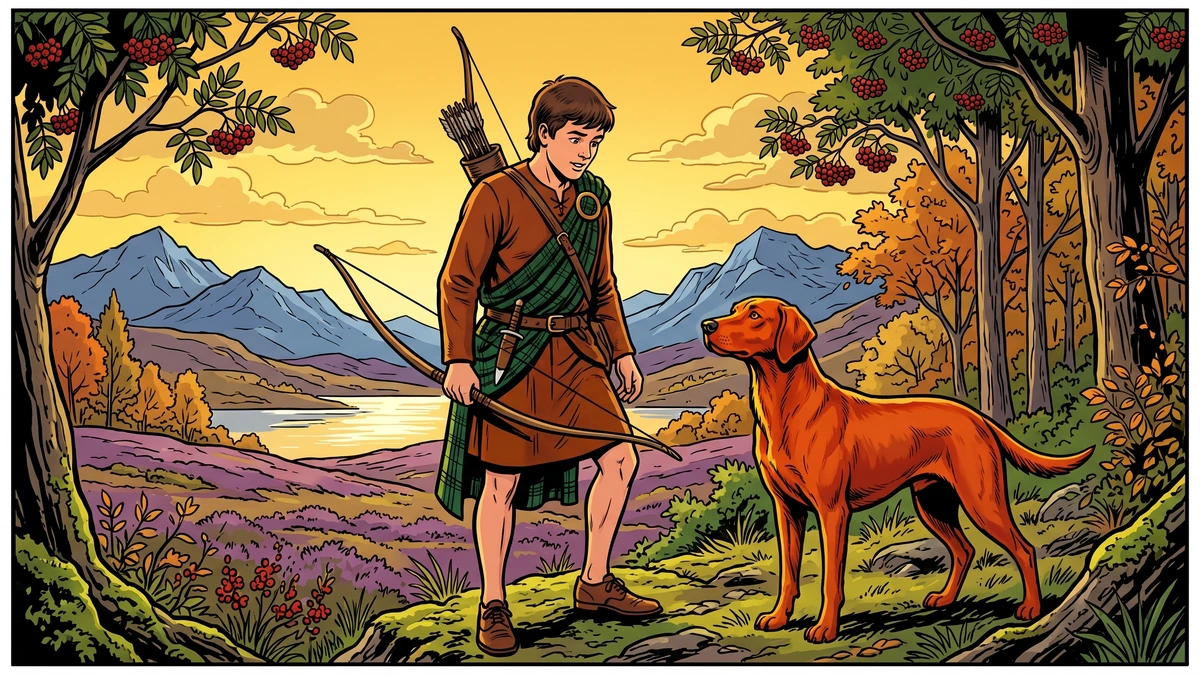
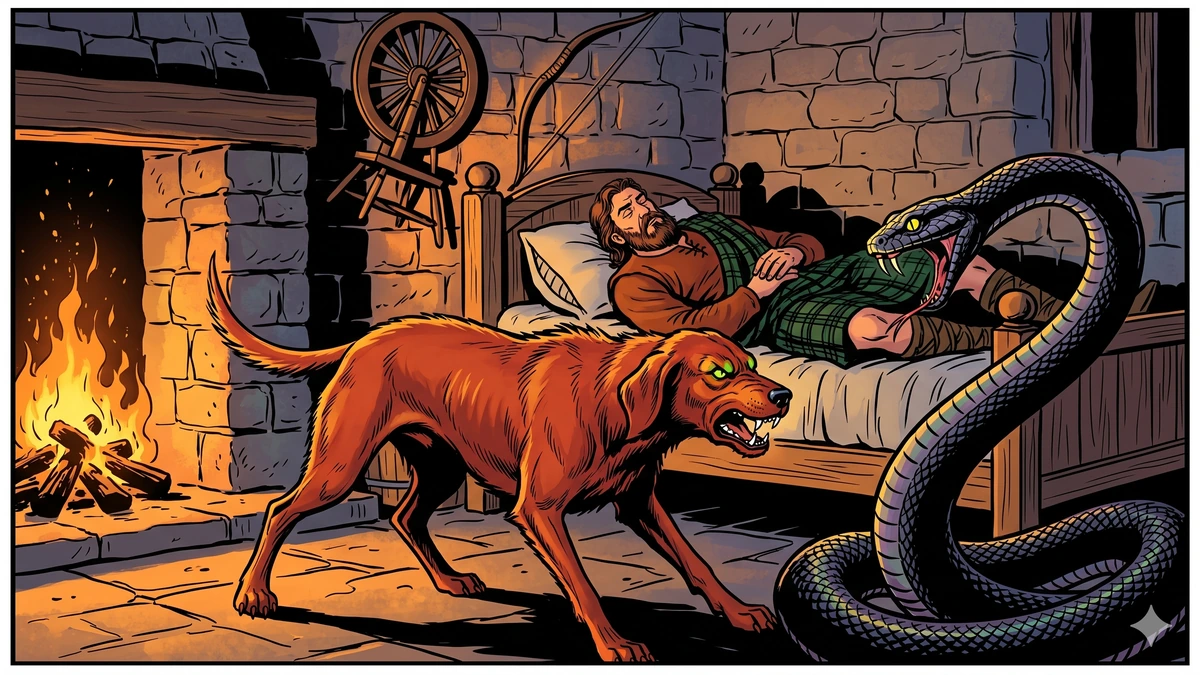
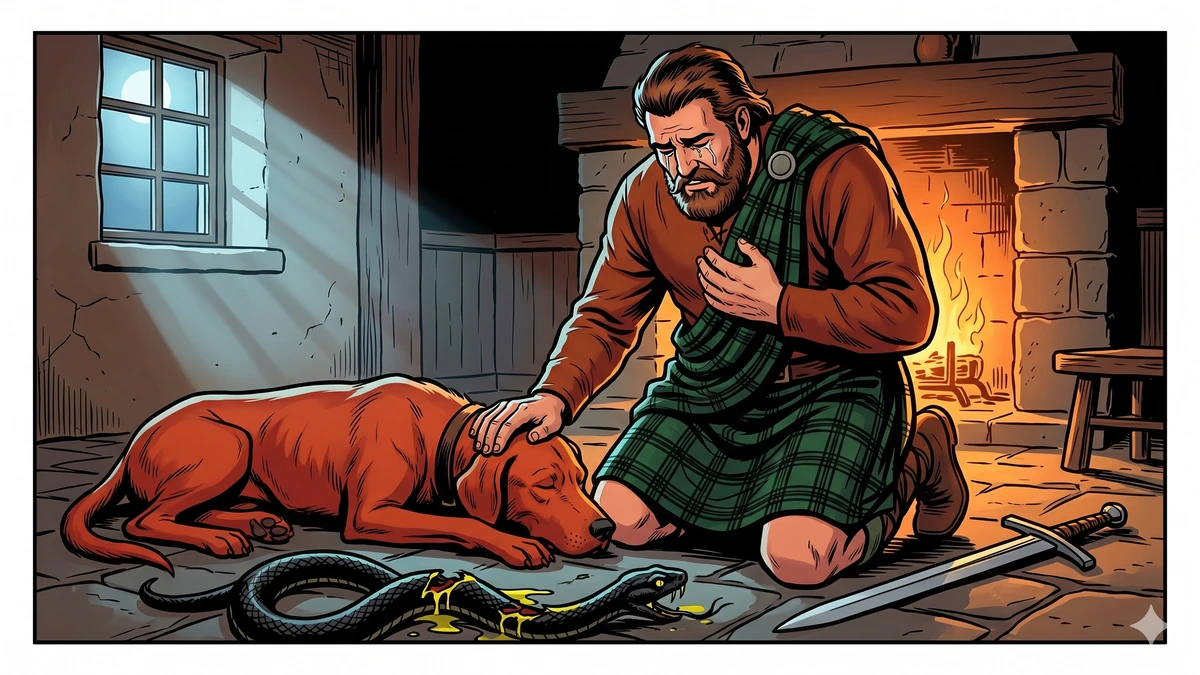
The tale centres on a hound of russet (red-brown) colouring that appears unexpectedly — sometimes in a hunter’s company, sometimes attached to a specific hero or household — and demonstrates capabilities far beyond those of ordinary dogs. The russet dog is invariably a creature of exceptional loyalty and fierce protectiveness, devoted to its human companion with a single-mindedness that becomes the engine of the narrative’s central tension. In many versions, the dog protects a child or a sleeping warrior from a supernatural threat — a serpent, a monster, an invader from the Otherworld — killing the threat at great cost to itself. The human, discovering the blood-covered dog standing over a seemingly threatened person, draws the wrong conclusion and kills the dog, only to discover too late what the dog had done.
This “faithful hound” structure places the tale in the worldwide family of stories sometimes called the “Gelert” type (after the Welsh legend of Llywelyn’s hound), classified as ATU 178A (The Dog Kills the Serpent). The Welsh legend of Gelert, the Irish tale of Bran and the wolf, and various Indian, Persian, and Eastern European analogues all share the same devastating structure: the dog’s fidelity is the cause of its death, because the very evidence of its faithfulness — the blood, the dead threat — is misread as evidence of guilt. The tragedy lies not in the dog’s failing but in the human’s inability to read the situation correctly before acting.
In the specifically Gaelic versions, this tragedy is often extended or complicated. Some Scottish versions give the russet dog a pre-narrative history that connects it to the Fenian tradition — it is, or was, a hound associated with Fionn’s great hunt, a creature of that heroic age now encountered in a diminished world that no longer recognises what it is looking at. The dog’s death in these versions is doubly tragic: it is the faithful hound killed by error, but it is also the last remnant of a heroic world killed by the incomprehension of a lesser age.
The Russet Colour: Supernatural Taxonomy and Liminal Status
The colour of the dog — russet, reddish-brown, tawny — is not merely a physical description but a marker of mythological status. In the Celtic supernatural taxonomy of animal colour, white animals are most commonly associated with the Otherworld (white hounds with red ears are messengers of death or fairy hunters; white deer are avatars of supernatural women; white horses carry Otherworld riders). Black animals can signal supernatural association in some traditions. But russet — the colour of autumn leaves, of certain kinds of iron, of dried blood — occupies a more ambiguous position, marking a creature as neither wholly of this world nor wholly of the other.
This ambiguity is functionally important in the tale. The russet dog is strange enough to attract attention and wonder, but not so obviously supernatural that it triggers immediate fear or reverence. It can be taken into a household, attached to a human, trusted and depended upon — and then killed by misreading, because its strangeness was noted but not fully understood. The colour is, in a sense, a visual metaphor for the dog’s narrative function: it stands between the fully known and the fully unknown, in the space where tragedy becomes possible.
In some versions of the tale, the russet colour is explicitly connected to supernatural origin: the dog was born in or near a fairy mound, or was given to a human by a supernatural patron, or has changed colour through an enchantment that has never been fully undone. In these versions, the russet colour is itself a kind of incomplete transformation — the dog is partway between a fully supernatural being and a fully natural one, and its death is the final resolution of that incomplete state, a return (in some versions) to its true form or its true world.
The Faithful Hound Motif: Celtic and Pan-European Parallels
The “faithful hound” motif that underlies “The Russet Dog” belongs to one of the most widely distributed narrative structures in world folklore. The tale type ATU 178A traces through dozens of cultures: the Indian story of the mongoose that kills a cobra and is killed by its owner in the Panchatantra; the Persian tale of the falcon and the bowl of water; the Welsh legend of Llywelyn’s hound Gelert (though this is largely a nineteenth-century literary construction rather than genuine medieval tradition); the Irish tale of Fionn’s hound Bran; and multiple eastern European, African, and South Asian variants. In every case, the structure is the same: a faithful animal servant destroys a threat, the evidence of its deed is misread as evidence of a crime, and the animal is killed before the truth can be established.
The Gaelic versions of this tale type are distinguished by their integration of the hound motif into the specific cultural complex of the heroic hunt and the Fenian tradition. Where Indian or Persian versions may use a mongoose, a falcon, or a dog in a domestic context, the Gaelic versions place the faithful hound in the landscape of the hunter-warrior — a world where the relationship between man and hound is already charged with a mythological weight that makes the tragedy of misreading especially resonant. To kill a hound in the Fenian tradition is not merely to kill a domestic animal but to destroy a companion in the deepest sense, a being whose loyalty is itself a form of heroism.
The emotional and moral weight of the misreading is also culturally specific in the Gaelic versions. The Irish and Scottish traditions place particular emphasis on the concept of fírinne — truth, or truthful judgment — as a foundation of good social order. A king who makes a false judgment brings disaster; a warrior who draws the wrong conclusion from evidence fails at a fundamental level. The owner of the russet dog has failed at this most basic level of correct perception, and the grief that follows is not merely emotional but moral and cosmic in register — the grief of someone who has acted wrongly in a world that demands correct action.
The Dog in Fenian Tradition
To understand the specific resonance of “The Russet Dog” in the Scottish Gaelic tradition, it is essential to appreciate the role of the dog in the Fenian Cycle — the body of tales surrounding Fionn mac Cumhaill and his warrior band, the Fianna. The Fianna were above all hunters, and their hounds were among their most prized possessions and closest companions. The cycle preserves the names and characteristics of multiple legendary hounds: Bran and Sceolán, Fionn’s two chief hounds, were actually the enchanted children of Fionn’s aunt, making them simultaneously dogs and humans, animals and kinsmen. This dual identity — the hound who is also, in some sense, a person — is the mythological background against which “The Russet Dog” plays out.
The Acallam na Senórach (The Conversation of the Old Men), the great compendium of Fenian lore composed in the twelfth century, preserves multiple episodes in which hounds of unusual quality or origin are encountered, tested, and either accepted into or rejected from the Fianna’s company. These episodes consistently emphasise the hound’s quality as a reflection of its owner’s quality: a great warrior has a great hound; the hound’s fidelity mirrors the warrior’s honour; the hound’s capabilities are an extension of its human companion’s heroic potential. When the russet dog appears in versions that connect it to this tradition, it carries all this accumulated meaning.
The gender politics of the dog in Fenian tradition are also worth noting. Bran and Sceolán are structurally female and male respectively in some tellings, and the loyalty of dogs in the Irish tradition is sometimes coded as a specifically feminine virtue — unconditional, self-sacrificing, not calculating advantage. The russet dog’s fidelity unto death participates in this coding, and the grief of the human who misreads and kills it is correspondingly gendered as a failure of the masculine virtues of clear perception and correct judgment. The tragedy of the tale is a masculine failure mourned in the register of feminine fidelity.
Regional Variation and Oral Tradition
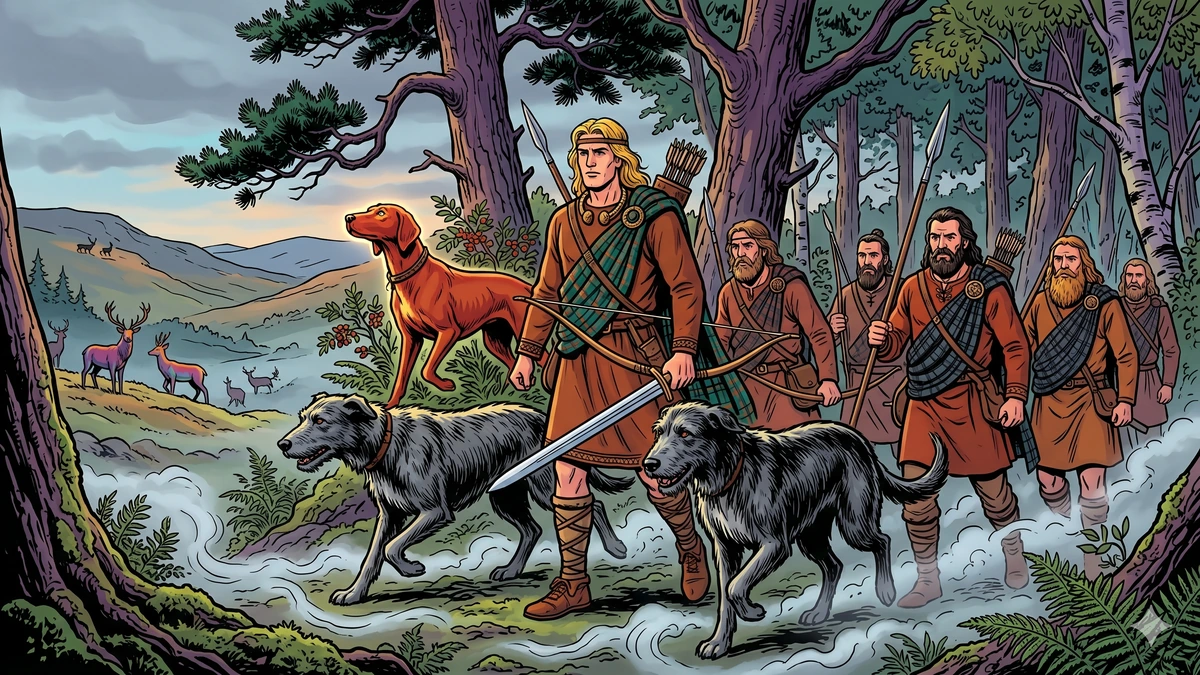
The tale of the russet dog has been collected across the Gaelic world in significantly different forms, and the regional variations illuminate both the tale’s flexibility and its cultural specificity. In Highland Scotland, particularly in Perthshire, Argyll, and the Hebrides, versions recorded by John Francis Campbell and later by the School of Scottish Studies tend to emphasise the Fenian connection — the dog is explicitly or implicitly associated with the heroic world of Fionn, and its death is the death of a heroic age. The landscape of these versions is invariably the Highland hunting ground: deer forest, loch-shore, mountain pass.
Irish versions, particularly those recorded in Connacht and Munster by the Irish Folklore Commission, tend to give the tale a more domestic setting and a stronger emphasis on the child-protection episode. In these versions, the dog is typically protecting a sleeping infant from a supernatural threat — a serpent, a cat of unusual size, an entity from the fairy realm — and the grief of the parent who kills the dog before discovering the dead threat is the emotional and moral heart of the tale. These versions connect to the wider Irish tradition of protective animals and the vulnerability of children to supernatural interference.
Ulster versions show the strongest integration with the heroic tradition, presenting the dog as a war-hound rather than a hunting dog and the human as a warrior rather than a hunter or parent. In these versions, the misreading is particularly acute: the warrior, trained to read signs of battle correctly, fails at the most basic level of situational reading and kills the companion who was protecting him. The tragedy here is specifically martial: a warrior’s error, measured against the standards of the heroic tradition that demand clear-sightedness in precisely the moments when emotion clouds judgment.
The Aftermath: Grief, Guilt, and Memorial
The aftermath of the faithful hound’s death is among the most emotionally powerful elements of the tale and among the most culturally revealing. The discovery of the truth — the killed serpent or monster, the undisturbed child or sleeping warrior, the evidence that rewrites the entire scene — is a moment of devastating reversal in which the human comprehends, too late, the full magnitude of what they have done. The grief that follows is not ordinary grief but is compounded by guilt: the loss is worse because it was unnecessary, because it was caused by the human’s own failure of perception.
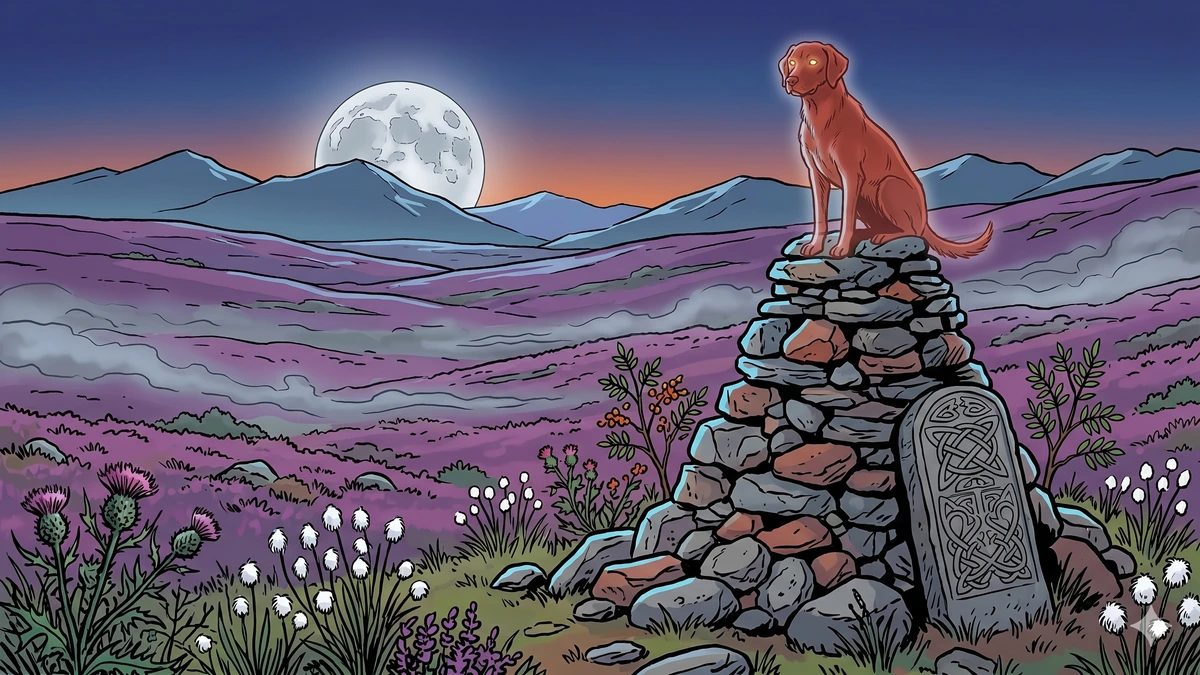
In many Gaelic versions, this grief takes a culturally specific form: it is memorialised in a place-name, a stone, or a narrative formula that preserves the dog’s fidelity against the human’s error. The Welsh legend’s association of the Gelert story with a specific grave-mound (Beddgelert — “Gelert’s Grave”) in Snowdonia has an analogue in Gaelic tradition in the naming of specific landscape features after faithful animals: a loch or hill or standing stone that bears the name of the dog and marks the site of its burial. This place-name memorialisation is one of the oldest narrative traditions in Celtic culture — it connects the dindshenchas tradition of Irish place-name lore to the specific emotional register of the faithful hound tale.
Some versions extend the aftermath further into a moment of supernatural resolution. In these variants, the dog’s spirit returns — in dream, in vision, at dusk near the burial place — not in anger or reproach but with the same unconditional fidelity it showed in life. The spirit-dog’s return is not haunting but consolation: it demonstrates that fidelity of this quality cannot be killed, that the dog’s loyalty persists beyond death and beyond the human’s error. This resolution transforms the tale from pure tragedy into something closer to the Irish concept of caointeachas — lamentation that contains within it an affirmation of the value of what is mourned.
Literary Adaptations and Cultural Legacy
The russet dog tradition has fed into broader Celtic literary culture in ways that range from the direct to the deeply embedded. The Welsh Gelert legend, though largely a nineteenth-century tourist-era elaboration of older material, reflects the cultural currency of the faithful hound narrative across the Celtic world and demonstrates how readily the emotional structure of the tale attaches to specific historical figures and places. In Scotland, the faithful hound narrative was a staple of the Romantic-era collections of Highland lore that fed directly into the cultural nationalism of the late eighteenth and early nineteenth centuries — Ossian’s poems, whether authentic Gaelic tradition or Macpherson’s reconstruction, draw on the emotional register of the Fenian hound tradition.
In Irish literature, the hound motif permeates writing from the medieval period through the revival. Standish O’Grady’s historical romances, Lady Gregory’s Cuchulain plays, and W.B. Yeats’s engagement with the Fenian tradition all draw, at varying removes, on the mythological complex in which the dog is a marker of heroic loyalty and its death a register of heroic loss. The specific tale of the russet dog has been less often adapted in literary form than its emotional logic has been absorbed into the broader cultural vocabulary of Irish and Scottish writing, where the faithful companion wrongly killed is a recurring figure of the gap between right action and right perception.
Contemporary storytelling traditions in Ireland and Scotland continue to treat the russet dog tale as a live narrative, performed at festivals and in schools as an example of the Irish and Scottish traditions’ capacity for emotional complexity. The tale resists easy consolation and refuses the redemptive arc of the transformation tale: the dog does not come back to life, the error cannot be undone, and the grief is real. This refusal of easy resolution is itself culturally significant — the Gaelic tradition has always valued the tale that tells a hard truth without softening it, and the russet dog’s story is one of the hardest and most enduring of these truths.
Moral and the Gaelic Wisdom Tradition
The moral force of “The Russet Dog” speaks in the lapidary register of Gaelic gnomic tradition. The Old Irish wisdom-text Audacht Morainn (“The Testament of Morann,” 7th–8th century, ed. Fergus Kelly, DIAS 1976) lays down as its first precept that fír flaithemon — the truth-act of the king — depends upon clear sight and unhasty judgment. To strike before knowing, the Gaelic tradition holds, is to make the world worse by the very act that intended to make it safer. The faithful hound’s blood is the price exacted by the world from those who act before they understand.
“Apair fris: ná bad fer co fírinde; ná bad breithem co heólas; ar is fír flaithemon dia tara folta in talman.”
— “Tell him: let him be no man without truth; let him be no judge without knowledge; for it is by the prince’s truth that the fruits of the earth are gathered.”
— Audacht Morainn §53, ed. Fergus Kelly, Dublin: Dublin Institute for Advanced Studies, 1976, p. 18.
The russet dog’s death is the obverse of this precept made narrative: a man without fírinne — without the truth-seeing that ought to precede the truth-acting — strikes, and the fruits of the earth recede. The Gaelic tale does not need to preach its lesson; it simply lets the dog die, and the man kneel beside the dead serpent, and the silence speak.
“The Russet Dog” endures because it encodes a truth about the limits of human perception and the cost of acting before understanding is complete. The dog’s fidelity is beyond question; it is the human’s ability to read correctly that fails. In the Gaelic tradition, which places the highest value on accurate perception and true judgment as the foundations of good action, this failure is not a minor slip but a moral catastrophe. And yet the tale does not condemn — it mourns. It mourns the dog, it mourns the human’s error, and it mourns the world in which beings of such absolute fidelity can be destroyed by the incomprehension of those they serve. The russet dog, tawny as autumn, faithful beyond death, stands in the Gaelic imagination as a figure of what loyalty costs — and what it is worth.
You May Also Like
 Celtic Folk Tales
Ages 9-12
Celtic Folk Tales
Ages 9-12
The Field Of Boliauns
The Field Of Boliauns: One fine day in harvest it was indeed Lady-day in harvest, that everybody knows to be one of the greatest holidays in the year Tom
 Celtic Folk Tales
Ages 9-12
Celtic Folk Tales
Ages 9-12
The Little White Cat
The Little White Cat: A long, long time ago, in a valley far away, the giant Trencoss lived in a great castle, surrounded by trees that were always green. Even
 Celtic Folk Tales
Ages 3-5
Celtic Folk Tales
Ages 3-5
The Selkie Wife: A Scottish Tale of Love and the Sea
The Selkie Wife: A Scottish Tale of Love and the Sea: On the rocky shores of Scotland, where the North Sea crashes against ancient cliffs, there lived a