The Shepherd Of Myddvai
The Shepherd Of Myddvai: Up in the Black Mountains in Caermarthenshire lies the lake known as Lyn y Van Vach. To the margin of this lake the shepherd of
The Shepherd of Myddfai — in Welsh, Bugail Myddfai — is among the oldest and best-attested local legends of Wales. It is anchored to a single body of water, Llyn y Fan Fach (“the lake of the little peak”), a glacial corrie lake on the northern flank of the Carmarthenshire Black Mountains, beneath Bannau Sir Gaer. The legend is inseparable from a real medieval medical lineage, the Meddygon Myddfai, court physicians to Rhys Gryg, Lord of Dinefwr (d. 1234). When Joseph Jacobs printed the story in Celtic Fairy Tales in 1892, he abbreviated a much longer narrative whose canonical printed form had appeared three decades earlier in the great folio volume edited for the Welsh Manuscripts Society by the Rev. John Williams ab Ithel and translated by John Pughe, FRCS, of Aberdyfi: The Physicians of Myddvai; Meddygon Myddfai (Llandovery: D. J. Roderic; London: Longman & Co., 1861), in which the Llyn y Fan Fach legend is prefixed to the medieval medical text proper, edited from the Red Book of Hergest (Jesus College, Oxford, MS CXI), the Llanover manuscripts of Lady Llanover (now NLW MSS), and the Tonn collection. The story is what folklorists now classify as ATU 400 (The Man on a Quest for His Lost Wife) with strong subtype features of the Celtic swan-maiden / lake-bride complex; Stith Thompson catalogues the central episode under motif C31.1.2 (Tabu: striking supernatural wife). It is the type-specimen of the gwragedd annwn — the lake-fairy wives of Welsh popular belief.
I. The Three Visitations at the Lake
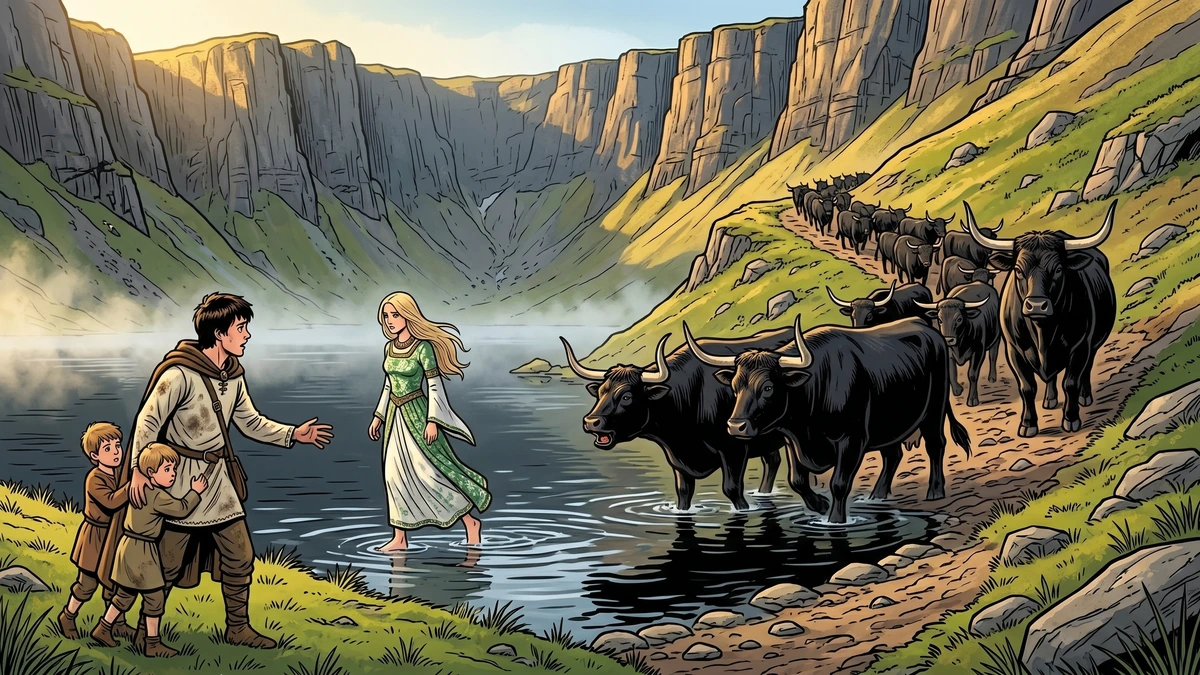
The setting of the legend is geographically precise. A widow of Blaen Sawdde, the upland farm near the village of Llanddeusant in the parish of Myddfai, sent her only son to graze the family’s small herd on the grasslands above the lake. He was a young shepherd in cob jacket of undyed cream wool, a long brown brethyn cartref cloak fastened at the shoulder, and rough leather esgidiau brogues; he carried a hazel staff and a wallet of dark Welsh oat-bread. The lake lay in a basin of dark slate beneath the cliffs of the Bannau, its surface so still that the great corrie above it seemed to hang inverted in the water. Sir John Rhûs, recording the legend at Myddfai itself in the late nineteenth century, fixed the place with topographical exactness in Celtic Folklore: Welsh and Manx, 2 vols (Oxford: Clarendon Press, 1901), I.2–3.
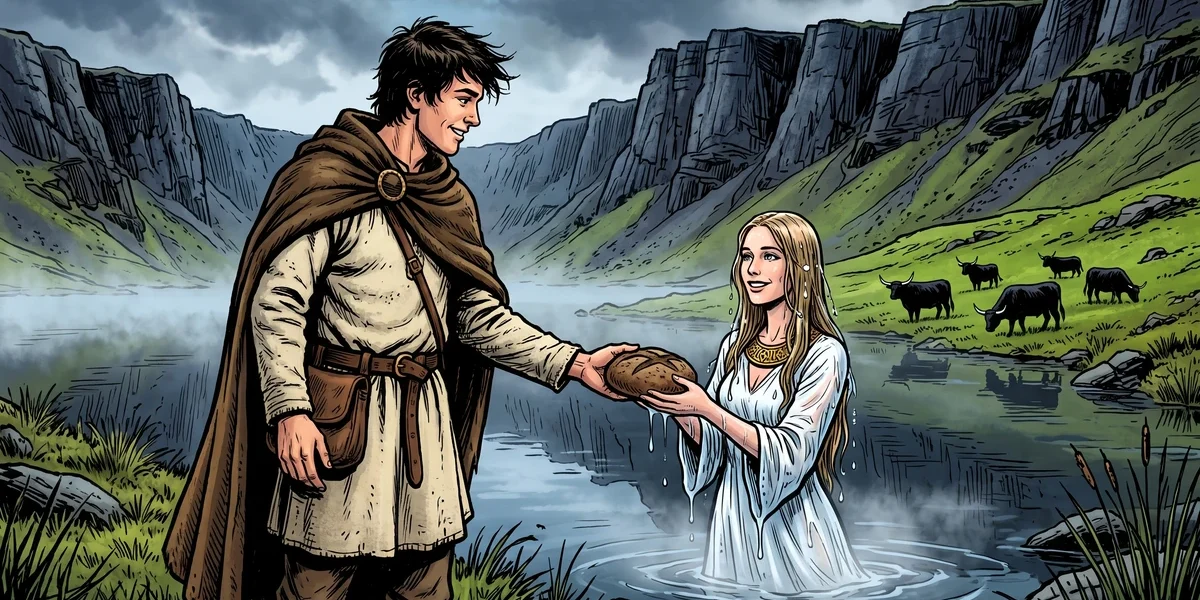
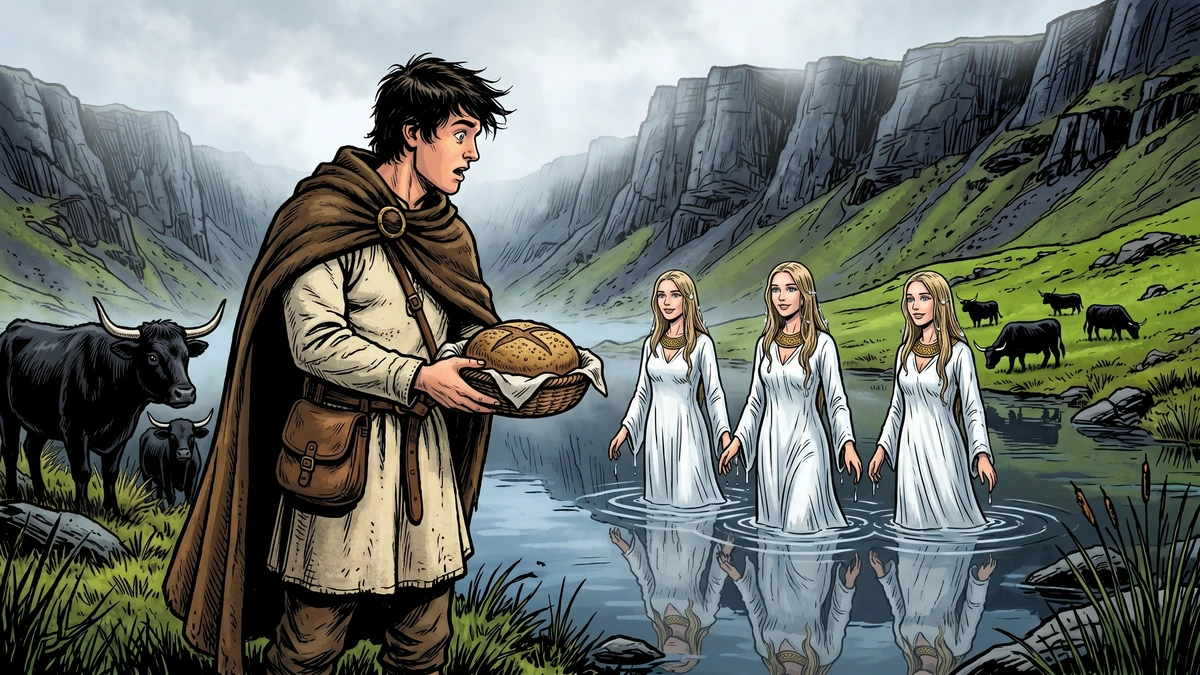
At noon on the first day, as the cattle drowsed and the shepherd dipped his oat-bread in the lake to soften it, the dark water broke and three young women rose to its surface, shaking from their fair hair what looked like silver drops. They glided to the margin and walked barefoot among his beasts. He understood at once that they were of the tylwyth teg, the Fair Family, and that the loveliest of them — for there was one whose face stayed his breath — had no human mother. He offered her his bread. She tasted it, and sang to him in a voice neither sad nor merry:
Cras dy fara,
Nid hawdd fy nala.Hard-baked is thy bread,
Not easy to catch me.
And she ran laughing into the lake. On the second day he offered her bread half-baked, scarcely set. She tasted it and sang:
Llaith dy fara,
Ti ni fynna.Unbaked is thy bread,
I will not have thee.
And again she vanished. On the third day, taught by his mother, he offered her a loaf he had found floating on the lake’s edge — bread neither cras nor llaith, but the gift of the water itself. She tasted it and, this time, did not refuse. Pughe and ab Ithel’s 1861 edition records the bread-formula and its couplets in Welsh and English on facing pages, and on this point the longer text is far richer than Jacobs’s 1892 abbreviation.
II. The Marriage, the Dowry, and the Geis
The lake-maiden agreed to marry the shepherd on a single condition: tri ergyd diachos — “three causeless blows.” If he should strike her three times without just cause, she would return to the lake, and her father’s gifts with her. This is a geis: a formal, ritual prohibition of the kind catalogued in the Old Irish material by Tom Peete Cross (Motif-Index of Early Irish Literature, Indiana University Press, 1952, C31). The shepherd, who could imagine no circumstance in which he might strike her, agreed at once.
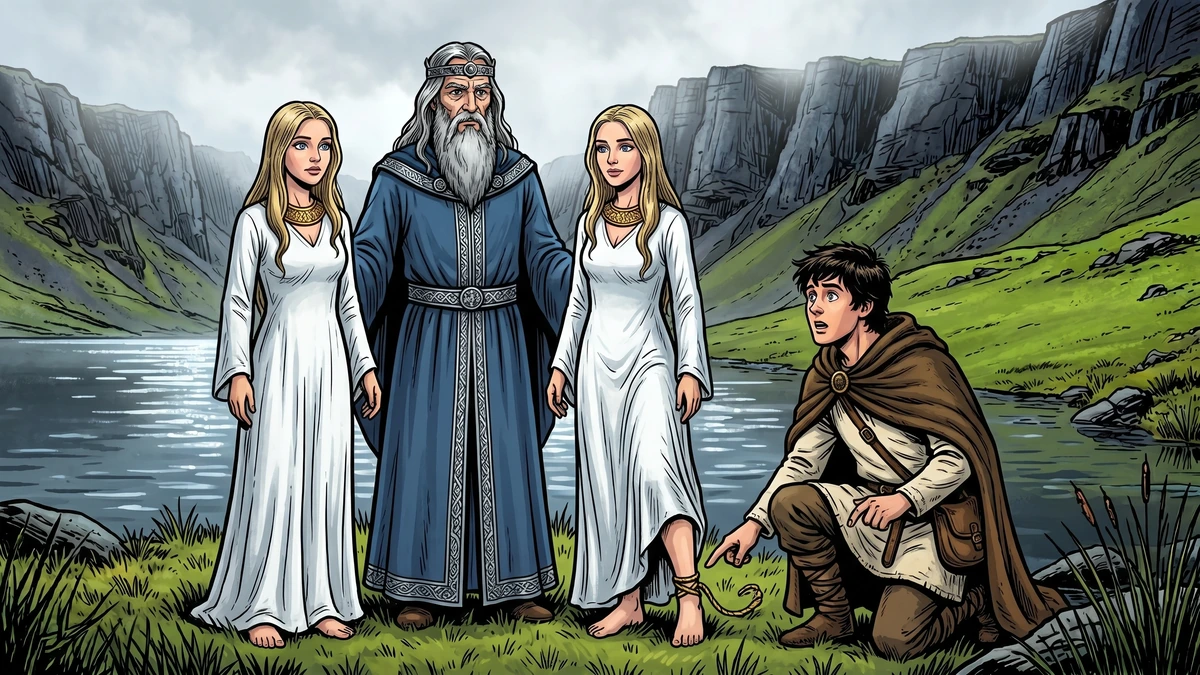
To seal the bargain her father, a tall grey old man of the lake whose two daughters stood beside him so alike that the shepherd hesitated, asked the shepherd to choose his bride. He looked from one to the other and could not tell them apart — but he had noticed, the day before, that her sandal-strap was tied in a particular way at the ankle, and by this small earthly detail he picked her out. The old man laughed and gave his daughter as dowry whatever cattle she could count in a single breath. She counted, and there rose from the lake five times five of the small dark long-horned Welsh cattle of the hill country, with two great oxen and a black bull. They were led down the valley to the farm of Esgair Llaethdy, near Myddfai, where the shepherd’s mother had her holding; and there, in the years that followed, three sons were born to them. Their names are preserved in the medical apparatus of the 1861 edition: Cadwgan, Gruffydd, and Einion; though in the older Red Book genealogy the eldest is Rhiwallon, ancestor of the dynasty, and his brothers are listed as Cadwgan and Gruffydd.
The marriage prospered. The Welsh cattle of Esgair Llaethdy throve as no others in the Tywi valley; the dairy of the farm gave its name to the holding (llaethdy, “milk-house”); and the three children grew strong, watchful, and fond of their strange mother, who taught them, on the lower slopes above Llanddeusant, the names and uses of every plant of the upland.
III. The Three Causeless Blows
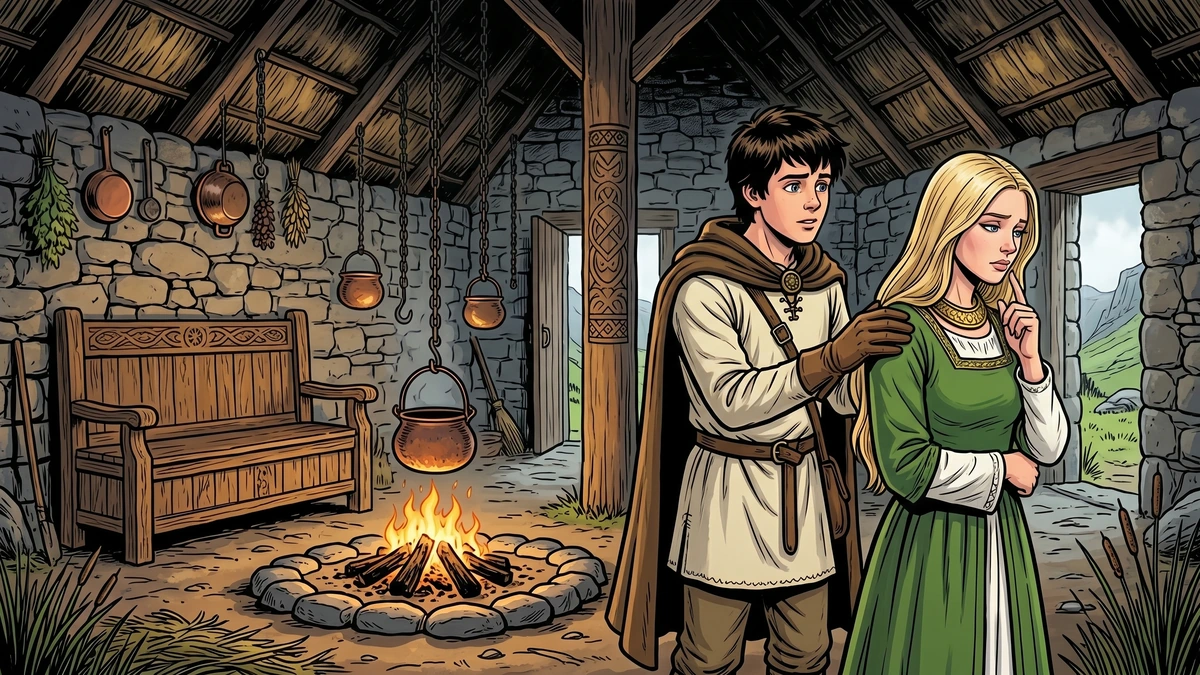
The first blow fell at a christening. The lake-wife was reluctant to walk so far. Her husband told her to fetch the horses. “I will,” she said, “if you will bring me my gloves, which I have left in the house.” He went to the house, returned with the gloves, and found her unmoved; she had not stirred toward the stable. He tapped her lightly on the shoulder with the gloves — not in anger but in playful reproach. Y cyntaf, she said: that is the first. He was bewildered: he had not struck her in anger. But the geis took no account of his intent. A blow without sufficient cause was a blow; the word diachos means precisely “without cause,” and it is the cause, not the force, that the prohibition weighs.
The second fell at a wedding feast. While the company laughed and the harp played a tune of welcome, the lake-wife suddenly began to weep. Her husband, ashamed before the guests, tapped her on the shoulder and asked what ailed her. “I weep,” she said, “because the man and the woman whom they are joining are entering into sorrow; and your trouble is now upon you, because that is the second causeless blow. Be careful, husband; the third is the last.” From that day he kept watch upon his hand, and for many years he did not transgress.
But the third blow came — as the strict logic of the legend requires — not in anger and not in jest, but as a small thoughtless gesture against the order of feeling. The neighbours had gathered for a funeral, and as the procession moved past the coffin the lake-wife laughed aloud. Her husband, mortified, touched her on the shoulder — only touched her — and said: “Is this a time for laughter?” “I laugh,” she said, “because those who die go out of trouble; and your trouble has now come, for that was the last causeless blow.” She rose, kissed her three sons, and walked out of the house and back along the steep mountain path toward Llyn y Fan Fach. As she came to the water her cattle, the great black bull at their head, lowed once and followed her. Even, says the legend, the ploughing-yoke of four oxen that was at that moment turning over the new tilth in the field above the farm broke its chain and went with her. The whole of the lake’s dowry, every horn of it, passed back into the dark water. There is a hollow in the upland still called Cwys Yr Ychen Bannog, “the furrow of the long-horned oxen,” cut, the people of Myddfai say, by their last departing plough.
IV. The Lady’s Return: The Physicians of Myddfai
The lake-wife was gone, but she had not abandoned her sons. On a still morning she appeared to the eldest, Rhiwallon, on the bank of a small stream called the Nant y Meddygon (the “stream of the physicians”) above the farm. She told him that his earthly calling was to be a healer of men, and that she would teach him. She brought him to a particular hillside above the lake where the medicinal herbs grew thickest, named each plant by its Welsh and Latin names, and dictated to him the indications and the doses for which each was used. Day after day she returned, until he and his two brothers had learned the whole pharmacopoeia of the tylwyth teg. From these three brothers, the legend says, descended the Meddygon Myddfai — the Physicians of Myddfai — who served the Lord Rhys Gryg of Dinefwr (d. 1234) and his successors as hereditary court physicians, and whose practice continued in the parish for nearly six hundred years; the last of the line, John Jones of Myddfai, died in 1739 and is buried in the churchyard there.
The medical manuscript itself — the Meddygfeydd Myddfai — survives in several thirteenth- and fourteenth-century witnesses, including the Red Book of Hergest (Jesus College, Oxford, MS CXI), British Library Additional MS 14912, and the Tonn manuscripts now at the National Library of Wales. It is the longest single medical text in medieval Welsh and one of the most important vernacular medical compilations of the British Isles, contemporary with the Trotula of Salerno and the Bald’s Leechbook of Anglo-Saxon England. Its herbal sections show extensive borrowing from the European herbal tradition (Pseudo-Apuleius, Macer Floridus), but its remedies for cattle-fevers, milk-curd, and lake-side intermittent fevers are distinctively local to the Tywi valley. The 1861 edition reproduces the Welsh text on the left page and Pughe’s English translation on the right, with ab Ithel’s editorial annotations between.
The Moral
The moral of the Shepherd of Myddfai is preserved in the Welsh proverb that the people of Myddfai still attached to the legend in the nineteenth century. Rhûs records the formula in Celtic Folklore:
Tri ergyd diachos a wahanant gariad oddi wrth gariad.
Three causeless blows part love from love.
The legend is not a tale about cruelty — the shepherd is gentle from first to last, and the three blows are all light, none of them given in anger. It is rather a tale about the irreducible difference between the natural world (which forgives small thoughtlessness) and the Otherworld (which does not). The geis of the lake-wife is not a contract to be measured by force or by intention; it is a ritual term, and once the term is broken it cannot be unbroken. To live with a creature of the Otherworld is to live every day inside the precise wording of an oath. Carelessness is itself the offence. The proverb sets, as its parallelism makes clear, the small careless blow against the long marriage, and asserts that the small thing is sufficient to part the great thing. It is the same moral logic that governs the Norse tale of Hadingus and the Irish Tochmarc Étaíne; the same logic, in a Christian register, that governs Eve in the Garden and Lot’s wife at Sodom; a small turning aside, a small forgetting, and the gift is forfeit.
Why the Tale Has Lasted
The Shepherd of Myddfai has lasted for at least eight hundred years — the medical manuscript that depends on it is securely datable to the early thirteenth century — because it does several rare things at once. It anchors a tale of the Otherworld to a real place: you can walk to Llyn y Fan Fach today, climb the corrie above it, find the furrow of the long-horned oxen, and see the parish church of Myddfai where the last of the physicians lies buried. It anchors a tale of magic to a real profession: the Meddygon Myddfai were court physicians of real consequence, and their pharmacopoeia is a serious medieval document. It explains, in narrative form, why a particular family in a particular Welsh upland village inherited a particular and unusual skill — an explanation of much greater interest to the people of the valley than any abstract account of guild apprenticeship would have been. And it preserves, almost without alteration, an extraordinarily archaic mythic pattern: the marriage of a mortal man to a being from the water, the geis that hedges the marriage, the inevitable transgression of the geis, the loss of the wife and her dowry, and the consolation of the children, who inherit from their lost mother a knowledge their fellows do not have. The same pattern shapes the Old Irish Mac Dathó’s swan-women, the Breton Mor-Bran tales, the Norse selkie complex, and (one degree further out) the Greek myth of Peleus and Thetis. To stand at the rim of Llyn y Fan Fach on a still morning is to stand at the precise point in the British Isles where this pattern has put down its deepest local roots, and the proof of those roots is not in any one manuscript but in the eight-centuries-long continuity of a medical practice descended, the people of the parish insisted, from a woman who came out of the lake.
Frequently Asked Questions
Where is Llyn y Fan Fach, and is the place named in the legend real?
Llyn y Fan Fach (“the lake of the little peak”) is a real glacial corrie lake on the northern flank of the Carmarthenshire Black Mountains in south-west Wales, beneath the cliffs of Bannau Sir Gaer. The widow’s farm of Blaen Sawdde sits in the parish of Llanddeusant; the marriage farm of Esgair Llaethdy lies in the neighbouring parish of Myddfai; and the parish church of Myddfai, where the last hereditary physician of the legendary line, John Jones, is buried under a stone dated 1739, can be visited today. Sir John Rhûs walked the whole topography of the legend in the 1880s and 1890s and recorded it in Celtic Folklore: Welsh and Manx (Clarendon Press, 1901), I.2-3.
Who were the Physicians of Myddfai, and is the medical manuscript real?
The Meddygon Myddfai were a real medieval Welsh medical dynasty. According to the legend, Rhiwallon and his two brothers (variously named Cadwgan, Gruffydd, and Einion) inherited their healing knowledge from their lake-fairy mother and became hereditary court physicians to Rhys Gryg, Lord of Dinefwr (d. 1234). The Welsh-language medical compilation associated with them, the Meddygfeydd Myddfai, survives in multiple thirteenth- and fourteenth-century manuscript witnesses including the Red Book of Hergest (Jesus College, Oxford, MS CXI), British Library Additional MS 14912, and the Tonn collection now at the National Library of Wales. The full text was edited and translated for the Welsh Manuscripts Society by John Pughe and the Rev. John Williams ab Ithel as The Physicians of Myddvai; Meddygon Myddfai (Llandovery: D. J. Roderic; London: Longman, 1861).
What is the meaning of the bread test at the lake, and why three breads?
The bread test (cras-llaith-y dwfn, hard-soft-floating) is a near-universal motif in Welsh and Manx lake-bride legends and is catalogued by Stith Thompson under motif F302.4.1.1 (Fairy bride won by offer of food). Hard-baked bread (cras) is the food of the human upland farm; unbaked or sodden bread (llaith) is the food of mere want. The third loaf, which floats on the lake’s edge and is acceptable, is bread that has been transformed by the water itself — neither human nor wholly fairy. The maiden agrees to a marriage that is, like the bread, an intermediate condition: she lives on land but is bound to the lake, and the precise terms of that intermediacy are fixed by the geis of the three causeless blows.
How is the legend classified in modern folklore scholarship?
It is the type-specimen of the Welsh gwragedd annwn (lake-fairy wives) complex, which Hans-Jörg Uther (The Types of International Folktales, FF Communications 284-286, Helsinki, 2004) places within ATU 400 (“The Man on a Quest for His Lost Wife”) with strong subtype features of the Celtic swan-maiden tradition (Stith Thompson motif B81, F302, C31.1.2). The geis of the three causeless blows is the central distinguishing feature of the Welsh sub-type and aligns it with the Old Irish geis-tradition catalogued by Tom Peete Cross (Motif-Index of Early Irish Literature, Indiana University Press, 1952). Parallels survive in Norse selkie traditions, Breton mor-bran (“sea-women”) tales, and the Anglo-Welsh border legend of Wild Edric.
Is the moral about cruelty, or about something else?
It is emphatically not about cruelty. The shepherd is gentle throughout: the three blows are all light — a tap with a glove, a tap on the shoulder, a touch of the hand — and none is given in anger. The moral, fixed in the Welsh proverb Tri ergyd diachos a wahanant gariad oddi wrth gariad (“Three causeless blows part love from love”), is about the irreducible strictness of the Otherworld bargain. A geis is a ritual term, not an emotional one. The wife asks not that her husband be kind — he is kind — but that he be careful; carelessness in itself constitutes the offence. The same logic governs Eve’s tasting of the fruit, Lot’s wife’s backward look, and the Old Irish Tochmarc Étaíne: a small turning aside, and the gift is forfeit.
You May Also Like
 Celtic Folk Tales
Ages 9-12
Celtic Folk Tales
Ages 9-12
Princess Finola And The Dwarf
Princess Finola And The Dwarf: A long, long time ago there lived in a little hut in the midst of a bare, brown, lonely moor an old woman and a young girl.
 Celtic Folk Tales
Ages 9-12
Celtic Folk Tales
Ages 9-12
The Salmon of Knowledge
The Salmon of Knowledge: In the ancient days of Irish mythology, when magic flowed through the world as freely as water through a stream and the pursuit of
 Celtic Folk Tales
Ages 9-12
Celtic Folk Tales
Ages 9-12
The Children of Lir
The Children of Lir: In the time when magic still dwelt in the lands of Ireland and the boundaries between the mortal world and the realm of the Sidhe were