The Story of the McAndrew Family
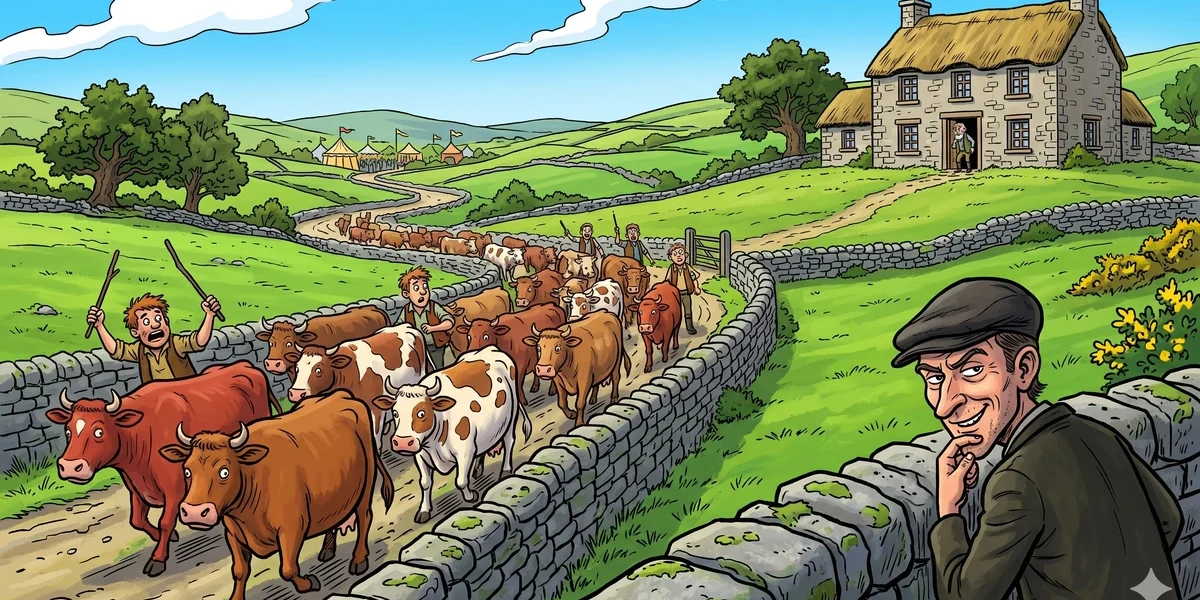
The Story of the McAndrew Family: long time ago, in the County Mayo, there lived a rich man of the name of McAndrew. He owned cows and horses without number
The Story of the McAndrew Family
Canonical Attribution
| Source | Joseph Jacobs, More Celtic Fairy Tales (1894); drawn from Connacht oral tradition, County Mayo |
|---|---|
| Irish Context | County Mayo, western Connacht; the story engages with the Irish fairy tradition of the sídhe and the fairy cattle (bó sí), as well as the consequences of fairy entanglement for mortal families |
| ATU Tale Type | ATU 470 — Friends in Life and Death; elements of ATU 1640 (The Brave Tailor) and Irish fairy bride/fairy gift sub-types; Motif F301 (Fairy lover); F241 (Fairies have cattle); N411 (Treasure found) |
| Thematic Tradition | Part of the broader Irish sídhe tradition; connects to Connacht legends of fairy hills (cnoic sí), the fairy realm beneath the land, and the price mortals pay for fairy assistance or proximity |
I. The House of McAndrew
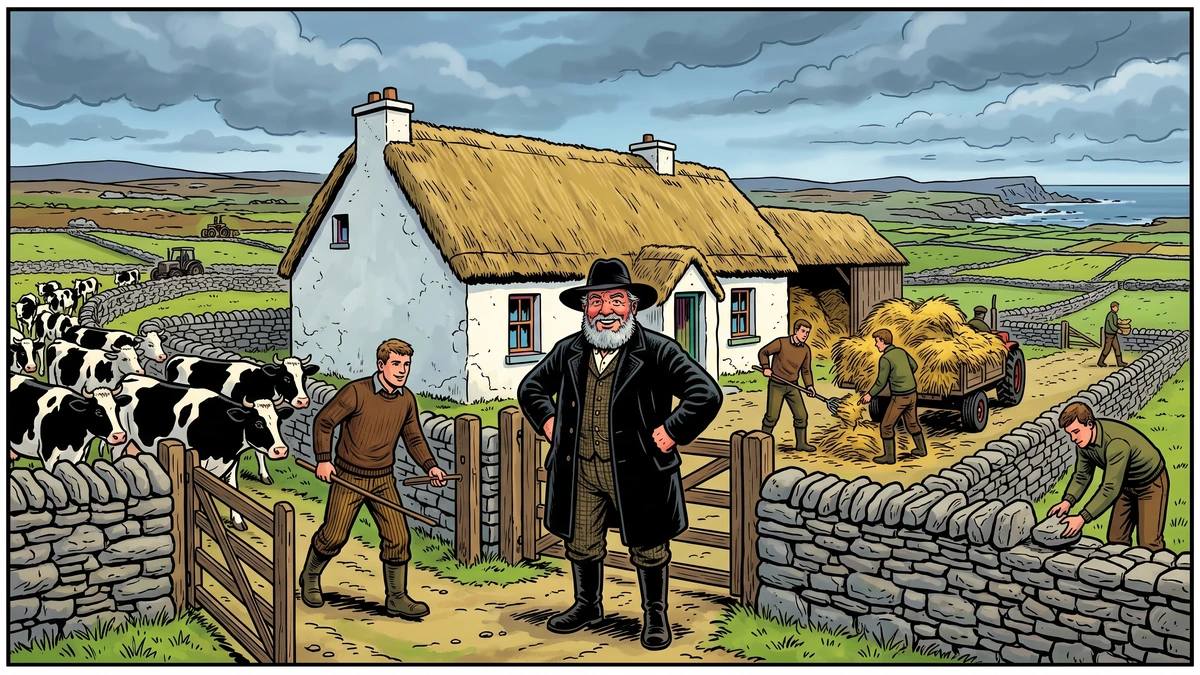
In the county of Mayo, in the west of Ireland where the Atlantic wind comes unimpeded off three thousand miles of open ocean and the land is a patchwork of stone wall and bogland and sudden fierce green, there lived a rich man named McAndrew. He owned cows and horses in numbers that his neighbours could not count, and geese and pigs and farmhands, and land that ran to every horizon. By every measurable standard of his world, McAndrew was a man who had been given everything.
He had also been given seven sons, and this was where the accounting grew complicated. Seven sons, each healthy, each growing like a weed in spring — and in that western Ireland of hungry land and inherited farms, seven sons and one farm was a problem that no man could solve by patience alone. The eldest would inherit, as the law required; what would become of the other six was a question that darkened McAndrew’s sleep on more nights than he cared to admit.
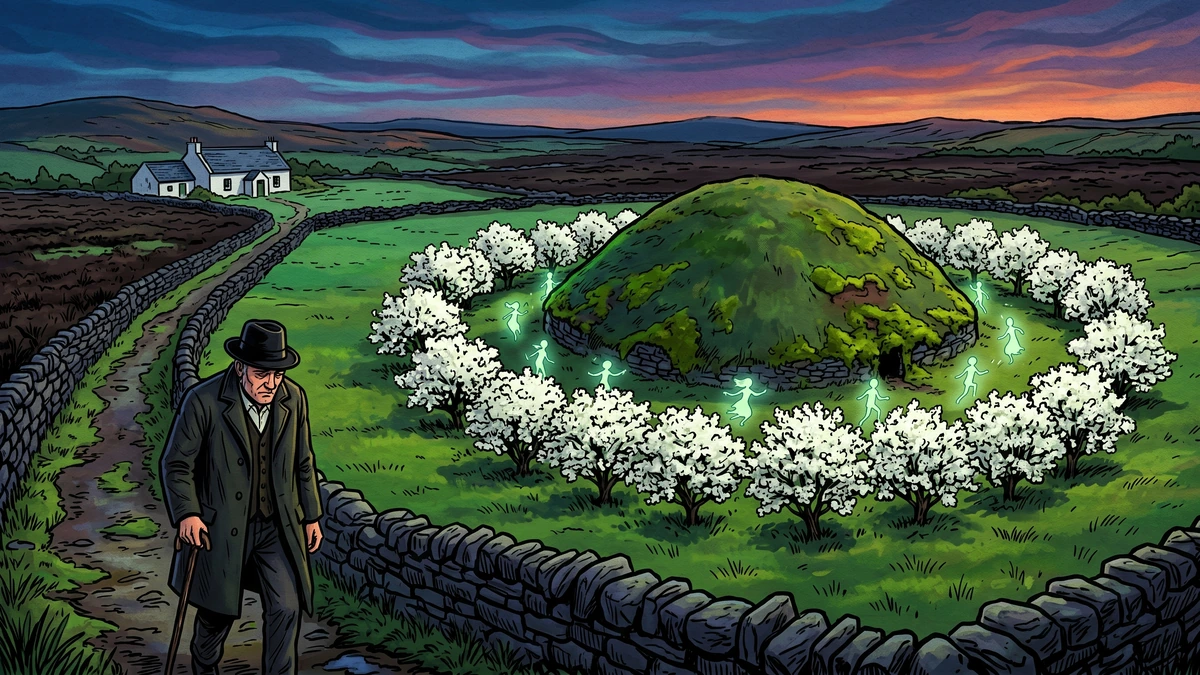
The fairy mounds of Connacht — the cnoic sí, the hills where the Tuatha Dé Danann retreated when the Gaels took Ireland — were an established feature of the Mayo landscape, as present in the daily reckoning of those who farmed their shadows as the weather or the price of cattle. Men who lived close to the fairy hills were expected to observe certain courtesies: not ploughing too near the mound, not drawing water from the spring on the western side after dark, not speaking ill of the good people within earshot of the hill. McAndrew, being a practical man, observed all of these without much thought, as one observes the tide or the calendar.
It was therefore something of a surprise when the fairy hill repaid his courtesy.
II. The Gift from the Mound
The help, when it came, was subtle — as fairy help in Ireland almost always is. It did not arrive with trumpets or apparitions but in the ordinary texture of good fortune: a calf found in the field that no cow of McAndrew’s had dropped, calves that grew faster and gave richer milk than any natural stock, a grey mare that appeared one morning in the paddock without explanation and could outrun every horse in the county. Each of these gifts came from the direction of the fairy hill.
McAndrew, being the kind of man he was, accepted the gifts and asked no questions. He knew enough of the tradition to understand that fairy gifts are not unconditional — they are always, in some sense, loans — and that the accounting would come in its own time. In the meanwhile he expanded his herd, sold cattle at favourable prices at the Mayo fairs, and prospered in ways that his neighbours attributed to good management and God’s favour and which McAndrew himself attributed, privately, to the hill.
The hill, for its part, seemed to require only one thing in return: that the McAndrew family continue to live quietly, honestly, and in proper relationship with the land they occupied. No son of McAndrew was to cheat his neighbour, bring shame on the family, or fail in his duty to those who depended on him. These were not difficult conditions. McAndrew raised his sons accordingly, and for a generation the arrangement held, and the family prospered, and the fairy hill sat quietly in its field and asked for nothing but the respect of proximity.
III. The Breaking of the Compact
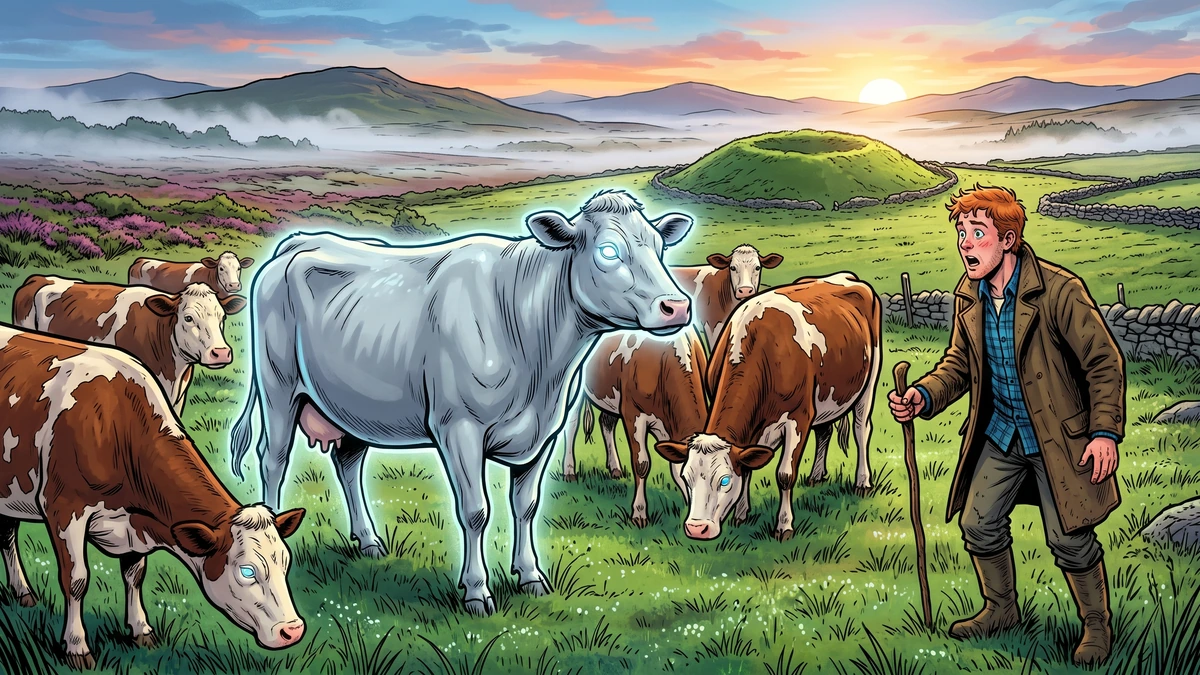
Trouble, in Irish fairy tales, comes most often not from deliberate malice but from carelessness — from the forgetting, in a moment of haste or pride or temptation, of what one owes and to whom. The McAndrew compact with the fairy hill did not break dramatically. It began to fray at its edges in small ways, across a generation: a son who drove too hard a bargain at the fair, another who was sharper with his tenants than McAndrew had ever been, a grandchild who ploughed a field that had always been left fallow, near the boundary of the mound.
Each small thing alone might have been overlooked. Together they accumulated into a debt that the hill eventually required to be settled. The manner of the settling was neither violent nor unusual by Irish supernatural standards — it was simply a withdrawal of goodwill. The fairy cattle grew lean. The grey mare’s line failed. Crops that had always come in well began to suffer from late frost and wet summers. Neighbours who had always thought the McAndrews lucky began to revise their opinion.
“Is dual do mhac an chait luch a mharú.”
“It is natural for a cat’s son to kill a mouse.”
— Irish proverb on the inheritance of character, Mayo oral tradition
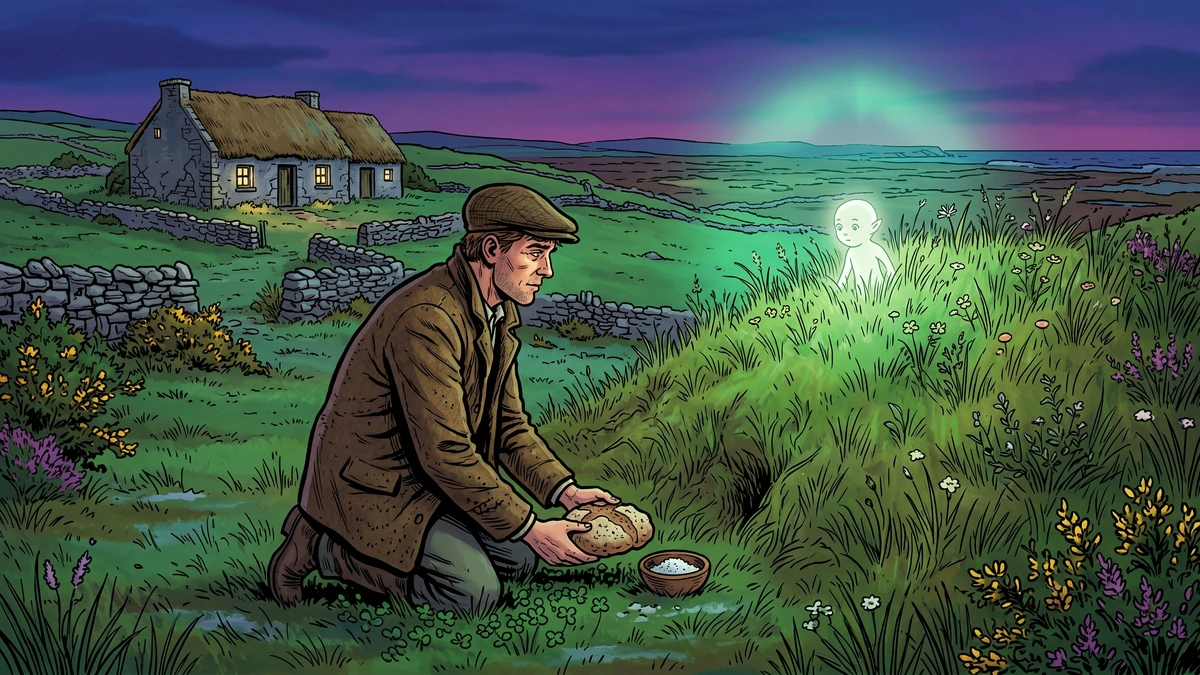
The oldest son, coming into his inheritance in the middle years of this decline, recognised what had happened more clearly than any of his predecessors had. He was the one in the family who still remembered the old stories, who still walked the long way round when he passed the mound at dusk, who still left the western spring untouched after dark. He understood that the debt was real and that it had to be paid — not in money or in cattle, but in the only currency the sídhe ever ultimately accepted: a return to right relationship.
IV. The Restoration
The restoration of the McAndrew family’s fortunes was not accomplished by any single dramatic act but by the patient work of a man who understood that the fairy world operates on the same principle as the natural world: slowly, through proper attention, over time. The eldest son fenced off the field nearest the mound and left it permanently fallow, as his grandfather had done. He left the May morning dew on the grass around the hill untouched. He settled the sharper of his brothers’ debts quietly and without broadcasting the fact. He was, in short, a fair man — and a fair man in Connacht fairy tradition is the best protection against the withdrawal of fairy goodwill.
The grey mare’s line did not return, but other good fortune did — smaller, steadier, the kind that comes from being known in your community as a man of his word. The McAndrew farm did not again reach the heights of the old patriarch’s legendary prosperity, but it survived. The family continued. The seven sons’ descendants spread across Mayo and Galway and, eventually, across the Atlantic to Boston and New York, carrying with them the old stories about the family’s fairy hill, which they told to their children in rooms very far from the Connacht bogland, on winter nights, as a reminder of where they had come from and what it had cost and why it mattered to keep faith with the ground beneath your feet.
The Moral
“Caith an saol le cineáltas agus fillfidh an cineáltas chugat.”
“Treat the world with kindness and kindness will return to you.”
— Irish proverbial wisdom, County Mayo oral tradition
The McAndrew story is a generational parable: prosperity built on right relationship with the land and the invisible powers that inhabit it is sustainable; prosperity built on forgetting what was owed is not. The fairy world in this tale is not hostile — it is simply just. It gives generously to those who live generously and withdraws when they do not. The restoration comes not from any heroic intervention but from a grandson returning to his grandfather’s habits of careful, respectful, honest dealing with the world around him. The tale encodes a deeply practical piece of West of Ireland agricultural wisdom: the land remembers how you treat it, and so does the community, and so — in the old Irish understanding — do the powers that dwell beneath the land.
Why This Story Has Lasted
The story of the McAndrew family survived in the oral tradition of County Mayo because it spoke to a genuine anxiety of rural Irish life: the problem of how a family’s fortunes could rise and fall across generations, and the need for an explanatory framework that made sense of that rise and fall in moral terms. The fairy hill provided that framework. A family prospered because it had been fair and respectful; it declined because a later generation forgot what the first had known; it recovered when someone remembered. This arc was both emotionally satisfying and practically instructive — it told its listeners what they needed to do.
Joseph Jacobs, who collected the tale for his 1894 More Celtic Fairy Tales from Connacht oral sources, recognised its place in the broader Irish tradition of stories in which the sídhe function not as capricious supernatural enemies but as a kind of moral accounting system embedded in the landscape — invisible but responsive, impartial but not indifferent. That function has kept the tale alive long after the specific social conditions that produced it have passed, because the underlying anxiety — how do families maintain what they have built, across generations? — is permanent.
You May Also Like
![The Fairy Tree Of Dooros.[6]](https://indianfolktales.com/wp-content/uploads/2026/05/P-0829-the-fairy-tree-of-dooros-6-cover-400x260.webp) Celtic Folk Tales
Ages 9-12
Celtic Folk Tales
Ages 9-12
The Fairy Tree Of Dooros.[6]
The Fairy Tree Of Dooros.[6]: Once upon a time the fairies of the west, going home from a hurling-match with the fairies of the lakes, rested in Dooros Wood
 Celtic Folk Tales
Ages 3-5
Celtic Folk Tales
Ages 3-5
The Three Golden Hairs of Grandfather Know-All: A Czech Tale of Wit and Destiny
The Three Golden Hairs of Grandfather Know-All: A Czech Tale of Wit: In the Kingdom of Bohemia, there lived a nobleman who was obsessed with destiny. He had
 Celtic Folk Tales
Ages 9-12
Celtic Folk Tales
Ages 9-12
The Huntsman’S Son
The Huntsman’S Son: A long, long time ago there lived in a little hut on the borders of a great forest a huntsman and his wife and son. From his earliest