The Tale Of Ivan
The Tale Of Ivan: There were formerly a man and a woman living in the parish of Llanlavan, in the place which is called Hwrdh. And work became scarce, so the

The Tale of Ivan
Canonical Attribution
| Source | Joseph Jacobs, More Celtic Fairy Tales (London: David Nutt, 1894); sourced from Welsh oral tradition, Llanlavan parish, north Wales |
|---|---|
| Welsh Setting | Parish of Llanlavan (Llanfabon), Glamorganshire or alternatively Gwynedd, Wales; the place-name Hwrdh may refer to a specific farm or hamlet in the Welsh uplands |
| Tradition | The tylwyth teg tradition — the Welsh equivalent of the Irish sídhe; the fair folk of Welsh legend who inhabit fairy mounds, lakesides, and liminal places, and who engage in contracts and exchanges with mortals on terms that are precise but never fully explained |
| ATU Tale Type | ATU 650A — Strong Hans; elements of ATU 313 (The Girl as Helper in the Hero’s Flight) and ATU 554 (The Grateful Animals); Motif F601 (Extraordinary companions); G530 (Ogre’s relative aids hero) |
| Welsh Context | The tale reflects the Welsh tradition of the gwas y neidr (serpent’s servant) and magical craft apprenticeship; the protagonist’s journey east for work echoes historical Welsh labour migration patterns |

I. Ivan Goes East to Find Work
In the parish of Llanlavan, in the upland country of Wales where the fields run thin over limestone and the wind comes in off the hills with a particular directness, there lived a man and his wife in the place called Hwrdh. They were not wealthy and they were not starving, but work had grown scarce — scarcity of that slow, grinding kind that does not arrive as a single blow but as a steady diminishment, month by month, until one morning you reckon up what you have against what you owe and find the numbers do not balance.
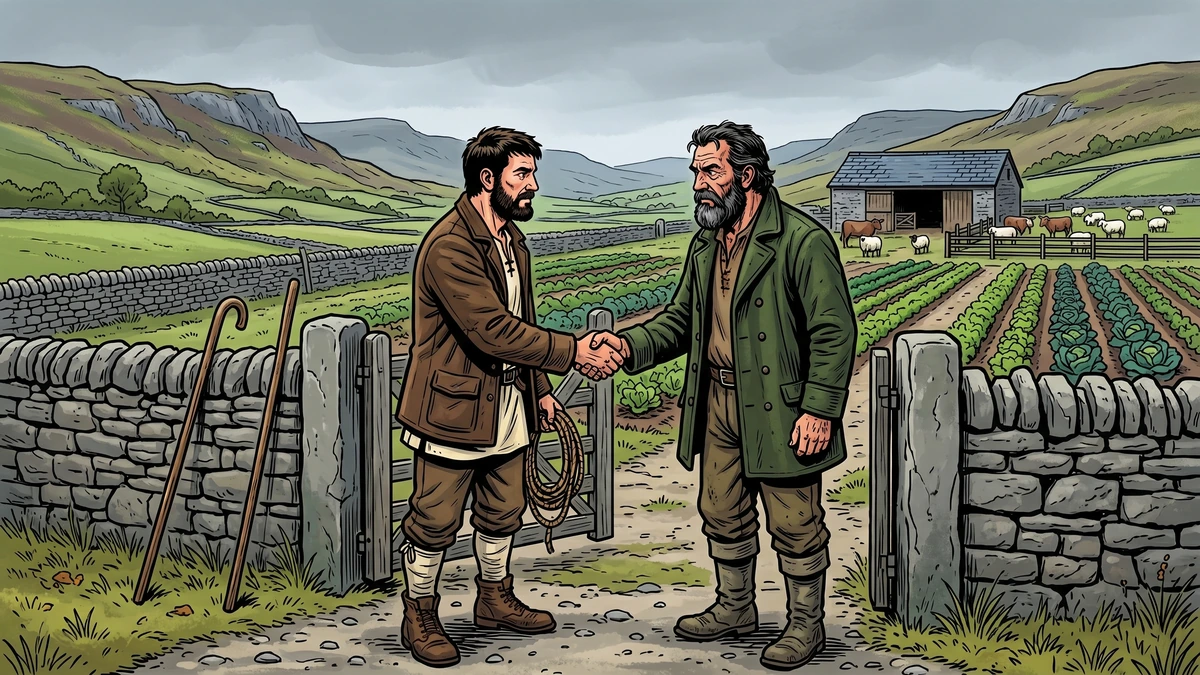
“I will go east to search for work,” the man — Ivan — told his wife. “You may live here till I return.” He took fair leave of her, kissed her, and set out walking eastward through Wales, through the country of the March, until he came at last to a farm in the lower country where a farmer stood at his gate watching the road with an expression of calculated evaluation.
“What work can you do?” said the farmer.
“I can do any work that needs doing,” said Ivan, which was the standard answer a man gave when he needed a position badly enough to be flexible about its content.
The farmer hired him on the spot, at wages that were fair by the standards of that district, on one condition: that either party who left the employment before the year was out would lose the right to complain about anything the other had done. This was an unusual clause, and Ivan noticed it, and hired on anyway, because men who have walked far from home for work are not in a strong negotiating position.
II. The Farmer’s Strange Conditions
The work itself was not unusual — the ordinary labour of a working farm, the feeding and herding and fencing and mucking that fills a working day from first light to last. What was unusual was the farmer himself, and the things he did not explain.
He was a man of certain rules that he announced rather than justified. Ivan was not to go into the barn after dark. He was not to draw water from the well in the eastern field on Fridays. He was not to follow the farmer when the farmer went, once a month, to the far meadow alone at midnight. He was not to ask what the large iron chest in the kitchen contained. Ivan, who had signed a contract that prevented him from complaining, observed all of these prohibitions with the patience of a man who has made a practical decision and intends to honour it.
“Araf deg mae dal iâr.”
“Gently, gently, one catches a hen.”
— Welsh proverb on the virtue of patience and observation, north Wales oral tradition
He did not ask. He watched. And what he observed, in the course of a year’s close attention, was that the farm ran on principles that had nothing to do with good farming practice and everything to do with some older arrangement between the farmer and the powers that inhabited the land around him. The crops grew too evenly. The animals never died of ordinary causes. The rain fell when it was needed and stopped when it was not. The farmer knew things before they happened — not by prediction but by a particular quality of attention, as if he were in continuous quiet conversation with something Ivan could not see or hear.

III. The Test at Year’s End
At the end of the year the farmer called Ivan to account, and what he required was not money or goods but a task — a specific, impossible-seeming task of the kind that in Welsh and Irish tradition signals that a mortal has come to the attention of beings who operate by different rules. He was to go to the high lake before dawn and bring back water from its exact centre in a vessel that had no bottom. He was to do this before the cock crew at the farm, or the contract would be forfeit.
This was, by any rational measure, impossible. Ivan took the bottomless vessel and walked up to the lake in the last dark before dawn, and he stood at the water’s edge and thought about it, and he was not by nature a man given to despair, so he thought practically: what could he use? What did he have? What did the lake offer that might plug a bottomless vessel long enough to carry water to the farmhouse?
The answer came from the lake itself — or from something in the lake, a voice barely louder than the water moving against the shore, that told him the clay from the eastern bank, packed firm against the vessel’s base, would hold long enough if he moved quickly. Ivan packed the clay. He moved quickly. He arrived at the farm gate as the cock took its first breath to crow, and he tipped the water into the farmer’s hand, and the contract was honoured.
IV. What Ivan Learned
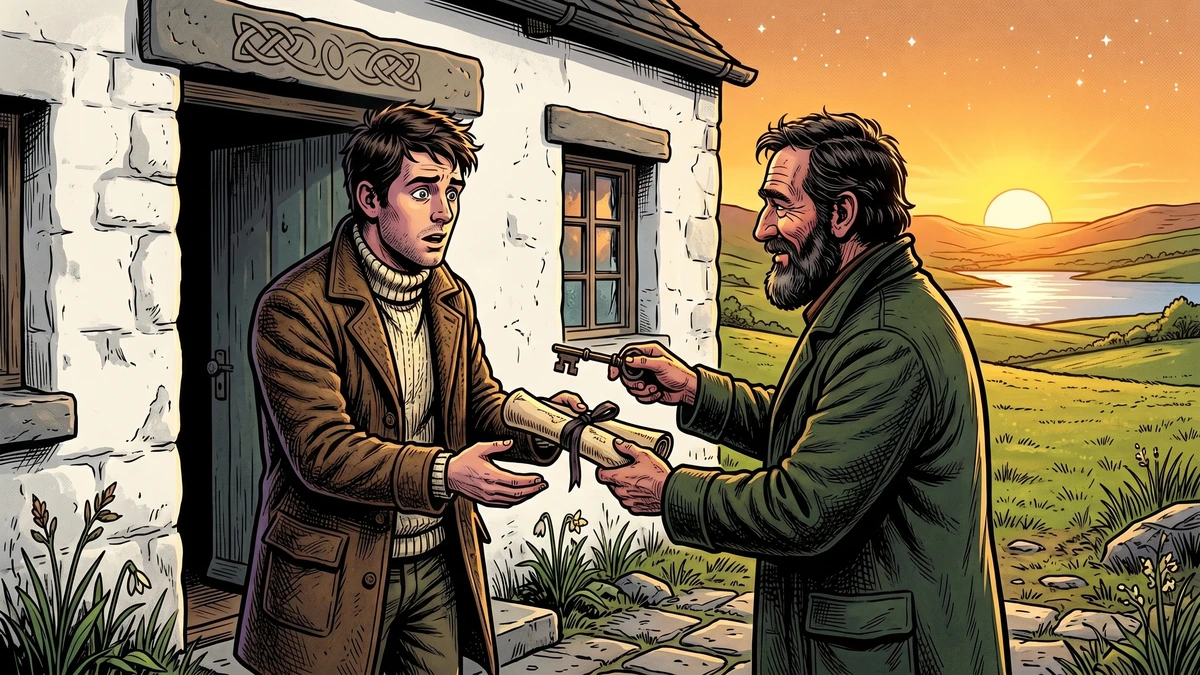
The farmer paid Ivan his year’s wages and added something that money could not buy: the knowledge of where the voice in the lake had come from, and what the farm’s arrangement with the local tylwyth teg was, and how a man could live in that country in right relationship with the powers that inhabited it. He gave Ivan a specific piece of land near his own farm — the eastern meadow that Ivan had been forbidden to enter — and told him to settle there and farm it by the principles he now understood.
Ivan walked back west to Llanlavan, to the house at Hwrdh, and he brought his wife east with him to the new land. They farmed it as the farmer had taught — with attention, with patience, with respect for the prohibitions that the previous tenant had observed, and with the understanding that certain things could not be explained but had to be trusted. They prospered, after the fashion of people who ask the right questions and wait for the answers.
The lake where Ivan had drawn water from its centre is still there in the Welsh uplands. On still mornings, before the cattle are brought down, you can sometimes hear a sound from its surface that is almost a voice. Those who know what it is are careful not to mention it. Those who don’t know can listen all they like and never be quite sure whether it is the water or the wind or something older than either.
The Moral
“Nid da lle gellir gwell.”
“That is not good where something better may be had.”
— Welsh proverbial wisdom, north Wales oral tradition
The tale’s moral is embedded in the contract Ivan signs: a man who complains about what he has agreed to has waived the right to be heard. The farmer’s conditions are strange, but Ivan signed them knowing they were strange, and his willingness to honour them — without complaint, without evasion, without demanding explanations — is the quality that earns him the reward at the end. The lesson is not obedience for its own sake but the more refined virtue of keeping faith with what you have freely chosen, even when what you have chosen turns out to be harder than you expected. The tylwyth teg, in this tale as in Welsh tradition generally, are not testing Ivan’s strength or cleverness but his integrity: does he mean what he agreed to?
Why This Story Has Lasted
The Tale of Ivan has survived in Welsh oral tradition because it encodes a set of practical values — patience, attention, honouring one’s word, not demanding explanations for things you have agreed to accept — in narrative form that makes them memorable and emotionally vivid. The impossible task at year’s end (fetch water in a bottomless vessel) is solved not by magic or cleverness but by listening: Ivan hears the voice that tells him what to do because he has spent a year learning to pay the kind of attention that makes hearing possible.
The story also belongs to a specific cultural anxiety of the Welsh uplands: the difficulty of finding and keeping work, the precariousness of the labouring man’s position relative to his employer, and the question of what forms of knowledge and relationship might protect a family against that precariousness. The farmer’s knowledge — of the tylwyth teg, of the lake’s voice, of the prohibitions that keep the land in good order — is coded as the deepest form of protection available, and Ivan earns access to it through the most Welsh of virtues: persistent, quiet, uncomplaining attention to the task at hand.
You May Also Like
 Celtic Folk Tales
Ages 9-12
Celtic Folk Tales
Ages 9-12
The Battle Of The Birds
The Battle Of The Birds: I will tell you a story about the wren. There was once a farmer who was seeking a servant, and the wren met him and said: “What are
 Celtic Folk Tales
Ages 9-12
Celtic Folk Tales
Ages 9-12
Beth Gellert
A loyal dog saves a prince from a wolf but is killed by his master's hasty judgment. A lesson on patience.
 Celtic Folk Tales
Ages 9-12
Celtic Folk Tales
Ages 9-12
The Ridere of Riddles
The Ridere of Riddles: here was a king once, and he married a great lady, and she departed on the birth of her first son. And a little after this the king