Beth Gellert
A loyal dog saves a prince from a wolf but is killed by his master's hasty judgment. A lesson on patience.
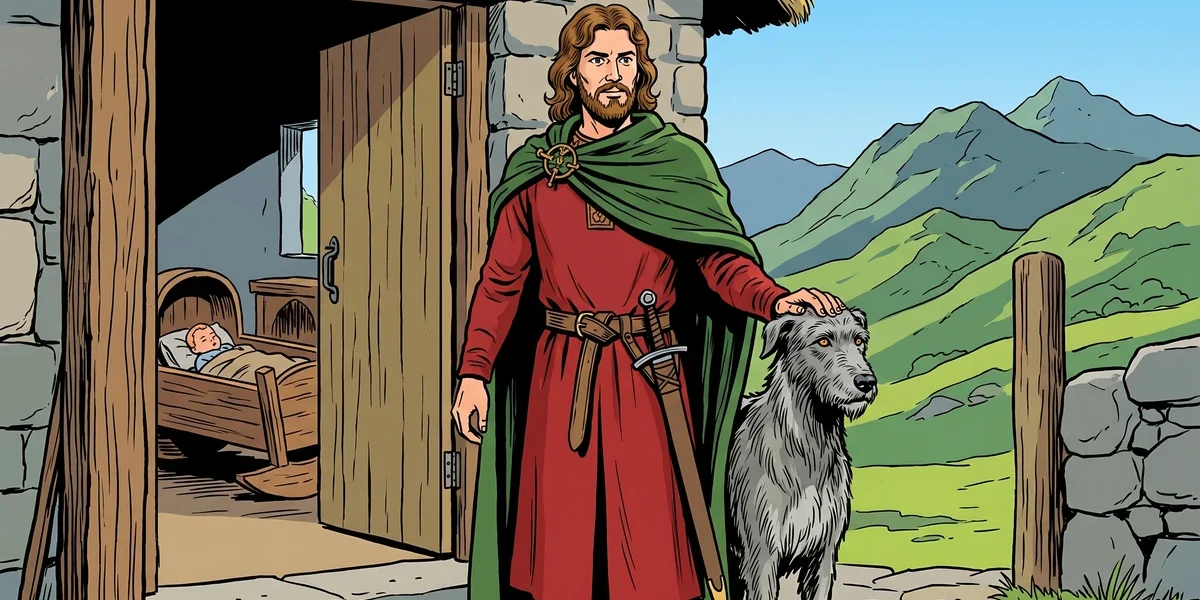
Beth Gellert — more correctly Bedd Gelert, “Gelert’s Grave” — is one of the most enduring tragedies of the Welsh oral tradition, a tale of a prince, a wolfhound, and a single irrevocable act of haste that has been wept over for two centuries. It is best known to English readers from Joseph Jacobs’s Celtic Fairy Tales (London: David Nutt, 1892), Tale XXI, where Jacobs prints the story under the title “Beth Gellert” and traces it to the Welsh village of Beddgelert in the shadow of Yr Wyddfa (Snowdon), Gwynedd. Folklorists classify the tale internationally as Aarne–Thompson–Uther Type 178A, “The Innocent Dog” (also called “The Faithful Animal Rashly Killed”), a migratory legend whose Sanskrit ancestor is preserved in the Panchatantra as “The Brahmin and the Mongoose.” This is the Welsh form of a story humanity seems unable to stop telling.
A Gift from a King to a Prince of Gwynedd
The hero of the legend is Llywelyn ap Iorwerth — known to history as Llywelyn Fawr, “Llywelyn the Great” — Prince of Gwynedd from 1195 until his death in 1240, and the first Welsh ruler to style himself “Prince of Aberffraw and Lord of Snowdon.” In Jacobs’s telling, Llywelyn’s father-in-law is the English king John, and the gift that passes between them is no ordinary hound. He is a milgi, a Welsh greyhound of the old, rough-coated, deerhound type, broad in the chest, deep-throated, swift on the heather, and trained from a pup to be gentle with infants and merciless with wolves. The Welsh call such a hound Gelert, and the name has carried more weight in this island than the name of many a king.
Llywelyn rode home from his father-in-law’s court with the hound at his stirrup. From the first moment Gelert lay down beside the cradle of the prince’s only son, the bond was settled. The dog ate from the boy’s small wooden bowl. He slept across the threshold of the nursery. When the infant cried in the night, it was Gelert’s grey muzzle that nosed first into the cot, and Gelert’s deep sigh that settled the child back into sleep. Llywelyn would say afterwards, in the years he had nothing left but saying it, that no man in Wales ever owned a dog whose love for a child was so plain a thing.
The Hunt at Dawn, the Empty Cradle at Dusk
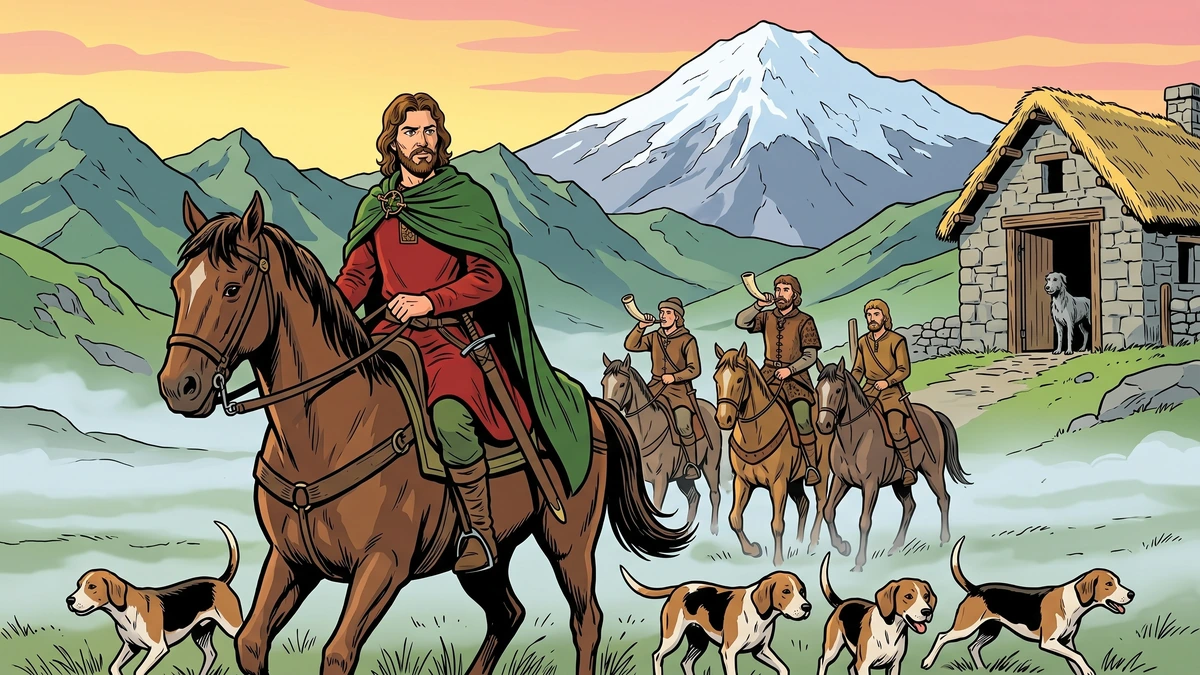
The morning of the calamity broke clear over Eryri — the great mountain range the English have learned to call Snowdonia. Llywelyn’s huntsmen sounded the horn beneath the oaks. The prince mounted, whistled for Gelert as he always did — and, for the first and only time, the hound did not come. Llywelyn searched the kennels and the stable yard. The dog was nowhere. With the hounds baying impatiently at the gate and the morning thinning over Moel Hebog, Llywelyn made the choice that no telling of this story has ever been able to forgive him. He rode out without Gelert. He left the cradle, and the door, and the long quiet hall of the hunting lodge.
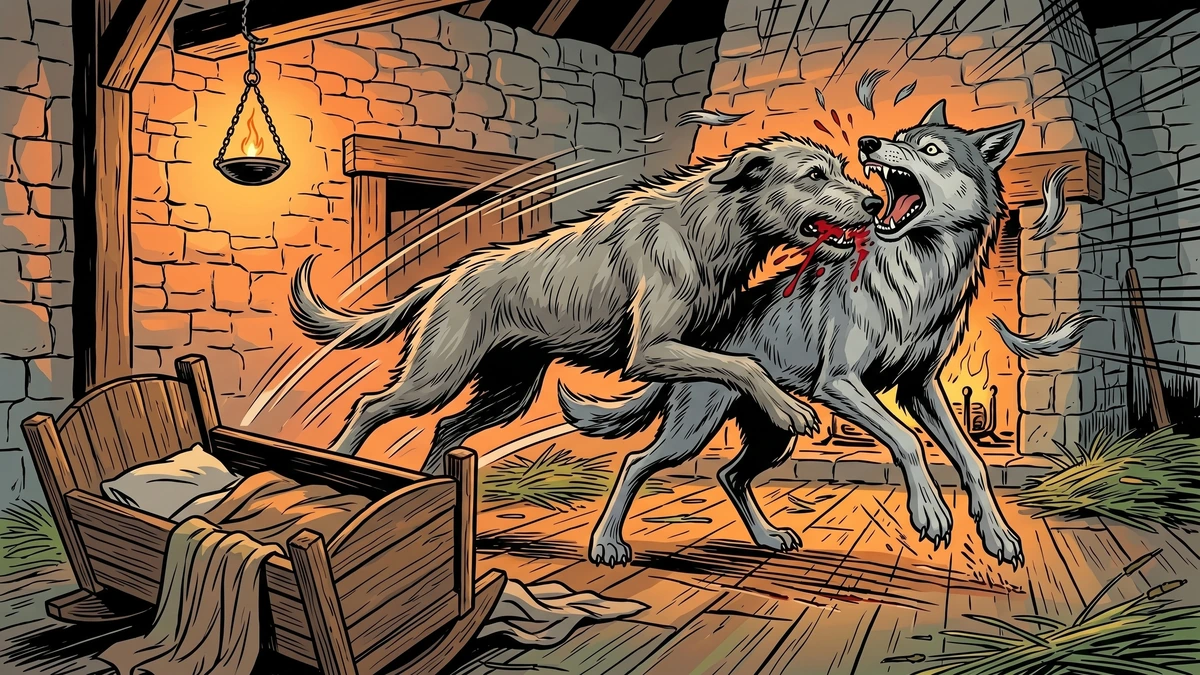
What happened in the lodge while the horn sounded over the moors has been pieced together by every reader of the tale since. A great gaunt wolf — the last of the Welsh wolves were not yet hunted out in Llywelyn’s century — slipped down from the high ground in search of the spring lambs and, finding the lodge door unbarred, came instead upon the cradle. Gelert had not come to the hunt because he had stayed where his deepest training told him he was needed. The fight that followed broke benches and overturned the cradle, splashed the rushes with blood, and sent the wolf away into the bracken with its throat torn out. Then Gelert, his own shoulder ripped open, dragged himself back to the overturned cradle, lay down across the child who slept inside it unhurt, and waited for his master.
Llywelyn returned at dusk. The horn sounded across the courtyard. He pushed open the door of the lodge — and the lamp in his hand showed him, as Jacobs writes in the most quoted line of the tale, only a dog smeared scarlet, a cradle on its side, and no sign of the prince’s son.
A Sword Drawn in Haste, a Cry from Beneath the Wreckage
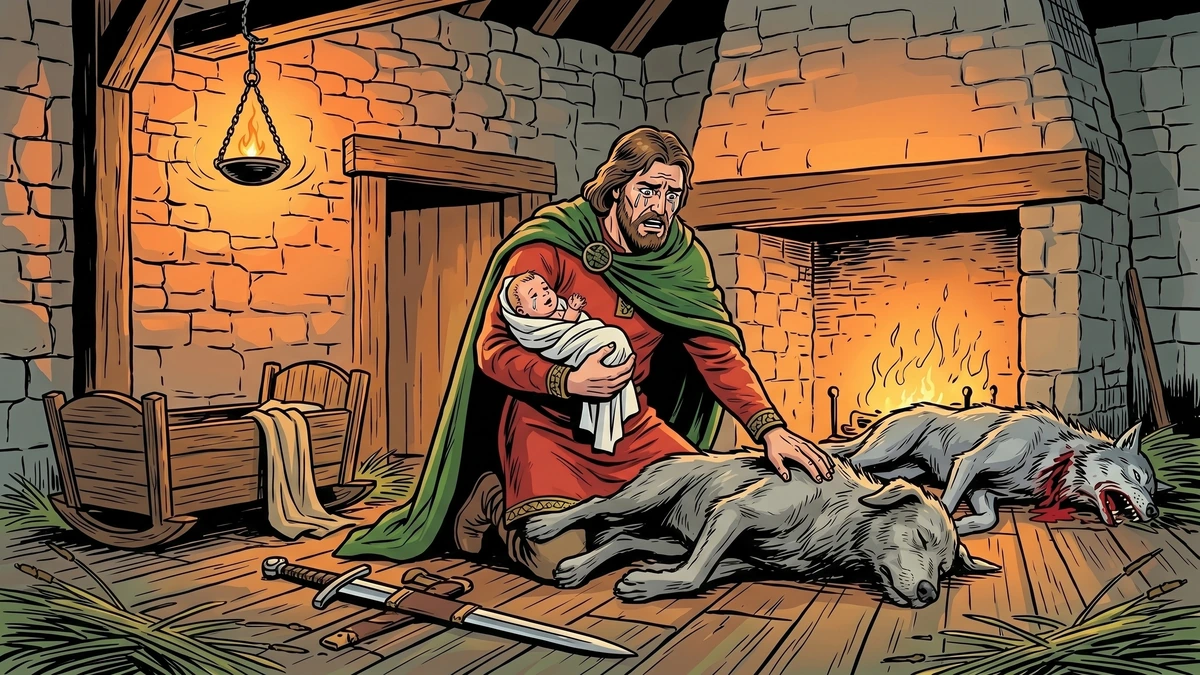
The next thing in the story is the thing that Welsh mothers have used for two hundred years to teach their children why one must never strike in heat. Llywelyn drew his sword without a question and ran it through the hound. Gelert’s eyes — and the storytellers always come back to the eyes — were on his master to the last. He did not cringe. He did not run. He laid his great grey head down on the rushes and was still. Llywelyn stood over him panting, and as the hound’s tail stopped moving, he heard, from underneath the upturned cradle that he had not yet thought to lift, the small, indignant, alive cry of his son.
He turned the cradle over. The boy was unmarked. Beside the cradle, half-hidden in the rushes that the dog had pulled over the child to hide him, lay the wolf — its grey hide ripped, its jaws still drawn back, dead at least an hour. Llywelyn understood, in the single beat of breath it took to lift his son into his arms, what he had just done. The story says he never afterwards smiled. The story says he never afterwards hunted with a hound. The story says, more soberly, that he carried the body of Gelert out of the lodge himself, would let no servant touch it, and dug the grave with his own hands at the foot of Yr Wyddfa, and that the cairn raised above it gave its name to the village that grew up there: Bedd Gelert, Gelert’s Grave.
A Story That Travelled — From the Panchatantra to Snowdonia
Jacobs himself, in his careful “Notes and References” at the back of Celtic Fairy Tales, was honest about something the tourist trade at Beddgelert has never been keen to advertise: the story is older than Llywelyn, older than Wales, and almost certainly older than Christendom. The same plot — a faithful animal kills a predator, is mistaken for the killer, and is slain before the truth comes out — is found in the Sanskrit Panchatantra (Book V, where the animal is a mongoose and the predator a black cobra), in the Persian Sindibādnāma, in the Arabic Kalīla wa Dimna, in Bidpai, in the Latin Gesta Romanorum, in the medieval French Dolopathos, and across the whole north European margin where the predator is variously a bear, a serpent, or a wolf. Folklorists since Stith Thompson have catalogued it as ATU 178A, “The Innocent Dog” (with motif B331.2, “Llewellyn and his dog”); D. L. Ashliman, in his folktales archive at the University of Pittsburgh, gathers more than a dozen national variants under the heading “Fables of Type 178A: Llewellyn and His Dog Gellert.” The grave at Beddgelert was almost certainly opened, named, and set on the tourist trail by a local innkeeper, David Prichard of the Royal Goat, around 1800; the English ballad most often quoted at the site, “The Grave of the Greyhound,” was composed by William Robert Spencer in 1800 from the materials Prichard supplied. Whether or not Llywelyn the Great ever owned a hound called Gelert, the tale the village has fastened to him is among the most genuinely ancient narrative inheritances Wales possesses, drifting north out of India along the Silk Road of stories.
The Mongoose Beneath the Wolfhound
It is worth pausing on the Indian root of the tale, because to a reader of Welsh folklore the Sanskrit version restores something the Welsh has worn smooth. In the Panchatantra, Book V (the Apariksitakaraka, “Ill-Considered Action”), a Brahmin and his wife rear a mongoose alongside their infant son, the mongoose curling at the cradle as Gelert curls at it. A black cobra creeps into the hut while the parents are out; the mongoose kills the cobra; the mother returns first, sees the mongoose with a bloodied muzzle, and concludes — instantly, with the same lethal speed Llywelyn shows — that the creature has killed her child. She crushes the mongoose with the water-pot she is carrying. Only then does she look in the cradle, find her son alive, and find the dead cobra in the corner. The Sanskrit verse the storyteller quotes at this moment is the verse the entire Panchatantra exists to teach: “Apariksya na kartavyam, kartavyam suparīksitam” — “Do not act without examining; act only after careful examination.” It is the mother of the Welsh proverb at Beddgelert; the wolfhound and the mongoose are speaking the same sentence in different languages. The migration of the plot — Sanskrit → Persian (the Sindibādnāma) → Arabic (Kalīla wa Dimna) → Latin (Gesta Romanorum) → French (Dolopathos) → Welsh — is one of the most clearly traceable journeys in the entire migratory-legend literature, and it ends not in a book but in a meadow at the foot of Snowdon, with a slate plaque written in two languages and a cairn that Welsh schoolchildren still leave wildflowers on.
Spencer’s Ballad and the Making of a National Memory
The version of the story that nineteenth-century Wales took to its heart was not Jacobs’s prose retelling — Jacobs would not publish for almost a century — but the ballad of The Honourable William Robert Spencer, first printed privately at Strawberry Hill in 1800 and circulated in countless chapbooks, school readers, and tourist pamphlets through the Victorian era. Spencer had been a guest at the Royal Goat Inn at Beddgelert, where the proprietor David Prichard was busy giving the village a usable past. Spencer’s ballad supplied the cadence — “And now a gallant tomb they raise / With costly sculpture deck’d / And marbles storied with his praise / Poor Gelert’s bones protect” — and the closing verse with which generations of Welsh children learned, in English, the moral their grandparents had always known in Welsh. The ballad fixed the story’s shape so completely that even oral tellers in Welsh today reach instinctively for Spencer’s stanza pattern when they tell it. It is one of the rare cases in which a romantic-period English ballad has, by sheer poetic force, made itself part of the indigenous tradition it was retelling.
The Silent Hound at the Hearth
What the villagers of Beddgelert show the modern visitor is a low cairn in a meadow beneath the ridge of Cefn Cwm Llan, fenced about with slate, and a slate plaque in Welsh and English. The Welsh of that plaque, taken from an older oral tradition, is the line that any Welsh-speaker will tell you sums the moral of the story: “Mor ffyddlon â Gelert” — “as faithful as Gelert.” It is not, to a Welsh ear, a poetic phrase; it is a measurement. To be mor ffyddlon â Gelert is the highest praise that can be paid in the language to the loyalty of a dog, a friend, or a soldier. The phrase passed from the legend into the language and stayed there.
The tragedy of the tale is that this loyalty was unanswered. Gelert was not killed by the wolf. He was killed by a sword in the hand of the master he had just spent his life defending — and the sword was drawn for no reason except that the master had not stopped, in the half-second before the blow, to look at the room with patient eyes. Welsh storytellers underline this point with a steadiness that does not flag from one century to the next: the wolf did not destroy the dog. Haste destroyed the dog. Anger destroyed the dog. The refusal to lift one overturned cradle before drawing one bright sword destroyed the dog. The wolf merely set the trap; Llywelyn sprang it himself.
The Moral — the Welsh Reading
“Mor ffyddlon â Gelert.”
— “As faithful as Gelert.” Traditional Welsh proverb associated with the grave at Beddgelert, recorded in Joseph Jacobs, Celtic Fairy Tales (London: David Nutt, 1892), notes to Tale XXI.
The Welsh moral is not the moral of the wolf. It is the moral of the cradle. Look before you strike. Lift the cradle before you draw the sword. The blood you see is rarely the blood you think you see. Jacobs, who collected the tale from oral tellings in north Wales and from Spencer’s ballad, sums it with characteristic restraint at the end of his version: “Llewelyn never smiled again.” Four words; an entire ethic of patience.
The Wolves of Llywelyn’s Wales
One detail that modern readers often skim past deserves a quiet historical footnote, because it is the detail that makes the whole story plausible to the people who first told it. The wolf in this legend is not a fairy-tale wolf. It is a real animal that lived, hunted, and was hunted, in the upland forests of Gwynedd well into the thirteenth century. The last fully attested wild wolves in Wales were killed in the reign of Llywelyn’s grandson, Edward I — the same king who built Caernarfon and Conwy and Harlech to hold Gwynedd down — and contemporaneous Welsh laws still levied a “wolf tribute” (commorth) of wolfskins on Welsh tenants of the prince. A great gaunt grey wolf coming down out of Cwm Llan in lambing season would have been, in Llywelyn’s lifetime, an ordinary enough story for a winter night by the hearth. The hound trained to fight it would have been an ordinary enough hound. What is not ordinary in the tale, and what marks it as a story rather than a chronicle, is the moment of misjudgment in the doorway — the half-second of failure to look — and that moment is the one moment the story refuses to let its listeners forget.
Why the Tale Has Lasted Eight Hundred Years
Most folktales survive because they end well. This one survives because it does not. Children remember it because it is unfair, and because the unfairness is not the world’s: it is Llywelyn’s, and Llywelyn cannot give the dog back. The grave at Beddgelert, the slate plaque, the Welsh proverb, the cairn above which Yr Wyddfa rises white in winter — all of them keep saying the same patient sentence to every passer-by: do not be Llywelyn. Do not draw before you understand. Do not strike the friend who is bleeding for you. The story has crossed from Sanskrit India through Persia and the Arab world into Latin Europe and out, finally, onto a hillside in Gwynedd, and at every stage of that journey it has been told for the same reason: human beings, when frightened, are very fast with the sword and very slow with the cradle, and the cost of that asymmetry is paid not by the wolf but by the most loyal heart in the room.
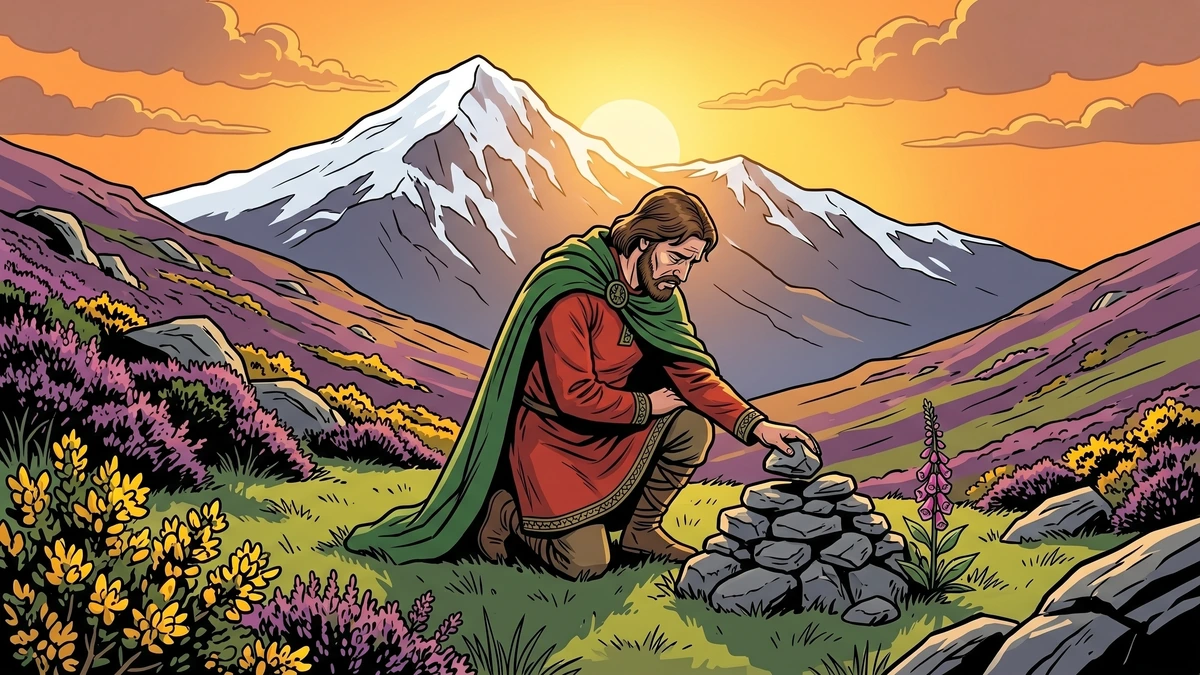
Wales has many graves. Only one of them gave its name to the village around it. Only one of them is visited every summer by people who have never heard the story but who, having heard it once at the cairn, never forget it. Mor ffyddlon â Gelert — the proverb has outlived the prince. It will outlive the rest of us as well.
You May Also Like
 Celtic Folk Tales
Ages 9-12
Celtic Folk Tales
Ages 9-12
Connla And The Fairy Maiden
Connla And The Fairy Maiden: Connla of the Fiery Hair was son of Conn of the Hundred Fights. One day as he stood by the side of his father on the height of
 Celtic Folk Tales
Ages 9-12
Celtic Folk Tales
Ages 9-12
The Enchanted Cave
The Enchanted Cave: A long, long time ago, Prince Cuglas,[7] master of the hounds to the high King of Erin, set out from Tara to the chase. As he was leaving
 Celtic Folk Tales
Ages 9-12
Celtic Folk Tales
Ages 9-12
Conal Yellowclaw
Conal Yellowclaw: Tales of West Highlands_, No. 105-8, “Conall Cra Bhuidhe.” I have softened the third episode, which is somewhat too ghastly in the original.