The Lion that Sprang to Life
Four Brahmin friends encounter a dead lion. Three use knowledge to bring it to life, but wisdom saves the fourth.
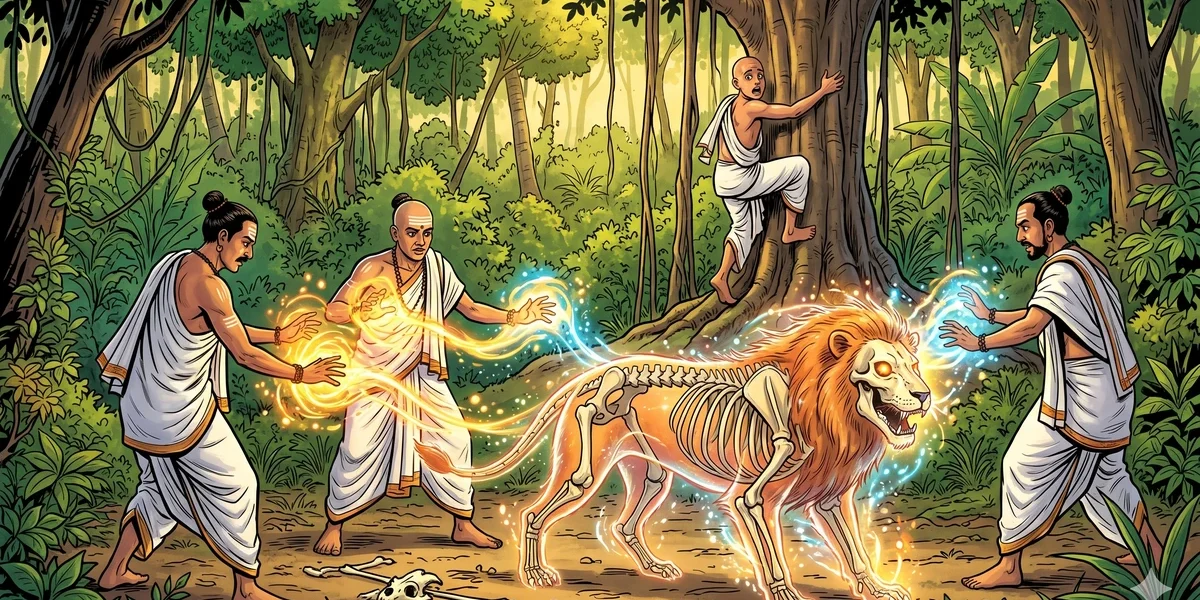
The Lion that Sprang to Life
Source: Panchatantra, Book V — Apariksitakarakam (Ill-considered Action), attributed to the sage Vishnu Sharma, composed c. 300 BCE–300 CE; this redaction follows the Sanskrit Tantrakhyayika recension and Patrick Olivelle’s critical translation (Oxford University Press, 2006).
शास्त्रज्ञो नाम नरस्य महामूढंः, न तु तत् भवति यस्य न’स्ति बुद्धिःः
Four Brahmin scholars travel together seeking their fortune. Three possess extraordinary learning; the fourth has only common sense and no scriptural knowledge. When the three find the skeleton of a lion and decide to demonstrate their mastery of the life-sciences by restoring it to life, the fourth warns them. They dismiss him. He climbs a tree. The tale is the Panchatantra’s most economical argument for practical wisdom over academic pride — a cautionary fable that has been cited in Indian classrooms for two thousand years as a definition of the difference between vidya (learning) and viveka (discernment).
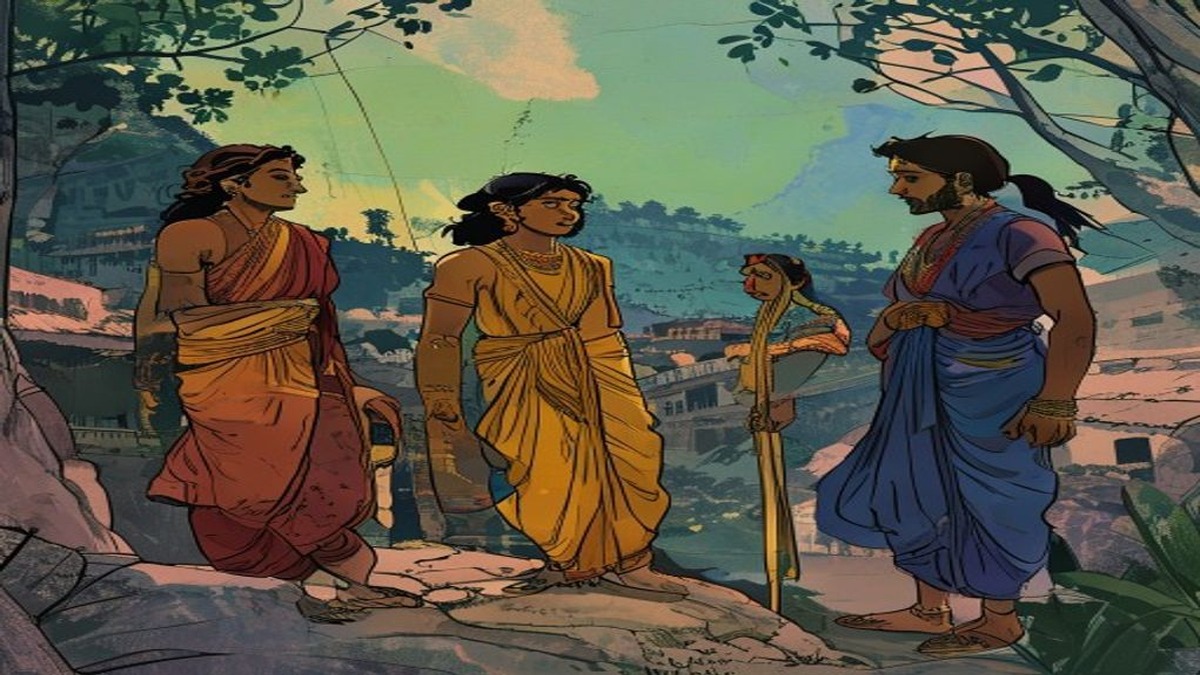
Part I: The Scholars and the Skeleton
In the city of Pataliputra there lived four young Brahmin men who had been friends since childhood. Three of them — Siddhartha, Vishwambhara, and Devarata — had spent their youth studying the shastras with extraordinary dedication. Siddhartha had mastered the science of bones and could reconstruct any creature from a single fragment. Vishwambhara knew the mahavidya of flesh and sinew and could clothe a skeleton in muscle and skin. Devarata had learned the deepest secret of all: the pranashakti, the breathing of life into a restored form. Together they represented the full arc of biological scholarship.
The fourth friend, Subuddhi, had spent the same years working with tradesmen, watching crops grow and fail, listening to his grandmother’s proverbs about weather and human nature. He could not recite a single verse of the Vedas. What he could do was look at a situation and understand almost immediately what would happen next.
The four decided to travel together and convert their knowledge into wealth. They had not gone far into the forest when they came upon a clearing where the bones of a large animal lay scattered among dry leaves. Siddhartha knelt and examined a single vertebra. “A lion,” he announced. “Adult male. Dead perhaps two seasons.” He looked at his companions with the particular bright gaze of a man who has spotted an opportunity. “We should restore it,” he said. “Here is a perfect chance to demonstrate what our years of study have produced.”
Vishwambhara and Devarata immediately agreed. The chance to demonstrate mastery was irresistible to all three. They had worked so long in theory; here was a canvas for practice. No one asked whether a lion ought to be restored to life in the forest in which they intended to continue travelling.
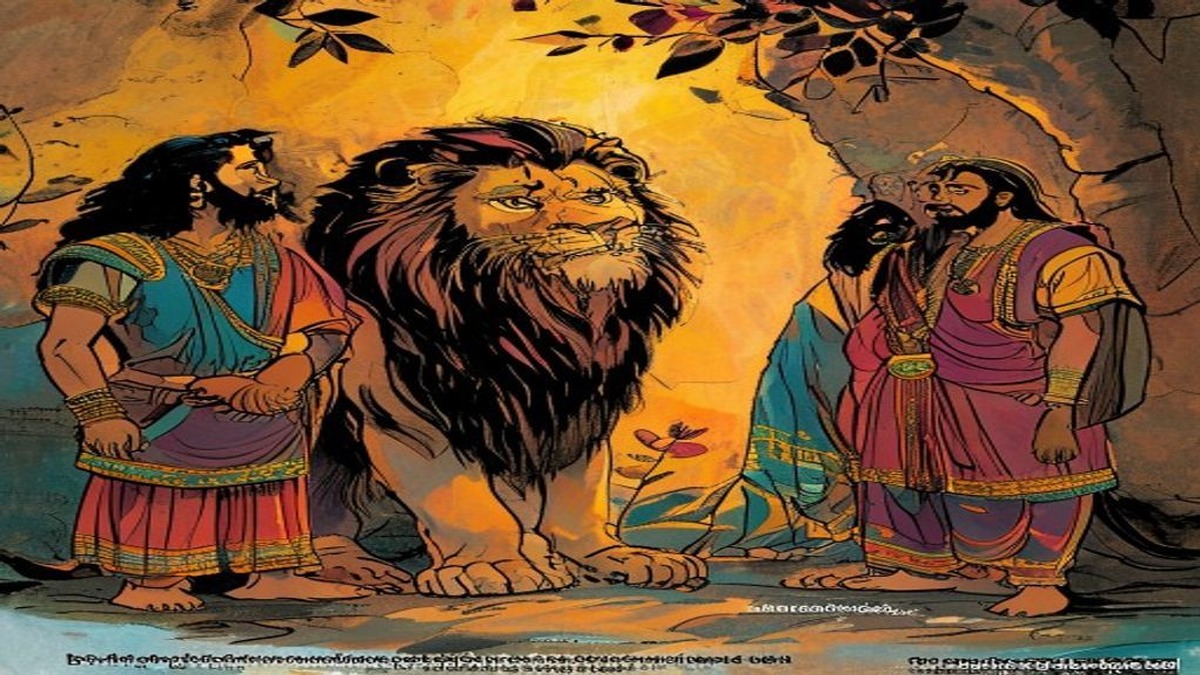
Part II: The Warning and Its Dismissal
Subuddhi spoke. “Friends,” he said carefully, “I am the least educated person here and I speak with full awareness of that. But this is a lion. If you restore it, it will eat us. This forest has no town within a day’s walk. We have no weapons. Our knowledge of lion behaviour, as far as I am aware, does not extend to making them grateful.”
Siddhartha smiled the particular smile of an expert addressing a non-expert. “Subuddhi,” he said, “you confuse practical caution with intellectual ambition. We did not study for a decade to be afraid of what we create. A lion restored by the pranashakti is not an ordinary lion; it wakes in a state of confusion and equanimity. The texts are clear on this.”
Subuddhi had not read the texts, so he could not challenge this claim directly. But he had spent enough time watching animals that he doubted very strongly that a lion waking up hungry in a forest would feel equanimity toward four men standing nearby. He tried once more. “Then at least wait until I have climbed that tree,” he said, pointing to a large banyan twenty paces away. “Let me observe the equanimity from a height. Purely out of scholarly curiosity.”
The three scholars exchanged the glance that experts exchange when an amateur says something both absurd and impossible to argue with on its own terms. “Go,” Siddhartha said, mildly amused. “We will tell you how it went.”
Subuddhi climbed the tree. He climbed to a height where a lion could not easily reach him and wedged himself firmly into the fork of a large branch. Then he watched.
Vishnu Sharma’s text pauses here for a single sentence of commentary: “This is the man who, having no learning, had only judgment; and judgment is what saved him.”
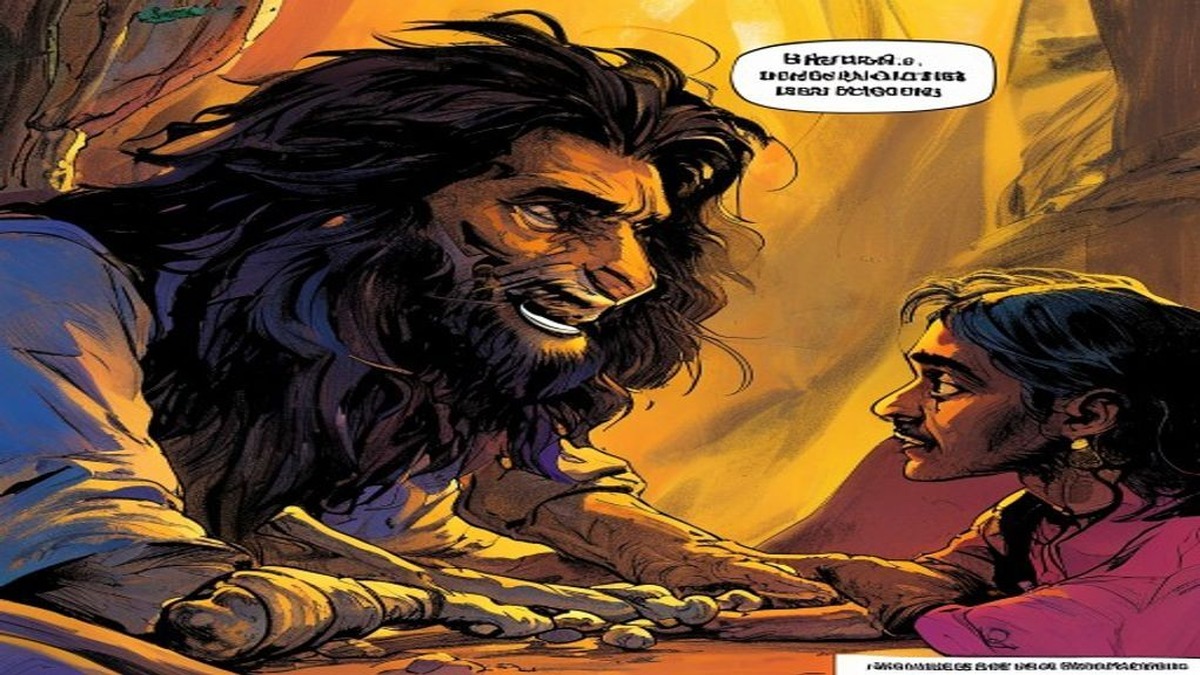
Part III: The Restoration
Siddhartha arranged the bones with extraordinary precision. His hands moved with the assurance of a man who had reconstructed a dozen creatures from memory in examination halls. Within the hour, the skeleton was complete — every vertebra in place, every joint correctly articulated, the skull set at the exact angle of a resting lion.
Vishwambhara began his work. This was slower, more meditative: the weaving of tissue around the framework, muscle laid over bone in the correct sequence, the skin spread across the completed form and sealed by the force of concentrated mantra. From the tree, Subuddhi watched a lion take shape in the clearing below with a feeling he could not quite name — something between professional admiration for the technique and profound personal dread of the outcome.
By the time the sun had moved a hand’s breadth, the lion lay in the clearing fully formed but still. Its coat was golden. Its mane was thick. Its paws were the size of a large man’s head. The three scholars stood back and looked at their creation with undisguised pride.
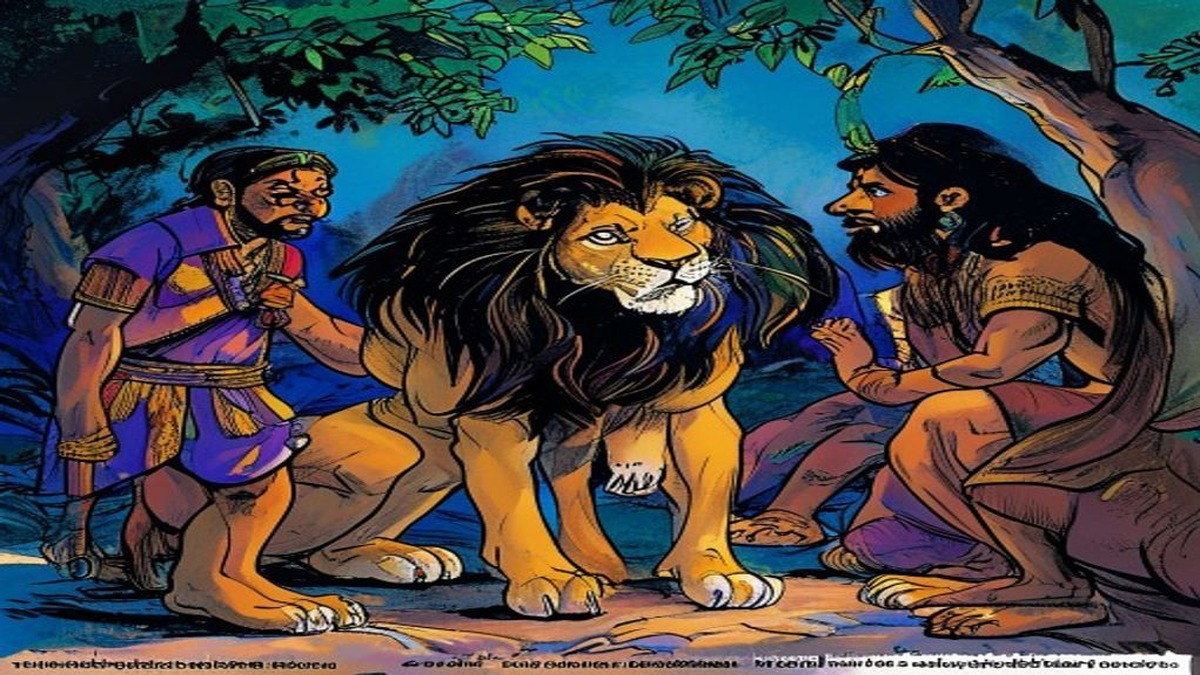
Devarata knelt beside the lion’s head, placed his hands on either side of its face, and began the pranashakti recitation. The words were ancient — so old that their literal meaning had become secondary to their vibrational precision. The lion’s chest rose once, fell, rose again. Its eyes opened. They were amber. They focused.
The lion looked at Devarata. It looked at Vishwambhara. It looked at Siddhartha. It was not confused. It was not equanimous. It was, as Subuddhi had suspected it would be, a very hungry lion that had just woken up to find three men standing within easy striking distance.
Part IV: The Reckoning
The lion killed all three scholars in rapid succession. It was not a prolonged event. A lion that has been dead for two seasons is still, upon restoration, a lion — instinct pre-dates learning by several million years and is not overridden by the good intentions of the men who performed the restoration. The clearing, which had rung with Sanskrit recitation moments before, fell quiet.
The lion ate, rested, and eventually walked into the forest. Subuddhi descended from the banyan tree and continued his journey alone. He reached the next city, explained what had happened, and found that the story he carried was worth more than any scholarship he could have claimed. A man who had watched three of the greatest scholars of his generation die of their own expertise and had survived by the timely use of common sense had something to teach that no university could offer.
Vishnu Sharma ends the tale with characteristic bluntness: “Therefore one should act only after considering the consequences. Scholarship without judgment is the most dangerous kind of ignorance, because it wears the face of competence.” The Sanskrit term apariksitakari — one who acts without first examining — gives Book V its name. All the stories in the book explore the same theme; this one is its most famous and most direct expression.
Why This Story Has Lasted Three Thousand Years
“The Lion that Sprang to Life” endures because it captures something that formal education systems in every era have struggled to address: the gap between technical mastery and practical wisdom. The three scholars are not villains or fools in the ordinary sense; they are genuinely accomplished. Siddhartha’s bone-work, Vishwambhara’s tissue-weaving, Devarata’s life-breathing are presented without irony as real achievements. What they lack is not intelligence but what Vishnu Sharma calls viveka — the capacity to step outside one’s expertise and ask: is this wise?
The story has been cited in Sanskrit pedagogical literature as a cautionary frame for the entire education system: the purpose of learning is not demonstration but discernment. A student who has mastered the curriculum but cannot judge when to apply it has achieved the most expensive form of ignorance available.
The tale crossed into Arabic as one of the most-retold fables of Kalila wa Dimna, where it was used by medieval Islamic scholars to argue for the integration of rational judgment (aql) alongside transmitted knowledge (naql). In European versions it became a parable about the arrogance of natural philosophers who could create without restraint. Each culture kept the structure and changed the example of forbidden knowledge: the lion became a plague, then a machine, then a formula.
For modern readers, the story’s resonance is immediately legible. Every era produces its lion-revival projects: technologies or systems assembled by extremely competent specialists who did not pause at the moment of completion to ask whether the thing they had made was safe to release into the clearing. Subuddhi’s tree remains the only rational response to expertise untempered by judgment — not a refusal to engage, but the discipline to maintain one’s position until the consequences of others’ actions have become clear.
Frequently Asked Questions
What is the moral of The Lion that Sprang to Life?
The story teaches that scholarship without judgment is dangerous. The three learned scholars who restore the lion to life have real mastery of their fields, but they fail to ask whether they should use that knowledge in the given situation. Only Subuddhi, who lacks their learning but possesses common sense, survives — by climbing a tree before the lion wakes.
Which book of the Panchatantra does this story come from?
The story comes from Book V, Apariksitakarakam (Ill-considered Action), named after the Sanskrit term for one who acts without examining consequences. All stories in Book V address the danger of proceeding without pausing to consider outcomes; this tale is the most famous example in the book.
What is the difference between vidya and viveka in this story?
Vidya means learning or scholarship — what the three Brahmin scholars possess in abundance. Viveka means discernment or practical wisdom — the ability to judge whether and when knowledge should be applied. The Panchatantra argues through this story that viveka is more valuable for survival than vidya, because expertise without judgment creates danger rather than safety.
Who are the four scholars in The Lion that Sprang to Life?
The four friends are Siddhartha, the master of bone-science; Vishwambhara, who knows the science of flesh and tissue; Devarata, who can breathe life into restored forms; and Subuddhi, who has no scriptural learning but possesses practical judgment. The story contrasts Subuddhi's common sense with the others' academic pride to show that survival belongs to those with discernment, not those with credentials.
How did this story travel to other cultures?
The story became one of the most-retold fables in Kalila wa Dimna, the eighth-century Arabic translation of the Panchatantra. Medieval Islamic scholars used it in debates about the relationship between transmitted knowledge and rational judgment. In European versions through Directorium Humanae Vitae, the story became a parable about natural philosophers who create without considering consequences — a theme that remained culturally active through the Frankenstein tradition.
You May Also Like
 Panchatantra Stories
Ages 3-5
Panchatantra Stories
Ages 3-5
The Lion And The Crane
The Lion And The Crane: The Bodhisatta was at one time born in the region of Himavanta as a white crane; now Brahmadatta was at that time reigning in Benares.
 Panchatantra Stories
Ages 3-5
Panchatantra Stories
Ages 3-5
The Three Fish – Moral Story for Kids
The Three Fish – Moral Story for Kids: Once upon a time, there lived three big fish in a lake. They were close friends, but characteristically very different.
 Panchatantra Stories
Ages 6-8
Panchatantra Stories
Ages 6-8
The Carpenter’s Wife
The Carpenter's Wife: Once upon a time, a carpenter lived in a village with his wife. He had heard bad stories about her and wanted to know the truth about