Jack And His Master
Jack And His Master: A poor woman had three sons. The eldest and second eldest were cunning clever fellows, but they called the youngest Jack the Fool, because
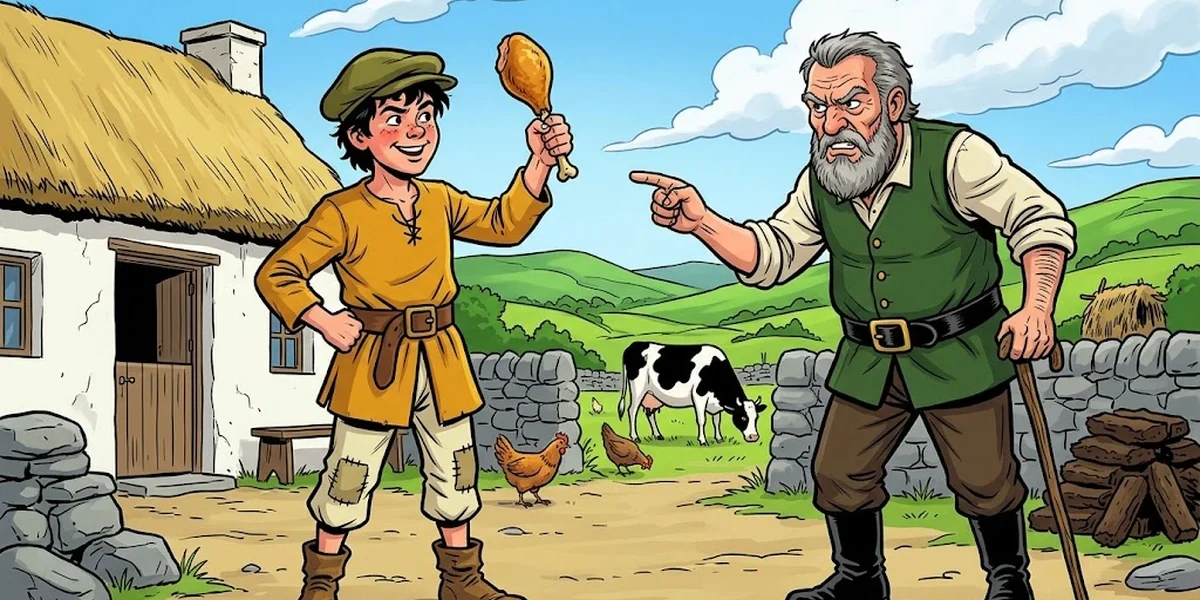
Jack and His Master is an Irish folk-comedy of three brothers and a stingy farmer. The two cunning brothers go out to service with the Gray Churl of the Townland of Mischance, lose patience under his bargain, and come home with a strip of skin flayed from shoulder to hip. The youngest, simple-seeming Jack the Fool, takes the same contract — and by means of relentless, beautifully literal obedience drives the master into breaking it himself. The version below follows the canonical text in Joseph Jacobs, Celtic Fairy Tales (London: David Nutt, 1892), Tale XIX, set down from Patrick Kennedy’s The Fireside Stories of Ireland (Dublin: M'Glashan and Gill, 1870). Folklorists classify the tale as ATU 1000 (“Bargain Not to Become Angry”) with the embedded sub-type ATU 1006 (“Casting Eyes”) at its climax — a story-pair distributed across the whole of Indo-European Europe and one of the great comic engines of the master-and-servant tradition.
Origin, Source & Scholarly Attribution
“Jack and His Master” was first set in print by the Wexford bookseller and folklorist Patrick Kennedy (1801–1873), the most reliable nineteenth-century recorder of south-east Irish oral tradition, in his Legendary Fictions of the Irish Celts (London: Macmillan, 1866) and again, in a shorter chap-book form, in The Fireside Stories of Ireland (Dublin: M'Glashan and Gill, 1870), where the tale appears under the heading “Adventures of Gilla na Chreck an Gour'.” Kennedy heard the bargain narrative from tellers in the County Wexford district of Mount Leinster around the towns of Bunclody and Ferns; his testimony is one of the few surviving traces of the late-eighteenth-century Hiberno-English oral repertoire of that region before the Famine emigrations broke its transmission lines.
Twenty-two years later Joseph Jacobs (1854–1916), folklorist for the British Folk-Lore Society and editor of the Folk-Lore Journal, abridged Kennedy's text for the children's reading public in Celtic Fairy Tales (London: David Nutt, 1892), Tale XIX, pp. 186–195, with notes at pp. 257–258. Jacobs flagged the tale as a fine specimen of the international “humorous fool” cycle and pointed his readers to Norwegian and Russian analogues — Asbjørnsen and Moe's “Lord Peter” (Norske Folkeeventyr, 1841) and the Afanasyev cluster around the figure of the trickster servant. The tale was reprinted by Andrew Lang in fragments and discussed by W.B. Yeats in his preface to Fairy and Folk Tales of the Irish Peasantry (London: Walter Scott, 1888) as an example of “the wit that comes up out of poverty.”
In the modern type and motif index — Hans-Jörg Uther, The Types of International Folktales, FFC 284–286 (Helsinki: Academia Scientiarum Fennica, 2004), II.18–22 — the story is filed as ATU 1000, “Bargain Not to Become Angry” (German Der Vertrag, sich nicht zu ärgern; Aarne's 1910 Finnish original was Vihaa-ei-saa-näyttä). The sheep-eye scene at the wedding feast is the classic instance of the embedded sub-type ATU 1006, “Casting Eyes,” in which a servant takes a master's figurative idiom (Hiberno-English throw a sheep's eye at her = “give her a glance of affection”) and executes it literally with butchered eyes from the master's flock. Stith Thompson's Motif-Index of Folk-Literature (Indiana University Press, 1955–58) tags the central comic engine as K1761 (“Servant carries out master's order to the letter”), J2461 (“Literal numskull”), and K231.1.1 (“Master agrees to pay enormous penalty if he loses temper”).
Cultural Context: Service, the Bargain, and Hiberno-English Wit
“Jack and His Master” is in form a servitude tale — a story about the contract between a master and a hired man, set into a comic frame in which the master is the villain and the servant's only weapon is his tongue. Its background is the Irish institution of spailpín (hired) labour, the seasonal contract by which the labouring poor of pre-Famine Ireland engaged themselves for six or twelve months to a strong farmer (a strong man, in the Irish-English sense, meaning one with land enough to need help), in exchange for a stipulated wage, dinner, and a bed in the loft. The Gray Churl of the Townland of Mischance — note the placename, a translation of the Irish Baile na Mí-Áidh, “the townland of bad fortune” — is the proverbial bad master of that economy: stingy with bread, generous with abuse, and famous in country mouths for sending his servants home crippled.
The bargain itself is a stock literary form found across Indo-European folklore: each side names a forfeit if the other is the first to break a promise of even temper. In the Norwegian “Lord Peter,” in the Russian “Shabarsha” (Afanasyev no. 153), in Grimm KHM 7 (“The Good Bargain”) and KHM 162 (“The Wise Servant”), in the Sicilian “Lu Cumpari” — the deal is the same and the loser pays his pound of flesh. What distinguishes the Irish version is the precision of the forfeit: “an inch wide of the skin from shoulder to hip,” a phrase that recurs verbatim in oral testimony from Wexford to Donegal, and which gives the tale its grim spine beneath the comedy.
The comic surface, by contrast, is pure Hiberno-English wit. Kennedy preserved the speech of his tellers with great care, and the dialogue between Jack and the Churl is studded with idioms that no longer pass in standard English: red the ground (turn it with a plough), the bawn (the cattle yard), haggard (a hayrick enclosure), cast a sheep's eye (give a sidelong amorous glance), bosthoon (clumsy fellow, from Irish bastún), ounkrawn (rascal, from ainmhide), Stone Jug (the gaol), red lane (throat). Each of these idioms is the seam at which a misunderstanding can be opened, and Jack, who is no fool at all but only the cunning man wearing the mask of the fool, opens every one. He is the prototype of the amadán beannaithe, the “blessed fool,” who sees through the polite surface of the master class because his hunger has taught him to read every word for what it costs him in bread.
The Story
The Two Cunning Brothers and the Gray Churl
A poor widow had three sons. The two eldest were known in the parish as quick clever fellows, but the youngest was called Jack the Fool, because he was slow at the books and slower at the spade and seemed, to those who did not look close, to be no better than a simpleton. The eldest grew restless of his mother's thin porridge and said one morning that he would take service away from home for a year. He went down the road and came at last to the place known as the Townland of Mischance, and to the strong farmer there, the Gray Churl, who was famous in three baronies for the hardness of his table and the sharpness of his tongue.
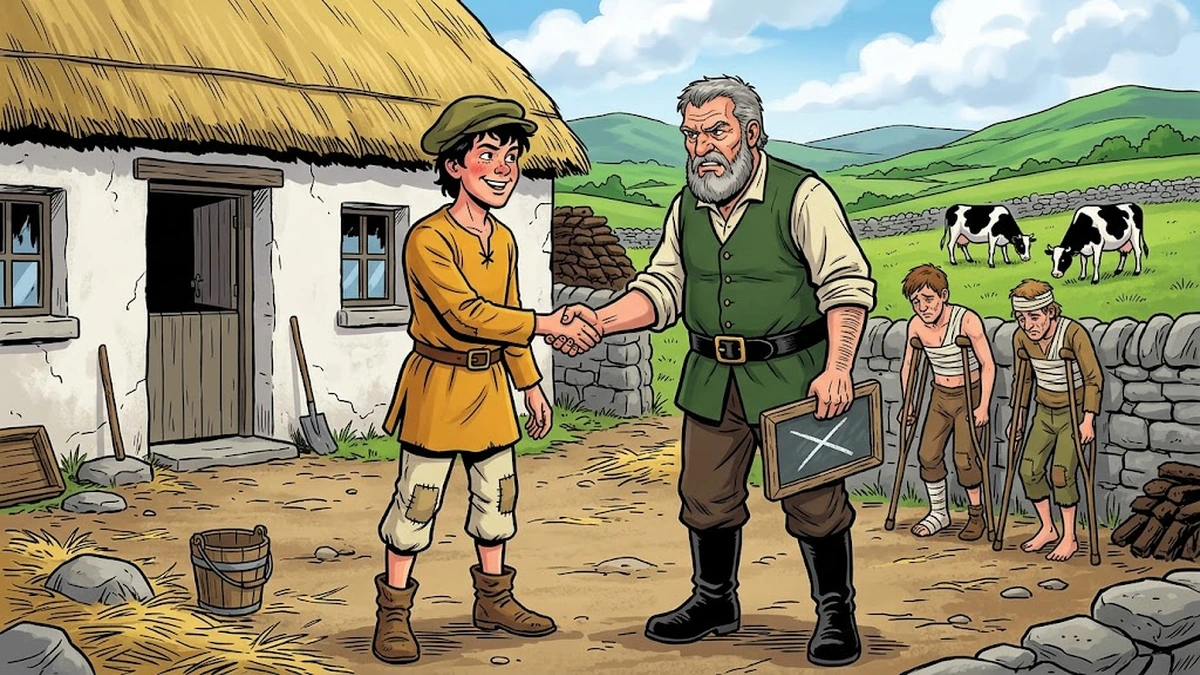
The Churl agreed to take the boy for twelve months at twenty pounds a year, on this condition: whichever of them first said he was sorry for the bargain, that one was to lose an inch wide of the skin of his back, taken in a single strip from his shoulder to his hip; and if it was the master who said it, he was further to pay double wages; and if it was the servant, he was to leave without wages at all. The boy thought he had the better of it, signed his name with a cross on the slate, and went to work. But the Gray Churl gave him so little to eat and worked him so far past the limit of flesh and blood that one day, in a fit of hunger and rage, the boy let it slip from his mouth that he was sorry, and lost his strip of skin and his wages and was sent home a wreck.
The second brother, full of fury, swore he would punish the Churl, took the same bargain, and came back at the end of his year in the same broken state. The widow wept on the doorstep over the second son as she had wept over the first; and into that doorstep, with the morning sun behind him, walked Jack the Fool, with his cap under his arm, saying he would now take his turn with the Gray Churl and bring back the wages of all three brothers and a bit besides. His mother begged him not to go. But Jack only smiled the patient smile of a boy who has been listening for two years to everything his clever brothers had said about the master's house, and went his way down the road toward the Townland of Mischance.
The Goose at the Master's Table
Jack and the Gray Churl stood in the cattle-yard and made the bargain word for word as the brothers had made it — twenty pounds a year, the strip of skin, the double wages — and to it Jack added three small clauses of his own. If you blame me for obeying your orders, said Jack, I am to have one month's wages additional. If you stop me from doing a thing after telling me to do it, I am to have one month's wages additional. And if you refuse me a thing I am willing to do, I am to have one month's wages additional. The Churl, certain he could outwit a fool, signed each clause and went whistling into his parlour to dinner.
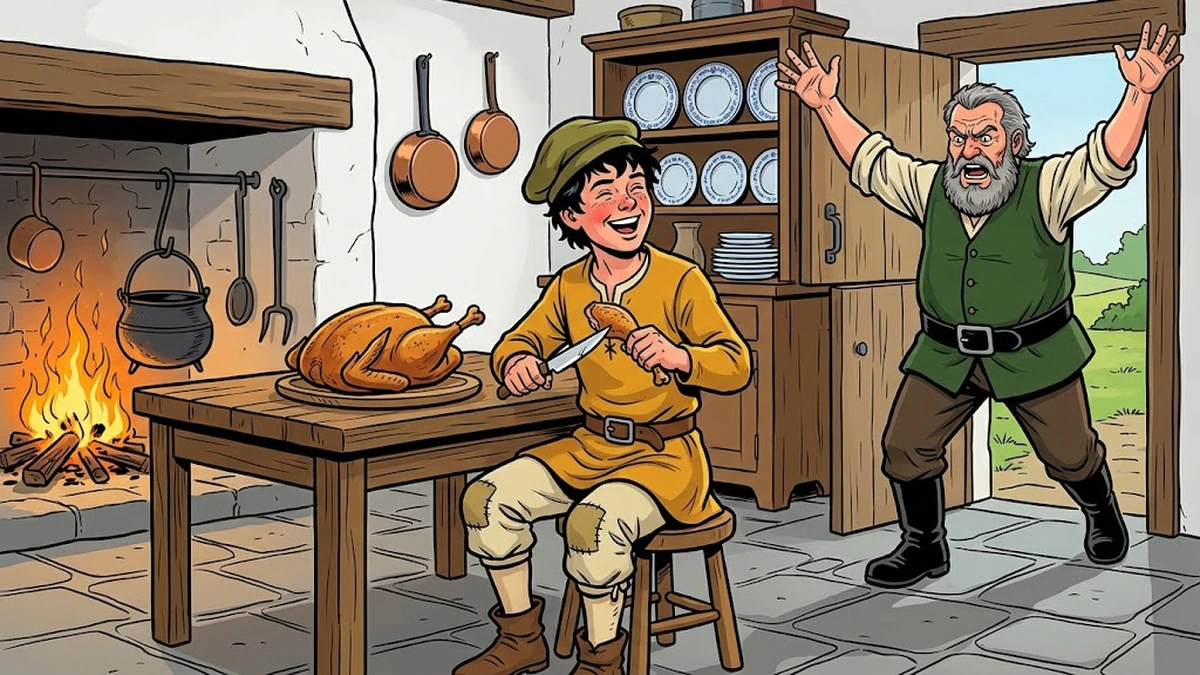
The first morning Jack was fed thin gruel and worked from before light to after dark. The second day, just as the goose was being lifted from the spit and carried up to the master's table, Jack walked in from the bog, took a knife from the dresser, and with a single sweep cut from the goose one whole side of the breast, one whole leg and thigh, and one whole wing, and sat down at the kitchen board and fell to. The Churl burst in roaring. You villain, he cried, what are you about? Jack swallowed and said, mild as buttermilk: Master, you are to feed me, and wherever the goose has gone, the goose will not be needing to be filled again until supper. Are you sorry for our bargain? The Churl opened his mouth to say he was — and shut it just in time, and ground his teeth, and said: Oh, no. Not at all. Jack smiled and ate the wing.
The next day Jack was sent to the bog to clamp turf, and asked the mistress, sweet as honey, whether he might take his dinner before he went, to save the time of coming home; and his supper too, since he meant to sleep that night up beside the peat-stack. The mistress, thinking he would carry both meals away in a kerchief, gave him a great cake of soda-bread, a print of butter, and a bottle of milk; and Jack, sitting at her board, ate every crumb of it down the red lane, and then asked her for his supper, and ate that too, and went off to the haggard and climbed up onto the loft above the stable and stripped and lay down and was asleep before the cock crowed twice. What do servants in this country do after their supper, sir? he had asked the master on the way out. Nothing, the Churl had answered, but go to bed. Jack, in the loft, was only obeying.
The Churl came up the ladder white with rage. Jack, you anointed scoundrel, said he, do you blame me? I do not, master, said Jack, but the mistress, God bless her, has given me my breakfast, my dinner, and my supper, and yourself has just told me bed was the next thing. Hand me one pound thirteen and fourpence — that is the month's wages you owe me by the third clause. And the Churl, gasping, paid it.
The Plough, the Cow, the Thatch, and the Sheep's Feet
So began the war of literal obedience. The Churl told Jack to hold the plough in the fallow field — and Jack held it, gripping it tight in both hands, and pulled against the horses while the boy whipped them on, so that the plough never moved an inch and the field stayed unbroken. The Churl told Jack to keep Browney from the wheat — and Jack tied Browney by a long rope to a thorn-tree and went to sleep, and the rest of the herd trampled the green wheat into mud, and Jack, opening one eye, observed mildly that Browney, as ordered, had not stirred. The Churl told Jack to look in every place likely and unlikely for three lost heifers — and Jack pulled half the thatch off the cabin roof, peering with great seriousness into the holes, on the grounds that the cabin loft was the unlikeliest place of all and therefore the very place to look. (He afterwards put back the thatch better than it was, and brought the three heifers home from the paddock before sunset.)
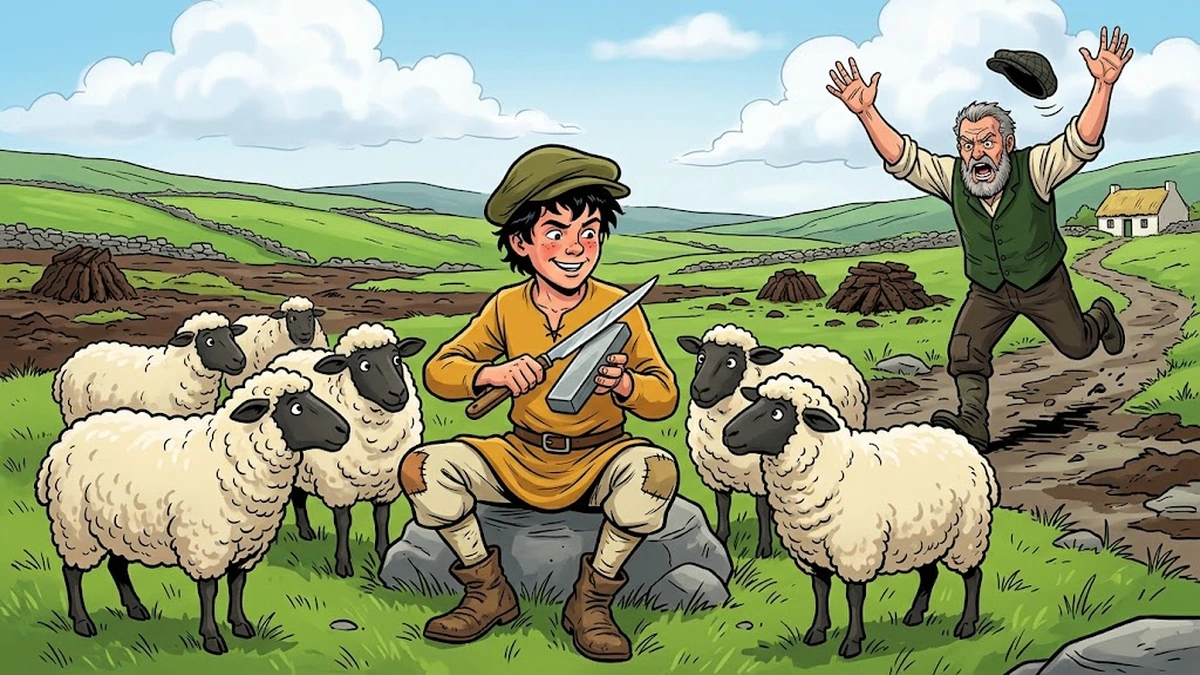
The Churl told Jack to make the sheep's feet a good path across the bog — and Jack, when the master came up an hour later, was sitting at the bog edge sharpening a long carving knife with the whole flock standing around him, ready, he said, to take the feet off every sheep in the flock and lay them in a row to mend the path, since that was what the master had told him to do. The Churl, choking, screamed that he had meant make a good path for the sheep's feet; and Jack only said, with his head on one side, It is a pity you did not say so, master. Are you sorry for our bargain? And every time the Churl began to bawl that he was, he caught himself, and choked it down, and paid out instead one pound thirteen and fourpence to settle the day's clauses.
By the end of three months Jack had a fat bag of guineas put by under the loose stone in the stable wall, and the Gray Churl had grown so thin from grinding his teeth and choking down the word sorry that the neighbours laughed in the chapel-yard about him. But still, with the iron stubbornness of the bad master, he would not say it; he meant to keep Jack the year and pay nothing in the end and have the strip of skin into the bargain. One more bridge to cross, he said to himself; and that is my own brother's wedding next Friday night.
The Wedding Feast: The Sheep's Eyes
The Friday night came, and the Churl set out for his brother's wedding in the next parish, dressed in his best dark coat. He was uneasy at leaving Jack at home unwatched, and so, just before he mounted, he said over his shoulder a great Hiberno-English idiom: Jack, come down to the wedding-house at midnight; come and be company for me on the road home, in case I am taken with the drink. If you find me at the table, you may throw a sheep's eye at me, and I will make sure they pour you a drop of the bridegroom's health. Now to throw a sheep's eye, in the country idiom, means simply to give a sidelong amorous glance — a country flirtation. Jack, who knew this perfectly well, simply nodded.
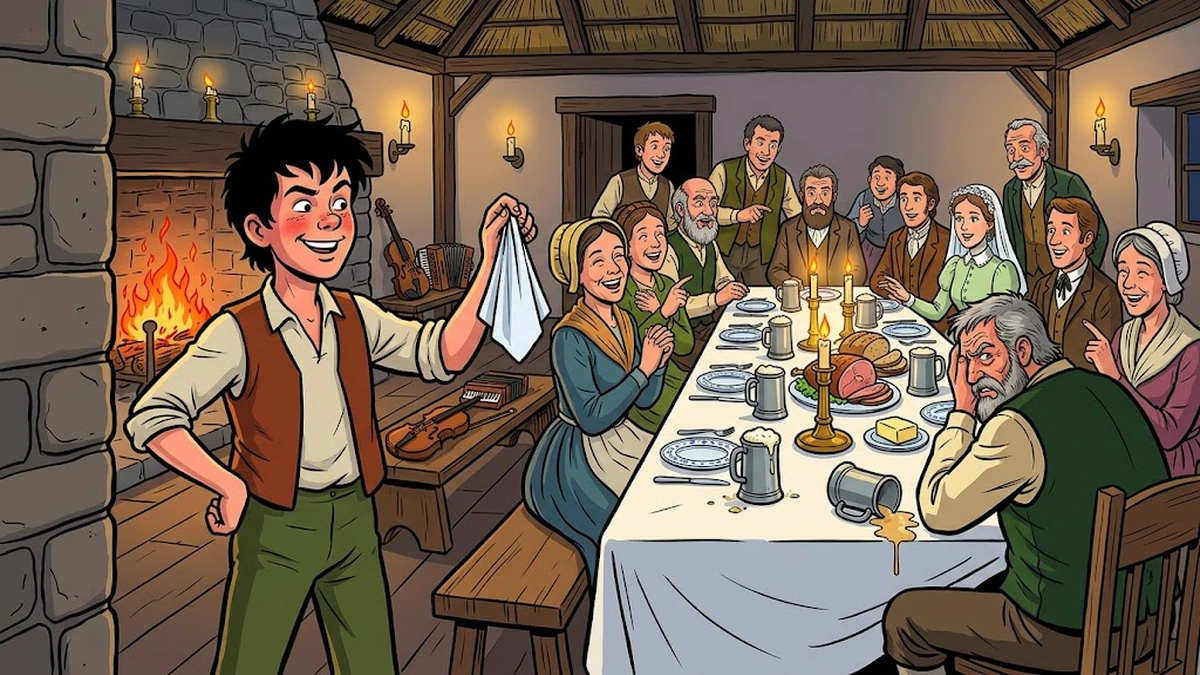
That afternoon Jack walked into the parish butcher's and bought from him, for sixpence, the eyes of three sheep that had been killed that morning. He put them in a clean rag in his pocket. About eleven o'clock he slipped into the wedding-house and stood in the dark behind the chimney-jamb. The Churl was in great form at the head of the long oaken table, joking and pouring wine and breaking bread. Jack waited for the music to lift and the talk to grow loud, and then he reached into his pocket and flung the first sheep's eye, soft and clammy, against the Churl's left cheek. It fell with a wet plop into the master's tumbler. The Churl looked up startled and saw what it was and went pale; but he could see no one, and said nothing, and took out the eye with two fingers and laid it on his plate.
Two minutes later the second eye sailed across the room and slapped against his right cheek. The Churl mopped his face with his sleeve and looked round wildly. The third — and this was Jack's masterpiece — flew straight into the Churl's open mouth as he raised the wine to drink the bridegroom's health. The Churl spluttered and roared and spat the eye onto the table-cloth. Man of the house, he bellowed, is it a great shame for you to have any one in the room that would do such a nasty trick? And out of the chimney-corner stepped Jack, mild as a saint at his prayers. Master, said Jack, do not blame the honest man. It was only myself was throwing those sheep's eyes at you, to remind you I had come, and that I wanted my drop of the wedding health. You yourself bade me, sir.
The Churl, beside himself, struck the table with his fist. And where in the name of all the saints did you get the eyes? Master, said Jack, with the smallest possible smile, and where would I get them but in the heads of your own sheep? You would not have me steal a neighbour's sheep, and end up in the Stone Jug for it? The Gray Churl flung up both hands and roared out the one word he had ground his teeth against for nine months: Sorrow on me, he cried, that ever I had the bad luck to meet with you!
The whole table fell quiet. You are all witnesses, said Jack, in the steady voice of a man stating a proven fact. My master has said he is sorry for our bargain. My time is up. Master, please to pay me my double wages, and step into the next room and lay yourself out like a man, that I may take from you the strip of skin an inch wide from your shoulder to your hip — for you took the same strip from my two brothers, and sent them home penniless to their poor mother.
The wedding company, which had heard the rights of the matter all in one breath, rose to back the boy. The Churl was stripped to his hips, laid white-faced on the floor of the inner room, and Jack stood over him with the carving knife. Master, said Jack, scraping the knife along the floor in a horrible whisper, here is my offer. Add to my double wages two hundred guineas to keep my disabled brothers, and I will let you keep your skin. No, said the Churl, through his teeth. Skin me from head to foot first. Jack put the point of the knife to the Churl's shoulder and made one tiny scratch, no deeper than a pin. The Churl let out a yell that lifted the rafters. Stop your hand, he cried; I will give the money — every penny of it — only stop your hand!
And Jack did stop. He stood up and grinned and said to the wedding-folk: Now, neighbours, do not think worse of me than I deserve. I would not have the heart to take an eye out of a rat, much less the skin of a man. Six sheep's eyes I bought from the butcher, and only three I used. I would never have done him a real hurt. The hall roared with laughter and relief, and somebody pressed Jack down into the master's own chair, and they drank his health all together in one great toast, and he drank theirs back. Six stout fellows of the wedding party walked the Gray Churl home between them. He went up to his strong-box and counted out the two hundred guineas for the two crippled brothers and the double wages for Jack, and stood at his own door white as a winding-sheet while Jack walked away down the lane in the moonlight with the gold heavy in his pockets. From that night to the day of his death no one in three baronies called him Jack the Fool any longer. He was known instead as Skin-Churl Jack, the boy that brought the summer home.
The Moral & Why It Lasted
“Is fearr ciall ná gliocas” — better is good sense than mere cleverness.
— Connacht Irish proverb cited in Patrick Kennedy, Legendary Fictions of the Irish Celts (1866), p. xv
The moral of “Jack and His Master” is older than its laughter: the man who knows how to listen exactly to what is said can never be cheated by the man who knows how to say it cleverly. The Gray Churl is the master of the polite Hiberno-English idiom — red the ground, throw a sheep's eye, look in places likely and unlikely, do as if it were your own — and he uses these idioms as the rope by which he hangs his servants. Jack's genius is to refuse the polite layer altogether and to obey the literal words. Each idiom turns into a comedy because the labouring boy has dared to take seriously the words of the master class. The bargain — he who first says sorry pays a strip of skin — is the formal-legal expression of the same opposition: it is the master who has the power to set the terms, but it is the servant who, by patience, can decide which side cracks.
This is why the tale travelled so widely. Stith Thompson's motif K1761 (“Servant carries out master's order to the letter”) and Aarne's type 1000 (“Bargain not to become angry”) are recorded from Norway (“Lord Peter,” Asbjørnsen and Moe, Norske Folkeeventyr, 1841), Russia (“Shabarsha,” Afanasyev no. 153 in the 1855–63 collection), Germany (Grimm KHM 7 “The Good Bargain” and KHM 162 “The Wise Servant”), Sicily (Pitrè, Fiabe, Novelle e Racconti Popolari Siciliani, 1875), Catalonia, Hungary, Estonia, and Iceland. The Indian Pancatantra has the analogous frame in the Brahmin-and-servant tales of Book III. The Hibernian version is distinguished by the precision of its forfeit, the verbatim trio of brothers, and the final stroke of the sheep's eyes — and by the social bite that Kennedy and Jacobs both heard in it: a tale told by labouring people for the laughter of labouring people, in which the just wages of a stingy master are not coin but cold steel.
For a child today the lesson behind the laughter is simpler still: be careful what you ask for, exactly. To Kennedy's Wexford listeners in the 1860s, two decades after the Famine, the lesson was sharper — that the labouring poor had only their wits between them and the strong farmer, and that wit, patiently used, was a knife sharper than any in the Churl's drawer. To Joseph Jacobs, writing for the children of Victorian London in 1892, it was a fable of class translated into joy: read it slowly, hear the Hiberno-English idioms one by one, and you will see that the small boy who looks like a fool is in fact the most exact reader in the parish. Skin-Churl Jack reads the Churl's words the way a scholar reads a difficult text — and the result is one of the great comic justices of the Irish folk canon.
Read also: “Jack and His Comrades” (Jacobs / Kennedy 1866); “Hudden and Dudden and Donald O'Neary” (Jacobs 1892); “Lord Peter” (Asbjørnsen and Moe, 1841); “The Good Bargain” (Grimm KHM 7); “The Wise Servant” (Grimm KHM 162); “Shabarsha” (Afanasyev no. 153, 1855–63); “Master Pfriem” (Grimm KHM 178).
You May Also Like
 Celtic Folk Tales
Ages 9-12
Celtic Folk Tales
Ages 9-12
The Wooing Of Olwen
The Wooing Of Olwen: Shortly after the birth of Kilhuch, the son of King Kilyth, his mother died. Before her death she charged the king that he should not take
 Celtic Folk Tales
Ages 9-12
Celtic Folk Tales
Ages 9-12
Powel, Prince of Dyfed
Powel, Prince of Dyfed: owel, Prince of Dyfed, was lord of the seven Cantrevs of Dyfed; and once upon a time Powel was at Narberth, his chief palace, where a
 Celtic Folk Tales
Ages 9-12
Celtic Folk Tales
Ages 9-12
Andrew Coffey
Andrew Coffey: My grandfather, Andrew Coffey, was known to the whole barony as a quiet, decent man. And if the whole barony knew him, he knew the whole barony