The Sprightly Tailor
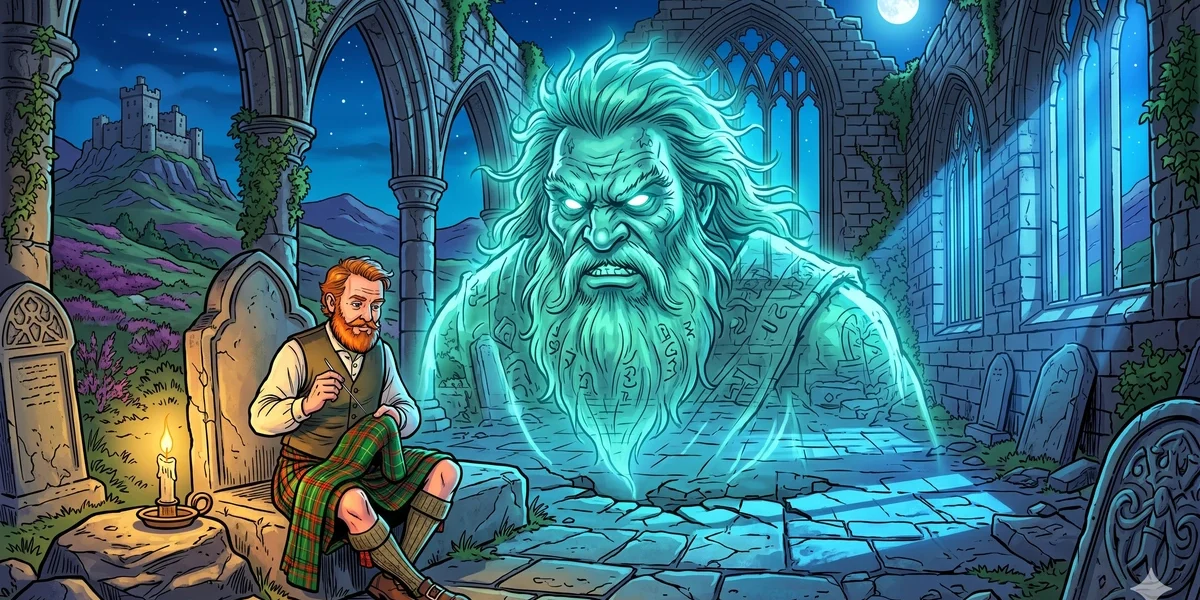
The Sprightly Tailor: A sprightly tailor was employed by the great Macdonald, in his castle at Saddell, in order to make the laird a pair of trews, used in
The Sprightly Tailor
Canonical Attribution
| Source | Joseph Jacobs, Celtic Fairy Tales (1892), Tale XI, pp. 79–83 |
|---|---|
| Oral Source | The Dewar Manuscripts — West Highland Gaelic oral tradition, Kintyre Peninsula, Argyll, Scotland, collected c. 1860s by John Dewar |
| Gaelic Title | An Tàillear Sunndach (“The Cheerful / Sprightly Tailor”) |
| Setting | Saddell Castle and the ruins of Saddell Abbey, Kintyre, Argyllshire, Scotland; seat of Clan MacDonald of Saddell, c. 16th–17th century |
| ATU Tale Type | ATU 326 — The Youth Who Wanted to Learn What Fear Is (courage-test variant); Motif H1411 (Fear test: staying in haunted place) |
| Motifs | F402.1 (spirit rises from below); H1411 (night in haunted church); D1273 (magic task completed at speed); F531 (giant apparition); G303.9.1 (meeting a supernatural creature alone) |
| Collector Note | Jacobs notes: “From the Dewar MSS., where it is given in Gaelic. The tale is a good example of the Kintyre local legend, firmly attached to identifiable landmarks — the ‘finger marks’ on the wall above the abbey gate being cited as visible proof to this day.” |
I. The Wager at Saddell
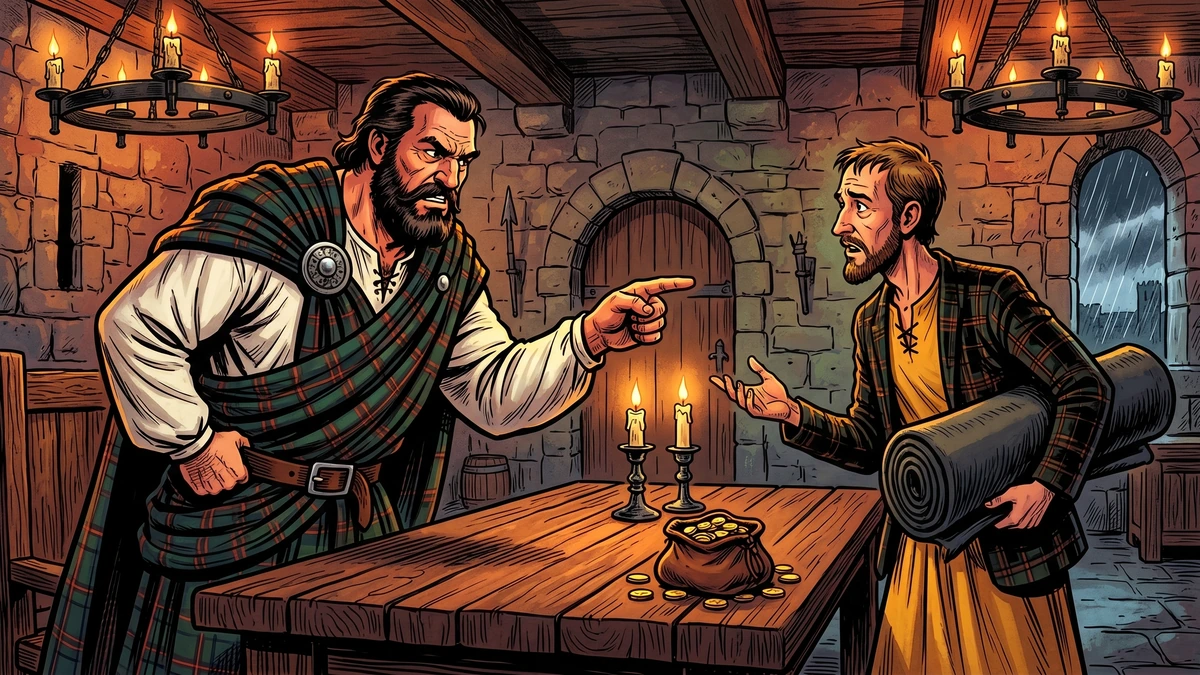
On the long western shore of the Kintyre peninsula, where the grey waters of the Kilbrannan Sound lap against basalt shingle and the ruins of Saddell Abbey rise pale against the moorland sky, there lived a great chief of Clan MacDonald — lord of the castle that stands to this day between the old monastic walls and the sea. He was a man who liked to test the mettle of those who served him, and one autumn evening, when the candles guttered in the hall and the wind drove rain hard against the stone, he called for a tailor.
The tailor who answered the summons was known throughout Kintyre as a sprightly fellow — quick with his fingers, quick with his tongue, and quick on his feet, which last quality would prove most useful before the night was done. The laird spread before him a length of good dark cloth and issued a challenge that was half commission and half wager.
“I need a pair of trews made for me,” said the MacDonald. “Good close-fitting trews in the Highland fashion, cut and sewn from neck to ankle in a single piece, fine enough to dance or walk the hill in.” He leaned across the table and lowered his voice. “Sew them tonight — in the ruined kirk by the abbey gate, alone, by candlelight. Stay the whole night through and bring me the finished trews at dawn, and I will reward you with a purse of gold. Quit the church before morning and you leave with nothing.”
The ruins of Saddell Abbey had stood roofless since the Reformation stripped them in the sixteenth century, and no man of the glen would willingly linger inside them after dark. Strange sounds were said to come up from the old monk-graves when the moon was hidden. But the tailor was sprightly in spirit as well as body, and he weighed the gold against the ghosts and accepted the bargain without a tremor. He gathered his chalk, his shears, his needles and his thread, tucked the cloth under his arm, stuck his candle in his pocket, and walked out into the wet Scottish night.
II. Needles in the Dark
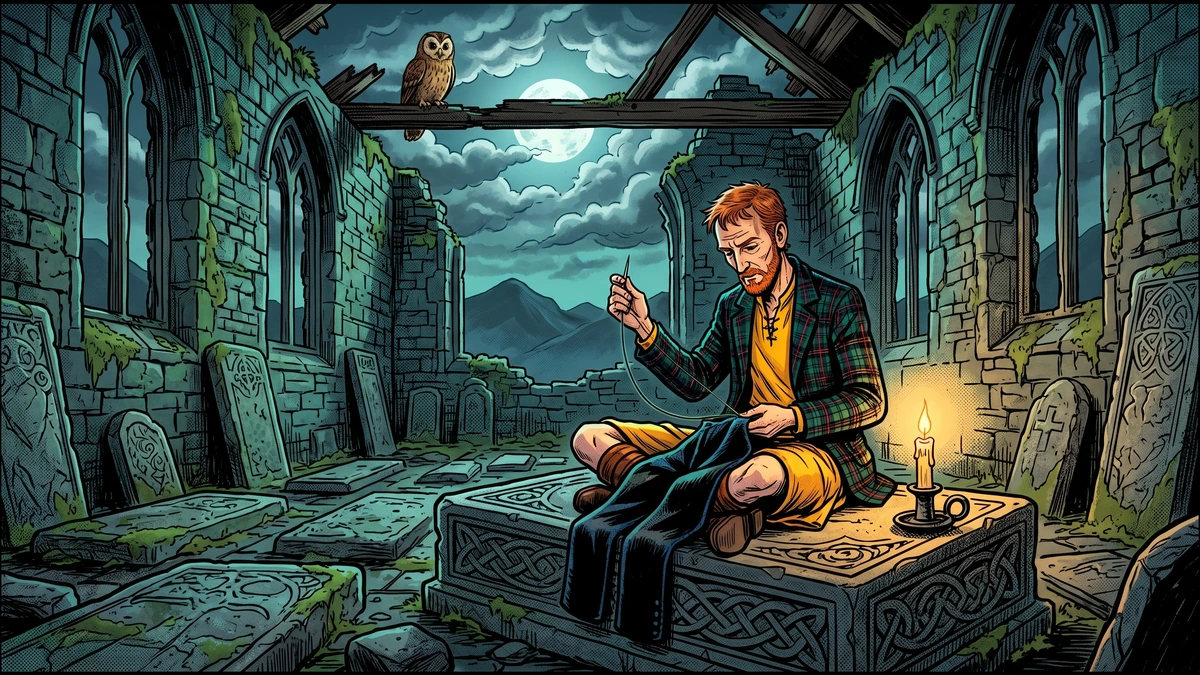
The abbey gate was low and the stonework damp with centuries of Argyll rain. The tailor ducked through, found the flattest, broadest of the old grave-slabs — one that the monks of long ago had carved with a floriated cross — and set his candle on a corner of it. The flame held. He smoothed the cloth, set his chalk-line, and began to cut.
The ruins of a Highland abbey at midnight are no silent place even when they are empty. Wind moves through the open tracery of windows that no longer hold their glass. Water finds its way down roofless walls and taps on flagstones with a sound not unlike fingers. An owl, nesting high in what had been the choir, shifted on its beam and called. The tailor took note of all of this, found it worth less than a farthing’s concern, and went on with his work. He was, after all, a professional. He threaded his needle, pulled his first stitch, and murmured to himself — as tailors do when they work alone — an old snatch of Gaelic verse to keep the rhythm of his fingers.
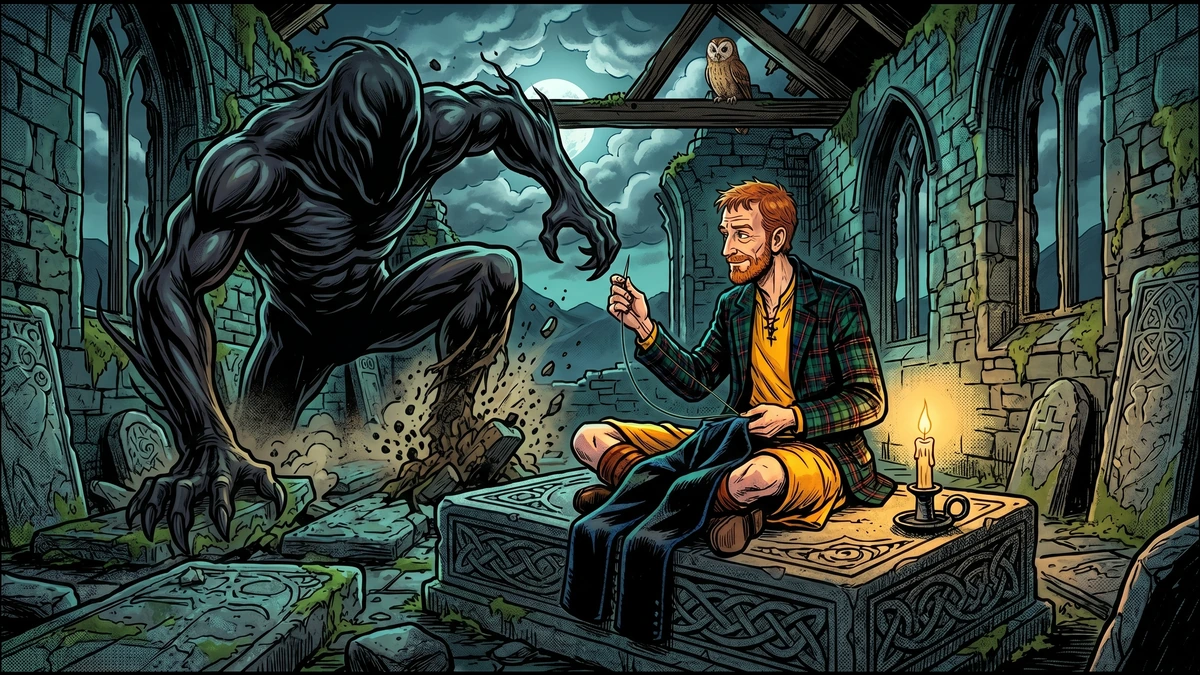
He had the front panel well advanced, and the seam running cleanly, when he heard the first sound that had no natural explanation. It came from below the slab beneath him — a slow, grinding resonance, as of stone moving against stone deep underfoot, and with it a breath of cold air from a direction that had nothing to do with the abbey windows. The tailor looked down. By the light of his candle he saw the grave-slab at his left begin, almost imperceptibly, to rise.
“An tàillear nach crith, chan eil e dall — tha e a’ coimhead is a’ fuaigheal fhathast.”
(“The tailor who does not tremble is not blind — he is watching, and still sewing.”)
— Gaelic proverb attributed to Kintyre oral tradition
The tailor watched — and he kept sewing.
III. The Great Leg
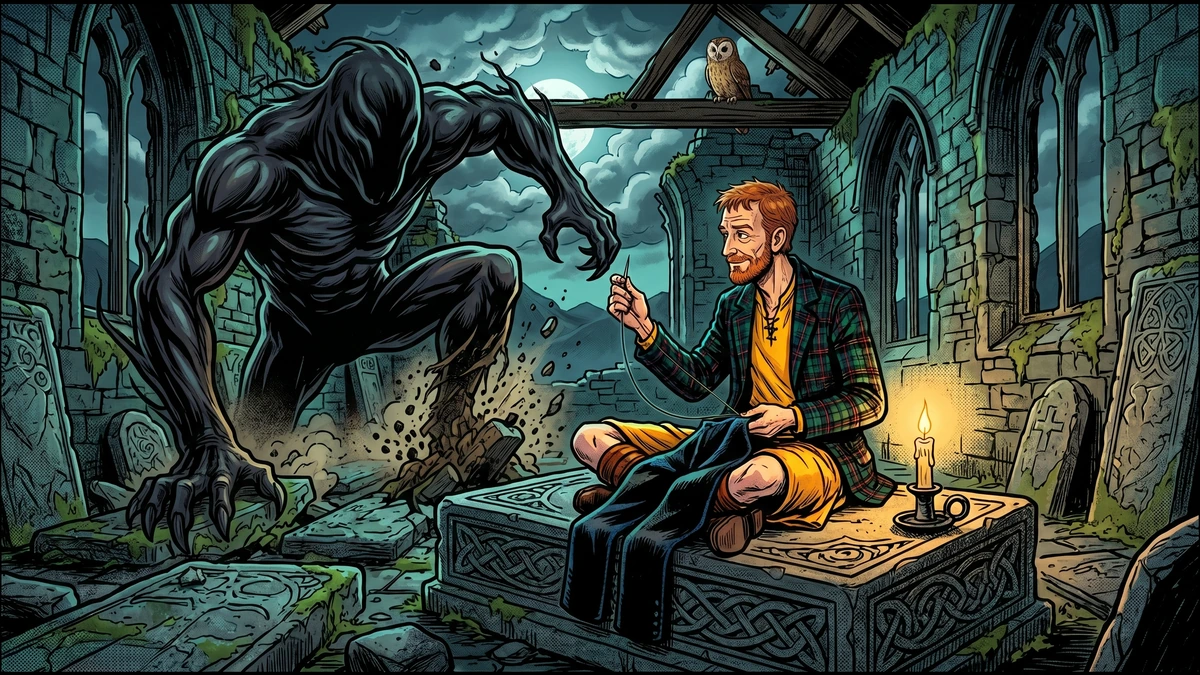
What rose from the floor of Saddell Abbey was not any ghost that the theological tradition of the Church prepared its parishioners to meet. It was enormous — a creature of the old, pre-Christian dark that the abbey had been built to overlay and supplant but had never entirely succeeded in driving out. It rose slowly, as if testing the cold air above the stone, and as it rose it gathered substance: first a crown of matted darkness, then vast shoulders, then arms thick as the beams of a mill-wheel.
“Do you see this great leg of mine?” it bellowed, its voice filling the roofless nave like thunder in a box canyon, and it lifted one limb — a leg like the trunk of an oak — and stamped it on the paving with a crack that sent splinters of mortar flying across the tailor’s cloth.
The tailor looked at the great leg. He considered it gravely, as a man of his craft is trained to consider a length of cloth or a difficult seam. Then he looked at his work — the trews were perhaps three-quarters done, the main body complete, one leg seam open — and he went back to his needle.
“A very fine leg,” he said, without looking up.
The creature seemed to take this as encouragement. It strained upward, beginning to haul its second limb free of the stone, and as it did it roared again: “Now do you see this great leg of mine?” — meaning the other one, which was not yet fully clear of the slab.
“A very fine leg indeed,” said the tailor, and he drew the last thread through the last seam, bit it off, and folded the finished trews across his arm.
IV. The Race to the Gate
The tailor blew out his candle.
Darkness in a roofless ruin on a clouded night is near-total, but a man who has just spent three hours working in one small pool of candlelight knows every stone and ankle-twist of the ground between himself and the door. The tailor was up from his gravestone in an instant, the trews under his arm, his tools rattling in his pocket, and he sprinted for the abbey gate with the particular light-footed speed of a man who had, through thirty years of professional fitting sessions, learned to dodge in very small spaces at high velocity.
Behind him he heard the creature bellow — the sound of that second great leg finally pulling free of the earth, of enormous weight landing on old stone, of fury at having its audience removed. The roar was close and getting closer.
The tailor made the gate. He ducked through. He ran.
The creature reached the gate a half-second behind him — and the gate was too small. It struck the lintel with its fist in rage, and the blow it delivered to the stone above the arch left the impression of five enormous fingers pressed deep into the masonry, where they remained for all who cared to look.
The tailor ran all the way to the castle and arrived at the great door in the grey hour before dawn, breathing hard but entirely composed. He knocked. The porter opened. The MacDonald himself came down the stair in his night-clothes to see what the noise was about.
“Your trews, my laird,” said the tailor, and held them out. “Cut, sewn, and finished in the kirk at Saddell. I will take that purse of gold now, if it please you.”
The MacDonald paid, as a gentleman of his word must do. And if you go to Saddell today and look carefully at the stonework above the old abbey gate, you may still — so they say — see the mark of five great fingers pressed into the rock, left by a creature that was too large to follow a sprightly man through a small and ancient door.
The Moral
“Is fearr an obair na an eagal.”
“Work is better than fear.”
— Scottish Gaelic proverbial wisdom
The tale turns on a paradox that Highland storytelling loved to expose: the man who focuses entirely on his task is, in practical terms, the most fearless man in the room — not because he is ignorant of the danger, but because his attention is fully employed elsewhere. The tailor never pretends the apparition is not there. He acknowledges it — “A very fine leg indeed” — with the polite detachment of a craftsman for whom the work in hand takes absolute precedence. Fear, in this reading, is essentially a failure of concentration; courage is simply keeping your needle moving.
There is a secondary moral embedded in the tale’s geography: the laird who sets the test must also honour the result. Power without integrity is shown to be toothless — the MacDonald could not have used the trews if he had refused to pay for them. Contractual honour, the story suggests, binds lords as firmly as it binds the tradespeople who serve them.
Why This Story Has Lasted
“The Sprightly Tailor” has survived because it does something rare in the folklore of the supernatural: it makes the audience laugh at the monster rather than with it, and it does so without diminishing the genuine menace of the thing rising from the earth. The creature is undeniably terrifying — enormous, ancient, wrathful — and yet it is ultimately ridiculous, defeated not by a hero’s sword or a cleric’s prayer but by a tradesman’s deadline. That inversion of expected categories — the humble artisan triumphing over a force of primordial dark — gave the tale enormous popular energy across the oral tradition of the Scottish Gaeltacht.
The tale also works as local legend, anchored to a real, surviving landmark: Saddell Abbey on the Kintyre coast. The alleged finger-marks in the stonework above the abbey gate gave listeners a physical proof they could go and look at, transforming an entertaining story into something that felt like testimony. Joseph Jacobs, who collected the tale for his 1892 Celtic Fairy Tales from the Dewar Manuscripts of West Highland oral tradition, understood this perfectly: he closed his own retelling with the same invitation to go and look, preserving the story’s claim on the landscape rather than merely its plot.
Across the comparative folklore record the tale belongs to ATU 326 — the courage-test subtype in which a protagonist spends a night in a haunted place not to lay a ghost but simply to complete a task — and it shares its skeleton with hundreds of European and Asian variants. What distinguishes the Kintyre version is its specificity: the trews, the MacDonald, the Saddell gate, and above all the tailor’s unhurried professional commentary on the apparition’s limbs, which lifts the tale from a generic ghost story into a fully realised character study. That character — competent, unflappable, gently amused by the world’s attempts to unsettle him — is one that Scottish oral tradition returned to again and again, and in him listeners across four centuries have found both comfort and delight.
You May Also Like
 Celtic Folk Tales
Ages 9-12
Celtic Folk Tales
Ages 9-12
The Little White Cat
The Little White Cat: A long, long time ago, in a valley far away, the giant Trencoss lived in a great castle, surrounded by trees that were always green. Even
 Celtic Folk Tales
Ages 3-5
Celtic Folk Tales
Ages 3-5
The Three Golden Hairs of Grandfather Know-All: A Czech Tale of Wit and Destiny
The Three Golden Hairs of Grandfather Know-All: A Czech Tale of Wit: In the Kingdom of Bohemia, there lived a nobleman who was obsessed with destiny. He had
 Celtic Folk Tales
Ages 9-12
Celtic Folk Tales
Ages 9-12
Gold-Tree And Silver-Tree
Gold-Tree And Silver-Tree: Once upon a time there was a king who had a wife, whose name was Silver-tree, and a daughter, whose name was Gold-tree. On a certain