The Enchanted Cave
The Enchanted Cave: A long, long time ago, Prince Cuglas,[7] master of the hounds to the high King of Erin, set out from Tara to the chase. As he was leaving

The Enchanted Cave (Irish: Uaimh Bealaigh Conglais, “the cave of the pass of Cuglas”) is one of seven Irish wonder-tales gathered by the nationalist member of parliament and folklorist Edmund Leamy (1848-1904) and published posthumously as Tale III of The Golden Spears, and Other Fairy Tales (Desmond FitzGerald, Inc., New York, 1911), with full-page colour illustrations by Corinne Turner. Leamy had earlier circulated several of these tales in the Irish nationalist papers and in the slim volume Irish Fairy Tales issued in Dublin from the late 1880s onward; the posthumous Golden Spears collection brought them together for an Irish-American readership at the height of the Gaelic Revival.
The tale belongs to the great medieval-Irish category of the echtra — the journey of a mortal hero into a parallel Otherworld kingdom — refracted through nineteenth-century literary fairy-tale convention. In the international tale-type index it is principally ATU 400 (The Man on a Quest for His Lost Wife), with grafted-in episodes from ATU 313 (The Magic Flight) and a closing motif of love proved by failed bridal-quest. The geographical anchor is the real Wicklow town of Baltinglass: Bealach Conglais, “the pass of Cú Glas”, named in early Irish topographical tradition after the Fianna huntsman Glas whose hounds chased a magical boar to its death there. Leamy spins this place-name etymology into a full-blown romance in which Cuglas, master of hounds to the High King of Erin at Tara, follows a deer through that very cave into the kingdom of a fairy queen of the Floating Island and is held there forever — until love proves stronger than every fairy art.

I. The Chase Out of Tara: A Royal Huntsman Salutes His Beloved
Leamy opens his tale on the great fortified hill of Tara, the legendary seat of the High Kings of Ireland in County Meath, on a summer morning when “the light mists were drifting away from the hill-tops, and the rays of the morning sun were falling aslant on the grianan” — the sunny upper bower — “of the Princess Ailinn.” The opening tableau is studied. A grianan in early Irish architecture is the solarium reserved for women of the highest rank, and naming it in Gaelic immediately places the reader inside the imagined world of pre-Christian Erin. The Princess Ailinn herself bears one of the most freighted names in the Irish romantic tradition. The tragic Aithed Ailinne ocus Bhaile Mhic Bhuain — the elopement of Aillinn and Baile son of Buan, in which the young lovers die at the news of one another’s deaths and grow up afterward as a yew and an apple-tree whose entwined wood is carved into the rod-of-knowledge of the poets — was already a thousand years old when Leamy wrote, and his audience would have heard the echo at once.
Prince Cuglas is introduced as master of the hounds: not a king’s son in his own right but the chief of the chase, a position of intimate trust at the High King’s court and one with an old pedigree in Irish saga (the Fianna under Fionn mac Cumhaill were essentially a royal hunting fraternity). He doffs his “plumed and jewelled hunting-cap” toward the grianan; Ailinn waves “her little hand, that was as white as a wild rose in the hedges in June.” Then the hounds give tongue and a “dappled deer” bounds away through the forest. The deer, throughout Celtic literature, is the standard creature sent by the Otherworld to lure mortal heroes across the boundary — a motif catalogued by Stith Thompson as B563.1 (Deer leads man to fairyland) and recurring in the Fenian cycle, in Acallam na Senórach, in Pwyll Pendefig Dyfed from the Welsh Mabinogion, and in countless modern tales.
Leamy lingers over the chase for half a day — “through soft, green, secret ways and flowery dells, then out from the forest, up heathery hills, and over long stretches of moorland, and across brown rushing streams” — in order to make the moment of disappearance shocking. At sunset the hounds close in; the deer plunges into “the mouth of a cave which opened before him”; the dogs follow; Cuglas’s reins break in his hands; horse and rider plummet “as a stone cast from the summit of a cliff sinks down to the sea.” When the prince’s eyes adjust to the new light, he is no longer in Erin: he is on a sunlit grassy plain in fairyland, and a herald in a “shining brown cloak, fastened by a bright bronze spear-like brooch, and bearing a white hazel wand,” is approaching to lead him to the court of the Princess Crede.
II. The Court of the Floating Island: Crede’s Three-Tiered Welcome
The herald’s salutation — “You are welcome, Cuglas, and I have been sent by the Princess Crede to greet you” — is delivered in the formal high-Gaelic register of medieval reception scenes. The name Crede (modern Irish Céide) is itself a celebrated Otherworld name. In the early-Irish poem Créide ingen Ronain a fairy princess of the Tuatha Dé Danann pines for the warrior Cáel, and in the Dá Choca’s Hostel tradition Crede is a divine queen-of-the-fairies whose dwelling is described in catalogues of jewelled rooms. Leamy’s Crede inherits all of this lineage and adds the specifically nineteenth-century image of the Floating Island — an Otherworld realm that, like the moving Mag Mell of Immram Brain mac Febail (the seventh-century Voyage of Bran), is glimpsed and then hidden by tides and mist.
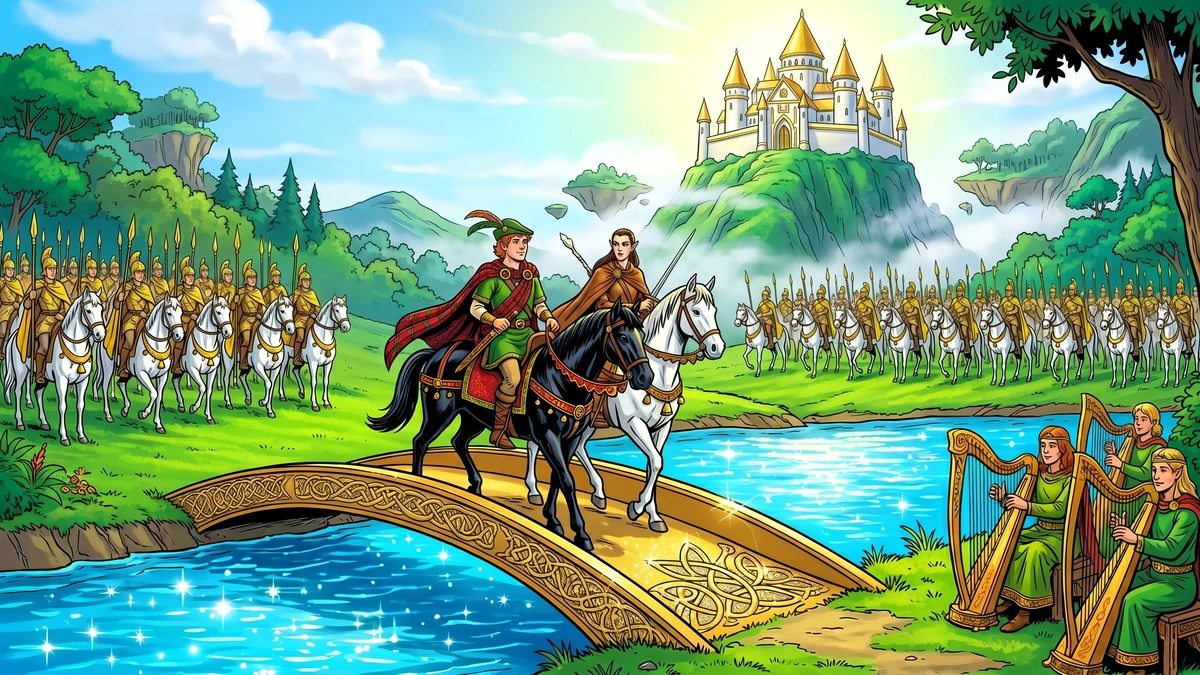
The journey to her palace is told in graduated triadic order, in the manner of a Gaelic professional storyteller. First Cuglas meets a “troop of warriors on coal-black steeds,” wearing “helmets of shining silver, and cloaks of blue silk,” with silver crescents and silver bells at the horses’ breasts. Next comes “a hundred champions on snow-white steeds” with golden crescents and golden bells, golden helmets, golden sandals, “and yellow silken mantles fell down over their shoulders.” Last comes “a band of harpers, dressed in green and gold,” whose music heralds the river that loops “like a blue riband around the foot of a green hill” upon which the palace of Crede stands. The progression silver to gold to harp is the classic Irish triad of valour, kingship, and poetry; the colour code (black for the ride out, white for the approach to the king’s house, green and gold for the throne itself) is exactly the colour-grammar of the medieval Irish tale of welcome.
The bridge across to the palace is “a golden bridge, so narrow that the horsemen had to go two-by-two.” The instant Cuglas crosses, Leamy delivers the mythic detonation: “You are on the floating island now“, says the herald, and the bridge has vanished. The land Cuglas stands on is the country of the dá shíde, the “fairy peoples”; he is no longer mortal but a guest, and unless something protects him he will, in the manner of Oisín after Tír na nÓg, never set his foot on Erin again.
III. The Bracelet of the Scandinavian Dwarfs: The Mechanics of Fidelity
What protects him is one of the most beautifully imagined small inventions in nineteenth-century Irish fairy literature, a piece of magical machinery worth pausing on. Concealed under the sleeve of his silken tunic, Cuglas wears a golden bracelet “made by the dwarfs who dwell in the heart of the Scandinavian Mountains” — sent with other costly presents from the King of Scandinavia to the King of Erin, given by the king to Princess Ailinn, and clasped by her around the prince’s wrist on the day she promised him her hand. Two laws govern the bracelet: whoever wears it cannot forget the giver, and it cannot be loosened from the arm by any art or magic spell. There is one safety-clause, both lyrical and pitiless: “if the wearer, even for a single moment, liked anyone better than the person who gave it to him, that very moment the bracelet fell off from the arm and could never again be fastened on.“
The bracelet is Leamy’s elegant solution to a problem every Otherworld-romance has had to confront since Homer’s lotus-eaters. The Otherworld is, by definition, a place of perfect ease: “where pain, and sickness, and sorrow, and old age, are unknown, and where every rosy hour that flies is brighter than the one that has fled before it.” The fairy queen herself talks to Cuglas of “all the pleasures that were in store for him in fairyland”; he is fed at her side at the banquet, opens the dance with her under high moonlight, hunts at the head of her court the next morning, sails her lake under purple silk awnings the morning after that. Without the bracelet a mortal would forget within a week. The bracelet keeps memory burning, and so keeps love itself burning, even though it does so at the cost of joy: night after night Cuglas lies awake on his couch grieving for the fair hills of Erin and the bonny Princess Ailinn.
The stylistic decision to make the bracelet a Scandinavian dwarf-work, rather than a Gaelic or Tuatha Dé Danann one, is also pointed. It glances northward to the Norse Brisingamen and to the goldsmiths of the Sigurð cycle, and it acknowledges the Viking layer that runs through the metal-craft of the Irish Sea coast — a layer that nineteenth-century Irish folklorists, of whom Leamy was very much one, were beginning to take seriously rather than to sweep aside.
IV. The Three Failures: Sea-Monster, Mirage, and the Champion on the Bridge
The narrative engine of The Enchanted Cave is a Gaelic triad — the very oldest of Irish narrative shapes — of three escape attempts mediated by a tutelary fairy “little woman” who floats in on the moonbeams and sits on the floor of the prince’s chamber. She is one of the mná sí, fairy women of Ireland, in the ancient role of the banshee who is benign rather than mournful: a hereditary friend of Ailinn’s mother, paying off a debt of memory.
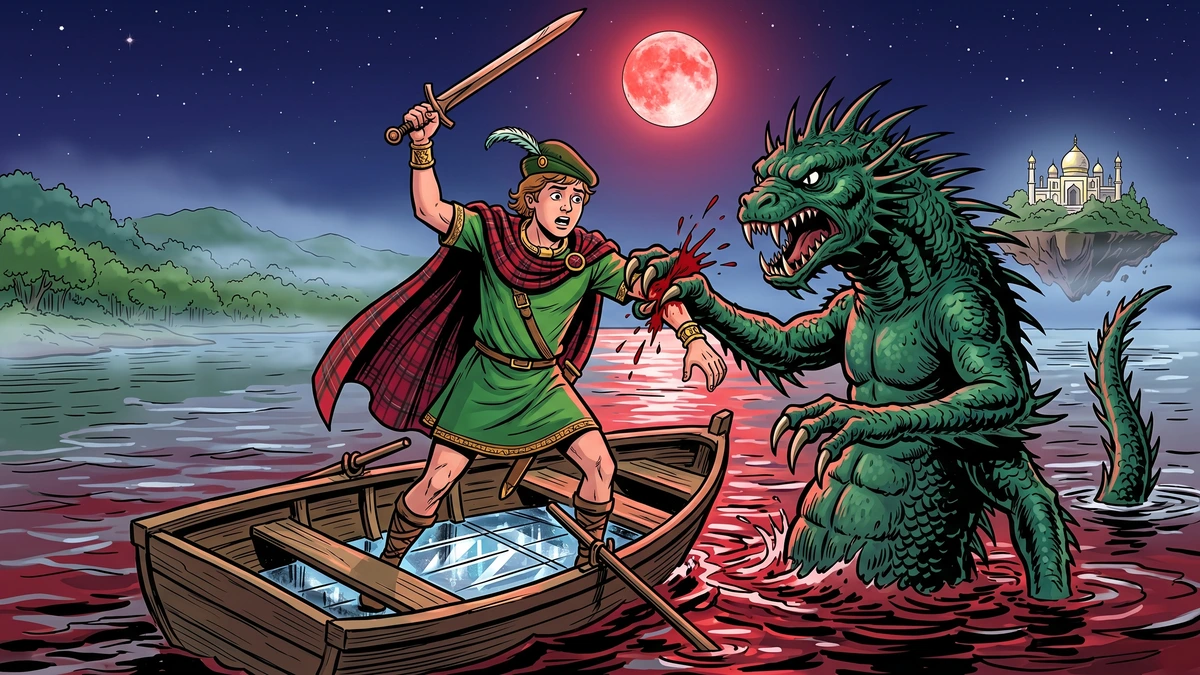
The first attempt is by night-boat across the lake. A bristling sea-monster rises from the waters and drives a claw “in the left arm of the prince, and pierced the flesh to the bone.” Maddened by the pain, Cuglas draws his sword and strikes off the claw — and at the very stroke the moon turns blood-red, the lake turns crimson, and the boat is swept back. He has been told not to draw his sword before he tread upon the mainland, and he has drawn it; the test was endurance, and he has failed by the smallest margin.
The second attempt is by underground passage. While the queen is paying her own visit to her fairy kinsmen at the great sí of Tara — an inversion that briefly puts Crede in Erin while Cuglas is in fairyland — the prince finds a hidden door in the floor of the banquet hall and descends to a “gloomy and lonesome valley.” Here Leamy reaches deep into the strata of Irish folklore. The “wild people of the glen” who beset him, hammered hands of cloud and shrieking forms in the lightning, are unmistakeably the geilt or gábócána, the wild men of the wastes who afflict travellers in the medieval Buile Shuibhne and elsewhere. Beyond the glen Cuglas crosses a sand-desert that springs deceiving fountains around him — the universal mirage of bridal-quest tales, paralleled in The Sea-Maiden in Campbell’s West Highland Tales and the Welsh Math fab Mathonwy — and the second test arrives at the foot of a green hill where a fairy sits holding out “a crystal cup, over the rim of which flowed water as clear as crystal.” He had been told to accept nothing from anyone he met along the way, and he drinks; the desert and the hill and the fairy vanish and he is back in Crede’s forest. The forfeit, again, is by the smallest margin: thirst, not desire, undid him.
The third attempt is the most beautiful and the saddest. A golden bridge is thrown across the lake by a golden bodkin cast into the water; halfway across the bridge a silver-helmeted champion meets him and, striking shield with sword, challenges him in single combat. Cuglas fights and slays him in one stroke. He has been warned not to draw his sword; he has drawn it. The bridge breaks under the body of the fallen champion; the further half sinks beneath the lake; the steed wheels and bears Cuglas back to the palace door. There is no fourth chance.
What is striking is the moral verdict the little fairy-woman delivers when she returns by night-boat to receive his confession. “I should have borne the pain inflicted by the monster’s claw,” Cuglas says. “I should have borne the thirst on the sandy desert. But I could never have faced the nobles and chiefs of Erin if I had refused to meet the challenge of the battle champion on the golden bridge.” And the little woman answers, smiling: “And you would have been no true knight of Erin, and you would not have been worthy of the wee girl who loves you, the bonny Princess Ailinn, if you had refused to meet it.” The sentence is the moral pivot of the entire tale: the prince’s last failure is also the proof that he is exactly the man Ailinn loved.

V. The Resolution: Ailinn Borne to the Floating Island, and the Cave that Bears the Prince’s Name
Leamy reverses the standard ending of the Otherworld tale. Oisín comes home to find Erin Christianised and three centuries gone; Connla, in Echtrae Conlai, sails away with a fairy maiden never to return; Bran returns from his island voyage only to crumble to dust on touching shore. In The Enchanted Cave, by contrast, Erin comes to the Otherworld. The Princess Ailinn, learning of her lover’s vanishing, fades on her couch in Tara — “the colour had fled from her cheeks, and her eyes… lost nearly all their lustre, and the king’s leeches could do nothing for her” — until on a bright afternoon her chamber is filled with sudden darkness, fairy music sounds over her bed, a gleam of golden light passes, and the watchers find the couch empty. The fairy queen has done what could only be done by a queen of her rank: she has carried Ailinn alive across the boundary.
The closing scene at the lake-edge is one of the most quietly perfect endings in the literature. Cuglas hears fairy music; a fleet of moonlit boats crosses the lake; the royal shallop holds the little fairy-woman in the prow, the queen at the stern, and Ailinn beside her. The prince catches Ailinn into his arms and kisses her; the little fairy-woman, half teasing, asks for her own kiss and Cuglas catches her up too; Crede speaks the verdict that closes the tale:
“I lured him here hoping that in the delights of fairyland he might forget you. It was all in vain. I know now that there is one thing no fairy power above or below the stars, or beneath the waters, can ever subdue, and that is love. And here together for ever shall you and Cuglas dwell, where old age shall never come upon you, and where pain or sorrow or sickness are unknown.” — The Princess Crede, fairy queen of the Floating Island
The mortal lovers do not return to Erin; instead they are accepted into the deathless country together, and the country itself is changed by their being there. And the cave above — in the real world — is given the prince’s name forever. Leamy closes with a footnote that fastens the entire fantasy back to the geography of County Wicklow: Uaimh Belaigh Conglais, the cave of the road of Cuglas, today Baltinglass. The toponymic legend of Bealach Conglais, recorded for centuries before Leamy wrote, told of a Fianna huntsman called Cú Glas whose hounds chased a wild boar from the plain of Tara to the Wicklow pass, where boar and hounds and huntsman together fell. Leamy retains the chase, retains the disappearance, retains the place-name — but he gives the lost huntsman an Otherworld and a princess and a kept bracelet, and he sends him in love instead of in death.
Moral
“There is one thing no fairy power above or below the stars, or beneath the waters, can ever subdue, and that is love“: the bracelet of memory is in the end only the visible token of an interior fact — that fidelity, kept under temptation, has more force than any enchantment. Cuglas is rewarded not because he passes the three escapes (he fails all three) but because he never wanted anything other than to come home to Ailinn. The bracelet does not fall off — and that, in Leamy’s moral economy, is the whole of his answer to the tale.
Why The Enchanted Cave Has Lasted
Edmund Leamy died in 1904, four years after his serialised Irish Fairy Tales began appearing in Dublin papers and seven years before The Golden Spears assembled them in book form. He wrote at the moment when the Gaelic League was reviving the spoken Irish language and when the Abbey Theatre was about to put Cathleen ni Houlihan on the stage; his contemporaries included Lady Gregory, Douglas Hyde, and Standish O’Grady, and his fairy tales sit on the same shelf as their work. The Enchanted Cave has lasted because it does three things at once. It plants a real Wicklow place-name — Baltinglass — in the cosmology of the Tuatha Dé Danann, knitting modern Ireland to its pre-Christian inheritance. It supplies the standard Gaelic Otherworld tale with a happy ending, an ending that became thinkable only in the literary fairy-tale of the modern period. And it offers, in the small invention of the Scandinavian dwarf-bracelet that cannot be removed unless love fails, an image of fidelity that earlier echtra stories had only implied. Children read it for the moonlit boats and the silver bells; adults read it for what Crede says at the end, in the dark beside the lake, when she lets Ailinn go and lets Cuglas keep her.
You May Also Like
 Celtic Folk Tales
Ages 9-12
Celtic Folk Tales
Ages 9-12
The Shepherd Of Myddvai
The Shepherd Of Myddvai: Up in the Black Mountains in Caermarthenshire lies the lake known as Lyn y Van Vach. To the margin of this lake the shepherd of
 Celtic Folk Tales
Ages 3-5
Celtic Folk Tales
Ages 3-5
Baba Dochia and the Coming of Spring: A Romanian Tale of Humility
Baba Dochia and the Coming of Spring: A Romanian Tale of Humility: High in the Carpathian Mountains of Romania, where snow fell thick and heavy for months on
 Celtic Folk Tales
Ages 9-12
Celtic Folk Tales
Ages 9-12
The Golden Spears
The Golden Spears: Once upon a time there lived in a little house under a hill a little old woman and her two children, whose names were Connla and Nora. The