The Field Of Boliauns
The Field Of Boliauns: One fine day in harvest it was indeed Lady-day in harvest, that everybody knows to be one of the greatest holidays in the year Tom
The Field of Boliauns is one of the most loved and most frequently anthologised of all Irish leprechaun tales – a small comic masterpiece of the Munster countryside in which a peasant boy almost catches a fairy shoemaker, almost gets his crock of gold, and almost becomes the richest man in his parish, only to be undone by the simplest trick the Otherworld can play. The earliest printed version is in Thomas Crofton Croker’s Fairy Legends and Traditions of the South of Ireland (London: John Murray, 1825–1828, three volumes), the foundational nineteenth-century collection of Irish fairy lore that Sir Walter Scott called “the most lively and pleasing book of its kind that has appeared in our time” and that the brothers Jacob and Wilhelm Grimm so admired that they translated the first volume into German as Irische Elfenmaerchen in 1826, with a long folkloristic introduction. The story passed from Croker into W. B. Yeats’s anthology Fairy and Folk Tales of the Irish Peasantry (London: Walter Scott, 1888), pp. 19–21, and from Yeats into the version most read in modern English – Joseph Jacobs’s Celtic Fairy Tales (London: David Nutt, 1892), Tale XXII, pp. 230–237, illustrated by John D. Batten with one of the most famous of all leprechaun pictures.
Tale Type, Manuscripts, and Comparative Position
Folklorists classify the Field of Boliauns as a Munster variant of ATU 503 (The Gifts of the Little People) hybridised with the trickster pattern ATU 1539 (Cleverness and Gullibility), in which a small supernatural creature gets the better of a greedy mortal by exploiting the literal letter of an oath. The classification is given in Hans-Joerg Uther, The Types of International Folktales, FFC 284–286 (Helsinki: Academia Scientiarum Fennica, 2004), volume I, pp. 291–293 and II, pp. 238–240. The defining motif is F451.5.10.5 (Leprechaun reveals hiding place of treasure to mortal) – entered as such in Stith Thompson’s Motif-Index of Folk-Literature, FFC 116–117 (Bloomington: Indiana University Press, 2nd ed., 1955–1958), and treated at length in Tom Peete Cross’s Motif-Index of Early Irish Literature (Indiana University Press, 1952), under F420 (Water-spirits) and F451 (Dwarfs). The associated marker-motif K231.1.1 (Promise to keep watch broken) and the substitution-motif K1820 (Disguise by changing place) govern the closing reversal.
The little man Tom Fitzpatrick catches in the hedge is a leipreachán, the smallest and most solitary of the three orders of Irish fairies, distinguished in Croker’s introduction (volume I, pp. 128–131) and in Yeats’s headnote (1888, p. 19) from the gregarious sidhe of the green raths and from the malevolent fear darrig or red-coat. The word is an Anglo-Irish form of Middle Irish lúchorpán, “little body,” through Early Modern Irish leithbrágán, “the maker of one shoe” – for a leprechaun is always glimpsed mending a single brogue, never a pair. The name lúchorpán appears as early as the eighth-century Echtra Fergusa maic Léti (“The Adventure of Fergus son of Léti”), preserved in Trinity College Dublin MS H.3.18 and edited by D. A. Binchy in Eriu 16 (1952), pp. 33–48; in that text the lúchorpáin are the diminutive Otherworld people who carry the sleeping King Fergus into the sea and grant him three wishes. The Field of Boliauns is the eleventh-century literary descendant of that small comic moment.
The Munster setting and the agricultural detail belong to the post-Penal Laws Irish countryside that Croker rode through on the King’s collector’s circuit between 1812 and 1822. Tom Fitzpatrick is a poor cottier’s son in a parish on the edge of one of the great limestone sheep-walks of north Cork or east Kerry; his “father’s property” is a strip of rented oats and potatoes; the field he is sent into is a fallow common of buachalán buí – “yellow-boy,” the common ragwort (Senecio jacobaea Linn., a name Linnaeus took deliberately in honour of the saint’s-day on which Tom’s adventure occurs). The plant grows so thickly on overgrazed Irish pasture that an entire field of it is, in literal botanical fact, indistinguishable from another, and the closing trick of the leprechaun is therefore a piece of perfectly observed natural history.
The Story Retold
Beat One – Lady-day in Harvest and the Clacking in the Hedge
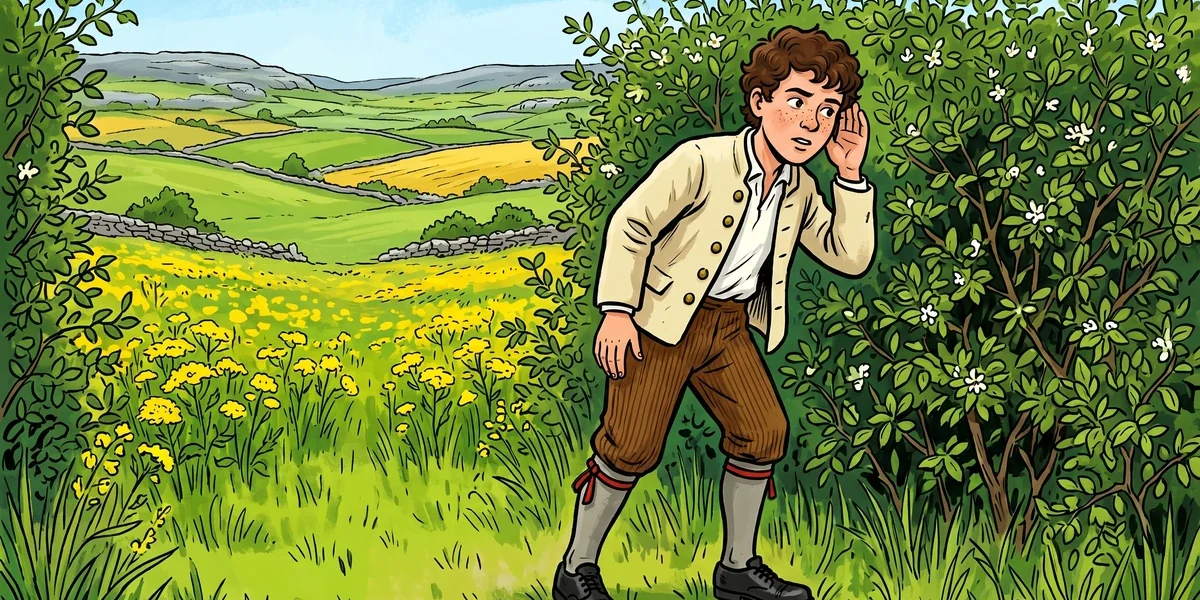
It was the fifteenth of August, the Feast of the Assumption of the Blessed Virgin Mary – Lá Fhéile Muire san Fhómhar, the great Lady-day of the Irish harvest, the holiday on which no plough could turn and no scythe could fall, and on which every man in the parish put on his Sunday coat and walked the lanes with his hands behind his back. Young Tom Fitzpatrick, the only son of a small Munster farmer, was rambling along the sunny side of a high blackthorn hedge in the warm afternoon. He wore the plain bawneen jacket of his trade – cream homespun wool, brass buttons – over a white linen shirt; his breeches were of brown corduroy; his stockings were grey wool; his shoes were heavy black brogues with iron-tipped heels. Above the hedge the August sun lay heavy on the limestone hills; a yellow-hammer fluted somewhere in the whitethorn; and out of the deep green nook of the hedge there came, suddenly, a small clear sound like a tap-tap-tap on leather.
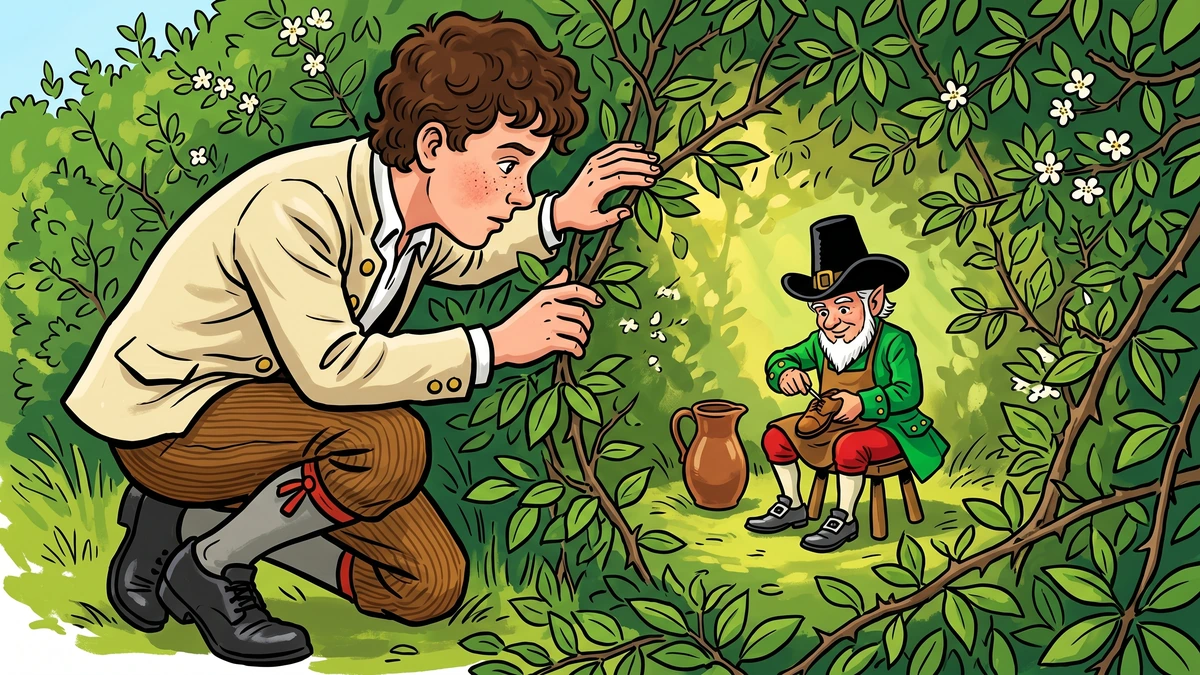
Tom stopped, and listened, and stole on, going on the tops of his toes. He parted the leaves with his hand as carefully as if he had been parting the hair of a sleeping child, and he saw, in a small green hollow, a brown earthenware pitcher of about a gallon and a half, and beside the pitcher a tiny man not nine inches high. The little man wore a high-crowned cocked hat of the old Wexford fashion, a deeshy-daushy leather apron tied with linen tape, a green coat with brass buttons, red breeches, and silver-buckled shoes. He was sitting on a tiny three-legged wooden stool dipping a tiny piggin into the pitcher, and he was working with a tiny awl on the heel of a tiny brogue not bigger than the nail of Tom’s little finger. Tom held his breath. He had heard tell of the leprechauns from his grandmother, who had come from the parish of Doneraile and had known a man whose father had nearly caught one; he had never quite believed her. Now he stood and watched the small bearded face bent over the work, and he remembered, very clearly, the one rule his grandmother had given him: never take your eyes off a leprechaun, for the moment you blink he is gone.
Beat Two – Heather Beer and the Captured Shoemaker
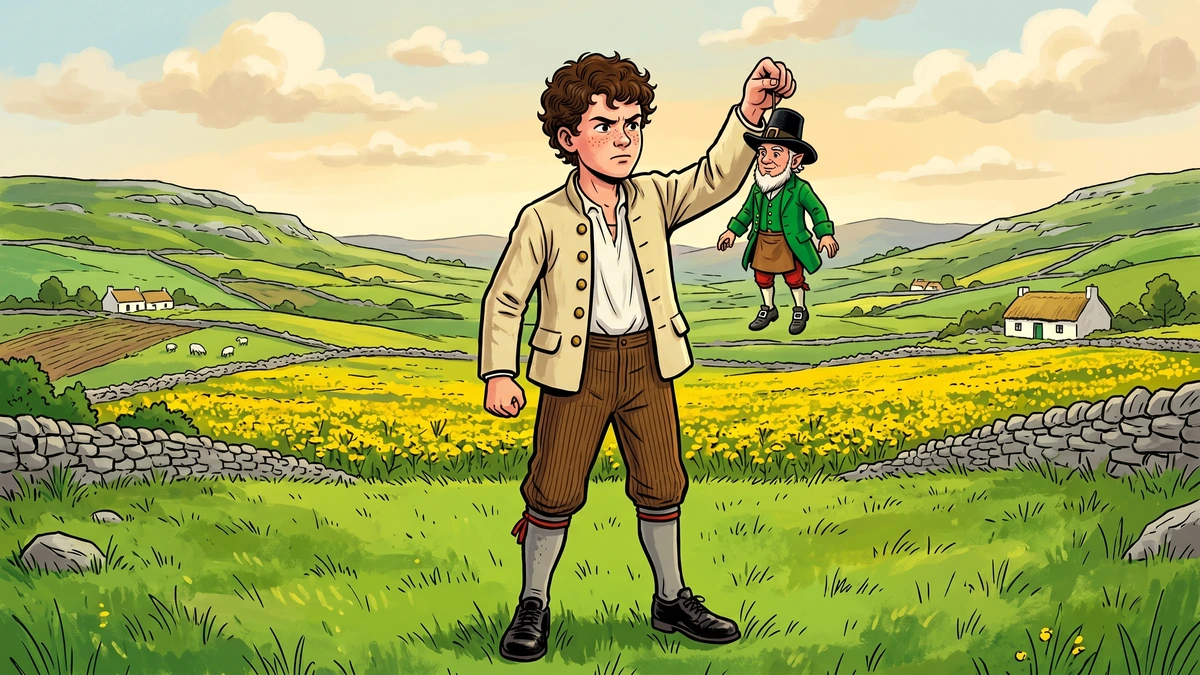
Tom stole forward until he was within arm’s length of the little man and gave him civilly the country greeting, “God bless the work, neighbour.” The leprechaun raised his small head, looked Tom calmly in the eye, and said, “Thank you kindly.” There followed a polite, careful conversation about the pitcher: it held, the leprechaun said, the best heather-beer in Ireland, brewed by a recipe the Danes had taught his ancestors when they were here – the same secret of fraoch ale that Robert Louis Stevenson would later turn into his ballad of “Heather Ale” (1890). Tom asked for a taste; the leprechaun, knowing the country trick, glanced sharply over Tom’s shoulder and cried, “Look, the cows are in the corn!” Any other lad would have turned, but Tom had been warned by his grandmother. He did not turn. He shot out his right hand, caught the leprechaun firmly round the middle, and lifted him off his stool, the awl still in his hand and the brogue still in his lap.
“Now,” said Tom, fixing the small man with the steady gaze his grandmother had counselled, “you’ll show me your crock of gold, or by the holy poker I’ll squeeze the breath out of you.” The leprechaun looked sad and patient and weary, as a small clever creature looks when it has been caught by a large slow one. He sighed, he shook his head, he muttered in old Munster Irish that there was no help for it; he rolled his bright black eyes once round the field and said, “Very well, young master, since you have caught me fairly, and since I see you have your wits about you, I will show you where the gold is. But you must not let me go until I have shown you.” Tom nodded grimly, tightened his grip, and the leprechaun, dangling between thumb and forefinger but unruffled, pointed away across the field, away across two stone walls, and down to a low fallow on the far side of the boreen where the August sun lay thick on a great waving sea of yellow blossom.
Beat Three – The Field of Yellow Boys
“Do you see,” said the leprechaun, “yonder big buachalán standing taller than the rest, the one with the three flowers on top of it?” Tom looked, and saw the field thick with ragwort – buachalán buí, the yellow-boy, the weed of the limestone fallows, three feet high, every stalk indistinguishable from the next, every yellow head as bright as the next, ten thousand of them in one acre. “I see it,” said Tom carefully. “There,” said the leprechaun, “exactly under that buachalán, three feet down, in a brown earthenware crock no bigger than this one of mine, lies your fortune: gold pieces of the old kings, gold of the Danes, gold of the abbots of Mungret, gold of the Geraldines – as much gold as will make you and your father and your father’s father gentlemen for seven generations. Dig it up, and it is yours.”
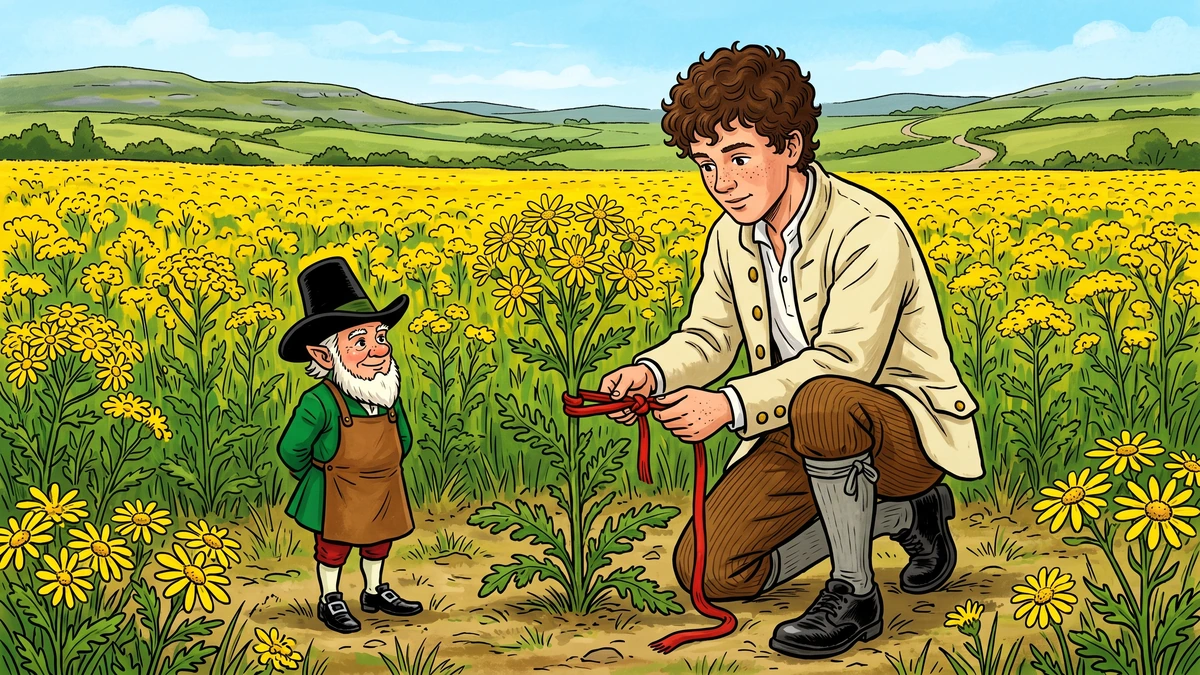
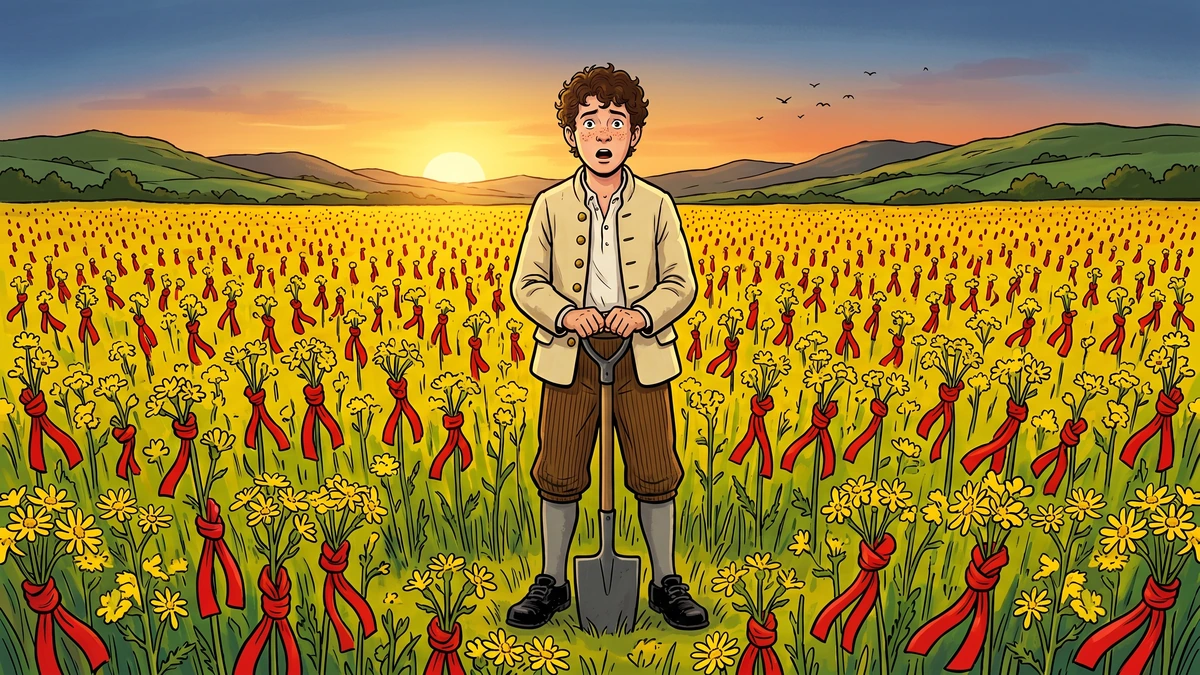
Tom carried the little man under his arm across the two stone walls and down the boreen and into the field. He set the leprechaun down beside the tall buachalán with the three flowers, and he kept his eye fixed on him as carefully as a sheepdog keeps its eye on a sheep. He had no spade with him. He had nothing but his clothes. So he took off his red worsted garter – the long woollen tape with which his stocking was tied below the knee – and he tied it carefully round the stalk of the chosen buachalán, in a neat double knot, where it could not slip and where any man with eyes could see it for half a mile. “There now,” said Tom, “I have marked the spot, and I will not lose it. Tell me, little man, may I take off my garter and run home for my spade?” “Take it off,” said the leprechaun mildly, “for indeed I would not have you walk all the way home with the stocking falling about your ankle. The spade you may fetch and welcome, and there is no need to keep me any longer; you have given me a fair hold and I have given you a fair word, and the gold will be where I have said.” Tom paused; and the leprechaun added, very politely, “Have I your leave, young master, to be going about my own business?” Tom’s grip slackened. “You have, and thank you kindly,” said Tom. The little man bowed; Tom blinked – and there was nothing in the field but ten thousand yellow boys and the August sun.
Beat Four – The Field of Red Garters
Tom ran the whole way home across the two walls and the boreen, and he ran into the cabin and told nobody, and he took down his father’s spade from the rafters, and he ran the whole way back. The sun was lower in the sky and the field was as bright as a sheet of beaten gold. He climbed the wall, he stepped down into the field, and he raised his eyes to find his marker.
An méid buachalán buí a bhí sa pháirc, bhí gairtear dhearg ar gach uile cheann acu.
(On every yellow ragwort in the field, there was a red garter.)
For every yard of the field, in every direction, on every buachalán tall and short, on every flowering stalk and every leafy stalk, on every weed in the acre, there was tied a neat double knot of red worsted, exactly like the one Tom had tied himself. He stood with his spade in his hand and the August sun on his back, and he counted – one, two, three, ten, fifty, a hundred – and he could no more tell which buachalán was his than he could have told one yellow flower from another in a meadow of buttercups. He stood there till the sun went down, turning slowly on his heel; and at last he understood; and at last he laughed, because there was nothing else for an honest Munster lad to do; and he shouldered his spade, and he walked the long road home.
That night his mother set down a plate of buttered boxty and a mug of cold buttermilk before him, and she asked him where he had been all the long afternoon. Tom looked at the buttermilk and at the boxty, and he said, “I was in a field of yellow boys, mother, and I caught a small man, and he showed me where the gold was, and he asked me kindly to be let go, and I let him go.” His mother nodded and said, “And the gold, Tom?” Tom said, “The gold is under one of ten thousand buachaláns, and every one of them has a red garter on it, and the small man is laughing somewhere in the hedge.” His mother gave him a long quiet look such as Munster mothers give their sons, and she said, “Eat your boxty, Tom, and put a knot in your tongue, for nobody in the parish will believe you, and the small man’s word is as good as gold to those that have caught him.”
The Moral and Its Irish Wording
The moral of the Field of Boliauns turns, as all the great Irish leprechaun tales turn, on the proverb of the bargain kept too literally. The lesson is preserved in the Munster country saying that Patrick Weston Joyce gathered for his English as We Speak it in Ireland (London: Longmans, Green & Co., 1910), p. 108: the leprechaun keeps his word in the strictest letter and breaks it in the kindest spirit. He never said the gold was only under that one buachalán; he never said the marker would not be matched. He gave the boy the bargain the boy had asked for, and the boy had not asked precisely enough. The Old Irish triadic proverb, preserved in Tecosca Cormaic (the Instructions of Cormac mac Airt) chapter 16, edited by Kuno Meyer in Todd Lecture Series XV (Royal Irish Academy, Dublin, 1909), governs the case:
Tairí tré eolas, ní tré ainbhfhios; a thí ri ní thabhair mó ndá ghealltar.
(Come by knowledge, not by ignorance; he that promises gives no more than he has promised.)
The leprechaun is, like all the small folk of the Munster hedges, an exact lawyer. He grants what is asked and not what is meant. The lesson is the same as that taught by the leprechauns of Patrick Kennedy’s Legendary Fictions of the Irish Celts (London: Macmillan, 1866), pp. 113–120, by the cluricaune of the cellar in Croker (volume I, pp. 87–100), by the fear darrig of Lady Wilde’s Ancient Legends, Mystic Charms and Superstitions of Ireland (London: Ward and Downey, 1887), and by the bargain-keeping shoe-makers of the Manx fynnoderee and the Scottish brownie. In every variant of the type, the lesson is that a wish loosely worded is a wish loosely fulfilled.
Why This Story Still Matters
The Field of Boliauns has had a longer literary afterlife than almost any other Irish folktale of its size. Croker’s first version (1825) was translated by the brothers Grimm in 1826 and praised in their introduction as a model of “the lightness and gaiety of the Irish national imagination”; Thomas Keightley’s Fairy Mythology (London: George Bell, 1828) reproduced it as the type-piece of the Irish dwarf-tale; Yeats reprinted it in 1888 as one of his “Solitary Fairies” canon and added it (under the headnote “The Lepracaun, or Fairy Shoemaker”) to the foundational corpus of the Irish Literary Revival; Jacobs’s 1892 redaction with John D. Batten’s full-page line drawing made it the visual archetype of the leprechaun for the English-reading nineteenth century – the green coat, the red cap, the cocked hat, the silver buckles, and the small awl all derive from Batten’s plate. Lady Augusta Gregory included a Connacht variant in Visions and Beliefs in the West of Ireland (Putnam, 1920); James Stephens turned the leprechaun-bargain into the central comic engine of his novel The Crock of Gold (London: Macmillan, 1912), whose plot is structurally a long variation on Tom Fitzpatrick’s afternoon; and Walt Disney’s 1959 feature Darby O’Gill and the Little People, with its King Brian and the cooperage hidden under a brown crock, is the twentieth-century descendant of the same Munster pattern.
For the modern reader the abiding power of the tale lies in its perfect economy. There is no malice in the leprechaun and no malice in the boy. Tom Fitzpatrick is not punished for greed; he is sent home with the same red-garter knot in his hand that he carried out, the same hunger for gold, the same parents, and a story that no neighbour will ever quite believe. The leprechaun is not punished for sharpness; he keeps his word and his crock and disappears back into the hedge as quietly as a thrush into a thorn. What changes is only Tom’s understanding – and through Tom, the reader’s – of the small unbridgeable gap between what is asked and what is meant. The tale is, in this sense, the child’s first lesson in the literal logic of contracts; and it is, like the Three Wishes of the Black Forest and the Monkey’s Paw of W. W. Jacobs (1902), a small permanent reminder that the Otherworld will give exactly and only what is asked, and that the burden of asking precisely is the price of any commerce with the small folk.
Cultural Context and Continuing Influence
In Ireland, the Field of Boliauns has remained a perennial schoolbook piece since its inclusion in the Royal Reader series of the Commissioners of National Education in the 1880s; it appears in successive editions of the Schools’ Folklore Scheme manuscript collections (UCD National Folklore Collection, MSS 1–1128, 1937–1939) in versions gathered from Counties Cork, Kerry, Limerick, Tipperary, Clare and Galway, with regional variations on the marker (a red garter in Munster, a kerchief in Connacht, a hazel rod in Ulster) and on the trickster’s name. The story is the structural archetype of the modern St Patrick’s Day leprechaun joke, of every Irish-American greeting card with a green-coated little man at the foot of a rainbow, of Eugene O’Neill’s “shanty Irish” leprechaun-allusions in A Touch of the Poet (1957), and of the title sequence of John Ford’s The Quiet Man (1952). For a tale of perhaps eight hundred words in its earliest printed form, it has had a cultural reach out of all proportion to its size, and every generation of Irish writers has measured itself, sooner or later, against the small clear voice of the leprechaun in the hedge: You have given me a fair hold, and I have given you a fair word.
For the reader in India, in Britain, in any country where the bargain is the basic unit of social trust, the Field of Boliauns is a small comic masterpiece on the cost of imprecise asking. The crock of gold lies, as it has always lain, three feet under one of ten thousand buachaláns in a Munster fallow on a hot August afternoon; and the red garter is on every stalk; and the leprechaun is laughing somewhere in the hedge, with his small awl in his hand and his small heel-piece on his small brogue, mending the half-shoe of a fairy that no mortal has ever seen.
You May Also Like
 Celtic Folk Tales
Ages 9-12
Celtic Folk Tales
Ages 9-12
The Horned Women
The Horned Women: A rich woman sat up late one night carding and preparing wool, while all the family and servants were asleep. Suddenly a knock was given at
 Celtic Folk Tales
Ages 9-12
Celtic Folk Tales
Ages 9-12
The Battle Of The Birds
The Battle Of The Birds: I will tell you a story about the wren. There was once a farmer who was seeking a servant, and the wren met him and said: “What are
 Celtic Folk Tales
Ages 9-12
Celtic Folk Tales
Ages 9-12
The Lad With The Goat-Skin
The Lad With The Goat-Skin: Long ago, a poor widow woman lived down near the iron forge, by Enniscorth, and she was so poor she had no clothes to put on her