The Shee An Gannon And The Gruagach Gaire
The Shee An Gannon And The Gruagach Gaire: The Shee an Gannon was born in the morning, named at noon, and went in the evening to ask his daughter of the king
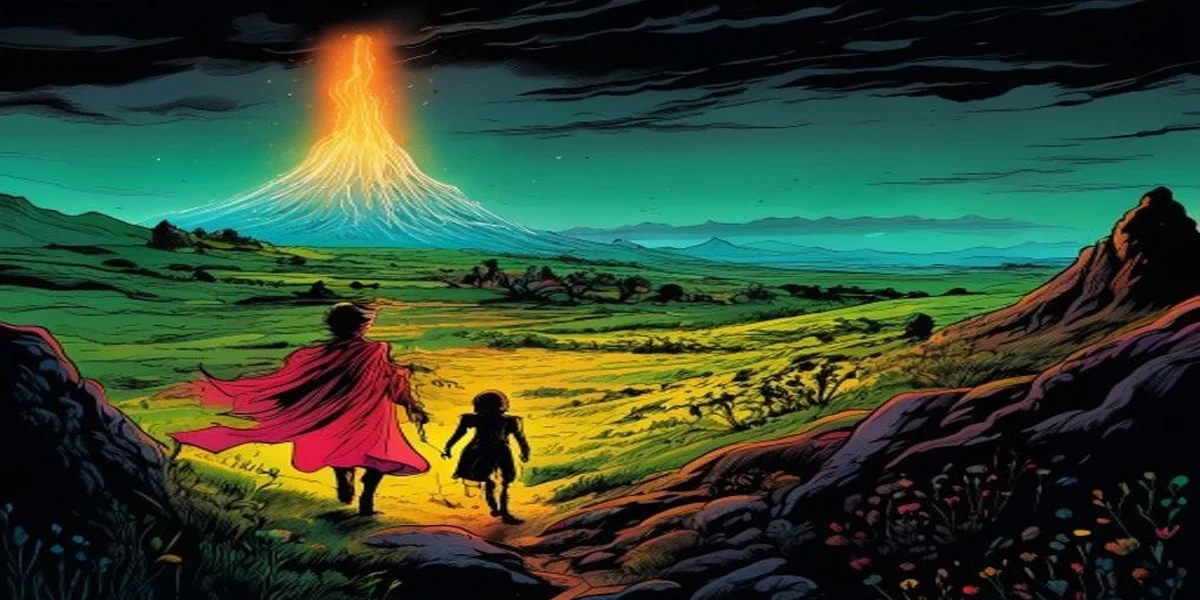
“The Shee An Gannon and the Gruagach Gaire” is among the most distinctively titled and thematically rich tales in the Irish oral tradition collected by Jeremiah Curtin in the late nineteenth century. The title itself carries the weight of an entire mythological world: Shee (from Sídhe) marks the hero as one of supernatural or semi-divine parentage — a man of the fairy mounds — while Gruagach Gaire designates his adversary or quest-object as “the laughing enchanter” or “the long-haired laughing one,” the gruagach being a class of supernatural being in Gaelic tradition associated with long hair, shapeshifting, and uncanny power. The very names announce that this tale operates in the mythological register, at the boundary between the human world and the deeper world of the Otherworld beings.
The tale belongs to the rich tradition of Irish wonder tales (scéalta iontais) in which a hero of unusual origin undertakes a quest that simultaneously proves his identity, restores a disrupted natural order, and reveals hidden truths about the relationship between the human and supernatural worlds. It was recorded by Curtin from Irish-speaking narrators in Munster and published in his Myths and Folk-Lore of Ireland (1890), where it stands as one of the longest and most elaborately structured of all the tales he collected.
The Gruagach Gaire: The Being Who Cannot Laugh
The central figure around whom the tale organises its narrative is the Gruagach Gaire — a supernatural being of great power who has lost the ability to laugh. The gruagach in Irish and Scottish Gaelic tradition is a liminal figure, associated with the threshold between the domestic and the wild, the human and the supernatural. Gruagachs were believed to inhabit farms and mills, sometimes helpful, sometimes dangerous, always demanding of proper treatment and proper acknowledgment of their nature. The Gruagach Gaire belongs to a more elevated variant of this tradition: he is a being of genuine supernatural power whose loss of laughter signals a disruption of the natural order.
Laughter in Irish tradition is not merely an emotional response but a marker of vitality, of right relationship with the world, of the alignment between inner state and outer reality that characterises the healthy person and the healthy society. The king who cannot laugh in Irish tales is always the sign of a kingdom in disorder; the person who has been cursed to weep rather than laugh is under an enchantment that prevents them from accessing their own true nature. The Gruagach’s inability to laugh is therefore not a personal affliction but a cosmic statement: something has gone wrong in his relationship with the world, and the tale’s hero must find and repair that wrong.
The hero, the Shee an Gannon — whose identity as a being of the Sídhe origin marks him as capable of operating between the human and supernatural registers — is tasked with making the Gruagach laugh. This apparently simple quest is revealed to be enormously complex: the Gruagach can only laugh when a specific condition is met, a condition that requires the hero to undertake a series of dangerous adventures across multiple supernatural domains before the resolution becomes possible.
The Quest Structure and Its Moral Logic
The quest for the Gruagach’s laughter is organised around a series of tasks that test the hero’s courage, ingenuity, and capacity for correct relationship with the beings he encounters. Each stage of the quest involves a different kind of challenge: some demand martial prowess, others demand cleverness, others demand qualities of patience or empathy that conventional heroic tradition does not always foreground. The tale’s cumulative structure — task after task, each more demanding than the last — is characteristic of the Irish wonder tale tradition, which uses narrative accumulation to build a picture of heroic character that is considerably more complex than any single episode could convey.
The beings the hero encounters across his quest are invariably defined by their relationship to some form of excess or imbalance: they are too proud, too greedy, too isolated, too powerful in a single direction. The hero’s interactions with them require him to find the point of balance — the correct form of engagement — that resolves the excess and allows the narrative to move forward. This moral logic connects the tale to the Irish tradition of fírinne (truth, right order) as the foundation of heroic action: the hero who operates correctly, who perceives the truth of each situation and acts accordingly, is able to resolve conditions that those who operate incorrectly cannot even diagnose.
The Irish wonder tale’s characteristic treatment of supernatural beings as individuals with their own histories, grievances, and needs — rather than as mere obstacles — is particularly well developed in this tale. The beings the Shee an Gannon encounters are not simply monsters to be defeated but complex figures whose conditions must be understood before they can be resolved. This understanding — the requirement of genuine comprehension before effective action — is the deepest level of the hero’s qualification.
The Hero’s Sídhe Origin and Its Narrative Functions
The Shee an Gannon’s designation as a being of Sídhe origin gives him a specific and important narrative status. In Irish mythology, the Sídhe are the dwelling places of the Tuatha Dé Danann — the pre-Christian divine race who retreated underground after the coming of the Gaels. Beings of Sídhe association in later folklore inherit some of this divine quality: they are more powerful than ordinary humans, capable of operating in the supernatural world where ordinary humans cannot, and possessed of knowledge and abilities that ordinary human heroism cannot supply.
The Shee an Gannon is therefore a liminal figure in the deepest sense: he belongs to both the human and supernatural worlds, and his ability to navigate between them — to encounter the Gruagach Gaire and work toward his restoration — depends on this dual citizenship. Where an ordinary human hero would be destroyed by the Gruagach’s power or blocked by the supernatural beings guarding the path to him, the Shee an Gannon can engage with these beings on their own terms, negotiate, combat, or ally with them as circumstances require.
This liminal status connects the hero to the broader Irish mythological tradition of the mac síde (son of the fairy mound) who appears periodically in the mortal world as a champion or liberator. Fionn mac Cumhaill, in his deeper mythological aspects, participates in this tradition; so does Cú Chulainn, whose supernatural paternity (Lugh) enables his extraordinary capabilities. The Shee an Gannon is a later, more popular version of this ancient tradition, shorn of the epic weight of the great cycles but retaining their structural logic.
Laughter Restored: Resolution and Its Meaning
The climax of the tale involves the condition that, once fulfilled, finally makes the Gruagach Gaire laugh again. In Curtin’s version, this condition involves the restoration of something lost — a family connection, a disrupted relationship, a truth that had been hidden — and the Gruagach’s laughter when the condition is met is the spontaneous expression of a natural order restored. The laughter is not merely emotional satisfaction but an ontological statement: the world has returned to right relationship, and the being who embodies that relationship through his laughter can now express it.
The moment of laughter is one of the most celebrated endings in Irish oral narrative. It is structurally parallel to the transformation endings of enchantment tales — the enchanted being reverts to their true form — but operates through a different register: not visual transformation but acoustic and emotional release. The Gruagach who cannot laugh is under a condition as restrictive as any physical enchantment; his restored laughter is a liberation as complete as any disenchantment.
The tale’s emotional arc is carefully constructed to make this moment maximally resonant. By the time the Gruagach finally laughs, the audience has followed the hero through a long sequence of challenges, has invested in his success, and has developed a genuine understanding of what the Gruagach’s restoration means. The laughter, when it comes, releases not only the Gruagach but the narrative tension that has been building throughout — and through the logic of Gaelic wonder tale, it signals the restoration of right order in the world the tale has spent its considerable length constructing.
Curtin’s Collection and the Oral Tradition
Jeremiah Curtin (1835–1906) was an American ethnologist who made several extended trips to Ireland in the 1880s to collect folklore from Irish-speaking communities in Munster and Connacht. His collections — Myths and Folk-Lore of Ireland (1890) and Hero-Tales of Ireland (1894) — provided the English-speaking world with its first substantial access to the Irish oral narrative tradition in translation, and they remain valuable records of a tradition that has since contracted significantly.
Curtin’s method was to work through interpreters with native Irish speakers, transcribing and translating as he went. His translations are not literal but aim at capturing the narrative quality of the original, and they preserve the characteristic features of oral performance — the formulaic phrases, the triadic structures, the elaborate description of combat and equipment — more faithfully than many later literary reworkings. The tale of the Shee an Gannon and the Gruagach Gaire as Curtin recorded it is among the longest in his collection, suggesting that it was one of the prestige pieces of the tradition, a tale told at length on occasions that demanded the full performance.
The Munster tradition from which Curtin collected was particularly rich in the wonder tale genre. The long winter evenings in Irish-speaking communities were occasions for extended storytelling, and the best storytellers — the seanchaí — were valued community figures whose repertoires included tales of exactly this kind: long, structurally complex narratives that could occupy an evening and that combined entertainment with a profound encoding of cultural values.
Legacy and Contemporary Resonance
The tale of the Shee an Gannon and the Gruagach Gaire has been less widely reproduced than some other Irish folktales — its length, the difficulty of its supernatural cast, and the complexity of its quest structure make it less amenable to short anthology pieces than simpler tales. Yet for those who encounter it in its full form, it is among the most rewarding narratives in the Irish tradition, offering a dense and carefully structured exploration of heroic identity, supernatural obligation, and the cosmic importance of laughter as a sign of right order.
Contemporary Irish storytellers who work in the seanchaí tradition occasionally perform the Gruagach Gaire story in full, and it has been the subject of scholarly attention from folklorists interested in the complex multi-episode structure characteristic of the Irish wonder tale at its most elaborate. Lady Gregory did not include it in her major collections, which tended toward the epic and mythological rather than the wonder tale, but it appears in several twentieth-century anthologies of Irish folklore alongside the more commonly reproduced canonical tales.
The tale’s central image — the being of great power who cannot laugh until right order is restored — speaks with unexpected directness to contemporary experience. In a world that has developed elaborate mechanisms for the suppression of genuine feeling, the Gruagach’s condition resonates: he has not lost the capacity for joy, but something in his relationship with the world has been disrupted to the point where that capacity cannot express itself. The hero’s quest is to find and repair that disruption. In the Gaelic tradition, that is heroism at its most fundamental.
The Shee an Gannon’s quest to make the Gruagach Gaire laugh is, at its deepest level, a quest to restore the world to its right condition — a condition in which genuine joy is possible. The hero who can do this is not merely a fighter or a cleverman but someone who has developed, through the trials of his journey, a comprehensive enough understanding of the world to perceive the source of its disorder and act precisely to correct it. When the Gruagach finally laughs, it is not because the hero made a joke. It is because the hero made the world right.
You May Also Like
 Celtic Folk Tales
Ages 9-12
Celtic Folk Tales
Ages 9-12
The Story of the McAndrew Family
The Story of the McAndrew Family: long time ago, in the County Mayo, there lived a rich man of the name of McAndrew. He owned cows and horses without number
 Celtic Folk Tales
Ages 9-12
Celtic Folk Tales
Ages 9-12
Fair, Brown, And Trembling
Fair, Brown, And Trembling: King Hugh Curucha lived in Tir Conal, and he had three daughters, whose names were Fair, Brown, and Trembling. Fair and Brown had
 Celtic Folk Tales
Ages 9-12
Celtic Folk Tales
Ages 9-12
Powel, Prince of Dyfed
Powel, Prince of Dyfed: owel, Prince of Dyfed, was lord of the seven Cantrevs of Dyfed; and once upon a time Powel was at Narberth, his chief palace, where a