How Cormac Mac Art went to Faery
How Cormac Mac Art went to Faery: ormac, son of Art, son of Conn of the Hundred Battles, was high King of Ireland, and held his Court at Tara. One day he saw a
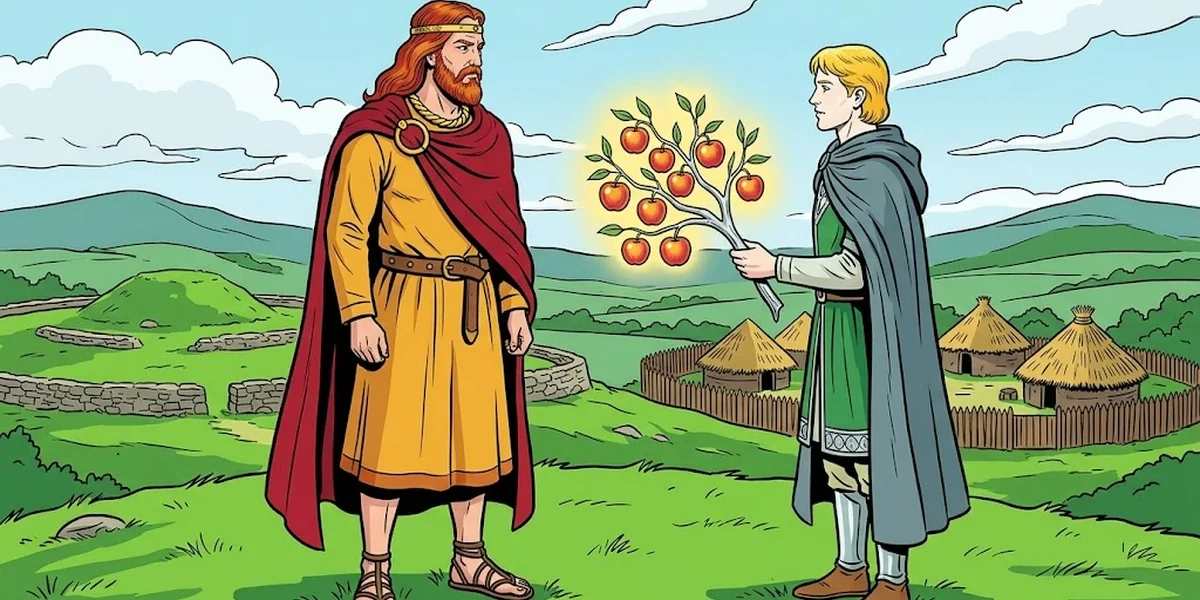
The High King and the Stranger on the Green of Tara
One bright morning at Tara of the Kings — the royal seat of Ireland on the long limestone ridge of the Boyne valley — Cormac mac Airt, son of Art, son of Conn of the Hundred Battles, looked out from the rampart and saw a youth he did not know walking the green. The stranger carried a branch of silver in his hand, and on the branch hung nine apples of red gold. When the youth shook the branch, music rose from the apples — sweet beyond any music known in Erin — and at the sound the wounded forgot their wounds, women in childbed forgot their pains, and the careworn forgot the cares that pressed upon them. It was the music of Tír Tairngiri, the Land of Promise, where Manannán mac Lir, the sea-god, kept his marvels.
This is the opening of one of the great echtrai — the Otherworld journey-tales — of medieval Irish literature. The Old Irish title is Echtra Cormaic i Tír Tairngiri, “Cormac’s Adventure in the Land of Promise,” and it survives in three principal manuscript witnesses: the late fourteenth-century Book of Ballymote (Royal Irish Academy MS 23 P 12), the contemporary Yellow Book of Lecan (Trinity College Dublin MS H.2.16), and a second recension preserved in the fifteenth-century Book of Fermoy (Royal Irish Academy MS 23 E 29). Whitley Stokes edited the first recension under its full manuscript title — Scél na Fír Flatha, Echtra Cormaic i Tír Tairngiri, ocus Ceart Claidib Cormaic (“The Tale of the Truth of Princes, Cormac’s Adventure in the Land of Promise, and the Decision as to Cormac’s Sword”) — for Ernst Windisch’s Irische Texte, third series, volume one, published in Leipzig by Hirzel in 1891. Vernam Hull edited and translated the Book of Fermoy recension for the Publications of the Modern Language Association in 1949 under the simpler heading Echtra Cormaic Maic Airt. Linguistic dating places the original composition in the second half of the twelfth century, drawing on a now-lost earlier exemplar, with a re-working in the fourteenth.
The retelling that became known to English-language readers is the version Joseph Jacobs published in More Celtic Fairy Tales (London: David Nutt, 1894), tale number eighteen, where it bears the title “How Cormac Mac Art went to Faery.” Jacobs based his text on Standish O’Grady’s English rendering in Silva Gadelica (Williams and Norgate, 1892), which itself drew on the Book of Lismore and the Stokes edition. The tale’s deep antiquity — its place among the cycles of Cormac mac Airt, the legendary High King who ruled at Tara from 227 to 266 AD according to the synthetic chronology of Lebor Gabála Érenn — gives it a status closer to national epic than to nursery story, even though Jacobs gathered it among children’s tales.
The Bargain of the Branch and the Year of Sorrow
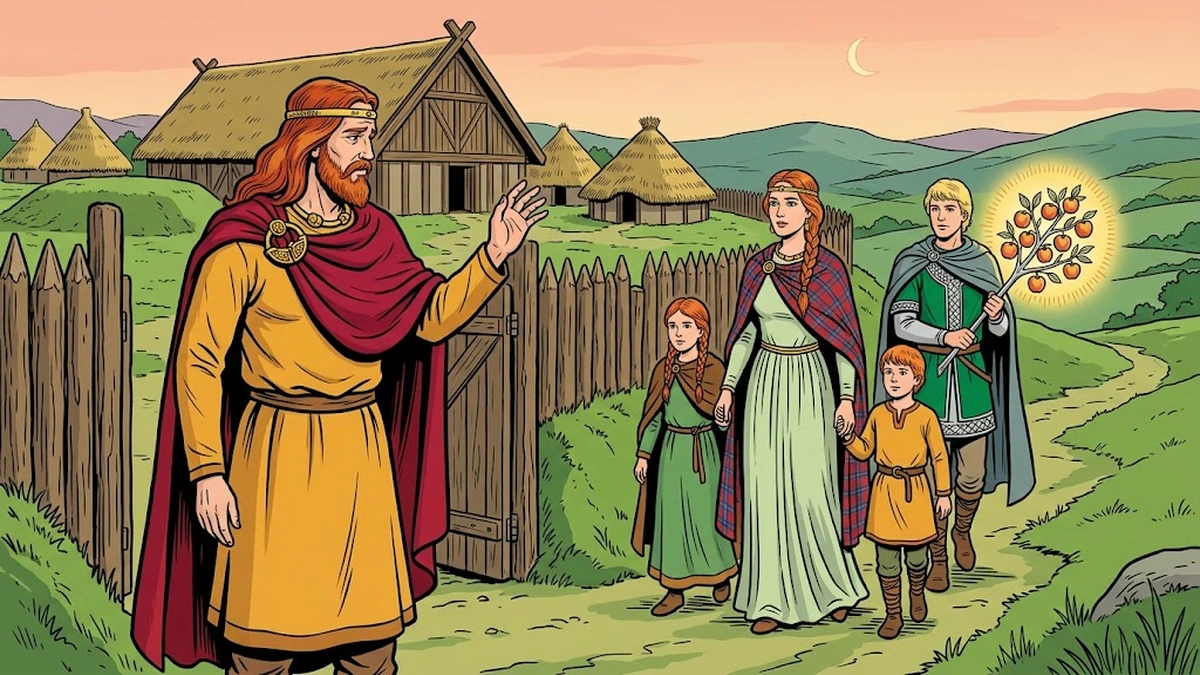
“Is that branch your own?” Cormac asked the youth on the green. “Will you sell it? And what will you ask?” The stranger answered with the deceptive courtesy that always marks the Sídhe in Irish tradition: “Will you give me what I ask?” The High King — bound by the fír flatha, the Truth of Princes that is the moral spine of his sovereignty — gave his word. And the youth claimed his price: Cormac’s wife Eithne Tháebfhota (“of the Long Side”), daughter of Dúnlang of Leinster; his daughter Ailbhe; and his son Cairpre Lifechair, who would one day be High King after him.
Sorrowful of heart was Cormac, but a king’s word given on the green of Tara cannot be unsaid. Eithne, Ailbhe, and Cairpre wept; the household wept; the grianán of Tara filled with weeping. Then Cormac shook the branch among them, and at the music of the nine apples they forgot all care and went forth willingly with the youth, and were seen no more. A year and a day passed, and when the cry of weeping had spent itself across Erin and Cormac alone could not forget — for the king who has bound himself by truth cannot also free himself by it — he rose at last, took the branch in his hand, and set out by the road that the youth had taken. So begins the second movement of the tale: the journey of the High King out of the visible world and into the Land of Promise.
The Marvels of the Plain
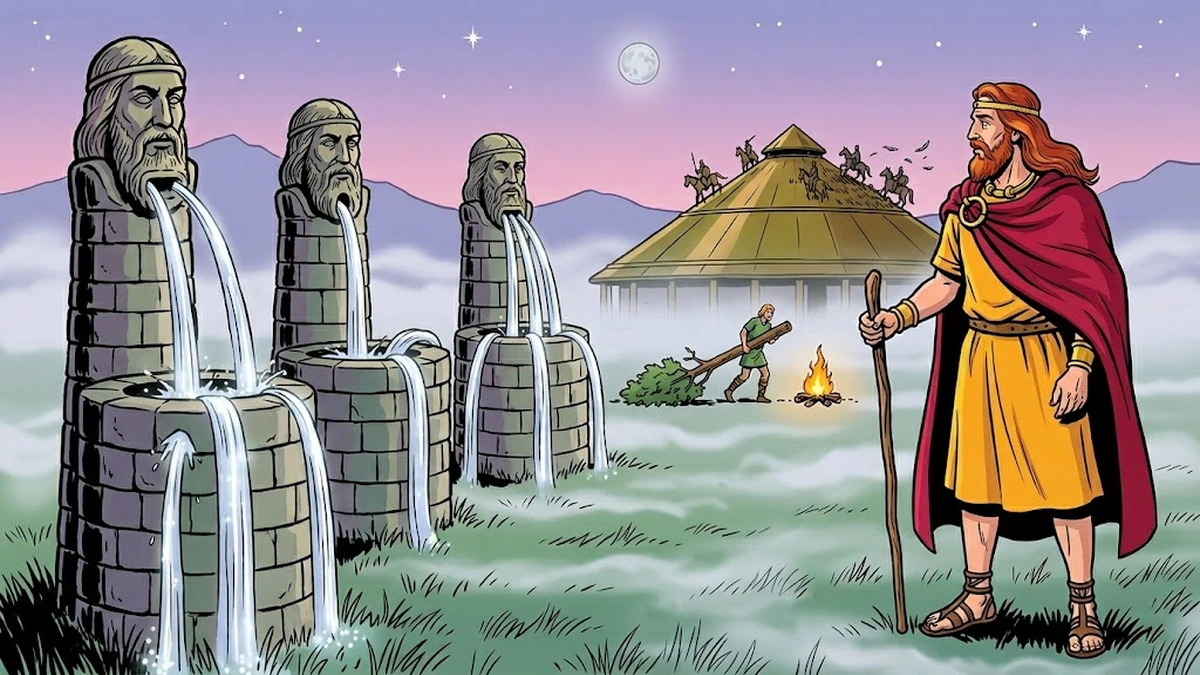
A dark magical mist closed about Cormac, and when it lifted he stood upon a wide plain that he did not know. There he saw the thatchers of feathers: many horsemen on a great house, thatching the roof with feathers of foreign birds; when one side was thatched they would ride away to gather more, and by the time they returned the wind had carried every feather off, and the roof was bare. Then he saw the fire-builder: a youth dragging up trees out of the wood, kindling a fire from one before the next could be brought, so that the first was always burnt before the second was found, and his work would never end.
And he saw the three wells of the heads. From the mouth of the first head two streams flowed out and one flowed in. From the mouth of the second head one stream flowed out and one flowed in. From the mouth of the third head three streams flowed out and none flowed in at all. Cormac stood gazing on these wonders, and could find no man on the plain who would tell him what they meant. So he went forward, until in the middle of the field he came to a tall house under a roof of bronze.
The House of Manannán and the Cooking of Truth
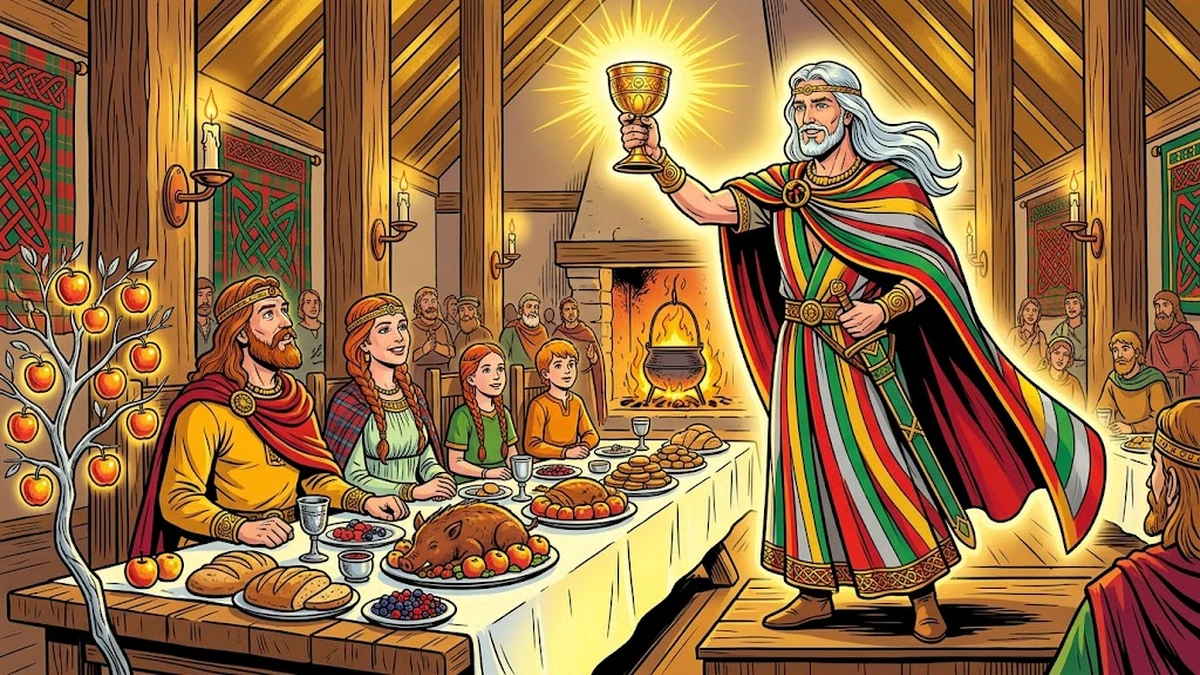
Within the house sat a tall couple in many-coloured garments — gold and silver and crimson and the green of new grass — and they greeted Cormac and bade him welcome for the night. The wife sent her husband out for meat, and he came back carrying a great wild boar across his shoulders and a single oaken log in his hand. He flung them down on the floor and said, “There is your supper. Cook it for yourselves.” Cormac did not know how. “I will teach you,” said the man of the house. “Split the log into four; quarter the boar; lay a quarter on each piece of log; and tell a true story over each quarter, and the meat will cook of itself.”
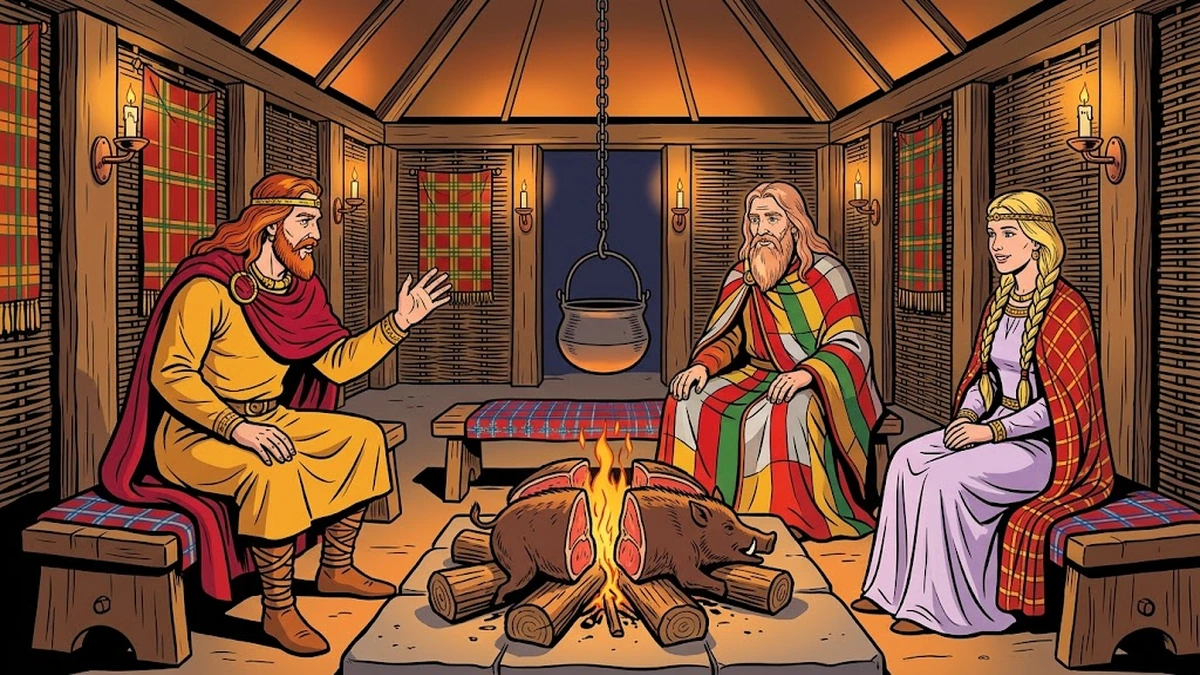
This is the heart of the tale, and it is the oldest stratum of all: the cooking-fire that responds to truth. The motif belongs to the family of Old Irish fír-tests — the Truth-Acts catalogued in Audacht Morainn (“The Testament of Morann,” seventh-eighth century) and Críth Gablach — by which the cosmos itself recognises a king’s word as binding. The man of the house spoke first: “Seven swine I have of the breed of this one, and with them I could feed the whole world; for if a swine be killed, I have only to put its bones into the sty, and it will be found alive in the morning.” The story was true, and the first quarter was cooked. The wife spoke next: “Seven white cows have I, and they fill seven cauldrons of milk every day, and I give my word that those cauldrons would slake the thirst of all the men of the world drinking on yonder plain.” That story was true, and the second quarter was cooked. Cormac told his story — of the youth and the branch, of the wife and the son and the daughter borne away, of the year that he had sought them — and that story was true, and the third quarter was cooked.
“You are Cormac, son of Art, son of Conn of the Hundred Battles,” said the man of the house. “I am,” said Cormac. The fourth quarter was cooked. The door opened, and Eithne, Ailbhe, and Cairpre came in, well and unharmed; and the host put off his guise of the tall man in many-coloured garments and stood revealed as Manannán mac Lir, lord of the Sídhe of the sea, master of Tír Tairngiri, who had borne them away to bring Cormac to his own house. “I gave you the branch,” said Manannán, “that I might bring you here. Now eat with me.”
The Meaning of the Marvels
Cormac would not eat until he had been told the meaning of what he had seen on the plain. Manannán spoke as the schoolmaster of kings. The horsemen thatching the roof with feathers, he said, are the likeness of those who go out into the world to seek riches and fortune; when they come home, what they have gathered has scattered before them, and so they must ride out again, and ride out again, and there is no end of their riding. The youth dragging up trees for a fire that is always burning low is the likeness of those who labour for others: their trouble is great, but they themselves never warm at their own hearth. The three heads in the wells are three kinds of human beings: some who give freely when they receive freely; some who give freely though they receive little; and some who receive much and give little — and these last, said Manannán, are the worst of the three.
Then a tablecloth was spread, and Manannán put into Cormac’s hand three precious things to take back to Tara. The first was the tablecloth of the world’s food, on which any meat that was asked for would appear without fail. The second was the cup of truth, a goblet that broke into four pieces when a false word was spoken over it and made itself whole again when a true word followed. The third was the silver branch with the nine apples of red gold, the music-bringer that had drawn Cormac out of Tara in the first place. “All three are yours,” said Manannán. They ate and drank, and a couch was prepared for them, and they slept; and when Cormac woke in the morning he was lying on the green of Tara, with his wife and son and daughter beside him, and at his head the cloth, the cup, and the branch.
Moral: The Truth of Princes
The moral of Echtra Cormaic is not the moral of an Aesopic fable — it is constitutional. The cup of truth and the cooking-fire of true stories belong to the Old Irish doctrine of fír flatha, the Truth of the Prince, by which a king’s word is the warrant of weather, harvest, and peace in his realm. The seventh-century Audacht Morainn states it plainly:
Is tre fhír flathemon ad-mórchatha crícha cu námait curatar.
“It is through the Truth of the Prince that great battles are driven against the borders of enemies.”
And again, in the same text: Is tre fhír flathemon mortlithi márlóchet di doínib dingbatar — “It is through the Truth of the Prince that plagues and great lightnings are kept from the people.” Cormac was famed in tradition as the wisest of the kings of Erin, the lawgiver of the Tecosca Cormaic (the “Instructions of Cormac” preserved in the Book of Leinster) and the supposed author of the Senchas Már, the great compendium of Brehon law. Echtra Cormaic is the myth that explains why such a king deserved such instruments: he had walked into the Land of Promise, told three true stories over a king-cooking fire, and brought the cup of truth back across the threshold.
Why the Tale Has Lasted
The persistence of Echtra Cormaic across nine centuries — from twelfth-century Munster scriptoria to Joseph Jacobs’s Victorian nursery and on to the late-twentieth-century revivals of W. B. Yeats’s “The Song of Wandering Aengus” and Kuno Meyer’s Voyage of Bran translation — has several roots. First, the tale balances political authority and metaphysical wonder in a way that is rare in any literature: the High King is not deposed by his journey to the Sídhe but vindicated by it, and he comes back not weaker but with the very instruments by which he can rule justly. Second, the parable of the three wells is one of the great moral images of the Celtic imagination, ranking with Pwyll’s year as Arawn in the Mabinogi and the Grail journey of Peredur — the quiet, geometric clarity of “two streams out and one in” makes it almost mathematical. Third, the silver branch is among the oldest survivals of an Indo-European otherworld-token motif: it has cousins in the golden bough of Aeneas (Vergil, Aeneid VI.136), the apples of the Hesperides, and the Welsh cyrn hud (magic horns) of Culhwch ac Olwen. Fourth, the tale is the central source for what folklorists now classify as motif F112 (Land of Promise), D1551 (Magic apples), D1316.5 (Magic cup that breaks at falsehood), and D1472.1.8 (Magic tablecloth) in Stith Thompson’s Motif-Index of Folk-Literature and Tom Peete Cross’s Motif-Index of Early Irish Literature (Indiana University, 1952).
Beyond folk classification, Echtra Cormaic shaped the Irish literary tradition continuously. It supplied Yeats with the imagery of the apple-bearing branch and the fairy bride; it gave James Stephens (Irish Fairy Tales, 1920) one of his finest re-tellings; and it stands behind the magic vessels of the matière de Bretagne, including the cauldron of Dyrnwch the Giant in the Welsh Tair Rhamant and — in the view of Roger Sherman Loomis (Celtic Myth and Arthurian Romance, Columbia, 1927) — the eucharistic cup that became the Holy Grail itself. The cup of truth that breaks when a lie is spoken over it is recognisably the same vessel as the Grail that will not feed the unworthy and shines only for the pure.
What the tale teaches has not changed: a king’s word is the foundation of his kingdom; truth is what makes the meat cook on the fire; and the world that we cannot see is, in the end, the source of the laws by which we govern the world that we can. Cormac came back to Tara with the branch, the cup, and the cloth — but the real gift was the answer to the riddle of the wells, which is that justice is what flows out from a person rather than what flows in.
About this story
This retelling preserves the structure and ethical content of the original Old Irish echtra while opening up its scholarly apparatus for the modern reader. Sources consulted: Whitley Stokes, “The Irish Ordeals, Cormac’s Adventure in the Land of Promise, and the Decision as to Cormac’s Sword,” in Irische Texte, ed. Ernst Windisch and Whitley Stokes, Series III.1 (Leipzig: Hirzel, 1891), pp. 183–229; Vernam Hull, “Echtra Cormaic Maic Airt, ‘The Adventure of Cormac Mac Airt,'” PMLA 64 (1949), pp. 871–883; Standish Hayes O’Grady, Silva Gadelica (London: Williams and Norgate, 1892), II.203–209; Joseph Jacobs, More Celtic Fairy Tales (London: David Nutt, 1894), Tale XVIII, pp. 91–98 and notes pp. 226–227; Kuno Meyer and Alfred Nutt, The Voyage of Bran, Son of Febal, to the Land of the Living (London: David Nutt, 1895–97), II (“The Happy Otherworld”); Tom Peete Cross, Motif-Index of Early Irish Literature (Bloomington: Indiana University, 1952); Proinsias Mac Cana, Celtic Mythology (London: Hamlyn, 1970, rev. 1983); Myles Dillon, The Cycles of the Kings (Oxford University Press, 1946); the CELT corpus electronic edition at University College Cork (G302000); and Geraldine Parsons, The Manuscript Sources for the Cormac Mac Airt Cycle (Cambridge: D. S. Brewer, 2008). Cormac’s queen Eithne Tháebfhota and his son Cairpre Lifechair are named in the genealogies of Lebor Gabála Érenn and the king-list of the Annals of the Four Masters.
Tale type: Echtra (Otherworld journey) — formally outside the ATU index, which catalogues international wonder-tales rather than the Irish saga corpus, but related to ATU 470 (Friends in Life and Death) and ATU 470A (The Offended Skull). Origin: Ireland, twelfth century, from oral and manuscript tradition reaching back to the eighth or earlier. Cycle: Cycle of the Kings (Cormac mac Airt sub-cycle). Manuscripts: Book of Ballymote (RIA 23 P 12), Yellow Book of Lecan (TCD H.2.16), Book of Fermoy (RIA 23 E 29), Book of Lismore. Read time: 10 minutes.
You May Also Like
 Celtic Folk Tales
Ages 3-5
Celtic Folk Tales
Ages 3-5
Baba Dochia and the Coming of Spring: A Romanian Tale of Humility
Baba Dochia and the Coming of Spring: A Romanian Tale of Humility: High in the Carpathian Mountains of Romania, where snow fell thick and heavy for months on
 Celtic Folk Tales
Ages 9-12
Celtic Folk Tales
Ages 9-12
The Shee An Gannon And The Gruagach Gaire
The Shee An Gannon And The Gruagach Gaire: The Shee an Gannon was born in the morning, named at noon, and went in the evening to ask his daughter of the king
 Celtic Folk Tales
Ages 9-12
Celtic Folk Tales
Ages 9-12
The Tale Of Ivan
The Tale Of Ivan: There were formerly a man and a woman living in the parish of Llanlavan, in the place which is called Hwrdh. And work became scarce, so the