Baba Dochia and the Coming of Spring: A Romanian Tale of Humility
Baba Dochia and the Coming of Spring: A Romanian Tale of Humility: High in the Carpathian Mountains of Romania, where snow fell thick and heavy for months on
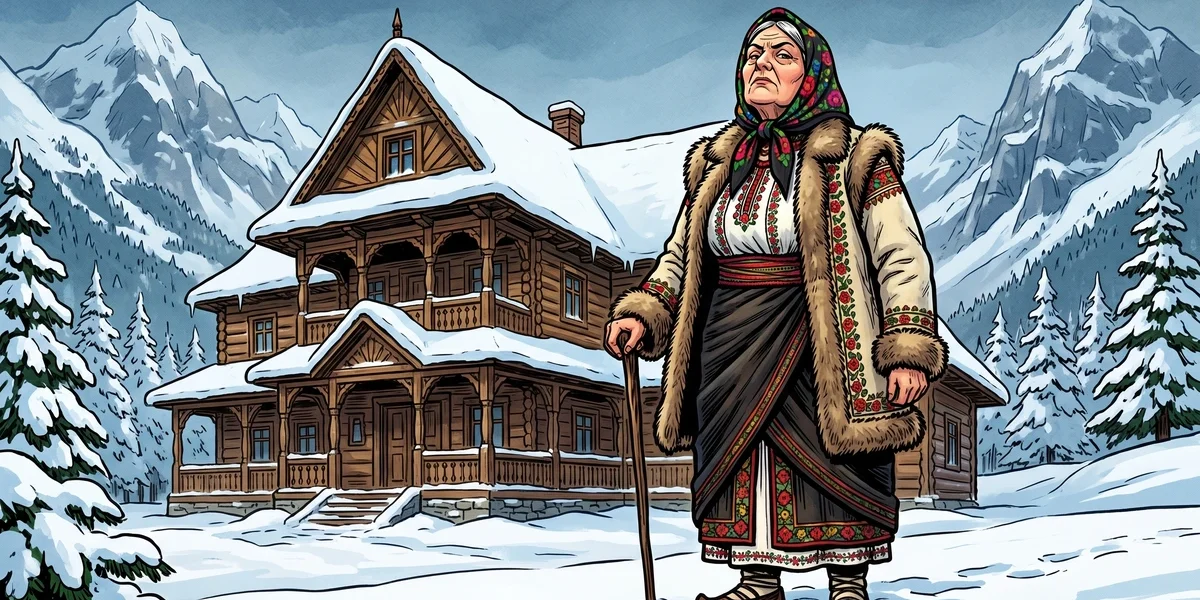
High in the Carpathian Mountains of Romania, where snow lies deep from the feast of Saint Nicholas until well past the first stirrings of March, the villagers tell a story they have told for centuries — the story of Baba Dochia, the proud old woman who believed herself stronger than the seasons. It is at once a tale of cruelty and redemption and an etiological legend: a story invented to explain why the first nine days of March, when winter and spring wrestle for the sky, are still called by Romanians the Zilele Babei, the “Days of the Old Woman.”
Origins: A Calendar Legend of the Carpathians
Baba Dochia — the name means simply “Old Dochia,” and babele is the Romanian plural for “the old women” or “the hags” — is one of the most layered figures in Romanian folklore. Folklorists generally trace her name to the Byzantine ecclesiastical calendar, which commemorates the second-century martyr Saint Eudokia of Heliopolis (in Romanian, Sfânta Evdochia) on 1 March. Over the centuries the saint’s feast fused with a much older pre-Christian personification of departing winter, and the result was Dochia: a figure who embodies humankind’s impatience for the return of spring, and the danger of mistaking a few warm days for the season itself.
The legend belongs to a family of European “cruel mother-in-law” narratives. In its most widely recorded form — the version collected in the nineteenth century and retold by writers such as Mihai Eminescu and the folklorist Simion Florea Marian — Dochia torments her daughter-in-law and sends her into the forest in late February to gather berries or to wash black wool until it turns white. This links the tale to the international ATU 480 tale type, “The Kind and the Unkind Girls,” in which a gentle young woman is set an impossible task and is rewarded by a mysterious helper. In the climbing-the-mountain episode Dochia famously sets out wrapped in nine (in some districts twelve) sheepskin coats, the cojoace, shedding one each day as deceptive warmth tempts her higher — which is why the nine volatile days of early March are counted as her coats. The version retold below preserves the legend’s emotional core: pride humbled, and a hard heart at last made soft.
The Many Faces of Dochia: Saint, Princess, and Winter Hag
Part of what makes Baba Dochia so compelling to folklorists is that she is not one figure but a knot of overlapping ones, each layer of Romanian history adding a face. At the oldest level she is the personified spirit of winter — the hard, hoarfrost hag who must die before the land can green, a being with cousins all across Europe, from the Gaelic Cailleach to the Slavic Marzanna. Onto that pre-Christian core the medieval Church grafted the name and the date of Saint Eudokia, whose 1 March feast gave the legend its calendar anchor.
A wholly different, learned tradition makes Dochia a Dacian princess — the daughter or sister of King Decebalus, last ruler of independent Dacia. In this patriotic retelling, popular with nineteenth-century Romantic writers, Dochia flees into the Carpathians to escape marriage to the Roman emperor Trajan after his conquest of her homeland. Trapped, with no way down the mountain, she begs the supreme Dacian god Zalmoxis to save her honour, and he answers by turning her and her flock of sheep to stone — an origin story for the Babele rock formations of the Bucegi range. The poet Mihai Eminescu drew on exactly this mythic material in his unfinished verse and prose fragments on Dochia and the ursitoare, the fate-spinning women of Romanian belief.
The household legend retold here — Dochia the cruel mother-in-law — is the most domestic of her faces, and the most morally pointed. It sits within a wider Romanian spring cycle: Dragobete, the day of young love at the end of February (in several versions Dragobete is named as Dochia’s own son); Mărțișor, the red-and-white talisman tied on wrists on 1 March; and the Babele themselves. Together these customs turn the uncertain weeks between winter and spring into a small drama with characters, and Dochia is its tragic, and finally redeemed, protagonist.
The Old Woman Who Found Fault With the World
There once lived, on a wide estate beneath the snow-locked peaks, an old woman named Baba Dochia. She was wealthy and she was powerful, with broad pastures, a manor of carved Carpathian timber, and a household of servants who hurried at her word. Yet for all her abundance she was never once satisfied. She found fault the way other people find breath — constantly, and without effort.
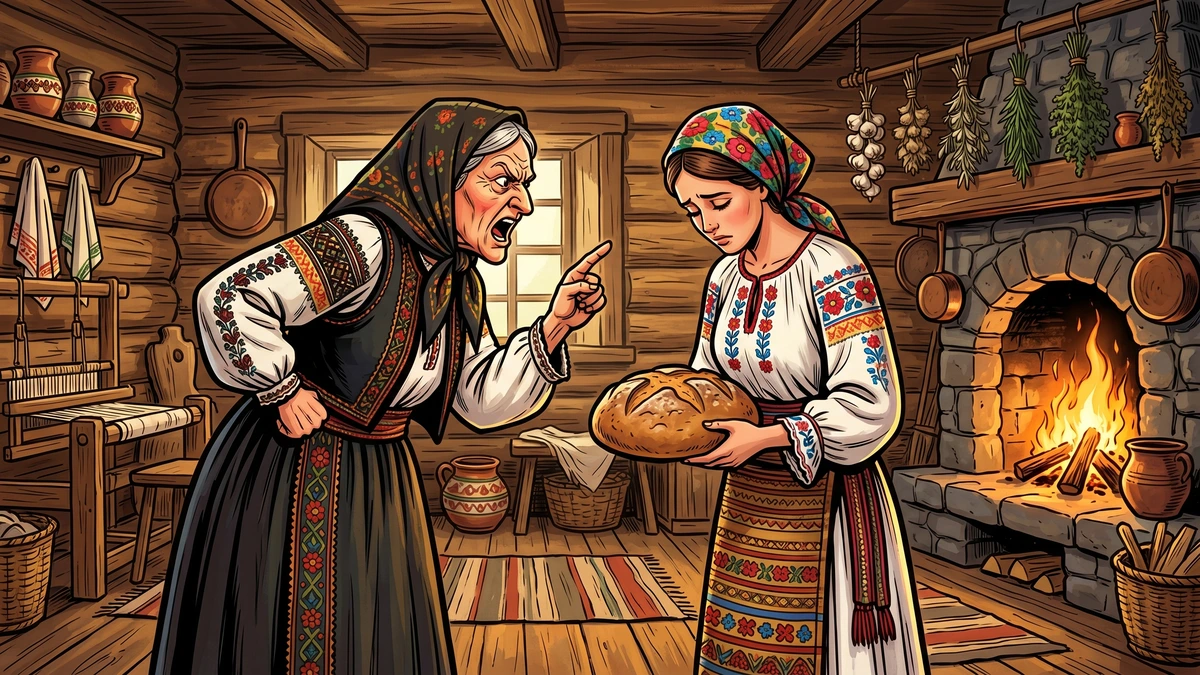
Her sharpest cruelty she saved for her daughter-in-law, Elena, the gentle wife of her only son. Every day Dochia hunted for some new failing. “Your bread is too hard,” she would say, though Elena’s loaves were the finest in three valleys. “Your hands are too soft for honest work,” she would sneer, though Elena’s palms were callused from dawn till dusk. What Dochia despised most was Elena’s tenderness: her quiet prayers, her kindness to the servants, her habit of pressing extra food into the hands of the poor who came shivering to the door. “You will ruin me with your foolish mercy!” Dochia would shout. “One day you will learn that the world punishes the soft-hearted.”
Elena did not argue. She bowed her head, finished her work, and went on being kind — for she understood something her mother-in-law did not: that gentleness is not weakness, and that a house held together by fear is colder than any winter.
The Boast Against the Mountain
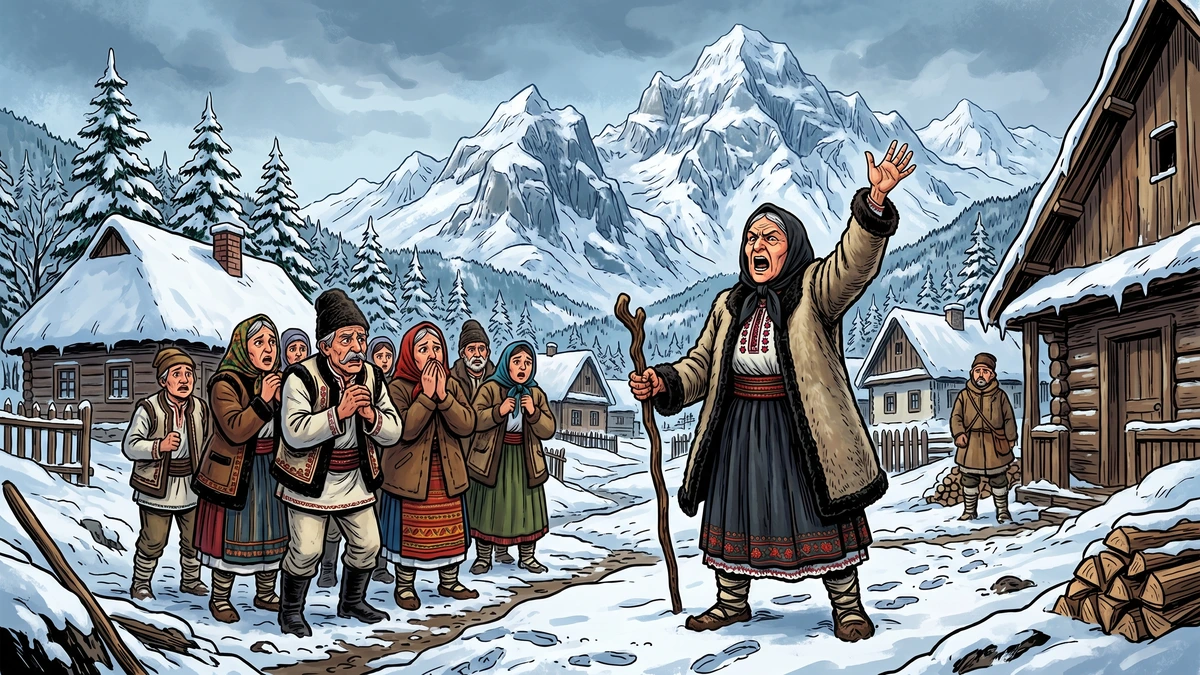
One year the winter was merciless. The snow lay six feet deep and the wind came down off the ridges howling like a pack of wolves. It was the last week of February, and in the village the people had begun to speak hopefully of spring, of Mărțișor and the red-and-white thread soon to be tied on every wrist. Dochia heard them and scoffed.
“Spring?” she said. “There is no spring. The world is nothing but cold and hardship without end. I am stronger than any season. I am stronger than nature herself — and I will prove it.”
Elena, hearing such words, whispered a prayer, for it frightened her to hear a mortal woman set herself against the sky. But Dochia’s son was away on business, and no servant dared lay a hand on their mistress. “I will climb to the highest peak,” Dochia declared, “in nothing but my housedress and a thin shawl. If the fools are right and winter is ending, I shall come down alive. If I freeze, then I was right all along — there is only eternal cold, and I was a fool to expect anything kinder.”
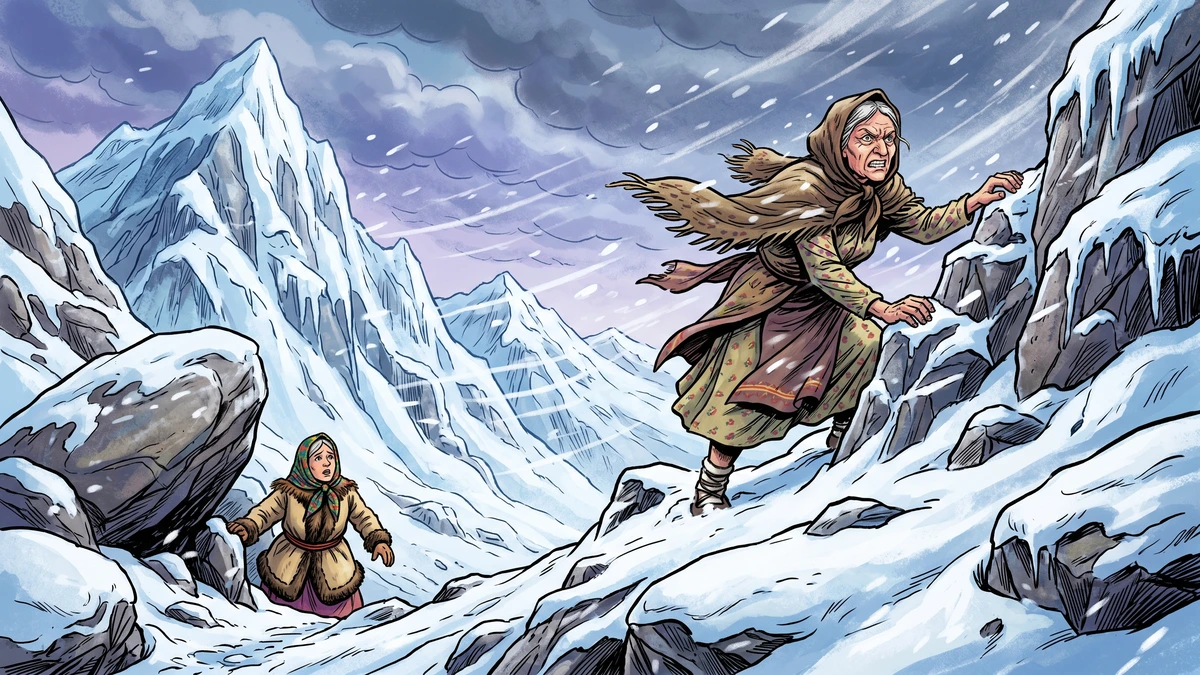
That very afternoon she set out, climbing past the last crooked trees into the bare country of rock and ice where nothing grows. And Elena — terrified, unable to abandon even the woman who had wounded her so often — followed quietly at a distance, keeping to the shelter of the boulders.
The Long Night of Freezing and Thawing
As darkness fell the cold deepened beyond anything Dochia had imagined. She wedged herself into a crevasse between two great rocks, her thin shawl useless against the wind, her housedress soaked and then frozen stiff against her skin. By midnight she was dying. Her teeth chattered until she feared they would shatter; her fingers turned blue, then black; her feet went numb. She wept — with cold, and with a rage she would not yet release, refusing to admit that the world might be greater than her will.
Then, as if the mountain itself were teaching her, the wind dropped. The clouds parted. A warm southern air came flowing up the slope, and the snow began to soften and run. Within an hour Dochia was warm. Triumphant, she flung off her shawl. “You see?” she cried to the empty sky. “I have conquered winter! I am supreme!”
But the mountain was not finished. The wind shifted. The warmth vanished as suddenly as it had come, and out of the north rolled storm clouds darker than before. The cold returned, and now it struck a woman with no shawl and skin still flushed from the false thaw. So the night went on — freeze and thaw, freeze and thaw, each violent swing battering her body anew. Below, in the lee of a rock, Elena watched and prayed and wept, certain that dawn would show her a corpse.
The Hands That Were Scarred Into Kindness
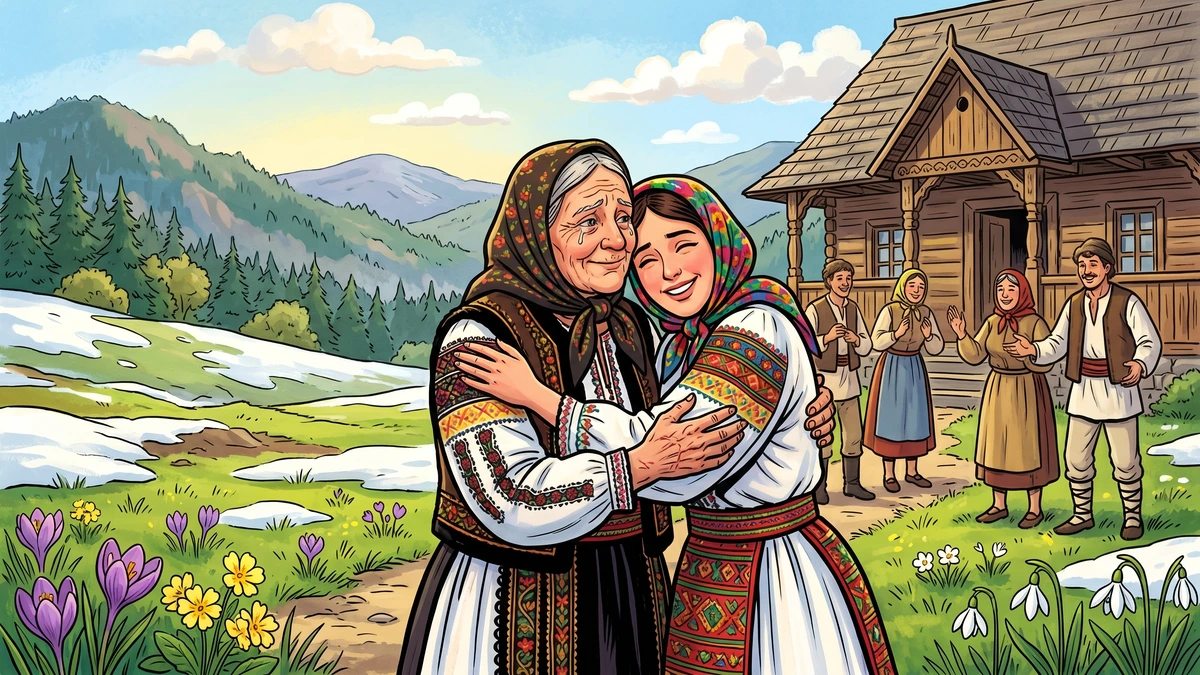
Yet at dawn Baba Dochia still breathed. Broken, trembling, barely conscious, she stumbled down the rocks — and Elena ran to her, wrapped her in her own warm cloak, and half-carried her down the long slope home.
For weeks Dochia lay near death. Healers tended her frostbitten fingers and the burns the false warmth had seared into her skin; her lungs rattled with every breath. Through all of it Elena never left her side. She brought warm broth, changed the bandages, and whispered comfort — offering, freely, every tenderness the old woman had spent years mocking.
When at last Dochia could speak clearly, her first words were these: “Elena, my daughter — forgive me.” And she wept, confessing every cruelty, every harsh word, every unkindness. Elena took her scarred hand and forgave her, as she had always longed to do.
From that day Baba Dochia was a changed woman. She never fully recovered her health; her ruined hands remained, a permanent reminder of her hubris. But she used those hands now to work beside her servants rather than to command them. She opened her door to the poor and shared her wealth without counting it. And she came, in time, to love Elena truly — recognising at last that real strength is not pride or dominance, but the quiet, unbreakable power of mercy.
The Moral: The Bowed Head the Sword Does Not Cut
The legend of Baba Dochia is, at heart, a meditation on hubris — the ancient warning against setting one’s small will against the vast order of the world. Dochia does not lose her wealth or her life; she loses her certainty, and in losing it she finally gains a soul. Romanian grandmothers, telling the tale each spring, draw from it a single steady thread: that pride blinds, that cruelty is itself a kind of blindness, and that humility is not defeat but the beginning of sight. An old Romanian proverb says it plainly:
“Capul plecat sabia nu-l taie.”
— “The sword does not cut the bowed head.” The humble survive what the proud cannot.
The bowed head in the proverb is not the head of a coward. It is the head of someone wise enough to know the size of the world — and Dochia learns that wisdom only after the mountain forces it on her. Elena, by contrast, carries it from the start. Her gentleness, scorned as foolishness, turns out to be the one thing strong enough to thaw a frozen heart.
Why the Tale Has Lasted
Few folk legends are still alive in daily speech the way Baba Dochia’s is. Every year, when March arrives and the Carpathian weather lurches from sun to sleet and back again, Romanians say that Dochia is “shedding her coats” once more, and many still keep the old custom of the Babele: each person picks one of the nine days between 1 and 9 March, and the weather of that chosen day is said to foretell the temper of their old age — bright if it is fair, bitter if it is cold. The strange rock formations of the Bucegi and Ceahlău mountains, weathered into hunched, hooded shapes, are pointed out to children as Dochia and her petrified flock.
The story endures because it binds together three things people never stop needing: an explanation for the restless weather of early spring, a vivid warning against the pride that hardens a heart, and the deep consolation that even the cruellest person may still be transformed. Dochia’s scarred hands are the tale’s truest image — proof that suffering met with grace need not destroy us, but can remake us into something kinder than we were. And so, each spring, as the snow retreats and the first red-and-white mărțișor threads appear, the old woman climbs her mountain again in the telling, and is humbled again, and the people of the Carpathians remember that spring — like forgiveness — always comes, but never to those who command it, only to those who wait for it with an open hand.
Frequently Asked Questions
Who was Baba Dochia in Romanian folklore?
Baba Dochia, or “Old Dochia,” is a central figure of Romanian mythology — a personification of departing winter and of humankind’s longing for spring. Folklorists trace her name to Saint Eudokia of Heliopolis, commemorated on 1 March, whose feast fused with a far older pre-Christian winter-hag figure. She appears variously as a cruel mother-in-law, a Dacian princess, and the spirit of the cold itself.
What are the “Days of Dochia” or Babele?
The Zilele Babei (“Days of the Old Woman”), also called Babele, are the first nine days of March, 1–9, linked to the nine sheepskin coats Dochia sheds while climbing the mountain. The weather in this period is famously volatile. A folk custom invites each person to choose one of the nine days: a fair chosen day promises a serene old age, a cold one a bitter temperament.
What is the moral of the Baba Dochia legend?
The legend is a meditation on hubris. Dochia’s boast that she is “stronger than nature” is humbled by the mountain’s violent freeze-and-thaw, and only after her suffering — met by Elena’s unwavering mercy — does she truly change. The Romanian proverb “Capul plecat sabia nu-l taie” (“the sword does not cut the bowed head”) captures its teaching: humility, not pride, is real strength.
Why is Baba Dochia connected to the Bucegi Mountains?
In the Dacian-princess version of the legend, Dochia — daughter or sister of King Decebalus — flees the Roman emperor Trajan into the Carpathians and begs the supreme Dacian god Zalmoxis to petrify her and her flock rather than be captured. The weathered, hooded rock formations of the Bucegi and Ceahlău mountains, known locally as “Babele,” are pointed out as her stone remains.
How is Baba Dochia related to Mărțișor and Dragobete?
Baba Dochia stands at the centre of the Romanian spring cycle. Dragobete, the late-February day of young love, is in several versions named as her own son; Mărțișor, the red-and-white thread tied on 1 March, marks the start of spring; and the Babele days follow. Together these customs dramatize the contested passage from winter into spring.
You May Also Like
 Celtic Folk Tales
Ages 9-12
Celtic Folk Tales
Ages 9-12
The Fate of the Children of Lir
The Fate of the Children of Lir: t happened that the five Kings of Ireland met to determine who should have the head kingship over them, and King Lir of the
 Celtic Folk Tales
Ages 9-12
Celtic Folk Tales
Ages 9-12
The Little White Cat
The Little White Cat: A long, long time ago, in a valley far away, the giant Trencoss lived in a great castle, surrounded by trees that were always green. Even
 Celtic Folk Tales
Ages 9-12
Celtic Folk Tales
Ages 9-12
The Russet Dog
The Russet Dog: h, he’s a rare clever fellow, is the Russet Dog, the Fox, I suppose you call him. Have you ever heard the way he gets rid of his fleas? Cunning