Shepherd Of Myddvai
A Welsh Celtic legend about a shepherd who falls in love with a fairy maiden from a magical lake.
The Shepherd of Myddvai is the most famous of the medieval Welsh fairy-bride tales and the founding legend of one of the oldest documented medical traditions in Britain. The story belongs to the cluster of legends gathered around Llyn y Fan Fach, a small dark glacial lake on the northern flank of the Carmarthen Black Mountains (Mynydd Du), in what is now Carmarthenshire, southwest Wales. The tale was first set down in writing in the medieval Welsh medical compendium Meddygon Myddfai (the Physicians of Myddfai), preserved in the late thirteenth- and fourteenth-century manuscripts Llyfr Coch Hergest (the Red Book of Hergest, Jesus College, Oxford, MS 111, c. 1382-1410) and Hafod 16 (National Library of Wales). The version most read in English is the one Joseph Jacobs printed in Celtic Fairy Tales (London: David Nutt, 1892), pp. 42-49 and notes pp. 254-255, drawing on the bilingual edition by John Pughe and the Rev. John Williams ab Ithel, The Physicians of Myddvai: Meddygon Myddfai (Llandovery: D. J. Roderic for The Welsh Manuscripts Society, 1861), and on the popular retelling in Wirt Sikes, British Goblins: Welsh Folk-Lore, Fairy Mythology, Legends and Traditions (London: Sampson Low, Marston, Searle and Rivington, 1880), chap. III.
Tale Type, Manuscripts, and Comparative Position
Folklorists classify the Shepherd of Myddvai as a Welsh variant of ATU 400 (The Man on a Quest for His Lost Wife) with strong contamination from the Mélusine subtype ATU 411 (The King and the Lamia / Otherworld Bride with Taboo); the classification is given in Hans-Joerg Uther, The Types of International Folktales, FFC 284-286 (Helsinki: Academia Scientiarum Fennica, 2004), volume I, pp. 231-238. The story turns on the narrative engine known to folklorists as the three-blow taboo (motif C31.1.2 in Stith Thompson’s Motif-Index of Folk-Literature, FFC 116-117, Bloomington: Indiana University Press, 2nd ed., 1955-1958): an otherworld bride agrees to marry a mortal on the condition that he never strike her three causeless blows; on the third blow she returns to her own kindred. The same motif governs the Irish water-bride tales of Lough Gur in Limerick, the Breton legends of Dahut, and the medieval French romance of Mélusine as told by Jean d’Arras (1393).
The Welsh material, however, is older and tighter than its continental cousins. The earliest extant manuscript witness, the Llyfr Coch Hergest, dates the foundation of the Myddfai medical lineage to c. 1230 in the reign of Rhys Gryg, lord of Dinefwr (d. 1234), and names the first three physicians as Rhiwallon Feddyg and his sons Cadwgan, Gruffydd, and Einion. The historical record bears the legend out: from the thirteenth century until the death of Rhys Williams at Aberystwyth in 1842, an unbroken line of Myddfai physicians practised in Carmarthenshire for more than six hundred years – a span unmatched anywhere in European folk medicine. The tale is therefore both folktale and family charter: see Morfydd E. Owen, “The Medical Books of Mediaeval Wales and the Physicians of Myddfai,” The Carmarthenshire Antiquary 31 (1995), pp. 34-44, and Diana Luft, Medieval Welsh Medical Texts (Cardiff: University of Wales Press, 2020).
The Story Retold
Beat One – The Bread, the Lake, and the First Glimpse
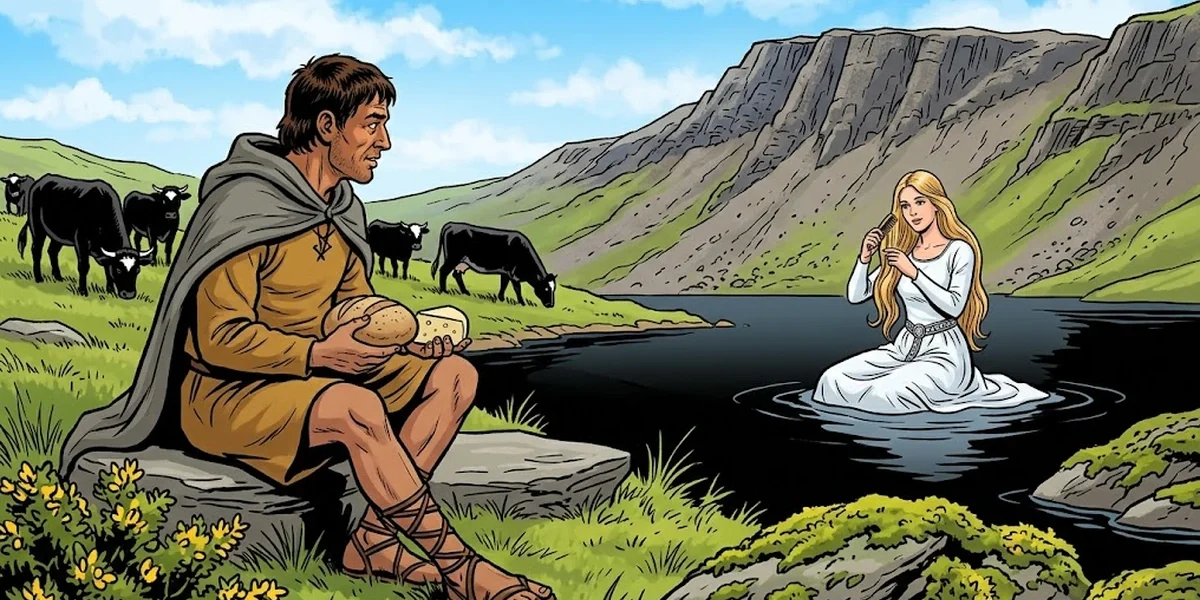
In the parish of Myddfai, on the slopes that rise from the Tywi valley toward the dark crags of Mynydd Du, there lived in the early thirteenth century a poor widow whose only son tended her small herd of black cattle on the upland pastures around Llyn y Fan Fach, the Lake of the Small Peak. The lake lies in a steep glacial cwm at about fifteen hundred feet above sea level; its waters are deep and dark even on the clearest summer day, and the ridge above it, Picws Du, casts a shadow that touches the lake’s surface for half the year. The boy was tall and gentle, with the brown weather-beaten skin of every Welsh upland shepherd, and he wore the plain woollen tunic and grey hooded cloak of his trade, with leather sandals laced to the calf.
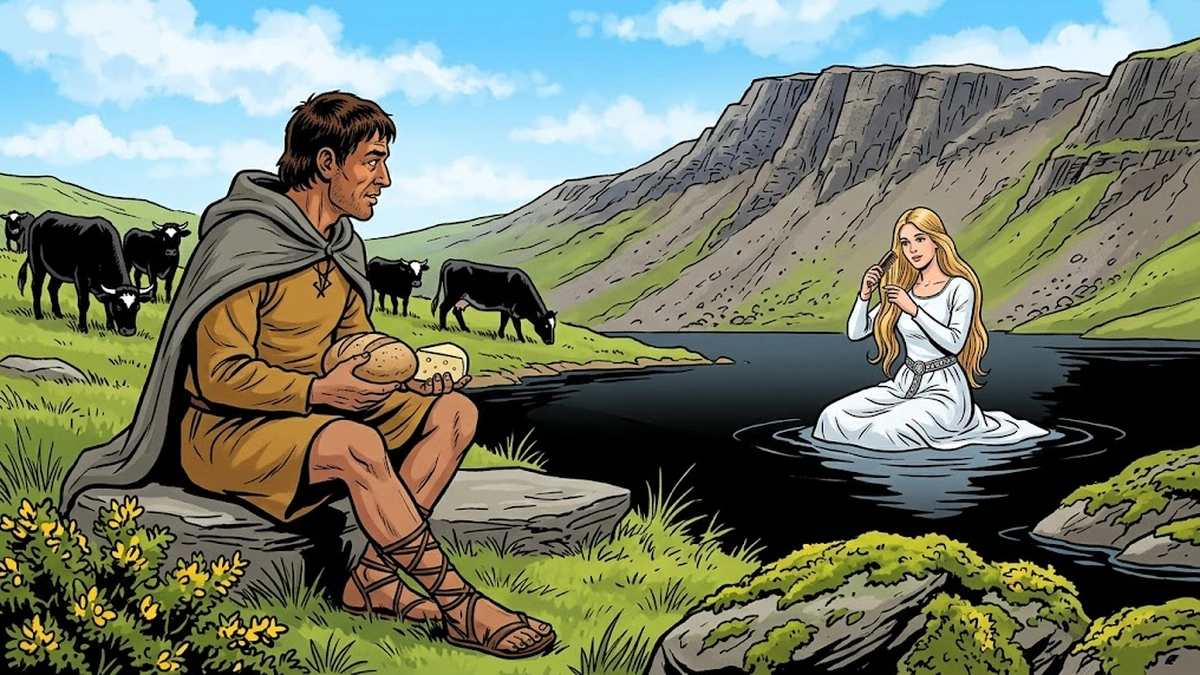
One bright midsummer morning, while his cattle grazed by the lakeside, the shepherd sat down on a rock to eat his noon meal of barley bread and ewe-milk cheese. As he raised the loaf to his mouth, he saw – sitting on the unbroken surface of the water some little way out from the shore, as though the water were polished marble beneath her – the most beautiful young woman he had ever seen. Her hair was the colour of ripe wheat and fell loose to her waist; her gown was of plain white linen, gathered with a silver belt; her feet were bare upon the water; and she was combing her long hair with a comb of bog-oak set with river-pearls. The shepherd, half believing himself in a daydream, held out his bread to her in mute invitation.
The maiden glided closer until she was within arm’s reach of him, looked at the loaf, and shook her head. Cras dy fara, nid hawdd fy nala, she said in the old Welsh that even the sheep on the slopes of the Black Mountain still seem to remember when the wind is in the right quarter; hard-baked is your bread, and not easy to catch me are you. And before he could find his tongue she sank beneath the water and was gone. He went home empty-handed and told his mother all that he had seen.
Beat Two – Three Loaves and the Bargain by the Lake
The widow had heard, as every old woman of Myddfai had heard, the murmur of stories about the daughters of Tylwyth Teg – the Fair Folk – who lived in halls beneath the lake. She baked her son a loaf of unbaked dough and sent him back the next morning. The maiden rose, looked at the soft loaf, and laughed. Llaith dy fara, ti ni fynna, she said: too soft is your bread, you I will not have. The third morning the widow baked a loaf moderately – neither hard nor soft – and the boy carried it back to the lake. This time the maiden ate of the bread, climbed onto the bank beside him, and let him take her hand.
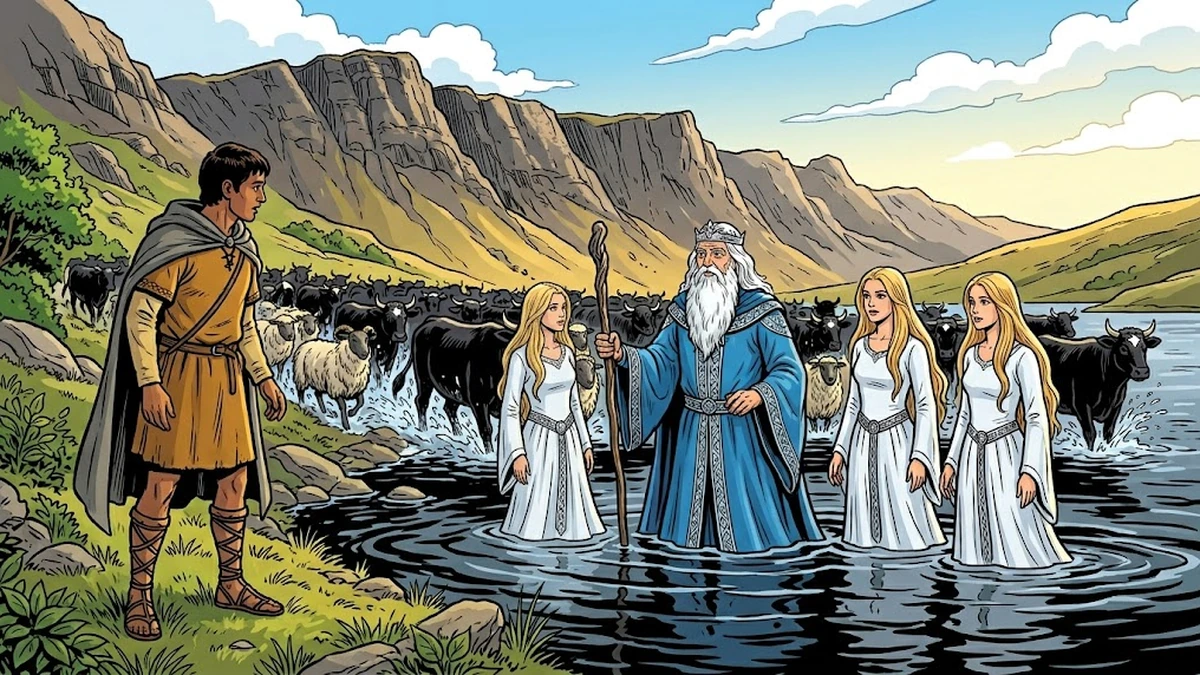
As he led her toward the shore an old man with a long white beard and the bearing of a king rose out of the water beside her. With him came two young women so alike in face and dress to the shepherd’s beloved that he could not at the first or second look tell which was the one he had courted. The old man spoke gravely. I will give my daughter in marriage to the young man, he said, if he can name her. And as her dowry I will give her as many sheep, and goats, and cattle, and horses as she can count without drawing breath. But mark my words: if ever he strike her three causeless blows, she and all that she has brought him will return to me beneath the lake. The shepherd looked from one sister to the other and was on the point of despair when one of them set her foot a little forward and he caught a glimpse of a strap or a thong he had noticed on her sandal at their first meeting. He named her by that small token, and her father blessed the match.
Then the lake-king turned to his daughter and bade her count her dowry. She counted by fives – un, dau, tri, pedwar, pump, again and again – and from the lake there rose, in groups of five, the herds and flocks of the Otherworld: black cattle with the white star on the forehead that breeders of the Welsh Black still recognise; long-fleeced sheep with the small horns of the original mountain stock; cobs the colour of midsummer cloud; and goats with bells of beaten copper. She counted as many as her breath would allow; her father raised his hand, and the lake closed behind him; and the shepherd led his bride and her wealth down to a small farmstead called Esgair Llaethdy on the south side of Myddfai.
Beat Three – The Three Causeless Blows
For many years the shepherd and the lake-bride lived in great prosperity at Esgair Llaethdy. She bore him three sons, named in the manuscript of the Red Book as Cadwgan, Gruffydd, and Einion; the eldest, called also Rhiwallon, was the wisest and the most thoughtful of the three. The lake-wife was, as the manuscript notes, llawen, gwastad, doeth – cheerful, steady, wise – but she had a strange habit, for she would sometimes laugh when others wept and weep when others laughed, and her laughter and her weeping always seemed to know more than the company around her did. Three times in those long years her husband forgot, in the press of the ordinary world, to handle her gently as the lake-king had told him to.
The first blow fell at a christening. The lake-wife wept while the family laughed, and when her husband, mortified before his neighbours, tapped her on the shoulder and asked her to be cheerful, she turned and said: The infant is entering a sorrowful world, and I weep for him; that is the first causeless blow you have given me, husband; remember. The second blow fell at a wedding feast. The lake-wife laughed while the company wept, and when her husband, again mortified, tapped her on the shoulder and bade her be sober, she turned and said: This couple are stepping out of poverty into love, and I laugh for them; that is the second causeless blow, husband; one more and I am lost to you. The third blow fell at a funeral. The lake-wife laughed while the mourners wept, and her husband, angered, tapped her on the arm and told her to be silent. She turned to him and said:
Y mae’r marw’n troi at hawddfyd, a chwi sydd yn troi at alar; dyna y trydydd ergyd, a llymma’r diwedd.
(The dead is turning to ease, and you are turning to grief; that is the third blow, and here is the end.)
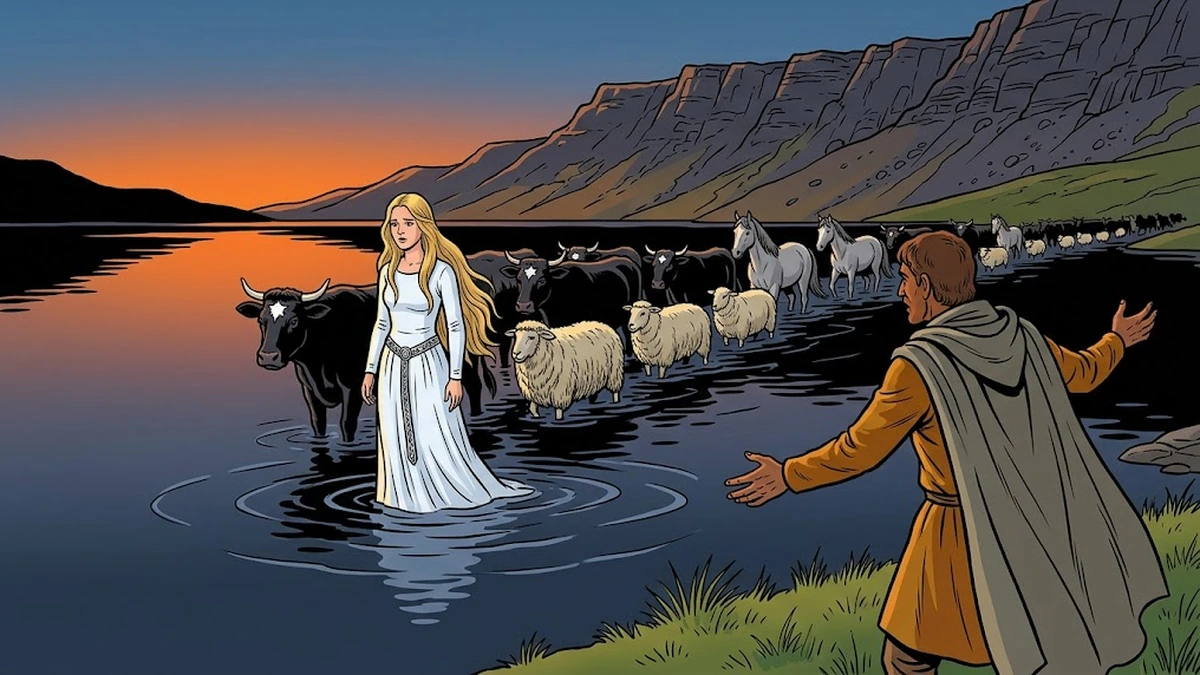
She rose from the funeral hearth, called her cattle and her sheep and her goats to her by their secret names, and walked out of Esgair Llaethdy with all the wealth she had brought her husband at her heels. Behind her the herd of black cows turned their broad faces toward the lake and followed her up the long slope. At the lake’s brink she gathered her flocks around her and walked slowly into the water, and the herd followed her, lowing softly; and the man who had loved her stood on the bank and saw the lake close above the last horn of the last black bull, and the surface of Llyn y Fan Fach was as still and as dark as it had been on the morning he had first set eyes on her.
Beat Four – The Gift to the Sons – the Founding of the Physicians of Myddfai
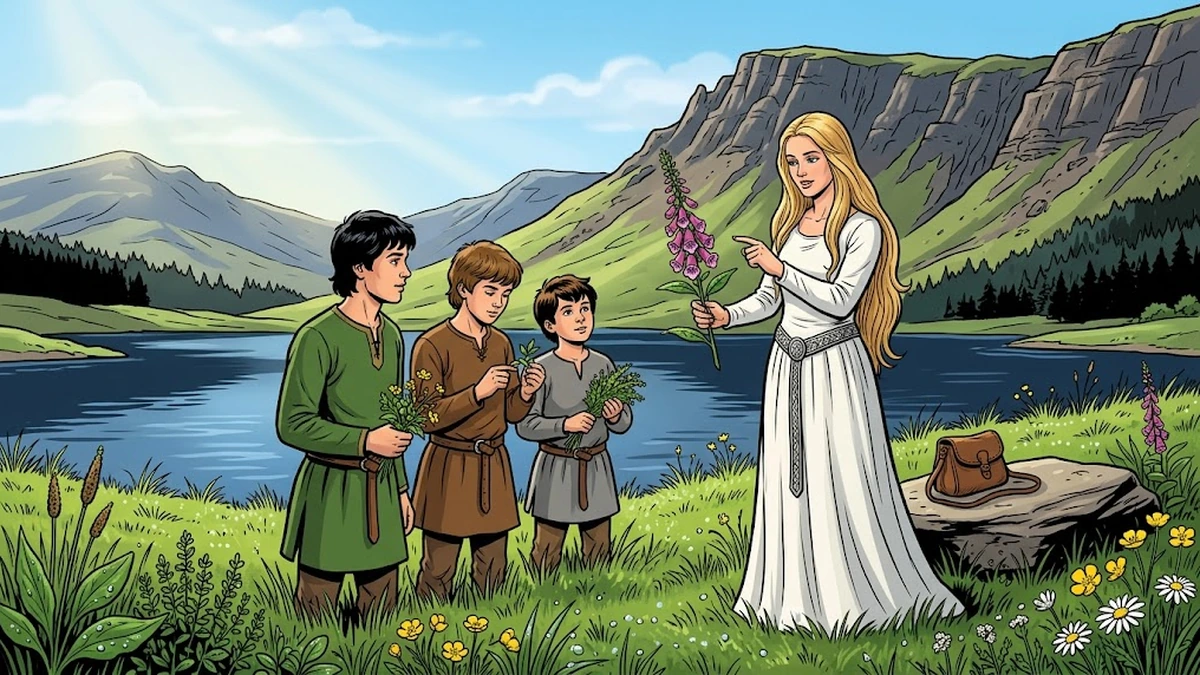
The shepherd never saw his wife again, though he wandered the shores of Llyn y Fan Fach for the rest of his life. But she did not abandon her three sons. One day, while her eldest, Rhiwallon, was walking on the southern shore at a place still called Llidiad y Meddygon – the Physicians’ Gate – she rose out of the water once more, in the same white linen gown and silver belt, with the same wheat-coloured hair, and she stood with her sons on the bank.
She told them that they had been born for the relief of human suffering; that she would teach them the names and the virtues of the herbs that grow on the slopes of the Black Mountain – the llysiau gwyrdd of the upper meadow, the cudd-ddail of the marshy hollow, the blodau gwynion of the limestone rocks above the lake; that they would heal where others could only mourn; and that their descendants, as long as they remembered the lake and kept faith with the herbs, would be physicians to the people of Wales. Then she walked into the lake and was not seen again, except (so the country people of Myddfai still say) on certain mornings when the mist clears off the water and a young woman in a white gown and silver belt is glimpsed combing her hair on the surface, and is gone before the watcher can call her name.
The three brothers became the founding Meddygon Myddfai. Their patron was Rhys Gryg, lord of Dinefwr, who granted them the lands of Myddfai. Their medical knowledge – some six hundred remedies, recipes for compound waters, ointments, and herbal decoctions – was set down in Welsh in the Red Book of Hergest and the Hafod manuscripts, and survives today as one of the earliest vernacular medical texts in Europe. The line of physicians of Myddfai continued in unbroken descent until the death of Dr Rhys Williams at Aberystwyth in 1842; their gravestones may still be read in the parish churchyard of Eglwys Myddfai, half a mile from the road that climbs to Llyn y Fan Fach, and the lake itself, today a Site of Special Scientific Interest, is still visited every August by walkers who come up from the valley to watch the surface of the water at noon.
The Moral and Its Welsh Wording
The moral of the Shepherd of Myddvai turns, like all the great Welsh and Irish fairy-bride tales, on the proverb that the lake-wife herself speaks at the moment of her departure: that the gift of love comes always with a condition, and that the condition is gentleness. The proverb is preserved in many forms in Welsh; the one set down in the medieval triads of Llyfr Coch Hergest, fol. 312 verso, runs:
Tair gormodd wraig: gormodd amheuaeth, gormodd llaw a gormodd dafod.
(Three things are too much in a husband: too much suspicion, too much hand, and too much tongue.)
The lake-wife teaches her husband – and through him, the men of Myddfai for thirty generations – that what is given by the Otherworld can be kept only by remembering its first condition. The shepherd had been told the rule on his wedding day; the rule had cost him nothing for many years; and yet, three times across two decades, he forgot. The story is therefore not about magic gone wrong; it is about ordinary forgetfulness, the small absent-minded slap of a hand or word that, repeated three times, makes a marriage uninhabitable. The Old Welsh ethical compendium Cyfraith Hywel – the Law of Hywel Dda, codified in the tenth century and preserved in Llyfr Iorwerth (Peniarth MS 35) – already provided that a wife was entitled to leave her husband on the third llaw ddiachos, the third causeless blow; the lake-bride’s departure is therefore not magic but Welsh law, dignified into legend. See Dafydd Jenkins, ed. and trans., The Law of Hywel Dda: Law Texts from Medieval Wales (Llandysul: Gomer Press, 1986), pp. 45-49.
Why This Story Still Matters
The Shepherd of Myddvai is the founding myth of the longest-attested medical lineage in pre-modern Britain. For more than six hundred years the descendants of the lake-bride’s three sons practised in Carmarthenshire, copying and recopying the Red Book of Hergest’s recipes and adding their own; and the herbs the lake-bride is said to have shown her sons – bog-bean, betony, agrimony, hedge-mustard, foxglove – are still found on the slopes she walked, and several of them are the parent compounds of drugs in modern pharmacopoeia (digitalis from foxglove most famously). The legend is therefore, unusually for a fairy tale, also a piece of intellectual history: it remembers the moment in which the herbal knowledge of the Welsh uplands first acquired written prestige.
For the modern reader, however, the abiding moral is the gentler one. The shepherd lost his wife not by failing to seek her, not by failing to love her, but by failing to remember a small private rule of tenderness that he had been told and had agreed to. The lake-bride’s lesson – that the third causeless blow is always one too many – is the same lesson that runs through the Mélusine of Jean d’Arras, the Lough Gur tales of County Limerick, the Selkie wives of Orkney and Shetland, the Banshee-bride of County Mayo, the “Crane Wife” (Tsuru no Ongaeshi) of Japan, and the Indian Urvashi-Pururavas tale of the Shatapatha Brahmana XI.5.1. In every culture the otherworldly bride teaches the same austere doctrine: that love which is not held with both hands at once will, in the end, slip back into the water from which it came.
Cultural Context and Continuing Influence
The legend has had a continuous literary afterlife in Wales and beyond. Wirt Sikes’ British Goblins (1880) printed the tale in the form most familiar to nineteenth-century English readers; Joseph Jacobs included it in Celtic Fairy Tales (1892); W. Jenkyn Thomas re-shaped it for children in The Welsh Fairy Book (London: T. Fisher Unwin, 1907), pp. 1-9, with illustrations by Willy Pogany; Gwyn Jones and Thomas Jones used the Red Book recension in their Welsh Legends and Folktales (Oxford University Press, 1955); Robert Graves alluded to the lake-bride throughout The White Goddess (Faber and Faber, 1948); and the modern Welsh poet Gwyneth Lewis has returned to the legend repeatedly in her bilingual collections, most notably Y Llofrudd Iaith (Barddas, 1999). The Brecon Beacons National Park signs the path to Llyn y Fan Fach in both Welsh and English, and a stone monument at the southern shore commemorates the Physicians of Myddfai.
For modern readers – in Wales, in India, in any country where a marriage is judged not by its happy beginning but by its careful continuation – the Shepherd of Myddvai is a small medieval Welsh masterpiece on the cost of gentleness. The lake-bride’s wealth, her wisdom, her sons, and her healing knowledge are the gift; the third causeless blow is the price; and the dark surface of Llyn y Fan Fach, on a clear summer morning when the wind drops and the lake mirrors the ridge of Picws Du, is the standing reminder of how easy a gift is to lose and how difficult it is to win back.
You May Also Like
 Celtic Folk Tales
Ages 9-12
Celtic Folk Tales
Ages 9-12
Connla And The Fairy Maiden
Connla And The Fairy Maiden: Connla of the Fiery Hair was son of Conn of the Hundred Fights. One day as he stood by the side of his father on the height of
 Celtic Folk Tales
Ages 9-12
Celtic Folk Tales
Ages 9-12
Princess Finola And The Dwarf
Princess Finola And The Dwarf: A long, long time ago there lived in a little hut in the midst of a bare, brown, lonely moor an old woman and a young girl.
 Celtic Folk Tales
Ages 9-12
Celtic Folk Tales
Ages 9-12
Powel, Prince of Dyfed
Powel, Prince of Dyfed: owel, Prince of Dyfed, was lord of the seven Cantrevs of Dyfed; and once upon a time Powel was at Narberth, his chief palace, where a