Connla And The Fairy Maiden
Connla And The Fairy Maiden: Connla of the Fiery Hair was son of Conn of the Hundred Fights. One day as he stood by the side of his father on the height of
Origin: Celtic — Old Irish, the earliest stratum of Gaelic literature. Old Irish title: Echtrae Chonnlai (also Echtra Condla / Echtrae Conli) — “The Adventure of Connla.” Genre: echtra — the Otherworld-journey tale, of which this is the oldest preserved Irish example, ancestor of Echtrae Brain and Echtrae Cormaic. Earliest manuscript witness: Royal Irish Academy MS 23 E 25, the Lebor na hUidre (“Book of the Dun Cow”), c. 1100, p. 120 col. a, opening Cid día n-apar Art Óenfer (“Why is Art called the Lone-One?”). Other surviving witnesses: Yellow Book of Lecan (14th c., closer to the lost archetype); Book of Fermoy; British Library Egerton 88. Linguistic dating: Kim McCone, Echtrae Chonnlai and the Beginnings of Vernacular Narrative Writing in Ireland (Maynooth Medieval Irish Texts 1, 2000), assigns the lost archetype to the late 7th or early 8th century, making this one of the very earliest narratives in any vernacular European tongue. Earlier critical editions: Eugene O’Curry, Atlantis III (1862) and Lectures on the Manuscript Materials of Ancient Irish History (Dublin 1861); Heinrich Zimmer, Zeitschrift für deutsches Altertum 33 (1889); Kuno Meyer, The Voyage of Bran appendix (London 1895). Definitive English retellings: Patrick Weston Joyce, Old Celtic Romances (Kegan Paul, London 1879), pp. 106–111; Joseph Jacobs, Celtic Fairy Tales, no. III, “Connla and the Fairy Maiden” (David Nutt, London 1892), the version that fixed the tale in English-language children’s tradition. Cognate medieval visions: Immram Brain maic Febail (Voyage of Bran), Immram Curaig Maíle Dúin (Voyage of Máel Dúin), Tochmarc Étaíne (Wooing of Étaín). Tale-type and motifs: ATU 470 Friends in Life and Death; Stith Thompson motifs F302 Fairy mistress, F129.1 Otherworld journey to Land of the Living, F377 Supernatural lapse of time in fairyland, D1359.3.1 Magic apple gives sustenance, F112 Journey to land of immortal women, F162.1.2 Otherworld plain (Mag Mell). Historical anchor: Conn Cétchathach (“Conn of the Hundred Battles”) is dated by the synchronisms of the Annals of the Four Masters (sub anno) to the High Kingship of Ireland AD 122–157. Modern reception: Lady Augusta Gregory included it in Gods and Fighting Men (Murray, London 1904), Part I, Book IV; James Stephens retold it in Irish Fairy Tales (Macmillan 1920); W. B. Yeats invoked the apple-tree of the Land of the Living in The Wanderings of Oisin (1889) and The Song of Wandering Aengus.
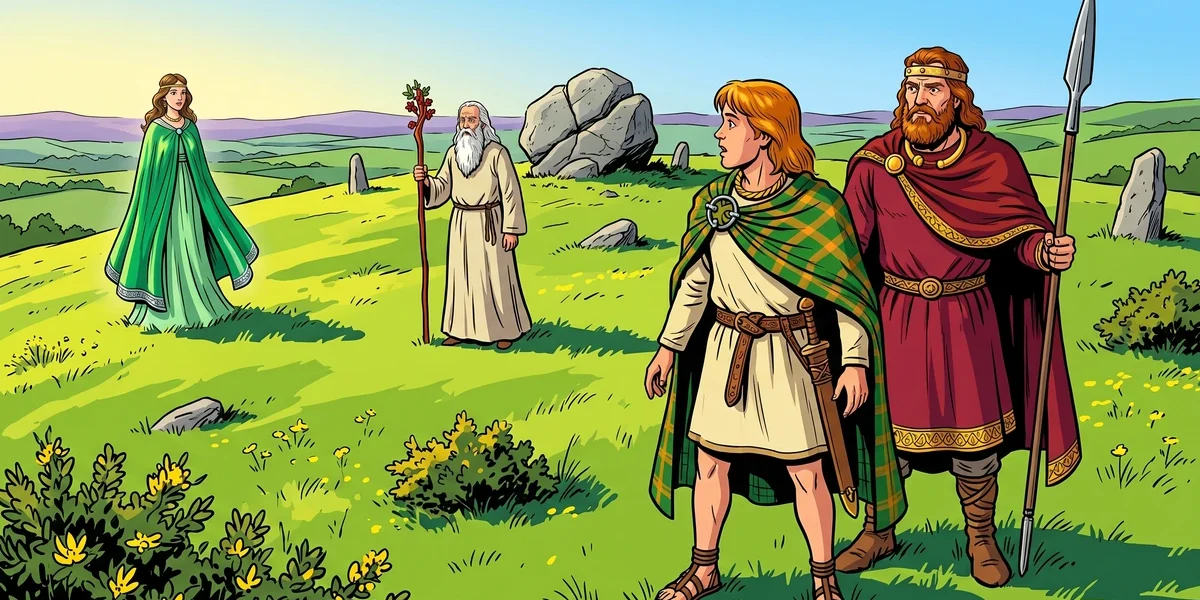
It happened in the days when Conn of the Hundred Battles was High King at Tara and the slow round of the year was still measured by the four great fires of the druids — Imbolc, Bealtaine, Lughnasa, Samhain. Conn had three sons by his wife Eithne Tháebfhota, and the eldest of these was Connla, called Connla Ruad for the red gold of his hair, and Connla Cáin for the fairness of his face. He was a young man of seventeen summers, slim as a willow and quick as a hawk, and the country looked at him and said: seo an tuiscealach — “this is the heir.” On a still afternoon at the height of summer, when the corn was a hand-span from harvest and the heat lay on the green hills like a second sky, Conn took his sons up the long slope of the Hill of Uisneach to look out over the five provinces; for from Uisneach, where the centre-stone of Ireland is set, a man may see Connacht to the west, Ulster to the north, Leinster to the east, Munster to the south, and the lost fifth province of Mide between his own two feet. And what came up the hill that afternoon to meet them was a thing that had never come up the hill before, and has not, in the long thereafter, come up it again.
I. The Woman in the Cloak of Strange Cloth — The First Meeting on Uisneach
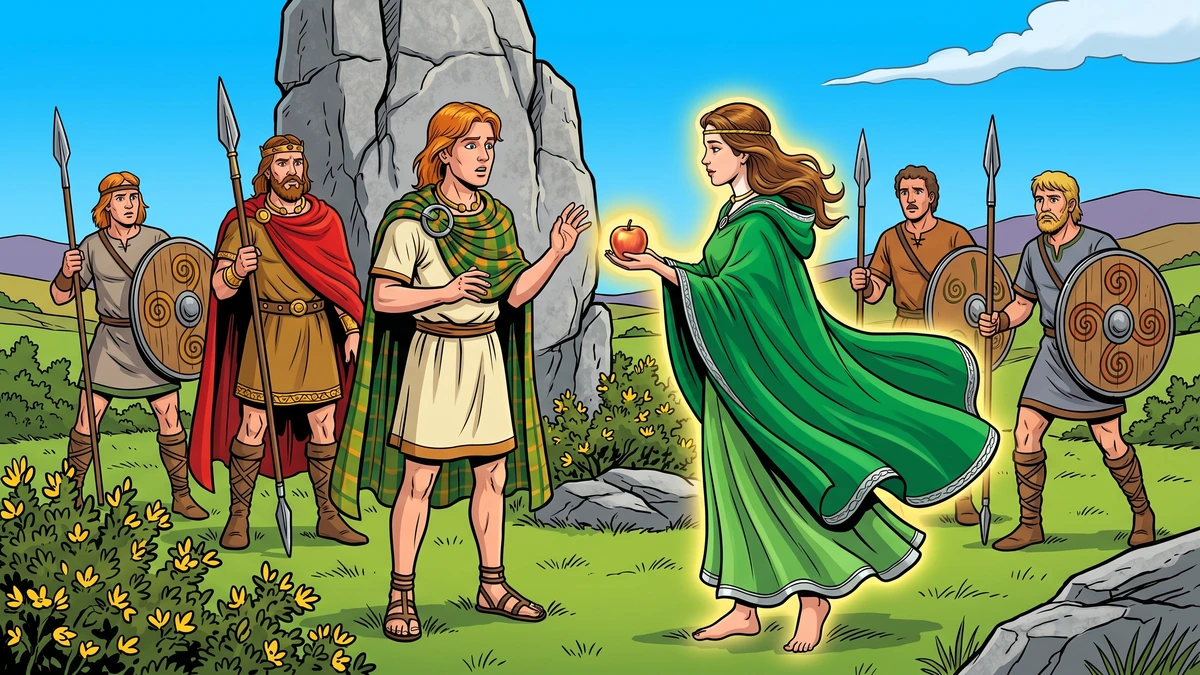
She was standing on the western face of the hill where no woman had been a moment before. Her cloak was of a green that the eye knew was not quite the green of any leaf or moss in Ireland, and it was hemmed with a thread that ran like water in the sun. Her hair was the colour of the inside of a hazel kernel and was bound with a fillet of pale gold, and on her white throat she wore a torc of a workmanship so fine that Conn’s chief goldsmith would have wept to see it. She had the bearing of a woman who has come a long road in a moment, and her eyes, when she lifted them, were fixed upon Connla and upon Connla alone.
Conn put his hand upon his son’s wrist. “Whom dost thou see, my son?” he said in a low voice; for to Conn, and to all the company of warriors and druids upon the hill, the woman was as invisible as the wind that bent the sweet flag at her feet. She was visible to Connla only.
“I see,” said Connla slowly, his voice gone the colour of his face, “a young woman in a cloak of strange cloth, and she is looking at me as if she had known me before I was born.”
The woman spoke, and her speech was the Old Irish of the schools, but with a lilt in it that no school had taught. “Tánag-sa,” she said — “I have come from the lands of the living, where there is neither death nor sin nor the breaking of any law. We keep our feast-days without contention. We are called the People of the Síde, and the People of the Hill, and the People of Peace; and because we are at peace we are called the aes síde.” She put back her hood. “I have set my love upon thee, Connla Ruad, son of Conn of the Hundred Battles. Come away with me to Mag Mell, the Plain of Honey, where the trees bear fruit and flower at the same hour, where there is no winter and no want and no growing-old. There is a king there who has been waiting for thee. Come, Connla, and rule.”
Conn felt his son tremble under his hand. He turned, swift as a man drawing iron, to the chief of his druids — a tall white-bearded man named Coran, whose voice in spell-craft was famous from the Foyle to the Suir. “Coran,” said the king, “I hear my son speak with one I cannot see, and his face has gone from him. This is a thing of the síde. Make thy spell.”
II. The Druid’s Chant — How Coran Drove Her Back, but Not For Long
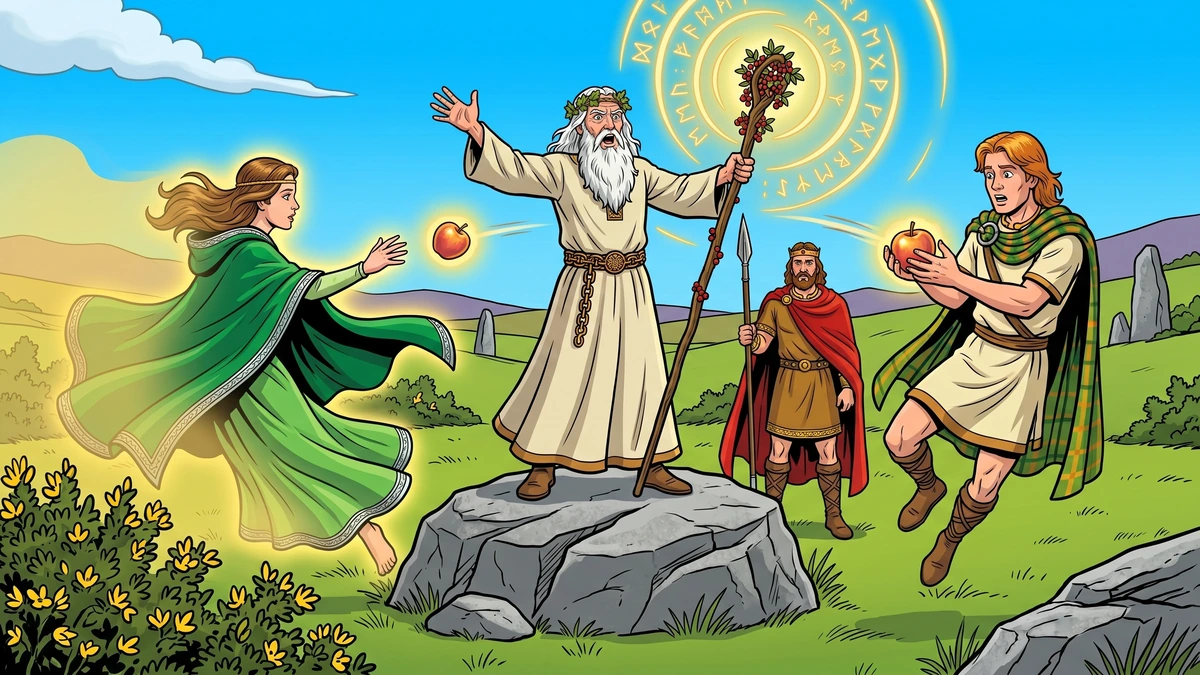
Coran the druid took his rowan staff from his shoulder and set the butt of it upon the centre-stone of Uisneach, where the five provinces met under one stone, and he began to chant. His chant was in the deep druidic measure, the one that uses the names of the rivers as a ladder; he climbed it river by river — Boyne and Shannon, Erne and Bann, Suir and Slaney, Lee and Liffey, Foyle and Lagan — and at each name he struck the staff once upon the stone, and at each strike a small bright wind came out of the west and blew the woman backward by the breadth of one foot.
She did not fight him. She watched Coran with a mild patience, as one watches a child build a wall of pebbles against the rising tide. But before she went, she put her hand into the breast-fold of her green cloak and she took out a thing that flashed once like a salmon turning in deep water, and she threw it underhand to Connla. It was an apple. It was no bigger than a goose-egg and it was the colour of red gold lit from within. Connla caught it, more from a child’s reflex than a man’s intention, and hid it in his own cloak; and at that moment Coran’s chant came to its summit — “In ainm na cóig n-aibhne, in ainm na cóig n-iathaibh, imthigh!” (“In the name of the five rivers, in the name of the five lands — depart!”) — and the woman was gone like breath from a polished horn, leaving only the dent of her foot in the soft turf of Uisneach and a smell on the air that was the smell of apple-blossom in May, but at the height of August, when the apple-blossom is six months gone.
The king let out the breath he had been holding. “Coran,” he said, “thy spell-craft is a wall of bronze. Connla — give me thine arm. We will go down to Tara and there shall be feasting tonight to drive this thing from thy mind.” But Connla was looking at the place where the woman had stood, and the apple was a small heat in the breast-fold of his cloak, and he made his father no answer.
III. The Apple That Did Not Diminish — A Month of Silence at Tara
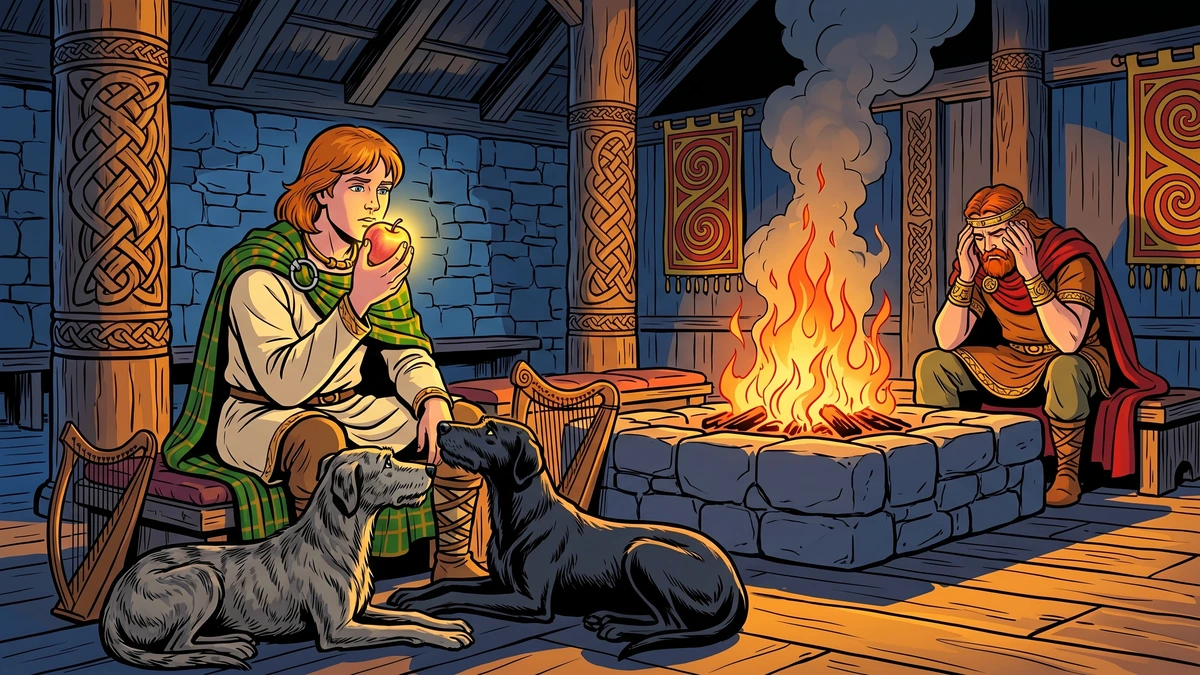
For a whole month after that day on Uisneach, Connla did not eat and did not drink — neither the venison from the king’s chase nor the white bread from the queen’s oven nor the milk of the brindled cow, the one with the gentle eye that had been nursemaid to him since his weaning. He sat by the hearth in his father’s hall with the dogs at his feet and his harp at his shoulder, and he ate from the apple. He ate as a thoughtful man eats, in slow bites, taking small mouthfuls. And the apple did not grow smaller. He bit, and where his teeth had been the flesh of the apple was whole again, with the small white scar of the bite closing as a wound closes under a fairy-wife’s hand.
At the end of the month the apple was the same apple, of a goose-egg’s bigness and a red gold’s colour, with no mark upon it but the mark of his own warmth where his thumb had held it. And Connla in that month did not sicken, did not grow thin, did not fall asleep in the day. But he did not speak either, except to murmur once an evening, when the long Irish dusk came down over Tara and the smoke of the cooking-fires went straight up because there was no breath of wind, the same five words: “Cá bhfuil sí, mo bhean ghlas?” — “Where is she, my green woman?”
The court of Tara grew afraid. Conn called Coran the druid again and said: “Coran, thy spell drove her one league. The apple has called her back and brought her two. Make a stronger spell, that I may keep my eldest son in the country of his fathers.” But Coran took the king aside, and he laid the rowan staff down at his feet as a man lays down a sword in surrender, and he said: “Lord, I have read the fios in the smoke of nine fires. The woman is no enemy and the apple is no poison. She is of the Tír na mBeo, the Land of the Living, and her king has set love upon thy son for a reason that is not to be known in this country. My spell will hold her one more time, and one more time only; and after that, lord, the boy will go where he is called, and no chant of mine will keep him. There is a country, lord, in the west where the salmon runs into the silver bay and the red sun goes down at evening: thither, lord, the boat will be drawn up on the strand at the next rising of the moon. Thou wilt be at the strand. Thou wilt see the boat. And after that thou wilt see thy son’s back, and after that thou wilt see no more, and thy hand on thy spear will be the empty hand of a king who has lost what no kingdom can keep.”
Conn of the Hundred Battles, who had broken the host of Munster at Mag Mucrama and had set his foot upon the neck of Cathaír Mór the king of Leinster, sat down upon the stone bench at the gate of his own hall and put his face in his hands and wept; for he had understood the druid.
IV. The Glass Coracle on the Western Strand — The Departure
On the night of the next full moon Conn rose from his couch in the dark of the second watch and called for his horses, and his charioteer Bricne harnessed the dappled mare and the black, and they drove westward by the hill-roads to the salt edge of the country, with Connla beside his father in the war-chariot and the apple in the breast-fold of Connla’s cloak still uneaten and still whole. They came down to the long white strand at the place that is now called Trá na bhFiann, the Strand of the Warriors, where the cliffs of Connacht open and the Atlantic comes in in slow smooth combers, each one a green hill as long as a hosting-march. The moon was at the full and the sea was a beaten plate of silver to the horizon, and at the lip of the tide, drawn half up upon the white sand, was a boat.
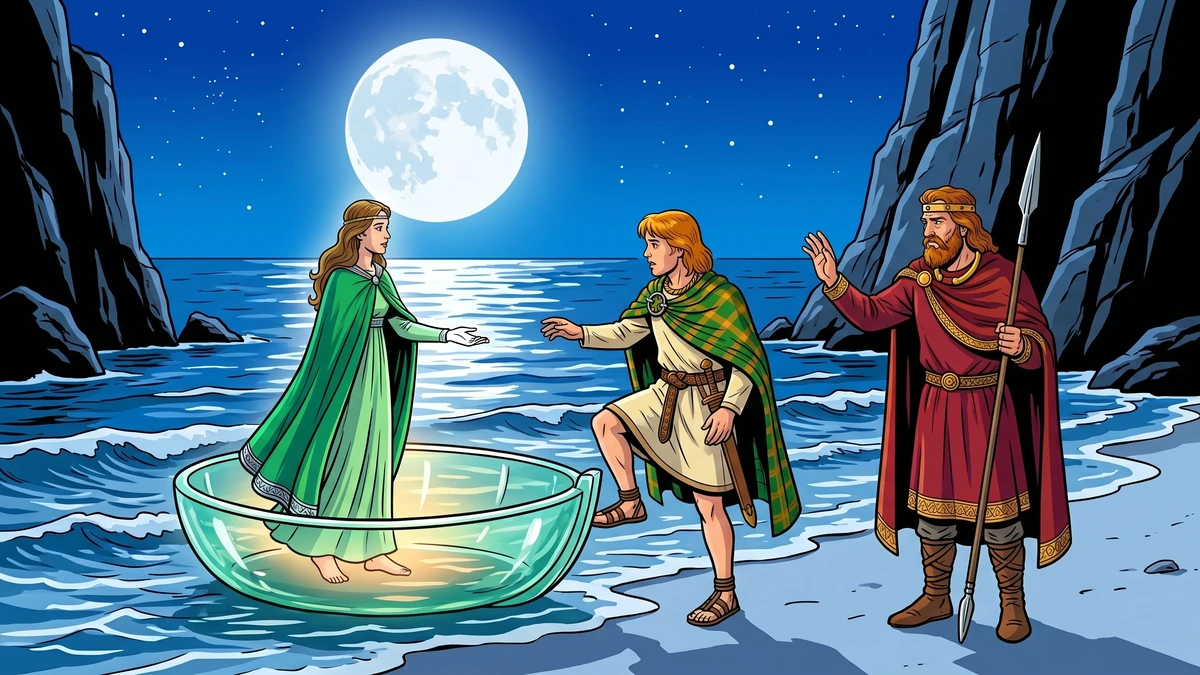
It was a coracle of the small Irish pattern, but it was made all of glass — curach gloine the old text calls it — and the glass was the green of the deep sea where the kelp grows, and the bench in the middle of it was of the same glass, and the rowing-thole was of the same glass, and there was no oar in it, for it had no need of any. The woman of Uisneach was standing in the boat. She was barefoot upon the glass and her hair was loose down her back, and the moon went through her cloak as moonlight goes through a clean window-pane, and put her shadow not on the strand but on the air a little behind her, where shadows fall in the country she came from.
She did not call. She held out her hand. Connla took one step forward and stopped, and turned to his father, and the look in his face was the look of a man who has been a son for seventeen years and is, in this one breath, ceasing to be one. “Father,” he said, and the word was very small. Conn opened his mouth to speak and could not. He raised his right hand — the hand that had broken Munster — and touched his son once upon the brow, between the brows, where a druid sets the mark of a blessing; and the touch was the only word that passed.
Connla stepped down upon the strand. The strand was the breadth of nine paces. He took the nine paces. He set his foot in the glass coracle, and the woman closed her hand upon his hand, and the boat slid back from the white sand without a sound, and went out upon the moon-track of the Atlantic westward, until it was a small green star upon the silver, and then a smaller, and then no star at all. The cliffs of Connacht came together over the silence. The dappled mare in the king’s harness shook her bridle, and the small bright noise of it was the only sound in the country of Ireland.
Conn of the Hundred Battles drove home to Tara at the slow walk of a man who is older than he was at sunset; and from that day he had only two sons, and Art (who would be the next king) was called Art Óenfer, “Art the Lone-One,” because his elder brother had been taken into the country where there is no death, and he, Art, was alone upon the hill of Tara to face whatever the years of Ireland had still to send.
The Moral — and the Original Old Irish
“Is fri báas atbail cách. Tír inna mbéo, ní fail bás and, ní fail peccad.“
— “Against death every man passes away. The Land of the Living — there is no death there, there is no sin.” (The fairy woman’s speech to Connla, Echtrae Chonnlai, §3, in the text of Lebor na hUidre; edited and translated by Kim McCone, Echtrae Chonnlai, Maynooth 2000, p. 121.)
The moral of Echtrae Chonnlai is not the small clean lesson that a fable carries home in its mouth like a hare; it is a question, and an old one. The fairy woman offers Connla a country where there is no death and no sin and no contention, and she offers it freely, and the apple in his cloak does not diminish, and the druid of Tara — the country’s greatest spell-craftsman — at last lays down his rowan staff and says simply, “the boy will go where he is called.” What, then, is the tale telling? Not to flee the world, certainly: Conn of the Hundred Battles is the hero of the country, not its fool, and his grief at the strand of Connacht is grief, not regret. The older reading, given by Kuno Meyer in his commentary on the Voyage of Bran, is that the tale is the Gaelic statement of a tension that every culture has to make: between the country one is born to defend and the country one is summoned to enter. The fairy woman is not a temptation to be resisted; she is a vocation, in the older sense — a calling that comes from outside the self, that one’s own kin cannot see, and that exempts one in the end from the long marching-time of mortal duty. Connla’s apple is the small portion of the other country that one carries inside the breast-fold of one’s cloak through the last month of one’s stay in this one. The tale is not against the king or against Ireland. It is for the simple, hard recognition that in any generation a few are called away — to the priesthood, to the sea, to the long fast in the desert, to the white saint’s cell in the rock — and that the parents of those few are required only to come down to the strand at the right tide and lay one hand upon the brow and let the glass coracle go.
Why This Tale Has Lasted
Three things have kept Echtrae Chonnlai alive for thirteen hundred years, and explain why a story written down by a tonsured Irish monk before the Vikings reached Iona is still being read aloud in primary-school classrooms from Galway to Goa. The first is its sheer antiquity and its consequent pre-Christian residue. Kim McCone’s linguistic analysis assigns the lost archetype to the late seventh or early eighth century — within a hundred years of the first Latin manuscripts produced in Ireland, and centuries before Beowulf was set down in its surviving form. The fairy woman’s promise — ní fail bás and, ní fail peccad, “there is no death there, there is no sin” — is an extraordinary line for a Christian monk to copy out faithfully, and the consensus of modern editors (McCone, Carey, Mac Cana) is that he copied it precisely because the older oral tradition was so unmovable that the monastic redactor chose to preserve rather than to censor. The second is the image of the glass coracle. The curach gloine, the boat made of nothing but the green of the deep sea, has burnt itself into Irish literature: it sails again in Immram Brain, in Immram Curaig Maíle Dúin, in the medieval Vita Brendani, and in modern voice in W. B. Yeats’s The Wanderings of Oisin, in James Stephens’s The Crock of Gold, and in Seamus Heaney’s translation of the Old Irish lyric The Hermit’s Song. No other single image in Gaelic literature is so reused, because no other so cleanly says the thing the literature wants to say: that the road out of the world is by water and by glass, that it is silent and that it does not look back. The third is the apple. The apple in Connla’s cloak — undiminished after a month of biting — is the seed-image of every “magical food that does not run out” motif catalogued by Stith Thompson under D1359.3.1, and its descendants are everywhere: the loaves and fishes of Galilee, the pot of Dagda in Cath Maige Tuired, the inexhaustible bran-tub of the Welsh Mabinogion, the cornucopia of the Greeks, even the brown loaf in C. S. Lewis’s The Silver Chair. To find the motif at this kind of age, in this kind of stillness, in a tale where the apple is doing nothing dramatic — only sustaining a quiet boy through the last quiet month before he goes — is to find the motif near its root. Echtrae Chonnlai has lasted, in the end, because it has the calm of a thing that was very early and was very well-told, and because the fairy woman’s question — “Art thou for the country that lasts, or the country that does not?” — is the question Ireland has never quite stopped asking.
You May Also Like
 Celtic Folk Tales
Ages 9-12
Celtic Folk Tales
Ages 9-12
How Fin went to the Kingdom of the Big Men
How Fin went to the Kingdom of the Big Men: in and his men were in the Harbour of the Hill of Howth on a hillock, behind the wind and in front of the sun
 Celtic Folk Tales
Ages 9-12
Celtic Folk Tales
Ages 9-12
The Greek Princess and the Young Gardener
The Greek Princess and the Young Gardener: here was once a king, but I didn’t hear what country he was over, and he had one very beautiful daughter. Well, he
 Celtic Folk Tales
Ages 9-12
Celtic Folk Tales
Ages 9-12
Munachar And Manachar
Munachar And Manachar: There once lived a Munachar and a Manachar, a long time ago, and it is a long time since it was, and if they were alive now they would